
admin
August 6, 2026
Pritha Pahari, The Core
5 Aug 2026
Saurav, a 27-year-old resident of Navi Mumbai, has bought the same tub of whey protein for three years, same brand, same 1kg pack, same monthly ritual after his gym membership renews.
Last month, at checkout, the price had jumped by nearly a thousand rupees. He assumed it was maybe a limited-time markup. But when he checked his order history, he noticed that the price had been going up for two to three months until it crossed a threshold that made him realise that whey protein has gradually become more expensive.
India is the world’s largest milk producer, yet it imports most of its whey protein because its dairy sector was never built to make cheese, the one thing that whey needs to exist.
That gap is now colliding with a global protein boom, driven partly by weight-loss drugs that leave patients needing more protein.
The result is a price rise that is now reaching the local pharmacy and fitness stores, and one that is unlikely to recede.
The Price Move
Research firm, The Daily Datum analysed Keepa price data for 11 whey protein SKUs on Amazon and found an average price increase of 32% and a median rise of 27% across varying tracking periods.
Keepa is a third-party price-tracking tool for Amazon, it logs a product’s price history over time by continuously scraping Amazon’s listing pages, so you can see a graph of how a specific SKU’s price has moved (sales, hikes, restocks) going back months or years.
Prices of different types of proteins i.e. blends, isolates and concentrates have all moved by similar amounts, and so have Indian D2C brands and long-established imported ones.
In protein powder terms, concentrates are ~70-80% protein (less processed, retain more fats/carbs), isolates are ~90%+ protein (more filtered, less lactose/fat), and blends mix two or more protein types (e.g., whey + casein, or whey concentrate + isolate) to combine benefits like fast and slow absorption.
The one outlier, MuscleBlaze’s premium Biozyme Performance line, has roughly doubled, but excluding it, the category average is still 26%, about five times India’s headline food inflation, which stood at 5.32% year-on-year in June 2026, according to government data.
The retail prices are only a reflection of what is happening with the raw ingredients needed for whey.
Imported whey protein concentrate landed in India at roughly Rs 700–800 per kg in 2024; by mid-2026, the industry estimates put it at Rs 2,300–3,000 per kg, a rise of over 200%.
Brands have absorbed much of that shock through smaller pack sizes and blended formulations rather than passing it straight through, which is why retail prices have risen a fraction of what the raw material has.
For scale, India’s protein supplement market (powders, bars and ready-to-drink shakes together) is put at roughly $860 million to just over $1 billion in 2025, though the exact figure depends a lot on which research firm and which product categories you ask (IMARC Group and Grand View Research land in that range but don’t agree closely). That compares with a global protein supplements market well above $30 billion.
Not A Farmed Commodity
“You don’t milk a cow for whey. You milk a cow for milk. And then you have to make cheese,” said Rajiv Mitra, Strategic Advisor, Sonai Dairy, a Maharashtra based dairy.
Whey from cheese-making is “sweet whey”, protein-rich and further processed through filtration and expensive drying infrastructure into the 80–90% protein concentrate that ends up in a gym-goer’s scoop.
“This is a structural bottleneck,” Mitra said. “It’s not a kind of seasonal commodity up and down.” New filtration and drying plants can take two to four years to build, with much of the machinery imported.
This is where India’s dairy habits work against it.
Devangshu Dutta, founder of the retail consultancy Third Eyesight, while speaking to The Core explained that globally, about 95% of whey protein comes as a co-product of Western-style hard and semi-hard cheeses such as cheddar and mozzarella. India’s dairy sector, by contrast, is built around paneer, curd, khoya and ghee.
Paneer is made by acid coagulation, which produces “acid whey”, lower in protein and higher in minerals, and not suitable for concentration into protein powder.
“Unless consumption of western-style cheeses grows dramatically in India, co-production capacity will remain low,” Dutta said.
Mitra makes the same point from the kitchen rather than the factory floor: squeeze lemon into milk to make paneer at home and the liquid that separates out simply gets drained. “Traditionally, for years, while we have been the highest producer of milk, our consumption pattern is such that we do not harness the whey that is produced,” he said.
That liquid is easy to overlook because it looks like nothing more than watery runoff, but it isn’t a waste.
When milk curdles, the solid part becomes paneer or cheese, and the yellowish liquid left behind, the whey, still carries a meaningful share of the milk’s protein along with lactose and minerals.
Filtered, concentrated and dried at an industrial scale, that liquid becomes the powder sold in tubs as whey protein concentrate or isolate. In most Indian kitchens it is simply poured away; in a cheese-and-whey-processing economy like the US or Europe’s, it is captured and turned into a saleable ingredient.
That gap between what gets thrown out and what gets processed is the crux of the shortage.
Why It’s Getting More Expensive
India imports an estimated 80–90% of its supplement-grade whey, mostly from the US, Europe, New Zealand and Australia, in dollars. The rupee has weakened sharply against the dollar over the past few years, from around 74 to nearly 97 by July 2026, adding another 10–15% to landed cost before customs and tax.
India’s own import policy adds a further layer of cost. Dairy is among the most protected sectors in the Indian economy: duties on whey, cheese and milk powder run 30–60% depending on the product, India offers no duty-free quota for dairy, and the government has repeatedly kept dairy outside trade negotiations, including in the interim India–US trade agreement reached in early 2026.
US suppliers, the world’s largest whey producers, also frequently fall short of the vegetarian-rennet certification Indian food rules require, which further narrows where Indian buyers can import from. None of this caused the current price spike, but it does mean India pays a built-in premium over the raw international price, and there is no sign of that premium being negotiated away soon.
Global demand, meanwhile, keeps climbing while milk output in the US and Europe grows only slowly. The global whey protein market is put at roughly $9.7 billion in 2025 by one widely cited estimate (Grand View Research).
It has clearly grown a lot over the past decade, but market-research firms disagree fairly widely on the starting point and pace of that growth.
Mitra pointed to a newer driver on top of the usual sports-nutrition demand: GLP-1 weight-loss drugs.
“Doctors have asked patients to consume more protein” to offset muscle loss from the drugs, he said, and as patents expire and generics spread to India and China, “the demand-supply gap is definitely going to increase further.”
(Some industry commentary points to semaglutide patents lapsing in markets including India and China around 2026, which would open the door to cheaper generics, though this detail comes from a single industry source and is worth treating as a general trend rather than a confirmed date.)
He laid out what he called a three-pronged squeeze: India’s own GLP-1 users will need more protein even as domestic production stays constrained; the US and Europe, which used to export surplus whey, will increasingly consume it themselves as their own GLP-1 use grows; and India’s roughly 30% vegetarian population, which depends on dairy for protein, will lean on it even harder.
Ingredient suppliers and dairy processors abroad broadly back this account, at least directionally, though they are careful not to call GLP-1 the sole cause. In wire-service and trade-press interviews, executives at FrieslandCampina and Lactalis have cited the weight-loss drug trend by name as a reason for new investment in high-protein whey processing, and StoneX’s dairy consulting head has said the food industry simply lacks the capacity to turn whey into the concentrates and isolates the market now wants. Those are real, on-record statements, but they’re a handful of quotes, not a market-wide survey, so it would be a stretch to read them as proof that GLP-1 is now a dominant driver.
The macro numbers, where they exist, suggest a more modest picture: one investment-bank estimate (cited secondhand rather than pulled from the original research note) put GLP-1’s impact on total European calorie demand at around a quarter of one percent, since only a low single-digit percentage of the population is on the drugs so far.
Separately, some retail-data providers have reported that households with a GLP-1 user spend noticeably more on protein-rich products than matched non-user households.
Taken together, traditional sports-nutrition and everyday-fitness demand almost certainly remains the larger base of whey consumption, GLP-1 use is a real and fast-growing add-on that industry executives say is starting to show up in sourcing decisions, but nobody has published a solid, independently verified number for how much of the current price spike GLP-1 specifically accounts for. Anyone who tells you an exact percentage is guessing.
Who Feels It First?
Large manufacturers are better insulated than small ones.
“The bigger players always get into long-term contracts,” Mitra said. Smaller brands and contract manufacturers, reliant on buying at spot prices, “get squeezed first.”
Big companies can also cross-subsidise from other product lines for a while, he said, but that isn’t a permanent fix: “Businesses are not there to absorb cost. Businesses are there to make profit.” Margin compression, in his words, “is never sustainable.”
An executive at HealthKart, which owns MuscleBlaze, was quoted saying in an Financial Express article that whey concentrate costs have more than tripled in two years and are “quickly approaching 4x,” and that the company has raised prices while absorbing part of the increase itself.
The founder of Wellbeing Nutrition was quoted in the same Financial Express article saying whey isolate prices have roughly tripled over the same period, and that whey, which makes up 15–20% of the company’s revenue, is now being promoted less actively as a result.
The founder of The Whole Truth, a clean-label brand that also uses cashews and cocoa, was quoted in the same article in Financial Express, saying input costs across its ingredient list have surged and that the company has pushed through several price increases, including a 15–20% hike on protein bars, rather than change its recipe.
Budget-focused brands such as Nakpro, AS-IT-IS and Avvatar have not made similar public statements, but their pricing sits in the same band as the rest of the market, and their category positioning, cheaper, no-frills whey aimed at price-sensitive buyers, looks consistent with the same cost pressure, even without a direct quote confirming it.
Smaller sachet and single-serve formats, which let a brand hold a lower shelf price even as the cost per kilogram rises, have also become more common across the category over the past year, though this is more an observed pattern than something brands have explained on the record.
Consumers shouldn’t expect quick relief either. “Commodity prices normally fall before retail prices,” Mitra said.
Existing contracts and retail pricing cycles are sticky, so the consumer will see relief much later than any drop in the raw material.
Some Headroom, No Quick Fix
Both experts see room for India to produce more eventually.
Dutta noted that rising protein-consciousness and GLP-1 adoption are giving Indian manufacturers “headroom for growth,” though feedstock constraints will remain a challenge.
Mitra talked about the scale needed: new capacity requires a couple of hundred crores of investment and years to commission, on top of a slow, generational shift in how Indians eat dairy. Cold storage for hard cheeses, which need months of ageing, is also still being built out.
Some of that investment is already happening.
Amul has launched a whey protein line priced well below imported brands, part of a broader push by Indian dairy majors to move into higher-margin, value-added products; cheese and whey can carry margins of 25–45%, against much thinner margins on liquid milk.
Parag Milk Foods already sells whey protein under its Avvatar brand and has positioned itself as a nutrition company rather than a pure dairy one.
Milky Mist, which is preparing a stock market listing, has said it will use part of the proceeds to add new production lines for whey protein concentrate, yoghurt and cream cheese at its Tamil Nadu plant.
Cheese-focused players including Schreiber Dynamix, Britannia Bel Foods and Lactalis India are separately expanding capacity, since more cheese production is what generates more whey as a by-product in the first place.
None of these projects will materially add to supply in the next year or two; dairy-processing plants of this kind typically take two to four years from investment to commissioning, and most industry estimates suggest India’s domestic whey production still covers only a small fraction of what the country consumes.
Neither expert expects plant-based protein to substitute for whey in a hurry. “Whey still offers a superior amino acid profile” and better digestibility, Mitra said, predicting diversification and hybrid blends rather than replacement.
What Could Break the Cycle?
Globally, the shortage is widely described by dairy analysts as a processing bottleneck rather than a milk shortage: milk supply itself has been broadly stable, and cheese production, which generates whey, has continued at normal levels. The constraint is the specialised filtration and drying capacity needed to turn liquid whey into the concentrated, dried powder the supplement industry uses, and that capacity takes years to build.
Major producers, including Glanbia, Fonterra, Arla, Tirlán and Idaho Milk Products, have announced billions of dollars of new whey-processing investment in the US, Europe and New Zealand over the past year. Most of these projects are expected to come online through 2027, not before, so global analysts generally don’t expect meaningful supply relief until late 2026 at the earliest, and more likely 2027.
US milk production is forecast to keep growing gradually into 2027 as well, which should help at the margin, though rising input costs (energy, feed, financing) are also squeezing dairy farmer margins in exporting regions, which cuts the other way.
For India specifically, easing would most likely need several things to move together over the next two to three years: new domestic processing capacity from players like Amul, Parag, Milky Mist and the cheese-focused majors actually coming online, rather than merely being announced; global WPC and WPI supply catching up with demand as the 2026–27 capacity wave lands; a stabler or stronger rupee, since a large share of India’s whey is still imported and priced in dollars; and some change to India’s own tariff and certification structure on dairy imports, which currently adds cost on top of the global price and shows no sign of loosening given how firmly successive governments have kept dairy out of trade deals.
GLP-1-driven demand would also need to plateau rather than keep accelerating as drug prices fall and generics spread.
Even if all of that happens, retail prices in India are unlikely to fall quickly. Brands are currently absorbing part of the cost increase rather than passing all of it through, which means a chunk of any future relief in the raw material would likely go toward rebuilding margins before it reaches the shelf.
Contracts, inventory cycles and psychological pricing (brands are usually slower to cut prices than to raise them) add further lag. Mitra’s framing captures this: raw material costs typically fall before retail prices do, and the gap between the two can run into quarters, not weeks.
What experts keep coming back to is that this has stopped being a niche fitness-industry story. “
This is no longer just about dairy,” Mitra said. It is now about healthcare, pharmaceuticals, nutrition, overall food.
(Published in The Core)
admin
August 1, 2026
Murali K Menon, Firstpost
1 August 2026
The next time you are shopping for veggies on a quick commerce app, we’d suggest you hop onto the organic produce section and consider where those vegetables came from. Chances are, they have travelled through a supply chain pretty different from the one that bought veggies to your kitchen just five years ago. Some of that produce is supplied by Urban Farms Co., a little-known company that is rethinking food systems.
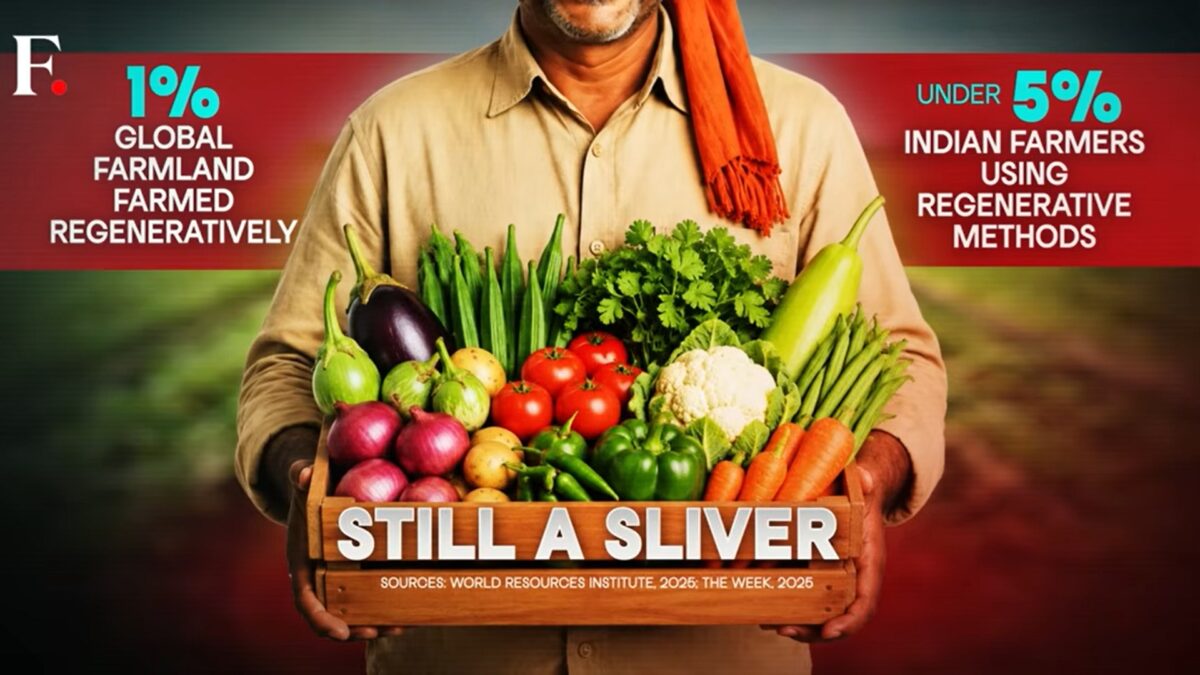
Urban Farms works with about 2,000 small farmers on the outskirts of several of India’s cities, as well as in states like Rajasthan and Maharashtra to grow vegetables using regenerative practices and supplies them to urban consumers via quick commerce and modern retail. The definition of renegenrative agriculture changes depending on who you ask, but broadly it refers to an approach that seeks to restore soil health, as opposed to conventional, chemical-intensive farming.
About 1% of global farmland is now under regenerative practices, according to a 2025 World Resources Institute study. Urban Farms, whose farmer network grows over 50 varieties of vegetables, handles around 12,000 tonnes annually and is targeting a twenty-fold jump in revenue from its current Rs 30 crore in the next five years.
That target might sound ambitious until you look at its origins. Urban Farms was founded by members of the team behind Araku Coffee, the specialty coffee brand that put Indian coffee on the global map. Both Araku Coffee and Urban Farms are backed by the Hyderabad-based Naandi Foundation, among the country’s largest, multi-sector non-profits. The NGO was set up by Dr. Reddy’s Laboratories founder, the late Kallam Anji Reddy, and counts Kris Gopalakrishnan and Anand Mahindra on its board.
The broad details of Araku Coffee’s success are well known, but the model that underpins it is much less discussed. Over two decades, the project worked with thousands of tribal farmers to promote regenerative farming practices, restore degraded land, and improve farmer incomes while building a globally recognised premium coffee brand. The same spirit animates Urban Farms. Instead of tribal farmers, it works with small farmers on the outskirts of India’s cities. Instead of a premium export crop, it is betting on everyday vegetables sold through quick commerce and modern retail. But can a model proven in a premium niche survive in the toughest, most commoditised part of Indian agriculture?
Beyond coffee
Coffee was just a conversation-starter, says Manoj Kumar, the lead architect of the Araku Coffee project and the founding CEO of the Naandi Foundation. The developmental economist says that the project proved two things. “It proved at scale that our regenerative organic agricultural science worked for 20 years in every crop, from coffee to millet, consistently season after season, without any drop in yield. And, just as importantly, that we could do world-class excellence at scale with very ordinary poor people.”
The eventual goal was improving farmer economics. “In India, 85% of farmers have less than one hectare of land,” Kumar says. “The question is: what do we do with small and marginal farmers?” Urban Farms is one answer to that question. Unlike Araku Coffee, though, it isn’t built around a single crop.
“Urban Farms is about doing a system change. We are changing food systems,” says Vikash Abraham, the company’s CEO. So, what does that mean for something as everyday as a lady finger? Before it reaches your kitchen, Urban Farms is involved in almost every stage of its journey. It supplies regenerative fertilisers to farmers, works with them through the growing season, buys back their produce, and sells it to retailers and quick commerce platforms.
Urban Farms
“We procure from the farmer at the same price as conventional produce. We do not pay a premium per kilogram because we believe profitability is about cost of cultivation versus the entire income you get from your farm,” Abraham says. In other words, with Urban Farms, farmers don’t earn more because they sell lady finger at a higher price. They earn more because regenerative farming lowers their costs while giving them an assured buyer. A typical vegetable grower could earn as much as Rs 20,000 to Rs 30,000 more per acre annually, says Abraham, with savings increasing over time. A first-season comparison conducted by the company across 56.5 acres in Wardha, Maharashtra, found that soybean yields rose 12% and total cultivation costs fell by 8%.
Spending on farm inputs dipped from ₹9,750 to ₹5,267 per acre, while profits increased from ₹12,550 to ₹19,195. The model does not rely on government subsidies and farmers pay for the inputs themselves. According to Abraham, Urban Farms doesn’t approach farmers from a moral standpoint, or talk about climate change. “We go to them with a business proposition, and the business proposition is about making profitability.”
From trial to habit
Urban Farms’ residue-free vegetables generally cost about 40% more than conventional produce, although the gap varies by crop, market prices, and platforms. Lady finger, for instance, was priced at ₹24 for a 250gm pack on Zepto in Azadpur, in north Delhi, earlier this week compared with ₹17 for conventional produce; on Blinkit, the same pack was sold at ₹35.
Quick commerce accounts for 65% of its business under the residue-free category, with modern trade and other channels making up the rest. Abraham says part of that premium reflects the cost of maintaining a separate, traceable supply chain. The company supplies Blinkit, Zepto, Swiggy, and Flipkart as well as Reliance, Jubilant, and Country Delight, among others.
Devangshu Dutta, founder of retail consultancy Third Eyesight, says that he expects demand to grow, as incomes rise and consumers become more conscious of the food they are eating. But he thinks a 40% premium may be too high for regular consumption because vegetables, unlike coffee or craft chocolate, are staples.
“You could have a premium of maybe 20% to 30%. Some products could be higher than that, but that is something that has to be managed carefully.” For category growth to accelerate, he says, the produce must become “a fixture in the consumer’s pantry, in the consumer’s kitchen, on the consumer’s plate.”
Dutta believes that quick commerce is well-suited to fresh produce because Indian households have traditionally bought vegetables frequently rather than stocking up. “The bottleneck really is having the product range that consumers will buy over a period of time again and again.” That requires farmers growing different crops across regions and climatic zones. And building a wide range of vegetables also means working with farmers and ensuring farmer retention in the system season after season. “You don’t just sign up a farmer and say he’s going to be there forever,” Dutta says.
Urban Farms says it has managed to do that so far. In May this year, Anand Mahindra posted on X that 80 to 90% of the farmers who work with the company return every season. “Not out of loyalty to a movement, but because the economics work,” he wrote, pointing to yields comparable with conventional farming, lower input costs and produce that consistently tests residue-free.
Abraham says that Urban Farms would like to work with about 100,000 farmers by 2030, and the company’s growth will depend on how quickly it can both build and nurture relationships with its partners across the country. Applying the Araku model to a far more unpredictable market won’t be easy, but if Urban Farms can keep both farmers and shoppers in the system as it grows, coffee, as Manoj Kumar said, may indeed have been just the conversation-starter.
(Published in Firstpost)
admin
August 1, 2026
Two decades ago, the team at the Naandi Foundation turned tribal farmers in a remote Andhra valley into some of the world’s best-paid coffee growers. Araku Coffee now sells in Paris, and the best of it goes for thousands of rupees a kilogram. Now the same team is trying to do it again — this time with everyday vegetables. Their company, Urban Farms Co., works with regenerative farmers and sells their produce on apps like Blinkit and Zepto. The bet is that what worked for premium coffee can work for staples too. But vegetables aren’t coffee. They’re cheap, everyday, and something people buy all the time. Can this really scale, and does it actually leave farmers better off?
admin
July 20, 2026
Kartikay Kashyap, Financial Express / Brandwagon
30 July 2026
Wendy’s first foray into India’s quick service restaurant (QSR) market in 2015 remained a non-starter. Sierra Nevada Restaurants, the then master franchisee, could not scale its retail presence beyond four conventional restaurants concentrated largely in Delhi-NCR. This limited physical availability, brand awareness and ordering frequency.
Ten years on and under a new master franchisee Rebel Foods since 2023, Wendy’s seems to have turned over a new leaf. With more than 250 stores, and ₹200 crore in revenues, the brand wants to be the one-stop destination for the younger generation where consumers come together to celebrate food, music and a sense of community. “The longer-term ambition is to expand to approximately 500 locations by 2028 through a combination of delivery kitchens and physical restaurants,” says Joy Bamania, brand head, Wendy’s India.
As a first step, Rebel Foods recently opened what it calls its “dynamic cultural flagship store” in Delhi’s vibrant student hub of Hudson Lane, GTB Nagar. The two-level youth-centric space blends food, music and anime, offering fans experiences like live rap battles, meet-and-greets, and specialised menu items like the signature Teriyaki Burger range.
“It has been designed to be livelier, more youthful and visually engaging—an Instagram-worthy space. It is a physical expression of how we want consumers to experience Wendy’s in India: bold, fun, culturally relevant and full of energy,” says Bamania.
Even before taking over Wendy’s operations Rebel Foods had been managing its delivery-only cloud kitchens since 2020 and was familiar with the brand’s DNA and what was required to mount a serious challenge in the ₹15,000-plus crore organised burger restaurants market in the country. The low capex delivery-only model has helped to improve its gross margins, but taking on established brands like McDonalds, KFC and Burger King would be a completely new ball game.
Is the latecomer up to a second bout in the ring?
New, improved
Wendy’s has at least three things going against it. It arrived late on India’s shores and couldn’t really stand apart during its last outing. “No matter how big a global brand you are, you need to stand out in the clutter,” says Devangshu Dutta, founder & CEO, Third Eyesight.
So while McDonald’s is the kid-first family restaurant, Burger King is intentionally “imperfect” and rides on humour, pop-culture moments, and viral marketing. Wendy’s, say experts, had no differentiation than just being a global brand.
Its premium pricing was another bugbear. In its first foray, Wendy’s tried to justify its higher prices saying its ingredients were better than that offered by the rest of the pack. So while the price of a Wendy’s entry level burger was ₹100, McDonald’s retailed one at half that price. “In the QSR business, you have to get your price right. There is nothing ‘premium’ in that space,” says Ankur Bisen, senior partner, The Knowledge Company. Rebel Foods addressed these problems with four fundamental shifts.
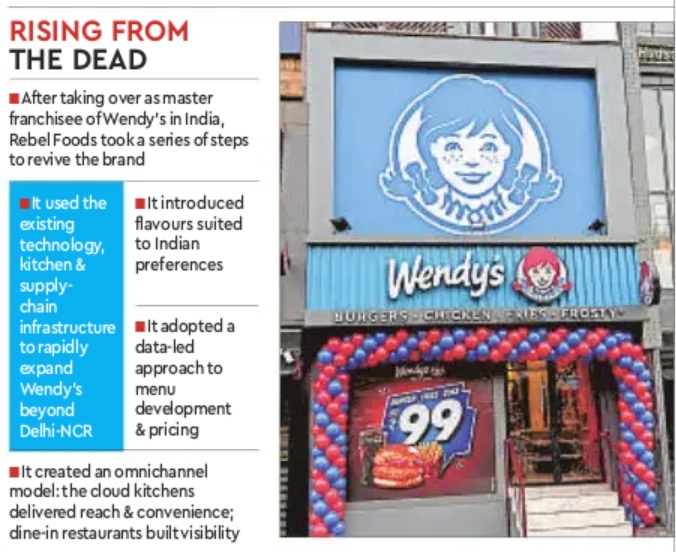
First, it used the existing technology, kitchen and supply-chain infrastructure to rapidly expand Wendy’s beyond Delhi-NCR. Second, it built a stronger and more accessible value architecture while introducing flavours suited to Indian preferences. Third, it created an omnichannel model in which cloud kitchens delivered reach and convenience, while selected dine-in restaurants built visibility and deeper brand experiences. Finally, it adopted a data-led approach to menu development, pricing, consumer feedback and operational performance.
Rebel Foods became Wendy’s master franchisee in India in 2023. At that stage, Wendy’s had approximately 90 locations across 19 cities. By March 2025, the brand had reached 200 locations across more than 50 cities, including 15 dine-in restaurants.
“The fivefold revenue growth has consequently not come from one product or campaign. It is the result of wider distribution, sharper value, continuous menu innovation, stronger operational execution and a much clearer proposition for the Indian consumer,” says Bamania.
(Published in Financial Express)
admin
July 13, 2026
Viveat Susan Pinto, S Shanthi (Financial Express)
13 July 2026
India’s new-age coffee chains are accelerating expansion despite continuing losses, as investors bet that the country’s under-penetrated branded cafe market can deliver long-term growth.
Third Wave Coffee plans to open 100 cafes this financial year while targeting company-wide break-even. Blue Tokai aims to expand from 240 outlets to 800 by FY30 and is preparing for an eventual public listing. Nothing Before Coffee (NBC), which has grown to 114 cafes across 45 cities, plans to more than double its network over the next two years.
The expansion comes even as profitability remains elusive. Investors, however, are increasingly prioritising store-level economics over headline profits, arguing that India’s cafe market is still in its early stages of growth.
“The earlier failures in the cafe segment were largely capital-discipline failures, not failures of the category itself,” said Vish Narain, managing partner at Pulsar Capital, which is backing Blue Tokai’s international expansion.
“Chains expanded store count before proving unit economics. Investors today understand that India’s per-capita coffee consumption is still in its early stages. They are reading past shutdowns as wrong execution, not wrong thesis,” he said.
Dissecting the Balance Sheets
The numbers highlight the challenge.
Heissette Beverages, the parent of Third Wave Coffee, accumulated losses of Rs 320 crore between FY21 and FY25, while total assets stood at Rs 538 crore at the end of FY25, according to Tracxn. Muhavra Enterprises, Blue Tokai’s parent, reported accumulated losses of Rs 175 crore over the same period, with total assets of nearly Rs 370 crore. Financials for FY26 are not yet available with Tracxn.
NBC accumulated losses of nearly Rs 3 crore over FY24 and FY25 against total assets of Rs 18 crore. Mumbai-based premium chain Subko Coffee, with 16 outlets in India and one in Dubai, posted losses of Rs 45 crore over five years, while total assets stood at Rs 61 crore at the end of FY25.
Third Wave Coffee said around 90% of its outlets are Ebitda-positive and expects to achieve company-wide break-even during FY27. Blue Tokai, backed by Verlinvest, is targeting profitability by March 2028.
NBC declined to specify a profitability timeline but said it has adopted a franchisee-invested, company-operated (FICO) model to reduce cash burn while retaining operational control.
“FICO lets us expand quickly with franchisee capital while keeping operational control,” said Ankesh Jain, co-founder and chief executive officer, Nothing Before Coffee.
Structural Shifts
Experts attribute the investor interest partly to improving outlet economics as operators shift from large dine-in formats to compact grab-and-go and cloud-kitchen models.
“These formats materially cut capex per outlet and shrink payback timelines, making the category venture-fundable rather than just a slow-and-steady, self-funded business,” said Krishna Dev Pathak, investment banker and advisor to early-stage startups.
Lower capital requirements have strengthened unit economics, reinforcing investor confidence despite delayed company-level profitability.
Investors are also betting on a broader shift in consumer behaviour. Anuj Kejriwal, chief executive officer and managing director of Anarock Retail, said rising incomes, urbanisation and changing preferences are gradually moving India from “a tea economy to a coffee economy”. The shift is widening the addressable market for organised coffee chains beyond the metros into smaller cities.
Consumers increasingly use cafes as workspaces, meeting points and all-day dining destinations, prompting chains to diversify into food, desserts, packaged coffee, vending solutions and merchandise.
“The cafe model is now well established as part of consumers’ lifestyles,” said Devangshu Dutta, founder and chief executive of retail consultancy Third Eyesight.
Challenges remain. Rentals in premium locations have surged, coffee prices remain volatile, and labour and supply-chain costs continue to pressure margins.
For now, investors appear willing to fund rapid expansion, betting that disciplined execution and improving unit economics will eventually turn India’s cafe boom into a profitable business.
(Published in Financial Express)
