
admin
February 14, 2026

This episode of theUpStreamlife is a freewheeling conversation between Vishal Krishna and Devangshu Dutta, founder of Third Eyesight, with insights into the growth of modern retail and consumption in India, brand building and M&A, the balance of power between brands and retailers/platforms, sustainability vs growth and many other aspects, and is well-suited for founders and teams who want to be building for the long run in India.
admin
December 10, 2025

Shabori Das, ET Bureau
Dec 10, 2025
India’s social media platforms are powerful marketing tools but not yet retail destinations. Billions scroll and swipe daily, but few buy directly within apps. Unlike China, India faces regulatory hurdles and a lack of integrated payment systems.
A billion Indians scroll, swipe and double tap every day, but barely buy. Despite Instagram and Facebook Marketplace being in India for over a decade, social media here remains a showroom, not a store. Creators and D2C brands are hustling to convert attention into action, but the holy grail of in-app shopping where discovery, live streaming, and purchase happen seamlessly, remains out of reach.
The question is, what’s stopping India from becoming the next China or the US in social commerce?
Influence-to-Commerce Gap
Globally, social commerce is powered by influencers. In China, influencer Li Jiaqi reportedly sold products worth $2 billion on Singles’ Day on Alibaba’s online marketplace Taobao Live in 2021. Another popular influencer Zheng Xiang Xiang, with over 5 million followers on Douyin (the Chinese equivalent of TikTok), reportedly generated $18 million in sales in a week in 2023. These are numbers India’s creator economy can only dream of, for now.
To be clear, influencer marketing in India is booming. EY estimates the sector at over Rs 3,000 crore and yet, due to regulatory restrictions, social media platforms in India can’t host end-to-end transactions. What India has is content commerce, driven by players like Meesho and Myntra, not social commerce. Globally, social commerce is a $1-trillion market. China alone accounts for over $500 billion and the US, $100 billion. India’s share? Around $10 billion — despite being home to the world’s largest Gen Z population and the second-largest base of internet users after China.
What’s Holding India Back
“Just as quick commerce changed how India buys food, social commerce will change how we shop for fashion and lifestyle,” says Anand Ramanathan, partner, consumer industry leader, Deloitte South Asia.
The idea is simple: Social commerce enables an end-to-end purchase journey within a social media app. But in India, the final sale still happens elsewhere — typically on e-commerce platforms.
“In China, live streaming contributes nearly 20% of total e-commerce revenue. In India, it hasn’t taken off,” says Puneet Sehgal, CEO of D2C apparel brand Freakins. He believes in-app checkout could be transformative. “Our Gen Z audience spends over an hour daily on social media. If the purchase could happen right there, it’s one step less for the consumer — and one step closer to a sale.”
The China Contrast
China’s social commerce revolution was built on three forces — speed, scale and seamlessness. Influencer Zheng, for instance, showcases each product for barely three seconds and moves on. That brevity, combined with integrated payments, drives impulse buying at staggering volumes.
India’s influencer-driven commerce, by contrast, is still warming up. Projected to touch $ 55 billion by 2030, it remains largely limited to discovery and advertising.
The barriers aren’t technological, they’re regulatory. India’s payment rules require clear accountability and settlement tracking, making it difficult for global platforms to enable in-app sales. Meta’s 2023 policy shift also directed purchases off-platform, keeping Instagram and Facebook Marketplace confined to discovery and promotion, rather than purchase. For now, social media in India remains a potent marketing engine, not yet a retail destination.
Experiments and Exceptions
Some Indian players are testing new waters. Myntra’s Glamstream, launched this July, lets influencers host live sessions where viewers can “shop the look” in real time — though the final checkout still redirects you to the Myntra app.
“India’s creator economy influences over $300 billion in annual consumer spending,” says Sunder Balasubramanian, chief marketing officer at Myntra.“That could grow to $1 trillion in the next few years, making India one of the fastest-growing creator economies globally,” adds Lakshminarayan Swaminathan, vice president-product management, Myntra.
The potential is clear. In 2021, Taobao Live hosted a 12-hour live streamed sale with influencer Li Jiaqi in China that clocked $2 billion in presales and attracted 250 million viewers.
Closer home, Sujata Biswas, co-founder of Suta Sarees, recalls Instagram’s shortlived Shop Now feature. “We saw an immediate dip in transactions after it was withdrawn,” she says. “Fashion is about instant gratification. You see it, you want it and buy it right away.”
The D2C Advantage
India’s D2C market, valued at $87 billion as of 2025 by Deloitte, could be the biggest gainer if social commerce does take off. Most D2C brands currently pay 25–35% retailer margins to platforms like Myntra and Nykaa. Social commerce could let them bypass intermediaries and sell directly to their audiences.
“Anything that reduces friction between intent and purchase is gold,” says Sehgal. “If that entire journey — from watching to buying — happens within the same app, conversion rates would shoot up.”
Even so, social platforms come with their own costs. TikTok, for instance, charges promotional, marketplace and fulfilment fees. But for Indian D2C players, the larger hurdle isn’t cost — it’s access.
Open vs Closed Ecosystems
“India’s retail market is far more open than China’s,” explains Devangshu Dutta, CEO of ThirdEyesight, a retail consulting firm. “In China, closed ecosystems like WeChat and Douyin created the perfect environment for social commerce to thrive. In India, where consumers can freely move between Google, Meta and e-commerce giants, those closed loops don’t exist.”
Globally, TikTok Shop, Douyin, WeChat, Pinduoduo, and Taobao Live dominate social commerce. According to Business of Apps, a data provider for the global app industry, TikTok earned $23 billion in 2024, with nearly 23% of it from in-app and commerce purchases.
If similar models are launched in India, e-commerce giants would face direct competition from the very platforms that fuel their traffic.
The Wait Continues
From beauty tutorials to thrift stores, social media spawns thriving micro economies. Yet, true social commerce — where discovery leads directly to purchase — hasn’t yet clicked.
The next big leap for India’s e-commerce may not come from deeper discounts or faster delivery but from social media itself. “The idea of instant gratification is key,” says Biswas. “When the ‘Shop Now’ button comes back, we’ll be the first to use it.”
Till then, India scrolls, likes, shares — and waits.
(Published in Economic Times)
admin
October 10, 2025

Pooja Yadav, Exchange4Media
10 October 2025
Over the years, India’s e-commerce market has been dominated by the duopoly of Amazon and Flipkart. These platforms have not only captured consumer attention but also shaped how brands spend their marketing budgets. In parallel to this, the concept of retail media networks (RMNs), marketplaces selling ad placements to brands directly, has also grown rapidly. Not only this, it is emerging as one of the fastest-growing channels in digital advertising.
As a result, the industry is witnessing a wave of new retail media platforms entering the market. From grocery and pharmacy marketplaces to Q-comm platforms, D2C marketplaces, and ONDC pilots, all are attempting to carve out space for themselves. Yet despite these new entrants, Amazon and Flipkart continue to command the lion’s share of shopper-marketing rupees, leaving little oxygen, even for challenger players like eBay, even as it retools its India strategy.
Retail media is now outpacing social and video in growth, and in India, this expansion remains concentrated around these two dominant players. According to several experts e4m spoke with, Amazon and Flipkart dominate because of their massive logged-in traffic at the point of purchase, first-party data, and closed-loop attribution linking impressions directly to GMV. These platforms succeed by combining large logged-in audiences, direct attribution from impressions to sales, and first-party data insulated from signal loss-advantages most challengers cannot match.
Adding to this, Shradha Agarwal, Co-Founder & CEO of Grapes, highlighted the key hurdles brands face when allocating budgets to newer networks like ONDC or eBay. She noted that brands consider three main factors: whether the network can deliver the same sales efficiency, whether it reaches new users or just shoppers already accessible on Amazon, and whether the scale is meaningful. Quoting an example, she said if a brand is already generating 10 crore on Amazon, it may question whether investing in a new platform that delivers only 25 lakh is worth the effort.
Vaibhav Jain, Head of Media at First Economy, pointed out, the biggest barriers to scaling budgets across newer retail media networks like eBay or ONDC or any other, are fragmented infrastructure, limited data maturity, and inconsistent measurement. Many platforms still lack robust first-party data systems and unified reporting standards, making it difficult for brands to validate ROI at the level provided by Amazon or Flipkart.
Everyone’s building a network – but is there room?
Despite the dominance of Amazon and Flipkart, the retail media landscape is attracting new entrants, including grocery and pharmacy marketplaces, Q-commerce platforms, D2C marketplaces, and ONDC pilots, all attempting to carve out space for themselves. Among these challengers, eBay has recently re-entered India with a markedly different approach focussing on building technical and export-led capabilities rather than competing directly in the domestic consumer market.
Against this backdrop, eBay has reopened its India chapter with a Global Capability Centre (GCC) in Bengaluru, planning to host over 300 engineers across AI/ML, product, design, and data analytics. Unlike its previous consumer-facing stints in 2005 and 2013, this pivot is capability and export-led, not a direct battle with domestic marketplaces. Globally, eBay earns revenue through Promoted Listings and other advertising products, but in India, it has historically lacked domestic shopper scale and first-party data, the two critical ingredients that make retail media profitable.
This time, eBay appears to be betting on cross-border trade, technology-led capabilities, and potentially new ad-tech opportunities a model that could differentiate it from established players like Amazon and Flipkart.
Speaking on this, Lloyd Mathias, business strategist and angel investor, said, “Retail media takes off only when you have a large front-end site like Amazon or Flipkart, where advertisers want to reach shoppers at the point of purchase. I don’t think retail media is going to be a big revenue driver for eBay at all.”
Adding to this, seasoned e-commerce analyst and Datum Intelligence advisor Satish Meena noted, “Retail-media economics depend on domestic shopper traffic and first-party data both of which eBay currently lacks in India. The realistic play is export-facing promotions, enabling Indian sellers to advertise SKUs to international buyers on eBay’s global sites. That’s valuable but niche, and unlikely to rival Flipkart or Amazon’s India-scale retail-media businesses.”
Devangshu Dutta of Third Eyesight stated, “On the trade front, the company appears to be prioritising exports from India rather than competing in the domestic market, which is already hypercompetitive and price-driven.”
Until eBay establishes a stronger consumer-facing presence, retail media will not be a priority, as per experts. In the near term, its strategy is likely to focus on export-facing ads, promoting Indian sellers to global buyers. Looks like this approach is unlikely to challenge Amazon or Flipkart in India.
What it would take to break the duopoly
While eBay’s strategy has been called smart, opportunities remain. Harish Bijoor, Founder, Harish Bijoor Consults Inc, noted that communication formats are evolving. with peer-to-peer engagement gaining reliability over top-down approaches. Amazon and Flipkart follow top-down models, whereas eBay could differentiate itself through 1:1 consumer interaction.
After two failed attempts at cracking India’s consumer market, eBay’s third innings (as some may call) is fundamentally different. It is no longer chasing domestic consumers but enabling Indian sellers to export globally, leveraging eBay’s global logistics, trust programs, and buyer base. The company is also partnering with government export initiatives, MSME councils, and logistics providers, while buildin technical, analytic, and product capabilities through the Bengaluru GCC.
Mandar Lande, co-founder of Waayu, a platform working with ONDC and MSMEs to enable digital commerce, said that eBay is unlikely to build a traditional retail media business in India without a large consumer marketplace. “eBay lacks the first-party shopper data and traffic scale that power retail media networks like Amazon Ads or Flipkart Ads. However, it could still build a niche ad-tech play focused on export sellers, cross-border insights, and global buyer intent analytics essentially an “export intelligence and seller marketing’ platform rather than a domestic retail media business. While it won’t rival Amazon Ads in India, it can carve out a high-value B2B media niche rooted in cross-border commerce rather than local eyeballs.”
For challenger brands like eBay aiming to break into India’s retail media landscape, success will depend on proving incremental sales rather than just impressions, offering unique audiences, maintaining pricing flexibility, and providing ease of buying through self-serve tools and standardised metrics.
Experts told eam that while retail media and ad-tech may not be immediate revenue drivers, eBay’s export-first strategy allows the company to build scale, technology, and credibility, setting the stage for potential consumer-facing or advertising initiatives in the future.
Jain mentioned, “Closed-loop measurement is central to shifting brand spend beyond Amazon and Flipkart. It offers verifiable proof of performance, linking ad exposure directly to sales. Challenger retail media networks that can deliver credible attribution and comparable ROAs will gain traction faster. Measurement sophistication isn’t just an advantage; it’s the entry ticket to serious brand consideration.”
Speaking about how self-serve tools, standardised metrics, and competitive CPC/CPM rates influence a brand’s willingness to experiment with challenger retail media networks, Jain told e4m that these elements are critical for encouraging experimentation. They simplify campaign management, enable agility, and allow brands to benchmark performance fairly against established players.
From a brand execution perspective, Agarwal emphasised that the availability of self-serve tools is crucial for experimentation. Advertising on commerce platforms was previously cumbersome, but self-serve options now allow brands to launch campaigns at any budget, large or small, providing flexibility and control. When pricing is competitive and reporting is standardised, brands are more willing to test new networks. Early experiments have shown that allocating even a portion of retail media budgets to challenger platforms can deliver meaningful incremental sales, although such cases remain limited.
Reality check for 2025 plans
Brands in India are increasingly looking to diversify their retail media spend and reduce costs, but in a market dominated by Amazon and Flipkart, certainty still drives allocation decisions. Amazon Ads India revenue surged to 8,342 crore in FY25, a 25% year-on-year increase, while Flipkart Ads has grown 600% since 2020, capturing a significant share of marketplace marketing budgets. Until challengers can match these giants on shopper intent, identity, and attribution, most retail media budgets will remain top-heavy.
While many new entrants are trying to add variety at the edges by offering niche audiences, alternative ad formats, and export-focussed solutions, However, breaking into the core of India’s retail media market requires domestic scale, robust attribution frameworks, and access to unique audiences that cannot be replicated elsewhere.
Experts point to several structural barriers for newer networks. Fragmented infrastructure, limited first-party data, and inconsistent measurement make it difficult for brands to validate ROI at the level provided by Amazon or Flipkart.
(Published in Exchange4media)
admin
September 17, 2025

Sowmya Ramasubramanian, Mint
17 September 2025
Snapdeal, run by AceVector, is relying on strong growth in fashion and apparel to strengthen its position in the competitive e-commerce space, especially during the high-stakes festive season when customer loyalty is low. According to CEO Achint Setia, the company has seen its fashion and lifestyle categories triple in growth this year, though exact figures remain undisclosed.
“Fashion has been a standout category this year and, in fact, has been possibly the fastest-growing one so far. Overall, lifestyle [including fashion, home decor, and kitchen] already accounts for 90% of our business today, and fashion is a major driving force,” Setia told Mint in an interview.
Setia was appointed to the role in January, replacing Himanshu Chakrawarti, who led Snapdeal and its subsidiary Stellaro Brands for three years. Setia has over two decades of experience across marketing and strategy roles in firms like Myntra, Viacom18 Media, and Zalora Group.
While the festival season is a key period for all consumer-facing brands and platforms, this year is important for Snapdeal as it is currently waiting for the Securities and Exchange Board of India (Sebi) clearance to list in the public markets.
“Approval from Sebi before the end of the financial year is crucial for Snapdeal. If they don’t get it, or if they have to refile, they’ll need to update their IPO documents with a full year of financial data. This means the festive season performance will be key in shaping investor sentiment, especially in a volatile market,” said a senior e-commerce executive, asking not to be named.
The firm filed its draft papers for an IPO reportedly to raise ₹500 crore through the confidential route in July, which allows it to withhold public disclosure of IPO details until later stages. Setia declined to comment on the progress of the filing.
Despite its early entry, Snapdeal is yet to make a mark among the top e-commerce players in the country by both market share and volume of transactions. For context, industry estimates show Flipkart as the market leader with 48% share, followed by Meesho and Amazon. The Indian e-commerce market is projected to grow at a compound annual growth rate (CAGR) of 21% and reach $325 billion dollars in 2030 as per an October 2024 report by Deloitte.
Founded in 2010 by Kunal Bahl and Rohit Bansal, Snapdeal was initially launched as a daily deals platform and later pivoted to a full-fledged marketplace in 2011. Over the years it raised more than $1.8 billion in funding from Softbank, Alibaba group, Foxconn and Blackrock among others. However, intense competition and the absence of a distinct growth strategy have gradually eroded Snapdeal’s momentum in the e-commerce space.
Snapdeal largely caters to cities outside metropolitan areas where value retail has picked up in recent years. Within this, fashion remains the top growth driver-with more than 80% of orders placed priced below 1599 and 80% of them com-ing from small town India, accord-ing to CEO Setia. “For us, it’s about the value-conscious mindset that could be sitting out of anywhere,” he noted.
Over the last few months, Snapdeal has invested substantially in in-house festive campaigns, as well as technology and tools for returns forecasting and logistics. According to Setia, it has also expanded its seller portfolio, adding more from key clusters like Tirupur, Surat, Ludhiana, and Agra.
According to a September 2024 report by market research firm Centrum, the mass-market fashion segment accounts for 56% of India’s total apparel market.
However, offline continues to account for more than half the sales, with Tata’s Trent, D-Mart, and Vishal Mega Mart offering a sufficient selection of price-conscious consumers in smaller towns.
While small-town India offers a wide online shopping-savvy market waiting to be captured, Meesho has raced past Snapdeal in those geographies, especially in value commerce.
“For a very long time, Snapdeal has been positioned as an e-commerce platform for Bharat, but it doesn’t necessarily hold a strong position. Meesho, Flipkart and Amazon have expanded their presence in these markets over the years, which means competition is so much more now,” said Devangshu Dutta, founder and chief executive officer at consulting firm Third Eyesight.
(Published in Mint)
admin
September 5, 2025
Pooja Yadav, Exchange4Media
4 September 2025
Quick commerce today is no longer just about delivering groceries in 10 minutes. It has emerged as one of India’s most coveted retail media channels, where brands are willing to pay a steep premium for visibility.
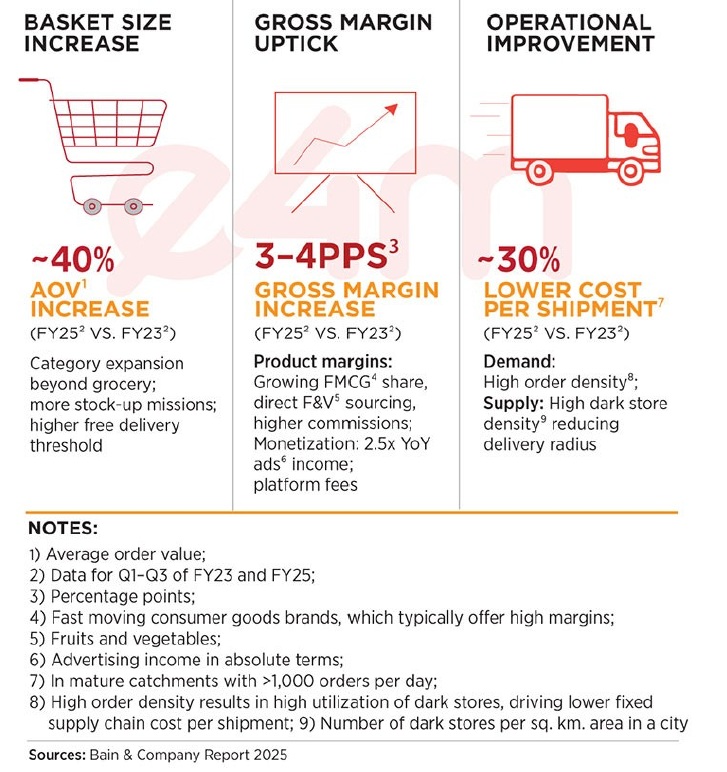
If FY25 was about building scale, FY26 is definitely shaping up to be about pricing power. With consumer adoption of 10–20-minute delivery apps surging, advertisers are competing for limited inventory, pushing ad rates up by 30–50% year-on-year.
“Ad rates on quick commerce platforms have surged by 30–40% year-onyear, especially during high-impact windows like festive seasons and major cricket events. This is fuelled by rising user engagement and proven performance outcomes. With more sophisticated ad formats and attribution models now in play, advertisers increasingly view the premium as justified,” added Uday Mohan, COO, Havas Media India & Havas Play.
Scale, Pricing & Soaring Ad Rates
While agencies point to surging demand, market data shows that platforms themselves are firming up monetisation models with steep onboarding thresholds.
As per market estimations, Swiggy Instamart offers tiered onboarding packages ranging from ₹4.5 lakh to ₹10 lakh, adjustable against advertising spends over a three-month period. Zepto reportedly asks new or small brands to commit anywhere between ₹2 lakh and ₹7 lakh per month on ads, depending on the category. Blinkit, on the other hand, charges ₹25,000 per SKU per state as a non-refundable onboarding fee, which is credited to the brand’s ad wallet.
This aggressive push comes against the backdrop of a sector that has grown at breakneck speed. According to CareEdge Analytics’ July 2025 data, India’s quick commerce market was valued at around ₹64,000 crore in FY25, growing at a staggering 142% CAGR during FY22–FY25 on the back of evolving consumer preferences, hyperlocal infrastructure, and a low base.
The momentum is expected to continue with strong double-digit growth over the next few years, as adoption deepens in Tier II & III cities, delivery networks expand, and instant fulfilment becomes mainstream.
At the same time, platforms are pivoting from pure hypergrowth to sustainable profitability—tapping into advertising, subscriptions, private labels and tech-led inventory optimization as key revenue levers. This shift is being enabled by India’s expanding digital backbone: with over 1.12 billion mobile connections and 806 million internet users (a 6.5% YoY rise), the country is projected to cross 900 million internet users by the end of 2025. Rising smartphone penetration in both urban and rural areas, aided by affordable data and policy support, has created one of the world’s largest online consumer pools, with 270 million e-shoppers in 2024, making India the second-largest e-retail market globally.
Unsurprisingly, advertisers are flocking to these platforms because that’s where their consumers are. Even though seller commissions contribute the bulk of revenues (68–74%), ad placements and brand boosts already account for 9–11%. Industry data shows that ad rates on quick commerce apps have climbed by 30–50% in just a year, with premiums doubling during high-impact windows like festivals and cricket tournaments. This steep inflation reflects both rising consumer traffic and the limited nature of in-app inventory, pushing brands to pay top dollar for guaranteed visibility at the point of purchase.
Bain’s ‘How India Shops Online 2025’ report also underscores this momentum: beauty, personal care, and snacking categories are already outpacing overall e-retail growth, and these are the very segments leaning most aggressively into quick commerce ads.
“Ad rates on quick commerce platforms have jumped by nearly 40–50% compared to last year. This spike reflects that premium brands are willing to pay for immediacy and guaranteed visibility, where ad placement directly links to instant purchase behaviour,” said Mandar Lande, founder of Waayu, a zero-commission food delivery app in India.
According to Aditya Aima, Managing Director, Growth Markets; Co-MD, India & MENA, AnyMind Group, ad rates on quick commerce platforms have not only risen but demand has intensified. “The surge is fuelled by three dynamics: sticky consumer behavior with high visit frequency, dense purchase intent compared to social or entertainment platforms, and the scarcity of ad real estate.”
Quick commerce becomes a strategic channel
For brands, quick commerce has moved far beyond being a fulfillment partner. It has become a strategic advertising channel, especially for those in fast-moving and competitive categories like beauty, wellness, snacks, and personal care. The platforms offer not just last-mile delivery but also front-of-shelf visibility in an increasingly cluttered digital environment.
According to Seshu Kumar Tirumala, Chief Buying and Merchandising Officer, bigbasket, “Brands are moving beyond purely search-centric strategies and increasingly adopting immersive display activations with formats like Spotlight Videos, Banners with Add-to-Cart (ATC), targeted banners, and ATC widgets. For established brands, most investments still flow into performance-led formats such as Sponsored/PLA ads, while a portion is reserved for top-funnel initiatives like storytelling, new launches, and high-visibility events. Emerging or smaller brands usually begin with awareness and consideration campaigns before shifting focus toward performance once they’ve built stronger customer connections.” Unlike marketplaces or social media, quick commerce blends data-led targeting, high engagement, and measurable ROI.
Many brands pair Q-comm placements with collab ads on Meta, Google, and Criteo to build visibility while keeping consumers engaged across the funnel. This creates a sharper, closed-loop system where awareness, consideration, and conversion happen almost instantly. “D2C brands have been rapidly scaling up ad spends on quick commerce platforms, up to 40–50% year-on-year, with a significant share during the festive season. Among the key reasons are fast-growing adoption of Qcomm by consumers and better ROI than marketplaces,” said Shrikant Shenoy, AVP at Lodestar UM.
What sets this instant delivery model apart is its ability to compress the purchase journey. Marketplaces drive comparisons, and social platforms spark discovery, but Q-comm taps into impulse buying with SKU-level attribution.
“The quick delivery model encourages impulse purchases and immediate gratification shopping, which is particularly valuable for D2C brands. Qcomm platforms have lower competition density, and ad formats are more native and less cluttered than traditional e-commerce,” said Devangshu Dutta, founder of Third Eyesight.
“When someone opens Blinkit or Zepto, they’re usually in active purchase mode, not just browsing. For consumables, personal care, or lifestyle products, this is the sweet spot of marketing,” Dutta noted.
“Ad rates on quick commerce have gone up by more than 20% in the last year. If you want a prime slot, say a homepage banner in a big city, you might even be paying 50% more than last year. Because every brand wants it. When a Blinkit or Swiggy placement can move your product in minutes, not weeks, those ads aren’t just distribution, they are discovery,” said Mohit Singh, Head of Product at Zippee, a quick commerce logistics platform.
Meanwhile, pricing pressures are only going up. Ratnakar Bharti, VP, Media, Mudramax said, “Quick commerce isn’t just ‘fast delivery’ anymore, it has become high-intent retail media sitting right next to the ‘add to cart’ button, with sales that can be measured in real time. Quick commerce platforms say their ads business grew 5X in a year to about $200M ARR. At that kind of scale, inventory quality improves, targeting gets sharper, and the medium starts looking like the next big retail media play.”
“In a nutshell, expect meaningfully higher prices in peak weeks — often up to 2x — and a higher year-round floor price due to steeper minimums and fees. The trade-off is harder proof of sales at the exact SKU, which is why demand and prices are rising,” Bharti added.
“Brands pay a premium for Q-Comm because it drives sales at the point of purchase. What began as experimental spends has now become a steady line item in media plans, thanks to strong ROI and proven results,” added Jatin Kapoor, MD, AdsFlourish.
Beauty, beverages & snacking lead the charge
Notably, not all categories are leaning on quick commerce equally. Industry executives point out that beauty & personal care, beverages, snacking, and wellness are the biggest spenders, given their high repeatability, impulse-driven nature, and urban skew.
Beauty and personal care brands, for instance, are using Q-comm not just to drive trial packs and quick replenishment, but also to run festival-led campaigns targeting affluent millennials. Similarly, beverages and packaged snacks are thriving on the “in-the-moment” consumption occasions that these apps uniquely enable.
“The biggest spenders are beverages, beauty, packaged foods, and wellness. Those categories thrive on impulse and repeat consumption, which is exactly what quick commerce delivers best,” Singh added. As per many industry experts, wellness and lifestyle brands, too, are seeing outsized returns. From daily supplements to discreet personal care items, quick commerce is proving to be a low-friction purchase environment with high conversion rates.
“Quick commerce platforms have lower competition density, and ad formats are more native and less cluttered than traditional e-commerce,” explained Dutta.
Media buyers also note that Q-comm platforms are evolving fast, offering more contextual in-app placements and data-driven targeting. This is creating a level playing field for challenger brands that lack legacy shelf space in offline retail.
“Quick commerce advertising is inherently contextual. A beverage or snack brand running an IPL campaign is literally tapping into the consumer’s 15-minute window of intent, it’s that instant,” added Mohan.
With ad rates on quick commerce platforms climbing 30–50% year-on-year, it’s clear the medium is shifting from experimental budgets to a core retail media channel. However, with competition heating up, festive weeks commanding 2X pricing, and minimum spends rising, the question is: how long before quick commerce ads start resembling the crowded, high-cost landscape of traditional e-commerce marketplaces?
(Published in Exchange4Media)
