
admin
November 26, 2025
Aakriti Bansal, Medianama
November 26, 2025
MediaNama’s Take: The Central Consumer Protection Authority’s (CCPA) decision to publish 18 self-declarations confirms only a partial picture of its dark pattern(s) identifying exercise. The authority has stated that 26 platforms have filed their declarations, but it has made only 18 of them public. This gap means the public still cannot see what eight major platforms submitted or whether those filings contain any meaningful detail. Moreover, even among the published declarations, several are one-paragraph statements that offer almost no insight into the scope or accuracy of the companies’ internal audits.
LocalCircles’ new survey adds further complications, reporting that 21 of the 26 platforms that submitted declarations still display at least one dark pattern. This finding suggests that the CCPA’s reliance on voluntary self-assessment may not be enough to shift platform behaviour at scale. It also raises questions about what the unpublished declarations contain and whether the missing submissions are similarly sparse or incomplete.
Notably, the CCPA has not clarified how it plans to verify the accuracy of any of the declarations, whether published or unpublished. If filings remain unverified for months, compliance risks turning into a box-ticking exercise rather than a meaningful regulatory process. Therefore, the next phase matters far more than the publication of select declarations, because the current approach raises more questions than it answers.
What’s the News
The CCPA has made 18 dark pattern self-declarations public, despite stating that 26 platforms have filed their compliance letters. The publication follows an RTI filed by MediaNama that revealed which companies had submitted their declarations, and pointed out that none of the filings had been available to the public at the time.
These declarations stem from the Ministry’s June 5 advisory, which required e-commerce and quick commerce companies to conduct internal audits under the 2023 Guidelines for Prevention and Regulation of Dark Patterns and submit compliance letters within 90 days.
For context, Moneycontrol reported that Amazon has still not filed its declaration and has asked for additional time. A senior government official told the publication that the government “has done what it had to” and does not plan further discussions.
The official also said that any punitive action would depend on consumer complaints routed through channels such as the national consumer helpline. This indicates that the enforcement approach continues to be reactive rather than compliance-driven.
What Did The CCPA Ask Platforms To Do?
The June 5 advisory set out a simple compliance framework for digital platforms. It asked every e-commerce and quick commerce company to complete a self-audit of its website and mobile app within 90 days and check their interfaces for the 13 dark patterns listed in the 2023 guidelines. Platforms were required to file a self-declaration confirming compliance once this internal review was complete.
However, the advisory did not specify how the audit should be conducted. Companies were free to choose any methodology, and the CCPA did not prescribe a standard format, a uniform checklist, or a minimum evidence requirement. Also, the advisory did not require independent audits or third-party validation.
Furthermore, there was no explanation of how the CCPA planned to verify whether the declarations were accurate or complete. In effect, the responsibility for defining the scope, depth, and rigour of the audit rested entirely with each platform.
What the CCPA Has Done With the Declarations
As mentioned before, the CCPA has now published 18 self-declarations on its website. The release confirms that companies submitted their compliance letters, but it does not indicate whether the authority evaluated the accuracy or depth of the filings.
Several platforms submitted very short statements that simply assert compliance without describing any checks or findings. BigBasket, Zomato, Blinkit and Swiggy were among the companies that filed especially minimal disclosures. The CCPA has not explained why these filings were accepted or whether any follow-up questions were asked. Therefore, asking for and disclosing self-declarations shows some administrative progress, but it does not reflect any regulatory scrutiny.
This lack of verification aligns with concerns raised by Devangshu Dutta, Founder of business consulting firm Third Eyesight. He told MediaNama that self-declarations “do not change things much” when regulators do not audit submissions or impose consequences.
Further, Dutta remarked that most companies comply at the minimum level required if their claims are not examined and are not made public in full. According to him, revenue-driving design choices such as forced add-ons, confusing checkout flows or misleading scarcity claims will not be voluntarily removed sans oversight.
What Independent Evidence Shows
LocalCircles’ latest audit presents a sharply different picture from the companies’ filings. The organisation found that 21 of the 26 platforms that submitted “dark pattern free” declarations still use one or more manipulative design practices. The assessment relied on feedback from more than 250,000 consumers across 392 districts along with AI-assisted testing.
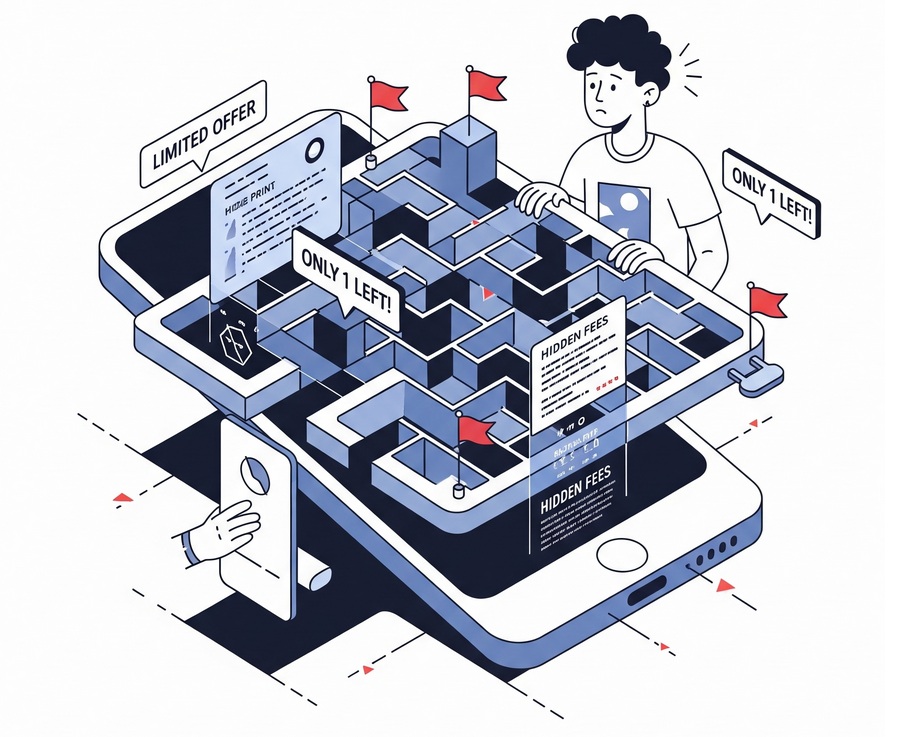
The most common violations include forced action, subscription traps, bait and switch, basket sneaking, interface interference and disguised advertisements. In practice, these dark patterns respectively mean that users are pushed into steps they did not choose, face hidden or hard-to-cancel subscriptions, see offers change during checkout, encounter fees added at the last moment, get nudged toward platform-favoured choices, and come across ads that appear as regular listings.
LocalCircles also identified drip pricing (gradually adding mandatory fees during the checkout process) on 11 of the 26 companies, including Flipkart, Myntra, Cleartrip, MakeMyTrip, BigBasket, Zomato and Blinkit, among others. The organisation said that many platforms appear to misunderstand what qualifies as drip pricing, which has led to incomplete corrections.
Trust Can Erode Due To Gap Between Declarations And User Experience
Sachin Taparia, Founder of LocalCircles, said that the problem begins with the absence of any verification. “Our understanding is that CCPA is wanting that companies submit a self-declaration at the earliest. However, there is no cross checking of claims that is being done by the CCPA, and as a result the companies are not being as thorough with their dark-pattern detection and resolution,” he said.
Taparia added that discrepancies between declarations and user experience could harm trust. “LocalCircles has found dark patterns on 21 of the 26 platforms submitting self-declarations. If this exercise is not done with high accuracy, both platforms doing so and CCPA could see consumer trust being impacted,” he said.
Importantly, Dutta echoed this concern, saying that the absence of penalties or reputation-related consequences allows companies to self-declare compliance while keeping revenue-generating patterns intact. He described the current process as “more an administrative formality [rather] than a behaviour-changing regulatory tool”.
Why This Matters
The gap between self-declarations and independent audits in the true sense of the word brings the real enforcement question into focus. What should the next phase of regulation look like?
In this context, Dutta said that regulators need to move beyond self-certifications and mandate detailed user experience (UX) audit reports that map every user journey, including pop-ups, onboarding, search, checkout, cancellations and returns.
He explained that regulators should reinforce this by demanding substantive evidence instead of brief compliance letters. This evidence can include screenshots and screen recordings of key flows, version histories that show how an interface changed over time, and product design documents or A/B testing results that reveal why specific nudges were introduced. To explain, A/B testing is essentially a method for comparing two versions of something to see which one performs better.
Furthermore, Dutta noted that platforms already collect extensive data on user complaints and drop-off points, which can help identify harmful or confusing design choices. He also said that independent third-party attestations, similar to security or accessibility audits, can provide a credible external check and increase the cost of non-compliance.
Multiple Annual Audits For Apps that Change Interface Frequently
Notably, Dutta stressed that most dark pattern categories appear across e-commerce, quick commerce and Direct-to-Consumer (D2C) websites, which means regulators can create a baseline audit standard that works across sectors instead of relying on platform-specific interpretations. He also suggested that audits should occur at least once a year, and companies that frequently modify their interfaces may need to report two or three times annually.
The larger concern now is whether the CCPA plans to move toward such a structured framework. Without independent verification and clear audit expectations, companies can continue declaring compliance even when manipulative designs remain embedded in their interfaces.
(Published in Medianama)
admin
November 13, 2025

Saumyangi Yadav,Entrepreneur
Nov 13, 2025
India’s consumer landscape is undergoing a decisive shift in 2025. While D2C brands that once thrived on digital-only distribution are now aggressively building an offline footprint, legacy FMCG majors are simultaneously acquiring digital-first brands to strengthen their portfolios and tap into new consumer behaviours.
As analysts suggest, these trends signal a maturing phase for India’s D2C ecosystem, one that blends physical retail and strategic consolidation.
Offline Push Accelerates
According to a recent CBRE report, ‘India’s D2C Revolution: The New Retail Order’, D2C brands leased nearly 5.95 lakh sq ft of retail space between January and June 2025, accounting for 18 per cent of all retail leasing during this period, up sharply from 8 per cent in the first half of 2024. Fashion and apparel dominated the expansion, contributing close to 60 per cent of D2C leasing, followed by homeware and furnishings and jewellery at about 12 per cent each, while health and personal care brands accounted for roughly six per cent. The shift is equally visible in the choice of retail formats: 46 per cent of D2C leasing went to high streets, 40 per cent to malls, and the remaining to standalone stores, reflecting the category’s growing focus on visibility, trial and experiential discovery.
Experts suggest that it represents a strategic pivot to blended engagement.
As Devangshu Dutta, CEO of Third Eyesight, notes, “India’s D2C surge is powered by digital-first consumers, tremendous improvement in seamless logistics, and low-cost market entry, supported subsequently by substantial amounts of investor capital chasing those startups that stand out from the competition. Yet, lasting success demands a more holistic view: the divide between online and offline is a business construct, not a consumer reality. The larger chunk of retail sales still happens through physical channels and, for brands that want to be mainstream, an omnichannel presence is absolutely essential.”
This also aligns with the broader market outlook. The India Brand Equity Foundation (IBEF), in its Indian FMCG Industry Analysis (October 2025), estimates the value of India’s D2C market at USD 80 billion in 2024, with expectations of crossing USD 100 billion in 2025. Much of this growth is being led by categories that combine frequent purchase cycles with strong digital discovery, beauty, personal care, and food and beverage segments where consumers are open to experimentation but demand authenticity, transparency, and a compelling product narrative.
“The Gen Z and millennial consumer cohorts value newness but also authenticity and unique product stories, which are best communicated in spaces that are controlled by the brand,” Dutta added, “In the launch and growth phases, this could be the brand’s digital presence including website and social media, but over time this can include pop-up stores, kiosks, shop-in-shops and even exclusive brand stores.”
CBRE’s data reflects this shift clearly, with D2C brands increasingly opting for flexible store formats and high-street locations to maximise traffic and visibility.
M&A Gains Momentum
Parallel to the offline push is a noticeable wave of consolidation. Large FMCG companies are accelerating acquisitions to capture emerging consumer niches and strengthen their digital-native capabilities.
In recent years, Hindustan Unilever has acquired Minimalist; Marico has bought Beardo, Just Herbs, True Elements, and Plix; ITC has taken over Yoga Bar; and Emami has secured full ownership of The Man Company. These deals, reported widely across business media in 2024 and 2025, point to the need for established companies to fast-track entry into high-growth, ingredient-forward, and youth-focused categories without the lead time of in-house incubation.
“Legacy FMCG companies are acquiring D2C brands to rapidly gain access to new consumer segments, product innovation, and digital-native capabilities, including direct engagement and insights. Such deals enable large companies to diversify portfolios, accelerate entry into trending segments by-passing the initial launch risks, and rejuvenate their brands with modern digital marketing expertise,” Dutta explained.
Challenges and Risks
But the acquisitions do not come without risk and challenges, analysts warned.
“However, integrating D2C operations also poses challenges, including cultural differences, the risk of stifling entrepreneurial agility, and the need to harmonise data and omnichannel strategies. The ability to nurture acquired brands without diluting their distinctive appeal will determine acquisition success,” Dutta added.
Yet even as the ecosystem expands, challenges remain. Offline stores add operational complexity, inventory planning, staffing, last-mile logistics, and real-time data integration. Still, the bottom line is that India’s D2C sector is moving into a hybrid era defined by tighter omnichannel integration, sharper product storytelling, and portfolio realignment through acquisitions.
(Published in Entrepreneur)
admin
June 5, 2025

Aakriti Bansal, MediaNama
June 5, 2025
A restaurant owner recently took to X (formerly Twitter) to publicly slam Zomato for “mystery charges” and unauthorised ad placements, reigniting concerns over how the platform treats its small business partners. The tweet, accompanied by screenshots of the restaurant’s earnings dashboard, claimed that despite months of listings, his restaurant received zero payouts, and Zomato allegedly ran ads without his consent.
“Dear @zomato @deepigoyal I’m finally pulling my restaurant off your platform. Congrats! Your mystery service charges, surprise ad placements (without consent), and a POC who ghosts like it’s a talent show—truly inspiring. Small outlets deserve better,” restaurant owner Manish posted on X, under the username @maniyakiduniya.Zomato responded: “We hear you! As mentioned earlier, please share your restaurant ID with us via DM, so that our team can get in touch with you.”
The post has struck a chord among restaurant owners who say Zomato’s ad model bleeds their business dry. In conversations with MediaNama over the week, two restaurant owners and a former manager with Zomato independently confirmed that the platform’s advertising system leaves little room for transparency, choice, or sustainable profit.
The names of the restaurant owners and the former Zomato manager have been withheld to protect their anonymity.
Forced Ad Spending and Diminishing Returns
Restaurant owners say visibility on Zomato is tightly tied to how much they spend on advertising.
“If you don’t run ads, your restaurant won’t even show up unless someone searches for you by name,” one owner told MediaNama. He further added, “From what I’ve seen, the top 10 restaurants you see when you open Zomato are all paying for that spot.”Even ratings and reviews don’t help. For instance, if a user searches for ‘noodles’, only those who have paid for the ad category will show up in the list.
Restaurant owners explained how the ad budget starts small, around Rs. 300–400 per week, but grows rapidly. In one case, as seen by MediaNama in a restaurant’s ad dashboard, spending jumped from Rs. 9,000 to Rs. 15,000 per week in just two to three weeks.
“Some are spending Rs. 18,000 to Rs. 20,000 weekly now on ads just to stay afloat,” an owner explained, noting that these costs are hard to bear for restaurants with weekly sales as low as Rs. 2,500.
“When everyone is pushed to advertise just to stay visible, it raises serious questions about how fair the competition is on the platform,” they said. “It’s not about food quality or ratings anymore, it’s about who pays more,” they added.
A screenshot shared by a restaurant owner showing a decline in sales from ads, offers, and orders with applied discounts, highlighting concerns over the effectiveness of Zomato’s advertising model.
Click Charges with No Sales
Zomato charges restaurants based on clicks, not conversions. This means a restaurant is charged whenever a user taps on its listing after seeing a sponsored ad, regardless of whether the user places an order.
One owner explained, “A single click can cost around Rs. 6. Even if a customer just views the restaurant by clicking on it and doesn’t buy, that money is deducted.” He showed a dashboard with 4,877 clicks – most of which occurred before noon – but no conversions. “They exhaust our daily limit by 12 PM and then tell us to increase ad budgets,” he added.
Another restaurant owner echoed similar concerns in a Reddit conversation reviewed by MediaNama. The owner stated that Zomato counts a ‘visit’ even when a user scrolls past an ad and places an order a day later. “That is on purpose,” he wrote, calling the model “scammy for sure”. He also confirmed that restaurants receive no detailed data on who placed orders via ads versus organically.
Furthermore, the owner noted that Zomato lacks a clear grievance redressal mechanism for ad-related issues, as complaints are often ignored by a restaurant owner’s point of contact.
“There’s no formal audit or independent review if an ad campaign fails,” he said.The Legal Escape Hatch: You Signed the Contract
Restaurant owners say Zomato deducts ad spends automatically, citing terms buried in the onboarding agreement – terms many admit they didn’t fully understand before signing. Once enrolled, there’s no clear way to pause or cancel.
“There’s no way to opt out once it starts, and no refunds either,” one merchant said. “Zomato just says, ‘You came to us,’ whenever we raise concerns,” he added.
But is this consent truly informed? “It’s a honeytrap,” the merchant said. “There’s no other option but to keep spending on ads if you want to stay relevant on the platform,” he explained.
Price Parity, Platform Pressure, and Squeezed Margins
Another major source of concern is Zomato’s price parity push. According to one owner, the company convinced restaurants to upload their table-rate menu on the platform by offering to lower commission fees. However, this strategy has backfired for many.
“They promised lower commission if we maintained the same prices online and offline. But now we pay Good and Services Tax (GST), high commissions, and ad spends on top of that. Our margins are cut down to 5–10%,” he said. Commissions alone can go up to 35–40% every month, forcing smaller restaurants to comply just to remain competitive.
In effect, merchants are footing the bill for everything: discounts, ads, visibility, and commissions, while Zomato gains from each layer.
Coupons and Data Obscurity
The dashboard Zomato offers shows data like clicks and visits, but it hides key financial insights that would help merchants make informed decisions. “They will show you how much you sold, but not how much you are paying to the platform,” one owner said.
Restaurant owners also said they have little to no control over how Zomato spends their ad budget. “We don’t know when our ads are shown, or to whom. There’s no data on which campaign worked better, or what to change,” one merchant said. Without visibility into targeting and performance strategy, many feel they are blindly spending in hopes of visibility.
Coupon codes, too, are deducted from the restaurant’s share, even if the platform offers them without informing the merchant. “Whatever discount a customer sees, it’s cut from our side. Zomato’s share is tiny, about 15%. We bear the rest,” the merchant added.
If a platform issues discounts unilaterally but bills restaurants for them, is that a fair bargain?
Opaque Categories and Manipulated Targeting
Merchants also highlighted how Zomato divides ad rates by cuisine categories — North Indian, Chinese, etc. — and even by customer frequency. “There are eight to 10 customer categories, each with a different ad rate,” an owner said. “Frequent buyers are more expensive to target”, he added.
The platform nudges merchants to buy targeted ads by showing graphics and dashboards that suggest potential boosts. But when profits drop, and merchants reach out, they are told that competition has increased significantly since they last got in touch with Zomato and they should spend more.
“It’s a vicious cycle. They’ll say: ‘Try a brand title ad or pay Rs. 300 extra to reach daily customers.’ The game never ends,” revealed the restaurant owner.Inside Zomato: How Ads Shape Visibility
A former Zomato manager told MediaNama that restaurants not running ads don’t get deliberately penalised, but they do end up losing visibility. “Those who run ads automatically rise in rankings. So the others fall behind,” he said. Even a high-rated restaurant may slip if competitors outspend it.
For context, how much a restaurant pays for ads often depends on their rapport with the specific Zomato account manager and their business goals. “If a restaurant wants aggressive growth, we push it to the top line: high spend, high return. Others stay in the down line: lower investment, slower scale,” he said.
Ad pricing, he said, is not standardised. “It varies depending on what the manager thinks the client can afford and how much they are willing to push.”
He added that Zomato’s discovery algorithm changes every five to six months, which makes it difficult for restaurants to adapt or plan long-term. “The idea is to keep the system rotating so one client doesn’t dominate.”
Performance tracking for restaurants, he said, is mostly transparent except for one missing piece: acquisition data. “Zomato doesn’t show how many customers came through advertising. That’s where it becomes murky.”
He admitted Zomato doesn’t intervene if a restaurant complains about bad ad results. “It depends on the manager’s willingness but hardly anyone did it because of too many internal disputes on this issue.”
Why Ad Revenue Matters So Much
Ad revenue, the former Zomato manager said, is especially crucial in Tier 2 and Tier 3 cities.
“In big cities, order values are high, so aggregators can survive on commissions. But in smaller cities, ad income is the main driver as the order values are comparatively low”, the former manager added.Zomato’s Q4FY25 Shareholders’ Letter reflects this reliance: the company’s advertising and sales promotion expenses rose to Rs. 1,972 crore on a consolidated basis in FY25, up from Rs. 1,432 crore in FY24. While these are expenses borne by the platform, they highlight how advertising has become a structural lever in both customer acquisition and revenue generation.
Elsewhere, an HDFC Securities report states that quick commerce companies have theoretical levers to improve margins, such as increasing take rates, including higher ad income. It also observes that Blinkit would need to improve its take rates from 18.5% to 22% to reach a 5% adjusted EBITDAM (Earnings before Interest, Taxes, Depreciation, Amortisation, and Management Fees), with ad revenue identified as a key lever to meet that target.
However, the report notes that heightened competition may keep some of these levers non-operational.
Zomato‘s Response
In response to MediaNama’s queries, a Zomato spokesperson shared the following statement:
“All marketing collaborations such as ads, promotions, and discounts etc., as well as commercials, are mutually discussed with our restaurant partners before being switched on, switched off or modified. Our multi-factor authentication system ensures that partners retain full control and give explicit consent which is registered before any changes go live. We also maintain robust escalation mechanisms, allowing partners to raise concerns and receive prompt, satisfactory resolutions through the Restaurant Partner App as well as centralised helpline numbers.
We continue to see restaurants having confidence in our partnership and are taking a proactive step to improve and enhance our interactions and processes. For our smaller restaurant partners, we work extra hard to make it easier for them to grow with us. There are always opportunities to improve and we are committed to working on them, on-time.”
While Zomato says it maintains robust escalation mechanisms and explicit partner consent, restaurant owners who spoke to MediaNama described a different reality: one of automatic deductions, limited control, and opaque ad operations.
What Zomato’s Policy Says and Doesn’t
According to Zomato’s Sponsored Listing Service terms, merchants are expected to make full payments in advance. Refunds are not guaranteed, and Zomato has full discretion on ad placements, sizes, and category changes.
The company “assumes no liability or responsibility for any… click frauds, technological issues or other potentially invalid activity that affects the cost of Service.” It also “does not warrant the results from use of Service, and the Merchant assumes all risk and responsibility.”
The Sponsored Listing Service terms grant Zomato broad rights to use merchant content, brand names, and logos, while limiting the company’s liability to the amount of fee paid during a term. These terms become legally binding once the Service Request Form (SRF) is signed.
While Zomato offers a merchant dashboard to track visits, it does not disclose the full breakdown of how ad money is being spent or how much value is being returned. One merchant noted that visibility data only started appearing in the last five to six months. Before that, they had no metrics at all.
Swiggy’s Self Serve Ads: A More Transparent Model?
Swiggy says its ad platform puts control in the hands of restaurant partners. Through the Self Serve Ads tool, restaurants can create their own campaigns, adjust daily spends, and track how those campaigns perform. The company promotes the tool as flexible and cost-effective, with no upfront payments.
The onboarding process is laid out step-by-step: restaurants upload documents like GST and Food Safety and Standards Authority of India (FSSAI) certificates, complete Know Your Customer (KYC), and sign a Partnership Agreement after a verification visit from a Swiggy representative, As per Swiggy, commissions are based on location and whether a restaurant opts for extra promotions.
Compared to Zomato’s Sponsored Listings model, which some restaurant owners say they didn’t fully understand when signing up, Swiggy’s approach looks more structured and consent-driven, at least on the surface.
But that clarity doesn’t always hold up. One of the restaurant owners told MediaNama that Swiggy’s model isn’t entirely different from Zomato’s. “You have to pay them if you want your restaurant to show up in search. It’s the same thing, just framed differently,” the owner said, suggesting that visibility on the platform often comes at a cost, regardless of how the ad system is marketed.
Advertising as a Structural Lever in Quick Commerce
Restaurant owners have flagged the rising costs and opacity of advertising on platforms like Zomato. But industry research shows that this isn’t just a revenue stream but it’s central to how delivery platforms, especially in quick commerce, are designed to operate.
A September 2024 report by CLSA, titled App-racadabra- Magic Behind Instant Delivery Liberating Customers, found that ad revenue makes up around 3.5% to 4.5% of gross merchandise value (GMV) on Zepto. That figure is only expected to grow as more brands start recognising the significance of quick commerce.
Interestingly, Zepto doesn’t just run ads for brands that sell on its platform. It also allows companies to advertise even if they aren’t listed, using spaces like the order tracking page, according to the report.
Quick commerce platforms can also use past purchase data to deliver more targeted ads and push higher-value products – what the report calls driving “premiumisation” of fast-moving consumer goods (FMCG).
Zomato’s quick commerce arm, Blinkit, is expected to lean heavily on ads to hit profitability targets. CLSA notes that Blinkit’s margins could eventually exceed those of food delivery, given the larger potential for ad revenue and the shift toward higher-margin categories.
The report adds that quick commerce is especially useful for smaller or direct-to-consumer (D2C) brands. These businesses can tap into a pan-India audience without having to build their own distribution networks.
The CLSA findings reinforce how advertising isn’t just about visibility, but it is baked into the business model. As margins tighten, discovery on these apps is no longer organic but paid.
Expert View: Power, Visibility, and Platform Dependence
These patterns mirror broader trends across retail and platform ecosystems, not just food delivery.
Devangshu Dutta, the Founder and Chief Executive of specialist consulting firm Third Eyesight, told MediaNama that these dynamics are not unique to Zomato or even food delivery.
“Advertising and promotion focussing on specific brands or products is standard across various platforms and formats. It is an outcome of the balance of power between the platform and the supplier brand, and is equally true of physical retail chains, online marketplaces and aggregation platforms such as Zomato,” he said.
Brands or restaurant chains with deeper pockets tend to secure greater visibility—whether through premium shelf space in physical stores or prominent placements like sponsored listings and banners on delivery platforms.
“Demand-side concentration inevitably favours larger suppliers and brands who can fund visibility, whether it is through endcap displays in a retail aisle or sponsored banners or top-of-search-list positions on an app,” Dutta stated.However, he noted that some established brands may choose to bypass platform dependence altogether.
“If brands are well-established or have other means to ensure that their message and product reaches the target consumer, they may choose to opt out of the channel, as many restaurants have done with Zomato and Swiggy,” Dutta explained.
How Can Restaurants Push Back?
In the context of restaurants displaying resistance to food delivery apps, one of the restaurant owners said that small restaurants need to come together.
“There should be local unions who can stand up to Zomato. And there should be a blanket rule on how much ad spend is allowed, so merchants don’t fall into this trap,” the owner said.He added that Zomato seems to earn more from merchants than from customers. “Whatever we pay to be visible, it all goes into the platform’s pocket”, he explained.
Further, he argued that without collective action, individual pushback rarely works. “The minute we stop ad spend, our listings drop to the bottom. So we need to walk together. If even 30% of merchants stop ads at once, it will force a reaction.”
Why This Matters
As India’s online food delivery market continues to grow, so does the reliance of small businesses on platforms like Zomato. However, these platforms are acting as gatekeepers by deciding who gets seen, how often, and at what price.
By tying discovery to opaque algorithms and costly ad spends, they tilt the playing field in favour of businesses that can afford to pay more. In such a system, can small restaurants survive?
And the issue goes beyond advertising. Zomato recently paused its 50:50 refund-sharing policy after public backlash and partner complaints. Restaurant owners said the company auto-enabled the policy and deducted money without consent or clear explanation. As with ads, there was no transparent opt-out process or formal appeal.
Together, these practices raise broader concerns: Should platform-led monetisation come with stricter disclosure norms? Can regulators step in to ensure pricing fairness and transparency in merchant contracts? And what role can merchant collectives play in counterbalancing this power?
For now, many restaurant owners feel caught in a system that offers visibility and participation at a cost they cannot afford and exit without impact.
(Published in MediaNama)
admin
March 20, 2025

Sagar Malviya, Economic Times
Mumbai, 20 March 2025
Established beauty product makers such as Forest Essentials, Colorbar, Kama Ayurveda, Body Shop, VLCC Personal Care and Lotus Herbals saw a slowdown in sales growth in FY24, according to the latest Registrar of Companies filings. Consumers favoured new-age rivals such as Minimalist and Pilgrim, specialised derma brands, as well as global labels Shiseido, Innisfree and Eucerin.
Sales growth of established brands mostly in the natural skincare segment, more than halved to single digits during the previous financial year amid a broader economic slump.
In contrast, companies such as L’Oreal, Nykaa and Sephora continued to grow at 12-34% on a significantly bigger base, even as they lost pace.
Direct-to-consumer brand Pilgrim more than doubled its sales, Minimalist’s revenue increased 80% and Foxtale’s sales surged 500% on a lower base.
“With most consumers tightening their budget on discretionary spends in FY24, they seem to have opted for brands that give instant benefits compared to natural products, which take time to be effective,” said Devangshu Dutta, founder of retail consulting firm Third Eyesight.
Over the past few years, there has been a flurry of beauty product launches, which have depended on platforms such as Nykaa and Tira for sales.
In the past two years, Nykaa has launched more than 350 brands, or In the past two years, or nearly one new label every alternate day on average.
This includes international brands such as CeraVe, Uriage and Versed, as well as home-grown brands such as Foxtale and Hyphen.
Reliance Retail, which entered beauty retailing with Tira two years ago, now sells nearly 1,000 brands, including exclusive labels such as Akind, Augustinus Badee, Allies of Skin, Kundal and Patchology.
“10 years ago we were only competing against big guys,” Vincent Karney, global chief executive of Beiersdorf, maker of Eucerin, Nivea and La Prakrit, told ET last month. “Now we have those local brands, and we have to become a bit more agile.”

On Nykaa, Fenty Beauty by Rihanna is the highest-selling brand in lipcare while Eucerin has become its biggest premium dermo-cosmetic serum. South Korean beauty brands Axis-Y, Tirtir and Numbuzin grew over 60% in 2024, with sales of toners increasing 104%, serums 45%, moisturisers 52% and sunscreens 154% on the platform.
VLCC and Colorbar did not respond to ET queries, while Forest Essentials was not reachable.
In January, Mike Jatania, cofounder and executive chairman of The Body Shop and Aurea Group, told ET, “There would be continuation of new entrants. Inflation is still a global issue and we will see the pressure. Competitive environment will be a challenge… 70% of our stores are showing decent growth. We have closed some stores and opened a few also, that’s the nature of the business.”
Ingredients Matter
Warnery of Beiersdorf emphasised the need to stay focused on “big innovation, by being able to talk to GenZ, (a position) which might be filled in by those local brands coming with basic ingredients.”
The likes of Minimalist, Ordinary and Pilgrim disclose active ingredients at a granular level, specifying the exact percentage of acid used in the product to appeal to GenZ users (those born between 1997 and early 2010s), who are said to be far more conscious of what they use on their skin compared to millennials (those born during 1980s to mid-1990s) and Gen X (those born from about 1965 to 1980).
Shoppers Stop, which manages brands such as Estee Lauder, Shiseido, Bobbi Brown, Mac and Clinique in India, sees the overall beauty market driven by companies focusing on consumers across age groups, and not just younger ones. Both natural and dermatological products are expected to find takers.
“While most new age brands tap younger cohorts, their pocket size allows them to mostly buy affordable products and the more affluent consumers opt for established global brands that have proven themselves since decades,” said Biju Kassim, chief executive, beauty, at Shoppers Stop. “Beauty is still not a habit in India and with hundreds of brands being launched, the focus is to grow penetration. There is also a shift from care to cure, driven by derma-recommended products and brands disclosing active ingredients, but it is still a niche sub-segment.”
Dutta of Third Eyesight sees the current trend as temporary. “We expect growth of (established) companies to bounce back in the current fiscal, driven by a strong demand for beauty,” he said, pointing especially to online platforms. India’s beauty and personal care market is expected to reach $34 billion by 2028, up from $21 billion now, driven by an online surge and a growing preference for high quality, premium beauty products according to a report by Nykaa and consulting firm Redseer.
Nicolas Hieronimus, chief executive of cosmetics giant L’Oreal, last year said consumers in India are more demanding and are not just settling for very basic things like putting an ingredient in a product such as salicylic acid or collagen. “That’s where L’Oreal has the best cards to play, and that’s where we really thrive,” he had told ET.
Beiersdorf, Unilever, L’Oreal and Shiseido, among the world’s largest cosmetics companies, have all identified India as a key growth driver, citing the burgeoning population and growing affinity for beauty products.
(Published in Economic Times)
admin
September 16, 2024

Sesa Sen, NDTV Profit
16 September 2024
As India’s economy grows and digital technologies reshape consumer behavior, the future of kirana stores—the quintessential neighbourhood grocery shops—hangs precariously in the balance.
These soap-to-staple sellers, once impervious to change, now confront an existential threat from quick commerce players like Blinkit, Instamart, Zepto, and from modern retailers such as DMart and Star Bazaar, raising a pivotal question: Can kiranas survive the pressure of change, or will they die a slow death?
The All India Consumer Products Distributors Federation, that represents four lakh packaged goods distributors and stockists, has recently raised alarms, urging Union Minister for Commerce and Industry Piyush Goyal to investigate the unchecked proliferation of quick commerce platforms and its potential ramifications for small traders.
Their concerns are not unfounded. Data suggests that the share of modern retail, including online commerce, which is currently below 10%, is set to cross 30% over the next 3-5 years. Much of this growth will come at the cost of traditional retail.
“Unless the government takes on an activist role to support the smallest of business owners, the shift toward large corporate formats is inevitable,” according to Devangshu Dutta, head of retail consultancy Third Eyesight.
Casualties Of The Boom
Madan Sachdev, a second-generation grocer operating Vandana Stores in eastern Delhi, has thrived in the recent years, adapting to the digital age by taking orders via WhatsApp and employing extra hands for home delivery.
Despite having weathered the storm of competition from giants like Amazon and BigBazaar, he now finds himself disheartened, as his monthly sales have halved to about Rs 30,000, all thanks to quick commerce.
Sachdev is worried about meeting expenses such as rent, his children’s education, and other household bills. He finds himself at a crossroads, uncertain about how to modernise his store or adopt new-age strategies in order to attract customers in an increasingly competitive market.
India’s $600 billion grocery market, a cornerstone for quick commerce, is largely dominated by more than 13 million local mom-and-pop stores.
Retailers like Sachdev are also seeing a steep decline in their profit margins from FMCG companies, which now hover around 10-12%, down from the 18-20% margins seen before the Covid-19 pandemic. The consumer goods companies are instead offering higher margins to quick commerce platforms so that they can afford the price tags.
Quick deliveries account for $5 billion, or 45%, of the country’s $11 billion online grocery market, according to Goldman Sachs. It is projected to capture 70% of the online grocery market, forecasted to grow to $60 billion by 2030, as consumers increasingly prioritise convenience and speed.
Many of the mom-and-pop shops are family-run and have been in business for generations. Yet they lack the resources to modernise and compete effectively with larger chains. Modern retail businesses, including quick commerce, begin with significantly more capital, thanks to funding from corporate investors, venture capital, private equity, and public markets.
“They can scale quickly and capture market share due to a superior product-service mix, larger infrastructure, and more robust business processes,” said Dutta.
Moreover, their ability to engage in price competition poses a challenge for small retailers and distributors, making it difficult for them to compete.
“This is something that has happened worldwide, in the largest markets, and I don’t think India will be an exception,” Dutta said, adding that it would be incomplete to single out a specific format of corporate business such as quick commerce as the sole villain in this situation.
“India is a tough, friction-laden environment at any given point in time, including government processes which don’t make it any easier,” he said.
Peer Pressure
Data from research firm Kantar shows that general trade, which comprises kirana and paan-beedi shops, have grown 4.2% on a 12-month basis in June, while quick commerce grew 29% during the same period.
Shoppers are becoming more omnichannel, rather than gravitating towards one particular channel, said Manoj Menon, director- commercial, Kantar Worldpanel, South Asia. “While the growth [for quick commerce and e-commerce] might appear to have declined compared to a year ago, a point to note is that the base for these channels has significantly grown. Therefore, achieving this level of growth is still commendable.”
Consumer goods companies such as Hindustan Unilever Ltd., Dabur India Ltd., Tata Consumer Products Ltd., etc., have acknowledged the salience of quick commerce to their packaged food, personal and homecare products. The platform currently comprises roughly 40% of their digital sales.
“We are working all the major players in the quick commerce space and devising product mix and portfolio. This is a very high growth channel for us,” according to Mohit Malhotra, chief executive officer, Dabur India.
Elara Capital analysts have pointed out that the share of quick commerce is expected to rise to60% in the near future with e-commerce and modern trade turning costlier for FMCG brands than quick commerce. “The larger brands tend to make better margins on quick-commerce platforms versus e-commerce due to lower discounts on the former,” it said in a report.
However, it is too premature to draw a parallel between kirana and quick commerce in terms of competition, given the significant size difference.
The average spend per consumer on FMCG in kirana stores stands at Rs. 21,285 annually while the same is Rs. 4,886 for quick commerce, according to Menon.
Rural Vs Urban Divide
Quick commerce is still an urban phenomenon. In contrast, in rural settings, where internet penetration is still catching up and access to large retail chains is limited, kirana stores continue to thrive.
According to Naveen Malpani, partner, Grant Thornton Bharat, while the growth of quick commerce is undeniable, this channel is not poised to replace traditional retail, which still has a wider reach in the country. “It will complement older models, filling a niche for immediate, smaller purchases. Also, a 10-20-minute delivery may not have a strong market pull in rural markets where distance and time are not much of a concern.”
Yet many others believe, even in these areas, the challenge is palpable.
The small businesses are beginning to feel the sting of same slow decline that once befell the ubiquitous telephone booths in the era of mobile phone, according to Sameer Gandotra, chief executive officer of Frendy, a start-up that is building ‘mini DMart’ in small towns where giants like Reliance and Tatas have yet to establish their presence.
As rural customers slowly start to embrace digital shopping and seek more variety, kirana stores must adapt or risk becoming obsolete, he said.
Besides, the popularity of quick commerce is set to challenge the dominance of incumbent e-commerce platforms, especially in categories such as beauty and personal care, packaged foods and apparel.
“Quick commerce is primarily operational in metros and tier 1 markets, which is impacting the sales of traditional companies in these areas. However, if quick-commerce players were to extend their operations to tier 2 and tier 3, it would even challenge companies such as DMart and Nykaa, and would pare sales and profitability,” noted analysts at Elara Securities.
Frendy’s Gandotra believes the journey for kirana stores is not a lost cause, but it requires strategic interventions. Many kirana store owners struggle to integrate point-of-sale systems, inventory management software, or even digital payment solutions. These stores need to embrace technology.
Another aspect is the need for policy support. Regulations to ensure fair competition can prevent monopolisation by large retailers. Additionally, subsidies, tax benefits, and grants for infrastructure improvements can help small businesses adapt to changing market dynamics. With renewed support, kirana stores can continue to be the backbone of Indian retail.
Nonetheless, there will be some who’ll be left behind during this shift. Analysts at Elara Capital warn that the swift rise of quick-commerce platforms, combined with aggressive discounting, could wipe off 25-30% of traditional grocery stores.
(Published on NDTV Profit)
