
admin
December 7, 2025
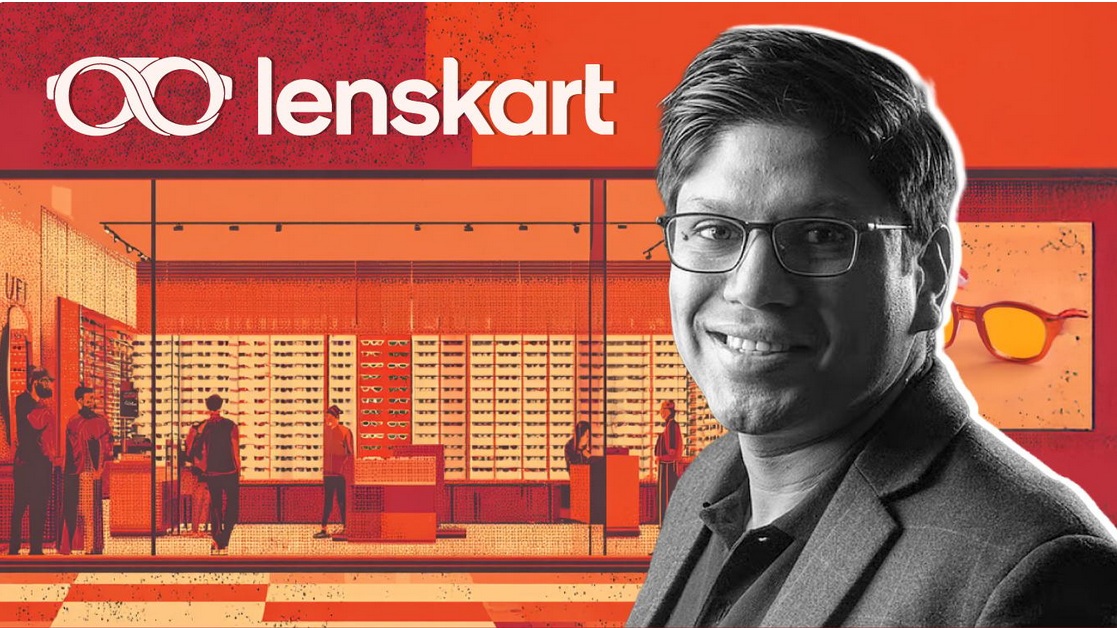
Gargi Sarkar, Inc42
7 December 2025
The past year has been nothing short of monumental for LensKart — from reporting another operationally profitable quarter in Q2 FY26 to making the public markets leap in November, and crossing a market capitalisation of INR 70,000 Cr despite a muted stock market debut.
A clear shift this year has been Lenskart’s effort to move beyond the image of a ‘basic D2C eyewear’ brand selling prescription glasses and sunglasses. The company is now working to reposition itself as a new-age tech brand.
Further, Lenskart is rethinking where and how its products are manufactured. Currently, around 20–25% of its frames are reportedly manufactured in India. The company is ramping up its domestic production. As a new manufacturing facility in Telangana is a work in progress, Lenskart intends to gradually shift most of its manufacturing operations from China to India.
In many ways, 2025 has been about scaling up for Lenskart, and as it embarks on a fresh journey as a publicly listed company, let’s take stock of the company in 2025 and where it might be headed in 2026.
Lenskart’s Smart Eyewear Bet
Lenskart began its smart eyewear journey last year with the launch of Phonic, its audio glasses. It later deepened its push into the segment by announcing a strategic investment in Ajna Lens, a Mumbai-based deeptech company that develops AI-powered XR glasses. Back then, Peyush Bansal described the move as the “next chapter” in Lenskart’s smart glasses journey.
Cut to December 2025, the company is all set to launch its AI camera smartglasses, B by Lenskart, by the end of this month.
What makes B by Lenskart noteworthy is that it isn’t being marketed as just another pair of smart glasses. The new eyewear features an integrated Sony camera that enables hands-free photo and video capture. The glasses come with a built-in AI assistant powered by Gemini 2.5 Live. They are designed to offer natural, conversational interactions and pack in a range of advanced features — from hands-free UPI payments and live translation to wellness insights and more.
What makes the move even more significant is Lenskart’s decision to open B by Lenskart to India’s developer ecosystem. By making its AI and camera technology accessible to consumer apps and independent developers, the company is enabling integrations across categories such as food delivery, entertainment, and fitness.
“By opening its AI smartglasses to third-party developers, Lenskart is moving from a one-time product-sale model to a platform ecosystem model. In the long run, this could unlock recurring revenue streams and higher margins,” said a product developer.
Besides, the company is aligning itself with a younger customer cohort, aided by affordability, style, and technology.
“That’s what seems to define their current strategy. Over time, they’ve also brought in elements of innovation like virtual try-ons, and any product, feature, or service that brings novelty and appeals to younger customers has become part of their brand approach,” said Devangshu Dutta, the founder of Third Eyesight.
Next, the timing couldn’t be better for Lenskart to place its bet on smart glasses. An IDC report reveals that despite a slowdown in smartwatch and earwear segments in the second half of 2025, smart glass shipments shot off more than 1,000% over the last year.

However, it’s not going to be smooth sailing from here.
At its core, Lenskart is still a consumer-facing company, and it needs new products to keep its revenue growing. But the competition is already heating up. Jio unveiled its own AI-powered smart glasses, Jio Frames, at Reliance Industries’ 48th annual general meeting. And of course, Meta continues to lead the global smart glasses market.
At this point, smart eyewear is a niche category, which comes with a hefty price tag.
“Unless cost drops dramatically, mass adoption is still a distant dream. As of now, the product will only attract early adopters and tech enthusiasts, rather than the mainstream consumer,” Dutta adds.
Lenskart’s Make In India Push
Lenskart is not only widening its product range but also ramping up its manufacturing. The company currently operates centralised manufacturing facilities in India (Bhiwadi in Rajasthan and Gurugram in Haryana), Singapore, and the UAE. It also has manufacturing operations in China.

Back home, Lenskart has also signed a non-binding MoU with the Government of Telangana for setting up a greenfield manufacturing facility for optical glasses. The proposed investment stands at INR 1,500 Cr and will be supported by certain incentives and assistance from the state government.
The new production facility is expected to strengthen Lenskart’s domestic manufacturing capabilities while reducing its exposure to foreign exchange fluctuations and import-related volatility.
However, the expansion comes with its own set of challenges. While the new manufacturing plant in Telangana is expected to strengthen Lenskart’s vertical integration, it will come with a hefty cost burden.
Profitability Still A Troubling Question
The cost structure is becoming increasingly important for Lenskart. Despite its headline-grabbing profitability, the company is still operating on fairly thin margins.

Lenskart reported a net profit of INR 297 Cr in FY25, a notable turnaround from a loss of INR 10 Cr in FY24. However, market analysts caution that the business’ core operations were unprofitable. It was largely “other income” or investment income that drove the FY25 bottom line.
“Though Lenskart has increased its revenue from INR 3,789 Cr in FY23 to INR 6,651 Cr in FY25, the company’s profitability has largely improved due to a rise in other income. While it reported a PAT of INR 297 Cr in FY25, a closer look shows that the profit was driven significantly by an increase in other income, which jumped to INR 356 Cr in FY25,” SimranJeet Singh Bhatia, senior research analyst for equity at Almondz Group.
The point of concern here is that Lenskart turned operationally profitable only after its market debut. Bhatia believes that at least three to four quarters of consecutive profitability will be needed to prove the company’s underlying strength.
However, making matters worse are the company’s climbing expenses, which stood at INR 1,980.3 Cr in Q2 FY26, up 18.5% YoY.
What Lies Ahead?
The year was equally sour for the eyewear major. While its IPO generated significant buzz and saw strong subscription levels, its market debut turned out to be a muted affair.
At the upper end of its INR 382 to INR 402 IPO price band, the public issue implied a price-to-earnings (P/E) multiple of roughly 235–238 times its FY25 profits, placing it among the most expensive consumer tech listings in India.
On its first day of trading, Lenskart Solutions Ltd. was listed on the NSE at INR 395 per share, a discount of 1.74% to the issue price of INR 402. The stock, however, fell close to 9% shortly thereafter. On the BSE, it debuted at INR 390, marking a discount of nearly 3%.
After the IPO, Bhatia adds, the biggest concern surrounding Lenskart is the store-level unit economics, particularly because a significant share of the IPO proceeds is being directed toward expanding its company-owned, company-operated store network.
Entering the new year as a public company, Lenskart will have to prove that its scale-up plans are justified and that it has greater control over its balance sheet. 2026 will be a critical juncture for the company, as the next three to four quarters will be closely watched for signs of sustainable growth, improved margins, and stronger operational discipline.
[Edited by Shishir Parasher]
(Published in Inc42)
admin
November 13, 2025

Saumyangi Yadav,Entrepreneur
Nov 13, 2025
India’s consumer landscape is undergoing a decisive shift in 2025. While D2C brands that once thrived on digital-only distribution are now aggressively building an offline footprint, legacy FMCG majors are simultaneously acquiring digital-first brands to strengthen their portfolios and tap into new consumer behaviours.
As analysts suggest, these trends signal a maturing phase for India’s D2C ecosystem, one that blends physical retail and strategic consolidation.
Offline Push Accelerates
According to a recent CBRE report, ‘India’s D2C Revolution: The New Retail Order’, D2C brands leased nearly 5.95 lakh sq ft of retail space between January and June 2025, accounting for 18 per cent of all retail leasing during this period, up sharply from 8 per cent in the first half of 2024. Fashion and apparel dominated the expansion, contributing close to 60 per cent of D2C leasing, followed by homeware and furnishings and jewellery at about 12 per cent each, while health and personal care brands accounted for roughly six per cent. The shift is equally visible in the choice of retail formats: 46 per cent of D2C leasing went to high streets, 40 per cent to malls, and the remaining to standalone stores, reflecting the category’s growing focus on visibility, trial and experiential discovery.
Experts suggest that it represents a strategic pivot to blended engagement.
As Devangshu Dutta, CEO of Third Eyesight, notes, “India’s D2C surge is powered by digital-first consumers, tremendous improvement in seamless logistics, and low-cost market entry, supported subsequently by substantial amounts of investor capital chasing those startups that stand out from the competition. Yet, lasting success demands a more holistic view: the divide between online and offline is a business construct, not a consumer reality. The larger chunk of retail sales still happens through physical channels and, for brands that want to be mainstream, an omnichannel presence is absolutely essential.”
This also aligns with the broader market outlook. The India Brand Equity Foundation (IBEF), in its Indian FMCG Industry Analysis (October 2025), estimates the value of India’s D2C market at USD 80 billion in 2024, with expectations of crossing USD 100 billion in 2025. Much of this growth is being led by categories that combine frequent purchase cycles with strong digital discovery, beauty, personal care, and food and beverage segments where consumers are open to experimentation but demand authenticity, transparency, and a compelling product narrative.
“The Gen Z and millennial consumer cohorts value newness but also authenticity and unique product stories, which are best communicated in spaces that are controlled by the brand,” Dutta added, “In the launch and growth phases, this could be the brand’s digital presence including website and social media, but over time this can include pop-up stores, kiosks, shop-in-shops and even exclusive brand stores.”
CBRE’s data reflects this shift clearly, with D2C brands increasingly opting for flexible store formats and high-street locations to maximise traffic and visibility.
M&A Gains Momentum
Parallel to the offline push is a noticeable wave of consolidation. Large FMCG companies are accelerating acquisitions to capture emerging consumer niches and strengthen their digital-native capabilities.
In recent years, Hindustan Unilever has acquired Minimalist; Marico has bought Beardo, Just Herbs, True Elements, and Plix; ITC has taken over Yoga Bar; and Emami has secured full ownership of The Man Company. These deals, reported widely across business media in 2024 and 2025, point to the need for established companies to fast-track entry into high-growth, ingredient-forward, and youth-focused categories without the lead time of in-house incubation.
“Legacy FMCG companies are acquiring D2C brands to rapidly gain access to new consumer segments, product innovation, and digital-native capabilities, including direct engagement and insights. Such deals enable large companies to diversify portfolios, accelerate entry into trending segments by-passing the initial launch risks, and rejuvenate their brands with modern digital marketing expertise,” Dutta explained.
Challenges and Risks
But the acquisitions do not come without risk and challenges, analysts warned.
“However, integrating D2C operations also poses challenges, including cultural differences, the risk of stifling entrepreneurial agility, and the need to harmonise data and omnichannel strategies. The ability to nurture acquired brands without diluting their distinctive appeal will determine acquisition success,” Dutta added.
Yet even as the ecosystem expands, challenges remain. Offline stores add operational complexity, inventory planning, staffing, last-mile logistics, and real-time data integration. Still, the bottom line is that India’s D2C sector is moving into a hybrid era defined by tighter omnichannel integration, sharper product storytelling, and portfolio realignment through acquisitions.
(Published in Entrepreneur)
admin
December 14, 2024

Sagar Malviya, Economic Times
Mumbai, 14 December 2024
Fast fashion was on a slow lane in the last fiscal year. Sales growth slowed for top retailers and fast fashion brands, show the latest regulatory filings of Marks & Spencer, Zara, H&M, Levi’s, Lifestyle, Uniqlo, Benetton and Celio. The bottom line too had taken a hit, with most brands posting lower profits in the fiscal year ended March 31. Sales growth of H&M and Zara fell from 40% in FY23 to 11% and 8% in FY24, show the filings with the Registrar of Companies. Levi’s growth slowed to 4% from 54% in FY23, while that of Uniqlo halved to 31% from 60%.
The current year is not looking good either, as sticky inflation and stagnant income weigh on consumer spending on discretionary products, say experts.
Devangshu Dutta, founder of retail consulting firm Third Eyesight, said the job market has been under pressure and slower income growth for urban consumer impacted demand, a trend likely to continue even during FY25.
“There is a visible slowdown led by the urban middle class who buy branded products. These brands have been targeting young upwardly mobile consumers, who are tightening the purse strings due to the current economic circumstances of hiring slack and fewer jobs,” said Dutta. “The situation is not hunky-dory at all, and this will continue over the next few quarters.”
Being the world’s most populous country, India is an attractive market for apparel brands, especially with youngsters increasingly embracing western-style clothing. But most international and premium brands have been competing for a relatively narrow slice of the population pie in large urban centres.
Over the past few years, top global apparel and fast fashion brands struck a strong chord with young customers, racking up sales growth of between 40% and 60% in FY23, bucking the trend in a market where the overall demand for discretionary products started slowing down. This has reversed now.
Consumers started reducing non-essential spending, such as on apparel, lifestyle products, electronics and dining out since early last year due to high inflation, increase in interest rates, job losses in sectors like startups and IT, and an overall slowdown in the economy.
According to the Retailers Association of India (RAI), sales growth in organised retail segments such as apparel, footwear, beauty and quick service restaurants halved to 9% last year and slowed further to about 5% in the first six months in the current fiscal year. This slowdown came after a surge in spending across segments-from clothes to cars-in the post-pandemic period, triggered by revenge shopping.

“The base post-pandemic was extremely high, and that kind of growth is not sustainable as there is nothing spectacular in economy to drive demand,” said Kumar Rajagopalan, chief executive officer at the RAI that represents organised retailers. “Our bet was on the festive and wedding season, but we will have to wait and watch until next year for the performance numbers,” he said.
(Published in Economic Times)
Devangshu Dutta
March 24, 2007
The idea that the “younger generation” is from another planet is age-old, and no different from the notion that “Men are from Mars, women are from Venus.”
However, there is certainly a fundamental cultural shift that is taking place at work that is a product of the social, political and economic changes of the last 20 years or so.
In India’s case, I call this Generation-C (C for Choice). The 20+ year olds or younger who are entering the workforce in India are ones who were born after the introduction of color television in India (1982), who have grown up with the explosion of media options, who have always seen multiple models of colorful cars running around on the roads. They’ve savored the fruits of liberalization during their childhood. Similar shifts were happening in China, having started a couple of years earlier — and Eastern Europe — and South Africa — and, of course, the US and Western Europe.
There is absolutely no doubt that these changes mean something to the attitude that this generation brings through the door, when they walk into work. Expectations of the young are always high; this generation’s seem even steeper.
Secondly – it sounds trite – technology has definitely had a significant impact in how truly fragmented we can be as an organization and yet be functional. Rigid attendance rules need apply no longer. Telecommuting is a reality, if not the norm.
However, however…these changes couldn’t happen without the previous generation@work loosening their shirt-collars and work-habits somewhat. That generation – the baby boomers and Gen-X in the case of the US, other labels in other countries – have challenged earlier norms, started the changes rolling, and Gen-Y is building on them.
“Plus c’est la meme chose, plus ça change.”
