
admin
December 15, 2025

By Saumyangi Yadav, Entrepreneur India
Dec 15, 2025
India’s D2C ecosystem has grown rapidly over the past five years, but scale remains elusive. While thousands of brands have launched and many have crossed early revenue milestones, only a small fraction manage to break past INR 100 crore in annual revenue. According to a new report by DSG Consumer Partners, based on a survey of over 100 Indian D2C founders and operators, the problem is not demand or product-market fit, it is how brands attempt to scale.
The report shows that around 60–65 per cent of Indian D2C brands remain stuck in the INR 1–50 crore revenue band, with very few reaching the INR 100 crore mark. This stage marks the point where early traction exists, but growth begins to strain unit economics, teams, and operating systems.
Insights from over 100 D2C founders reveal that India’s fastest-growing brands win on fundamentals rather than speed alone. Clear product-market fit, disciplined data tracking, strong unit economics, creative velocity, and an early focus on retention consistently separate scalable brands from those that plateau. Founders also admit that performance marketing mistakes, pricing missteps, and weak creative systems slow growth far more than budget constraints. In a booming D2C landscape, capability gaps in operations, brand-building, and supply-chain depth are widening the divide between breakout brands and those stuck in the performance plateau.
Industry observers argue that this is where many brands mistake rapid online growth for sustainable scale.
As Devangshu Dutta, Founder & CEO, Third Eyesight, explains, “Scaling up online can be very rapid, but is also capital-hungry in terms of CAC. Given the intense competition, the lack of customer stickiness and the power of platforms, there is a constant churn of marketing spend which is a huge bleed for growing brands.”
CAC Inflation is The Real Constraint
One of the clearest findings from the playbook is that acquisition efficiency, rising CAC and unstable ROAS, is the single biggest blocker to growth, cited by more founders than funding or category expansion. Moreover, over 70 per cent of brands rely on Meta as their primary acquisition channel, increasing vulnerability to auction pressure and platform-driven volatility.
Dutta links this directly to the limits of a digital-only mindset. “Limited offline expansion can trap brands in narrow urban digital markets, blocking broader scale,” he said.
This over-reliance on online performance marketing often leads to growth that looks strong on dashboards but weak on cash flow.
Highlighting their report, Pooja Shirali, Vice President, DSG Consumer Partners, said, “Across over 90 consumer brands we’ve partnered with at DSGCP, one truth is clear: brands that master Meta’s ecosystem don’t just grow, they change their entire trajectory through strategic clarity and disciplined execution. The real drivers of scale have less to do with viral moments, and everything to do with the long-term fundamentals that make milestones like the first INR 100 crore predictable, not accidental.”
Why Omnichannel is Unavoidable
The report suggests that brands that scale sustainably are those that reduce overdependence on paid digital acquisition and expand their distribution footprint. However, offline expansion brings its own complexity.
Dutta stresses that omnichannel is not an optional add-on, but a strategic shift. “D2C brands must adopt an omnichannel approach, blending online with offline retail for sustainable and scalable reach. Clearly the channels work very differently and management teams have to be prepared and capitalised for the long haul to tackle acquiring customers with channel-appropriate strategies,” he adds.
This aligns with the DSGCP report’s broader insight that scale breaks down when brands fail to adapt operating models as they grow.

Even within digital channels, performance weakens over time. The playbook finds that 62 per cent of founders report creative fatigue, where repeated creatives fail to sustain ROAS despite higher spends. At the same time, 55 per cent admit to under-investing in CRM and retention, with most brands reporting repeat purchase rates of just 10–30 per cent.
Both the data and expert opinion point to a common theme: brands that cross the INR 100 crore mark are structurally different. They obsess over unit economics, processes, and capital efficiency rather than topline growth alone.
As Dutta puts it, “Scalable brands that cross the growth hump have leadership obsessed with unit economics and omnichannel execution rather than chasing vanity metrics. Cash always was and is king, especially at early stages of growth.”
He adds that execution strength matters as much as strategy. “They are able to grow and steer teams that build and replicate processes fast rather than spending time, effort and money reinventing all the time, and do so without constant CXO intervention.”
As competition intensifies and capital becomes more selective, the next generation of INR 100 crore D2C brands is likely to be defined not by speed, but by the ability to compound cash flows, institutionalise processes, and scale distribution beyond digital platforms.
Saumyangi is a Senior Correspondent at Entrepreneur India with over three years of experience in journalism. She has reported on education, social, and civic issues, and currently covers the D2C and consumer brand space.
(Published in Entrepreneur India)
admin
December 10, 2025

Shabori Das, ET Bureau
Dec 10, 2025
India’s social media platforms are powerful marketing tools but not yet retail destinations. Billions scroll and swipe daily, but few buy directly within apps. Unlike China, India faces regulatory hurdles and a lack of integrated payment systems.
A billion Indians scroll, swipe and double tap every day, but barely buy. Despite Instagram and Facebook Marketplace being in India for over a decade, social media here remains a showroom, not a store. Creators and D2C brands are hustling to convert attention into action, but the holy grail of in-app shopping where discovery, live streaming, and purchase happen seamlessly, remains out of reach.
The question is, what’s stopping India from becoming the next China or the US in social commerce?
Influence-to-Commerce Gap
Globally, social commerce is powered by influencers. In China, influencer Li Jiaqi reportedly sold products worth $2 billion on Singles’ Day on Alibaba’s online marketplace Taobao Live in 2021. Another popular influencer Zheng Xiang Xiang, with over 5 million followers on Douyin (the Chinese equivalent of TikTok), reportedly generated $18 million in sales in a week in 2023. These are numbers India’s creator economy can only dream of, for now.
To be clear, influencer marketing in India is booming. EY estimates the sector at over Rs 3,000 crore and yet, due to regulatory restrictions, social media platforms in India can’t host end-to-end transactions. What India has is content commerce, driven by players like Meesho and Myntra, not social commerce. Globally, social commerce is a $1-trillion market. China alone accounts for over $500 billion and the US, $100 billion. India’s share? Around $10 billion — despite being home to the world’s largest Gen Z population and the second-largest base of internet users after China.
What’s Holding India Back
“Just as quick commerce changed how India buys food, social commerce will change how we shop for fashion and lifestyle,” says Anand Ramanathan, partner, consumer industry leader, Deloitte South Asia.
The idea is simple: Social commerce enables an end-to-end purchase journey within a social media app. But in India, the final sale still happens elsewhere — typically on e-commerce platforms.
“In China, live streaming contributes nearly 20% of total e-commerce revenue. In India, it hasn’t taken off,” says Puneet Sehgal, CEO of D2C apparel brand Freakins. He believes in-app checkout could be transformative. “Our Gen Z audience spends over an hour daily on social media. If the purchase could happen right there, it’s one step less for the consumer — and one step closer to a sale.”
The China Contrast
China’s social commerce revolution was built on three forces — speed, scale and seamlessness. Influencer Zheng, for instance, showcases each product for barely three seconds and moves on. That brevity, combined with integrated payments, drives impulse buying at staggering volumes.
India’s influencer-driven commerce, by contrast, is still warming up. Projected to touch $ 55 billion by 2030, it remains largely limited to discovery and advertising.
The barriers aren’t technological, they’re regulatory. India’s payment rules require clear accountability and settlement tracking, making it difficult for global platforms to enable in-app sales. Meta’s 2023 policy shift also directed purchases off-platform, keeping Instagram and Facebook Marketplace confined to discovery and promotion, rather than purchase. For now, social media in India remains a potent marketing engine, not yet a retail destination.
Experiments and Exceptions
Some Indian players are testing new waters. Myntra’s Glamstream, launched this July, lets influencers host live sessions where viewers can “shop the look” in real time — though the final checkout still redirects you to the Myntra app.
“India’s creator economy influences over $300 billion in annual consumer spending,” says Sunder Balasubramanian, chief marketing officer at Myntra.“That could grow to $1 trillion in the next few years, making India one of the fastest-growing creator economies globally,” adds Lakshminarayan Swaminathan, vice president-product management, Myntra.
The potential is clear. In 2021, Taobao Live hosted a 12-hour live streamed sale with influencer Li Jiaqi in China that clocked $2 billion in presales and attracted 250 million viewers.
Closer home, Sujata Biswas, co-founder of Suta Sarees, recalls Instagram’s shortlived Shop Now feature. “We saw an immediate dip in transactions after it was withdrawn,” she says. “Fashion is about instant gratification. You see it, you want it and buy it right away.”
The D2C Advantage
India’s D2C market, valued at $87 billion as of 2025 by Deloitte, could be the biggest gainer if social commerce does take off. Most D2C brands currently pay 25–35% retailer margins to platforms like Myntra and Nykaa. Social commerce could let them bypass intermediaries and sell directly to their audiences.
“Anything that reduces friction between intent and purchase is gold,” says Sehgal. “If that entire journey — from watching to buying — happens within the same app, conversion rates would shoot up.”
Even so, social platforms come with their own costs. TikTok, for instance, charges promotional, marketplace and fulfilment fees. But for Indian D2C players, the larger hurdle isn’t cost — it’s access.
Open vs Closed Ecosystems
“India’s retail market is far more open than China’s,” explains Devangshu Dutta, CEO of ThirdEyesight, a retail consulting firm. “In China, closed ecosystems like WeChat and Douyin created the perfect environment for social commerce to thrive. In India, where consumers can freely move between Google, Meta and e-commerce giants, those closed loops don’t exist.”
Globally, TikTok Shop, Douyin, WeChat, Pinduoduo, and Taobao Live dominate social commerce. According to Business of Apps, a data provider for the global app industry, TikTok earned $23 billion in 2024, with nearly 23% of it from in-app and commerce purchases.
If similar models are launched in India, e-commerce giants would face direct competition from the very platforms that fuel their traffic.
The Wait Continues
From beauty tutorials to thrift stores, social media spawns thriving micro economies. Yet, true social commerce — where discovery leads directly to purchase — hasn’t yet clicked.
The next big leap for India’s e-commerce may not come from deeper discounts or faster delivery but from social media itself. “The idea of instant gratification is key,” says Biswas. “When the ‘Shop Now’ button comes back, we’ll be the first to use it.”
Till then, India scrolls, likes, shares — and waits.
(Published in Economic Times)
admin
December 7, 2025
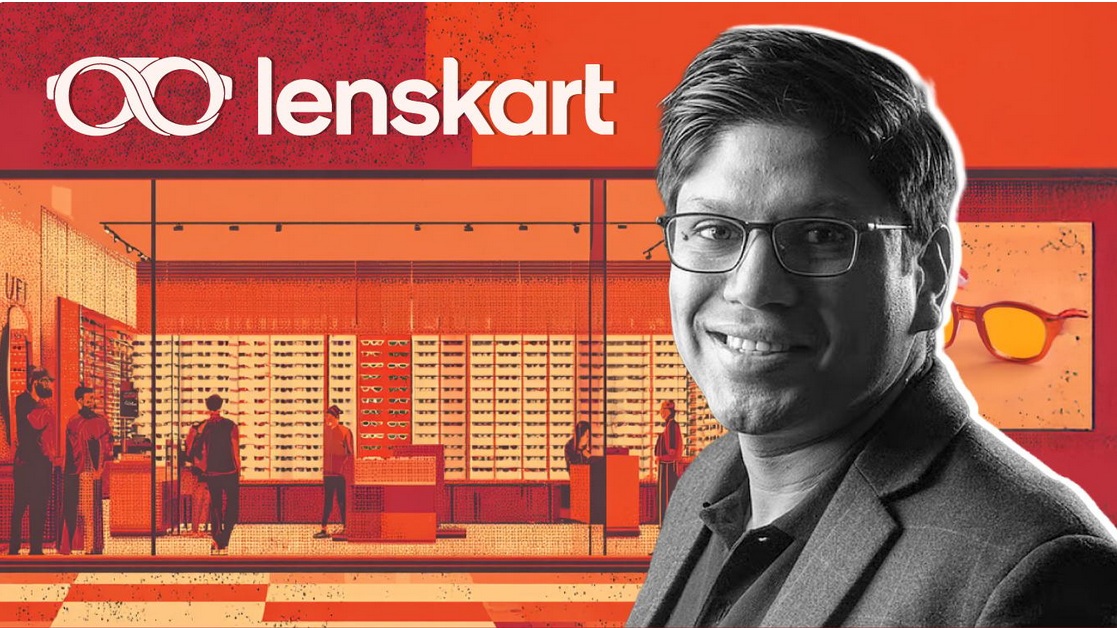
Gargi Sarkar, Inc42
7 December 2025
The past year has been nothing short of monumental for LensKart — from reporting another operationally profitable quarter in Q2 FY26 to making the public markets leap in November, and crossing a market capitalisation of INR 70,000 Cr despite a muted stock market debut.
A clear shift this year has been Lenskart’s effort to move beyond the image of a ‘basic D2C eyewear’ brand selling prescription glasses and sunglasses. The company is now working to reposition itself as a new-age tech brand.
Further, Lenskart is rethinking where and how its products are manufactured. Currently, around 20–25% of its frames are reportedly manufactured in India. The company is ramping up its domestic production. As a new manufacturing facility in Telangana is a work in progress, Lenskart intends to gradually shift most of its manufacturing operations from China to India.
In many ways, 2025 has been about scaling up for Lenskart, and as it embarks on a fresh journey as a publicly listed company, let’s take stock of the company in 2025 and where it might be headed in 2026.
Lenskart’s Smart Eyewear Bet
Lenskart began its smart eyewear journey last year with the launch of Phonic, its audio glasses. It later deepened its push into the segment by announcing a strategic investment in Ajna Lens, a Mumbai-based deeptech company that develops AI-powered XR glasses. Back then, Peyush Bansal described the move as the “next chapter” in Lenskart’s smart glasses journey.
Cut to December 2025, the company is all set to launch its AI camera smartglasses, B by Lenskart, by the end of this month.
What makes B by Lenskart noteworthy is that it isn’t being marketed as just another pair of smart glasses. The new eyewear features an integrated Sony camera that enables hands-free photo and video capture. The glasses come with a built-in AI assistant powered by Gemini 2.5 Live. They are designed to offer natural, conversational interactions and pack in a range of advanced features — from hands-free UPI payments and live translation to wellness insights and more.
What makes the move even more significant is Lenskart’s decision to open B by Lenskart to India’s developer ecosystem. By making its AI and camera technology accessible to consumer apps and independent developers, the company is enabling integrations across categories such as food delivery, entertainment, and fitness.
“By opening its AI smartglasses to third-party developers, Lenskart is moving from a one-time product-sale model to a platform ecosystem model. In the long run, this could unlock recurring revenue streams and higher margins,” said a product developer.
Besides, the company is aligning itself with a younger customer cohort, aided by affordability, style, and technology.
“That’s what seems to define their current strategy. Over time, they’ve also brought in elements of innovation like virtual try-ons, and any product, feature, or service that brings novelty and appeals to younger customers has become part of their brand approach,” said Devangshu Dutta, the founder of Third Eyesight.
Next, the timing couldn’t be better for Lenskart to place its bet on smart glasses. An IDC report reveals that despite a slowdown in smartwatch and earwear segments in the second half of 2025, smart glass shipments shot off more than 1,000% over the last year.

However, it’s not going to be smooth sailing from here.
At its core, Lenskart is still a consumer-facing company, and it needs new products to keep its revenue growing. But the competition is already heating up. Jio unveiled its own AI-powered smart glasses, Jio Frames, at Reliance Industries’ 48th annual general meeting. And of course, Meta continues to lead the global smart glasses market.
At this point, smart eyewear is a niche category, which comes with a hefty price tag.
“Unless cost drops dramatically, mass adoption is still a distant dream. As of now, the product will only attract early adopters and tech enthusiasts, rather than the mainstream consumer,” Dutta adds.
Lenskart’s Make In India Push
Lenskart is not only widening its product range but also ramping up its manufacturing. The company currently operates centralised manufacturing facilities in India (Bhiwadi in Rajasthan and Gurugram in Haryana), Singapore, and the UAE. It also has manufacturing operations in China.

Back home, Lenskart has also signed a non-binding MoU with the Government of Telangana for setting up a greenfield manufacturing facility for optical glasses. The proposed investment stands at INR 1,500 Cr and will be supported by certain incentives and assistance from the state government.
The new production facility is expected to strengthen Lenskart’s domestic manufacturing capabilities while reducing its exposure to foreign exchange fluctuations and import-related volatility.
However, the expansion comes with its own set of challenges. While the new manufacturing plant in Telangana is expected to strengthen Lenskart’s vertical integration, it will come with a hefty cost burden.
Profitability Still A Troubling Question
The cost structure is becoming increasingly important for Lenskart. Despite its headline-grabbing profitability, the company is still operating on fairly thin margins.

Lenskart reported a net profit of INR 297 Cr in FY25, a notable turnaround from a loss of INR 10 Cr in FY24. However, market analysts caution that the business’ core operations were unprofitable. It was largely “other income” or investment income that drove the FY25 bottom line.
“Though Lenskart has increased its revenue from INR 3,789 Cr in FY23 to INR 6,651 Cr in FY25, the company’s profitability has largely improved due to a rise in other income. While it reported a PAT of INR 297 Cr in FY25, a closer look shows that the profit was driven significantly by an increase in other income, which jumped to INR 356 Cr in FY25,” SimranJeet Singh Bhatia, senior research analyst for equity at Almondz Group.
The point of concern here is that Lenskart turned operationally profitable only after its market debut. Bhatia believes that at least three to four quarters of consecutive profitability will be needed to prove the company’s underlying strength.
However, making matters worse are the company’s climbing expenses, which stood at INR 1,980.3 Cr in Q2 FY26, up 18.5% YoY.
What Lies Ahead?
The year was equally sour for the eyewear major. While its IPO generated significant buzz and saw strong subscription levels, its market debut turned out to be a muted affair.
At the upper end of its INR 382 to INR 402 IPO price band, the public issue implied a price-to-earnings (P/E) multiple of roughly 235–238 times its FY25 profits, placing it among the most expensive consumer tech listings in India.
On its first day of trading, Lenskart Solutions Ltd. was listed on the NSE at INR 395 per share, a discount of 1.74% to the issue price of INR 402. The stock, however, fell close to 9% shortly thereafter. On the BSE, it debuted at INR 390, marking a discount of nearly 3%.
After the IPO, Bhatia adds, the biggest concern surrounding Lenskart is the store-level unit economics, particularly because a significant share of the IPO proceeds is being directed toward expanding its company-owned, company-operated store network.
Entering the new year as a public company, Lenskart will have to prove that its scale-up plans are justified and that it has greater control over its balance sheet. 2026 will be a critical juncture for the company, as the next three to four quarters will be closely watched for signs of sustainable growth, improved margins, and stronger operational discipline.
[Edited by Shishir Parasher]
(Published in Inc42)
admin
November 13, 2025

Saumyangi Yadav,Entrepreneur
Nov 13, 2025
India’s consumer landscape is undergoing a decisive shift in 2025. While D2C brands that once thrived on digital-only distribution are now aggressively building an offline footprint, legacy FMCG majors are simultaneously acquiring digital-first brands to strengthen their portfolios and tap into new consumer behaviours.
As analysts suggest, these trends signal a maturing phase for India’s D2C ecosystem, one that blends physical retail and strategic consolidation.
Offline Push Accelerates
According to a recent CBRE report, ‘India’s D2C Revolution: The New Retail Order’, D2C brands leased nearly 5.95 lakh sq ft of retail space between January and June 2025, accounting for 18 per cent of all retail leasing during this period, up sharply from 8 per cent in the first half of 2024. Fashion and apparel dominated the expansion, contributing close to 60 per cent of D2C leasing, followed by homeware and furnishings and jewellery at about 12 per cent each, while health and personal care brands accounted for roughly six per cent. The shift is equally visible in the choice of retail formats: 46 per cent of D2C leasing went to high streets, 40 per cent to malls, and the remaining to standalone stores, reflecting the category’s growing focus on visibility, trial and experiential discovery.
Experts suggest that it represents a strategic pivot to blended engagement.
As Devangshu Dutta, CEO of Third Eyesight, notes, “India’s D2C surge is powered by digital-first consumers, tremendous improvement in seamless logistics, and low-cost market entry, supported subsequently by substantial amounts of investor capital chasing those startups that stand out from the competition. Yet, lasting success demands a more holistic view: the divide between online and offline is a business construct, not a consumer reality. The larger chunk of retail sales still happens through physical channels and, for brands that want to be mainstream, an omnichannel presence is absolutely essential.”
This also aligns with the broader market outlook. The India Brand Equity Foundation (IBEF), in its Indian FMCG Industry Analysis (October 2025), estimates the value of India’s D2C market at USD 80 billion in 2024, with expectations of crossing USD 100 billion in 2025. Much of this growth is being led by categories that combine frequent purchase cycles with strong digital discovery, beauty, personal care, and food and beverage segments where consumers are open to experimentation but demand authenticity, transparency, and a compelling product narrative.
“The Gen Z and millennial consumer cohorts value newness but also authenticity and unique product stories, which are best communicated in spaces that are controlled by the brand,” Dutta added, “In the launch and growth phases, this could be the brand’s digital presence including website and social media, but over time this can include pop-up stores, kiosks, shop-in-shops and even exclusive brand stores.”
CBRE’s data reflects this shift clearly, with D2C brands increasingly opting for flexible store formats and high-street locations to maximise traffic and visibility.
M&A Gains Momentum
Parallel to the offline push is a noticeable wave of consolidation. Large FMCG companies are accelerating acquisitions to capture emerging consumer niches and strengthen their digital-native capabilities.
In recent years, Hindustan Unilever has acquired Minimalist; Marico has bought Beardo, Just Herbs, True Elements, and Plix; ITC has taken over Yoga Bar; and Emami has secured full ownership of The Man Company. These deals, reported widely across business media in 2024 and 2025, point to the need for established companies to fast-track entry into high-growth, ingredient-forward, and youth-focused categories without the lead time of in-house incubation.
“Legacy FMCG companies are acquiring D2C brands to rapidly gain access to new consumer segments, product innovation, and digital-native capabilities, including direct engagement and insights. Such deals enable large companies to diversify portfolios, accelerate entry into trending segments by-passing the initial launch risks, and rejuvenate their brands with modern digital marketing expertise,” Dutta explained.
Challenges and Risks
But the acquisitions do not come without risk and challenges, analysts warned.
“However, integrating D2C operations also poses challenges, including cultural differences, the risk of stifling entrepreneurial agility, and the need to harmonise data and omnichannel strategies. The ability to nurture acquired brands without diluting their distinctive appeal will determine acquisition success,” Dutta added.
Yet even as the ecosystem expands, challenges remain. Offline stores add operational complexity, inventory planning, staffing, last-mile logistics, and real-time data integration. Still, the bottom line is that India’s D2C sector is moving into a hybrid era defined by tighter omnichannel integration, sharper product storytelling, and portfolio realignment through acquisitions.
(Published in Entrepreneur)
admin
October 10, 2025

Pooja Yadav, Exchange4Media
10 October 2025
Over the years, India’s e-commerce market has been dominated by the duopoly of Amazon and Flipkart. These platforms have not only captured consumer attention but also shaped how brands spend their marketing budgets. In parallel to this, the concept of retail media networks (RMNs), marketplaces selling ad placements to brands directly, has also grown rapidly. Not only this, it is emerging as one of the fastest-growing channels in digital advertising.
As a result, the industry is witnessing a wave of new retail media platforms entering the market. From grocery and pharmacy marketplaces to Q-comm platforms, D2C marketplaces, and ONDC pilots, all are attempting to carve out space for themselves. Yet despite these new entrants, Amazon and Flipkart continue to command the lion’s share of shopper-marketing rupees, leaving little oxygen, even for challenger players like eBay, even as it retools its India strategy.
Retail media is now outpacing social and video in growth, and in India, this expansion remains concentrated around these two dominant players. According to several experts e4m spoke with, Amazon and Flipkart dominate because of their massive logged-in traffic at the point of purchase, first-party data, and closed-loop attribution linking impressions directly to GMV. These platforms succeed by combining large logged-in audiences, direct attribution from impressions to sales, and first-party data insulated from signal loss-advantages most challengers cannot match.
Adding to this, Shradha Agarwal, Co-Founder & CEO of Grapes, highlighted the key hurdles brands face when allocating budgets to newer networks like ONDC or eBay. She noted that brands consider three main factors: whether the network can deliver the same sales efficiency, whether it reaches new users or just shoppers already accessible on Amazon, and whether the scale is meaningful. Quoting an example, she said if a brand is already generating 10 crore on Amazon, it may question whether investing in a new platform that delivers only 25 lakh is worth the effort.
Vaibhav Jain, Head of Media at First Economy, pointed out, the biggest barriers to scaling budgets across newer retail media networks like eBay or ONDC or any other, are fragmented infrastructure, limited data maturity, and inconsistent measurement. Many platforms still lack robust first-party data systems and unified reporting standards, making it difficult for brands to validate ROI at the level provided by Amazon or Flipkart.
Everyone’s building a network – but is there room?
Despite the dominance of Amazon and Flipkart, the retail media landscape is attracting new entrants, including grocery and pharmacy marketplaces, Q-commerce platforms, D2C marketplaces, and ONDC pilots, all attempting to carve out space for themselves. Among these challengers, eBay has recently re-entered India with a markedly different approach focussing on building technical and export-led capabilities rather than competing directly in the domestic consumer market.
Against this backdrop, eBay has reopened its India chapter with a Global Capability Centre (GCC) in Bengaluru, planning to host over 300 engineers across AI/ML, product, design, and data analytics. Unlike its previous consumer-facing stints in 2005 and 2013, this pivot is capability and export-led, not a direct battle with domestic marketplaces. Globally, eBay earns revenue through Promoted Listings and other advertising products, but in India, it has historically lacked domestic shopper scale and first-party data, the two critical ingredients that make retail media profitable.
This time, eBay appears to be betting on cross-border trade, technology-led capabilities, and potentially new ad-tech opportunities a model that could differentiate it from established players like Amazon and Flipkart.
Speaking on this, Lloyd Mathias, business strategist and angel investor, said, “Retail media takes off only when you have a large front-end site like Amazon or Flipkart, where advertisers want to reach shoppers at the point of purchase. I don’t think retail media is going to be a big revenue driver for eBay at all.”
Adding to this, seasoned e-commerce analyst and Datum Intelligence advisor Satish Meena noted, “Retail-media economics depend on domestic shopper traffic and first-party data both of which eBay currently lacks in India. The realistic play is export-facing promotions, enabling Indian sellers to advertise SKUs to international buyers on eBay’s global sites. That’s valuable but niche, and unlikely to rival Flipkart or Amazon’s India-scale retail-media businesses.”
Devangshu Dutta of Third Eyesight stated, “On the trade front, the company appears to be prioritising exports from India rather than competing in the domestic market, which is already hypercompetitive and price-driven.”
Until eBay establishes a stronger consumer-facing presence, retail media will not be a priority, as per experts. In the near term, its strategy is likely to focus on export-facing ads, promoting Indian sellers to global buyers. Looks like this approach is unlikely to challenge Amazon or Flipkart in India.
What it would take to break the duopoly
While eBay’s strategy has been called smart, opportunities remain. Harish Bijoor, Founder, Harish Bijoor Consults Inc, noted that communication formats are evolving. with peer-to-peer engagement gaining reliability over top-down approaches. Amazon and Flipkart follow top-down models, whereas eBay could differentiate itself through 1:1 consumer interaction.
After two failed attempts at cracking India’s consumer market, eBay’s third innings (as some may call) is fundamentally different. It is no longer chasing domestic consumers but enabling Indian sellers to export globally, leveraging eBay’s global logistics, trust programs, and buyer base. The company is also partnering with government export initiatives, MSME councils, and logistics providers, while buildin technical, analytic, and product capabilities through the Bengaluru GCC.
Mandar Lande, co-founder of Waayu, a platform working with ONDC and MSMEs to enable digital commerce, said that eBay is unlikely to build a traditional retail media business in India without a large consumer marketplace. “eBay lacks the first-party shopper data and traffic scale that power retail media networks like Amazon Ads or Flipkart Ads. However, it could still build a niche ad-tech play focused on export sellers, cross-border insights, and global buyer intent analytics essentially an “export intelligence and seller marketing’ platform rather than a domestic retail media business. While it won’t rival Amazon Ads in India, it can carve out a high-value B2B media niche rooted in cross-border commerce rather than local eyeballs.”
For challenger brands like eBay aiming to break into India’s retail media landscape, success will depend on proving incremental sales rather than just impressions, offering unique audiences, maintaining pricing flexibility, and providing ease of buying through self-serve tools and standardised metrics.
Experts told eam that while retail media and ad-tech may not be immediate revenue drivers, eBay’s export-first strategy allows the company to build scale, technology, and credibility, setting the stage for potential consumer-facing or advertising initiatives in the future.
Jain mentioned, “Closed-loop measurement is central to shifting brand spend beyond Amazon and Flipkart. It offers verifiable proof of performance, linking ad exposure directly to sales. Challenger retail media networks that can deliver credible attribution and comparable ROAs will gain traction faster. Measurement sophistication isn’t just an advantage; it’s the entry ticket to serious brand consideration.”
Speaking about how self-serve tools, standardised metrics, and competitive CPC/CPM rates influence a brand’s willingness to experiment with challenger retail media networks, Jain told e4m that these elements are critical for encouraging experimentation. They simplify campaign management, enable agility, and allow brands to benchmark performance fairly against established players.
From a brand execution perspective, Agarwal emphasised that the availability of self-serve tools is crucial for experimentation. Advertising on commerce platforms was previously cumbersome, but self-serve options now allow brands to launch campaigns at any budget, large or small, providing flexibility and control. When pricing is competitive and reporting is standardised, brands are more willing to test new networks. Early experiments have shown that allocating even a portion of retail media budgets to challenger platforms can deliver meaningful incremental sales, although such cases remain limited.
Reality check for 2025 plans
Brands in India are increasingly looking to diversify their retail media spend and reduce costs, but in a market dominated by Amazon and Flipkart, certainty still drives allocation decisions. Amazon Ads India revenue surged to 8,342 crore in FY25, a 25% year-on-year increase, while Flipkart Ads has grown 600% since 2020, capturing a significant share of marketplace marketing budgets. Until challengers can match these giants on shopper intent, identity, and attribution, most retail media budgets will remain top-heavy.
While many new entrants are trying to add variety at the edges by offering niche audiences, alternative ad formats, and export-focussed solutions, However, breaking into the core of India’s retail media market requires domestic scale, robust attribution frameworks, and access to unique audiences that cannot be replicated elsewhere.
Experts point to several structural barriers for newer networks. Fragmented infrastructure, limited first-party data, and inconsistent measurement make it difficult for brands to validate ROI at the level provided by Amazon or Flipkart.
(Published in Exchange4media)
