
admin
February 11, 2026

Vaeshnavi Kasthuril, Mint
Bengaluru, 11 February 2026
Sales of winter wear were underwhelming for the second year in a row as an unusually delayed and milder winter disrupted demand for heavy winter wear, particularly in north and west India, executives at two of India’s top clothing retailers said. Initial optimism for a bumper season this year compounded the disappointment for retailers.
While early signs of a La Niña—a weather pattern typically known for bringing freezing temperatures to India—triggered some early buying in the previous quarter, the season remained unusually mild, leaving stores with a surplus of winter clothing. Excess rainfall and cyclonic activity during the festive period in parts of eastern and southern India further weighed on seasonal buying, compounding the pressure on winter sales which are typically front-loaded.
This slump is particularly painful because winter sales are the industry’s largest annual driver. These months coincide with India’s massive wedding season, when spending peaks. Together, they account for roughly 20% of total yearly revenue for apparel companies, according to industry estimates. India’s apparel market was estimated to be worth more than ₹1.9 trillion in FY25, of which 41% was organised, credit ratings firm CareEdge said in January 2026.
V-Mart: margin over volume
Lalit Agarwal, managing director of V-Mart Retail, said, “Northern India saw a delayed or milder winter initially, leading to dispersed demand for heavy winter wear. Winter demand was definitely delayed a little bit—it didn’t get lost, but it was erratic.” He added that while festive demand held up, “demand visibility was uncertain, particularly in winter-led categories, and we consciously chose to protect margins rather than chase volumes.”
V-Mart’s revenue grew a little over 10% year-on-year to ₹1,126.4 crore in Q3 from ₹1,023.7 crore a year earlier and ₹889.05 crore in the third quarter of FY24, but this growth was largely driven by wedding and festive-season clothing, executives at the company said.
Anand Agarwal, chief financial officer of V-Mart Retail, said despite forecasts of a strong, early winter, “peak winters were delayed across North and West India, leading to a lull post-Diwali.” He added, “While the festive period went off reasonably well, winter demand did not pan out as anticipated,” attributing the softer sales to fewer peak winter days and unusually warmer temperatures.
Despite the delayed demand, the company managed to avoid a build-up of unsold inventory during the quarter. “Inventory health remained strong despite the delayed winter, and in some categories we were even short of inventory,” said Anand Agarwal, indicating that the eventual dip in temperatures led to a sudden pick-up in demand in select winter categories rather than excess stock.
Winter-led assortments continue to account for a sizeable share of the company’s quarterly sales, underscoring its sensitivity to weather patterns. “Winter and pre-winter categories accounted for about 40-45% of the overall mix during the quarter, and this share rose to over 60% during peak winter weeks in December,” said Agarwal during the third-quarter earnings call. The higher share of winter wear sales during peak weeks helped cushion margins, even as volumes remained below expectations. Lalit Agarwal said the company refrained from aggressive discounting amid uncertain demand. “Higher full-price sell-through during the winter quarter supported margins, as we did not undertake aggressive discounting,” he said.
Vishal Mega Mart: the late recovery
Gunender Kapur, managing director and chief executive officer of rival Vishal Mega Mart, said delayed winters usually force retailers to push promotions to ensure that they don’t carry forward all that merchandise, because the next opportunity to sell it would be the following year.
Despite this, the company’s performance held up, he said, highlighting that winter sales achieved robust double-digit same-store growth for the entire season and the full quarter, effectively overcoming the sluggish demand during December. Kapur noted that demand for winter clothing increased significantly in January, adding, “Winter merchandise is still selling well, both in our stores and in other stores, we believe.”
Vishal Mega Mart reported revenue growth of about 17% to ₹3,670.3 crore in Q3 FY26 from ₹3,135.9 crore in Q3 FY25 and ₹2,623.5 crore in Q3 FY24, largely on the back of wedding and festive-season demand.
Kapur said the company was unsure whether there would be significant unsold winter merchandise at the end of the season, adding that maintaining pricing discipline helped protect profit margins. “Merchandise that sells in December typically fetches a higher price than January merchandise for winter because sales often begin by late December or early January,” he said. “In our case, there was no problem. We achieved same-store sales growth of over 10%, even with the winter merchandise we purchased for the autumn-winter season.”
V2 Retail: the outlier
In contrast, V2 Retail recorded strong performance in the third quarter, largely driven by winter wear. Revenue surged nearly 60% year-on-year to ₹929.2 crore in Q3 from ₹590.9 crore a year earlier. This is perhaps because V-Mart and Vishal Mega Mart are more concentrated in north and central India, where winter demand was more uneven this season, while V2 has a stronger presence in eastern and north-eastern markets, including Bihar, Jharkhand, Odisha and Assam.
Managing director Akash Agarwal said the early onset of winter led to a “very good season” for the company. He noted that winter garments typically command a much higher average selling price (ASP) than summer products, which resulted in a visible bump in average bill value during the third quarter, led by higher sales of jackets and sweaters. Agarwal said this high-ASP, high-margin category accounted for the bulk of Q3 sales and was a key driver of the company’s same-store sales growth.
A worsening problem?
Two straight years of sluggish sales because of erratic winters highlight broader challenges around climate change for apparel retailers, which peg their inventory based on weather patterns and demand.
“Seasons have always been inherently unpredictable, and retailers have never been able to forecast with certainty how cold or warm a winter will be or how long it will last,” said Devangshu Dutta, founder of Third Eyesight, a consulting firm. However, he said that the challenge has intensified over the past 15-20 years as apparel businesses have scaled up and expanded their store footprints nationwide, stretching product development and supply chains over several months.
“No matter how hard you work on the plan, your forecast will always be wrong. You will either overshoot or undershoot,” Dutta said, adding that this leaves retailers grappling with either shortages or excess stock. Winterwear, he said, is particularly vulnerable because it has a higher value per unit, a much shorter selling window, and a smaller market, factors which together create a “humongous problem” for retailers.
Data from a World Meteorological Organisation report published on 16 January showed that 2025 was among the three warmest years on record worldwide, continuing a decade-long streak of exceptional heat despite the cooling La Niña phase. This is a clear sign that background warming from greenhouse gases is overwhelming natural variability, the report said. It suggested that climate change will intensify seasonal shifts and extreme weather in the years and decades ahead, making industries tied to seasonal patterns, such as winter apparel, increasingly vulnerable to unpredictable weather swings and weaker cold spells.
(Published in Mint)
admin
November 27, 2025
Viveat Susan Pinto, Financial Express
November 27, 2025
Several of the country’s top retailers, malls and brands have kicked off a shopping extravaganza on the occasion of Black Friday, offering steep discounts across product categories.
A Western import, the day which symbolises the beginning of the Christmas shopping season in the US, the UK and Europe, gained popularity in India over the past two years as a crucial sale window after Diwali.
Domestic retailers, say experts, are using this period to exhaust existing inventory at steep discounts as they gear up for the winter season.
This year, discounts are up to 60-80% across fashion, lifestyle, electronics and cosmetics, higher than the 50% seen last year. E-tailers such as Ajio have pushed the pedal even harder, offering as much as 85-90% on denims, jackets and select products during the sale this year.
Bigger Deals, Longer Duration
“Retailers in India are building Black Friday as an important off-season peak. The participation of brands is growing, deals are getting bigger and the sale days are more,” Devangshu Dutta, founder and chief executive of Third Eyesight, a Gurugram-based retail consultancy, said. That is visible from the intense promotional activity this year. What began as a flash sale event a couple of years ago has now extended to a week-long sale period this year, experts said.
Pushpa Bector, senior executive director and business head, DLF Retail, said that brands this year are ready with strong offers, driven in part by GST cuts and a stable economic outlook. “Early trends show healthy interest across categories by consumers. We expect a strong double-digit uplift over the Black Friday period, setting us up for a strong close to the year,” she said.
Retailer Strategies
While Black Friday typically falls on the last Friday of November, some retailers such as Flipkart, Croma, Vijay Sales, Nykaa and Tata Cliq have kicked off their Black Friday sales last week itself to build on the excitement. For electronic retailers, said Nilesh Gupta, director, Vijay Sales, Black Friday will extend into Cyber Monday next week (falling on December 1), making it even more relevant for them to focus on the occasion.
“We’ve been building Black Friday as a retail property in the last few of years as it fills the post-Diwali void quite well. Black Friday also extends well into Cyber Monday which comes immediately after. While we started with a few categories in the initial years, we now have offers across all our segments. Discounts are up to 45-50% this year in line with last year,” he said.
Rival Croma is also offering up to 50% discount on products this year, executives said.
“Black Friday has become one of India’s most anticipated shopping moments. At Croma, we are focused on delivering value across categories with steal deals, bundled savings, and limited-time offers,” Croma’s CEO & MD Shibashish Roy said.
Croma will also introduce a special late-night shopping window on November 28 at select stores across India. For two hours—from 10 pm to 11:59 pm —these stores will remain open with exclusive additional discounts on some of the season’s most in-demand products.
Nishank Joshi, chief marketing officer, Nexus Select Malls, said it is elevating the Black Friday experience with bigger assured gifts, giveaways and reward points if consumers upload their bills on their Nexus One apps.
Mayank Lalpuria, director, marketing (north, central & west) at Phoenix Mills, which operates Phoenix malls, said that it was expecting double-digit year-on-year growth and strong footfalls during the Black Friday period.
Tanu Prasad, CEO – Malls, Oberoi Realty, said that the firm was seeing far more planned purchases towards premium products and a rise in family-oriented outings. “We are anticipating an encouraging response at the (Black Friday) weekend resulting in a strong kick-off to the (December) shopping season,” Prasad said.
Direct-to-consumer brands such as Inc.5 footwear and NEWME said that they have rolled out big deals for Black Friday. “We’re looking at a 30x surge in orders across both offline and online for Black Friday,” NEWME Co-founder & CEO Sumit Jasoria said.
“Our customers look forward to Black Friday, and this year, we’re excited to bring fresh new launches, curated edits, and our widest range yet,” Rajesh Kadam, CEO, Inc.5 Footwear, said.
(Published in Financial Express)
admin
November 4, 2025
Yash Bhatia, IMPACT
4 November 2025
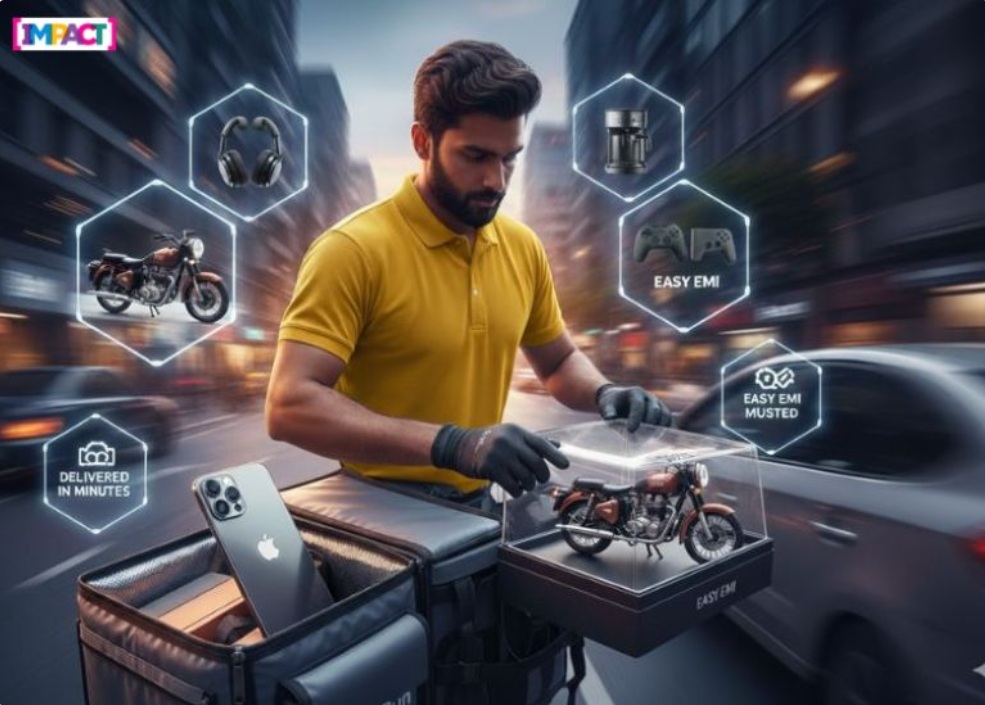
It started with groceries. Quick commerce started delivering milk, bread, and eggs in 10–15 minutes, which seemed revolutionary enough in 2022. Then came the iPhone 14 launch, and suddenly, quick commerce wasn’t just about convenience; it was about spectacle. Overnight, India’s app-based delivery ecosystem became the stage for a new ritual: flagship products arriving at your doorstep faster than you can say ‘checkout.’
And now? Phones aren’t the limit. You can even order motorcycles online. Yes, motorcycles. Royal Enfield has partnered with Flipkart to list its entire 350cc portfolio, which will be delivered to five cities: Bengaluru, Gurugram, Kolkata, Lucknow, and Mumbai.
The lines between e-commerce and quick commerce are becoming increasingly blurred. Flipkart’s Flipkart Minutes and Amazon’s instant delivery options are proof that speed is no longer a differentiator; it’s table stakes. And as platforms race to expand, high-ticket items are joining the frenzy, from electronics and furniture to watches, fitness equipment, and premium kitchen appliances. For platforms, these products are goldmines of margin; the challenge lies in logistics and consumer trust.
According to a report by CareEdge Advisory, India had over 270 million online shoppers in 2024, making it the second-largest e-retail user base globally, while the e-commerce market grew 23.8% in 2024 over the year-ago period, it said. The report also added that Indians ordered Rs 64,000 crore of goods from quick-commerce platforms.
From the consumer standpoint, one of the challenges for consumers to buy high-ticket items from the quick commerce platforms is to get consumer trust, which used to be the case when e-commerce started its operations. Can quick commerce move to high-ticket items? Is quick commerce looking at these items as a branding exercise, or are they looking at them as a serious revenue stream channel?
Chirag Taneja, Founder & CEO, GoKwik – an e-commerce enablement platform, says what began as a branding exercise for D2C brands has now evolved into a credible revenue stream. “In the early days, high-ticket categories on D2C platforms saw limited traction,” he explains. “Trust was still being built, customers were unsure if their orders would even reach them. There were many friction points.”
But that’s no longer the case. According to GoKwik’s network data, high-ticket purchases (above ₹2,500) are no longer outliers, they’re becoming a consistent driver of topline revenue.
Interestingly, most of these premium purchases are powered by credit instruments from no-cost EMIs to instant credit options at checkout. “This reflects a clear shift in mindset,” says Taneja. “Consumers no longer view high-value spending as a financial strain. They see it as a set of manageable, bite-sized payments that help them aspire higher, quicker. It’s not just a financial enabler, it’s a psychological unlock that makes premium consumption feel accessible and routine,” he adds.
“With strong trust in delivery reliability, smooth returns, and credible brand backing, the ecosystem has bridged the gap that once kept premium shopping offline,” says Taneja.
Devangshu Dutta, Founder of a specialist consulting firm, Third Eyesight, thinks differently and points out that high-value items still make up a small slice of quick commerce sales. “The model thrives on simplicity, a limited product range on the platform’s end, and quick, low-friction decision-making on the consumer’s,” he explains.
That said, Dutta believes quick commerce can still play a strategic role for premium brands. “For high-value products, q-comm can be an excellent lever for driving velocity, testing market response, or amplifying brand visibility. But it should be viewed as one piece of the channel mix, not the primary sales driver.”
From the platform’s perspective, however, listing high-ticket products brings its own upside. “They create excitement, boost average transaction values, and improve realised margins,” Dutta notes. “Consumers are often drawn in by novelty, exclusivity, or status appeal, especially during big launches or limited-time promotions.”
Still, he adds a note of realism: “Premium and high-ticket purchases largely remain planned decisions. Most consumers continue to prefer established offline and e-commerce channels for such buys where trust in authenticity, return policies, and after-sales services still carry greater weight than instant gratification.”
Seshu Kumar Tirumala, Chief Buying and Merchandising Officer, BigBasket, says the company doesn’t look at electronics as a high-ticket item category but rather focuses on building a complete category experience for customers. “For example, if we list an Enfield bike, we’d also want to offer spare parts, servicing options, and extended warranties, because that’s how the category functions,” he explains.
Tirumala adds that BigBasket adopted the same approach when it ventured into mobiles and mobile accessories. “When we launched this category last year, it was a trial. Today, it’s a sizable part of our business,” he says. Currently, electronics and mobile accessories contribute 5–10% of BigBasket’s monthly sales, having grown 250–300% year-on-year since the first iPhone launch on the platform.
While the launch day drives the highest demand for flagship devices like the iPhone, Tirumala notes that the following one to two months see strong accessory sales, from AirPods and headphones to chargers and power banks. “On average, mobiles and accessories account for 7–8% of our total sales, peaking at 10% during the festive season. Overall, this category has grown from zero to 7–8% of our total business in just a year, and we expect it to reach around 25% next year,” he adds.
Currently, the platform offers select models from smartphone brands, including OnePlus, Realme, Redmi, Vivo, and Oppo.
The Bengaluru-based platform is now piloting the delivery of large home appliances across across select city areas in partnership with Croma. If successful, BigBasket plans to expand this model to other cities, further broadening its quick commerce offering beyond everyday essentials.
Taneja points out that the traditional e-commerce model, once driven by discounts and affordability, is now evolving toward experience and access. Over the next few years, two major shifts will shape this transformation: credit-first commerce, where EMIs become the default mode for premium purchases, and aspirational commerce, where consumers view e-commerce as the easiest path to lifestyle upgrades. Consequently, platforms will need to reposition themselves from being “where you save more” to “where you unlock more”, prioritising personalisation, trust, and a seamless shopping experience.
As quick commerce matures, it is no longer just about instant gratification; it’s becoming a bridge between aspiration and accessibility.
Platforms are proving that speed, trust, and seamless experience can coexist with high-value purchases.
(Published in IMPACT)
Devangshu Dutta
December 17, 2019
Remember the year 2000? After Y2K passed safely, that year some optimistic analysts predicted that India’s modern retail chains would reach 20 per cent market share by 2015. Two years after that supposed watershed, another firm declared that modern retail will be at around that level in 2020 – but wait! – only in the top 9 cities in the country. Don’t hold your breath: India surprises; constantly. As many have noted, “predictions are tough, especially about the future!” What we can do is reflect on some of this year’s developments that could play out over the coming year.
In many minds 2019 may be the Year of the Recession, plagued by discounting, but that demand slowdown has brewing for some time now. However, there’s another under-appreciated factor that has been playing out: while small, independent retailers can flex their business investments with variations in demand, modern retail chains need to spread the business throughout the year in order to meet fixed expenses and to manage margins more consistently.
To reduce dependence on festive demand, retailers like Big Bazaar and Reliance have been inventing shopping events like Sabse Sasta Din (Cheapest Day), Sabse Sachi Sale (Most Authentic Sale), Republic Day / 3-Day sale, Independence Day shopping and more for the last few years. In ecommerce, there’s the Amazon’s Freedom Sale, Prime Day, and Great India Festival, and Flipkart’s Big Billion Day Sale. This year retailers and brands went overboard with Black Friday sale, a shopping-event concept from the 1950s in the USA linked to a harvest celebration marked by European colonisers of North America. (The fact that Black Friday has a totally different connotation in India since the terrorist bombings in Bombay in 1993 seems to have completely escaped the attention of brands, retailers and advertising agencies.) Be that as it may, we can only expect more such invented and imported events to pepper the retail calendar, to drive footfall and sales. The consumer has been successfully converted to a value-seeking man-eater fed on a diet of deals and discounts. With no big-bang economic stimuli domestically and a sputtering global economy, we should just get used to the idea of not fireworks but slow-burning oil lamps and sprinklings of flowers and colour through the year. Retailers will just have to work that much harder to keep the lamps from sputtering.
Ecommerce companies have been in operating for 20 years now, but the Indian consumer still mostly prefers a hands-on experience. The lack of trust is a huge factor, built on the back of inconsistency of products and services. The one segment that has been receiving a lot of love, attention and money this year (and will grow in 2020) is food and grocery, since it is the largest chunk of the consumption basket. Beyond the incumbents – Grofers, Big Basket, MilkBasket and the likes – now Walmart-Flipkart and Amazon are going hard at it, and Reliance has also jumped in. Remember, though, that selling groceries online is as old as the first dot-com boom in India. E-grocers still struggle to create a habit among their customers that would give them regular and remunerative transactions, and they also need to tackle supply-side challenges. Average transactions remain small, demand remains fragmented, and supply chain issues continue to be troublesome. Most e-grocers are ending up depending on a relatively narrow band of consumers in a handful of cities. The generation that is comfortable with an ever-present screen is not yet large enough to tilt the scales towards non-store shopping and convenience isn’t the biggest driver for the rest, so, for a while it’ll remain a bumpy, painful, unprofitable road.
Where we will see rapid pick-up is social commerce, both in terms of referral networks as well as using social networks to create niche entrepreneurial businesses – 2020 should be a good year for social commerce, including a mix of online platforms, social media apps as well as offline community markets. However, western or East Asia models won’t be replicated as the Indian market is significantly lower in average incomes, and way more fragmented.
As a closing thought, I’ll mention a sector that I’ve been involved with (for far too long): fashion. In the last 8-10 decades, globally fashion has become an industry living off artificially-generated expiry dates. A challenge that I have extended to many in the industry, and this year publicly at a conference: if consumption falls to half in the next five years, and you still have to run a profitable business (obviously!), how would you do it? Plenty of clues lie in India – we epitomise the future consumers; frugal, value-seeking, wanting the latest and the best but not fearful about missing out the newest design, because it will just be there a few weeks later at a discount. If you can crack that customer base and turn a profit, you would be well set for the next decade or so.
(Published as a year-end perspective in the Financial Express.)
