
admin
May 6, 2026
Vaeshnavi Kasthuril, MINT
Mumbai, 6 May 2026
Fashion retailers are speeding up deliveries to keep pace with instant-gratification shopping driven by quick-fashion startups, with established players and newer brands taking sharply different approaches.
For example, brands such as Biba and The House of Rare have adopted a more calibrated, infrastructure-led strategy rather than a rapid overhaul of existing store networks. “We’ve been doing this in a very soft way but not necessarily from the same stores because that affects the customer experience,” said Siddharth Bindra, managing director of Biba. Bindra said using retail stores as fulfilment hubs for rapid delivery creates operational constraints, particularly given store sizes and layouts. “We don’t have very large stores; they are anywhere between 1,000 and 2,000 square feet. So that’s not the right efficiency,” he said.
Instead, the brand is evaluating a hub-based model in cities with higher store density, enabling faster deliveries without disrupting stone operations. “If we do, it will be though proper hubs in cities where we have four to five stores, where we would start with quick commerce and accelerate it,” he said. This could enable same-day or two to three-hour deliveries.
The House of Rare, which houses Rare Rabbit (men’s urban fashion) and Rareism (women’s fashion), is adopting a similar approach, evaluating city-levee fulfilment hubs in markets with higher store concentrations to enable faster deliveries while keeping retail outlets focused on walk-in consumers.
The strategy reflects a broader attempt among legacy retallers to belance speed with experience, rather than treating stores as Interchangeable logistics nodes. “The eventual goal is the customer, but it creates a lot of difference in the customer experience” Bindra said, pointing to the trade-offs involved.
Different take
In contrast, some brands are moving more aggressively to integrate stones directly into fulfilment networks.
Libas, an initial public offering (IPO)-bound apparel company, is networking its operating model to plug its physical retail network Into a faster, hyperlocal delivery system.
Earlier, the 12-year-old company followed a more traditional structure. Online orders were largely fulfilled from central warehouses and delivered over a few days, while stores primarily served walk-in customers, with the two channels operating independently.
That is now changing. Libas is using its stores and nearby warehouses as local fulfilment points, allowing it to service orders within a much smaller delivery radius,
“At Libas, the time frame will be approximately 60-90 minutes at the max,” said Bhavay Pruthi, senior vice president, e-commerce and product management.
The rollout has been gradual, starting with select cities and limited catchments, typically within a 7-10km radius, where delivery timelines can be tightly controlled. It has also narrowed the product mix initialy to itams that are easier to move quickly.
The push comes as consumer expectations around delivery timelines extend beyond groceries into fashion, forcing brands to rethink supply-chain design,
Rise of quick fashion
The urgency to adapt is being shaped by a surge in quick fashion startups that are attracting investor attention despite heavy cash burm.
The segment has seen a flurry of funding in recent months, with Zilo raising $15.3 million in February led by Peak XV, and Knot securing $5 million in a round led by 12 Flags in December.
It has also evolved rapidly. Quick-commerce platforms such as Zepto, Instamart and Blinkit initially offered a limited range of basic fashion items for last-minute purchases. This has since expanded into a more specialized category, with vertical players offering wider assortments across party, work and occasion wear with rapid delivery timelines.
New entrants are pushing the model further. Wydo, for instance, promises deliveries within 15 to 30 minutes in Bengaluru, while Gen Z-focused offerings such as Newme’s Zip and Snitch Quick are building businesses around near-instant fashion access.
Myntra’s rapid commerce division, M-Now, accounted for about 10% of orders in the locations where it was available as of last November.
“This is the new kind of experience that customers are expecting,” Pruthi said.
Libas is working with third-party logistics providers and quick commerce platforms for the last-mile delivery, while focusing internally on faster picking, packing and order routing. Quick commerce currently accounts for about 2% of its overall sales, with scope to grow as the model scales..
Early results, however, highlight the trade-offs. “We saw very good sell-throughs for e-commerce, but it was cannibalizing existing store sales,” Pruths said.
There are also fimits to what customers are willing to buy through rapid-delivery channels. “Customers do not have the confidence to spend 15,000 for a fashion product from a quick- commerce channel,” he said.
To address this, Libas has tightened delivery radii, curated a more suitable product mix, and is testing stores with attached dark-store infrastructure to balance walk-in and online demand.
Experts say these challenges are structural.
“If you look at fashion, it’s extremely unpredictable, and if you are a brand across multiple products, it’s complicated process,” said Devangshu Dutta, founder of management consulting firm Third Eyesight.
While demand for faster deliveries is rising, it remains a small slice of the overall market, with profitability still uncertain due to limited assortments and high fulfilment costs. For traditional retailers, adopting the model requires a fundamental reworking of supply chains that were not built for near-instant delivery, Dutta added.
(Published in MINT)
admin
November 4, 2025
Yash Bhatia, IMPACT
4 November 2025
It started with groceries. Quick commerce started delivering milk, bread, and eggs in 10–15 minutes, which seemed revolutionary enough in 2022. Then came the iPhone 14 launch, and suddenly, quick commerce wasn’t just about convenience; it was about spectacle. Overnight, India’s app-based delivery ecosystem became the stage for a new ritual: flagship products arriving at your doorstep faster than you can say ‘checkout.’
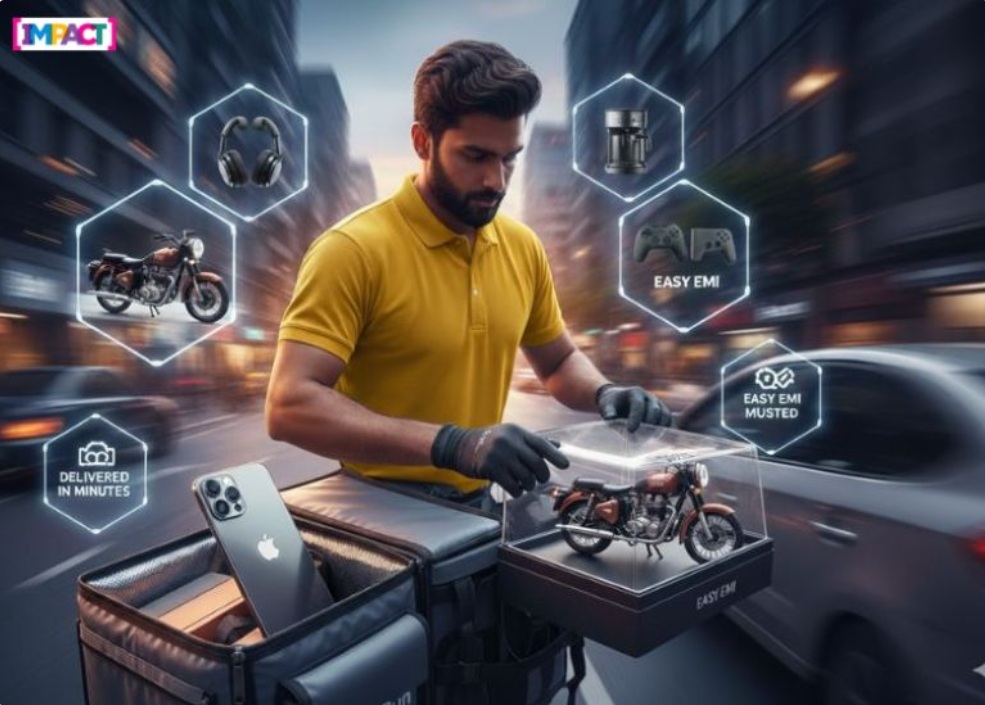
And now? Phones aren’t the limit. You can even order motorcycles online. Yes, motorcycles. Royal Enfield has partnered with Flipkart to list its entire 350cc portfolio, which will be delivered to five cities: Bengaluru, Gurugram, Kolkata, Lucknow, and Mumbai.
The lines between e-commerce and quick commerce are becoming increasingly blurred. Flipkart’s Flipkart Minutes and Amazon’s instant delivery options are proof that speed is no longer a differentiator; it’s table stakes. And as platforms race to expand, high-ticket items are joining the frenzy, from electronics and furniture to watches, fitness equipment, and premium kitchen appliances. For platforms, these products are goldmines of margin; the challenge lies in logistics and consumer trust.
According to a report by CareEdge Advisory, India had over 270 million online shoppers in 2024, making it the second-largest e-retail user base globally, while the e-commerce market grew 23.8% in 2024 over the year-ago period, it said. The report also added that Indians ordered Rs 64,000 crore of goods from quick-commerce platforms.
From the consumer standpoint, one of the challenges for consumers to buy high-ticket items from the quick commerce platforms is to get consumer trust, which used to be the case when e-commerce started its operations. Can quick commerce move to high-ticket items? Is quick commerce looking at these items as a branding exercise, or are they looking at them as a serious revenue stream channel?
Chirag Taneja, Founder & CEO, GoKwik – an e-commerce enablement platform, says what began as a branding exercise for D2C brands has now evolved into a credible revenue stream. “In the early days, high-ticket categories on D2C platforms saw limited traction,” he explains. “Trust was still being built, customers were unsure if their orders would even reach them. There were many friction points.”
But that’s no longer the case. According to GoKwik’s network data, high-ticket purchases (above ₹2,500) are no longer outliers, they’re becoming a consistent driver of topline revenue.
Interestingly, most of these premium purchases are powered by credit instruments from no-cost EMIs to instant credit options at checkout. “This reflects a clear shift in mindset,” says Taneja. “Consumers no longer view high-value spending as a financial strain. They see it as a set of manageable, bite-sized payments that help them aspire higher, quicker. It’s not just a financial enabler, it’s a psychological unlock that makes premium consumption feel accessible and routine,” he adds.
“With strong trust in delivery reliability, smooth returns, and credible brand backing, the ecosystem has bridged the gap that once kept premium shopping offline,” says Taneja.
Devangshu Dutta, Founder of a specialist consulting firm, Third Eyesight, thinks differently and points out that high-value items still make up a small slice of quick commerce sales. “The model thrives on simplicity, a limited product range on the platform’s end, and quick, low-friction decision-making on the consumer’s,” he explains.
That said, Dutta believes quick commerce can still play a strategic role for premium brands. “For high-value products, q-comm can be an excellent lever for driving velocity, testing market response, or amplifying brand visibility. But it should be viewed as one piece of the channel mix, not the primary sales driver.”
From the platform’s perspective, however, listing high-ticket products brings its own upside. “They create excitement, boost average transaction values, and improve realised margins,” Dutta notes. “Consumers are often drawn in by novelty, exclusivity, or status appeal, especially during big launches or limited-time promotions.”
Still, he adds a note of realism: “Premium and high-ticket purchases largely remain planned decisions. Most consumers continue to prefer established offline and e-commerce channels for such buys where trust in authenticity, return policies, and after-sales services still carry greater weight than instant gratification.”
Seshu Kumar Tirumala, Chief Buying and Merchandising Officer, BigBasket, says the company doesn’t look at electronics as a high-ticket item category but rather focuses on building a complete category experience for customers. “For example, if we list an Enfield bike, we’d also want to offer spare parts, servicing options, and extended warranties, because that’s how the category functions,” he explains.
Tirumala adds that BigBasket adopted the same approach when it ventured into mobiles and mobile accessories. “When we launched this category last year, it was a trial. Today, it’s a sizable part of our business,” he says. Currently, electronics and mobile accessories contribute 5–10% of BigBasket’s monthly sales, having grown 250–300% year-on-year since the first iPhone launch on the platform.
While the launch day drives the highest demand for flagship devices like the iPhone, Tirumala notes that the following one to two months see strong accessory sales, from AirPods and headphones to chargers and power banks. “On average, mobiles and accessories account for 7–8% of our total sales, peaking at 10% during the festive season. Overall, this category has grown from zero to 7–8% of our total business in just a year, and we expect it to reach around 25% next year,” he adds.
Currently, the platform offers select models from smartphone brands, including OnePlus, Realme, Redmi, Vivo, and Oppo.
The Bengaluru-based platform is now piloting the delivery of large home appliances across across select city areas in partnership with Croma. If successful, BigBasket plans to expand this model to other cities, further broadening its quick commerce offering beyond everyday essentials.
Taneja points out that the traditional e-commerce model, once driven by discounts and affordability, is now evolving toward experience and access. Over the next few years, two major shifts will shape this transformation: credit-first commerce, where EMIs become the default mode for premium purchases, and aspirational commerce, where consumers view e-commerce as the easiest path to lifestyle upgrades. Consequently, platforms will need to reposition themselves from being “where you save more” to “where you unlock more”, prioritising personalisation, trust, and a seamless shopping experience.
As quick commerce matures, it is no longer just about instant gratification; it’s becoming a bridge between aspiration and accessibility.
Platforms are proving that speed, trust, and seamless experience can coexist with high-value purchases.
(Published in IMPACT)
admin
September 24, 2025

Shabori Das & Sagar Malviya, Economic Times
Bengaluru/Mumbai, 24 September 2025
Chinese fast-fashion platform Shein plans to triple the number of launches in India and shrink its design-to-launch timeline by a third to deepen its push into an increasingly competitive market, a top official said.
The company, which re-entered India through a partnership with Reliance Retail in February this year, said it is overhauling its supply chain to enable faster turnaround times. To achieve this, it has moved away from large-scale manufacturing hubs to smaller production lines with each line focused on creating a single new design daily.
“Our current timelines, measured from ‘thought to site’, stand at 46 days. We are targeting 30 days,” said Vineeth Nair, chief executive of Reliance’s fashion platform Ajio that steers Shein in India. “We currently deliver 320 styles a day – about 10,000 a month – and plan to scale that to over 30,000 styles monthly in the coming months,” he told ET.
Speaking about the speed of manufacturing, Nair said, “We quantify our options in terms of production lines, with each line optimised to deliver one design option per day, rather than factories. Some of our large production units have been repurposed into multiple lines.”
Shein first launched in India in 2018 with its own online shop. However, the app was banned by the Ministry of Electronics and Information Technology (MeitY) along with TikTok, WeChat and over 55 other Chinese apps.
One of the primary issues and controversies surrounding Shein’s India operations was the use of the consumer data by the Chinese apparel retailer.
Under the current partnership model, Reliance Retail is operating Shein under licensing agreement and ensures complete customer data ownership as per the company.
Unlike international markets, Shein India products are made in India.
“It’s still early days – just about three months since we introduced Shein to the India Gen Z,” Nair said. “And we are still in the process of adding multiple products, which we intend to do in the next few months.”
He said the brand is witnessing two million daily average users, dominated by 21-year-old women who account for 62% of the traffic.
Shein, the world’s biggest ecommerce-centred fashion retailer, however, may find it hard to replicate its global success in India, according to Devangshu Dutta, founder of retail consulting firm Third Eyesight.
“Shein’s edge internationally has been its speed of dropping its products, and the width of its product category. The India model is not the same. The India model of fashion is slower, and the product category width is not as large,” he noted. “Hence, the brand will in all probability end up competing with the already established market like Myntra, Zudio and the likes.”

(Published in Economic Times)
admin
July 27, 2025
Alenjith K Johny & Ajay Rag, Economic Times
Jul 27, 2025
Startups in the 60-minute fashion delivery segment are betting on features such as ‘try and buy’ and artificial intelligence (AI)-powered virtual try-ons to tackle high return rates, a key pain point in the segment. These tools are helping increase conversion rates and reduce returns while offering greater flexibility to buyers, said industry executives.
Mumbai-based Knot, which recently raised funding from venture capital firm Kae Capital, said partner brands that typically see return rates of about 20% on their direct-to-consumer websites are witnessing sub-1% returns through offline stores, a trend it is now replicating through these digital features.
“Our partner brands, which have offline stores, would typically witness 20% returns on their direct to consumer websites. But for the same purchases on offline stores, the returns are less than 1%. That is the idea. With the ‘try and buy’ feature, users can make a very decisive purchase at their doorstep,” Archit Nanda, CEO of Knot, told ET.
Return rates among users of the company’s virtual try-on feature are similarly much lower than the platform’s overall user base, he said.
Other venture-backed quick fashion delivery startups such as Bengaluru-based Slikk, Mumbai-based Zilo and Gurugram-based Zulu Club are also testing similar features to increase conversions and reduce returns.
“Returns play as big a part as maybe forward delivery does. Because these are expensive products, giving the customer his or her money back also plays a very critical role,” said Akshay Gulati, cofounder and CEO of Slikk.
Instant returns
Slikk is piloting an ‘instant returns’ feature where, like its 60-minute delivery service, returns are also completed within an hour. Once a return request is made on the app, a delivery partner picks up the product and refunds the amount instantly. The startup claims its return rate is 40-50% lower than that of traditional marketplaces and that it doesn’t charge customers any extra fees for returns.
Some users said they were satisfied with the delivery speed and trial window but pointed out that the app does not provide any return status updates until the product reaches the warehouse.
“I received my order within 60 minutes and had enough time to try it out. However, after returning the product, I didn’t receive any notification in the application until the delivery agent reached the warehouse,” said Mohammed Shibili, a working professional based in Bengaluru, who tried Slikk’s feature.
Investor interest
Investors tracking the segment estimate that try-and-buy and virtual try-on features can reduce return rates by 15-20 percentage points, translating into substantial cost savings for both platforms and brands.
“Features like try and buy are a huge cost save, not just for the platform but also for the brand. The brand otherwise would lose that inventory till it comes back and can’t make the sale on it. But now, that’s all getting quickly turned around. So, for the brand, it’s a win-win situation as well as for the customer where the money is not getting stuck till it gets the returns refunded,” said Sunitha Viswanathan, partner at Kae Capital.
Old model, new infrastructure
Flipkart-owned fashion etailer Myntra had introduced try and buy back in 2016 to attract traditional shoppers to online retail. However, the feature didn’t scale up due to supply chain limitations, according to industry executives.
“Back when Myntra launched ‘try and buy’, there was no hyperlocal delivery infrastructure. Deliveries were through national courier services. That model isn’t feasible to try and buy unless you have your own hyperlocal delivery fleet,” the founder of a fashion delivery startup said on condition of anonymity.
The founder added that while Myntra operated from large warehouses located on the outskirts of cities, the new-age supply chains are built within cities, allowing faster deliveries and enabling features like try and buy.
By the end of last year, Myntra had launched M-Now, an ultra-fast delivery service currently live in Bengaluru, Mumbai and Delhi, with pilots in other cities. The company said daily orders through M-Now doubled in the last quarter.
“Although it’s still early, our observations so far suggest that the quick delivery model, with its reduced wait time, attracts high-intent customers, leading to naturally lower return rates,” said a spokesperson for Myntra.
The etailer did not confirm whether the try-and-buy feature is being tested under M-Now.
Viability concerns persist
Despite the benefits, the long-term viability of these features is open to question, experts said.
“There is a cost to also providing these services (like try and buy), and whether that becomes viable at all is a question mark at this point of time. I think that’s what the concern is, and it has not been that viable,” said Devangshu Dutta, founder of Third Eyesight, a management consulting firm focused on consumer goods and retail industries.
He added that when platforms offer the try-and-buy feature, delivery executives have to wait while customers try on products, which increases the cost per delivery and reduces the number of deliveries that can be completed. Despite that, some items may still be returned, further impacting operational efficiency.
However, startups are experimenting with these features mainly on higher-margin products to offset operational costs, Dutta said, as return rates across fashion categories can range from under 10% to as high as 40% for certain items.
(Published in Economic Times)
admin
July 1, 2025
Sankalp Phartiyal, Bloomberg
1 July 2025
Just last week, Amazon.com Inc.’s India unit announced the launch of five new fulfillment centers to speed up e-commerce deliveries across the South Asian country’s smaller towns and cities. The online shopping giant’s statement included the words fast, faster and fastest nine times. That’s because delivery speed has never mattered more in India than it does now.
Homegrown firms such as Eternal Ltd.’s Blinkit, Swiggy Ltd.’s Instamart and Zepto are now delivering everything from pricey herbal skincare to Bluetooth speakers in just 10 minutes, making Amazon’s overnight shipping look comparatively lethargic. With one of the world’s fastest-growing major economies and a swelling middle class that’s looking for instant gratification, India is growing ever more important — and demanding.
It’s no surprise that the as-yet-unprofitable Amazon India is investing another $233 million to boost its delivery network and infrastructure in the country this year. It’s already committed more than $11 billion in India, the bulk of which has gone toward building online retail from the ground up. Its upstart rivals, also in the red, are driving a behavioral shift and are quickly building up their order volumes to the point where they’ll be able to strike distribution deals with consumer brands at an Amazon-like scale. That’s the mood music I’m hearing from local investors and it’s why Amazon is actively trying to counteract these nascent fast-commerce players.
Take me as an example of changing habits. Last week, I found myself bereft of shaving supplies on the morning of a day that featured an important meeting. I ordered a razor, brush and shaving cream via Swiggy and they were with me within 10 minutes. That sort of convenience is (probably) why I neglected
to restock my bathroom cabinet in advance — I simply don’t need to spend time planning small purchases anymore.
What does this mean for Amazon? Well, beyond everyday conveniences, Amazon and Walmart Inc.’s Flipkart may also lose out on higher-ticket purchases such as smartphones and other consumer electronics. Why wait in line or for days for the latest iPhone if an army of scooter riders is ready to drop it off at your doorstep almost instantly? And, specific to Amazon, how compelling will Prime delivery be if there are superior alternatives?
The Seattle-based online retailer was once driven out of China by regulations promoting domestic names, “which had deep and patient capital, and strong capabilities,” said Devangshu Dutta, head of retail consultancy firm Third Eyesight. “Because of this, it becomes that much more important for Amazon to succeed in India, as it’s now the world’s largest market by users. The consumption numbers will also grow with time.”
It’s no overstatement to say that quick commerce could redefine online shopping for Indians, setting a precedent unique to the country. We’ve already seen that happen with UPI, the state-backed peer-to-peer digital payments system that’s outshined credit cards. The company that best adapts to and serves the demands of India’s growing online consumer base will command a share of a rapidly growing e-commerce arena that’s today worth $60 billion in gross merchandise value, according to Bain & Co.
Amazon’s already shifting gears in a highly visible way. Last month, it launched “Now,” a 10-minute delivery service, in some parts of the southern tech hub of Bangalore. That marks its experimental foray into quick commerce. The company is also taking baby steps to plug the money bleed, now charging all
online shoppers 5 rupees ($0.06) in marketplace fees. That’s negligible per transaction, but need I remind you that India is the world’s most populous country and hundreds of millions shop on Amazon?
Even while operating from a position of considerable strength, Amazon sees the rise of its more quick-witted rivals and the shift in consumer behavior, and it’s taking action. To avert those young companies building a comparable retail empire to its own, Amazon will have to show it still has the agility to outrace all comers.
–With assistance from Brunella Tipismana Urbano.
To view this story in Bloomberg click here:
https://blinks.bloomberg.com/news/stories/SYPVYEDWLU68
