
admin
July 27, 2025
Alenjith K Johny & Ajay Rag, Economic Times
Jul 27, 2025
Startups in the 60-minute fashion delivery segment are betting on features such as ‘try and buy’ and artificial intelligence (AI)-powered virtual try-ons to tackle high return rates, a key pain point in the segment. These tools are helping increase conversion rates and reduce returns while offering greater flexibility to buyers, said industry executives.
Mumbai-based Knot, which recently raised funding from venture capital firm Kae Capital, said partner brands that typically see return rates of about 20% on their direct-to-consumer websites are witnessing sub-1% returns through offline stores, a trend it is now replicating through these digital features.
“Our partner brands, which have offline stores, would typically witness 20% returns on their direct to consumer websites. But for the same purchases on offline stores, the returns are less than 1%. That is the idea. With the ‘try and buy’ feature, users can make a very decisive purchase at their doorstep,” Archit Nanda, CEO of Knot, told ET.
Return rates among users of the company’s virtual try-on feature are similarly much lower than the platform’s overall user base, he said.
Other venture-backed quick fashion delivery startups such as Bengaluru-based Slikk, Mumbai-based Zilo and Gurugram-based Zulu Club are also testing similar features to increase conversions and reduce returns.
“Returns play as big a part as maybe forward delivery does. Because these are expensive products, giving the customer his or her money back also plays a very critical role,” said Akshay Gulati, cofounder and CEO of Slikk.
Instant returns
Slikk is piloting an ‘instant returns’ feature where, like its 60-minute delivery service, returns are also completed within an hour. Once a return request is made on the app, a delivery partner picks up the product and refunds the amount instantly. The startup claims its return rate is 40-50% lower than that of traditional marketplaces and that it doesn’t charge customers any extra fees for returns.
Some users said they were satisfied with the delivery speed and trial window but pointed out that the app does not provide any return status updates until the product reaches the warehouse.
“I received my order within 60 minutes and had enough time to try it out. However, after returning the product, I didn’t receive any notification in the application until the delivery agent reached the warehouse,” said Mohammed Shibili, a working professional based in Bengaluru, who tried Slikk’s feature.
Investor interest
Investors tracking the segment estimate that try-and-buy and virtual try-on features can reduce return rates by 15-20 percentage points, translating into substantial cost savings for both platforms and brands.
“Features like try and buy are a huge cost save, not just for the platform but also for the brand. The brand otherwise would lose that inventory till it comes back and can’t make the sale on it. But now, that’s all getting quickly turned around. So, for the brand, it’s a win-win situation as well as for the customer where the money is not getting stuck till it gets the returns refunded,” said Sunitha Viswanathan, partner at Kae Capital.
Old model, new infrastructure
Flipkart-owned fashion etailer Myntra had introduced try and buy back in 2016 to attract traditional shoppers to online retail. However, the feature didn’t scale up due to supply chain limitations, according to industry executives.
“Back when Myntra launched ‘try and buy’, there was no hyperlocal delivery infrastructure. Deliveries were through national courier services. That model isn’t feasible to try and buy unless you have your own hyperlocal delivery fleet,” the founder of a fashion delivery startup said on condition of anonymity.
The founder added that while Myntra operated from large warehouses located on the outskirts of cities, the new-age supply chains are built within cities, allowing faster deliveries and enabling features like try and buy.
By the end of last year, Myntra had launched M-Now, an ultra-fast delivery service currently live in Bengaluru, Mumbai and Delhi, with pilots in other cities. The company said daily orders through M-Now doubled in the last quarter.
“Although it’s still early, our observations so far suggest that the quick delivery model, with its reduced wait time, attracts high-intent customers, leading to naturally lower return rates,” said a spokesperson for Myntra.
The etailer did not confirm whether the try-and-buy feature is being tested under M-Now.
Viability concerns persist
Despite the benefits, the long-term viability of these features is open to question, experts said.
“There is a cost to also providing these services (like try and buy), and whether that becomes viable at all is a question mark at this point of time. I think that’s what the concern is, and it has not been that viable,” said Devangshu Dutta, founder of Third Eyesight, a management consulting firm focused on consumer goods and retail industries.
He added that when platforms offer the try-and-buy feature, delivery executives have to wait while customers try on products, which increases the cost per delivery and reduces the number of deliveries that can be completed. Despite that, some items may still be returned, further impacting operational efficiency.
However, startups are experimenting with these features mainly on higher-margin products to offset operational costs, Dutta said, as return rates across fashion categories can range from under 10% to as high as 40% for certain items.
(Published in Economic Times)
Devangshu Dutta
January 10, 2017
In this piece I’ll just focus on one aspect of technology – artificial intelligence or AI – that is likely to shape many aspects of the retail business and the consumer’s experience over the coming years.
To be able to see the scope of its potential all-pervasive impact we need to go beyond our expectations of humanoid robots. We also need to understand that artificial intelligence works on a cycle of several mutually supportive elements that enable learning and adaptation. The terms “big data” and “analytics” have been bandied about a lot, but have had limited impact so far in the retail business because it usually only touches the first two, at most three, of the necessary elements.
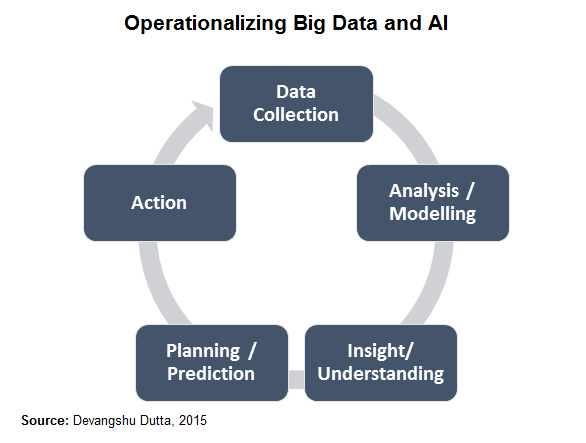
“Big data” models still depend on individuals in the business taking decisions and acting based on what is recommended or suggested by the analytics outputs, and these tend to be weak links which break the learning-adaptation chain. Of course, each of these elements can also have AI built in, for refinement over time.
Certainly retailers with a digital (web or mobile) presence are in a better position to use and benefit from AI, but that is no excuse for others to “roll over and die”. I’ll list just a few aspects of the business already being impacted and others that are likely to be in the future.
On the consumer-side, AI can deliver a far higher degree of personalisation of the experience than has been feasible in the last few decades. While I’ve described different aspects, now see them as layers one built on the other, and imagine the shopping experience you might have as a consumer. If the scenario seems as if it might be from a sci-fi movie, just give it a few years. After all, moving staircases and remote viewing were also fantasy once.
On the business end it potentially offers both flexibility and efficiency, rather than one at the cost of the other. But we’ll have to tackle that area in a separate piece.
(Also published in the Business Standard.)
admin
May 17, 2013
Organised by the Retailers Association of India the Delhi Retail Summit this year (10 May 2013) focussed on multi-fold growth for retailers utilising multiple channels to the consumer, with panel discussions and presentations by industry leaders who shared their experiences in exploiting the opportunities and dealing with the strategic and operational challenges of their varied businesses. Some snippets from the first panel discussion, comprising of the following panelists:
1. Devangshu Dutta, Chief Executive, Third Eyesight (Session Moderator)
2. Atul Ahuja, Vice President – Retail, Apollo Pharmacy
3. Lalit Agarwal, CMD, V-Mart Retail Ltd.
4. Atul Chand, Chief Executive, ITC Lifestyle
5. Rahul Chadha, Executive Director & CEO, Religare Wellness Ltd.
