
Devangshu Dutta
June 30, 2025

In every strategy meeting today, one metric is invariably mentioned: Customer Acquisition Cost (CAC). Whether you’re a well-funded corporate retailer, or raising your first angel round, or a well-established digital duopolist brand scaling Series C, CAC is one of the key performance metrics. “Real” spend that is neatly broken down by channel, optimised by funnel tweaks, scrutinised to the last rupee or dollar.
But there’s a metric we almost never hear about that could be costing brands far more in the long run.
Let’s call it Customer Forfeiture Cost (CFC), the residual lifetime value that is lost when a customer walks away from your business not because of price, competition, or even shifting needs, but because of a “burn”: a delivery missed or messed up, a refund that took weeks, an arrogant customer service call, or a product that failed spectacularly against the promise. In other words, when your brand hurts someone enough to make them walk away. Probably for ever.
It’s a paradox: brands are pumping thousands of crores into acquiring users, but they’re bleeding value at the other end. Yet, while CAC is a line item in every financial statement, CFC is invisible in management dashboards. CEOs don’t announce, “We’ve cut our forfeiture cost by 20% this quarter.”
Yet. every CXO knows it exists. The NPS scores, the social media complaints, the “never again” comments in reviews, the sinking feeling when repeat purchase rates fall.
Why CFC Matters More Than Ever
In every business, during the early stages each sale is a victory. Whether it was the retail chains that grew in the 1990s and early-2000s or the digital upstarts that came up through 2010s and 2020s, scale has been the mantra, and investors have poured money into scaling through the growing consumption of India 1 and India 2 customers.
Today customer acquisition isn’t cheap. The same person who clicked impulsively in 2020 now thinks twice before confirming payment. In this landscape, retention isn’t optional, it’s existential.
Every lost customer isn’t just a refund processed, or a cart abandoned. It’s the long tail of future repeat purchases that will never happen, negative word of mouth and brand distrust in the customer’s circle of influence, and increased future CAC due to declining organic reach.
Way back in 1967, management consultant Peter Drucker wrote in his book “The Effective Executive”: “What gets measured, gets managed”.
Today your CAC may be Rs. 500-1,000. If the average customer life time value (LTV) is Rs. 10,000, and a single burn causes churn after just one order worth Rs. 2,000, your CFC is Rs. 8,000, and that doesn’t even include reputational spillover.
Why We Don’t Measure It
Yes, CFC is hard to quantify. It’s not as easily attributable as ad spends. There’s usually no neat model telling you why someone never returned, because tech stacks aren’t typically designed to track emotional exits. And let’s face it, introspection about broken relationships is uncomfortable, even for management teams.
But that doesn’t mean it’s not real. If a customer leaves because your delivery executive messed up, or because your app crashed during checkout twice in a row, that’s on you, not the market. And in a business climate where sustainable growth is the mantra, LTV is king.
Ignoring CFC is like watching your roof leak and blaming the rain.
Toward a New Discipline
Brands and retailers must start measuring CFC, the value lost when customers disengage due to friction, mistrust, or neglect, and then start working on reducing it. This can be done by:
The Competitive Edge We’re Not Using
In a crowded space where everyone’s vying for eyeballs, trust is the true moat. Customers don’t expect perfection – they do expect accountability, authenticity, and recovery when things go wrong.
Brands that understand and act on Customer Forfeiture Costs will quietly start building a powerful edge: deeper brand loyalty, lower CAC over time thanks to referrals and repeats and greater lifetime value per user.
In other words, real, compounding value.
As the Indian brand ecosystem matures, Customer Forfeiture Cost needs to be as visible and valued as CAC. Acquisition is the invitation; experience is the relationship. Relationships, once broken, are expensive to rebuild; if they can be rebuilt at all.
In the end, growth isn’t just about who comes in. It’s about who stays, and why.
(Written by Devangshu Dutta, Founder of Third Eyesight, this was published in Financial Express on 2 July 2025)
admin
May 8, 2024
At the recent Phygital Retail Convention in Mumbai, Devangshu Dutta anchored an engaging “Fireside Chat” with Bhavana Jaiswal of IKEA India and Kapil Makhija of Unicommerce , on retailers engaging with their customers across channels and formats, and the opportunities as well as challenges in managing experiences seamlessly across online and offline interfaces.
Watch the video at this link:
admin
May 24, 2023

Shambhavi Anand, Economic Times
New Delhi, May 24, 2023
Retailers and shopkeepers will soon not be allowed to seek phone numbers of their customers while generating bills, according to a diktat by the department of consumer affairs, a senior government official said.
Taking the numbers of customers without their “express consent” is a breach and encroachment of privacy, said the official, without wanting to be identified.
The official added that such a move will be classified as an unfair trading practice defined as any business practice or act that is deceptive, fraudulent, or causes injury to a consumer.
Most large retailers mandatorily take down buyers’ phone numbers while generating the bill for their purchases and use them for loyalty programmes or sending push messages.
The move has come after the department received several complaints from consumers about retailers insisting on getting their phone numbers. This will be communicated to all retailers through industry bodies representing retailers soon, the official added.
While the implementation of these new rules may require some adjustments and initial costs for retailers, it is seen as a necessary step towards protecting consumer privacy and ensuring fair business practices in the retail sector, said experts.
While retailers will have to rework their systems in case this becomes a regulation, this won’t stop them from asking for phone numbers of consumers as their loyalty programmes run on these numbers, said Devangshu Dutta, founder of Third Eyesight, a retail consultancy firm.
He added that retailers also use numbers for sending e-invoices and so this could have a cost impact and environmental impact.
(Published in Economic Times)
admin
May 21, 2019
Written By Sangeeta Tanwar

Two of India’s leading retail chains are currently preparing the ground for their full-fledged e-commerce forays, albeit in totally different ways.
While the Kishore Biyani-led Future Group, which operates the popular Big Bazaar hypermarket chain, is busy listing its labels on Amazon, rival Reliance Retail is withdrawing its products from all e-commerce platforms, as parent Reliance Industries (RIL) gears up to launch its own online marketplace.
For both the traditional players, cracking online sales is important as they prepare for a future beyond high street retail.
Online sales in India will balloon from last year’s $18 billion (Rs1.25 lakh crore) to $170 billion by 2030, Jefferies India predicted recently. This potential aside, Indian e-commerce is still nascent and retailers are still perfecting their strategies.
“E-commerce is now a game of two dimensions, one of scale and the other of last-mile ubiquity. Whoever gets this right, will manage growth, revenue, and customer acquisition,” said Anil V Pillai, director of the independent marketing firm Terragni Consulting.
As for the Future Group, it thinks the best way to achieve this is by riding piggyback on Amazon’s proven capabilities in scale and last-mile delivery.
How the plan evolved
In 2016, the Future Group had made its first e-commerce acquisition by buying out the struggling furniture retailer FabFurnish from its German incubator Rocket Internet. Biyani had hoped to find synergies between the startup and his group’s furniture brand Hometown.
A year later, hit by heavy losses, FabFurnish was shuttered. Biyani downplayed the move saying his losses were “compensated” as the company had learnt “enough” from the episode.
The move now to partner Amazon seems to have stemmed from that learning.
Over the past month, the two have been trying to make joint plans, including in distribution, warehousing, and creating products for Amazon and its grocery format, Pantry. Also, Future group brands, including Big Bazaar, are being aligned with Amazon Now, which promises delivery of everyday essentials within two hours, suggest media reports.
A more serious handicap will be Amazon controlling Future Group’s data and customer relationships in the partnership. “In e-commerce, ownership of customer relationship and data, which offers consumer insights, is the real asset,” points out Devangshu Dutta, CEO of Third Eyesight, a consulting firm focussed on retail and consumer products.
Vianello agrees: “When you have your own e-commerce venture, as Reliance Retail plans, you are the owner of the data and you can slice and dice it to come up with exciting product offerings and improved service experience.”
This is one of the advantages that RIL might have seen in going it alone.
Going solo
“Reliance Retail has taken a more integrated approach towards e-commerce,” observed Dutta. “The company is set to leverage its pan-India retail presence and Reliance Jio’s (RIL’s telecom business) data capabilities to roll out an e-commerce platform,” explained Dutta.
The synergy between Reliance Jio and Reliance Retail is a big advantage. The retailer has about 10,000 stores across 6,500 towns in India, while Jio has a subscriber base of 306 million. After bringing many Indians online with Jio’s affordable data offerings, Reliance now hopes to get most of them to start shopping online as well.
The challenge, though, would be in getting the last-mile delivery right. “Reliance Retail could be at a disadvantage here compared to the Future Group, which has its delivery mechanism in place courtesy its partnership with Amazon,” suggested Vianello.
Moreover, like with Jio, consumers will expect heavy discounts from Reliance’s e-commerce venture as well, which may be difficult to sustain given the initial investments. “Biyani’s (online) launch involves lower upfront costs, while Reliance Retail’s will be resource hungry since it’s an almost greenfield project,” pointed out Pillai, adding, “Reliance’s challenge is the overwhelming perception about the group being a price warrior and disrupter.”
So, which strategy will triumph? Everything comes down to execution. “Success in retail, including e-commerce, is about more and more customers choosing to transact with you repeatedly. Achieving this is a difficult and ongoing process. There are no guaranteed or permanent winners,” says Dutta.
Source: qz
Devangshu Dutta
January 10, 2017
In this piece I’ll just focus on one aspect of technology – artificial intelligence or AI – that is likely to shape many aspects of the retail business and the consumer’s experience over the coming years.
To be able to see the scope of its potential all-pervasive impact we need to go beyond our expectations of humanoid robots. We also need to understand that artificial intelligence works on a cycle of several mutually supportive elements that enable learning and adaptation. The terms “big data” and “analytics” have been bandied about a lot, but have had limited impact so far in the retail business because it usually only touches the first two, at most three, of the necessary elements.
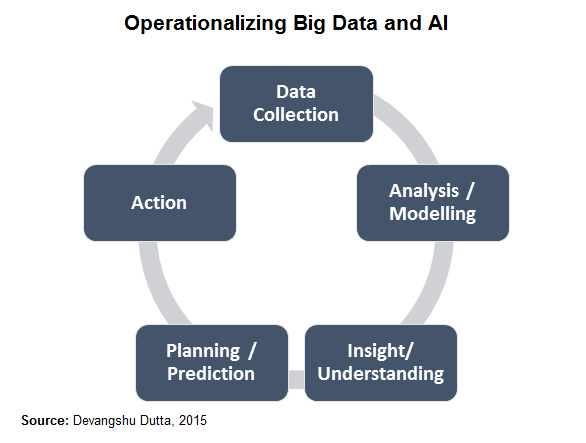
“Big data” models still depend on individuals in the business taking decisions and acting based on what is recommended or suggested by the analytics outputs, and these tend to be weak links which break the learning-adaptation chain. Of course, each of these elements can also have AI built in, for refinement over time.
Certainly retailers with a digital (web or mobile) presence are in a better position to use and benefit from AI, but that is no excuse for others to “roll over and die”. I’ll list just a few aspects of the business already being impacted and others that are likely to be in the future.
On the consumer-side, AI can deliver a far higher degree of personalisation of the experience than has been feasible in the last few decades. While I’ve described different aspects, now see them as layers one built on the other, and imagine the shopping experience you might have as a consumer. If the scenario seems as if it might be from a sci-fi movie, just give it a few years. After all, moving staircases and remote viewing were also fantasy once.
On the business end it potentially offers both flexibility and efficiency, rather than one at the cost of the other. But we’ll have to tackle that area in a separate piece.
(Also published in the Business Standard.)
