
admin
September 28, 2020
Written By Mihir Dalal

(From left to right) Doug McMillon, CEO of Walmart, which owns Flipkart; Mukesh Ambani, chairman and MD of RIL; Jeff Bezos, CEO of Amazon
BENGALURU : Last month, Nimit Jain, an entrepreneur, ordered biscuits, shampoo, toothpaste and other items for his family in Kota. He used JioMart—the new online shopping app by Mukesh Ambani’s Reliance Industries Limited—lured by its low prices and freebies.
JioMart was to deliver the order within two days, but Jain’s family didn’t receive the items on time and JioMart didn’t inform Jain about the delay. The delivery was done four days after he had placed the order, a few hours after Jain had complained to the firm via email and Twitter.
A few products were missing, Jain’s parents informed him. It took time to figure out the missing items because the details of the order weren’t available on the app. Jain had paid online and asked JioMart for a partial refund. Instead of receiving an acknowledgement for his refund request, he received a response for his previous email about the delay in delivery. Five days later, Jain got a refund.
Mumbai-based Jain, a computer science graduate from the Indian Institute of Technology, Madras, usually orders groceries from BigBasket and sometimes from Dunzo. He said that he doesn’t plan to use JioMart again.
“A couple of my friends and relatives (in Mumbai and Kota) have also had similarly bad experiences. It doesn’t look like JioMart is ready for online groceries. Their operations and customer care teams weren’t in sync,” Jain said.
Since JioMart expanded to more than 200 cities this summer, scores of customers like Jain have complained about missing products, delayed deliveries and generally poor service. Still, industry executives say that while its service levels have been inconsistent, JioMart is registering similar order volumes to BigBasket, the largest e-grocer, on the back of aggressive marketing and discounts.
These volumes still comprise a small fraction of the overall business of Amazon India and Walmart-owned Flipkart, the two dominant online retailers. But that’s because JioMart is only selling groceries now; it plans to sell other products like fashion and electronics soon. It’s clear that after many years of talk and hype, Reliance, which owns India’s largest offline retail chain, is finally becoming a serious challenger to Amazon and Flipkart, as well as BigBasket and Grofers.
Still, industry executives, logistics firms, consultants and analysts that Mint spoke with said that Reliance will find it tough to break the dominance of Amazon-Flipkart in e-commerce, similar to how Walmart is struggling to challenge Amazon in digital sales in the US even as its stores continue to prosper. Amazon and Flipkart both have deep pockets, proven expertise in e-commerce, popular brands and good knowledge of the Indian market.
“Reliance has the financial muscle, but Walmart (Flipkart) and Amazon are no pushovers,” said Harminder Sahni, managing director, Wazir Advisors, a consultancy. “Today, most people who want to shop online are happy with Flipkart and Amazon. These companies have achieved significant scale and have very few weaknesses. As a latecomer, it will be very difficult for Reliance to make a big dent in the market.”
Reliance did not respond to an emailed questionnaire seeking comment.
Local internet powerhouse
During the pandemic, Reliance has not only moved fast to make inroads into the e-commerce market, it has also consolidated its leadership in organized offline retail. Last month, Reliance bought most of the businesses of Future Group for about $3.4 billion in a deal that will take its retail footprint to nearly 14,000 stores—by far, the largest in India.
In the past six months, Reliance has raised more than $21 billion for its digital unit Jio Platforms. This month, Reliance kickstarted a separate fund-raising spree for its retail unit, Reliance Retail, bagging about $1.8 billion from private equity firms Silver Lake and KKR, two of the investors in Jio. Several more investment firms, including other shareholders in Jio, are expected to join them.
These moves are part of Reliance’s efforts to transform itself into a 21stcentury digital behemoth. It is positioning itself as India’s answer to Amazon, Facebook, Google, Alibaba and other world-class digital giants, and unlike local startups like Flipkart, Ola and Paytm that have or had similar ambitions, Reliance enjoys some unparalleled advantages.
It is now accepted wisdom among politicians and regulators that India needs a ‘local’ internet powerhouse to counter the dominance of America’s Big Tech and the growing influence of Chinese firms, partly because of sovereignty concerns. Reliance’s mastery in lobbying and its political clout makes the firm best-placed to exploit this urgent establishment need to find a domestic internet powerhouse.
Amazon, Flipkart, Facebook and others face many policy-related restrictions that not only serve as obstacles to them but pave the way for domestic firms led by Reliance to enter the fray. For instance, foreign investment rules prevent Amazon and Flipkart from owning inventory or selling private labels (though critics say that these firms do it anyway using clever legal workarounds), while Reliance has no such constraints. Apart from a supportive policy environment and huge capital resources, on the business front, too, Reliance has an enviable digital distribution network and reservoir of customer data on account of Jio.
But despite these formidable advantages, Reliance has yet to prove that it has the chops to realise its ambitious vision.
The war among Reliance and Flipkart and Amazon and other internet firms is also not restricted to retail, but will extend to other sectors like financial services, content and business-to-business commerce. The technology-centric nature of the battle is more suited to the internet companies than to Reliance. There’s little doubt that Reliance will be a major player in the digital business, but the jury’s out on how much value the firm can corner. Its foray in e-commerce and B2B will provide early answers to this question.
Retail battle
After JioMart began testing its service late last year, media reports said that the company would deliver products to customers from local kirana stores. After Facebook invested in Jio in April in a deal that included a business partnership between JioMart and WhatsApp, Ambani said that JioMart would soon connect some 3 crore kirana stores with their neighbourhood customers.
Many analysts, too, expect the partnership with WhatsApp, the most popular app in India, to be a game-changer. In July, Goldman Sachs estimated that Reliance’s entry will help expand the online grocery market by 20 times to about $29 billion by 2024. Reliance’s partnership with Facebook could help the firm become the leader in e-grocery and garner a market share of more than 50% by 2024, Goldman said.
But Mint learns that Reliance is sourcing a majority of orders on JioMart in many cities through Reliance Retail’s supply chain; only a small number of orders are served through kirana stores. JioMart is signing up a few thousand kirana stores every month, but its expansion is happening at a slower rate than many analysts expect. Two industry executives said that JioMart’s average order value is lower than that of other e-grocers, which means that Reliance is losing larger amounts of money on every order.
According to one e-commerce executive, for BigBasket and Grofers, the delivery cost is about 3-4% of the average order value, which exceeds ₹1000. For Reliance, the delivery cost is presently much higher because its order value is below ₹800. The lower order value is partly because most of JioMart’s 200 city-markets are non-metros. BigBasket and others generate an overwhelming majority of their business from the metros. Reliance is betting on expanding the e-grocery market rather, than taking market share from incumbents, which generate an overwhelming majority of their sales from 10-15 cities. But while Reliance may be able to attract customers in smaller cities initially with discounts, profitability will be tough.
“The economics of serving metros are very different from the rest of India. In the mass market, bill values are much, much lower. Right now, Reliance’s main focus is to scale JioMart, so they aren’t worried about the delivery cost,” the executive cited above said. “But eventually, reality will catch up, and they will have to increase basket sizes because this model isn’t sustainable. Grocery has very thin margins to start with. “
Private label push
One obvious way for Reliance to boost margins is by selling more private label products. In the grocery category, Reliance Retail already generates 14% of its revenues from private labels. People familiar with Reliance’s plans said that the company wants to push its private label products to kirana stores. While there are hundreds of well-known brands in FMCG, the grocery category (products like rice, pulses and flour) is largely unstructured. Reliance plans to sell its private label products both in grocery and FMCG.
Apart from retail, Reliance is also rapidly expanding its B2B business. Its private label products form a key component of its retail and wholesale business plans, the people cited above said.
The private label push, however, is making large FMCG companies like Hindustan Unilever, Marico and Dabur, which sell competing products, wary of working with Reliance’s B2B arm.
Like Flipkart and Amazon, which are also expanding their B2B businesses, Reliance’s grand vision over time is to have an integrated ecosystem of wholesale and retail in which it connects consumer goods makers with kirana stores and retailers, supplies a large number of private label products across many categories to retailers and end-customers, and becomes the biggest omnichannel retail firm in the country. But realising this vision will require Reliance to work seamlessly with millions of kirana stores, thousands of brands, modern retailers (all of which will see the firm as a rival to an extent)—and provide exceptional service in a profitable manner to retail customers.
Analysts and industry executives said that Reliance has a higher probability of finding success in categories like fashion (in which it already runs a portal called Ajio) and grocery that are mostly unorganised and have a shortage of established brands. In these categories, Reliance faces fewer barriers from existing players and has a better chance of pushing its private labels in both the wholesale and retail markets. But in categories like electronics and FMCG, which are dominated by entrenched brands, kirana stores and e-commerce firms, Reliance may struggle to scale as fast.
For instance, Flipkart and Amazon dominate online sales of electronics and fashion, which together comprise more than 75% of all e-commerce. To win significant share in electronics, Reliance will have to spend enormous amounts on discounts, marketing and offering favourable terms to brands . But, in fashion, Reliance can tap its low-priced private labels to lure customers without resorting to value destruction.
“The market is too varied for one player to be big in all categories,” an investment banker said. “Reliance will have to carefully choose its battles. There’s a risk that it may spread itself too thin, so it’s wise for them to have started with grocery.”
Meanwhile, while Google and Facebook have together invested more than $10 billion in Reliance, both companies are continuing to expand their own businesses in India. Google and Facebook have ambitions to enter e-commerce and expand in other sectors like payments and content. What this means is that while Google and Facebook will end up collaborating with Reliance in some areas, they will also compete with the firm in others, joining Flipkart and Amazon in the war of the digital conglomerates.
Flipkart and Amazon have already stepped up their lobbying efforts with the emergence of Reliance as a threat. Because of the pandemic that has made e-commerce indispensable, there has been a thaw in the government’s attitude towards the US e-commerce firms. A more antagonistic attitude may return when the pandemic passes.
Eventually, though, the war will be decided by customers. Here, experts are divided on whether Reliance will emerge as the winner. “Reliance still has to do a lot more on getting the customer experience in place, but given the strides they’ve made, it is well-placed to compete in the digital space,” said Devangshu Dutta, head of retail consultancy firm Third Eyesight.
Source: livemint
admin
March 27, 2019
“Fashion is a zombie business. It is dead and it doesn’t know it yet,” says Devangshu Dutta, Founder of Third Eyesight, a specialist management consulting firm.
This is a must-watch excerpt from a presentation and panel discussion anchored by Devangshu Dutta on 27 March 2019 at the India Fashion Forum, in Mumbai.
The challenge he presents is simple: create a new business model for the fashion sector.
Devangshu Dutta
January 10, 2017
In this piece I’ll just focus on one aspect of technology – artificial intelligence or AI – that is likely to shape many aspects of the retail business and the consumer’s experience over the coming years.
To be able to see the scope of its potential all-pervasive impact we need to go beyond our expectations of humanoid robots. We also need to understand that artificial intelligence works on a cycle of several mutually supportive elements that enable learning and adaptation. The terms “big data” and “analytics” have been bandied about a lot, but have had limited impact so far in the retail business because it usually only touches the first two, at most three, of the necessary elements.
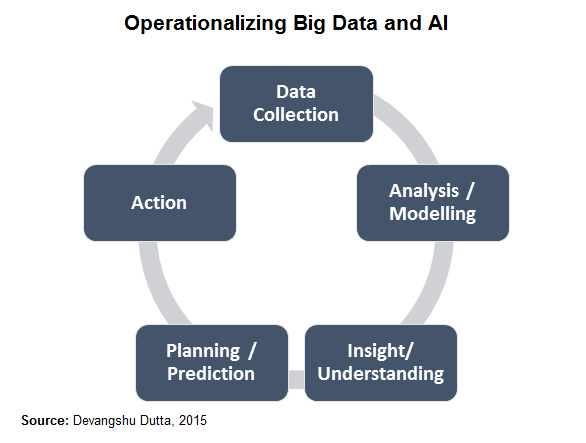
“Big data” models still depend on individuals in the business taking decisions and acting based on what is recommended or suggested by the analytics outputs, and these tend to be weak links which break the learning-adaptation chain. Of course, each of these elements can also have AI built in, for refinement over time.
Certainly retailers with a digital (web or mobile) presence are in a better position to use and benefit from AI, but that is no excuse for others to “roll over and die”. I’ll list just a few aspects of the business already being impacted and others that are likely to be in the future.
On the consumer-side, AI can deliver a far higher degree of personalisation of the experience than has been feasible in the last few decades. While I’ve described different aspects, now see them as layers one built on the other, and imagine the shopping experience you might have as a consumer. If the scenario seems as if it might be from a sci-fi movie, just give it a few years. After all, moving staircases and remote viewing were also fantasy once.
On the business end it potentially offers both flexibility and efficiency, rather than one at the cost of the other. But we’ll have to tackle that area in a separate piece.
(Also published in the Business Standard.)
Devangshu Dutta
July 22, 2011
The apparel retail sector worldwide thrives on change, on account of fashion as well as season.
In India, for most of the country, weather changes are less extreme, so seasonal change is not a major driver of changeover of wardrobe. Also, more modest incomes reduce the customer’s willingness to buy new clothes frequently.
We believe pricing remains a critical challenge and a barrier to growth. About 5 years ago, Third Eyesight had evaluated the pricing of various brands in the context of the average incomes of their stated target customer group. For a like-to-like comparison with average pricing in Europe, we came to the conclusion that branded merchandise in India should be priced 30-50% lower than it was currently. And this is true not just of international brands that are present in India, but Indian-based companies as well. (In fact, most international brands end up targeting a customer segment in India that is more premium than they would in their home markets.)
Of course, with growing incomes and increasing exposure to fashion trends promoted through various media, larger numbers of Indian consumers are opting to buy more, and more frequently as well. But one only has to look at the share of marked-down product, promotions and end-of-season sales to know that the Indian consumer, by and large, believes that the in-season product is overpriced.
Brands that overestimate the growth possibilities add to the problem by over-ordering – these unjustified expectations are littered across the stores at the end of each season, with big red “Sale” and “Discounted” signs. When it comes to a game of nerves, the Indian consumer has a far stronger ability to hold on to her wallet, than a brand’s ability to hold on to the price line. Most consumers are quite prepared to wait a few extra weeks, rather than buying the product as soon as it hits the shelf.
Part of the problem, at the brands’ end, could be some inflexible costs. The three big productivity issues, in my mind, are: real estate, people and advertising.
Indian retail real estate is definitely among the most expensive in the world, when viewed in the context of sales that can be expected per square foot. Similarly, sales per employee rupee could also be vastly better than they are currently. And lastly, many Indian apparel brands could possibly do better to reallocate at least part of their advertising budget to developing better product and training their sales staff; no amount of loud celebrity endorsement can compensate for disinterested automatons showing bad products at the store.
Technology can certainly be leveraged better at every step of the operation, from design through supply chain, from planogram and merchandise planning to post-sale analytics.
Also, some of the more “modern” operations are, unfortunately, modelled on business processes and merchandise calendars that are more suited to the western retail environment of the 1980s than on best-practice as needed in the Indian retail environment of 2011! The “organised” apparel brands are weighed down by too many reviews, too many batch processes, too little merchant entrepreneurship. There is far too much time and resource wasted at each stage. Decisions are deliberately bottle-necked, under the label of “organisation” and “process-orientation”. The excitement is taken out of fashion; products become “normalised”, safe, boring which the consumer doesn’t really want! Shipments get delayed, missing the peaks of the season. And added cost ends in a price which the customer doesn’t want to pay.
The Indian apparel industry certainly needs a transformation.
Whether this will happen through a rapid shakedown or a more gradual process over the next 10-15 years, whether it will be driven by large international multi-brand retailers when they are allowed to invest directly in the country or by domestic companies, I do believe the industry will see significant shifts in the coming years.
admin
February 28, 2011
 Business
Standard, Mumbai, February 28, 2011
Business
Standard, Mumbai, February 28, 2011
Sayantani
Kar (with inputs from Preeti Khicha)
When some of India’s big retail chains banded together recently to substitute Reckitt Benckiser’s products with private labels to protest the latter’s decision to cut sales margins on its products, they were doing something many global retailers have done with great success. Part of their overall strategy, especially for large chains in the US and Europe, is to develop quality private label products that complement other pieces in their marketing mix. While this is one way retailers can differentiate their firms from competition, it also helps them flex their muscles in their relationships with brand manufacturers. Indeed, retail giants Tesco, Walmart and Carrefour have a significant portion of their sales coming from private labels — ranging from 10 per cent for Costco and 50 per cent for Tesco.
India is a back runner in the private label race, but it is
catching up. A Shoppers Trend Study by Nielsen found awareness
about private labels has gone up from 64 per cent in 2009 to 78
per cent in 2010 across 11 cities in India. Nielsen Director (retail
services) Siddharthan Sundaram says, “Over the last three
to four months, we found an increased awareness of private labels
in categories such as staples, household products, personal care
products such as soaps, biscuits and packaged groceries.”
Thanks partly to the recent economic downturn, there is greater
acceptance — and even loyalty — to such brands in India,
say marketers. Future Group Business Head (private brands) Devendra
Chawla reasons, “A label on the shelf becomes a brand by
covering the two feet distance from the shelf to the trolley.
After all it is the consumer’s choice.” Even in the
toughest segment for private labels to crack — fast moving
consumer goods including food and personal care — store labels
claim share of 19-25 per cent.
Low-involvement categories such as household cleaners were among the first to see the entry of private labels (17-44 per cent of sale in modern trade), bringing in huge margin-lifts for modern retailers. In categories such as food products — jams, biscuits and staples — private labels today contribute more than 25 per cent of modern trade sales. Little wonder, retailers are now mining shopper data to make private labels shed their ‘low’ly tag — low involvement and low cost. Store chains are segmenting their brands according to consumer needs, combining more than one brand according to consumer behaviour, besides launching high-involvement premium products and innovative packaging to give national brands a run for their money.
Innovate or die
Retail innovation has had a big role to play in speeding up the
process of consumer acceptance. Future Group’s retail arm,
which includes Big Bazaar and Food Bazaar, calls its in-house
products ‘private brands’ not labels. It has a separate
team, headed by Devendra Chawla, to research and test FMCG products
before launch. The team has a range of private brands — Tasty
Treat, Fresh and Pure, Cleanmate, Caremate, Sach, John Miller,
Premium Harvest and Ektaa. Look at how it is using shopper data
to improve its products. The insight that kids found ketchup bottles
cumbersome and had to be served — making it inconvenient
if an adult was not around — led it to change the packaging
that in turn gave the brand a margin advantage. By offering ketchup
in pouches, it saved on the price of the glass bottle and freight
(pouches take up less space in a truck, hence more can be fitted
in). While ketchup in glass bottles continue to be Rs 99 for a
kilo, its Tasty Treat ketchup pouches come in Rs 59 packs.
By working with vendors it has also come up with interesting combinations — for example, its Tasty Treat jam has three small tubs packed as one unit, each tub containing a different flavour to offer consumers larger variety.
Retailers have now donned the hats of “product selectors” and “product developers” at the same time, points out Third Eyesight CEO Devangshu Dutta. “So far, most of the retailers were just selecting products from vendors which are mostly lower-priced knock-offs of manufacturer brands,” he says. Not any more.
Ashutosh Chakradeo, head (buying, merchandising and supply chain), HyperCity Retail, explains the process his company follows: “To develop food products, we identify vendors, tie up with food laboratories, chefs and consumers to be part of the tasting panels. Before launching a private label we do at least a month of consumer testing. We identify customers from our loyalty programme called Discovery Club, which tells us who buys a certain category of product. We give the relevant consumers our private label products for trial for a month. We meet the customers at their homes, take their feedback and these changes are incorporated into the private label brand.”
“Our stores act as research labs and are a constant source of feedback,” points out Chawla of Future Group. Chawla estimates 3-4 per cent of the sales of private labels are ploughed back into packaging and design innovation. Reliance Retail CEO Bijou Kurien says, “The teams are our main investment in private labels. Our 100-strong designers across all the formats help in coming up with product designs that fill a need gap or offer a few more features at the same price as national brands.” Reliance Retail has recently launched its own brand of watches priced Rs 149-199 which “no national player can offer” points out Kurien.
The edge
Most vendors directly supply to retailers’ distribution centres,
cutting out cost leakage at the distributor’s and carrying
and forwarding centres. Direct access to store shelves and aisles
also cuts out the high mainstream advertising costs that brands
have to bear. By clever product arrangements and in-store promotions,
retailers can sway the shopper and draw attention to the price
advantage. Chakradeo says, “We display private labels in
heavy footfall areas in the store. We complement displays —
so we keep our private label ketchup near the bakery.”
To tackle the tricky personal care category of face creams and shampoos that Aditya Birla Retail’s More chain has entered, it plans to communicate promotional offers straight to its loyalty programme members. “It will help us induce trials,” says Thomas Varghese, More’s CEO.
Bundling products is another way to woo the value-conscious consumer. Six months back, Future Group started bundling its private brands. Chawla says, “Take home-cleaning, which requires a floor cleaner, glass cleaner, toilet cleaner and utensil cleaner which we combined as a shudhikaran solution of our Cleanmate brand.” The combi-pack costs Rs 125, which would come to around Rs 220-250 if shoppers bought a la carte. The margins are still high at 26 per cent. “Vendors are assured of volumes,” points out Chawla.
What it also does is convert the fence-sitter who has not yet bought into a category. For example, consumers who avail of the shudhikaran solution also get into the habit of using glass cleaners — a category which has a small base and gets most of its sales from modern trade. Similarly, Future Group saw a 25 per cent spurt in the sales of soups when it clubbed soup mugs with its Tasty Treat soup packets based on the insight that Indians preference to sip their soup out of a coffee mug.
Don’t be surprised if you see MNC brands coming out with combo-offers for their products, way bigger than the occasional bucket with a detergent!
Growing up
There are signs the industry is evolving. Private labels in FMCG
are shedding their low-cost tags. But retailers know better than
to vacate low price-points altogether. Instead, they are segmenting
their brands just as a manufacturer brand would do. Chakradeo
of Hypercity says, “Over a period, we hope to increase the
stickiness and the differentiation our brands bring to our stores.
Particularly, in staples where we have seen our private label
business grow rapidly. This is a very quality and price-sensitive
category. We started with basic products but now we have premium
daals (lentils) and basmati rice as part of our portfolio.”
Future Group too has its ‘good, better, best’ policy firmly in place. In staples, the stores offer some products ‘loose’, such as rice, wheat, lentils, which is at the bottom of the ladder. Its Food Bazaar version of the products straddle the middle category, and above the two is its brand, Premium Harvest, which retails at a price higher than some manufacturer brands.
Stickiness may also result from the manner in which retailers are positioning their brands. Future Group’s brand Ektaa will retail regional food and staples across its stores in the country so that migrants can buy supplies they are comfortable with. Be it Govindbhog rice and kasundi (a rice variety and mustard sauce preferred by Bengalis), khakra (Gujarati snack) or murukku (loved by Tamilians). Boston Consulting Group Partner & Director Abheek Singhi says, “Indian retailers are not cut-pasting private label products from other markets but adapting them.”
Are private labels a risk worth taking? Chakradeo says, “The entire product formulation for our cleaners was done in partnership with Dow Chemicals, USA. We did not make any investment and we gave them a percentage of sales as fee. Investments are not huge in making private labels as in most cases it is partnered with vendors. It is more of operating expenses than capital expenditure.”
Future Group brought down logistics costs further by 6-8 per cent by appointing vendors in more than one region for 10 of its product categories to fill its distribution centres. Chakradeo adds, “As the volumes go up, we will be able to put up for backend infrastructure facilities for development and R&D.”
Should national brands be worried? Devangshu Dutta says, “As long as retailers have access to the production and development and have customers for it, the private labels will remain profitable.” India Equity Partners Operating Partner V Sitaram sums up, “In modern trade, though the market leaders will face some slip in market share, the number 3 or 4 brands might have a bigger problem in certain categories thanks to private labels.”
As retailers leverage consumer insights to deploy private labels more effectively, national brands are aggressively fighting the challenge. From sprucing up supply chains to galvanising in-store promotions, they are covering all bases. KPMG Executive Director Ramesh Srinivas says, “Earlier brands had to adjust between a modern trade and a general trade supply chain. The former had to be serviced directly at the stores or had their own supply chain while the latter used the manufacturer’s supply chain. Now, some brands separate modern trade teams and even distributors.”
Britannia Category Director (delight and lifestyle) Shalini Degan says, “We have divided our portfolio into three categories, A,B,C, each having its benchmark fill-rate. We don’t allow fill-rates to drop below those levels. Why the segmentation? We need to focus on brands which have a higher traction in modern trade when servicing it, else we might end up focusing on brands that are not modern trade-led.”
Fill-rates denote how often and to what accuracy the retailer’s orders for a product are supplied by the manufacturer. Low fill-rates could mean lost opportunity since the shopper sees an empty shelf or a private label instead of the brand she might have thought of picking up.
Samsung Vice-President and Business Head (home appliances) Mahesh Krishnan says, “We have gone in for central billing system 4-5 months back with all large-format retailers. Orders are tracked on a daily basis giving retailers more control over the chain.”
In other words, private labels are here to stay and will evolve as more and more chains gain national footprint and the economies of scale kick in. Dutta of Third Eyesight says, “Gross margins for organised retailers are still low compared to global standards: So, margin fights will continue for some time till retailers gain a bigger share of the pie.”
(Also read: The Private Label Maturity Model.)
