
admin
September 5, 2025
Pooja Yadav, Exchange4Media
4 September 2025
Quick commerce today is no longer just about delivering groceries in 10 minutes. It has emerged as one of India’s most coveted retail media channels, where brands are willing to pay a steep premium for visibility.
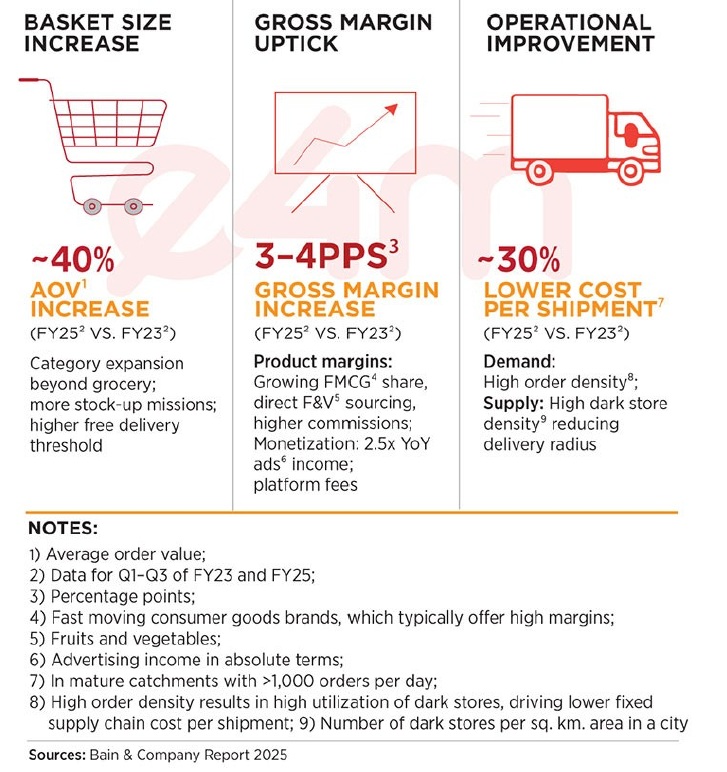
If FY25 was about building scale, FY26 is definitely shaping up to be about pricing power. With consumer adoption of 10–20-minute delivery apps surging, advertisers are competing for limited inventory, pushing ad rates up by 30–50% year-on-year.
“Ad rates on quick commerce platforms have surged by 30–40% year-onyear, especially during high-impact windows like festive seasons and major cricket events. This is fuelled by rising user engagement and proven performance outcomes. With more sophisticated ad formats and attribution models now in play, advertisers increasingly view the premium as justified,” added Uday Mohan, COO, Havas Media India & Havas Play.
Scale, Pricing & Soaring Ad Rates
While agencies point to surging demand, market data shows that platforms themselves are firming up monetisation models with steep onboarding thresholds.
As per market estimations, Swiggy Instamart offers tiered onboarding packages ranging from ₹4.5 lakh to ₹10 lakh, adjustable against advertising spends over a three-month period. Zepto reportedly asks new or small brands to commit anywhere between ₹2 lakh and ₹7 lakh per month on ads, depending on the category. Blinkit, on the other hand, charges ₹25,000 per SKU per state as a non-refundable onboarding fee, which is credited to the brand’s ad wallet.
This aggressive push comes against the backdrop of a sector that has grown at breakneck speed. According to CareEdge Analytics’ July 2025 data, India’s quick commerce market was valued at around ₹64,000 crore in FY25, growing at a staggering 142% CAGR during FY22–FY25 on the back of evolving consumer preferences, hyperlocal infrastructure, and a low base.
The momentum is expected to continue with strong double-digit growth over the next few years, as adoption deepens in Tier II & III cities, delivery networks expand, and instant fulfilment becomes mainstream.
At the same time, platforms are pivoting from pure hypergrowth to sustainable profitability—tapping into advertising, subscriptions, private labels and tech-led inventory optimization as key revenue levers. This shift is being enabled by India’s expanding digital backbone: with over 1.12 billion mobile connections and 806 million internet users (a 6.5% YoY rise), the country is projected to cross 900 million internet users by the end of 2025. Rising smartphone penetration in both urban and rural areas, aided by affordable data and policy support, has created one of the world’s largest online consumer pools, with 270 million e-shoppers in 2024, making India the second-largest e-retail market globally.
Unsurprisingly, advertisers are flocking to these platforms because that’s where their consumers are. Even though seller commissions contribute the bulk of revenues (68–74%), ad placements and brand boosts already account for 9–11%. Industry data shows that ad rates on quick commerce apps have climbed by 30–50% in just a year, with premiums doubling during high-impact windows like festivals and cricket tournaments. This steep inflation reflects both rising consumer traffic and the limited nature of in-app inventory, pushing brands to pay top dollar for guaranteed visibility at the point of purchase.
Bain’s ‘How India Shops Online 2025’ report also underscores this momentum: beauty, personal care, and snacking categories are already outpacing overall e-retail growth, and these are the very segments leaning most aggressively into quick commerce ads.
“Ad rates on quick commerce platforms have jumped by nearly 40–50% compared to last year. This spike reflects that premium brands are willing to pay for immediacy and guaranteed visibility, where ad placement directly links to instant purchase behaviour,” said Mandar Lande, founder of Waayu, a zero-commission food delivery app in India.
According to Aditya Aima, Managing Director, Growth Markets; Co-MD, India & MENA, AnyMind Group, ad rates on quick commerce platforms have not only risen but demand has intensified. “The surge is fuelled by three dynamics: sticky consumer behavior with high visit frequency, dense purchase intent compared to social or entertainment platforms, and the scarcity of ad real estate.”
Quick commerce becomes a strategic channel
For brands, quick commerce has moved far beyond being a fulfillment partner. It has become a strategic advertising channel, especially for those in fast-moving and competitive categories like beauty, wellness, snacks, and personal care. The platforms offer not just last-mile delivery but also front-of-shelf visibility in an increasingly cluttered digital environment.
According to Seshu Kumar Tirumala, Chief Buying and Merchandising Officer, bigbasket, “Brands are moving beyond purely search-centric strategies and increasingly adopting immersive display activations with formats like Spotlight Videos, Banners with Add-to-Cart (ATC), targeted banners, and ATC widgets. For established brands, most investments still flow into performance-led formats such as Sponsored/PLA ads, while a portion is reserved for top-funnel initiatives like storytelling, new launches, and high-visibility events. Emerging or smaller brands usually begin with awareness and consideration campaigns before shifting focus toward performance once they’ve built stronger customer connections.” Unlike marketplaces or social media, quick commerce blends data-led targeting, high engagement, and measurable ROI.
Many brands pair Q-comm placements with collab ads on Meta, Google, and Criteo to build visibility while keeping consumers engaged across the funnel. This creates a sharper, closed-loop system where awareness, consideration, and conversion happen almost instantly. “D2C brands have been rapidly scaling up ad spends on quick commerce platforms, up to 40–50% year-on-year, with a significant share during the festive season. Among the key reasons are fast-growing adoption of Qcomm by consumers and better ROI than marketplaces,” said Shrikant Shenoy, AVP at Lodestar UM.
What sets this instant delivery model apart is its ability to compress the purchase journey. Marketplaces drive comparisons, and social platforms spark discovery, but Q-comm taps into impulse buying with SKU-level attribution.
“The quick delivery model encourages impulse purchases and immediate gratification shopping, which is particularly valuable for D2C brands. Qcomm platforms have lower competition density, and ad formats are more native and less cluttered than traditional e-commerce,” said Devangshu Dutta, founder of Third Eyesight.
“When someone opens Blinkit or Zepto, they’re usually in active purchase mode, not just browsing. For consumables, personal care, or lifestyle products, this is the sweet spot of marketing,” Dutta noted.
“Ad rates on quick commerce have gone up by more than 20% in the last year. If you want a prime slot, say a homepage banner in a big city, you might even be paying 50% more than last year. Because every brand wants it. When a Blinkit or Swiggy placement can move your product in minutes, not weeks, those ads aren’t just distribution, they are discovery,” said Mohit Singh, Head of Product at Zippee, a quick commerce logistics platform.
Meanwhile, pricing pressures are only going up. Ratnakar Bharti, VP, Media, Mudramax said, “Quick commerce isn’t just ‘fast delivery’ anymore, it has become high-intent retail media sitting right next to the ‘add to cart’ button, with sales that can be measured in real time. Quick commerce platforms say their ads business grew 5X in a year to about $200M ARR. At that kind of scale, inventory quality improves, targeting gets sharper, and the medium starts looking like the next big retail media play.”
“In a nutshell, expect meaningfully higher prices in peak weeks — often up to 2x — and a higher year-round floor price due to steeper minimums and fees. The trade-off is harder proof of sales at the exact SKU, which is why demand and prices are rising,” Bharti added.
“Brands pay a premium for Q-Comm because it drives sales at the point of purchase. What began as experimental spends has now become a steady line item in media plans, thanks to strong ROI and proven results,” added Jatin Kapoor, MD, AdsFlourish.
Beauty, beverages & snacking lead the charge
Notably, not all categories are leaning on quick commerce equally. Industry executives point out that beauty & personal care, beverages, snacking, and wellness are the biggest spenders, given their high repeatability, impulse-driven nature, and urban skew.
Beauty and personal care brands, for instance, are using Q-comm not just to drive trial packs and quick replenishment, but also to run festival-led campaigns targeting affluent millennials. Similarly, beverages and packaged snacks are thriving on the “in-the-moment” consumption occasions that these apps uniquely enable.
“The biggest spenders are beverages, beauty, packaged foods, and wellness. Those categories thrive on impulse and repeat consumption, which is exactly what quick commerce delivers best,” Singh added. As per many industry experts, wellness and lifestyle brands, too, are seeing outsized returns. From daily supplements to discreet personal care items, quick commerce is proving to be a low-friction purchase environment with high conversion rates.
“Quick commerce platforms have lower competition density, and ad formats are more native and less cluttered than traditional e-commerce,” explained Dutta.
Media buyers also note that Q-comm platforms are evolving fast, offering more contextual in-app placements and data-driven targeting. This is creating a level playing field for challenger brands that lack legacy shelf space in offline retail.
“Quick commerce advertising is inherently contextual. A beverage or snack brand running an IPL campaign is literally tapping into the consumer’s 15-minute window of intent, it’s that instant,” added Mohan.
With ad rates on quick commerce platforms climbing 30–50% year-on-year, it’s clear the medium is shifting from experimental budgets to a core retail media channel. However, with competition heating up, festive weeks commanding 2X pricing, and minimum spends rising, the question is: how long before quick commerce ads start resembling the crowded, high-cost landscape of traditional e-commerce marketplaces?
(Published in Exchange4Media)
admin
August 6, 2025

Naini Thaker, Forbes India
Aug 06, 2025
It’s a known fact that of the thousands of startups founded each year, only a small fraction survive—and even fewer scale to become unicorns. Rarer still are those unicorns which, after reaching dizzying heights, come crashing down. The Good Glamm Group is one such cautionary tale.
Once celebrated as a unicorn that cracked the code on content-to-commerce, the company’s meteoric rise was matched only by the speed of its unravelling. At the heart of its downfall lies a critical misstep: The relentless pursuit of growth through acquisitions and brand launches, even as cracks in its house-of-brands model began to show. Instead of pausing to consolidate and build sustainably, Good Glamm doubled down—prioritising valuation over viability.
That strategy came to a head on July 23 when founder and CEO Darpan Sanghvi announced the dissolution of the group’s house-of-brands structure. In a LinkedIn post, Sanghvi confirmed that lenders would now oversee the sale of individual brands, effectively ending the company’s vision of building a digital-first FMCG conglomerate.
Despite raising $30 million in 2024 and undergoing multiple rounds of restructuring, the group failed to integrate its acquisitions or generate sustainable profitability. With key investors such as Accel and Bessemer Venture Partners exiting the board and leadership turnover accelerating, the company’s ambitious empire—built on rapid expansion and aggressive brand aggregation—has now been reduced to a lender-led breakup.
In the aftermath of the announcement, Sanghvi offered a candid reflection on what went wrong. “In hindsight, it wasn’t one decision, one market force, or one acquisition. It was three levers we pulled, which together, turned Momentum into a Trap,” he wrote in a LinkedIn post. According to Sanghvi, the group’s downfall stemmed from doing “too much, too fast and too big”.
He elaborated: “At first, Momentum feels like your greatest ally. Every headline, every funding round, every big launch is a shot of adrenaline. And you start believing you can do more and more and more. But momentum has a dark side. If you stop steering and go in a hundred different directions, it doesn’t just carry you forward, it drags you faster and faster until you can’t breathe.”
Where The Model Broke?
In October 2017, Sanghvi launched direct-to-consumer (DTC) beauty brand MyGlamm. Most brands at the time were big on selling on marketplaces such as Amazon or Nykaa. However, Sanghvi believed, “We wanted to be truly DTC and not just digitally enabled. We believed that to own the customer, the transaction needs to happen on our own platform.”
But the biggest challenge with being a DTC brand is its customer acquisition cost (CAC). Towards the end of 2019, the company was spending about $15 (over ₹1,000) to acquire a customer to transact on their website. “Around the same time, our revenue run rate was ₹100 crore. We were spending about $0.5 million to acquire 30,000 customers a month. That’s when we realised it was time to solve the CAC problem,” Sanghvi told Forbes India in 2022. In an attempt to find a solution, Sanghvi turned to the content-to-commerce model.
And then, started the acquisition spree. According to Sanghvi, with a single brand in a single category one can’t build scale. He told Forbes India, “The most you can scale it is ₹1,000 crore, if you want a company that’s doing ₹8,000 or ₹10,000 crore in revenue, it has to be multiple brands across multiple categories.” In hindsight, this perspective might be debatable.
As Devangshu Dutta, founder of consultancy Third Eyesight, points out, the “house of brands” model is essentially a modern-day consumer-facing business conglomerate—and its success hinges on multiple factors working in harmony. While there are examples globally and in India of such models thriving, both privately and publicly, the reality is far more nuanced. “Brands take time to grow, and organisations take time to mature,” Dutta notes, emphasising that rapid aggregation of founder-led businesses under a single ownership umbrella is no guarantee of success.
In recent years, Dutta feels the influx of capital into early-stage startups and copycat models—often seen as lower risk due to their success in other geographies—has shortened business lifecycles and inflated expectations. The hope is that synergies across the portfolio will unlock outsized value, but that rarely plays out as planned. “It is well-documented that more than 70 percent of mergers and acquisitions fail,” he adds, citing reasons such as weak brand fundamentals, lack of synergy, inadequate capital, limited management bandwidth, and internal misalignment.
In the case of Good Glamm, these fault lines became increasingly visible as the group expanded faster than it could integrate or stabilise.
Scaling Without Steering
In FY21, the company had losses of ₹43.63 crore, which rose to ₹362.5 crore in FY22 and went up to ₹917 crore in FY23. Despite the mounting losses, Good Glamm marked its entry into the US market, in a joint venture with tennis player Serena Williams to launch a new brand—Wyn Beauty by Serena Williams. The launch was in partnership with US-based beauty retailer Ulta Beauty.
For its international expansion, it invested close to ₹250 crore over three years. “We anticipate that the international business will account for 25 to 35 percent of our total group revenues by the end of next year. This strategic focus on international expansion is pivotal as we prepare for our IPO in October 2025,” he told Forbes India in April 2024.
Clearly, things didn’t pan out as expected. As Sanghvi rightly points out, it was indeed a momentum trap. “You tell yourself you’ll fix the leaks after the next milestone. But the milestones keep coming, and so do the leaks. Soon, you’re running from fire to fire, never realising that the whole building is getting hotter. And somewhere along the way, you lose the stillness to think,” he writes on his LinkedIn post.
Dutta feels that a strong balance sheet is the most fundamental requirement, “to provide growth-funding for the acquisitions or for allowing the time needed for the acquisitions to mature into self-sustaining businesses over years. In the case of VC-funded businesses, the pressure to scale in a short time can go against what may be best for the business or for its individual brands”.
The Good Glamm Group’s fall is a reminder that scale alone doesn’t build resilience. Its story reflects the risks of expanding faster than a business can integrate, and of prioritising valuation over value. The house-of-brands model can work—but only when backed by strategic clarity, operational discipline, and patience. This is less a warning and more a reminder for founders: Scale is not success, and speed is not strategy.
(Published in Forbes India)
admin
July 28, 2025
By Meenakshi Verma Ambwani, Hindu Businessline
New Delhi, July 28, 2025
Nykaa said that Kay Beauty, co-founded with actor Katrina Kaif, has crossed the ₹240 crore mark in terms of Gross Merchandise Value.
Stars from the tinsel town are donning the entrepreneurial hat to venture into the beauty and fashion business space. Some have even succeeded in growing their brands sustainably, earning big bucks.
Take for instance Skincare brand Hyphen, co-founded by actor Kriti Sanon with Pep Brands, which recently touched the ₹400 crore-mark in Annual Recurring Revenues.
Tarun Sharma, CEO and co-founder, Hyphen told businessline: “The brand is witnessing healthy growth rate quarter-on-quarter. In the first year itself, it touched ₹100 crore ARR. We had aimed for ₹500 crore ARR in 3-4 years and, within two years, we are at ₹400crore ARR.” Pep Brands led by Sharma owns mCaffeine and Hyphen.
The model that works
Sharma believes an operator-led, celebrity anchored model works better. ”The operator can bring in the necessary financial and execution muscle. If a celeb partners with an operator that has deep expertise in the space, then there is huge potential for growth,” he added.
“Product launches, marketing and distribution are very data-driven at Pep Brands. It guides us on what to launch, when to launch, and how to launch products. That has helped Hyphen in achieving this kind of growth rate. It is by design that the majority of the business of Hyphen is D2C,” Sharma explained.
In May, Nykaa said that Kay Beauty, co-founded with actor Katrina Kaif, has crossed the ₹240 crore mark in terms of Gross Merchandise Value. On an earnings call for Q4FY25, Adwaita Nayar, Executive Director, Chief Executive Officer, Nykaa Fashion, said: “Kay Beauty is one of the fastest-growing brands on the platform. It’s hit about ₹240 crore of GMV. The innovations have been fantastic this year. So, it is quite a premium brand, and I think the consumers are accepting it even at that price point. It’s got great gross margins.”
Earlier this year, Reliance Retail Ventures announced that it has decided to acquire 51 per cent stake in Ed-a-Mamma , a kid and maternity wear brand founded by actor Alia Bhatt. According to some reports, Hrithik Roshan’s sportswear brand HRX is a ₹1,000 crore brand.
Among the recent entrants are Ranbir Kapoor, who has decided to foray in the apparel and accessories space with ARKS. Launched in February, the brand has also launched its first store in Mumbai, followed by a second store in New Delhi and another with Broadway in Hyderabad.
‘Shift in preferences’
Abhinav Verma, co-founder and CEO, ARKS, told businessline: “We are seeing a shift in consumer preferences towards made-in-India brands. We decided to leverage on the strong manufacturing capability that India has to build a brand that is both aspirational and offers value. We are looking to build a ₹100 crore brand in the next 3-4 years with a strong omni-channel strategy.”
“The success of some of these brands demonstrates that building on consumer relevance and with powerful time-bound execution, celebrity ventures can become significant players in a crowded market. With consumer demand for relatability and digital-first branding on the rise, this segment will definitely grow. However, only brands that offer genuine value to consumers, and not just star appeal, are likely to endure,” said Devangshu Dutta, CEO, Third Eyesight.
(Published in The Hindu-Businessline)
admin
July 28, 2025

Ananditha Anand, Deccan Chronicle (Hyderabad Chronicle)
Hyderabad, 28 July 2025
Beauty is borrowing from the bakery. Be it glazed donut skin, popularised by Hailey Bieber, jam lips, or strawberry freckles – food related makeup looks, as well as cosmetic marketing trends have been at an all-time high. In June 2025, around 2 lakh users looked up latte makeup on the image-based social media platform, Pinterest.
The Novelty Value
According to social-media-influencer Yashvi Bhaia, these trends bring a sense of novelty to cosmetic products. “Take a look at one of the body washes called Whipped Lush. It feels exactly like whipped cream – fluffy, foamy and sweet. This visual being attached to the product brings a pleasant connection,” she says.
Devangshu Dutta, founder of Third Eyesight, a management consulting firm, says, “Terms like choco mousse blush or berry lip tint evokes indulgence, comfort, and a sense of reward, transforming cosmetics into emotional experiences rather than just functional items.” Dutta likened these products to comforting treats, exuding warmth and a nostalgia for food they have consumed before, bottled in these makeup products.
Dhanashree Kavitkar is an avid follower of makeup trends on platforms like Instagram, as well as Chinese sites like Douyin and Red Note. She observes that the melding of the sensory elements of food and makeup “satisfied” the consumer.
“It works almost the same way ASMR does. When I think of jelly lips, I think edible, with a plump and glossy texture. And it just hits the right spot in my brain,” she says.
She also believes that many of these beauty trends, under the guise of novelty, are repackaging pre-existing makeup trends to make it appealing again. “Take strawberry freckle makeup for example, it is literally just drawing freckles on your face, but they gave it a new name to intrigue people,” she says.
Bina Punjani, owner of Bina Punjani Hair Studio says, “These are all marketing buzz-words created by online makeup companies, who wish to advertise to a younger audience.” She explains that food related nomenclature has existed forever in the realm of hair care products, with wines, chocolates, and caramels dominating the hair colour market.
“Sensory feelings have been a huge part of marketing and communication, be it on television, or anywhere else,” said Bhaia. “Now that marketing is so video-forward online, brands will create visuals associated with food,” she says.
Dutta adds that rather than a new concept, the increased intensity and consistency of these beauty brands employing food-related marketing on social media platforms differentiate it from their marketing in the 1980s – when it was first popularised.
Cultural Adaptation
Talking about the virality aspect of these makeup trends, Kavitkar points out how the looks trending in India (and around the world right now), were popular in East Asian countries like China and South Korea a year ago.
“Thanks to the matcha wave now, strawberry matcha makeup is popular. More East Asian food items like mochi and tanghulu have also picked up steam in the makeup space, and have gotten popular globally. But they can feel a bit alien to Indian consumers who don’t know these trends beforehand,” she says. Bhaia talks about how Indian cosmetic products adapted these trends to cater to the Indian “taste.” A leading brand has come up with lip products named masala chai, and jalebi glaze.
“These are such Indian terms, and they’ve been marketed so well. When you think of jalebi, you think of this shiny, orange-ish kind of thing, and you have a very clear visual of it.”
Just Another Trend
What keeps the novelty of these trends alive? Punjani thinks that it is the familiarity that we as humans draw towards nature and ourselves. “Suppose you look at your skin tone, and you see that exact shade in a pear – you end up drawing a psychological connection between the two,” she says.
Kavitkar thinks that they bring in a new wave of experimentation. She says, “Look at tangerine dream makeup. It is a mix of yellow and orange blush on your face, which looks so weird. If you saw someone wearing yellow blush outside, you’d be like, what the hell is she wearing? But that’s the beauty of this look, it’s so out of the box.”
Dutta notes that the frequency of usage of any imagery in the industry ebbs and flows with fashions. “Food, however, consistently provides an intuitive, emotional, and relatable entry point for consumers to engage with beauty, and will remain a versatile tool for building stories around pleasure, nostalgia, authenticity, and self-care,” he says.
While the world goes ‘bananas’ over ‘latte makeup’ and ‘gingerbread nails’ you can try the silent power of ‘smokey eyes’ and nude lips!
(Published in Deccan Chronicle)
admin
July 27, 2025
Alenjith K Johny & Ajay Rag, Economic Times
Jul 27, 2025
Startups in the 60-minute fashion delivery segment are betting on features such as ‘try and buy’ and artificial intelligence (AI)-powered virtual try-ons to tackle high return rates, a key pain point in the segment. These tools are helping increase conversion rates and reduce returns while offering greater flexibility to buyers, said industry executives.
Mumbai-based Knot, which recently raised funding from venture capital firm Kae Capital, said partner brands that typically see return rates of about 20% on their direct-to-consumer websites are witnessing sub-1% returns through offline stores, a trend it is now replicating through these digital features.
“Our partner brands, which have offline stores, would typically witness 20% returns on their direct to consumer websites. But for the same purchases on offline stores, the returns are less than 1%. That is the idea. With the ‘try and buy’ feature, users can make a very decisive purchase at their doorstep,” Archit Nanda, CEO of Knot, told ET.
Return rates among users of the company’s virtual try-on feature are similarly much lower than the platform’s overall user base, he said.
Other venture-backed quick fashion delivery startups such as Bengaluru-based Slikk, Mumbai-based Zilo and Gurugram-based Zulu Club are also testing similar features to increase conversions and reduce returns.
“Returns play as big a part as maybe forward delivery does. Because these are expensive products, giving the customer his or her money back also plays a very critical role,” said Akshay Gulati, cofounder and CEO of Slikk.
Instant returns
Slikk is piloting an ‘instant returns’ feature where, like its 60-minute delivery service, returns are also completed within an hour. Once a return request is made on the app, a delivery partner picks up the product and refunds the amount instantly. The startup claims its return rate is 40-50% lower than that of traditional marketplaces and that it doesn’t charge customers any extra fees for returns.
Some users said they were satisfied with the delivery speed and trial window but pointed out that the app does not provide any return status updates until the product reaches the warehouse.
“I received my order within 60 minutes and had enough time to try it out. However, after returning the product, I didn’t receive any notification in the application until the delivery agent reached the warehouse,” said Mohammed Shibili, a working professional based in Bengaluru, who tried Slikk’s feature.
Investor interest
Investors tracking the segment estimate that try-and-buy and virtual try-on features can reduce return rates by 15-20 percentage points, translating into substantial cost savings for both platforms and brands.
“Features like try and buy are a huge cost save, not just for the platform but also for the brand. The brand otherwise would lose that inventory till it comes back and can’t make the sale on it. But now, that’s all getting quickly turned around. So, for the brand, it’s a win-win situation as well as for the customer where the money is not getting stuck till it gets the returns refunded,” said Sunitha Viswanathan, partner at Kae Capital.
Old model, new infrastructure
Flipkart-owned fashion etailer Myntra had introduced try and buy back in 2016 to attract traditional shoppers to online retail. However, the feature didn’t scale up due to supply chain limitations, according to industry executives.
“Back when Myntra launched ‘try and buy’, there was no hyperlocal delivery infrastructure. Deliveries were through national courier services. That model isn’t feasible to try and buy unless you have your own hyperlocal delivery fleet,” the founder of a fashion delivery startup said on condition of anonymity.
The founder added that while Myntra operated from large warehouses located on the outskirts of cities, the new-age supply chains are built within cities, allowing faster deliveries and enabling features like try and buy.
By the end of last year, Myntra had launched M-Now, an ultra-fast delivery service currently live in Bengaluru, Mumbai and Delhi, with pilots in other cities. The company said daily orders through M-Now doubled in the last quarter.
“Although it’s still early, our observations so far suggest that the quick delivery model, with its reduced wait time, attracts high-intent customers, leading to naturally lower return rates,” said a spokesperson for Myntra.
The etailer did not confirm whether the try-and-buy feature is being tested under M-Now.
Viability concerns persist
Despite the benefits, the long-term viability of these features is open to question, experts said.
“There is a cost to also providing these services (like try and buy), and whether that becomes viable at all is a question mark at this point of time. I think that’s what the concern is, and it has not been that viable,” said Devangshu Dutta, founder of Third Eyesight, a management consulting firm focused on consumer goods and retail industries.
He added that when platforms offer the try-and-buy feature, delivery executives have to wait while customers try on products, which increases the cost per delivery and reduces the number of deliveries that can be completed. Despite that, some items may still be returned, further impacting operational efficiency.
However, startups are experimenting with these features mainly on higher-margin products to offset operational costs, Dutta said, as return rates across fashion categories can range from under 10% to as high as 40% for certain items.
(Published in Economic Times)
