
admin
November 4, 2025
Yash Bhatia, IMPACT
4 November 2025
It started with groceries. Quick commerce started delivering milk, bread, and eggs in 10–15 minutes, which seemed revolutionary enough in 2022. Then came the iPhone 14 launch, and suddenly, quick commerce wasn’t just about convenience; it was about spectacle. Overnight, India’s app-based delivery ecosystem became the stage for a new ritual: flagship products arriving at your doorstep faster than you can say ‘checkout.’
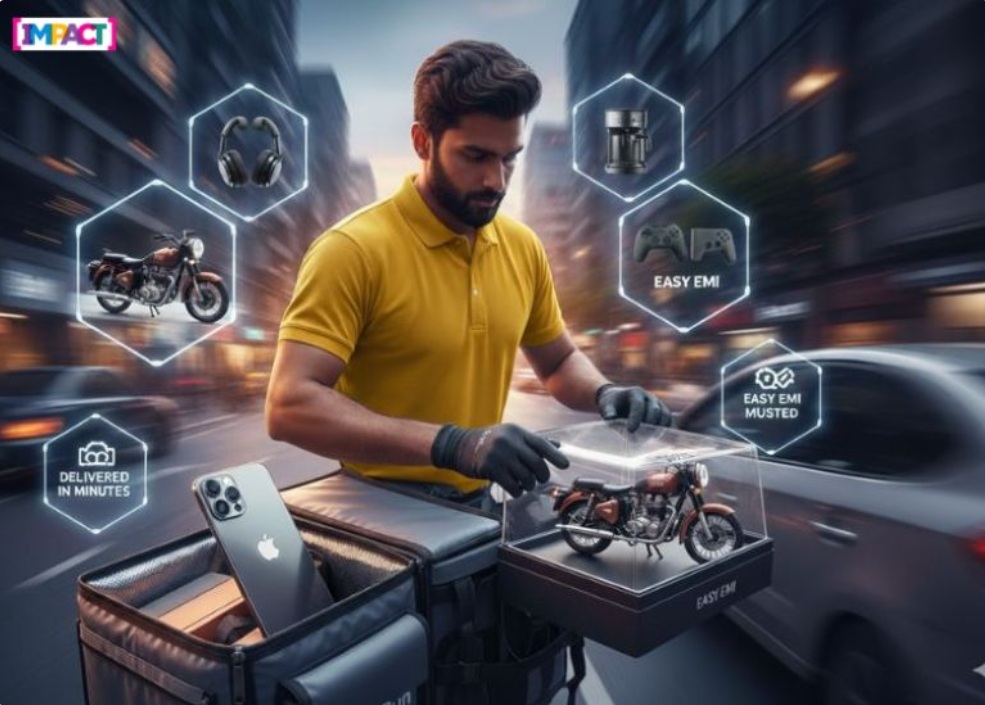
And now? Phones aren’t the limit. You can even order motorcycles online. Yes, motorcycles. Royal Enfield has partnered with Flipkart to list its entire 350cc portfolio, which will be delivered to five cities: Bengaluru, Gurugram, Kolkata, Lucknow, and Mumbai.
The lines between e-commerce and quick commerce are becoming increasingly blurred. Flipkart’s Flipkart Minutes and Amazon’s instant delivery options are proof that speed is no longer a differentiator; it’s table stakes. And as platforms race to expand, high-ticket items are joining the frenzy, from electronics and furniture to watches, fitness equipment, and premium kitchen appliances. For platforms, these products are goldmines of margin; the challenge lies in logistics and consumer trust.
According to a report by CareEdge Advisory, India had over 270 million online shoppers in 2024, making it the second-largest e-retail user base globally, while the e-commerce market grew 23.8% in 2024 over the year-ago period, it said. The report also added that Indians ordered Rs 64,000 crore of goods from quick-commerce platforms.
From the consumer standpoint, one of the challenges for consumers to buy high-ticket items from the quick commerce platforms is to get consumer trust, which used to be the case when e-commerce started its operations. Can quick commerce move to high-ticket items? Is quick commerce looking at these items as a branding exercise, or are they looking at them as a serious revenue stream channel?
Chirag Taneja, Founder & CEO, GoKwik – an e-commerce enablement platform, says what began as a branding exercise for D2C brands has now evolved into a credible revenue stream. “In the early days, high-ticket categories on D2C platforms saw limited traction,” he explains. “Trust was still being built, customers were unsure if their orders would even reach them. There were many friction points.”
But that’s no longer the case. According to GoKwik’s network data, high-ticket purchases (above ₹2,500) are no longer outliers, they’re becoming a consistent driver of topline revenue.
Interestingly, most of these premium purchases are powered by credit instruments from no-cost EMIs to instant credit options at checkout. “This reflects a clear shift in mindset,” says Taneja. “Consumers no longer view high-value spending as a financial strain. They see it as a set of manageable, bite-sized payments that help them aspire higher, quicker. It’s not just a financial enabler, it’s a psychological unlock that makes premium consumption feel accessible and routine,” he adds.
“With strong trust in delivery reliability, smooth returns, and credible brand backing, the ecosystem has bridged the gap that once kept premium shopping offline,” says Taneja.
Devangshu Dutta, Founder of a specialist consulting firm, Third Eyesight, thinks differently and points out that high-value items still make up a small slice of quick commerce sales. “The model thrives on simplicity, a limited product range on the platform’s end, and quick, low-friction decision-making on the consumer’s,” he explains.
That said, Dutta believes quick commerce can still play a strategic role for premium brands. “For high-value products, q-comm can be an excellent lever for driving velocity, testing market response, or amplifying brand visibility. But it should be viewed as one piece of the channel mix, not the primary sales driver.”
From the platform’s perspective, however, listing high-ticket products brings its own upside. “They create excitement, boost average transaction values, and improve realised margins,” Dutta notes. “Consumers are often drawn in by novelty, exclusivity, or status appeal, especially during big launches or limited-time promotions.”
Still, he adds a note of realism: “Premium and high-ticket purchases largely remain planned decisions. Most consumers continue to prefer established offline and e-commerce channels for such buys where trust in authenticity, return policies, and after-sales services still carry greater weight than instant gratification.”
Seshu Kumar Tirumala, Chief Buying and Merchandising Officer, BigBasket, says the company doesn’t look at electronics as a high-ticket item category but rather focuses on building a complete category experience for customers. “For example, if we list an Enfield bike, we’d also want to offer spare parts, servicing options, and extended warranties, because that’s how the category functions,” he explains.
Tirumala adds that BigBasket adopted the same approach when it ventured into mobiles and mobile accessories. “When we launched this category last year, it was a trial. Today, it’s a sizable part of our business,” he says. Currently, electronics and mobile accessories contribute 5–10% of BigBasket’s monthly sales, having grown 250–300% year-on-year since the first iPhone launch on the platform.
While the launch day drives the highest demand for flagship devices like the iPhone, Tirumala notes that the following one to two months see strong accessory sales, from AirPods and headphones to chargers and power banks. “On average, mobiles and accessories account for 7–8% of our total sales, peaking at 10% during the festive season. Overall, this category has grown from zero to 7–8% of our total business in just a year, and we expect it to reach around 25% next year,” he adds.
Currently, the platform offers select models from smartphone brands, including OnePlus, Realme, Redmi, Vivo, and Oppo.
The Bengaluru-based platform is now piloting the delivery of large home appliances across across select city areas in partnership with Croma. If successful, BigBasket plans to expand this model to other cities, further broadening its quick commerce offering beyond everyday essentials.
Taneja points out that the traditional e-commerce model, once driven by discounts and affordability, is now evolving toward experience and access. Over the next few years, two major shifts will shape this transformation: credit-first commerce, where EMIs become the default mode for premium purchases, and aspirational commerce, where consumers view e-commerce as the easiest path to lifestyle upgrades. Consequently, platforms will need to reposition themselves from being “where you save more” to “where you unlock more”, prioritising personalisation, trust, and a seamless shopping experience.
As quick commerce matures, it is no longer just about instant gratification; it’s becoming a bridge between aspiration and accessibility.
Platforms are proving that speed, trust, and seamless experience can coexist with high-value purchases.
(Published in IMPACT)
admin
October 24, 2025

Entrepreneur India
Oct 23, 2025
Indian consumers are increasingly opting for private labels and in-house brands over established ones, and retailers are taking note. According to EY’s ‘Future Consumer Index 2025’, more than half of India’s consumers are now choosing in-house brands over legacy labels.
The report highlights that 52 per cent of Indian consumers have switched to private labels for better value, while 70 per cent believe these in-house brands offer comparable or superior quality. Backed by this shift, retailers from BigBasket to DMart, and quick-commerce players like Zepto and Blinkit, are doubling down on their private label strategies, viewing them as a path to higher margins, stronger brand loyalty, and greater pricing control.
“Indian consumers’ growing preference for private labels reflects both short-term price pressures and a longer-term structural evolution in retail,” said Devangshu Dutta, CEO of Third Eyesight, speaking to Entrepreneur India.
Trending globally
The surge isn’t unique to India. A recent report by the Institute of Grocery Distribution (IGD) notes that globally, private labels now account for over 45 per cent of grocery volume and are expanding faster than legacy brands.
In India, this shift is becoming increasingly visible in-store. The EY report found that 74 per cent of consumers have noticed more private label options where they shop, and 70 per cent say these products are now displayed more prominently, often placed at eye level, signalling a strategic retail push.
Commenting on this trend, Angshuman Bhattacharya, Partner and National Leader, Consumer Products and Retail Sector, EY-Parthenon, said, “Consumer behaviour has traditionally evolved in response to changing economic situations, but the current shifts appear to be more permanent. Retailers are confidently launching private labels and allocating prime shelf space to them, while technology is enhancing the shopping experience by providing consumers with limitless options and the ability to compare products.”
From price-fighters to power brands
According to Dutta, private labels are no longer just “copycat” alternatives meant to undercut national brands.
“For retailers, not just in India but globally, lookalike private labels used to be tools at the opening price point to hook the customer, who saw them as credible, affordable alternatives to national brands,” he explained, adding, “However, as retailers have grown, they have gained both scale and expertise to widen and deepen their supply chains.”
Over time, he said, investments in formulation, packaging, and quality consistency have increased consumer trust.
“Private labels now compete on functional benefits rather than only on price, particularly in food staples and apparel, but also in brown goods and white goods, and increasingly in personal care and other FMCG categories,” he added. [Must read: “Private Label Maturity Model”]
Retailers scale up private labels
As demand for in-house brands grows, retailers are scaling up their strategies across sectors.
BigBasket, one of India’s largest online grocery platforms, reported that 35–40 per cent of its FY24 sales came from private labels like Fresho, BB Royal, and Tasties. The company aims to push this share closer to 45 per cent through expansion in frozen foods and ready-to-eat categories.
DMart’s private label arm, Align Retail, has reportedly more than doubled its sales in two years, touching INR 3,322 crore in FY25. The retailer’s in-house brands in staples, apparel, and home essentials have helped boost margins in a highly competitive retail landscape.
Zepto, the quick-commerce player, is taking private labels into the 10-minute delivery domain. Its brand Relish, focused on meats and eggs, has achieved INR 40 crore in monthly sales.
Meanwhile, Reliance Retail has also expanded its portfolio of private labels, including Good Life, Enzo, and Puric, across groceries, personal care, and household products, strengthening its broader FMCG play. In 2024, Reliance Retail’s Tira Beauty also announced the launch of its latest private label brand, Nails Our Way, signifying a major expansion in its beauty offerings.
Capturing a lion’s share in retail
Dutta noted that in India, private labels will remain a core pillar of modern retail strategy rather than a cyclical response to cost pressures.
“Consumers increasingly view retailers as brand owners rather than intermediaries. As private labels mature in branding and innovation, their growth aligns more and more with brand equity development rather than just opportunistic cost-saving,” he said.
From a retailer’s perspective, private labels deliver higher gross margins and greater strategic control, Dutta said. [Must read: “Private Label Maturity Model”]
Another report by the Private Label Manufacturers Association (PLMA), using Circana data, found that in 2024, private-label sales in food and non-edible categories grew faster than bigger brands globally. While figures vary by region and quarter, the pattern remains consistent: private labels are outpacing traditional FMCG growth.
Collectively, these shifts show that private labels are becoming a major revenue driver for retailers in India, and are fast evolving from value alternatives into brands with genuine consumer pull.
(Published in Entrepreneur India)
admin
August 5, 2025

Aakriti Bansal, Medianama
August 5, 2025
MediaNama’s Take: Swiggy is shifting from individual convenience to workplace capture. With DeskEats and Corporate Rewards, the company is embedding itself directly into the workday. This move is not just about food delivery. It is about becoming part of employees’ daily routines. More repetition leads to more orders, stronger retention, and access to a new layer of user behaviour: professional identity.
This approach draws from older models like office canteens and Sodexo meal cards. However, Swiggy reworks it for the app economy. Instead of fixed menus or closed ecosystems, it offers personalized choices tied to employer-subsidised benefits. That creates stickiness. When a company supports one app and offers discounts, switching becomes less likely.
The key question now is whether this integration creates lasting value or opens up new responsibilities. These include questions around consent, profiling, and where to draw the line between workplace systems and digital platforms.
What’s the News
Swiggy rolled out DeskEats, a curated food delivery collection for working professionals, in 30 cities and over 7,000 corporate hubs, according to Storyboard18. MediaNama also reviewed the feature on the Swiggy app. The collection includes categories like Stress Munchies, Healthy Nibbles, One-Handed Grabbies, and Deadline Desserts, aimed at common workday cravings.
During the pilot, DeskEats reached 14,000 companies and 1.5 lakh employees. Users can find it in the app by typing “Office” or “Work.”

Swiggy also launched Corporate Rewards, which lets users access benefits by verifying their work email. These include flat Rs 225 off food orders, Rs 2,000 off on Dineout, and Rs 100 off on Instamart.

On LinkedIn, Swiggy VP Deepak Maloo described Corporate Rewards as the professional version of its earlier Student Rewards program which offers perks like free deliveries, flat Rs 200 discounts, and deals starting at Rs 49, tailored for students aged 18–25 across India.
Financial Context
Swiggy may have launched DeskEats while under pressure to control its burn. In Q1 FY26, it spent Rs 1,036 crore on ads—a 132% jump and posted a loss of Rs 1,197 crore. DeskEats and Corporate Rewards offer a way to stabilise repeat orders without over-relying on discounts or ad spending.
The company’s adjusted Earnings Before Interest, Taxes, Depreciation and Amortisation (EBITDA) loss widened to Rs 813 crore. Overall, food delivery revenue grew by 20.2% year-over-year to Rs 2,080 crore, with order volume growing by 23.3%. At the same time, newer formats like ultrafast Bolt and SNACC are aimed at increasing consumption frequency and improving retention. These efforts signal Swiggy’s larger bet on everyday integration to drive value.
Platform Strategy and Corporate Integration
DeskEats gives Swiggy access to dense, time-sensitive demand during work hours. Devangshu Dutta, founder of Third Eyesight, says this helps streamline operations: “By integrating directly with workplaces, Swiggy can anchor itself in employees’ daily routines and provide a more predictable stream of orders.”
He adds, “Scheduled office meals create habitual consumption patterns and increase customer lifetime value, especially when the employer endorses a single platform and offers a favourable price-value mix.”
“This is the age-old model followed by contracted office canteens or cafeterias as well, but updated to the mobile app era, with more flexibility in terms of the items that an individual can order based on their own preferences”, Dutta added.
Furthermore Dutta opined, “Adoption is likely to be more in the larger cities where there is a greater concentration of demand and out-of-home consumption is higher among migrant professionals with high discretionary spending power.”
Data, Consent, and Workplace Targeting
To access Corporate Rewards, users verify with their work email. Swiggy hasn’t said whether it collects additional employee data or whether employers see usage metrics. It’s also unclear if enrolment is opt-in or automatic.
This concern mirrors recent questions raised about Zepto, which began recommending mood-specific product bundles like “Crampy” or “Ragey” based on user searches for PMS. Critics pointed out that such inferences may not be accurate and are often made without the user’s explicit awareness. Zepto’s privacy policy permits broad data collection, including health and behavioural patterns, but lacks clear disclosure on profiling. While Swiggy may not be doing this visibly, the direction of workplace-linked behaviour data raises similar concerns under India’s Digital Personal Data Protection Act (DPDPA), which still doesn’t regulate inferred or behavioural data clearly.
As this model scales, it raises questions under India’s DPDPA especially around purpose limitation and workplace-based profiling.
Why This Matters
Swiggy’s push into the workplace mirrors a broader shift across the food delivery market. Zomato recently launched ‘Zomato for Enterprise,’ a corporate food expense management platform that allows employees to charge business orders directly to their companies. With features like budgeting, ordering rules, and account toggling between work and personal use, Zomato is positioning itself as a paperless, digital alternative to legacy players like Sodexo. According to CEO Deepinder Goyal, over 100 companies have already onboarded the platform.
This move signals intensifying competition in the enterprise food space. While Zomato focuses on billing and reimbursements through employer-tied accounts, Swiggy is targeting recurring workplace consumption through curated menus and behavioural nudges. Both platforms appear to be building business-facing verticals that go beyond consumer ordering, aiming to lock in institutional clients and expand platform dependency within the workspace.
Unanswered Questions
MediaNama reached out to Swiggy with the following questions. The article will be updated when we receive a response:
Is Swiggy positioning DeskEats and Corporate Rewards as part of a larger shift into corporate benefits?
How do companies sign up for Corporate Rewards? Are there different plans or models based on company size?
What employee data does Swiggy collect when someone signs up using their work email?
Are DeskEats and Corporate Rewards linked to Swiggy One or any other paid subscription?
How many companies and users are currently active on DeskEats?
Does Swiggy plan to scale this into a standalone B2B vertical?
(Published in Medianama)
admin
May 19, 2025

Aakriti Bansal, Medianama
May 19, 2025
Zepto has launched Zepto Atom, a paid analytics product for consumer brands. The tool offers live dashboards with minute-level updates, PIN-code level performance maps, and Zepto GPT, an in-house Natural Language Processing (NLP) assistant trained on internal data.
While Blinkit and Swiggy Instamart have not announced comparable offerings, Zepto is pitching Atom as a first-of-its-kind play in quick commerce data access.
The launch comes as Zepto gears up for a public offering. The company is in talks to sell $250 million in secondary shares to Indian investors to boost local ownership ahead of its IPO. With a $5 billion valuation and a presence in just 15 cities, Zepto is seeking new ways to expand both revenue and market influence.
A strategic product in the lead-up to IPO
Zepto’s push to monetise platform tools comes at a time when it is attempting to raise its domestic shareholder base to 50%, reportedly as part of regulatory preparation for a future IPO. CLSA, in its 2024 App-racadabra report, estimates Zepto holds 28% of India’s quick commerce market despite a limited presence, trailing Blinkit at 39%.
With Zepto Atom, the company appears to turn its data infrastructure into a service layer for brands. This raises questions about how user behaviour transforms into brand-facing insight.
Zepto’s Multi-Lever Margin Play
Zepto’s cost structure is divided into warehouse transport, dark store operations, last-mile delivery, and corporate overheads. According to CLSA’s App-racadabra report, the company has achieved measurable efficiency gains across each of these categories. For instance, long-haul warehouse transport costs fell from Rs 1.7 per order in March 2022 to Rs 0.8 in February 2024. Handling costs inside dark stores declined from Rs 11 per order in June 2023 to under Rs 10 by January 2024. Last-mile delivery expenses dropped 20% between December 2023 and February 2024, from Rs 50 to Rs 40 per order.
HDFC Securities highlights three key levers for e-commerce profitability: raising average order values via premium or bundled products, improving take rates through ads and private labels, and reducing last-mile costs through better routing. Zepto has pursued these through initiatives like Zepto Café, Relish (in-house food and meat brands), the Zepto Pass loyalty program, and now Zepto Atom—signaling a multi-pronged approach to expand margins beyond logistics.
Whether brands will act on the data that Atom delivers, remains an open question.
Granular offtake data is rarely made available to brands, whether it is by offline retailers or by online platforms; so far brands have been largely flying blind, especially when it comes to marketplaces. In that sense, Zepto’s Atom can be a huge enabler and gamechanger,” Devangshu Dutta, Founder, Third Eyesight, told MediaNama.
Not All Brands May Be Ready
Zepto Atom lets brands monitor impressions, conversions, share of voice, and customer retention in near real-time.
“While having access to real-time geographical and time-stamped sales data is potentially an absolute goldmine for any brand, how useful it is will depend much more on how ready or capable the brand is to use the analysis and make adjustments to its strategy,” said Dutta.
Brands can use Zepto GPT, the NLP assistant embedded in Atom, to query platform data conversationally—for instance, to identify under-indexed Stock Keeping Units (SKUs) in a specific PIN code or analyse what’s driving category sales. However, it remains unclear how brands interpret or act on these insights in practice.
The company has not disclosed Atom’s pricing model. It also hasn’t confirmed whether access will be open to all brands or restricted to high-volume partners. These details will likely determine adoption.
How Atom Fits into the Margin Strategy
Zepto Atom’s real-time sales metrics, SKU-level performance data, and customer retention patterns align closely with the margin levers identified by HDFC Securities. By providing granular insights, Atom enables brands to fine-tune pricing, reposition products, and run targeted campaigns, potentially increasing order values, improving take rates, and optimizing delivery routes. Such adjustments could boost volumes and conversions, benefiting Zepto through higher commissions and ad revenues.
“For Zepto it is certainly a differentiator and could be a driver for additional revenue not just in terms of the subscription fees that they would charge but the incremental impact it could make on the brand partners’ sales and, by extension, on Zepto’s own overall fees/revenues,” said Dutta.
Still, widespread adoption may depend on how well Zepto supports brand onboarding and data literacy. “It may make sense for Zepto to even assist brand-side personnel in understanding how best to use the new tools and also help them create tangible operational changes on their side using the insights.”
Search behaviour and profiling concerns remain unresolved
Earlier this month, Zepto used search behaviour to curate mood-specific product categories such as “Crampy” and “Hangry,” in response to searches related to premenstrual syndrome (PMS)—a recurring condition affecting many women before menstruation. Critics told MediaNama that this kind of emotional profiling could occur without user awareness or consent.
Zepto’s privacy policy states that it collects lifestyle, health, and behavioural data for personalisation and internal analysis. However, the company does not explain whether it stores inferred data, shares it with brands, or applies it to pricing and promotions.
Whether Atom makes any of this data visible to brands remains unclear.
Why This Matters
Zepto Atom signals a shift in how quick commerce platforms are looking to generate value—not just from delivery, but from the data their ecosystems produce. With tools like real-time dashboards and search-linked behavioural insights, Zepto is turning user interactions into assets for brand partnerships.
The move raises larger questions about where platform growth is coming from. Is the business of quick commerce becoming the business of behavioural data? As brands gain new visibility through Atom, the balance between consumer experience and commercial analytics becomes harder to separate.
MediaNama has reached out to Zepto with these questions:
What specific types of consumer behaviour and purchase data are made available to brands through Atom?
Does Zepto Atom include inferred metrics such as user intent, repeat behaviour, or emotional tagging in its brand-facing dashboard?
Are brands shown real-time access to individual-level trends, or only aggregated cohort-level insights?
Are users informed that their platform activity may be used to generate commercial insights for brands?
Can users opt out of this data being shared with third parties via Atom?
As of publication, Zepto has not responded. We will update the story when we receive a response.
(Published in Medianama)
admin
May 5, 2025

Mint, 5 May 2026
Priyamvada C., Sneha Shah
Urban India’s pet parents are driving a wave of investor interest in the pet care space. A clutch of startups such as Heads Up For Tails, Supertails, and Vetic are now in fundraising talks amid rising demand for premium products and services
While Supertails looks to raise about ₹200 crore by the end of this year, Heads Up For Tails is eyeing an investment from domestic investment firm 360 One Asset over the next few months, according to mul tiple people familiar with the matter.
Vetic, a tech-enabled chain of pet clinics, is looking to raise a sizeable round and has begun discussions with investors, they said, adding that some of these transactions may see existing investors part exit their stake.
Supertails and Vetic did not immediately respond to Mint’s requests for a comment. While 360 One declined to comment, Heads Up For Tails’ founder Rashi Narang denied the development.
Investor interest in pet care surged in the years following the pandemic, driven by a wave of new pet adoptions and rising disposable incomes. In 2023, pet care startups raised a record $66.3 million across 16 rounds, led by one major transaction ― Drool’s $60 million fundraise.
While 2023 saw a funding spike driven by Drool’s large deal, overall funding activity in 2024 was more broad-based, with fundraising at $17.9 million spanning 13 rounds, as per Tracxn.
“Pet ownership in India is estimated to be less than 10% of overall households, but growing at a rapid pace with rising incomes, especially among urban consumers. In developed economies, pet ownership can exceed three in four households, and that headroom for growth is reflected among the upper income segments in India,” said Devangshu Dutta, chief executive of Third Eyesight, a management consulting firm.
He added that urban couples and singles in many cases are even opting to become “pet parents” instead of having children.
Platforms such as Supertails, Drools and Heads Up For Tails have been the big beneficiaries of this shift. Drools raised $60 million from LVMH-backed private equity firm L Catterton in 2023, while Supertails raised $15 million led by RPSG Capital Ventures in February last year.
Similarly, Supertails, which is in talks to acquire Blue 7 Vets, a multi speciality veterinary clinic, as part of its strategy to expand offline, will also raise capital to fund the acquisition of new customers, investments in technology, and the expansion of healthcare services, including Super-tails Pharmacy and build an omni-channel experience for consumers.
The company raised about $15 million in its series B funding round last year led by RPSG Capital Ventures and existing investors Fireside Ventures, Saama Capital, DSG Consumer Partners and Sauce VC.
(Published in Mint)
