
admin
September 24, 2025

Shabori Das & Sagar Malviya, Economic Times
Bengaluru/Mumbai, 24 September 2025
Chinese fast-fashion platform Shein plans to triple the number of launches in India and shrink its design-to-launch timeline by a third to deepen its push into an increasingly competitive market, a top official said.
The company, which re-entered India through a partnership with Reliance Retail in February this year, said it is overhauling its supply chain to enable faster turnaround times. To achieve this, it has moved away from large-scale manufacturing hubs to smaller production lines with each line focused on creating a single new design daily.
“Our current timelines, measured from ‘thought to site’, stand at 46 days. We are targeting 30 days,” said Vineeth Nair, chief executive of Reliance’s fashion platform Ajio that steers Shein in India. “We currently deliver 320 styles a day – about 10,000 a month – and plan to scale that to over 30,000 styles monthly in the coming months,” he told ET.
Speaking about the speed of manufacturing, Nair said, “We quantify our options in terms of production lines, with each line optimised to deliver one design option per day, rather than factories. Some of our large production units have been repurposed into multiple lines.”
Shein first launched in India in 2018 with its own online shop. However, the app was banned by the Ministry of Electronics and Information Technology (MeitY) along with TikTok, WeChat and over 55 other Chinese apps.
One of the primary issues and controversies surrounding Shein’s India operations was the use of the consumer data by the Chinese apparel retailer.
Under the current partnership model, Reliance Retail is operating Shein under licensing agreement and ensures complete customer data ownership as per the company.
Unlike international markets, Shein India products are made in India.
“It’s still early days – just about three months since we introduced Shein to the India Gen Z,” Nair said. “And we are still in the process of adding multiple products, which we intend to do in the next few months.”
He said the brand is witnessing two million daily average users, dominated by 21-year-old women who account for 62% of the traffic.
Shein, the world’s biggest ecommerce-centred fashion retailer, however, may find it hard to replicate its global success in India, according to Devangshu Dutta, founder of retail consulting firm Third Eyesight.
“Shein’s edge internationally has been its speed of dropping its products, and the width of its product category. The India model is not the same. The India model of fashion is slower, and the product category width is not as large,” he noted. “Hence, the brand will in all probability end up competing with the already established market like Myntra, Zudio and the likes.”

(Published in Economic Times)
admin
September 22, 2025

Christina Moniz, Financial Express
22 September 2025
It is already the largest player among organised fumiture makers with over 15% of the market. With 1,000 stores, it has the widest retail store footprint among organised players. The 102-year-old brand is also the second-largest revenue con-tributor to the parent enterprise.
So why is Interio tinkering with its name, logo and colour attributes?
“We want to move away from being viewed as a functional brand to more of a design-led lifestyle one. We have a wider range of offerings that are more modular and aesthetic,” says Reshu Saraf, head of marketing communications at Interio by Godrej.
As a first step, it has a new logo and name change – from Godrej Interio to Interio by Godrej. The brand has earmarked ₹50 crore towards an integrated campaign across TV, digital, outdoor and in-store branding to promote its new proposition over the next year. Overall, it will invest ₹300 crore in expansion and technology with the goal to more than double revenues to ₹10,000 crore by FY29.
Younger consumers don’t see furniture as utility but as lifestyle, observes Puneet Pandey, strategy head and managing partner, OPEN Strategy & Design. “By moving from ‘solid and sturdy’ to ‘stylish and aesthetic’, the brand earns the right to play at higher price points as well. Design-led positioning will also unlock repeat purchase since people no longer wait a decade to change their furniture based on utility; they want constant upgrades to refresh their living spaces as their tastes evolve,” he notes, adding that Interio needs to make the marketing leap from “catalogue to culture”.
Saraf says the brand is also building differentiation with its customer experience. “We’re using digital tools for store walkthroughs and visualisers to help visualise our products in the home. Our product portfolio, which is deeply personalised ane tailored for Indian sensibilities, it is a major differentiator that few other brands offer,” she points out.
E-commerce is also a focus area with the brand looking to increase the revenue share from 15% to 20-22% by 2029. The company is leveraging Al to improve the search functionand sharpen personalisation. Saraf adds the that offline too, the brand will have large format experience centres to help people envision what their rooms could look like, along with mid-size and small-format stores.
Interio also plans to widen its retail store footprint from 1,000 to 1,500 by 2029.
As per industry estimates, the Indian furniture market is set to grow at 11% annually to reach $64.1 billion by 2032 from $30.6 billion in 2025. It is this growth momentum that Interio is looking to cash in on.
Built-in differentiation
Although a significant chunk of Interio’s business comes from its home remodelling services, within the furniture category, it competes with global players like IKEA and digital-first brands like Pepperfry. The challenge for Interio in this market is to embed the design-led positioning in its productsandcus-tomer experience, says Nisha Sam-path, managing partner at Bright Angles Consulting.
One of its biggest advantages is the Godrej brand. “The Godrej brand stands for many values prized in interiors such as quality, trust, reliability and durability with a ‘Made in India’ tag. However, the brand has not been so successful in building an image of cutting-edge design and innovation. These are new values that can make the brand more contemporary,” she remarks.
Devangshu Dutta, CEO of Third Eyesight concurs, pointing out aside from nimble competition, Interio’s key challenges also come from the dual pressures of increasing consumer expectations for rapid delivery and customisation on the one hand, with aggressive price competition on the other.
(Published in Financial Express – Brandwagon)
admin
August 5, 2025

Aakriti Bansal, Medianama
August 5, 2025
MediaNama’s Take: Swiggy is shifting from individual convenience to workplace capture. With DeskEats and Corporate Rewards, the company is embedding itself directly into the workday. This move is not just about food delivery. It is about becoming part of employees’ daily routines. More repetition leads to more orders, stronger retention, and access to a new layer of user behaviour: professional identity.
This approach draws from older models like office canteens and Sodexo meal cards. However, Swiggy reworks it for the app economy. Instead of fixed menus or closed ecosystems, it offers personalized choices tied to employer-subsidised benefits. That creates stickiness. When a company supports one app and offers discounts, switching becomes less likely.
The key question now is whether this integration creates lasting value or opens up new responsibilities. These include questions around consent, profiling, and where to draw the line between workplace systems and digital platforms.
What’s the News
Swiggy rolled out DeskEats, a curated food delivery collection for working professionals, in 30 cities and over 7,000 corporate hubs, according to Storyboard18. MediaNama also reviewed the feature on the Swiggy app. The collection includes categories like Stress Munchies, Healthy Nibbles, One-Handed Grabbies, and Deadline Desserts, aimed at common workday cravings.
During the pilot, DeskEats reached 14,000 companies and 1.5 lakh employees. Users can find it in the app by typing “Office” or “Work.”

Swiggy also launched Corporate Rewards, which lets users access benefits by verifying their work email. These include flat Rs 225 off food orders, Rs 2,000 off on Dineout, and Rs 100 off on Instamart.

On LinkedIn, Swiggy VP Deepak Maloo described Corporate Rewards as the professional version of its earlier Student Rewards program which offers perks like free deliveries, flat Rs 200 discounts, and deals starting at Rs 49, tailored for students aged 18–25 across India.
Financial Context
Swiggy may have launched DeskEats while under pressure to control its burn. In Q1 FY26, it spent Rs 1,036 crore on ads—a 132% jump and posted a loss of Rs 1,197 crore. DeskEats and Corporate Rewards offer a way to stabilise repeat orders without over-relying on discounts or ad spending.
The company’s adjusted Earnings Before Interest, Taxes, Depreciation and Amortisation (EBITDA) loss widened to Rs 813 crore. Overall, food delivery revenue grew by 20.2% year-over-year to Rs 2,080 crore, with order volume growing by 23.3%. At the same time, newer formats like ultrafast Bolt and SNACC are aimed at increasing consumption frequency and improving retention. These efforts signal Swiggy’s larger bet on everyday integration to drive value.
Platform Strategy and Corporate Integration
DeskEats gives Swiggy access to dense, time-sensitive demand during work hours. Devangshu Dutta, founder of Third Eyesight, says this helps streamline operations: “By integrating directly with workplaces, Swiggy can anchor itself in employees’ daily routines and provide a more predictable stream of orders.”
He adds, “Scheduled office meals create habitual consumption patterns and increase customer lifetime value, especially when the employer endorses a single platform and offers a favourable price-value mix.”
“This is the age-old model followed by contracted office canteens or cafeterias as well, but updated to the mobile app era, with more flexibility in terms of the items that an individual can order based on their own preferences”, Dutta added.
Furthermore Dutta opined, “Adoption is likely to be more in the larger cities where there is a greater concentration of demand and out-of-home consumption is higher among migrant professionals with high discretionary spending power.”
Data, Consent, and Workplace Targeting
To access Corporate Rewards, users verify with their work email. Swiggy hasn’t said whether it collects additional employee data or whether employers see usage metrics. It’s also unclear if enrolment is opt-in or automatic.
This concern mirrors recent questions raised about Zepto, which began recommending mood-specific product bundles like “Crampy” or “Ragey” based on user searches for PMS. Critics pointed out that such inferences may not be accurate and are often made without the user’s explicit awareness. Zepto’s privacy policy permits broad data collection, including health and behavioural patterns, but lacks clear disclosure on profiling. While Swiggy may not be doing this visibly, the direction of workplace-linked behaviour data raises similar concerns under India’s Digital Personal Data Protection Act (DPDPA), which still doesn’t regulate inferred or behavioural data clearly.
As this model scales, it raises questions under India’s DPDPA especially around purpose limitation and workplace-based profiling.
Why This Matters
Swiggy’s push into the workplace mirrors a broader shift across the food delivery market. Zomato recently launched ‘Zomato for Enterprise,’ a corporate food expense management platform that allows employees to charge business orders directly to their companies. With features like budgeting, ordering rules, and account toggling between work and personal use, Zomato is positioning itself as a paperless, digital alternative to legacy players like Sodexo. According to CEO Deepinder Goyal, over 100 companies have already onboarded the platform.
This move signals intensifying competition in the enterprise food space. While Zomato focuses on billing and reimbursements through employer-tied accounts, Swiggy is targeting recurring workplace consumption through curated menus and behavioural nudges. Both platforms appear to be building business-facing verticals that go beyond consumer ordering, aiming to lock in institutional clients and expand platform dependency within the workspace.
Unanswered Questions
MediaNama reached out to Swiggy with the following questions. The article will be updated when we receive a response:
Is Swiggy positioning DeskEats and Corporate Rewards as part of a larger shift into corporate benefits?
How do companies sign up for Corporate Rewards? Are there different plans or models based on company size?
What employee data does Swiggy collect when someone signs up using their work email?
Are DeskEats and Corporate Rewards linked to Swiggy One or any other paid subscription?
How many companies and users are currently active on DeskEats?
Does Swiggy plan to scale this into a standalone B2B vertical?
(Published in Medianama)
admin
July 28, 2025
By Meenakshi Verma Ambwani, Hindu Businessline
New Delhi, July 28, 2025
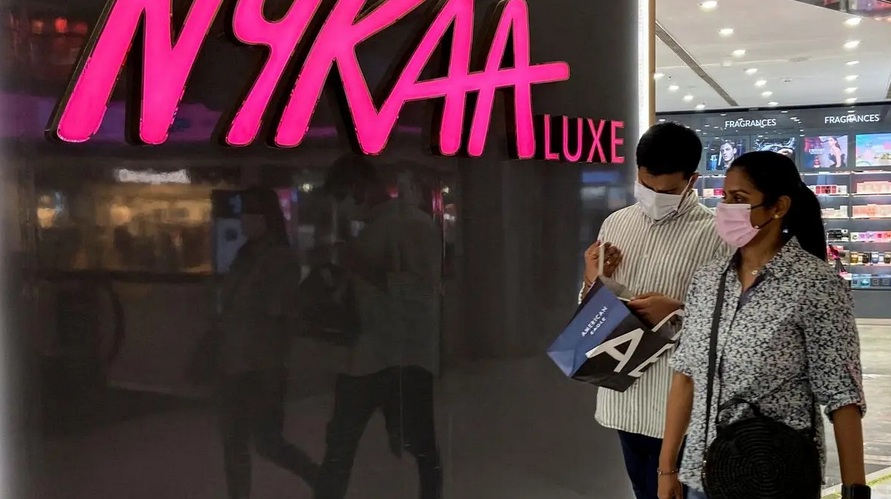
Nykaa said that Kay Beauty, co-founded with actor Katrina Kaif, has crossed the ₹240 crore mark in terms of Gross Merchandise Value.
Stars from the tinsel town are donning the entrepreneurial hat to venture into the beauty and fashion business space. Some have even succeeded in growing their brands sustainably, earning big bucks.
Take for instance Skincare brand Hyphen, co-founded by actor Kriti Sanon with Pep Brands, which recently touched the ₹400 crore-mark in Annual Recurring Revenues.
Tarun Sharma, CEO and co-founder, Hyphen told businessline: “The brand is witnessing healthy growth rate quarter-on-quarter. In the first year itself, it touched ₹100 crore ARR. We had aimed for ₹500 crore ARR in 3-4 years and, within two years, we are at ₹400crore ARR.” Pep Brands led by Sharma owns mCaffeine and Hyphen.
The model that works
Sharma believes an operator-led, celebrity anchored model works better. ”The operator can bring in the necessary financial and execution muscle. If a celeb partners with an operator that has deep expertise in the space, then there is huge potential for growth,” he added.
“Product launches, marketing and distribution are very data-driven at Pep Brands. It guides us on what to launch, when to launch, and how to launch products. That has helped Hyphen in achieving this kind of growth rate. It is by design that the majority of the business of Hyphen is D2C,” Sharma explained.
In May, Nykaa said that Kay Beauty, co-founded with actor Katrina Kaif, has crossed the ₹240 crore mark in terms of Gross Merchandise Value. On an earnings call for Q4FY25, Adwaita Nayar, Executive Director, Chief Executive Officer, Nykaa Fashion, said: “Kay Beauty is one of the fastest-growing brands on the platform. It’s hit about ₹240 crore of GMV. The innovations have been fantastic this year. So, it is quite a premium brand, and I think the consumers are accepting it even at that price point. It’s got great gross margins.”
Earlier this year, Reliance Retail Ventures announced that it has decided to acquire 51 per cent stake in Ed-a-Mamma , a kid and maternity wear brand founded by actor Alia Bhatt. According to some reports, Hrithik Roshan’s sportswear brand HRX is a ₹1,000 crore brand.
Among the recent entrants are Ranbir Kapoor, who has decided to foray in the apparel and accessories space with ARKS. Launched in February, the brand has also launched its first store in Mumbai, followed by a second store in New Delhi and another with Broadway in Hyderabad.
‘Shift in preferences’
Abhinav Verma, co-founder and CEO, ARKS, told businessline: “We are seeing a shift in consumer preferences towards made-in-India brands. We decided to leverage on the strong manufacturing capability that India has to build a brand that is both aspirational and offers value. We are looking to build a ₹100 crore brand in the next 3-4 years with a strong omni-channel strategy.”
“The success of some of these brands demonstrates that building on consumer relevance and with powerful time-bound execution, celebrity ventures can become significant players in a crowded market. With consumer demand for relatability and digital-first branding on the rise, this segment will definitely grow. However, only brands that offer genuine value to consumers, and not just star appeal, are likely to endure,” said Devangshu Dutta, CEO, Third Eyesight.
(Published in The Hindu-Businessline)
admin
July 27, 2025
Alenjith K Johny & Ajay Rag, Economic Times
Jul 27, 2025
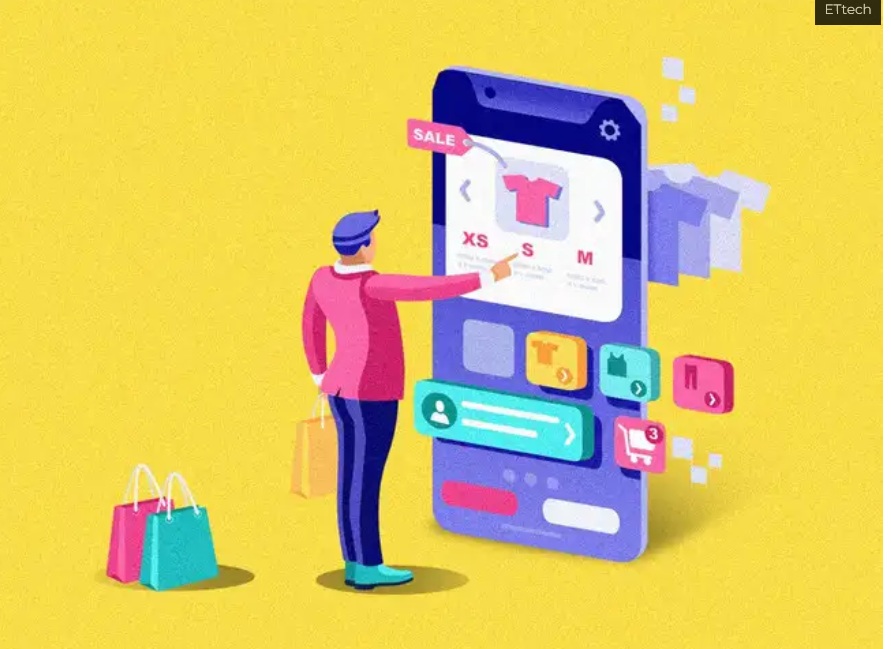
Startups in the 60-minute fashion delivery segment are betting on features such as ‘try and buy’ and artificial intelligence (AI)-powered virtual try-ons to tackle high return rates, a key pain point in the segment. These tools are helping increase conversion rates and reduce returns while offering greater flexibility to buyers, said industry executives.
Mumbai-based Knot, which recently raised funding from venture capital firm Kae Capital, said partner brands that typically see return rates of about 20% on their direct-to-consumer websites are witnessing sub-1% returns through offline stores, a trend it is now replicating through these digital features.
“Our partner brands, which have offline stores, would typically witness 20% returns on their direct to consumer websites. But for the same purchases on offline stores, the returns are less than 1%. That is the idea. With the ‘try and buy’ feature, users can make a very decisive purchase at their doorstep,” Archit Nanda, CEO of Knot, told ET.
Return rates among users of the company’s virtual try-on feature are similarly much lower than the platform’s overall user base, he said.
Other venture-backed quick fashion delivery startups such as Bengaluru-based Slikk, Mumbai-based Zilo and Gurugram-based Zulu Club are also testing similar features to increase conversions and reduce returns.
“Returns play as big a part as maybe forward delivery does. Because these are expensive products, giving the customer his or her money back also plays a very critical role,” said Akshay Gulati, cofounder and CEO of Slikk.
Instant returns
Slikk is piloting an ‘instant returns’ feature where, like its 60-minute delivery service, returns are also completed within an hour. Once a return request is made on the app, a delivery partner picks up the product and refunds the amount instantly. The startup claims its return rate is 40-50% lower than that of traditional marketplaces and that it doesn’t charge customers any extra fees for returns.
Some users said they were satisfied with the delivery speed and trial window but pointed out that the app does not provide any return status updates until the product reaches the warehouse.
“I received my order within 60 minutes and had enough time to try it out. However, after returning the product, I didn’t receive any notification in the application until the delivery agent reached the warehouse,” said Mohammed Shibili, a working professional based in Bengaluru, who tried Slikk’s feature.
Investor interest
Investors tracking the segment estimate that try-and-buy and virtual try-on features can reduce return rates by 15-20 percentage points, translating into substantial cost savings for both platforms and brands.
“Features like try and buy are a huge cost save, not just for the platform but also for the brand. The brand otherwise would lose that inventory till it comes back and can’t make the sale on it. But now, that’s all getting quickly turned around. So, for the brand, it’s a win-win situation as well as for the customer where the money is not getting stuck till it gets the returns refunded,” said Sunitha Viswanathan, partner at Kae Capital.
Old model, new infrastructure
Flipkart-owned fashion etailer Myntra had introduced try and buy back in 2016 to attract traditional shoppers to online retail. However, the feature didn’t scale up due to supply chain limitations, according to industry executives.
“Back when Myntra launched ‘try and buy’, there was no hyperlocal delivery infrastructure. Deliveries were through national courier services. That model isn’t feasible to try and buy unless you have your own hyperlocal delivery fleet,” the founder of a fashion delivery startup said on condition of anonymity.
The founder added that while Myntra operated from large warehouses located on the outskirts of cities, the new-age supply chains are built within cities, allowing faster deliveries and enabling features like try and buy.
By the end of last year, Myntra had launched M-Now, an ultra-fast delivery service currently live in Bengaluru, Mumbai and Delhi, with pilots in other cities. The company said daily orders through M-Now doubled in the last quarter.
“Although it’s still early, our observations so far suggest that the quick delivery model, with its reduced wait time, attracts high-intent customers, leading to naturally lower return rates,” said a spokesperson for Myntra.
The etailer did not confirm whether the try-and-buy feature is being tested under M-Now.
Viability concerns persist
Despite the benefits, the long-term viability of these features is open to question, experts said.
“There is a cost to also providing these services (like try and buy), and whether that becomes viable at all is a question mark at this point of time. I think that’s what the concern is, and it has not been that viable,” said Devangshu Dutta, founder of Third Eyesight, a management consulting firm focused on consumer goods and retail industries.
He added that when platforms offer the try-and-buy feature, delivery executives have to wait while customers try on products, which increases the cost per delivery and reduces the number of deliveries that can be completed. Despite that, some items may still be returned, further impacting operational efficiency.
However, startups are experimenting with these features mainly on higher-margin products to offset operational costs, Dutta said, as return rates across fashion categories can range from under 10% to as high as 40% for certain items.
(Published in Economic Times)
