
admin
September 1, 2026
Vikash Tripathi, Outlook Business
1 September 2026
Eight decades ago, the ‘nationalist businessman’ GD Birla helped prepare the ‘Bombay Plan’, which asked the state to pro-vide for the bare minimum needs of its people. His plan asked for 2,800 calories of well-balanced food per day, 30 yards of clothing per year and 100sq ft of housing per person.
Today, seventh-generation Aryaman Vikram Birla is betting on an entirely different opportunity: premium dining. “We continue to believe in the remarkable potential of the premium casual dining space, spurred by rising disposable income and evolving lifestyles,” the 29-year-old said after Aditya Birla New Age Hospitality acquired KA Hospitality in 2023.
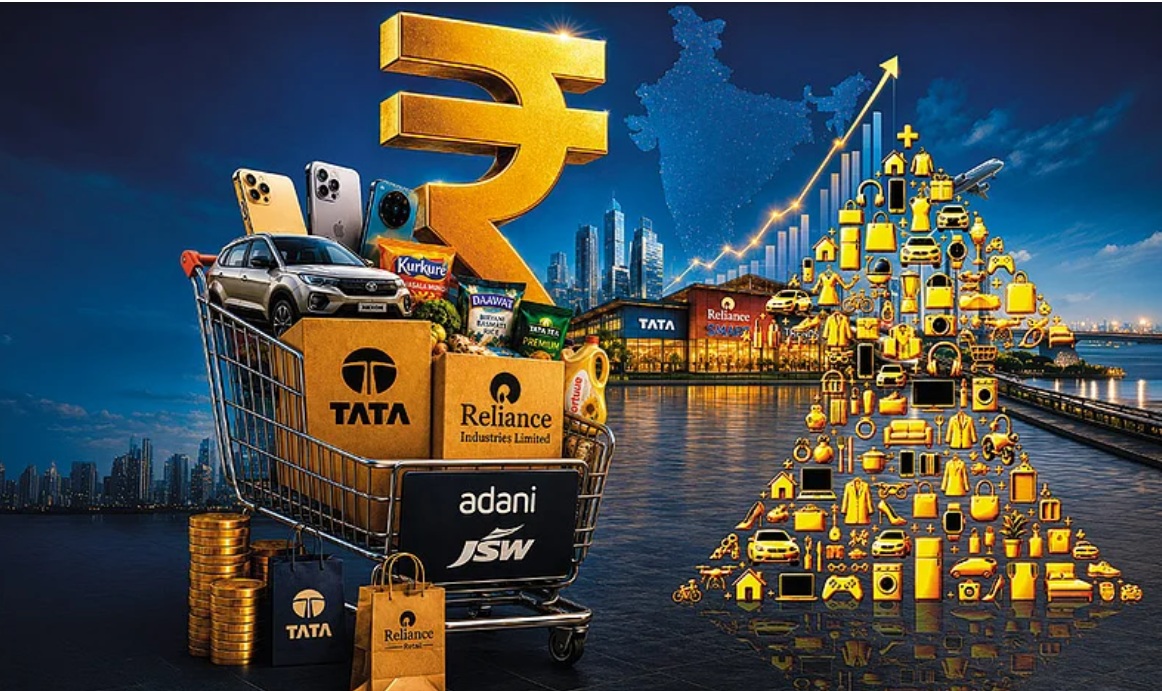
The Birlas are not alone in trying to cash-in on rising prosperity in India. In the past five years alone, India’s top 10 industrial groups have announced new ventures in consumer-facing sectors or doubled down on existing ones. A rough tally of these investments crosses ₹4.8 lakh crore.
For decades, these same business houses built their dominance in core sectors like steel, power, aluminium, cement and chemicals, laying the industrial backbone of the economy. This helped the nation become a large producer of such goods and, in some cases, an exporter as well.
But as India’s economic conditions changed, so has the focus of its largest conglomerates.
For the likes of Tata, Aditya Birla, Bajaj and Bharti, that journey started way back. “What has changed in recent years is the speed and openness of the amount of capital being invested,” says Jitender Kumar, associate professor and programme chairperson, retail management programme at Birla Institute of Management Technology.
“It is not ‘opportunistic’ reasons, it’s structural reasons.”
Two factors seem to be driving the shift: the first is the arrival of an affluent consuming class that can buy branded and premium goods, and the second is the attraction of consumer businesses as a way to diversify revenue and, in some cases, improve the quality of earnings.
The Rise of Affluence
A couple of decades ago, if an Indian household had some extra cash, it often meant buying more of the same. Today, it increasingly means buying better. Even salt is being upgraded, from iodised to Himalayan pink or rock salt. The same shift is visible in bigger purchases: sports utility vehicles (SUVs) over hatchbacks, and ₹1cr-plus homes over budget flats.
But India isn’t simply consuming more. It is moving from basic consumption towards discretionary, branded and premium consumption. This boom is most clearly seen in the rapid expansion of the financial infrastructure that enables consumption. Formal retail credit penetration has more than doubled over the past decade, according to a TransUnion Cibil report, driven largely by personal loans, credit cards and consumer durable loans. Meanwhile, the government-backed Unified Payments Interface has untethered spending from the cash in a buyer’s wallet.
The signs show up across the broader consumption economy. Homes priced above ₹1cr accounted for 54% of total sales in 2025, up from just 30% in 2023—the market that decorative paints and home solutions are chasing.
Out of 4.7mn cars sold in the financial year 2025–26, SUVs accounted for more than half.
“The consumer market has grown substantially—not only through rising incomes but also the dramatic expansion of branded consumption across product verticals,” says Devangshu Dutta, founder of management-consulting firm Third Eyesight.
The bets are also getting more varied, from Reliance Retail tying up with global brands like Fenty and Skims to the Bharti Group bringing Olive Garden to India.
The Lure of Returns
For a passenger walking through an airport, the flight is only one part of the journey. There is coffee before boarding, food between flights, a lounge, retail outlets, parking and a host of other things to spend money on. For Adani Airports, those non-aero businesses are increasingly becoming the more lucrative part.
Its non-aero operations already generate about ₹2,500cr, with returns in the high-20% range, against roughly 12% from regulated aeronautical operations.
Jeet Adani, director of Adani Airport Holdings, expects the share of aeronautical revenue to fall to around 10% of total revenue, with non-aero becoming the bigger growth driver. The motivation can be seen as an escape from a return ceiling as much as a bet on rising affluence.
As Kumar puts it, consumer businesses help the conglomerates in two major ways. First, they help insulate them from volatile and often punishing commodity cycles, and second, they often offer far better returns with lower capital intensity and faster cash conversion.
Reliance Industries (RIL) shows how significant that shift can become. By 2025–26, its consumer-facing arms, Jio Platforms, Reliance Retail Ventures and Reliance Consumer Products, together contributed over 40% of group revenue and nearly 60% of operating profit.
And there is another advantage. “A small business, when it wants to build a new venture, faces constant margin pressure and often has to build its supply chain from scratch. A large conglomerate can leverage its existing scale, infrastructure and supply chain to enter a new business far more efficiently,” explains Kranthi Bathini, equity strategist at WealthMills Securities.
Different Strokes
In chasing consumers, some conglomerates are following the fastest-growing categories, while others are using their existing industrial capabilities to enter consumer-facing businesses. One is trying to build an entire ecosystem around it. But the lines between these approaches are not always clean.
Tatas is doing both: building entirely new consumer brands while also using the industrial ecosystem it has built over decades.
For Tatas, the consumer opportunity has largely been about following where spending is moving. Their consumer ventures have followed this arc longest. It began decades ago with Lakmé (1952), Tata Tea (1962) and Titan (1984). Tanishq and the expansion of Trent under brands such as Zudio are only the latest examples.
At Tata Consumer Products, once largely a staples business built around salt, tea and pulses, the focus has been shifting towards value-added foods and beverages, with ₹7,000cr spent on the acquisitions of Capital Foods and Organic India in 2024. Across companies such as Tata Digital, Indian Hotels, Air India and Tata Motors Passenger Vehicles, the group has announced close to ₹93,180cr in investment over the past five years.
Aditya Birla’s jewellery chain Indriya and its move into premium hospitality belong to the same category of ‘pull-based’ diversification.
JSW is taking a different route. It is taking its existing industrial strengths one step closer to the buyer. The group, which has traditionally been focused on areas such as steel, energy and cement, has expanded into consumer-facing areas such as auto, paints and home solutions.
It launched JSW Paints in 2019, and acquired a controlling stake in paintmaker AkzoNobel India for ₹8,986cr last year. Its strategy is to leverage an established network of contractors, dealers, architects and builders to reach consumers.
The same strategy can be seen in its push into autos, acquiring a 35% stake in the Indian unit of China’s MG Motor in 2024, leveraging synergies with its established steel business.
At Tatas, too, group companies like Tata Steel, Tata Power, Tata AutoComp, Tata Technologies and TCS are doing significant businesses with Tata Motors.
Adani is also using an asset it already controls to move further into the consumer’s wallet. Adani Airports announced a ₹20,000cr investment in June to develop hotels, retail, entertainment and commercial infrastructure around its eight airports, and has signed hotel management agreements with IHG Hotels & Resorts for five hotels. City-side developments could contribute 30–40% of Adani Airport Holdings’ non-aero revenue.
Yet another example of the extension strategy is Aditya Birla Group’s attempt to diversify from cement, metals and textiles into decorative paints with Birla Opus.
RIL took a different approach: trying to connect multiple consumer businesses into one ecosystem. It expanded its retail network through new formats and acquisitions, added brands and partnerships, and then built a consumer-goods business around acquisitions such as Campa Cola and Lotus Chocolate.
That expansion was helped by billions of dollars raised by both Jio Infocomm and Retail Ventures from foreign investors in 2020. The group now plans to spend another ₹8,000cr expanding consumer goods manufacturing. The advantage of having that kind of scale is clear. If RIL has Ajio at a mall and, next to it, GAP and Herschel, it can negotiate better rental terms.
For conglomerates, Kumar points out, the next level of competition will not be based on investment, “but on the ability to create different consumer experiences, foster innovation and create lasting brand loyalty through the integration of these capabilities”.
Can Scale Win?
When Reliance Fresh opened its first stores in 2006, it was part of a rush by some of India’s biggest business groups to crack organised retail. Aditya Birla Group, RP-Sanjiv Goenka Group’s Spencer’s and Kishore Biyani’s Future Group were all betting that organised retail could transform the way Indians shopped. What followed was years of experimentation, losses and, for some, eventual retreat.
Birlas essentially gave up on grocery retail after a decade of heavy losses and exited entirely.
Future was pushed into insolvency after a controversial ₹24,713cr deal with RIL. Spencer’s is still trying to find its footing, with ₹249.33cr in net losses in 2025–26.
Conglomerates may have deeper pockets, but that does not automatically make them better at selling to consumers. India has seen some of those bets fail or take years to work. And even among today’s biggest players, the results are still mixed.
Tata Sons has been in this segment longer than the Ambanis, yet its consumer businesses still make up less than 40% of its total revenue —a share that has not changed since 2020.
These groups have what most standalone consumer companies don’t: capital, distribution, infrastructure, brands, scale.
But winning consumers takes something else entirely—reading what people want, building brands, innovating fast and earning loyalty.
“In B2B [business to business], it’s about manufacturing at scale, getting your costs down. Then you can compete. In B2C [business to consumer], it’s all about the product. With the right product at the right price, you have a chance to win in the market,” Parth Jindal, managing director of JSW Cement and JSW Paints, told Outlook Business in 2025.
Tata Sons’ chairman N Chandrasekaran hit the same wall while revamping the group’s consumer unit. “I have the money. But I don’t have the team to run it,” he had told Sunil D’Souza while hiring him to lead Tata Consumer Products in 2020.
Reliance and Tatas have had the longest head start, but even their journeys show how difficult it is to turn scale and capital into consumer businesses. Birla, JSW and Adani are now trying to make that transition in their own ways.
A longer tail—Bajaj in hospitals, L&T in retail finance and education, Mahindra in insurance and hospitality, Murugappa in electric mobility—is playing it safer, going deeper into what it already owns rather than chasing new categories.
What ties them together is a bet on consumers buying not just more but better, and on those consumers being worth more per rupee of capital than the industrial customers who built these houses.
The prize is growing, but so is the competition. Capital and scale may get these conglomerates through the door. They won’t guarantee a seat at the table.
(Published in Outlook Business)
admin
July 9, 2026
Neethi Lisa Rojan & Vaeshnavi Kasthuril, MINT
Mumbai/Bengaluru, 8 July 2026
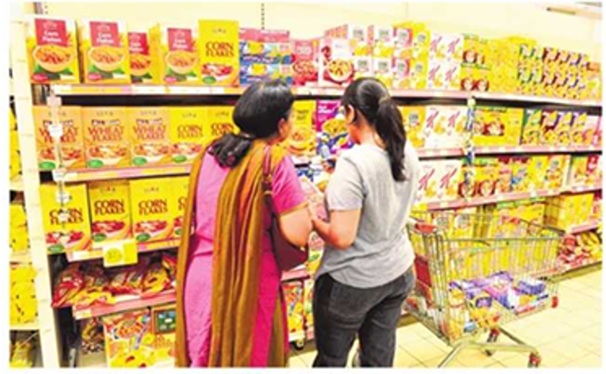
The collapse of the US-Iran peace deal in less than a month has rattled India’s consumer sector, reviving fears that higher oil prices and fresh supply-chain disruptions could squeeze demand just as companies were betting on a broader recovery.
The renewed uncertainty followed US President Donald Trump’s declaration on Wednesday that the peace deal with Iran was effectively over, alongside Washington’s decision to end a sanctions waiver on Iranian energy supplies. The market reaction was swift. The Nifty FMCG Index fell 2.49% on Wednesday, underperforming the broader market as all 15 constituents declined, led by Dabur India, Hindustan Unilever, and Tata Consumer Products, whose shares fell 3-4% each. The benchmark Nifty50 ended 2.12% lower after renewed hostilities in West Asia pushed crude prices higher.
Executives and analysts said companies have little room to respond immediately, leaving them to closely monitor devel opments as risks to costs and consumer spending mount. “I don’t think companies can react on this kind of a short notice,” said Arvind Singhal, chairman of consulting firm The Knowledge Company. “It takes 2-6 months to make any change in your plans and strategy. I think right now the Indian FMCG (fast moving consumer goods) companies will be watching the progress of monsoon more carefully than the Strait of Hormuz.”
Even after the US-Iran peace deal took effect on 18 June, consumer companies were unlikely to have expected immediate relief, analysts said.
“While everyone hoped for a cessation in hostilities, smart management teams would work on the realistic expectation that even with a ceasefire, pent-up supply chain input costs need to be absorbed over time, and pricing plans must be factored accordingly,” Devangshu Dutta, founder and chief executive of consulting firm Third Eyesight, said.
“Given that the conflict zone is active, I don’t think there is any immediate likelihood of pricing freeze or reductions, even though demand in rural areas as well as in lower-income urban segments is likely to be hit from both sides ― earnings and expenses.”
Large consumer goods companies including Dabur, Emami and Godrej Consumer had recently told investors they remained confident about consumer demand, including in rural markets.
But the renewed rise in crude prices, coupled with erratic monsoons marked by rainfall deficit in some regions and flooding in others, threatens to complicate that outlook. Higher fuel costs could lift prices of crude-linked raw materials such as plastic packaging and ingredients used in soaps and creams, while persistent inflation could push consumers to cut discretionary apne ding and trade down even on staples.
Major consumer companies had already raised prices or reduced grammage across packaged food, beverages and personal care products in the March quarter.
“As far as the crude prices are concerned, that is probably the only variable where the government has to decide as far as pricing of crude or the petroleum in India is concerned,” Singhal said.
That comes at an awkward time for India’s largest consumer companies, including Hindustan Unilever, which had earlier this year told analysts they intended to drive growth through higher volumes rather than price increases. A renewed bout of inflation could undermine that strategy.
(Published in MINT)
admin
September 22, 2025

Christina Moniz, Financial Express
22 September 2025
It is already the largest player among organised fumiture makers with over 15% of the market. With 1,000 stores, it has the widest retail store footprint among organised players. The 102-year-old brand is also the second-largest revenue con-tributor to the parent enterprise.
So why is Interio tinkering with its name, logo and colour attributes?
“We want to move away from being viewed as a functional brand to more of a design-led lifestyle one. We have a wider range of offerings that are more modular and aesthetic,” says Reshu Saraf, head of marketing communications at Interio by Godrej.
As a first step, it has a new logo and name change – from Godrej Interio to Interio by Godrej. The brand has earmarked ₹50 crore towards an integrated campaign across TV, digital, outdoor and in-store branding to promote its new proposition over the next year. Overall, it will invest ₹300 crore in expansion and technology with the goal to more than double revenues to ₹10,000 crore by FY29.
Younger consumers don’t see furniture as utility but as lifestyle, observes Puneet Pandey, strategy head and managing partner, OPEN Strategy & Design. “By moving from ‘solid and sturdy’ to ‘stylish and aesthetic’, the brand earns the right to play at higher price points as well. Design-led positioning will also unlock repeat purchase since people no longer wait a decade to change their furniture based on utility; they want constant upgrades to refresh their living spaces as their tastes evolve,” he notes, adding that Interio needs to make the marketing leap from “catalogue to culture”.
Saraf says the brand is also building differentiation with its customer experience. “We’re using digital tools for store walkthroughs and visualisers to help visualise our products in the home. Our product portfolio, which is deeply personalised ane tailored for Indian sensibilities, it is a major differentiator that few other brands offer,” she points out.
E-commerce is also a focus area with the brand looking to increase the revenue share from 15% to 20-22% by 2029. The company is leveraging Al to improve the search functionand sharpen personalisation. Saraf adds the that offline too, the brand will have large format experience centres to help people envision what their rooms could look like, along with mid-size and small-format stores.
Interio also plans to widen its retail store footprint from 1,000 to 1,500 by 2029.
As per industry estimates, the Indian furniture market is set to grow at 11% annually to reach $64.1 billion by 2032 from $30.6 billion in 2025. It is this growth momentum that Interio is looking to cash in on.
Built-in differentiation
Although a significant chunk of Interio’s business comes from its home remodelling services, within the furniture category, it competes with global players like IKEA and digital-first brands like Pepperfry. The challenge for Interio in this market is to embed the design-led positioning in its productsandcus-tomer experience, says Nisha Sam-path, managing partner at Bright Angles Consulting.
One of its biggest advantages is the Godrej brand. “The Godrej brand stands for many values prized in interiors such as quality, trust, reliability and durability with a ‘Made in India’ tag. However, the brand has not been so successful in building an image of cutting-edge design and innovation. These are new values that can make the brand more contemporary,” she remarks.
Devangshu Dutta, CEO of Third Eyesight concurs, pointing out aside from nimble competition, Interio’s key challenges also come from the dual pressures of increasing consumer expectations for rapid delivery and customisation on the one hand, with aggressive price competition on the other.
(Published in Financial Express – Brandwagon)
admin
August 31, 2025
Akanksha Nagar, Storyboard18
31 August 2025
The latest round of US tariffs- a steep 50% duty that kicked in last week- is reshaping the playbook for Indian brands eyeing global markets. While exporters brace for tighter margins and logistical hurdles in the US, experts say this disruption could be a defining moment for Indian consumer brands to shine globally by leaning on innovation, design strength, and the untapped potential of India’s domestic consumption story.
“With the 50% tariffs kicking in, what will India do? Expect an inward-looking India! Expect a deep focus on #IndiaForIndia as marketers develop the India-consumption story for Indian produce. Expect even a Swadeshi movement Ver 3.0. MNCs in India face pressure,” says brand guru Harish Bijoor, founder of Harish Bijoor Consults Inc.
Riding high on this wave is India Circus, which is emerging as one of the fastest-growing players in the new-age home décor space. With a growing appetite for aesthetics, the brand is redefining how Indians furnish their homes. As urban consumers grow more design-aware and seek products that reflect personal taste and cultural identity, design-forward brands are carving out their own niche.
“Consumers today want more than just functionality. They want form, flair, and a sense of identity in their living spaces,” says Devangshu Dutta, founder and CEO of Third Eyesight. This shift, he explains, is creating tailwinds for brands that can deliver both design value and cultural resonance.
But he also adds a note of caution in the tariff context: “Indian brands that are being exported to the US face margin pressures and reduced US market access, both due to import tariffs and due to logistical barriers. They may need to hold inventory in the US to reduce the tariff and shipping impact, but that would also be at a certain cost and loss of agility.
It is an opportune time to focus on exports to other markets. Of course, no other single market would have the scale offered by the USA, so it will perhaps be more expensive and a more fragmented growth.”
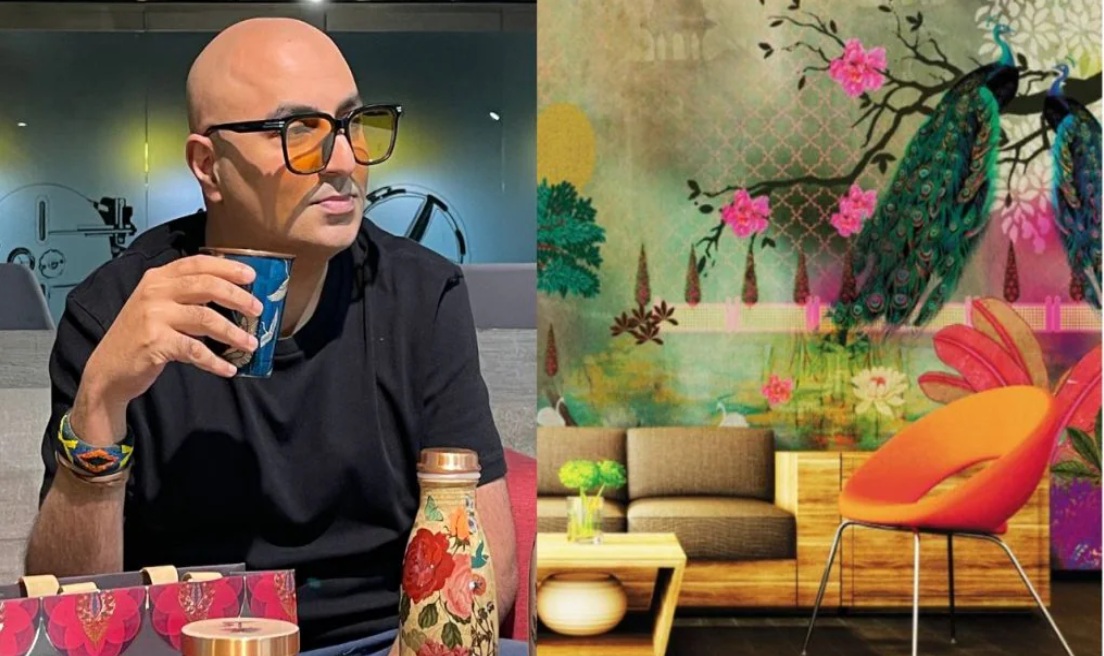
Founded by Krsnaa Mehta and now part of the Godrej Enterprises Group, India Circus has found the sweet spot between Indo-contemporary aesthetics and wide accessibility.
From crockery with 22-carat gold accents to tropical wallpapers and statement furniture, its design-led offerings have struck a chord with India’s style-conscious consumers. The brand has also forayed into fashion, while preparing to tap international markets through a new e-commerce platform. “Design is not just an add-on for us; it is our core. Every collection begins with a story, and that’s what keeps our customers coming back,” says Mehta.
On the impact of Trump’s tariffs, Mehta clarifies that the brand remains largely insulated.
“Our major consumer base is in India, we have been focused on expanding our reach and tapping unexplored markets in India. India has so much potential- the newer markets of tier-2 cities like Lucknow, Gurugram, Chandigarh, Ambala are exceptional and the buying power of our consumers has increased significantly in the past few years. So we are not really worried about the tariffs, considering that our designing, production and selling is totally in India. Yes, we do export to the US, but it is not really comparable to what we do in India.”
Yet, he views the moment as a wake-up call for Indian brands globally.
“As a proud Indian brand, we have always been at the forefront of innovation, evolving our design aesthetics from bold prints to more contemporary ones. Our consumers are now visually informed and thus we must keep evolving. It is not just moving ahead but also embracing our roots and creating what is best for not just one but for all. India Circus has always tried to democratise design, by making it affordable and providing great quality at great prices.”
India Circus’s growth is fueled by an omnichannel strategy that blends a strong digital presence with 18 (soon to be 28) offline stores, while aggressively expanding in tier-2 cities.
The brand is targeting ₹400 crore in revenue by FY2026, up from its current ₹100 crore. Having recently launched international website to serve the Middle East and Asia, tt is also exploring categories such as gifting, licensing, and royalty-based partnerships, alongside plans to scale manufacturing. Warehousing in Europe and North America is also under evaluation.
“The growing demand for sustainable, high-quality products has contributed to our growth, as consumers increasingly seek out brands that share their values. Our designers leverage consumer insights, in-house research, and sales data to create products that are both stylish and relevant. We proudly invest in Indian craftsmanship and manufacturing, eschewing imports from countries like China. This approach not only supports local economies but also enables us to maintain quality standards,” Mehta says.
Meanwhile, brands like Chumbak, who were once synonymous with playful, funky aesthetics, have had a patchier journey in the domestic market. At one point, Chumbak had drawn strong private equity interest and grew aggressively, only to later downsize and recalibrate. But Bisen cautions against equating it with India Circus: “Chumbak has always been broader in scope, and that universality may have made it less nimble when it came to capturing specific consumer segments within home decor.”
India Circus, in contrast, has stayed tightly focused, defining its identity around a clear aesthetic and target audience. This discipline, experts say, is crucial in a market that’s growing but fragmented.
“Most brands in the design-led home space operate in sub-categories. Very few cover the full décor spectrum,” Dutta notes. “The key is having a well-defined look and sticking to it.”
According to Statista, in 2025, India’s home décor market was worth $2.13 billion and is projected to grow at a CAGR of 8.6% through 2029. In comparison, the US market stands at $37 billion.
India’s growth is powered by its rising middle class, a young population hungry for differentiated products, and cultural emphasis on interior design. With gifting and new household formation boosting demand further, design-led Indian brands are positioned for deeper expansion, both at home and abroad.
For now, India Circus is leading that charge, proving that even as tariffs disrupt trade flows, Indian creativity, design, and resilience are ready to outshine globally.
(Published in Storyboard18)
admin
December 7, 2023

Sharleen Dsouza, Business Standard
Mumbai, 6 December 2023
Godrej Consumer Products is test marketing its liquid detergent under the brand name ‘Fab’ in South India. While this is not the company’s first move in detergents, the launch is expected to give it a bigger play in the category, especially with a competitive price point of Rs 99 a litre. The company already has Godrej Ezee for winter wear wash.
Some other fast moving consumer goods (FMCG) companies are also entering new categories which are allied to their current businesses. Companies are chasing low-penetrated categories which offer high growth both in terms of revenue and margins, according to analysts.
For instance, Parle Products, known as a biscuits manufacturer, has re-entered the wheat flour (atta) market. Earlier in 1996, it had launched packaged wheat flour but exited the segment as the demand failed to pick up. “Now, the demand is much higher for packaged wheat flour,” Mayank Shah, senior category head at Parle Products, told Business Standard while explaining the re-entry into the category. The company already procures wheat flour in bulk for biscuits and therefore packaging and selling it also makes sense for us, Shah pointed out.
Known for its snacks and namkeens, Bikano Bikanervala Foods has entered the Indian spices category under the sub-brand ‘Swad Anusar’. It came as a natural progression for the company.
“The top masala companies have either established or expanded their position in the sector over the past year, which is believed to account for up to 36 per cent of India’s entire Rs 70,000 crore spice industry,’’ Manish Aggarwal, director, Bikano, Bikanervala Foods, said. The remaining 64 per cent of the market is disorganised. ‘’We believe it’s the right time to invest in the spices category and foresee growth in this dynamic segment,” Aggarwal added.
The brand is already established in people’s mind and these companies already have distribution in place, according to Rajat Wahi, partner at Deloitte India.
“As long as these are adjacent categories, the company can easily leverage the existing distribution and also target new customers. These categories are typically low penetrated categories which offer high growth and are fragmented due to regional brands being present, thus giving them a better opportunity to enter these categories,” Wahi said.
Brand expert Devangshu Dutta, founder at Third Eyesight, also believes that companies can easily use their existing distribution strength while expanding into related categories. “There has been a broad-based consumer growth over the years in these categories. Also, large companies find it difficult to grow after a point when present only in a certain categories,’’ Dutta said while explaining the significance of group synergies in launching new products.
(Published in Business Standard)
