
Devangshu Dutta
January 10, 2017
In this piece I’ll just focus on one aspect of technology – artificial intelligence or AI – that is likely to shape many aspects of the retail business and the consumer’s experience over the coming years.
To be able to see the scope of its potential all-pervasive impact we need to go beyond our expectations of humanoid robots. We also need to understand that artificial intelligence works on a cycle of several mutually supportive elements that enable learning and adaptation. The terms “big data” and “analytics” have been bandied about a lot, but have had limited impact so far in the retail business because it usually only touches the first two, at most three, of the necessary elements.
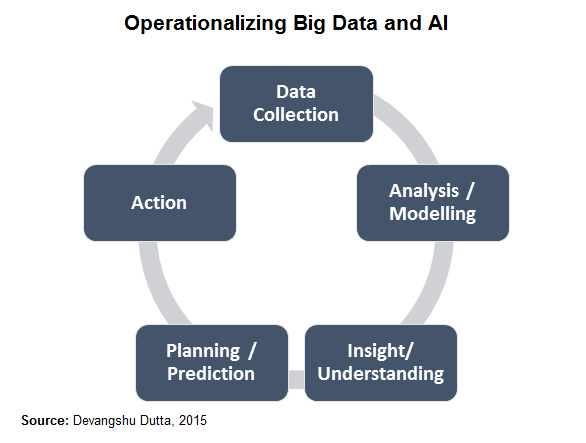
“Big data” models still depend on individuals in the business taking decisions and acting based on what is recommended or suggested by the analytics outputs, and these tend to be weak links which break the learning-adaptation chain. Of course, each of these elements can also have AI built in, for refinement over time.
Certainly retailers with a digital (web or mobile) presence are in a better position to use and benefit from AI, but that is no excuse for others to “roll over and die”. I’ll list just a few aspects of the business already being impacted and others that are likely to be in the future.
On the consumer-side, AI can deliver a far higher degree of personalisation of the experience than has been feasible in the last few decades. While I’ve described different aspects, now see them as layers one built on the other, and imagine the shopping experience you might have as a consumer. If the scenario seems as if it might be from a sci-fi movie, just give it a few years. After all, moving staircases and remote viewing were also fantasy once.
On the business end it potentially offers both flexibility and efficiency, rather than one at the cost of the other. But we’ll have to tackle that area in a separate piece.
(Also published in the Business Standard.)
admin
February 21, 2016
 Shinmin
Bali, Financial Express
Shinmin
Bali, Financial Express
Mumbai,
21 February 2016
 Having
created quite a stir at the time of their launch, hyperlocal companies
are now witnessing a dampened mood. While several have folded
up operations in some cities, others have downsized staff, tweaked
the services they offer and even made alterations to their business
models. A recent example is Grofers shutting down operations in
Bhopal, Bhubaneswar, Coimbatore, Kochi, Ludhiana, Mysuru, Nashik,
Rajkot and Visakhapatnam.
Having
created quite a stir at the time of their launch, hyperlocal companies
are now witnessing a dampened mood. While several have folded
up operations in some cities, others have downsized staff, tweaked
the services they offer and even made alterations to their business
models. A recent example is Grofers shutting down operations in
Bhopal, Bhubaneswar, Coimbatore, Kochi, Ludhiana, Mysuru, Nashik,
Rajkot and Visakhapatnam.
TinyOwl last year was in the news for a poorly-handled downsizing
operation in Pune, with a dramatic hostage situation involving
its co-founder Gaurav Choudhary. PepperTap also recently shut
down operations in six cities.
Ironically, giants like Amazon have not only aggressively entered
the hyperlocal space, they are building on it. Amazon is currently
offering the service in Bengaluru, Amazon Now, after running a
pilot project, Kirana Now, in 2015.
The investor sentiment in India is also on a decline, as was
reported earlier this year. Investments by venture capitalists
have dropped from $2.12 billion (October-December 2014) to $1.15
billion (October-December 2015), according to a report by CB Insights
and KPMG International. This leaves an even shorter window of
opportunity for players to retain investor interest.
Albinder Dhindsa, co-founder, Grofers, states that differing
levels of technology literacy among the majority of merchants
and consumer adaptation to the online platform are concern areas
for the company. In 2016, the company is looking to bring over
one lakh merchants aboard and ensure that turnaround time stays
under an hour. Grofers delivers more than 35,000 orders per day
on average. In Q4 2015, the firm acquired teams of SpoonJoy and
Townrush to bring dynamic learning to the table.
For Swiggy’s co-founder Nandan Reddy, the focus is currently
to grow the market, while catering to a wide demographic of consumers.
He admits that in the early stages, the brand had trouble educating
even its partners. Furthermore, operating a delivery fleet in
an on-demand service offering sub-40 minute deliveries is a challenging
task, given that there are at least 15 points of failure in an
average order. Swiggy currently owns a delivery fleet of 3,800
delivery executives. The brand’s repeat consumers contribute
to over 80% of orders.
Debadutta Upadhyaya, co-founder, Timesaverz, says some of the
major challenges in a hyperlocal market are optimum resource utilisation
and matching locations, price points, and other specific requirements
to customer needs. Timesaverz currently has a service range spread
across 40 categories, aided by a network of over 2,500 service
partners across five metros. Its revenue model is commission based,
where 80% of earnings from consumers are shared with service partners.
Vinod Murali, MD, Innoven Capital, points out that as the hyperlocal
industry is in its nascent stages, it needs a fair amount of time
to grow. “One aspect to keep in mind is that a large sized
equity cheque does not imply that a company has achieved operational
maturity or robust business metrics, especially in this segment,”
he notes.
Given the recent consolidation in this category, the survivors
have the opportunity and time to focus on improving unit economics
and demonstrate that their businesses are viable and valuable.
Devangshu Dutta, CEO, Third Eyesight, is of the opinion that
hyperlocals make the mistake of borrowing business models and
terminologies from Silicon Valley, without adequately understanding
the real context of the Indian market. “Is there an existing
or even potential demand for the service claimed to be provided?
Or are you just going to introduce an intermediary and an additional
link in the chain, with additional costs and unnecessary administration
involved?” he asks.
(Published in Financial Express)
admin
September 8, 2015
Devina
Joshi, Financial Express
Mumbai,
8 September 2015
 Recently,
there was news of restaurant reservation site EazyDiner expanding
operations to Mumbai from the National Capital Region, having
secured Series A funding worth $3 million led by existing investor
DSG Consumer Partners, and Saamna Capital.
Recently,
there was news of restaurant reservation site EazyDiner expanding
operations to Mumbai from the National Capital Region, having
secured Series A funding worth $3 million led by existing investor
DSG Consumer Partners, and Saamna Capital.
As per a PwC analyst, investors have pumped more than $150 million
into companies like Grofers, TinyOwl, Swiggy, LocalOye, Spoonjoy,
Zimmber and HolaChef, among others. Judging by the patronage showered
upon them by customers and investors alike, it would appear that
hyperlocal start-ups are all set to create the next big boom in
the Indian retail sector. But is it really all that rosy? Probably
not, as can be amply witnessed by acquisitions taking place in
the nascent yet already overcrowded market.
Between November 2014 and February 2015, the Rocket Internet-backed
Foodpanda acquired rivals TastyKhana and JustEat.in, and is rumoured
to be in acquisition mode with TinyOwl. Restaurant search app
Zomato, which recently got into the food ordering space, is also
reportedly looking to acquire minority stakes in food-ordering
firms.
While investors are attracted to hyperlocal start-ups, controlling
logistics well is key to sustained growth for these businesses
— all of these will definitely go through a constraint in
the supply of delivery boys, for example. In India, organising
fragmented labour is a challenge and, hence, a services-based
hyperlocal needs to figure out the mechanics of human capital
even more than a traditional, product-based e-commerce firm.
For services, another challenge is customer stickiness. If a
user uses an app to obtain the services of a plumber, for example,
he may not go through the app to contact the plumber next time
if his services are found satisfactory. Discounting can induce
trials, but just like in any other business, prove fatal in the
long run. Like what led to the end of HomeJoy in the US —
excessive discounts to dissuade direct contact between servicemen
and customers.
Even for product-based start-ups, maintaining data quality is
a big hurdle as stock and prices may not be updated by retailers
in real time, making it difficult to track offline sales.
Since the game is hyperlocal, you need to be physically present
in the city to bring retailers aboard. For that, you need a city
team. Other challenges include retailer verification and assessment,
given that hyperlocals deal with small city retailers.
Stickiness is needed on both sides, and each locality will certainly evolve into having a market leader and a follower, with other players falling far behind. “So the critical success factor for a hyperlocal is being able to rapidly create a viable model in each location it targets, and then—to build overall scale and continued attractiveness for investors—quickly move on to replicate the model in another location, and then another,” says retail consultant Devangshu Dutta of Third Eyesight. As they do that, they will become potential acquisition targets for larger ecommerce companies, which could use acquisition to not only take out potential competition but also to imbibe the learning and capabilities needed to deal with microcosms of consumer demand.
(Published in Financial Express.)
Devangshu Dutta
December 5, 2013
(Published in ETRetail.com on 6 December 2013)
Franchising isn’t rocket science, but advanced space programmes offer at least one parallel which we can learn from – the staging of objectives and planning accordingly.
A franchise development programme can be staged like a space launch, each successive stage being designed and defined for a specific function or role, and sequentially building the needed velocity and direction to successfully create a franchise operation. The stages may be equated to Launch, Booster, Orbiter and Landing stages, and cover the following aspects:

Stage 1: Launch
The first and perhaps the most important stage in launching a franchise programme is to check whether the organisation is really ready to create a franchise network. Sure, inept franchisees can cause damage to the brand, but it is important to first look at the responsibilities that a brand has to making the franchise network a success. Too many brands see franchising as a quick-fix for expansion, as a low-cost source for capital and manpower at the expense of franchisee-investors. It is vital for the franchiser to demonstrate that it has a successful and profitable business model, as well as the ability to provide support to a network of multiple operating locations in diverse geographies. For this, it has to have put in place management resources (people with the appropriate skills, business processes, financial and information systems) as well as budgets to provide the support the franchisee needs to succeed. The failure of many franchise concepts, in fact, lies in weakness within the franchiser’s organisation rather than outside.
Stage 2: Booster
Once the organisation and the brand are assessed to be “franchise-ready”, there is still work to be put into two sets of documents: one related to the brand and the second related to the operations processes and systems. A comprehensive marketing reference manual needs to be in place to be able to convey the “pulling” power that the brand will provide to the franchisee, clearly articulate the tangible and intangible aspects that comprise the brand, and also specify the guidelines for usage of brand materials in various marketing environments. The operations manual aims to document standard operating procedures that provide consistency across the franchise network and are aimed at reducing variability in customer experience and performance. It must be noted that both sets of documents must be seen as evolving with growth of the business and with changes in the external environment – the Marketing Manual is likely to be more stable, while the Operations Manual necessary needs to be as dynamic as the internal and external environment.
Stage 3: Orbiter
Now the brand is ready to reach out to potential franchisees. How wide a brand reaches, across how many potential franchisees, with what sort of terms, all depend on the vision of the brand, its business plan and the practices prevalent in the market. However, in all cases, it is essential to adopt a “parent” framework that defines the essential and desirable characteristics that a franchisee should possess, the relationship structure that needs to be consistent across markets (if that is the case), and any commercial terms about which the franchiser wishes to be rigid. This would allow clearer direction and focussed efforts on the part of the franchiser, and filter out proposals that do not fit the franchiser’s requirements. Franchisees can be connected through a variety of means: some will find you through other franchisees, or through your website or other marketing materials; others you might reach out to yourselves through marketing outreach programmes, trade shows, or through business partners. During all of this it is useful, perhaps essential, to create a single point of responsibility at a senior level in the organisation to be able to maintain both consistency and flexibility during the franchise recruitment and negotiation process, through to the stage where a franchisee is signed-on.
Stage 4: Landing
Congratulations – the destination is in sight. The search might have been hard, the negotiations harder still, but you now – officially – have a partner who has agreed to put in their money and their efforts behind launching YOUR brand in THEIR market, and to even pay you for the period that they would be running the business under your name. That’s a big commitment on the franchisee’s part. The commitment with which the franchiser handles this stage is important, because this is where the foundation will be laid for the success – or failure – of the franchisee’s business. Other than a general orientation that you need to start you franchisee off with, the Marketing Manual and the Operational Manual are essential tools during the training process for the franchisee’s team. Depending on the complexity of the business and the infrastructure available with the franchiser, the franchisee’s team may be first trained at the franchiser’s location, followed by pre-launch training at the franchisee’s own location, and that may be augmented by active operational support for a certain period provided by the franchiser’s staff at the franchisee’s site. The duration and the amount of support are best determined by the nature of the business and the relative maturity of both parties in the relationship. For instance, someone picking up a food service franchise without any prior experience in the industry is certainly likely to need more training and support than a franchisee who is already successfully running other food service locations.
Will going through these steps guarantee that the franchise location or the franchise network succeeds? Perhaps not. But at the very least the framework will provide much more direction and clarity to your business, and will improve the chances of its success. And it’s a whole lot better than flapping around unpredictably during the heat of negotiations with high-energy franchisees in high-potential markets.
Devangshu Dutta
July 22, 2011
The apparel retail sector worldwide thrives on change, on account of fashion as well as season.
In India, for most of the country, weather changes are less extreme, so seasonal change is not a major driver of changeover of wardrobe. Also, more modest incomes reduce the customer’s willingness to buy new clothes frequently.
We believe pricing remains a critical challenge and a barrier to growth. About 5 years ago, Third Eyesight had evaluated the pricing of various brands in the context of the average incomes of their stated target customer group. For a like-to-like comparison with average pricing in Europe, we came to the conclusion that branded merchandise in India should be priced 30-50% lower than it was currently. And this is true not just of international brands that are present in India, but Indian-based companies as well. (In fact, most international brands end up targeting a customer segment in India that is more premium than they would in their home markets.)
Of course, with growing incomes and increasing exposure to fashion trends promoted through various media, larger numbers of Indian consumers are opting to buy more, and more frequently as well. But one only has to look at the share of marked-down product, promotions and end-of-season sales to know that the Indian consumer, by and large, believes that the in-season product is overpriced.
Brands that overestimate the growth possibilities add to the problem by over-ordering – these unjustified expectations are littered across the stores at the end of each season, with big red “Sale” and “Discounted” signs. When it comes to a game of nerves, the Indian consumer has a far stronger ability to hold on to her wallet, than a brand’s ability to hold on to the price line. Most consumers are quite prepared to wait a few extra weeks, rather than buying the product as soon as it hits the shelf.
Part of the problem, at the brands’ end, could be some inflexible costs. The three big productivity issues, in my mind, are: real estate, people and advertising.
Indian retail real estate is definitely among the most expensive in the world, when viewed in the context of sales that can be expected per square foot. Similarly, sales per employee rupee could also be vastly better than they are currently. And lastly, many Indian apparel brands could possibly do better to reallocate at least part of their advertising budget to developing better product and training their sales staff; no amount of loud celebrity endorsement can compensate for disinterested automatons showing bad products at the store.
Technology can certainly be leveraged better at every step of the operation, from design through supply chain, from planogram and merchandise planning to post-sale analytics.
Also, some of the more “modern” operations are, unfortunately, modelled on business processes and merchandise calendars that are more suited to the western retail environment of the 1980s than on best-practice as needed in the Indian retail environment of 2011! The “organised” apparel brands are weighed down by too many reviews, too many batch processes, too little merchant entrepreneurship. There is far too much time and resource wasted at each stage. Decisions are deliberately bottle-necked, under the label of “organisation” and “process-orientation”. The excitement is taken out of fashion; products become “normalised”, safe, boring which the consumer doesn’t really want! Shipments get delayed, missing the peaks of the season. And added cost ends in a price which the customer doesn’t want to pay.
The Indian apparel industry certainly needs a transformation.
Whether this will happen through a rapid shakedown or a more gradual process over the next 10-15 years, whether it will be driven by large international multi-brand retailers when they are allowed to invest directly in the country or by domestic companies, I do believe the industry will see significant shifts in the coming years.
