
admin
February 2, 2026

Sakshi Sadashiv, MINT
Bengaluru, 02 Feb 2026
BRND.ME, a roll-up commerce company, expects to complete its reverse flip (change of headquarters) from Singapore to India by March, clearing a key regulatory hurdle as it prepares to tap Indian public markets with an IPO.
Despite the rise of private labels from quick-commerce giants such as Swiggy Instamart and Zepto, CEO Ananth Narayanan remains confident. He argues that BRND.ME’s core categories—spanning complex, value-added products such as specialized haircare and niche party supplies—possess a level of brand loyalty and complexity that is difficult for generic retail labels to replicate. While private labels are currently displacing national brands in high-frequency, simple categories like dairy and staples, Narayanan believes the company’s core categories remain protected from this encroachment as they drive searches.
Having shifted its strategy from aggressive acquisitions to organic scaling, the company is now doubling down on its four largest brands: MyFitness (peanut butter), Botanic Hearth (haircare), Majestic Pure (aromatherapy), and PartyPropz (celebration supplies).
About 10-15% of BRND.ME’s India business currently comes from quick commerce, a channel the company plans to scale, Narayanan said. The company is the leader in party supplies on quick-commerce platforms, benefiting from impulse-driven demand. “People forget birthdays and anniversaries, so it’s a classic category to build a brand on quick commerce,” he said. The category contributes about ₹200 crore of revenue. The company also leads the peanut butter category through MyFitness, with a 30% market share on all quick commerce platforms and annual revenue of ₹270 crore.
The company’s revenue run rate stands at about $200 million. Male consumers worried about male-pattern baldness now account for about 35% of haircare sales. The company aims for a 10-fold jump in aromatherapy and haircare sales from $6 million to $60 million within four years, led by Majestic Pure and Botanic Hearth.
Drawing on his experience running Myntra, Narayanan said that private labels typically have a ceiling. “Even when we pushed hard on private labels at Myntra, they never went beyond 25-30% of the overall portfolio. That tends to remain the case as the categories we operate in are very hard to displace because we drive searches.”
This dynamic is already visible across several quick-commerce categories. The peanut butter segment is heavily consolidated on Blinkit, with Pintola and MyFitness together accounting for about 73% of sales, according to data from Datum Intelligence. Similar patterns have emerged in other categories. Blinkit’s popcorn segment, for instance, has rapidly consolidated into a duopoly, with 4700BC and Act II controlling 99% of sales.
Private labels muscling in
While Blinkit has consciously avoided launching private-label products on its platform, Swiggy has done so through Noice, and Zepto through Relish and Daily Good. For established brands, these private labels are becoming harder to ignore. Swiggy has scaled Noice aggressively, expanding the portfolio from about 200 to 350 stock keeping units (SKUs) and onboarding more manufacturing partners while moving beyond staples into categories such as beverages and ready-to-cook foods. These products are aimed at delivering significantly higher margins of 35-40%, compared with 10-15% on third-party brands, Mint reported earlier.
Private labels now contribute an estimated 6-8% of quick-commerce sales, up from 1-2% two years ago, according to data from 1digitalstack.ai, though penetration in perishables remains limited because of supply-chain complexity and quality concerns. A broader push into fresh categories could lift private-label share to 10-15%. Noice has already captured 3.4% of wafer sales and 1.9% of biscuit sales on the platform within months of its launch, according to 1digitalstack.ai data. The two categories are dominated by Lay’s and Britannia, which have a market share of about 35% each in their respective segments.
Zepto’s private-label push spans multiple everyday categories, including Relish for meat products, Daily Good for staples, Chyll for ice cubes and juices, and Aaha! for snacks, sweets, cereals and batters.
This growing presence creates a structural ‘trap’ for digital-first brands. Devangshu Dutta, chief executive at Third Eyesight, a consultancy firm, said, “Brands that are overly dependent on a single sales platform remain structurally vulnerable to being replaced by the platform’s own private labels, which are designed to capitalise on product opportunities that already have proven demand.” Platforms, he explained, tend to dominate high-frequency purchases, often undercutting brands on both price and visibility.
Persistently high online customer acquisition costs add to the pressure, particularly if the customer relationship is owned by the platform rather than the brand. “This has been one of the significant friction points for all digital-only brands, and weighs especially heavily on companies that have online-heavy portfolios with multiple brands in play,” Dutta added.
(Published in Mint)
admin
December 29, 2025
Yash Bhatia, Impact Magazine
29 December 2025
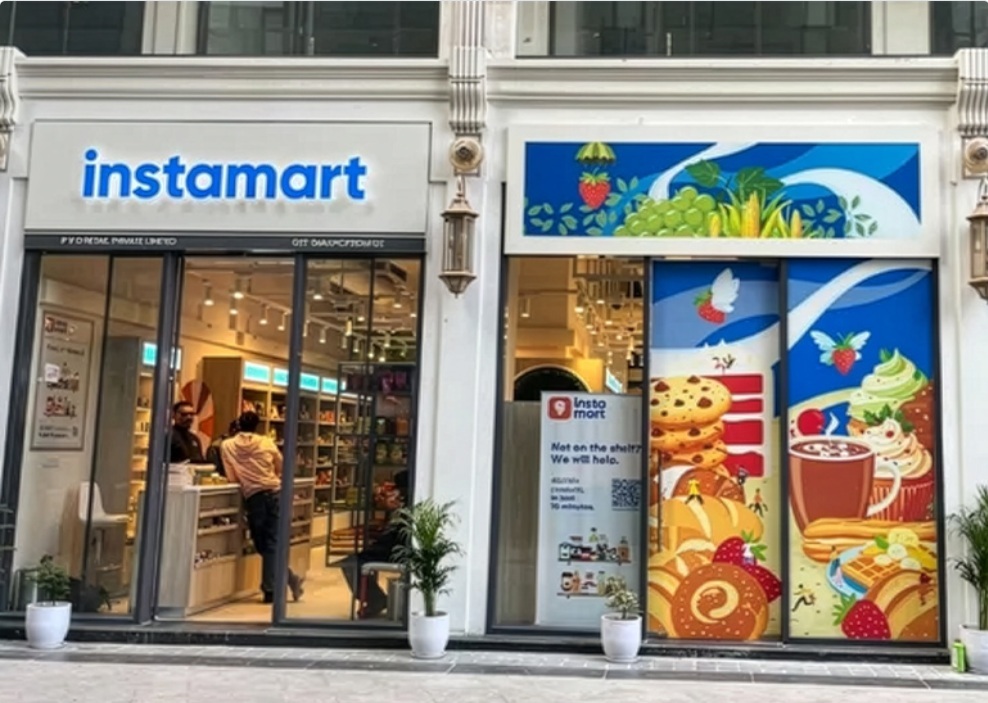
App, Tap, Pay and Zoom it’s delivered – that is Quick commerce for you. And in India, the narrative has so far been defined by speed, scale, high SKU counts, and the dominance of dark stores. Last week, however, Instamart nudged that model by opening an experiential store in Gurugram, allowing consumers to see and feel select products available on the platform.
The Bengaluru-based company has positioned the outlet not as a conventional retail store, but as a compact experiential format with a sharply curated assortment of around 100–200 SKUs, compared to the 15,000–20,000 SKUs typically housed in a dark store. Spanning roughly 400 sq. ft., the space is about one-tenth the size of a standard 4,000 sq. ft. dark store.
Under this model, sales proceeds are paid directly to sellers. This differs from Instamart’s regular arrangement, where payments are routed through the platform and later settled with sellers after deducting the platform’s share. IMPACT reached out to Instamart for further details, but the company declined to comment.
Sources close to the development say that Instamart has enabled sellers to open branded experiential stores in and around residential societies as part of a targeted consumer experiment. These are not conventional retail outlets, but compact experiential formats with a highly curated SKU assortment, focused on categories where consumers prefer to assess the products first-hand before purchasing, such as fresh fruits, vegetables, pulses, new product launches, and selected D2C brands. The initiative is largely centred on fresh categories and allows sellers to experiment with Instamart’s branding and service ecosystem.
Devangshu Dutta, Founder, Third Eyesight, a retail consultancy firm, says that physical presence plays a vital role in anchoring trust, particularly in premium products, groceries, and fresh produce. “Experiencing a product or brand physically can significantly enhance perceived value and help create stickiness. For this reason, offline stores continue to remain integral to the consumer products sector,” he explains.
Built on the promise of speed and convenience, quick commerce brands have come under growing scrutiny for quality and hygiene lapses at dark stores. Over the past year, several reports have flagged issues ranging from poor storage conditions and compromised freshness to the sale of expired or damaged products, particularly in food and grocery categories.
In some instances, regulatory inspections have led to licence suspensions after authorities identified hygiene violations at fulfilment centres. “Trust is what builds loyalty, and the shift is clearly moving from minutes to confidence,” says Shankar Shinde, Co-Founder, Aisles and Shelves, a behaviour-led brand consultancy in India. Shinde adds that the emergence of offline formats such as Instamart’s physical store aligns with this transition, particularly in grocery and fresh categories where consumers place a high premium on quality and consistency. “Physical touchpoints help reduce consumer anxiety, especially in a market like India, where shoppers still prefer hand-picked fresh produce such as fruits and vegetables,” he explains.
Against this backdrop, the opening of experiential centres could emerge as one way for quick commerce players to rebuild consumer trust by allowing shoppers to experience products in person before purchasing. IMPACT also reached out to Blinkit and Zepto for their views, but both declined to comment.
Kushal Bhatnagar, Associate Partner, Redseer Strategy Consultants, believes the move is aimed at unlocking incremental growth by tapping into offline-first consumers who are not yet active on quick commerce, while also catering to the offline purchase missions of existing quick commerce users. He notes that quick commerce currently reaches only about 75–80 million annual transacting users as of CY2025, even as over 90% of India’s grocery consumption continues to take place offline.
Beyond expanding reach, Bhatnagar sees offline formats as a way to address deeper trust barriers within the category. He adds that such formats can help deepen consumer confidence, particularly in categories where apprehensions around quality and freshness persist in quick commerce deliveries, concerns that are partly alleviated when consumers can experience products first-hand. Additionally, he points out that this approach benefits brands, especially emerging ones that are largely confined to quick commerce or a limited set of platforms, by giving them greater physical retail visibility without requiring heavy investment in traditional distribution networks.
Viewed through a financial lens, the move also carries implications for how quick commerce platforms justify value. Saurabh Parmar, fractional CMO, believes the initiative signals a shift from promise to performance, with a stronger emphasis on optimisation and a more realistic assessment of long-term value creation. He notes that while quick commerce has expanded into Tier 2 markets and seen growth in user numbers, these metrics alone still fall short of fully justifying current valuations. In this context, an offline presence becomes another lever to strengthen the overall business case.
At the same time, Parmar cautions that offline formats cannot replace the core proposition of quick commerce. He adds that experiential centres enhance brand credibility and make quick commerce feel closer to conventional retail, with the potential to eventually extend into other facets of e-commerce. However, he emphasises that quick commerce must continue to remain the frontline, as the sector’s valuations are fundamentally anchored in its speed-led proposition.
Retail experts, meanwhile, view physical touchpoints as a long-standing mechanism for building trust rather than a structural shift.
Dutta adds that such formats complement existing digital trust mechanisms such as delivery consistency, speed, ratings, and reviews by making brands feel tangible and accountable rather than abstract.
Bhatnagar notes that quick commerce currently has an average monthly transacting user base of around 40 million as of CY2025, leaving significant headroom for growth when compared to India’s overall e-commerce base of nearly 300 million active transacting users.
Beyond expanding the user base, he adds that experiential stores can also support wallet-share expansion across categories, which remains a key growth lever for the sector. “Non-grocery segments such as beauty and personal care, electronics, and fashion currently contribute about 25% of quick commerce GMV (Gross Merchandise Value), a share that is expected to rise further. Within groceries as well, platforms can drive incremental growth by building greater depth in fresh produce and staples,” Bhatnagar highlights.
From an operational perspective, however, the offline format is viewed more as a supporting layer than a core growth engine. Dutta sees Instamart’s offline presence as an experimental add-on rather than a replacement for its delivery-led model. The operating processes and economics differ significantly from those of quick commerce delivery, positioning physical formats as a complement to the speed proposition rather than an alternative. If the model proves viable and is backed by sufficient resources, it could eventually lead to a parallel scale-up of dark stores and experiential formats across different catchments.
For now, Instamart’s offline foray remains a tightly scoped experiment rather than a strategic pivot. Its significance lies less in square footage and more in what it signals about the evolving priorities of quick commerce. As the category matures, speed alone may no longer be sufficient to secure trust, loyalty, or long-term value. Experiential touchpoints, if deployed selectively, could help platforms bridge the gap between digital convenience and physical reassurance, particularly in categories where quality perception continues to remain fragile.
(Published in IMPACT)
admin
November 18, 2025

Chris Kay, Krishn Kaushik and Andrea Rodrigues in Mumbai
Nov 18 2025
Just before dawn, Kashif Sameer joins dozens of couriers zipping across Mumbai to deliver items stocked in a basement of a shopping mall run by Reliance Industries.
“I make between 20 and 30 deliveries in a day,” said the 25-year-old, who had just driven a mile across the chaotic roads of the Indian megacity to drop off groceries ordered 15 minutes earlier. “It is very popular with customers.”
The buzzing activity at the so-called dark store, a mini-warehouse operated by Reliance’s ecommerce platform JioMart, is part of a renewed push by the conglomerate’s chair and Asia’s richest man, Mukesh Ambani, to reassert his company’s position in India’s retail market.
It has added hundreds of dark stores to operate a total of nearly 20,000 physical outlets this year — almost double its pre-pandemic size — as it battles for dominance against Blinkit, Swiggy and Zepto in the country’s ballooning quick-commerce market.
“It’s a question of who runs out of money first,” said Arvind Singhal, chair of retail consultancy The Knowledge Company. “We will see some kind of a shakeout.”
Despite its large network of physical stores, Reliance has yet to corner the domestic consumer market like it did with telecoms a decade ago. It faces entrenched competition from established domestic and international rivals, as well as millions of kiranas, family-run convenience stores.
The sprawling Tata Group operates a wide range of consumer businesses, while global multinationals such as Unilever and Nestlé are important players in India’s household goods market.
Reliance Retail, the division that contains all of the conglomerate’s consumer-facing units, had shed tens of thousands of employees and closed underperforming stores following a bloated build-out during the Covid-19 pandemic and slowing middle-class spending.
But India’s most valuable company, which has a market value of more than $225bn and operates across oil refining, telecoms and entertainment, is expanding its retail reach again.
Reliance Retail’s latest results point to a rebound. In the quarter ending September, the unit reported revenue of about $10bn and profit of $390mn, up 18 and 22 per cent respectively from the previous year.
“Reliance’s scale in retail now is unmatched in India,” said Devangshu Dutta, chief executive of consumer advisory company Third Eyesight, in reference to the breadth of the conglomerate’s business. “This scale is unique in India and rare in global retail.”
Ambani’s retail ambitions are being led by his 34-year-old daughter, Isha. In August, she detailed plans for Reliance’s consumer brands subsidiary, which has a portfolio including Lotus Chocolate and the recently revived nostalgic Indian soft drink Campa Cola, to reach $11.7bn in revenue within five years.
Ultimately, the goal was to “become India’s largest FMCG company with a global presence”, said Isha Ambani during Reliance’s annual meeting.
The company told the Financial Times that it continued to “reinforce its position as India’s largest retailer, expanding its nationwide network”.

While Ambani originally indicated that he wanted to list Reliance Jio Infocomm, the telecoms unit, and Reliance Retail by 2024, people familiar with the company said the retail unit was not ready to go public. The billionaire said the Jio listing could happen in the first half of next year.
“Competitive intensity in every category in the discretionary retail side has picked up very sharply,” said Karan Taurani, executive vice-president at Elara Capital, who does not expect Reliance Retail to float for at least two years. “New competitors, new brands have come in and they are challenging the larger incumbents.”
The Ambanis, who operate as gatekeepers for foreign companies seeking access to India’s massive but challenging business landscape, have sought to cement their position through a spate of partnerships with western retail brands.
Foreign brands including West Elm, Pottery Barn and Superdry have stores in Reliance’s shopping malls in upmarket Mumbai. However, those joint ventures have largely struggled to gain traction with shoppers in India, where the per capita income remains less than $3,000.
The conglomerate’s foreign brands business housing these joint ventures lost Rs2.7bn ($30mn) in the financial year through March 2025, according to the latest available accounts. The Knowledge Company’s Singhal called Reliance’s push to bring international names to India “a vanity project”.
Reliance’s high-profile partnership with fast-fashion retailer Shein has also been underwhelming. The company returned to India this year under Reliance’s wing after being booted out in 2020 when relations between New Delhi and Beijing soured following military clashes along their disputed border.
Shein’s app has been downloaded just 11mn times, according to market intelligence firm Sensor Tower. Its discount prices are largely matched, if not undercut, by many Indian ecommerce and fashion retailers, say analysts.
Reliance is investing heavily in quick commerce, where deliveries are promised in 30 minutes or less. Bank of America estimates the market could reach $128bn by 2030.
The field is at present dominated by Blinkit, Swiggy and Zepto, which together control more than 90 per cent of the quick commerce delivery market and compete with Amazon and Walmart-owned Flipkart. None of the companies are profitable.
The Ambanis are eager to catch up. Over the past six months, Reliance has built about 600 dark stores across cities to plug gaps in its vast store network. By contrast, market leader Blinkit operates about 1,800 dark stores.
In quick commerce, “we have to be there because everybody is”, said a person close to the conglomerate. “It is a long-term strategy.”
On a call with analysts last month, Reliance Retail’s finance chief Dinesh Taluja admitted to delays in entering quick commerce. But he insisted that Reliance offered better prices, more variety and wider reach across smaller Indian cities where it is often the only formal retailer.
“The competition today is mainly in the top 10, 20 cities,” Taluja said. “We are present in almost a thousand cities. Competition will take many years to reach where we already have a head start there.”
Still, Reliance was facing an uphill battle, warned Elara’s Taurani. “JioMart is making a late entry,” he said, “it will be very tough to disrupt players here.”
(Published in Financial Times, all copyrights owned by FT)
admin
October 24, 2025

Entrepreneur India
Oct 23, 2025
Indian consumers are increasingly opting for private labels and in-house brands over established ones, and retailers are taking note. According to EY’s ‘Future Consumer Index 2025’, more than half of India’s consumers are now choosing in-house brands over legacy labels.
The report highlights that 52 per cent of Indian consumers have switched to private labels for better value, while 70 per cent believe these in-house brands offer comparable or superior quality. Backed by this shift, retailers from BigBasket to DMart, and quick-commerce players like Zepto and Blinkit, are doubling down on their private label strategies, viewing them as a path to higher margins, stronger brand loyalty, and greater pricing control.
“Indian consumers’ growing preference for private labels reflects both short-term price pressures and a longer-term structural evolution in retail,” said Devangshu Dutta, CEO of Third Eyesight, speaking to Entrepreneur India.
Trending globally
The surge isn’t unique to India. A recent report by the Institute of Grocery Distribution (IGD) notes that globally, private labels now account for over 45 per cent of grocery volume and are expanding faster than legacy brands.
In India, this shift is becoming increasingly visible in-store. The EY report found that 74 per cent of consumers have noticed more private label options where they shop, and 70 per cent say these products are now displayed more prominently, often placed at eye level, signalling a strategic retail push.
Commenting on this trend, Angshuman Bhattacharya, Partner and National Leader, Consumer Products and Retail Sector, EY-Parthenon, said, “Consumer behaviour has traditionally evolved in response to changing economic situations, but the current shifts appear to be more permanent. Retailers are confidently launching private labels and allocating prime shelf space to them, while technology is enhancing the shopping experience by providing consumers with limitless options and the ability to compare products.”
From price-fighters to power brands
According to Dutta, private labels are no longer just “copycat” alternatives meant to undercut national brands.
“For retailers, not just in India but globally, lookalike private labels used to be tools at the opening price point to hook the customer, who saw them as credible, affordable alternatives to national brands,” he explained, adding, “However, as retailers have grown, they have gained both scale and expertise to widen and deepen their supply chains.”
Over time, he said, investments in formulation, packaging, and quality consistency have increased consumer trust.
“Private labels now compete on functional benefits rather than only on price, particularly in food staples and apparel, but also in brown goods and white goods, and increasingly in personal care and other FMCG categories,” he added. [Must read: “Private Label Maturity Model”]
Retailers scale up private labels
As demand for in-house brands grows, retailers are scaling up their strategies across sectors.
BigBasket, one of India’s largest online grocery platforms, reported that 35–40 per cent of its FY24 sales came from private labels like Fresho, BB Royal, and Tasties. The company aims to push this share closer to 45 per cent through expansion in frozen foods and ready-to-eat categories.
DMart’s private label arm, Align Retail, has reportedly more than doubled its sales in two years, touching INR 3,322 crore in FY25. The retailer’s in-house brands in staples, apparel, and home essentials have helped boost margins in a highly competitive retail landscape.
Zepto, the quick-commerce player, is taking private labels into the 10-minute delivery domain. Its brand Relish, focused on meats and eggs, has achieved INR 40 crore in monthly sales.
Meanwhile, Reliance Retail has also expanded its portfolio of private labels, including Good Life, Enzo, and Puric, across groceries, personal care, and household products, strengthening its broader FMCG play. In 2024, Reliance Retail’s Tira Beauty also announced the launch of its latest private label brand, Nails Our Way, signifying a major expansion in its beauty offerings.
Capturing a lion’s share in retail
Dutta noted that in India, private labels will remain a core pillar of modern retail strategy rather than a cyclical response to cost pressures.
“Consumers increasingly view retailers as brand owners rather than intermediaries. As private labels mature in branding and innovation, their growth aligns more and more with brand equity development rather than just opportunistic cost-saving,” he said.
From a retailer’s perspective, private labels deliver higher gross margins and greater strategic control, Dutta said. [Must read: “Private Label Maturity Model”]
Another report by the Private Label Manufacturers Association (PLMA), using Circana data, found that in 2024, private-label sales in food and non-edible categories grew faster than bigger brands globally. While figures vary by region and quarter, the pattern remains consistent: private labels are outpacing traditional FMCG growth.
Collectively, these shifts show that private labels are becoming a major revenue driver for retailers in India, and are fast evolving from value alternatives into brands with genuine consumer pull.
(Published in Entrepreneur India)
admin
September 19, 2025

Anuja Jain, Exchange4Media
19 September 2025
Retail media is now the fastest-growing line in Indian advertising, with brand budget tilting hard toward e-commerce as digital shopping scales.
Fresh FY25 financials underline the shift: Amazon India’s ad sales jumped 25% to *8,342 crore, while Flipkart booked ₹6,310 crore. Together, the two platforms command 14,652 crore in commerce advertising, signaling a decisive move of performance spends from traditional channels to shoppable, data-rich placements.
At Amazon India, advertising has become the second largest revenue pillar after marketplace services, contributing nearly 28% of a 30,139-crore operating base. The heft now rivals or surpasses several legacy media categories, highlighting brands’ tilt to closed-loop, performance-led placements on commerce.
On the other hand, for Flipkart, ads are now a clear topline engine. Marketplace revenues have crossed ₹20,000 crore, with income from marketplace services more than doubling on the back of brand promotions, even as the company ploughs investment into logistics, new commerce formats, and Al-driven personalization.
For context, marquee media houses sit well below commerce ads, Zee Entertainment’s FY25 advertising revenue was 838 crore, while HT Media logged about a little over 1,070 crore for the year. Even Network18’s entire news segment revenue (ad + subscription) was approximately 468 crore, clearly indicating the scale retail media now commands.
Why retail media Is booming
According to brand experts, the surge in ad revenues of Amazon and Flipkart not only reflects the growing dominance of retail media in India but this works because it is closest to the point of purchase, akin to securing premium shelf space in physical retail.
“Consumers come to Amazon and Flipkart with high purchase intent, and coupled with first-party data, brands can sharply target audiences-premium or mass-with clear measurability of ROI,” said one of the experts.
Underlining the growing dominance of retail media, “E-commerce platforms know exactly who you are and what you buy,” he explains that this knowledge allows brands to pitch products with far greater precision thab traditional digital channels.
Retail expert Devangshu Dutta explains that the surge in ad revenues for e-commerce needs to be compared with the long-standing practices of large retailers, who have historically charged slotting fees for shelf placement and additional promotional charges for in-store or media visibility.
“As far as ad revenues for e-commerce companies in India are concerned, this is a fundamental structural shift rather than a temporary spike. It is a mature monetisation strategy that mirrors global trends,” he said.
The size and accuracy of retail media networks (RMNs) are the main drivers of the increase in e-commerce ad spending. According to Bloom Agency, an NCR based digital marketing outfit, companies are discovering unmatched reach and conversion prospects in India, where there will be over 342 million online consumers by 2025 with platforms like Amazon (with 150 million users) and Flipkart (with 180 million users) controlling over 65% of the market. In contrast to traditional digital advertisements on Google or Meta, retail media provides closed-loop attribution, which allows advertisers to track sales impact directly. This is a crucial indicator in today’s ROI-driven market.
IBEF (Indian Brand Equity Foundation) data shows that India’s digital advertising industry has crossed ₹60,000 crore in FY24, with retail media accounting for a fast-expanding share. Globally, retail media is already being hailed as the “third wave” of digital advertising after search and social media, and India is now firmly aligned with that trajectory.
Nipun Marya, CEO of iQOO, credited Amazon Ads as a crucial growth driver for the brand’s recent launches. “For recent launches, iQOO leveraged Amazon Ads to reach relevant audiences and build pre-launch buzz, using formats like Amazon Live, influencer-led shopping events, display, video, and search ads,” he said.
Emphasizing the centrality of Amazon in its strategy, Marya highlighted, “Based on consumer insights, iQOO identified Amazon as the key shopping destination for its core audience and built its e-commerce strategy around the platform.” This approach, which combines influencer-led activities, Amazon Live storytelling, and always-on Search Ads, has helped the brand deepen engagement and sustain consumer consideration in a competitive and price sensitive market.
Tight demand is also lifting platform pricing, through last Diwali, India retail-media CPMs spiked 30% at peak and CPCs ran 33% above baseline, and brands are budgeting for similar pressure this season. New premium placements, video/CTV and Amazon’s Sponsored TV are further nudging average rates up as advertisers chase shoppable reach.
Quick commerce platforms like Zepto, Blinkit and Swiggy Instamart are also capitalising on festive demand with steep hikes in ad rates, especially for premium slots like homepage banners and sponsored placements. Categories such as FMCG, snacks and personal care are leading the charge, with brands committing lakhs each month to secure visibility. By turning digital shelf space into monetised real estate, Q-comm ad revenues are projected to cross ₹5,000 crore by 2025, reinforcing why retail media is one of the fastest-growing, ROI-driven channels.
Quick commerce players are seeing varied traction from advertising revenues. Zepto has emerged as the frontrunner, crossing ₹1,000 crore in annualised ad revenue, or over ₹83 crore a month. In contrast, Blinkit earned just 7 crore in FY25 from related-party ads, dwarfed by its 502 crore ad spends. Zomato’s food delivery arm reported ₹8,080 crore in revenue, up 27% YoY on the back of commissions, ads and platform fees, while Swiggy’s operations grew 45% YoY to 4,410 crore but losses widened to 1,081 crore due to heavy quick commerce investments.
Intensifying competition for brand wallets
Sponsored listings, video commercials, and Al-driven targeting are just a few of the ways that Amazon’s commerce ecosystem seamlessly incorporates advertising, giving businesses greater visibility at the point of sale. Flipkart, on the other hand, is using its creator-led campaigns (Creator Cities), subscription play (Flipkart Black), and holiday specials to create an engaging layer of brand interaction.
The competitive dynamic is forcing consumer brands, especially in FMCG, electronics, and fashion, to rethink their media mix. With e-commerce penetration expected to jump from 25% in FY24 to 37% by FY30 as per the IBEF report, advertising spends on these platforms are projected to scale even faster. Analysts suggest that retail media could command over 20% of India’s total digital ad market by 2030.
A Reshaped Media Landscape
The implications for India’s advertising ecosystem are profound. Traditional digital duopoly players Google and Meta still command scale, but the entry of retail giants is fragmenting spends. For brands, the choice is less about “whether” to advertise on Amazon or Flipkart and more about “how much” to allocate in order to capture consumers at the point of intent.
As India races toward becoming the world’s second-largest online consumer market with 600 million shoppers by 2030, says Grab On report, retail media is set to be the fastest-growing channel. Amazon and Flipkart’s FY25 numbers signal that we are only at the beginning of this pivot. The clear signal for advertisers is that e-commerce has evolved beyond sales, now standing at the very core of digital ad planning.
(Published in Exchange4Media)
