
admin
December 3, 2025

Pooja Yadav, Exchange4Media
3 December 2025
Over the last few months, India’s e‑commerce and quick‑commerce ecosystem has undergone a wave of structural regulatory and tax reforms. Be it the Goods and Services Tax Council (GST Council) formally bringing “local delivery services” under the tax net with an 18% levy, or the newly implemented labour and social-security reforms expanding obligations for gig workers on aggregator platforms like Swiggy and Zomato, the cost and compliance landscape for delivery and fulfilment is shifting significantly.
The latest GST clarification, delivery fees, packaging charges, and logistics surcharges are now creating a ripple effect across pricing, platform margins, and seller compliance requirements.
The past few months have already shown concrete signals that platforms are revising their incentives, delivery promises, and fee structures. Following the GST clarification, major food‑delivery players have raised their platform fees, for instance, Zomato reportedly increased its per‑order fee from ₹10 to ₹12 (pre‑GST), while Swiggy also raised fees in select markets. Some quick‑commerce arms are also reworking free‑delivery thresholds or fee waiver conditions. Swiggy Instamart also recently updated its free‑delivery threshold to orders above ₹299, with handling and surge fees applying below that level, per reports.
Meanwhile, some platforms seem to be signalling a de‑emphasis on “ultra‑fast for every order” as universally viable; free or fast delivery now appears increasingly tied to higher order values or subscription/membership perks.
It looks like these pressures are forcing platforms to reconsider long-standing quick-commerce levers such as ultra-fast delivery, first-order free offers, zero delivery fees, and flash discounts — which have historically driven customer acquisition and retention.
While Zomato did not comment directly, it referred to the Code on Social Security, 2020 (CoSS), noting that the platform is prepared for gig-worker obligations and does not expect the rules to negatively impact long-term business sustainability.
According to Kapil Sharma of Amazon Ads, “The e‑commerce landscape will continue to evolve, but some fundamentals remain constant such as delivering value to consumers and providing advertisers with meaningful ways to engage. Our full-funnel ad solutions allow brands to focus on objectives such as new product launches, brand building, or promoting larger pack sizes, ensuring campaigns remain relevant and effective even as the ecosystem adapts to changing costs and regulations.”
e4m reached out to Swiggy, Meesho, Zepto and BigBasket for comments, but did not receive responses until the time of publishing.
Several experts told e4m that the economic model of quick commerce, built on heavily subsidised delivery and small-ticket frequent orders, is under pressure. Platforms will need to find sustainable levers to retain customers without eroding margins. The industry has started to see a strategic recalibration where speed is increasingly becoming a hygiene factor rather than a differentiator, free delivery is becoming conditional, and platforms are nudging consumers toward larger baskets, subscription models, curated bundles, and scheduled deliveries. Brands, in turn, are also shifting focus from mass discounting to premiumisation, value-led messaging, and precise cohort-based targeting.
Will Free Delivery Become Rare?
With the new social‑security obligations for gig workers under India’s labour reforms, and the added cost burden of delivery services now subject to GST, the economic logic underlying “free delivery” as a marketing lever is coming under stress. Chetan Asher, Founder and CEO of Tonic Worldwide, echoes this view, noting that quick-commerce platforms previously operated on thin contribution margins and heavily subsidised small-ticket, frequent orders. With rising delivery costs and mandatory social-security contributions, universal free delivery is becoming increasingly unsustainable.
Industry analysts point out that the new social-security mandates and GST on delivery fees have lifted per-order costs noticeably. Most quick-commerce platforms already operate at low single-digit contribution levels, making blanket “free delivery” hard to justify. It may continue, but only as a conditional incentive tied to higher basket values, subscription memberships, or flexible delivery slots, rather than as a universal subsidy.
Shradha Agarwal, Co- Founder & Global CEO, Grapes Worldwide, added from an advertising standpoint, “It’s already happened, brands like Zomato, Swiggy, Amazon and Flipkart, who know we are going to buy from them, have shifted from ‘buy now’ tactics to ‘stay with me’ strategies. Those days are gone when platforms were giving blanket discounts, now brands are the ones tightening their offers.” Citing an example she mentioned how offline pricing is ₹235, but online it is sold at ₹185, with online adding to top-line rather than bottom-line.
On promo hooks like ‘₹0 delivery’, ‘first-order free’ or ’10-minute delivery’, Agarwal said, “As labour codes, compliance costs, and social-security contributions kick in, platforms will have less room to burn cash on promos that don’t create sustainable value. Consumers care more about convenience than freebies.”
On ad spend shifts, she noted, “Offer-driven campaigns will weaken, while value-driven storytelling will rise. ATL and influencer campaigns will strengthen, and performance marketing will become more strategic. Retail media will become non-negotiable.”
From a brand perspective, Asher pointed out that quick-commerce spends are increasingly evaluated against contribution margin rather than sheer GMV growth. Discounts and zero-fee offers are losing bite as customer acquisition costs rise. First-party data, replenishment journeys, and sharper cohort-based offers are gaining importance, ensuring that incentives remain ROI-focussed rather than mass-oriented. Similarly, speed claims such as “0 delivery” or “10-minute delivery” are becoming less differentiating in top cities, where most players already deliver within 15–20 minutes. Consumers now respond better to reliable ETAs, fair fee structures, and transparent pricing than aggressive speed promises.
Adding her viewpoint, Pooja Dhamdhere, Commerce Lead at Starcom India, said, “Incentives like free delivery or first-order offers are likely to evolve rather than disappear, and platforms will explore strategies such as tiered benefits, curated bundles, or differentiated pricing for specific cohorts.”
According to serial entrepreneur Alok Chawla and Founder at Kiko Live, added that while platforms may continue absorbing delivery costs in the short term, the long-term economics will require charging for ultra-fast or low-value orders. “Once platforms pass the actual delivery costs to consumers, we expect order frequency and small-cart behaviour to change, with many users shifting to larger baskets or neighbourhood retailers offering free delivery,” he noted.
Alternative Consumer-Incentive Models
Devangshu Dutta, founder and chief executive of Third Eyesight, who is an expert in the consumer and modern retail sector, stated, “I think platforms will pass a significant portion of the new 18% GST burden on delivery to end-consumers, either through higher delivery charges or repackaged platform fees. Some of this cost may also be clawed back from restaurant partners and quick-commerce brands via revised commissions, slotting fees or mandatory participation in marketing programmes, especially in categories where the platform has stronger bargaining power. Overall, I expect higher minimum-order thresholds and a tighter margin environment for restaurants and small D2C brands that rely heavily on third-party platforms.”
Analysts highlight strategies such as minimum-order thresholds, where free or lower-fee delivery applies only above a certain cart value, nudging consumers to order larger baskets rather than frequent small-ticket items. Subscription and membership-based models are also gaining prominence, offering benefits like waived or discounted delivery, priority fulfilment, and access to exclusive promotions in exchange for a fixed fee.
Scheduled or batch delivery windows are being used to optimise logistics, reduce cost pressure on ultra-fast last-mile fulfilment, and improve operational efficiency. Meanwhile, curated bundles and value packs, including weekly or monthly combos, allow consumers to plan purchases while enhancing per-unit economics for platforms. These levers also enable brands to maintain margin integrity without over-reliance on short-term discounting.
From a marketing perspective, this shift is prompting agencies and creative-first firms to move toward value-led messaging, premiumisation, and cohort-based targeting. Dhamdhere explained, “Platforms are optimising assortments by surfacing premium SKUs, nudging higher average order values, and using search optimisation to strengthen profitability. Brands are now focusing on aspirational consumers with curated bundles, subscriptions, and value-led propositions, rather than mass discounting. Performance campaigns will continue, but clarity of value and sustainable margin-led offers are becoming key for acquisition and retention.”
2026: Will regulatory pressure force a recalibration?
As 2026 approaches, the combined impact of GST on delivery services and mandatory social-security contributions for gig workers is forcing a fundamental rethink of quick-commerce economics. With blanket discounts, zero delivery fees and ultra-fast delivery no longer viable as mass levers, platforms are shifting toward basket-building, subscriptions, curated bundles and conditional incentives. The growth thesis is evolving from “habit formation at any cost” to protecting contribution margins through reliable ETAs, transparent pricing and premium assortments rather than aggressive subsidies.
Brands are recalibrating alongside this shift. Premiumisation, value-led propositions and sharper cohort-based targeting are taking precedence over broad discounting, and campaigns are increasingly evaluated on ROI, repeat behaviour and lifetime value rather than raw GMV. Tiered memberships, scheduled deliveries and subscription-led conveniences are emerging as key retention tools, while short-form video, influencer ecosystems and retail media help articulate value in a tighter cost environment.
Chawla said platforms will have to move beyond “₹0 delivery”, “first order free” and “10-minute delivery” as core propositions because the delivery cost burn far exceeds margins on small-ticket orders. Many consumers currently place multiple micro-orders a day simply because delivery is free, but once fees come into play, behaviour will likely shift toward clubbing orders or reverting to neighbourhood retailers, who themselves are rapidly digitising through partners like Kiko Live.
In the next phase, he adds, free instant delivery will only be sustainable for larger baskets, whereas scheduled delivery may become the default for free delivery, with paid instant delivery as an optional upgrade. Subscriptions may drive loyalty, but only up to a point, since the heaviest users would consume more deliveries than the subscription fee can realistically subsidise, making it difficult for platforms to make the model profitable.
This points to a clear playbook for 2026. “Free delivery” and mass discounting are expected to fade, giving way to conditional, tier-based formats that reward higher basket values, subscriptions or specific cohorts. Brand platform partnerships will also move toward profitability rather than promotional burn, with campaigns designed to protect margins instead of fuelling discount-led spikes.
Taken together, the signs suggest that 2026 will not mark the end of convenience, but the end of convenience that is subsidised blindly. The real test now is who absorbs this new cost of convenience, platforms, brands, or consumers. And as that battle plays out, another tension is already emerging: whether small and regional advertisers can survive the rising cost of visibility in India’s digital economy.
(published in Exchange4Media)
admin
November 4, 2025
Yash Bhatia, IMPACT
4 November 2025
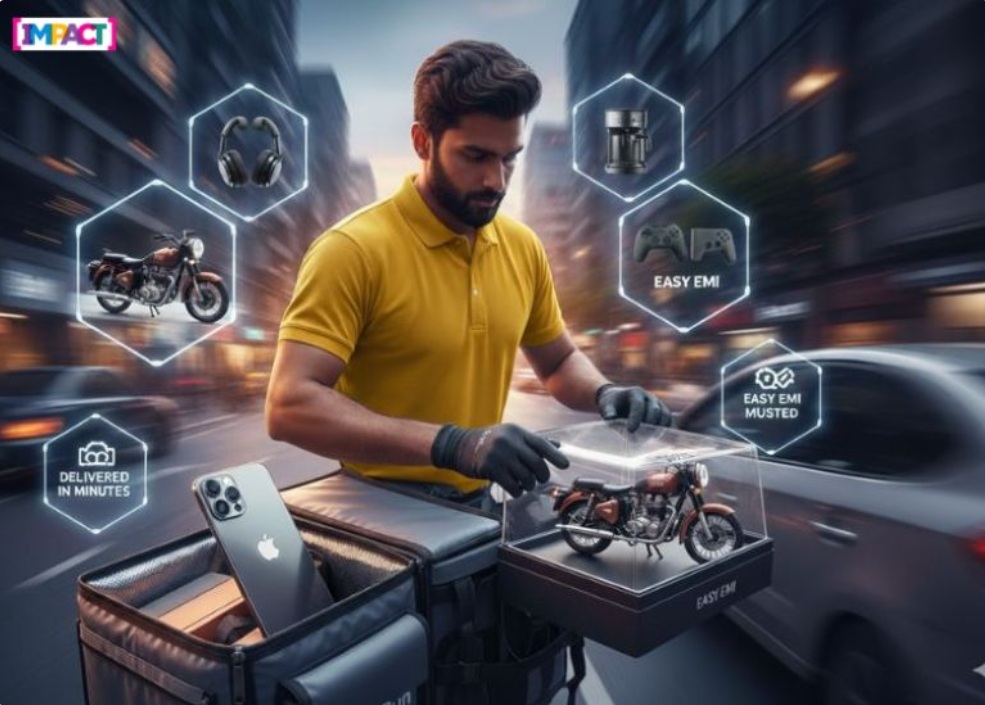
It started with groceries. Quick commerce started delivering milk, bread, and eggs in 10–15 minutes, which seemed revolutionary enough in 2022. Then came the iPhone 14 launch, and suddenly, quick commerce wasn’t just about convenience; it was about spectacle. Overnight, India’s app-based delivery ecosystem became the stage for a new ritual: flagship products arriving at your doorstep faster than you can say ‘checkout.’
And now? Phones aren’t the limit. You can even order motorcycles online. Yes, motorcycles. Royal Enfield has partnered with Flipkart to list its entire 350cc portfolio, which will be delivered to five cities: Bengaluru, Gurugram, Kolkata, Lucknow, and Mumbai.
The lines between e-commerce and quick commerce are becoming increasingly blurred. Flipkart’s Flipkart Minutes and Amazon’s instant delivery options are proof that speed is no longer a differentiator; it’s table stakes. And as platforms race to expand, high-ticket items are joining the frenzy, from electronics and furniture to watches, fitness equipment, and premium kitchen appliances. For platforms, these products are goldmines of margin; the challenge lies in logistics and consumer trust.
According to a report by CareEdge Advisory, India had over 270 million online shoppers in 2024, making it the second-largest e-retail user base globally, while the e-commerce market grew 23.8% in 2024 over the year-ago period, it said. The report also added that Indians ordered Rs 64,000 crore of goods from quick-commerce platforms.
From the consumer standpoint, one of the challenges for consumers to buy high-ticket items from the quick commerce platforms is to get consumer trust, which used to be the case when e-commerce started its operations. Can quick commerce move to high-ticket items? Is quick commerce looking at these items as a branding exercise, or are they looking at them as a serious revenue stream channel?
Chirag Taneja, Founder & CEO, GoKwik – an e-commerce enablement platform, says what began as a branding exercise for D2C brands has now evolved into a credible revenue stream. “In the early days, high-ticket categories on D2C platforms saw limited traction,” he explains. “Trust was still being built, customers were unsure if their orders would even reach them. There were many friction points.”
But that’s no longer the case. According to GoKwik’s network data, high-ticket purchases (above ₹2,500) are no longer outliers, they’re becoming a consistent driver of topline revenue.
Interestingly, most of these premium purchases are powered by credit instruments from no-cost EMIs to instant credit options at checkout. “This reflects a clear shift in mindset,” says Taneja. “Consumers no longer view high-value spending as a financial strain. They see it as a set of manageable, bite-sized payments that help them aspire higher, quicker. It’s not just a financial enabler, it’s a psychological unlock that makes premium consumption feel accessible and routine,” he adds.
“With strong trust in delivery reliability, smooth returns, and credible brand backing, the ecosystem has bridged the gap that once kept premium shopping offline,” says Taneja.
Devangshu Dutta, Founder of a specialist consulting firm, Third Eyesight, thinks differently and points out that high-value items still make up a small slice of quick commerce sales. “The model thrives on simplicity, a limited product range on the platform’s end, and quick, low-friction decision-making on the consumer’s,” he explains.
That said, Dutta believes quick commerce can still play a strategic role for premium brands. “For high-value products, q-comm can be an excellent lever for driving velocity, testing market response, or amplifying brand visibility. But it should be viewed as one piece of the channel mix, not the primary sales driver.”
From the platform’s perspective, however, listing high-ticket products brings its own upside. “They create excitement, boost average transaction values, and improve realised margins,” Dutta notes. “Consumers are often drawn in by novelty, exclusivity, or status appeal, especially during big launches or limited-time promotions.”
Still, he adds a note of realism: “Premium and high-ticket purchases largely remain planned decisions. Most consumers continue to prefer established offline and e-commerce channels for such buys where trust in authenticity, return policies, and after-sales services still carry greater weight than instant gratification.”
Seshu Kumar Tirumala, Chief Buying and Merchandising Officer, BigBasket, says the company doesn’t look at electronics as a high-ticket item category but rather focuses on building a complete category experience for customers. “For example, if we list an Enfield bike, we’d also want to offer spare parts, servicing options, and extended warranties, because that’s how the category functions,” he explains.
Tirumala adds that BigBasket adopted the same approach when it ventured into mobiles and mobile accessories. “When we launched this category last year, it was a trial. Today, it’s a sizable part of our business,” he says. Currently, electronics and mobile accessories contribute 5–10% of BigBasket’s monthly sales, having grown 250–300% year-on-year since the first iPhone launch on the platform.
While the launch day drives the highest demand for flagship devices like the iPhone, Tirumala notes that the following one to two months see strong accessory sales, from AirPods and headphones to chargers and power banks. “On average, mobiles and accessories account for 7–8% of our total sales, peaking at 10% during the festive season. Overall, this category has grown from zero to 7–8% of our total business in just a year, and we expect it to reach around 25% next year,” he adds.
Currently, the platform offers select models from smartphone brands, including OnePlus, Realme, Redmi, Vivo, and Oppo.
The Bengaluru-based platform is now piloting the delivery of large home appliances across across select city areas in partnership with Croma. If successful, BigBasket plans to expand this model to other cities, further broadening its quick commerce offering beyond everyday essentials.
Taneja points out that the traditional e-commerce model, once driven by discounts and affordability, is now evolving toward experience and access. Over the next few years, two major shifts will shape this transformation: credit-first commerce, where EMIs become the default mode for premium purchases, and aspirational commerce, where consumers view e-commerce as the easiest path to lifestyle upgrades. Consequently, platforms will need to reposition themselves from being “where you save more” to “where you unlock more”, prioritising personalisation, trust, and a seamless shopping experience.
As quick commerce matures, it is no longer just about instant gratification; it’s becoming a bridge between aspiration and accessibility.
Platforms are proving that speed, trust, and seamless experience can coexist with high-value purchases.
(Published in IMPACT)
admin
October 10, 2025

Pooja Yadav, Exchange4Media
10 October 2025
Over the years, India’s e-commerce market has been dominated by the duopoly of Amazon and Flipkart. These platforms have not only captured consumer attention but also shaped how brands spend their marketing budgets. In parallel to this, the concept of retail media networks (RMNs), marketplaces selling ad placements to brands directly, has also grown rapidly. Not only this, it is emerging as one of the fastest-growing channels in digital advertising.
As a result, the industry is witnessing a wave of new retail media platforms entering the market. From grocery and pharmacy marketplaces to Q-comm platforms, D2C marketplaces, and ONDC pilots, all are attempting to carve out space for themselves. Yet despite these new entrants, Amazon and Flipkart continue to command the lion’s share of shopper-marketing rupees, leaving little oxygen, even for challenger players like eBay, even as it retools its India strategy.
Retail media is now outpacing social and video in growth, and in India, this expansion remains concentrated around these two dominant players. According to several experts e4m spoke with, Amazon and Flipkart dominate because of their massive logged-in traffic at the point of purchase, first-party data, and closed-loop attribution linking impressions directly to GMV. These platforms succeed by combining large logged-in audiences, direct attribution from impressions to sales, and first-party data insulated from signal loss-advantages most challengers cannot match.
Adding to this, Shradha Agarwal, Co-Founder & CEO of Grapes, highlighted the key hurdles brands face when allocating budgets to newer networks like ONDC or eBay. She noted that brands consider three main factors: whether the network can deliver the same sales efficiency, whether it reaches new users or just shoppers already accessible on Amazon, and whether the scale is meaningful. Quoting an example, she said if a brand is already generating 10 crore on Amazon, it may question whether investing in a new platform that delivers only 25 lakh is worth the effort.
Vaibhav Jain, Head of Media at First Economy, pointed out, the biggest barriers to scaling budgets across newer retail media networks like eBay or ONDC or any other, are fragmented infrastructure, limited data maturity, and inconsistent measurement. Many platforms still lack robust first-party data systems and unified reporting standards, making it difficult for brands to validate ROI at the level provided by Amazon or Flipkart.
Everyone’s building a network – but is there room?
Despite the dominance of Amazon and Flipkart, the retail media landscape is attracting new entrants, including grocery and pharmacy marketplaces, Q-commerce platforms, D2C marketplaces, and ONDC pilots, all attempting to carve out space for themselves. Among these challengers, eBay has recently re-entered India with a markedly different approach focussing on building technical and export-led capabilities rather than competing directly in the domestic consumer market.
Against this backdrop, eBay has reopened its India chapter with a Global Capability Centre (GCC) in Bengaluru, planning to host over 300 engineers across AI/ML, product, design, and data analytics. Unlike its previous consumer-facing stints in 2005 and 2013, this pivot is capability and export-led, not a direct battle with domestic marketplaces. Globally, eBay earns revenue through Promoted Listings and other advertising products, but in India, it has historically lacked domestic shopper scale and first-party data, the two critical ingredients that make retail media profitable.
This time, eBay appears to be betting on cross-border trade, technology-led capabilities, and potentially new ad-tech opportunities a model that could differentiate it from established players like Amazon and Flipkart.
Speaking on this, Lloyd Mathias, business strategist and angel investor, said, “Retail media takes off only when you have a large front-end site like Amazon or Flipkart, where advertisers want to reach shoppers at the point of purchase. I don’t think retail media is going to be a big revenue driver for eBay at all.”
Adding to this, seasoned e-commerce analyst and Datum Intelligence advisor Satish Meena noted, “Retail-media economics depend on domestic shopper traffic and first-party data both of which eBay currently lacks in India. The realistic play is export-facing promotions, enabling Indian sellers to advertise SKUs to international buyers on eBay’s global sites. That’s valuable but niche, and unlikely to rival Flipkart or Amazon’s India-scale retail-media businesses.”
Devangshu Dutta of Third Eyesight stated, “On the trade front, the company appears to be prioritising exports from India rather than competing in the domestic market, which is already hypercompetitive and price-driven.”
Until eBay establishes a stronger consumer-facing presence, retail media will not be a priority, as per experts. In the near term, its strategy is likely to focus on export-facing ads, promoting Indian sellers to global buyers. Looks like this approach is unlikely to challenge Amazon or Flipkart in India.
What it would take to break the duopoly
While eBay’s strategy has been called smart, opportunities remain. Harish Bijoor, Founder, Harish Bijoor Consults Inc, noted that communication formats are evolving. with peer-to-peer engagement gaining reliability over top-down approaches. Amazon and Flipkart follow top-down models, whereas eBay could differentiate itself through 1:1 consumer interaction.
After two failed attempts at cracking India’s consumer market, eBay’s third innings (as some may call) is fundamentally different. It is no longer chasing domestic consumers but enabling Indian sellers to export globally, leveraging eBay’s global logistics, trust programs, and buyer base. The company is also partnering with government export initiatives, MSME councils, and logistics providers, while buildin technical, analytic, and product capabilities through the Bengaluru GCC.
Mandar Lande, co-founder of Waayu, a platform working with ONDC and MSMEs to enable digital commerce, said that eBay is unlikely to build a traditional retail media business in India without a large consumer marketplace. “eBay lacks the first-party shopper data and traffic scale that power retail media networks like Amazon Ads or Flipkart Ads. However, it could still build a niche ad-tech play focused on export sellers, cross-border insights, and global buyer intent analytics essentially an “export intelligence and seller marketing’ platform rather than a domestic retail media business. While it won’t rival Amazon Ads in India, it can carve out a high-value B2B media niche rooted in cross-border commerce rather than local eyeballs.”
For challenger brands like eBay aiming to break into India’s retail media landscape, success will depend on proving incremental sales rather than just impressions, offering unique audiences, maintaining pricing flexibility, and providing ease of buying through self-serve tools and standardised metrics.
Experts told eam that while retail media and ad-tech may not be immediate revenue drivers, eBay’s export-first strategy allows the company to build scale, technology, and credibility, setting the stage for potential consumer-facing or advertising initiatives in the future.
Jain mentioned, “Closed-loop measurement is central to shifting brand spend beyond Amazon and Flipkart. It offers verifiable proof of performance, linking ad exposure directly to sales. Challenger retail media networks that can deliver credible attribution and comparable ROAs will gain traction faster. Measurement sophistication isn’t just an advantage; it’s the entry ticket to serious brand consideration.”
Speaking about how self-serve tools, standardised metrics, and competitive CPC/CPM rates influence a brand’s willingness to experiment with challenger retail media networks, Jain told e4m that these elements are critical for encouraging experimentation. They simplify campaign management, enable agility, and allow brands to benchmark performance fairly against established players.
From a brand execution perspective, Agarwal emphasised that the availability of self-serve tools is crucial for experimentation. Advertising on commerce platforms was previously cumbersome, but self-serve options now allow brands to launch campaigns at any budget, large or small, providing flexibility and control. When pricing is competitive and reporting is standardised, brands are more willing to test new networks. Early experiments have shown that allocating even a portion of retail media budgets to challenger platforms can deliver meaningful incremental sales, although such cases remain limited.
Reality check for 2025 plans
Brands in India are increasingly looking to diversify their retail media spend and reduce costs, but in a market dominated by Amazon and Flipkart, certainty still drives allocation decisions. Amazon Ads India revenue surged to 8,342 crore in FY25, a 25% year-on-year increase, while Flipkart Ads has grown 600% since 2020, capturing a significant share of marketplace marketing budgets. Until challengers can match these giants on shopper intent, identity, and attribution, most retail media budgets will remain top-heavy.
While many new entrants are trying to add variety at the edges by offering niche audiences, alternative ad formats, and export-focussed solutions, However, breaking into the core of India’s retail media market requires domestic scale, robust attribution frameworks, and access to unique audiences that cannot be replicated elsewhere.
Experts point to several structural barriers for newer networks. Fragmented infrastructure, limited first-party data, and inconsistent measurement make it difficult for brands to validate ROI at the level provided by Amazon or Flipkart.
(Published in Exchange4media)
admin
September 19, 2025

Anuja Jain, Exchange4Media
19 September 2025
Retail media is now the fastest-growing line in Indian advertising, with brand budget tilting hard toward e-commerce as digital shopping scales.
Fresh FY25 financials underline the shift: Amazon India’s ad sales jumped 25% to *8,342 crore, while Flipkart booked ₹6,310 crore. Together, the two platforms command 14,652 crore in commerce advertising, signaling a decisive move of performance spends from traditional channels to shoppable, data-rich placements.
At Amazon India, advertising has become the second largest revenue pillar after marketplace services, contributing nearly 28% of a 30,139-crore operating base. The heft now rivals or surpasses several legacy media categories, highlighting brands’ tilt to closed-loop, performance-led placements on commerce.
On the other hand, for Flipkart, ads are now a clear topline engine. Marketplace revenues have crossed ₹20,000 crore, with income from marketplace services more than doubling on the back of brand promotions, even as the company ploughs investment into logistics, new commerce formats, and Al-driven personalization.
For context, marquee media houses sit well below commerce ads, Zee Entertainment’s FY25 advertising revenue was 838 crore, while HT Media logged about a little over 1,070 crore for the year. Even Network18’s entire news segment revenue (ad + subscription) was approximately 468 crore, clearly indicating the scale retail media now commands.
Why retail media Is booming
According to brand experts, the surge in ad revenues of Amazon and Flipkart not only reflects the growing dominance of retail media in India but this works because it is closest to the point of purchase, akin to securing premium shelf space in physical retail.
“Consumers come to Amazon and Flipkart with high purchase intent, and coupled with first-party data, brands can sharply target audiences-premium or mass-with clear measurability of ROI,” said one of the experts.
Underlining the growing dominance of retail media, “E-commerce platforms know exactly who you are and what you buy,” he explains that this knowledge allows brands to pitch products with far greater precision thab traditional digital channels.
Retail expert Devangshu Dutta explains that the surge in ad revenues for e-commerce needs to be compared with the long-standing practices of large retailers, who have historically charged slotting fees for shelf placement and additional promotional charges for in-store or media visibility.
“As far as ad revenues for e-commerce companies in India are concerned, this is a fundamental structural shift rather than a temporary spike. It is a mature monetisation strategy that mirrors global trends,” he said.
The size and accuracy of retail media networks (RMNs) are the main drivers of the increase in e-commerce ad spending. According to Bloom Agency, an NCR based digital marketing outfit, companies are discovering unmatched reach and conversion prospects in India, where there will be over 342 million online consumers by 2025 with platforms like Amazon (with 150 million users) and Flipkart (with 180 million users) controlling over 65% of the market. In contrast to traditional digital advertisements on Google or Meta, retail media provides closed-loop attribution, which allows advertisers to track sales impact directly. This is a crucial indicator in today’s ROI-driven market.
IBEF (Indian Brand Equity Foundation) data shows that India’s digital advertising industry has crossed ₹60,000 crore in FY24, with retail media accounting for a fast-expanding share. Globally, retail media is already being hailed as the “third wave” of digital advertising after search and social media, and India is now firmly aligned with that trajectory.
Nipun Marya, CEO of iQOO, credited Amazon Ads as a crucial growth driver for the brand’s recent launches. “For recent launches, iQOO leveraged Amazon Ads to reach relevant audiences and build pre-launch buzz, using formats like Amazon Live, influencer-led shopping events, display, video, and search ads,” he said.
Emphasizing the centrality of Amazon in its strategy, Marya highlighted, “Based on consumer insights, iQOO identified Amazon as the key shopping destination for its core audience and built its e-commerce strategy around the platform.” This approach, which combines influencer-led activities, Amazon Live storytelling, and always-on Search Ads, has helped the brand deepen engagement and sustain consumer consideration in a competitive and price sensitive market.
Tight demand is also lifting platform pricing, through last Diwali, India retail-media CPMs spiked 30% at peak and CPCs ran 33% above baseline, and brands are budgeting for similar pressure this season. New premium placements, video/CTV and Amazon’s Sponsored TV are further nudging average rates up as advertisers chase shoppable reach.
Quick commerce platforms like Zepto, Blinkit and Swiggy Instamart are also capitalising on festive demand with steep hikes in ad rates, especially for premium slots like homepage banners and sponsored placements. Categories such as FMCG, snacks and personal care are leading the charge, with brands committing lakhs each month to secure visibility. By turning digital shelf space into monetised real estate, Q-comm ad revenues are projected to cross ₹5,000 crore by 2025, reinforcing why retail media is one of the fastest-growing, ROI-driven channels.
Quick commerce players are seeing varied traction from advertising revenues. Zepto has emerged as the frontrunner, crossing ₹1,000 crore in annualised ad revenue, or over ₹83 crore a month. In contrast, Blinkit earned just 7 crore in FY25 from related-party ads, dwarfed by its 502 crore ad spends. Zomato’s food delivery arm reported ₹8,080 crore in revenue, up 27% YoY on the back of commissions, ads and platform fees, while Swiggy’s operations grew 45% YoY to 4,410 crore but losses widened to 1,081 crore due to heavy quick commerce investments.
Intensifying competition for brand wallets
Sponsored listings, video commercials, and Al-driven targeting are just a few of the ways that Amazon’s commerce ecosystem seamlessly incorporates advertising, giving businesses greater visibility at the point of sale. Flipkart, on the other hand, is using its creator-led campaigns (Creator Cities), subscription play (Flipkart Black), and holiday specials to create an engaging layer of brand interaction.
The competitive dynamic is forcing consumer brands, especially in FMCG, electronics, and fashion, to rethink their media mix. With e-commerce penetration expected to jump from 25% in FY24 to 37% by FY30 as per the IBEF report, advertising spends on these platforms are projected to scale even faster. Analysts suggest that retail media could command over 20% of India’s total digital ad market by 2030.
A Reshaped Media Landscape
The implications for India’s advertising ecosystem are profound. Traditional digital duopoly players Google and Meta still command scale, but the entry of retail giants is fragmenting spends. For brands, the choice is less about “whether” to advertise on Amazon or Flipkart and more about “how much” to allocate in order to capture consumers at the point of intent.
As India races toward becoming the world’s second-largest online consumer market with 600 million shoppers by 2030, says Grab On report, retail media is set to be the fastest-growing channel. Amazon and Flipkart’s FY25 numbers signal that we are only at the beginning of this pivot. The clear signal for advertisers is that e-commerce has evolved beyond sales, now standing at the very core of digital ad planning.
(Published in Exchange4Media)
admin
September 17, 2025

Sowmya Ramasubramanian, Mint
17 September 2025
Snapdeal, run by AceVector, is relying on strong growth in fashion and apparel to strengthen its position in the competitive e-commerce space, especially during the high-stakes festive season when customer loyalty is low. According to CEO Achint Setia, the company has seen its fashion and lifestyle categories triple in growth this year, though exact figures remain undisclosed.
“Fashion has been a standout category this year and, in fact, has been possibly the fastest-growing one so far. Overall, lifestyle [including fashion, home decor, and kitchen] already accounts for 90% of our business today, and fashion is a major driving force,” Setia told Mint in an interview.
Setia was appointed to the role in January, replacing Himanshu Chakrawarti, who led Snapdeal and its subsidiary Stellaro Brands for three years. Setia has over two decades of experience across marketing and strategy roles in firms like Myntra, Viacom18 Media, and Zalora Group.
While the festival season is a key period for all consumer-facing brands and platforms, this year is important for Snapdeal as it is currently waiting for the Securities and Exchange Board of India (Sebi) clearance to list in the public markets.
“Approval from Sebi before the end of the financial year is crucial for Snapdeal. If they don’t get it, or if they have to refile, they’ll need to update their IPO documents with a full year of financial data. This means the festive season performance will be key in shaping investor sentiment, especially in a volatile market,” said a senior e-commerce executive, asking not to be named.
The firm filed its draft papers for an IPO reportedly to raise ₹500 crore through the confidential route in July, which allows it to withhold public disclosure of IPO details until later stages. Setia declined to comment on the progress of the filing.
Despite its early entry, Snapdeal is yet to make a mark among the top e-commerce players in the country by both market share and volume of transactions. For context, industry estimates show Flipkart as the market leader with 48% share, followed by Meesho and Amazon. The Indian e-commerce market is projected to grow at a compound annual growth rate (CAGR) of 21% and reach $325 billion dollars in 2030 as per an October 2024 report by Deloitte.
Founded in 2010 by Kunal Bahl and Rohit Bansal, Snapdeal was initially launched as a daily deals platform and later pivoted to a full-fledged marketplace in 2011. Over the years it raised more than $1.8 billion in funding from Softbank, Alibaba group, Foxconn and Blackrock among others. However, intense competition and the absence of a distinct growth strategy have gradually eroded Snapdeal’s momentum in the e-commerce space.
Snapdeal largely caters to cities outside metropolitan areas where value retail has picked up in recent years. Within this, fashion remains the top growth driver-with more than 80% of orders placed priced below 1599 and 80% of them com-ing from small town India, accord-ing to CEO Setia. “For us, it’s about the value-conscious mindset that could be sitting out of anywhere,” he noted.
Over the last few months, Snapdeal has invested substantially in in-house festive campaigns, as well as technology and tools for returns forecasting and logistics. According to Setia, it has also expanded its seller portfolio, adding more from key clusters like Tirupur, Surat, Ludhiana, and Agra.
According to a September 2024 report by market research firm Centrum, the mass-market fashion segment accounts for 56% of India’s total apparel market.
However, offline continues to account for more than half the sales, with Tata’s Trent, D-Mart, and Vishal Mega Mart offering a sufficient selection of price-conscious consumers in smaller towns.
While small-town India offers a wide online shopping-savvy market waiting to be captured, Meesho has raced past Snapdeal in those geographies, especially in value commerce.
“For a very long time, Snapdeal has been positioned as an e-commerce platform for Bharat, but it doesn’t necessarily hold a strong position. Meesho, Flipkart and Amazon have expanded their presence in these markets over the years, which means competition is so much more now,” said Devangshu Dutta, founder and chief executive officer at consulting firm Third Eyesight.
(Published in Mint)
