
Tarang Gautam Saxena
February 1, 2012
As the debate over FDI (even for single brand retail) continues, over 250 international brands in the food service and fashion and lifestyle sectors alone continue to service the Indian consumers. Interestingly more than half of them are present in the Indian market through the franchising route.
Franchising has been a preferred entry strategy especially in case of the food service sector. Many of the international food brands have opted to give the master franchise to an Indian partner who can use the international brand’s name but is responsible for sourcing the ingredients and maintaining the international quality standards for food and service. One such example is Dominos, which incidentally is also the country’s largest international food service brand. Of course, as FDI liberalisation seems nearer the finish line, brands such as Starbucks are choosing to join hands with an Indian partner while others such as Denny’s Corp are planning to tie up with regional licensees.
In case of the fashion sector, in the early years of liberalisation few international companies chose franchising. Instead some chose licensing to gain a quick access to the Indian market at a minimal investment. Others set up wholly owned subsidiaries or entered into majority-owned joint ventures to have a greater control over their Indian business operations, product sourcing and supply chain and brand marketing.
However, at the turn of the last decade, many international fashion brands chose franchising owing to favourable business environment. An environment conducive for growth of franchising was created by reduction in import duties under WTO agreements, the absence of a wide network of multi-brand retail platforms, the need for using exclusive branded outlets as a marketing tool to create a full brand experience and the simultaneous growth of real estate investors who were potential master franchises ready to invest capital and real estate.

The question is how the liberalisation of FDI norms will impact the choice of market entry strategy for the international brands. Would franchising continue to remain the preferred entry mode as we set into the liberalised FDI regime? The change in foreign investment norms has already led to some brands (in particular those in the fashion and lifestyle sector) transitioning their existing licensing or franchise partnership into a joint venture or wholly owned subsidiary while the new entrants are actively considering ownership routes rather than franchising.
Certainly, the ideal scenario for an international brand would be to have complete ownership and control over the operations in a strategic market like India, but direct investment does also increase their risk and the investment is not financial alone. Amongst other choices licensing offers the least control, and while joint venture may be preferable for some brands, for many franchising still proves to be the practical choice for some time to come.
Franchising may potentially be quicker way to launch with higher chances of the retail business being successful. As it is an “entrepreneurship” model of business, the franchisee’s motivation to make the venture a success is high. The international brand has an assured income by way of royalty on the license agreement and could expand more rapidly in the market. Having a local partner with a closer understanding of the market and the ability to adapt to the changing needs of the consumers also helps to ensure that the international brand’s offering is tuned in to consumers’ demand.
Further, unlike more developed markets where brands have sizable networks of large-format store as a launch and growth platform, in India there are still limited choices to simply “plug-and-play” using department stores or any other large-format retail network. Partnering with a franchisee who has access to retail real estate can be a quick way to reach the target consumers. On his part the franchisor needs to ensure that the business model is well thought through in terms of the team and infrastructure required and is scalable.
For a successful relationship it is vital that the franchisee has an entrepreneurial mind-set. The essence of the brand needs be well understood, and the franchisee must have operational involvement rather than a “passive investment” approach.
If both partners understand their respective responsibilities, franchising can truly be a win-win business model.
Tarang Gautam Saxena
June 27, 2011
In most conversations we have had with international brands in the last 2-3 years, India consistently appears on list of the top-5 markets in which to expand into.
The second most populous country in the world, India has a young population that offers a vibrant population mix that will provide a workforce and consumers in decades to come. There is steady growth in per capita income and a greater availability of credit, as well as a significant change in the consumers’ outlook to life that has propelled consumption levels.

The United Nations Conference on Trade and Development ranked India as the second most attractive destination for global foreign direct investments in 2010. The lowest recorded GDP growth rate during the global slowdown was still a decent 6.7 per cent. This growth rate is expected to have returned around 9 per cent in 2011, and is driven by robust performance of the manufacturing sector, as well as government and consumer spending.
The ongoing opening up of the economy over two decades and its robust growth has steadily attracted brands and retailers into the country. Many of them have now been in the country since the early 1990s, and the numbers have grown exponentially during the last 8-10 years. Despite this, the market is far from saturation and many more international brands are actively scouting the market.
Many of them are value brands in their home markets and may, therefore, be more a logical fit into a “developing” market, but there are also plenty of premium and luxury names on the list. For instance while the growth has largely been led by soft goods product brands, as incomes have grown, the presence of more expensive consumer durable brands has also expanded.

While the journey to the Indian market has not been a smooth ride even for the well established and successful international brands in the market, brands that have invested in understanding the psyche of the Indian consumer, adopted flexibility in market approach and displayed persistence, have been paid off handsomely.
Some international brands have exceeded domestic brands in size and reach, while others have had to reconcile to being niche operators. Some have seen profits while others may have their senior management wondering what fit of madness brought them to tackle this market where they can only dream about making money sometime in the future.
Typically, when looking at a new market the very first question anyone would ask is: what is the market potential for brand?
However, you should also be prepared to ask yourself: what need is the brand addressing and what is the value being offered by the brand? How would it be able to effectively and efficiently deliver that value? In many cases, for those entering a non-existent product category a more basic question is: “Is there a need for my product offer?” Just because a brand is huge somewhere else in the world does not automatically make it desirable to the Indian consumer.
While most brands want to target the Indian middle-class millions, their sourcing structure and strategy places them out of the reach of most of the population. Brands that have succeeded in creating a significant presence, maintaining their brand image and having a sustainable operating model have, almost uniformly had a significant amount of local manufacturing. Notable examples from fashion include Bata, Benetton, Levi Strauss, Reebok, among others. In case of certain food brands such as Domino’s and McDonald’s, the companies have collaborated with and developed their vendors locally to bring down costs, and improve serviceability.
Apart from the costs and margins, another important issue is that of the adaptability of the product mix. Brands that are sourcing locally and have a significant product development capability in India are also able to respond to specific needs of the Indian market better, rather than being driven by what is appropriate for European or North American markets. This is an enormous advantage when you are trying to be “locally relevant” to the consumer in an increasingly cluttered marketplace.
Indeed the question is more to do with the brand’s willingness and capability to create a product mix that is most suitable for India through a blend of international and India-specific merchandise. The famous “Aloo-tikki” burger by McDonald’s is a great example of a product specifically developed for the Indian consumers. Not just that, India is probably McDonald’s only market in which its signature dish, the Big Mac, is not sold.
Of course, flexibility in tweaking the product to suit Indian market can become a concern when it amounts to losing control over the brand direction, and mutating away from the core proposition that defines the parent in the international market. Many brands wish to control every aspect of product development head office, but this also severely limits their ability to respond to local market needs and changes. A one-size fits all strategy obviously will limit the number of consumers that the brand can effectively address in a market such as India.
Another key question is: what is the degree of control that a brand wants to exercise on the brand, the product, the supply chain and the retail experience of the consumer? The corporate structure itself may be determined by the internal capabilities and strategies of the international brand in their home market or other overseas markets. A brand that has presence through a wholesale business in the home market may not have internal capability or experience in retail, and would look for an Indian partner who can fill in the gap.
Based on whether they want direct operational control over store operations, international companies can set up fully owned subsidiaries or joint ventures to manage the business in India. Many brands prefer to take a slow and steady approach as they do want to exert a significant amount of control over the business (including companies such as Inditex, the owner of Zara, and other retailers such as Wal-Mart and Tesco), entering only when they are fairly confident of being able to closely manage the business in India right up to the retail store.
During our work we have come across both extremes – companies that want to manage the minute details of the India business out of their own head offices, as well as companies that are so hands-off that they only want to hear from their franchisee or licensee when things are especially good or particularly bad. While a balanced, middle-of-the-road approach would be the logical one in each case, in reality individual styles of the top management have a huge influence on the approach actually taken. Also, the size of the potential market segment – relevant to the brand – has an important role to play in the strategy. If the brand is meaningful only to a small segment of the population, or priced at the top-most end of the market, one company may choose to establish an exploratory distribution relationship, while another might choose to set up an owned presence rather than look for an Indian partner to handle their small business.
While perfect partnerships seldom exist, companies could be a lot more careful we have found them to be, in questioning the criteria and motivations for choosing partners. In some cases, financial strengths, or past industrial glory were qualifying factors for picking franchisees, and the relationships have failed because the business culture was divergent from the Principal’s. In other cases, partners have been picked because they “have real estate strengths”, but no consideration has been paid to whether the partner has the operational skills to manage a fashion brand.
On several occasions, franchise relationships and joint ventures have split because one or both partners find that their expectations are not being fulfilled, or the water looks deeper than it did when they got into the business.
The opportunities in India are many. As the managing director of one international brand commented in a conversation with Third Eyesight, India is a market where a brand can enter and live out an entire lifetime of growth.
However, international brands do need to carefully identify what role they wish to play in the market, and what capability and capacity they need operationally to create the success that can truly root a brand into the rich Indian soil.
Tarang Gautam Saxena
February 7, 2011
It has been almost two decades since the government in India re-opened the economy to international investors and brands. During the first dozen years or so, apart from a single visible bump in 1995, every year had a steady dribble of fashion brands coming into the country. It was not until 2005 that this rate accelerated to over 20 international fashion brands entering the Indian market annually, even as the existing brands grew their own retail footprint in the market.
2008 and 2009 were both slightly damp by comparison, reflecting the global economic sentiment, but we were optimistic as we laid out our expectations for 2010. While writing the previous version of our research report released a year ago, we felt that 2010 was going to be promising and it could well be a “curtain-raiser for a new decade of growth for international fashion brands in India”.
The increased bustle in the market has endorsed our forecast. Though initially slow, the growth of new international brands entering the Indian market in 2010 bounced back with the same vigour as before the downturn. Some brands that had exited the Indian market earlier also made a comeback as in the earlier years.
The Entry Strategies In 2010
The most preferred entry route for the international fashion brands entering India in 2010 has been franchise or distribution, with more than half the brands selecting this strategy that allows high control over the product and the supply chain with less intensity of involvement at the front-end. There are two discernible categories of brands that are picking this route: firstly, brands that are usually distributed through department stores and multi-brand independent stores in their home market and other markets, but also those brands that are as yet unsure of their capability to engage intensively with the Indian market. Franchising remained a popular choice in 2010 particularly for the brands looking to test the market or operating in niche or luxury segments.
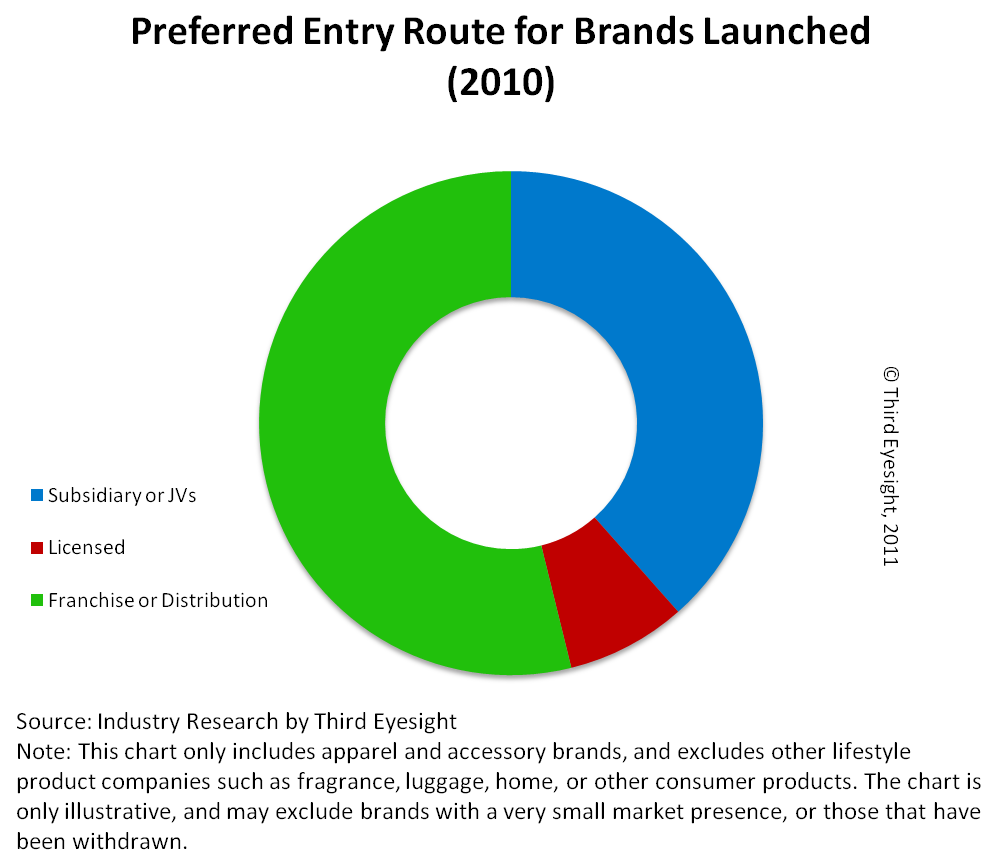
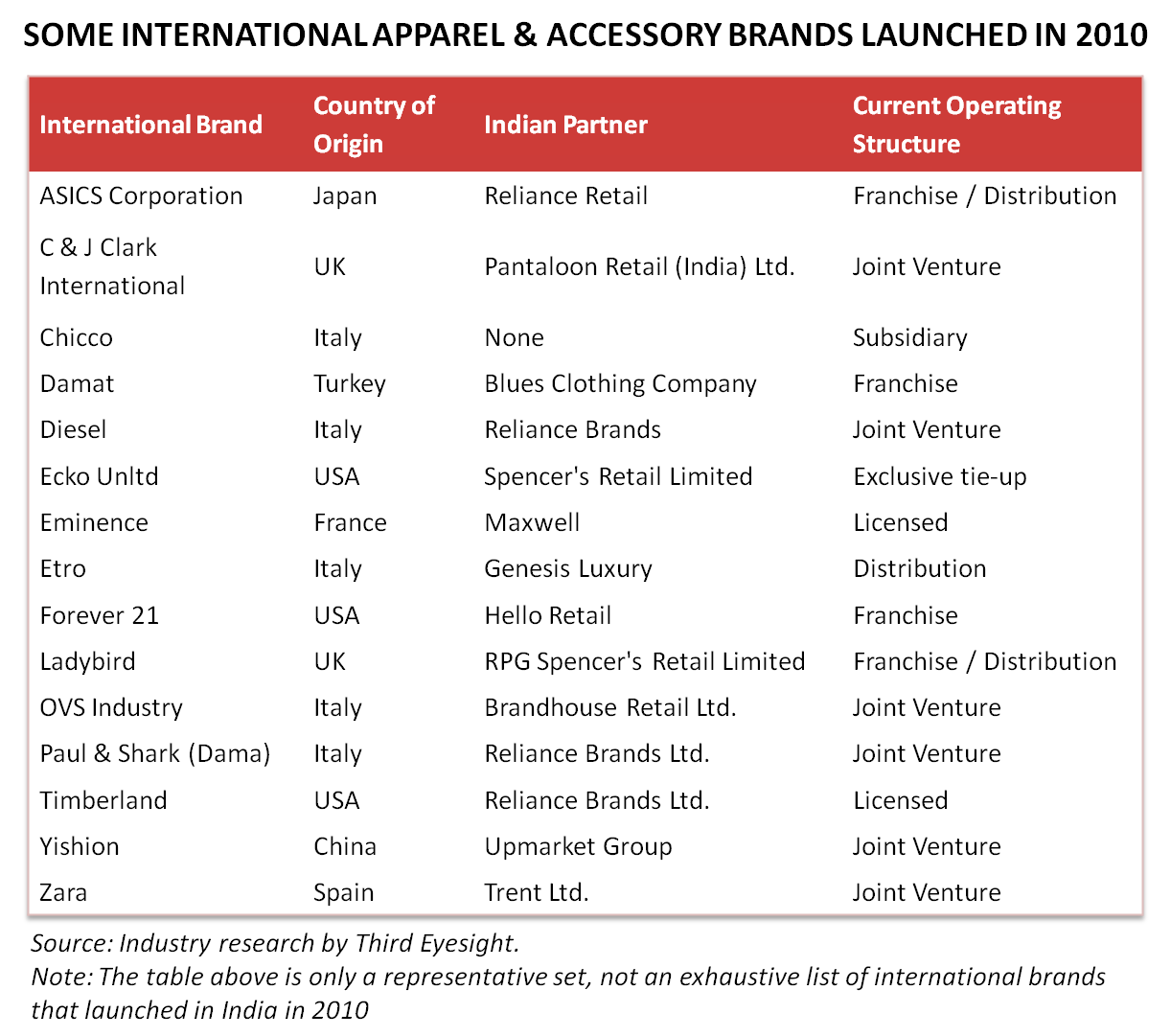
Some brands taking this route for entering the Indian market include Forever 21, Etro, Tom Ford, and Ladybird, amongst others. However, a number of brands that entered in 2010 (nearly 40% for the new entrants) also showed that they wanted a piece of the action through some degree of ownership (whether through a majority or minority stake in a joint venture or through a wholly owned subsidiary). Some – such as S. Oliver – also switched to joint-ventures from their earlier franchise structure.
Under the current regulations governing foreign investment into retail, several companies that typically want control operate either through 100% subsidiaries that sell to independent retail franchisees , or through 51:49 joint-ventures that operate the stores as well.
We are finding increasing signs among companies of a confidence in the market, a growing comfort with the operating environment, and a desire to own and control the direction their brand takes in a strategic market like India. it is likely that if the government decides to allow 100% FDI in single brand retail, several brands will opt to set up wholly-owned subsidiaries that control the entire chain of activities, source-to-store.
International brands opting for the ownership in the Indian venture included OVS (Italy’s Gruppo Coin), Yishion (China) and Chicco (Italy).
Fast Fashion for the Family
Amongst the new launches, a highlight of the year was the launch of the most awaited and discussed-about brand Zara. The first store was launched in Delhi with menswear, womenswear and childrenswear, followed by a store in Mumbai, and a third again in Delhi. While almost every other brand launches with an advertising blitz, Zara – in its usual fashion – needed none. The news buzz it generated created enough traffic to provide record sales during the first few weekends. It was also instrumental in generating 30-40% more footfall in the malls where it opened.
Inditex was certainly one of the brands looking for control, and has formed a 51:49 joint venture with the Tata Group’s retail business, Trent. For now the company has adopted its global supply chain for the Indian market as well which clearly adds cost and time to the supply chain. The merchandise is imported from the central distribution centre in Spain, and includes products manufactured in the Indian subcontinent. Competing brands in the industry have raised questions about Zara being able to build a successful and sustainable business in India just on the back of rapid fashion changes, at prices that are not quite “competitive”. However, the brand is reportedly aware of the struggle in building a successful business around import-led sourcing model and is seen to have planned growth conservatively.
Another southern European value fashion brand, OVS Industry, was launched last year by Oviesse through a joint-venture with Brandhouse Retail from the SKNL group. OVS Industry also offers a range for men, women and kids. While in the first year products have been imported from Italy, the company says it intends to bring in the merchandise directly from the supply source for speed and cost effectiveness, to achieve aggressive growth over the next five years.
Multi-Brand Platforms, Larger Stores
International brands have been drawn to India by its large “willing and able to spend” consumer base and the rapidly growing economy, but so also are Indian companies – manufacturers or retailers – who are ready to act as platforms for their launch.
Given the current restrictions on investment into retail operations, Indian companies are increasingly setting up large multi-brand outlets for an array of international brands under one roof. This allows the Indian franchisee to share overheads among many brands, and also negotiate harder for shopping centre space that is increasingly unaffordable. However, the idea is not only to gain from the operational efficiencies and cost efficiencies, but also to capture a higher share of the wallet of the consumers walking into the stores.
Even those Indian companies that are already retailing their own brands in a particular category are seeking franchise or distribution relationships with international brands, in order to capture a complementary segment of consumers or to offer a larger choice-set to their existing consumers.
For instance, Reliance Brands has partnered with some well known premium to luxury fashion and lifestyle brands. In 2010 alone, it brought Diesel, Paul & Shark and Timberland to the Indian market. On the other hand Maxwell Industries’ relationship with Eminence, a French innerwear brand, has allowed it to address the premium segment in which it was not present, and to compete with other international players such as Jockey, Triumph, Hanes, Fruit of the Loom and others.
RPG Group’s Spencer’s Retail, one of the pioneers of modern retail in the last two decades is looking at increasing the share of its apparel business. Apart from its private labels, Spencer’s is also actively seeking to grow its international brand portfolio quickly. Following up on its launch of Beverly Hills Polo Club in 2008, Spencer’s introduced Ecko Unltd (a youth fashion brand) in 2010. It has also become the platform for the British childrenswear brand Ladybird in its second coming to India.
While the emergence of large multi-brand franchise outlets is driven by Indian franchisees looking to optimise their businesses, the brands themselves are also looking at larger store sizes that are gradually becoming comparable to their stores elsewhere. For instance, the American brand Forever 21 launched with 10,000 square feet for only women’s western clothing and accessories. Similarly, Zara launched its business with a 14,000 square feet store. Larger stores are allowing brands to increase the efficiency of their operations, maximise the visual impact, and increase the speed at which they can achieve critical mass in the country.
Beyond Europe and the US
While European and American brands clearly dominate, 2010 also saw brands from China, Japan and Turkey making inroads to the Indian market.
China’s apparel retailer Yishion launched a 51:49 joint venture with a distribution company, Upmarket Group. Yishion is aiming at rapid growth in the mid price segment in India through own stores and multi-brand outlets (MBOs).
Turkish brands Tween, ADV and Damat from the Orka Group have been brought to the market by Blues Clothing Company, a mid-sized retailer of fashion apparel that also distributes brands such as Versace, Corneliani and Cadini.
The Strategy Shifts & Changing Structures
In the past the international brands have undergone changes in their strategy and operating structures to suit their current context and changing environment. Last year was not an exception to the correction and some brands did undergo a change in their approach and strategy for the Indian market.
Italian denim brand Energie exited the market and their partnership with Reliance Brands in 2007. However, in 2010, the Miss Sixty group entered into a licensing agreement with Arvind Limited which relaunched Energie as part of its portfolio of international denim brands. Arvind already had international brands catering to the mass and the middle segments of the denim market, and with the launch of Energie, it has achieved brand presence in the super-premium category as well.
Another notable denim brand that re-entered the market in 2010 was GAS, also from Italy. After it fell out with Raymond, the brand investigated other relationships, and finally decided to set up a fully-owned subsidiary. The brand was re-launched with one flagship store and through various shop-in-shop counters at Shoppers Stop, the department store chain.
The second attempt of the Germany-based casualwear apparel brand Lerros owned by the House of Pearl was ill-timed in 2008. With business coming up below expectations, the company decided exit the business in India. But instead of exiting the market, it granted the license to manufacture, retail and distribute Lerros to the maker of the Indian denim brand Numero Uno. With a complementary product mix, the principal and the licensee are looking to achieve greater success together.
Another brand that has undergone a shift in its strategy and the operating structure is the Italian brand Zegna, a world leader in luxury menswear. It was first introduced in the Indian market early on in the decade through a franchise arrangement. In 2005 with 51% FDI being allowed the Zegna Group invested in taking a majority stake in its Indian operations. Last year the brand entered into a joint venture with Reliance Brands Limited with the objective of ramping up its India operations and capturing a larger share in the Indian luxury market. For Reliance, it was a great addition to its international brand portfolio.
Compared to 2009, 2010 witnessed hardly any exits, Aigner being one.
Strategies for Growth and Prospects For 2011
Overall the year 2010 has been very positive and the pace of new brands entering the market is picking up. Those already present in the market, have been adapting their strategies to grow their India business. The growth strategy for international brands has revolved around lowering the prices and entering new segments.
The brands that have rationalised their pricing last year to attract more customers include Adams Kidswear. Previously priced significantly higher than the market leaders in that segment, Adams is looking to change its sourcing strategy and source a part of its product range locally. Similarly, having tasted success in the previous year, The Body Shop not only rationalised prices for more products in 2010, but also introduced new products at lower price points.
Another notable trend last year was the focus of international brands on Tier 2 and 3 cities. Marks & Spencer unveiled its plans to enter Tier 2 cities such as Jaipur and Chandigarh and grow its national footprint. Reebok, Adidas, Ed Hardy, Tommy Hilfiger, The Bodyshop and Puma are amongst those that have stated their intent to further expand to such cities. The success of adopting these strategies is bearing results already and the momentum is likely to build further as others follow.
For international brands, as for Indian brands, significant challenges remain in the path of growing their business.
At the base level is drumming up adequate demand. While India is often compared with China because of similar size of population, the fact is that urban discretionary incomes and the concentration of spend are far higher in China. This reflects in the speed with which brands have been able to ramp up in the two countries. For instance, Mango entered the two markets around the same time. However, a the end of 2010, the network of stores in India was only a tenth the size of the store network in China (100-plus), with over 200 more stores projected to open in 2011.
In scaling up, the lack of affordable good retail locations is one of the other biggest hurdles. With the slow growth in 2008 and 2009, brands are significantly more cautious in signing up space at high rentals.
Future challenges also remain more at the internal operational level. Retaining adequately trained front-line staff is an issue. Not only does the increasing number of international brands increase the competition for the employee pool, so also does growth in other segments of the economy and it is tough to sell retail as an employment option of first-choice.
We expect prices to become more realistic, but also operational efficiency to be a driver. Clustering of stores for efficient management, a concerted drive towards lower cost locations and variable (revenue-linked) payments to landlords are likely to be critical in driving better performance. We also expect many brands to seriously consider scaling up the network to provide critical mass to their business, which can also drive local sourcing of merchandise or direct shipments to the Indian business from Indian and other Asian sources.
If the Indian Government announces further relaxation in the foreign ownership norms, we would expect more brands to take equity stakes in the business in India, including the entry of those that wish to operate fully-owned subsidiaries. However, with many different signals from various arms of the government it is best not to try and read the crystal ball too closely on that issue.
Despite challenges and barriers, the market is far from being saturated right now as newer product segments and product lines create ever-newer needs. With India being one of the few large economies showing consistently strong performance, many more are considering the Indian market seriously. Among the ones reported to be interested in launching are GAP, Uniqlo and Polo by Ralph Lauren.
The market may become more segmented and even fragmented with a plethora of international brands being available.
The largest brands currently include Levi Strauss and Reebok which are both reportedly well past the US$ 100 million mark in India, but the race for market leadership is still well and truly on. No matter which brand comes out ahead the winner, without a doubt, will be the consumer.
Devangshu Dutta
March 30, 2010
Last week, Starbucks unveiled its strategy for profitable global growth, having taken approximately US$ 600 million out of costs in since January 2008.
About 3 years ago in a leaked memo, chairman Howard Schultz had raised concern about how, in the race to scale and to become consistent, Starbucks was losing sight of all critical things that had made it successful in the first place. (“The Commoditization of the Starbucks Experience – Soul Searching by Howard Schultz“).
In January 2008, Schultz took on an active role as CEO in a bid to stem the rot (“Leadership Change at Starbucks – The Barista Returns“).
These two years have been eventful. Shortly after Schultz stepped in, Starbucks announced that it would close 600 under-performing stores in the US. That was well before the “financial tsunami”. In 2009, another 200 in the US and 100 globally were identified for closure, and the company also scaled back on its 2009 expansion plan for 200 new stores.
At its shareholders’ meeting last week, Starbucks presented a more confident face, and outlined a return to growth with plans to expand its presence and “accelerate profitable growth in both the U.S. retail business and in key international markets”. (This profitable growth mantra was also recited in last year’s shareholder meeting.)
However, while the business is looking better, it is far from fixed.
The environment is different. Globally, consumer wallets are leaner, competitors are meaner, and Starbucks may yet need to shrink further; the fat ain’t all in the latte.
Yet, there must be much good in the business if, for all its faults, it still gets imitated around the world.
According to Starbucks, it currently has less than 4 percent of the U.S. coffee market with its 6,800 own and 4,400 licensed stores, and less than 1 percent of the global coffee market even with 2,000+ company stores and 3,500 licensed stores. The company sees that as enough headroom to grow.
Schultz has promised to put the tough lessons learned in the last two years to good use. The company currently has approximately 200 fewer stores than it did at the beginning of 2009 even after new store openings during the year. (To put the current number of 16,700+ stores in perspective, the company had a total of “only” 2,600 stores in Q1-2000.)
But there’s something to think about. If the entrepreneur needs to step back in to fix things gone horribly corporate (bland) and wrong, maybe it’s time to acknowledge that there’s a logical limit to the size and scaling-up capability of personalized experience businesses.
Or, as a friend says, scale can be a logical outcome of excellence but excellence is never the logical outcome of scale.
It remains to be seen whether this round of growth will come from the company’s natural strengths or whether Starbucks will return to growth-by-steroids as Schultz eases on the controls.
admin
January 7, 2010
By Tarang Gautam Saxena, Chandni Jain and Neha Singhal
In Retrospect
While India was a promising market to many international brands, it was not completely immune from the global economic flu. More than its primary impact on the economy, the global downturn sobered the mood in the consumer market. Even the core target group for international brands, that had just begun to splurge apparently without guilt, tightened their purse strings and either down-traded or postponed their purchases.
In 2008 in the midst of economic downturn, skepticism and uncertainty, the international fashion brands had continued to enter India at nearly the same momentum as the previous year. Many international brands such as Cartier, Giorgio Armani, Kenzo and Prada entered India in 2008 targeting the luxury or premium segment. However, given the high import duties and high real estate costs, the products ended up being priced significantly higher than in other markets. Many players ended up discounting the goods heavily to promote sales while a few also gave up and closed shop.
As the Third Eyesight team had foreseen last year, 2009 saw a further slowdown and fewer international brands being launched during the year. The brands that were launched in 2009 included Beverly Hills Polo Club, Fruit of the Loom, Izod, Polo U.S., Mustang, Tie Rack and Timberland. Some of these had already been in the pipeline for quite some time and invested a considerable time and effort in understanding the dynamics of the Indian retail market, scouting for appropriate partners, building distribution relationships and tying up for retail space, setting up the supply chain and, most importantly, getting their operational team in place.
International Fashion Brands in India

After many deliberations, the well-known global brand Donna Karan New York set foot in the Indian market in 2009 through an agreement with DLF Brands to set up exclusive DKNY and DKNY Jeans stores India. The brand is also reported to have signed a worldwide licensing agreement with S Kumars Nationwide Ltd to design, manufacture and retail DKNY menswear in certain specific countries.
Second Chances
Amongst the international brands that have recently entered the Indian market, a few are on their second or even third attempt at the market.
For instance, Diesel BV initially signed a joint venture agreement in 2007 with Arvind Mills, and the partnership intended opening 15 stores by 2010. However, by the middle of 2008, the relationship ended with mutual consent, as Arvind reduced its emphasis on retailing international brands within the country. Within a few months of the ending of this relationship, Diesel signed a joint venture with Reliance Brands for a launch scheduled for 2010. Both partners seem to be strategically aligned with a common goal as the international iconic denim brand wants to take on the Indian market full throttle and the Indian counterpart has indicated that it wants to rapidly build its portfolio of Indian and foreign brands in the premium to luxury segments across apparel, footwear and lifestyle segments.
Similarly, Miss Sixty entered India in 2007 through a franchisee agreement with Indus Clothing. It switched to a joint venture with Reliance Brands in the same year but the partnership was called off in 2008, despite plans to open more than 50 stores in the first three years of operations. Miss Sixty has finally entered India through a franchise agreement with a manufacturer of women’s footwear and accessories. The company has currently introduced only shoes and accessories category and is looking at potential partners for its label Energie and girls’ range Killah.
Other brands that have re-entered the Indian market include Germany-based Lerros whose first presence in India was back in mid-1990s. The brand re-entered the market in 2008 through own brand stores and is growing its presence through this route as well as through multi-brand stores.
Oshkosh B’gosh is another brand that had entered India in mid 1990s, through a licensing agreement with Delhi based buying house, Elanco. The licensee found the childrenswear market hard to crack, and closed down. In 2008, Oshkosh re-entered the Indian market through a licensing partnership with Planet Retail and is now available through shop-in-shop counters at Debenhams stores. Reports suggest that it may consider setting up exclusive brand outlets.
During the turbulence of 2008 and 2009, a few brands also exited the market. Some of them were possibly due to misplaced expectations initially about the size of the market or about the pace of change in consumer buying habits. Others were due to a failure either on the part of the brand or its Indian partners (or both) to fully understand what needed to be done to be successful in the Indian market. Whatever the reason, the principals or their partners in the country decided that the business was under-performing against expectations and for the amount of effort and money being invested, and that it was better to pull the plug.
Some brands that have been pulled out of the Indian market during 2008 and 2009 include Dockers, Gas, Springfield and VNC (Vincci). Gas (Grotto SpA) is reported to remain interested in the market but has not found another partner after its deal with Raymond fell through in 2007 and all dozen of its standalone stores were shut down.
The Scottish brand Pringle and its Indian licensee did not renew their agreement upon its expiry. The Indian partner has reportedly signed an agreement to launch another international brand in India, while Pringle is said to be looking for new licensee.
The good news is that successful relationships outnumber every exit or break in relationship possibly by a factor of ten. Some of the brands that have sustained are among the early entrants having a presence in India since the late-1980s and 1990s or even earlier. These include Bata, Benetton, adidas, Reebok (now also owned by adidas), Levi Strauss and Pepe. Having grown very aggressively during 2006 and 2007 Reebok quickly became the largest apparel and footwear brand in India, while Benetton and Levi’s are expected to cross the $100-million mark for sales this year.
Entry Strategy & Recent Shifts
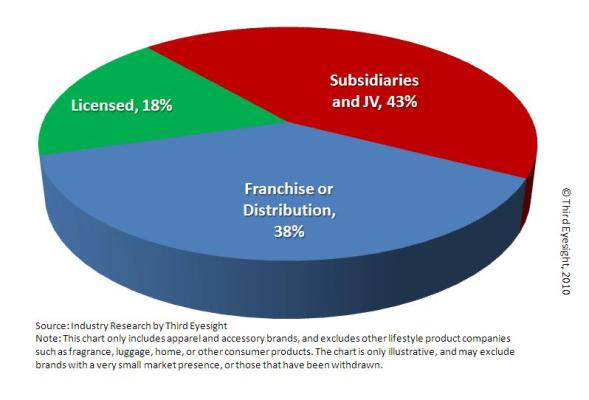
As envisaged in Third Eyesight’s report from a year ago, with changing market conditions and a growing confidence in the Indian market, there has been a shift among international brands in the choice of the launch vehicle. While franchising has been the preferred mode of market entry in the recent past for risk-averse brands, more brands today demonstrate a long-term commitment to the Indian market, and are choosing to exercise ownership through wholly or partially owned subsidiaries and through joint ventures.
In 2009, we have seen a noticeable shift in favour of joint-ventures as the choice for entry into the market. Even the brands already present are looking to modify the nature of their existing presence in India in order to exert more control over the retail operations, products, supply chain and marketing.
Current Operating Structure
(End 2009)
Brands that changed their operating structures and, in some cases partners, in recent years include VF (Wrangler, Lee etc.), Lee Cooper, Lee, and Louis Vuitton amongst others.
Mothercare, the baby product retailer, which is present through a franchise agreement with Shopper’s Stop has, in addition, recently formed a joint venture with DLF Brands Ltd to enable the expansion through stand-alone stores. Gucci, which had initially entered in 2006 with the Murjani Group as a franchisee, has recently changed over to Luxury Goods Retail, and is now in the process of restructuring the relationship into a joint venture.
VF has also been reported to be looking to license Nautica, Jansport and Kipling to a new partner. Until now, these brands were handled through the joint venture with Arvind Brands. Arvind has increasingly focused on its core business, closed stores and scaled down expansion plans for the international brands.
Burberry that had entered India in 2006 through a franchisee arrangement with Media Star opened two stores under this arrangement. It has now set up a new joint venture with Genesis Colors and plans to open 20 stores across the country.
More recently Esprit has also been reported to have approached Aditya Birla Nuvo to deepen its engagement by moving from its distribution arrangement into joint venture as the international brand sees excellent potential in the Indian market.
Buckling up for 2010
Throughout 2009, the one fact that became clear was that the Indian market was resilient. Now, as the global economic condition stabilizes, confidence levels of brands and retailers in India have also improved.
Several launches are already expected in 2010, and possibly many more are being worked upon. In the following 12 months, consumers can expect to find within India acclaimed brands such as Diesel, Topman, Topshop and the much-anticipated Zara. Many more Italian, British and French brands are examining the market.
Most of the international fashion brands already present in the market are also projecting a cautiously upbeat outlook in their plans, while a few are looking positively bullish.
For example, Pepe, an old player in premium and casual wear segment, has reported plans to grow its retail network further and open 50 more franchise stores by September 2010. Similarly the German fashion brand S. Oliver that entered the Indian market in 2007 is looking to grow significantly. It has already moved from a franchise arrangement with Orientcraft to a joint-venture with the same partner, and has stepped up its above-the-line marketing presence. The brand has recently reported its plans to scale up its retail presence to 77 stores by the end of 2012 while also strengthening its presence through shop-in-shop in multi-branded outlets in high potential markets.
Those international brands that have tasted success have not achieved it by blindly importing business models and formulas from other markets. Most have had to devise a different positioning from their home markets. Some have significantly corrected pricing and fine-tuned the product offering since they first launched. These include The Body Shop which decreased its prices by up to 30% this year, and Marks & Spencer which reduced prices by 20-40%. Others are unearthing new segments to grow into; for instance, Puma and Lacoste are now seriously targeting womenswear as a growth market.
On the operational side, the good news for retailers and brands is that the average real estate costs have reduced significantly, although marquee locations remain high. In several locations lease models have also moved from only fixed rent to some form of revenue sharing arrangement with the landlord. And, while the sector has seen some employee turmoil as many non-retail executives who came into the business in the last 5-7 years have returned to other sectors, employee salary expectations are also more realistic.
As customer footfall and conversions pick up, international brands are also shoring up their foundations for future expansion in terms of better processes and systems, closer understanding of the market, and nurturing talent within their team. Third Eyesight’s recent work with international brands’ business units in India highlights the international players’ concern with ensuring a consistent brand message, improved organizational capabilities right down to front-line staff, and focus on unit productivity (per store and per employee).
We may yet see a few more exits, and possibly some more relationships being reshuffled and partners being changed. However, all things considered, we can look forward to a net increase in the number of international brands in the country.
The Indian consumer is certainly demonstrating more optimism and as far as there are no major unforeseen global or domestic shocks, this optimism should translate into a healthier business outlook for international brands as well. According to early signs, 2010 could be an excellent curtain-raiser for a new decade of growth for international fashion brands in India.
[The 2009 report is available here: “International Fashion Brands – India Entry Strategies”]
(c) 2010, Third Eyesight
[Note: This report is based on information collected from a combination of public as well as proprietary sources, and in some cases may differ from press reports. However, no confidential information has been shared in this report.]
