
admin
January 21, 2013
By Tarang Gautam Saxena & Devangshu Dutta
Since the onset of reopening of India’s economy in the late 1980s, fashion is one consumer sector that has drawn the largest number of global brands and retailers. Notwithstanding the country’s own rich heritage in textiles the market has looked up to the West for inspiration. This may be partly attributable to colonial linkages from earlier times, as well as to the pre-liberalisation years when it was fashionable to have friends and relatives overseas bring back desirable international brands when there were no equivalent Indian counterparts. Even today international fashion brands, particularly those from the USA, Europe or another Western economy, are perceived to be superior in terms of design, product quality and variety.
International brands that have been drawn to India by its large “willing and able to spend” consumer base and the rapidly growing economy have benefitted in attaining quick acceptance in the Indian market and given their high desirability meter, most international brands have positioned themselves at the premium-end of the market, even if that is not the case in the home markets. In addition, Indian companies – manufacturers or retailers – have been more than ready to act as platforms for launching these brands in the market and today there are over 200 international fashion brands in the Indian market for clothing, footwear and accessories alone, and their numbers are still growing.
Global Fashion Brands – Destination India
Europe’s luxury brands have had a long history with India’s princely past, but modern India tickled the interest of international fashion brands in the 1980s when it set on the path of liberalisation. The pioneering companies during this stage were Coats Viyella, Benetton and VF Corporation. At the time the Indian apparel market was still fragmented, with multiple local and regional labels and very few national brands. Ready-to-wear apparel was prevalent primarily for the menswear segment and was the logical target for many international fashion brands (such as Louis Philippe, Arrow, Allen Solly, Lacoste, Adidas and Nike). (Addendum: The rights to Louis Philippe, Van Heusen and Allen Solly in India and a few other markets were sold after several years to the Indian conglomerate, Aditya Birla Group, as part of the Madura Garments business.)
The rapidly growing media sector also helped the international brands in gaining visibility and establishing brand equity in the Indian market more quickly. However, this period did not see a huge rush of international brands into India. West Asia and East Asia (countries such as Japan, South Korea, Taiwan and even Thailand) were seen as more attractive due to higher incomes and better infrastructure. In the mid-1990s there was a brief upward bump in international fashion brands entering the Indian market, but by and large it was a slow and steady upward trend.
The late-1990s marked a significant milestone in the growth of modern retail in India. Higher disposable incomes and the availability of credit significantly enhanced the consumers’ buying power. Growth in good-quality retail real estate and large format department stores also allowed companies to create a more complete brand experience through exclusive brand stores in shopping centres and shop-in-shops in department stores.
By the mid-2000s, however, a very distinct shift became visible. By this time India had demonstrated itself to be an economy that showed a very large, long-term potential and, at least for some brands, the short to mid-term prospects had also begun to look good.
While India was a promising market to many international brands, it was not completely immune to the global economic flu. More than its primary impact on the economy, it sobered the mood in the consumer market. Even the core target group for international brands tightened the purse strings and either down-traded or postponed their purchases.
In 2008, in the midst of economic downturn, scepticism and uncertainty, international fashion brands continued to enter India at nearly the same momentum as the previous year. Many international brands such as Cartier, Giorgio Armani, Kenzo and Prada entered India in 2008, targeting the luxury or premium segment. However, given the high import duties and high real estate costs, the products ended up being priced significantly higher than in other markets. Many brands ended up discounting the goods heavily to promote sales, while a few gave up and closed shop.
The year 2009 saw the true impact of the slowdown as fewer international brands were launched during the year. The brands that launched in 2009 included Beverly Hills Polo Club, Fruit of the Loom, Izod, Polo U.S., Mustang, Tie Rack, Donna Karan/DKNY and Timberland amongst others. Some of these had already been in the pipeline for quite some time and had invested considerable time and effort in understanding the dynamics of the Indian retail market, scouting for appropriate partners, building distribution relationships and tying up for retail space, setting up the supply chain and, most importantly, getting their operational team in place.
2010 was better in comparison: although initially slow, the growth of new international brands entering the Indian market in 2010 bounced back later during the year, and some brands that had exited the Indian market earlier also made a comeback. Amongst the new launches, a highlight of the year was the launch of the most awaited and discussed-about Spanish brand Zara. The first store was launched in Delhi to an absolutely phenomenal response, followed by a store in Mumbai, and a third again in Delhi. The Italian value fashion brand, OVS Industry, was launched in 2010 by Oviesse through a joint-venture with Brandhouse Retail from the SKNL group. While in its first year products were imported from Italy, the company had mentioned that it intended to bring in the merchandise directly from the supply source for speed and cost effectiveness, to achieve aggressive growth over the following five years.
2010 indicated a fresh round of optimism as the pace of new brands entering the market picked up, and those already present in the market showing signs that they were adapting their strategies to grow their India business, including lowering prices and entering new segments.
Though the number of new brands entering the Indian shores in 2011 and 2012 may not have matched the numbers in the peak years, both years have been healthy and the list of new brands ready to enter in 2013 already seems promising.
Amongst others, 2011 saw the entry of Australian brands such as Roxy and Quiksilver having tied up with Reliance Brands for distribution. The largest British football club and lifestyle brand Manchester United, signed up with Indus-League Clothing Ltd. to bring the fashion products to India, after having launched café bars in India in 2010 through a franchisee.
2012 brought in luxury brands such as Christian Louboutin, Roberto Cavalli and Thomas Pink, womenswear brands such as Elle, Monsoon and fashion accessories brands such as Claire’s.
Routes to Market – The Evolution
The choice for entry strategy for the fashion brands has evolved over the years. During the initial years licensing was the preferable route for international brands that were testing the market. This shifted to franchising as import duties dropped and brands looked at exerting more control on the product and the supply chain. More recently, brands seem to be opting for some degree of ownership, as they begin to take a long-term view of the market.
In the 1980s and the early 1990s, licensing was a popular entry strategy amongst the global fashion brands, with minimal involvement in the Indian business.

In the mid-1990s a few companies such as Levi Strauss set up wholly owned subsidiaries while others such as Adidas and Reebok entered into majority-owned joint ventures. This helped them to gain a greater control over their Indian operations, sourcing and supply chain, and brand. In the subsequent years import duties for fashion products successively came down making imports a less expensive sourcing option and the realty boom brought in many investors in retail real estate who became franchisees for the international brands. By 2003, franchising became the preferred launch vehicle for an increasing number of international companies, while only a few chose to enter through licensing.
In 2006 the Government of India reopened retail to foreign investment (allowing up to 51 per cent foreign direct investment in single-brand retail). Using this route, many brands have entered India by setting up majority-owned joint ventures, or moving their existing franchise relationships into a joint venture structure. By the end of 2008, more than 40 per cent of the international brands were present through a franchise or distribution relationship, while more than 25 per cent had either a wholly-owned or majority-owned subsidiary. All these structures allowed the brands to have greater control of operations, particularly of the product.
Amongst the international brands that entered the Indian market, a few were on their second or even third attempt at the market. For instance, Diesel BV initially signed a joint venture agreement in 2007 with Arvind Mills. However, by the middle of 2008, the relationship ended with mutual consent, as Arvind reduced its emphasis at the time on retailing international brands within the country. Within a few months of ending this relationship, Diesel signed a joint venture with Reliance Brands as the iconic denim brand wanted to take on the Indian market full throttle and the Indian counterpart had indicated that it wanted to rapidly build its portfolio of Indian and foreign brands in the premium to luxury segments across apparel, footwear and lifestyle segments.
Similarly, Miss Sixty entered India in 2007 through a franchisee agreement with Indus Clothing. It switched to a joint venture with Reliance Brands in the same year but the partnership was called off in 2008. Miss Sixty finally entered India through a franchisee agreement with a manufacturer of women’s footwear and accessories.
During the turbulence of 2008 and 2009, a few brands also moved out of the market. Some of them were possibly due to misplaced expectations initially about the size of the market or about the pace of change in consumer buying habits. Others were due to a failure either on the part of the brand or its Indian partners (or both), to fully understand what needed to be done to be successful in the Indian market. Whatever the reason, the principals or their partners in the country decided that the business was under-performing against expectations for the amount of effort and money being invested, and that it was better to pull the plug. Amongst the brands that exited the market during 2008 and 2009 were Gas, Springfield and VNC (Vincci).
In the last few years as the foreign direct investment rules are being softened in particular with regard to the more flexibility in the 30% domestic sourcing and clarification on brand ownership norm there is an increasing preference for international companies to enter the India market with some form of ownership while those that are already in the market are looking to increase their stakes in the business.
Several brands have taken the plunge into investing in the Indian operations and moved more aggressively into the market. Since the year 2009, international brands increasingly opted for joint-ventures as the choice for entry into the market. Even the brands already present started looking to modify the nature of their presence in India in order to exert more control over the retail operations, products, supply chain and marketing. Brands that changed their operating structures and, in some cases partners, include VF (Wrangler, Lee etc.), Lee Cooper, Lee, Louis Vuitton, Gucci, Burberry amongst others. Mothercare, the baby product retailer, which was initially present through a franchise agreement with Shoppers Stop, formed a joint venture with DLF Brands Ltd to enable the expansion through stand-alone stores.
During 2011, Promod changed its franchise arrangement with Major Brands into a joint-venture that is majority-owned by Promod. From its launch in 2005, the brand has opened 9 stores so far. However with the new joint venture in place, the international brand is reported to be looking at opening 40 stores in the next four years with the hope of increasing the contribution of India business to its global revenue to the extent of 15-20% from a mere 3% at present.
After its partnership with Raymond fell through in 2007 and all of its standalone stores were shut down, Gas (Grotto SpA) scouted around for an appropriate partner for India business. Eventually, the brand set up a wholly owned subsidiary in 2010 for wholesale operation while retail stores were franchised. In 2012 the company formed an equal joint venture partnership with Reliance Brands with plans to ramp up India retail presence.
2012 was a defining year marking the government’s decision to allow 100% foreign direct investment in single brand retail business and permitting multi-brand retail in India. Not only has this encouraged new brands to consider the Indian market but many existing brands have started reviewing their existing operating structures and alliances, and have initiated moves towards greater ownership and a stronger foothold in the Indian market. Some of the brands have taken the decision to step into an ownership position in India as they felt that India was too strategic a market to be “delegated” entirely to a partner (whether licensee or franchisee), or that an Indian partner alone might not be able to do justice to the brand in terms of management effort and financial capital.
S. Oliver restructured its India operations in 2012 by exiting its prior relationship with the apparel exporter Orient Craft and tied up with a new partner through a majority joint venture. To gain a larger share in the Indian market the company has repositioning the brand, changed its sourcing strategy, reduced the entry-level prices by 40% while reducing the store size (from 5,000 sq. ft. to 1,200-2,400 sq. ft.). It has also put in place an aggressive expansion strategy for tier II towns. The change in FDI norms towards the end of last year may cause it to review its position further.
Canali has entered into a majority-owned joint-venture with its existing partner Genesis Luxury. The brand had entered in India in 2004 through a distribution agreement. Through this change the international brand plans to grow its presence in India multi-fold by opening 10-15 stores over the next three-four years.
Pavers England is the first international brand to have applied for and been granted the permission to own and operate its retail business in India through a 100 per cent subsidiary owned by a UK based company. Newcomers such as H&M and Loro Piana are reportedly considering the joint venture route.
As we have already mentioned in one of our earlier papers (“Tapping into the India Gold Rush”) we do not expect a dramatic short-term growth in the number of international brands following the retail FDI relaxation in September 2012. However, at that time we did foresee some changes in the operating structures for the single brand ventures already active in the market, as well as entry of new brands that have been holding back so far as they wanted greater control in their India retail business and this seems to be happening already.
In the luxury sector, 51 percent FDI and distribution relationships are likely to continue to be a norm, since it is virtually impossible for most luxury companies to meet the 30 percent domestic sourcing requirement in its true spirit. In many cases, the local partner in a joint venture is a mere placeholder until FDI rules are liberalised further and, unless the business grows significantly, most brands will be content to keep the existing structures in place.
In the other segments some more relationships could be reconstituted during 2013, taking the international brand at least a step closer to gaining greater control, even if their partners remain the same.
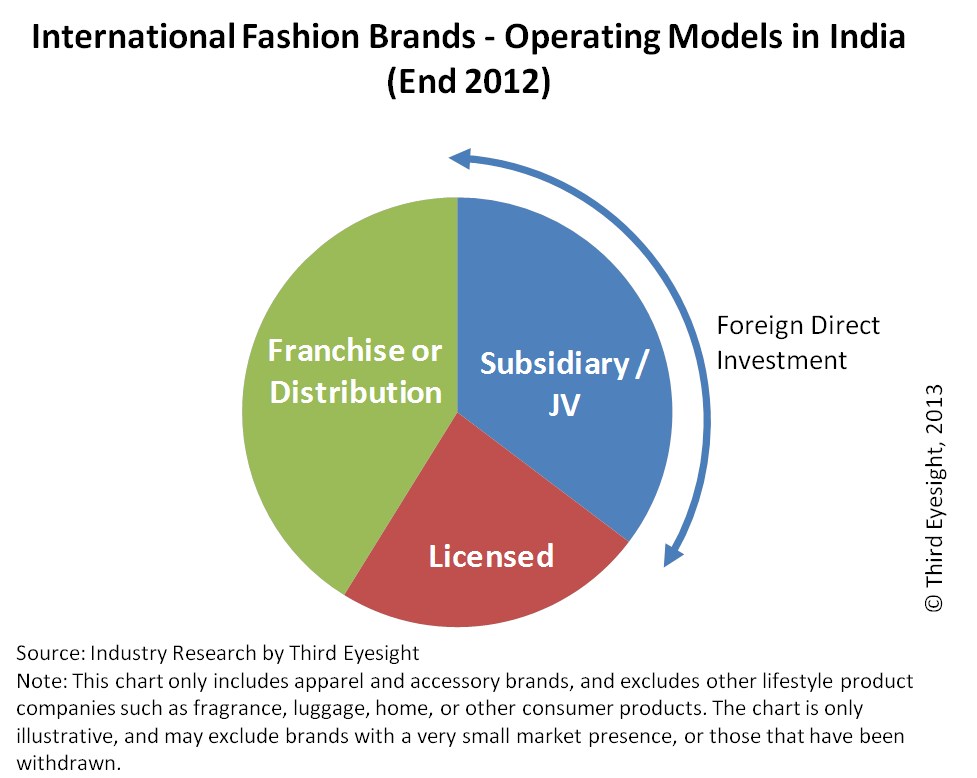
Franchising is still the more common form of route to market for most single brand retail companies although for many international companies an eventual ownership in India business may be desirable. However, licensing should not be excluded from the choice set, especially for companies that are multi-brand retail concepts such as Sephora or those that manage to find a suitable Indian partner that can provide end-to-end support from product sourcing to distribution and retail (for example, the relationship between Elle and Arvind).
Today two thirds of the international fashion brands come from three countries the U.S.A., Italy and the U.K. with nearly 30 per cent originating from the U.S.A. alone.

Is This A Lucky 13?
The theme for the year 2013 is positive for most brands, although still cautious.
Amongst the international brands that one can look forward to shopping in 2013 are “Uniqlo” of Fast Retailing, Japan’s largest apparel retailer, Sweden’s H&M, Emilio Pucci and Billabong. But India is not merely a destination anymore for the international brands to grow their business. The country is also increasingly becoming the innovation-platform or testing ground for new concepts and trends. World Co. a Japanese retailer with more than 3,000 stores in Japan and 200 stores in other parts of Asia is also test-marketing women’s apparel and accessories brands such as Couture Brooch, Opaque.clip, zoc, Tk Mixpie and Hot Beat to gain insights into consumers’ psyche. Italian brand United Colors of Benetton has recently introduced a global retail interior design concept which is present in major European cities but is the first-of-its-kind store in Asia and may well set the trend for the rest of Asia.
Gucci recently opened its largest store in India recently Delhi-NCR after two failed joint ventures. All of its five stores are now run directly by the company and the Indian business also reported to have turned profitable this year.
Brands such as Mango who have chosen the franchise route are tying up with additional partners (e.g. DLF) in the hope of making the Indian business contribute significantly to the overall revenue of the company.
UK-based apparel chain Marks & Spencer is accelerating its expansion in India with plans to add ten stores in the next six to eight months in the country. The company has identified India as one of the key markets to become the world’s most sustainable retailer by 2015. It plans to increase the number of stores in India from 24 currently to over 30 through the 51:49 joint venture with Reliance Retail.
Puma SE, the global sports lifestyle company for athletic shoes, footwear, and other sports-wear aggressively set out to gain 30 per cent of the Indian organised retail sportswear market within a year, from a share of 18-20 per cent in the top four branded sportswear segments in 2011. To this end the company targeted opening nearly 100 more stores during 2012. While the actual numbers are reportedly short of target, the brand has been opening amongst the largest stores during the year.
The confidence in the India opportunity is rising again, with existing global brands expecting the contribution from India business to grow multi-fold in a few years. However, the approach is of careful consideration and brands realise that India is a unique market, different not only from the West but also from other Asian economies such as China. Rather than adopting a “cut-and-paste” approach one needs to seriously consider the appropriate business model for India. Many of the global players have had to create a different positioning from their home markets. Some have significantly corrected pricing and fine-tuned the product offering since they first launched; these include The Body Shop and Marks & Spencer. Others are unearthing new segments to grow into; for instance, Puma and Lacoste are now seriously targeting womenswear as a growth market.
It is not only international brands that are more optimistic. Indian partners are also reviewing their approach. For instance, the Arvind Group that had looked at reducing its emphasis on international fashion brands in 2007-08 has recently acquired the business operations of Planet Retail which operated the franchises of British fashion retailers Debenhams and Next, and American lifestyle brand Nautica in India. The company termed Debenhams’ franchise as a significant acquisition as it provided an entry into the department store segment. Arvind plans to increase the India presence of Debenhams from 2 stores to 8 over the next three years. It also plants to grow the network of Next, the large-format speciality stores, from 3 to 12 in the same period.
As customer footfall and conversions pick up, international brands are also shoring up their foundations for future expansion in terms of better processes and systems, closer understanding of the market, and nurturing talent within their team. Third Eyesight’s study of the market highlights international brands’ concerns with ensuring a consistent brand message, improved organisational capabilities right down to front-line staff, and focussing on unit productivity (per store and per employee).
India shows signs of a healthier business outlook for International brands but the game has just begun and with competition getting tougher, we can expect interesting times ahead.
Devangshu Dutta
July 30, 2012

(Published in “BusinessWorld SME Handbook 2012-13”, released on Oct. 29, 2012 in New Delhi, and “Indian Management”, the journal of the All India Management Association in January 2013, published by Business Standard.)
There are parallels between Christmas and the growth of modern retail. At Christmas much of the attention is fixed on Santa Claus, while the elves labouring away behind the scenes barely get any air-time. So also in the retail business, the focus very much is on the retailer; the bigger the better.
The Indian retail sector’s sales are estimated at about Rs. 26 lakh crores. Of this, more than 80% of the product requirements are estimated to be met by small or mid-sized businesses. We don’t usually think about these myriad manufacturing and trading companies that make up the retailer’s supply chain. Large branded suppliers – multinational or domestic corporate groups – are still able to make their presence known, but most others remain largely invisible. Many of these fall not just into the small-medium enterprise (SME) classification, but in micro-enterprises, even cottage-scale. Not only do the large retailers source from SMEs directly, those small suppliers in turn work with other upstream SME manufacturers.
Chicken or Egg?
Most of us are inclined to view the growth of modern retail as a precursor to the growth of the SME sector. Actually the reverse is equally true, perhaps even more so. Without a robust base of suppliers having taken the initial risk of setting up better-organised manufacturing facilities and supply chains, modern retailers would not be able to set up their businesses in the first place. We may view modern retailers as the catalyst for this development; however, they are first beneficiaries of SMEs, and only after they achieve critical mass can they catalyse further SME growth.
For instance, through the 1950s and 1960s, as the American and western European economies grew with the baby boom, it was the growth of manufacturing entities and brands – most of them SMEs – that led the charge. As these SMEs consolidated their growth, modern retail chains actually rode upon this. Subsequently, of course, retail chains have put most of their suppliers in the shade in terms of overall size and profitability. Japan in the 1960s and 1970s, Taiwan and Korea during the 1970s and 1980s, and China during the 1990s and 2000s also saw similar manufacturing-led prosperity and consumption, although their growth was driven initially by exports to the west.
In India, too, the tremendous social and economic changes in the last two decades have encouraged a resurgence of the entrepreneurial spirit. The consumer sector is specifically attractive to entrepreneurs as something that is tangible, provides visibility of the business fairly quickly and can be communicated and positioned well within the entrepreneur’s family and social circle, an important driver.
The Rationale for Supporting SMEs
We tend to ignore the fact that India has a workforce estimated at over 750 million, and which is growing annually by 9-10 million. Most of these people will not be employed by the government, or in large organisations or in the much-feted service sector. Allowing for a declining active employment in agriculture, it is manufacturing, trading and retail by small businesses that is needed to keep the economic engine running.
It is also important to remember that growth of SMEs raises prosperity rather more equitably than other sectors. Widespread growing incomes lead to growth in consumption, supporting retail growth, which in turn can feed back into further growth of SMEs. There are enough significant examples of such economic growth worldwide, whether we look at economies such as Western Europe and Japan recovering from the ravages of war, or at the Asian tigers, China and others emerging countries who’s GDPs are not overly dependent on extractive natural resources.
Innovation is another reason to nurture SMEs. Consumer needs are changing more rapidly than ever before in India’s history, with rising incomes, and evolution of life styles and social structures. Small companies are better at foreseeing or at least reacting to rapid changes. Large companies compete on the basis of their sheer scale and aim to maximise returns from every investment made, but small businesses have no choice but to be innovative in some way simply to enter the market or to stay in business. Experimentation with products, business models, service level and commercial practices is what SMEs thrive on. Differentiation is what makes small suppliers attractive to retailers. With the technology and tools available today, we should expect ever increasing amount of innovation to emerge from small rather than large companies in the consumer sector.
Small suppliers also provide diversification of supply risk for individual retailers, as well as for the market overall. Concentrating on a few large sources has, time and again, proven to be a risky approach, whether it is due to the balance of power tilting unduly towards a specific supplier, or simply the risk of product not being available in case the dominant large supplier’s business is affected. A mix of small suppliers is more like a supporting cushion – a bean bag, if you like – which can be adapted and moulded more easily to changing customer needs.
The Role of Modern Retail
There are three areas in which modern retail can be a significantly more important partner for SMEs than traditional channels.
Firstly, modern retail stores are possibly the most effective route to launch new products, or even entirely new categories. As a platform they offer a more consolidated and effective way to reach a new product to consumers, and to gain visibility and acceptability quicker.
As a follow-on to this, due to their innate need to scale-up successful initiatives, a product and or a service proven in one store or region would typically get included in buying plans for the retailer’s stores across the country. This provides a quicker and more efficient scaling up opportunity than the small brand or supplier trying to reach myriad stores across the country on its own.
Third, whether it is quintessentially Indian brands such as Fabindia, or Indian products through international brands and retailers such as Monsoon, Gap, Mothercare, Ikea, Marks & Spencer, these are but a few examples of the access route for small Indian companies to major world markets. In fact, B. Narayanaswamy suggested in an article titled “Opportunity Lost is Gone for Good” (July 2012), that the Indian government should negotiate hard with retailers interested in investing in India to open supply opportunities to the retailers’ businesses globally, rather than putting minimum sourcing requirements for the small Indian business alone which only act more as a constraint than an enabler. The government has, in the past, used such opportunities to allow investment in the consumer sector while enlarging the playing field for Indian businesses – Pepsi is a case in point.
For some companies, modern retail is in fact a launch pad for wider ambitions, as they evolve into building brands themselves. Mrs. Bector’s has grown from a contract supplier to the likes of McDonald’s to launching its branded products not only in India but also in international markets targeting Indian expatriates. Genesis Colors went from being a Satya Paul licensee for ties to being the owner of the brand, and then further to being a partner for many internationally established premium and luxury brands who want to be part of the India growth story. Others become growth vehicles for larger businesses after being acquired by them, such as ColorPlus by Raymond, Fun Foods by Dr. Oetker (Germany) or Anchor by Panasonic (Japan).
Making Business Easier
India is one of the few countries to have a Ministry dedicated to SMEs. However, India’s SME sector is very far from competing effectively with SMEs in other countries.
The German Mittelstand employs more than 70% of Germany’s workforce and is acknowledged to be at the leading edge of technology and efficient business management. Other western European countries such as the UK and Italy also have vibrant SME sectors. All these countries have not only been competitive globally as exporters, but have also co-opted into the growth of industries elsewhere including the BRICs.
Three enormous obstacles stand in the way of the growth of India’s SMEs, as a huge amount of entrepreneurial energy is wasted tackling these areas. The government certainly has a large role to play in all, but one of these is also the responsibility of large corporate groups.
The lack of adequate infrastructure is arguably the most recognised obstacle, followed by compliances that can hold SME operations hostage under outdated laws, many of which have not been reviewed since India had an Empress! Entrepreneurs and businesses lose millions of manhours annually managing these two areas.
However, the one area in which not just the government but large retailers can play a role is in ensuring that SMEs are funded adequately. Bank sources in the form of term loans and working capital limits is only the start. The rest comprises of actual cash flow, much of which are limited by the long credit period demanded by retailers. Payment can stretch as far as 6-8 months, and include sale-or-return terms which squarely place the burden of funding the retailer’s business on the SME supplier. Unless we can mandate better payment practices, the boom of retail giants will be created using millions of dead or barely alive SMEs as building blocks. And what we don’t realise is that the retailers’ own health is also at stake, because lazy payment terms create a maze of poor practices, from product planning at head office all the way to the retail store. For instance, products that will not sell get stocked for short-term margin through placement fees, and block shelf-space and cash flow that affects other suppliers. Promptness of payment to SMEs must become a metric to measure the health of retail companies – after all, what gets measured gets tackled. And for the proponents of “Corporate Social Responsibility” – what better way to promote CSR and wide-ranging economic well-being than by ensuring the the smaller businesses in the ecosystem are not starved of the funds that are rightfully theirs!
SMEs are not just the foundation, but also the beams and pillars on which the glass and steel cathedrals of modern retail are built, and a vital indicator of the economy’s overall health. The sector needs to be tended to proactively and holistically, both by government and by large businesses, as an investment in India’s economic future. Perhaps we will even create some world-beating companies along the way.
Devangshu Dutta
June 26, 2012
(This piece appeared in ‘The Strategist’ supplement of the Business Standard newspaper, on 2 July 2012.)
 Modern retail is equated with a more structured and systematised organisation, hence the term “organised retail”. This term is weighted with expectations of greater capability, better competitiveness and greater benefits for industry and society. However, if we take organised to mean better for the consumer then, often, our age-old corner shop and the local cloth-merchant-turned-fashion-retailer appear more organised and better at delivering more relevant products to us at lower prices with superior services than most of the new corporate chains.
Over the last two decades or so, there has been a steady transformation of the retail landscape and the consumer’s shopping attitudes. There are many more people with much more money in hand to spend at their discretion today than ever before. This has encouraged the growth of brands, Indian and international, as well as the emergence of modern retail chains and malls. The transformation is most visible in our largest cities, with some locations already having built a surplus of mall space. A generation is growing up in these cities that takes malls for granted, and that completely avoids the more traditional retail spaces.
There has certainly been a gold-rush, among companies, investors, real estate developers, even professionals looking to put the “next big thing” on their resumes. The true impact, however, is still very limited, very shallow for the country overall. In fact, in locations with high concentration of modern retail, the impact has even been negative in terms of poorly developed space, rising costs, and stressed infrastructure to the detriment of the local inhabitant.
The impact of this growth is little understood, much less guided or planned for the long term. There are loud voices both for and against corporatised modern retail, but there is very little balanced discussion. There are several laws binding or restricting retail activity, but very little policy enabling it, whether we look at modern retail or traditional, corporate or individual owner-driven stores.
Here are some major issues that we need to tackle, at the policy level and within retail businesses:
We need to drastically rethink the role of retail in our society if we want India’s urban centres to be healthier, dynamic and sustainable in every possible way. Retail is the one economic activity that touches the daily life of virtually everyone – modernising it is an imperative. Modern retail should not mean space more expensive than that in rich economies, for a handful of companies selling brands to an elite fraction of India’s population. We shouldn’t treat it as the exclusive party to which only large companies are invited, whether Indian or foreign. For a true movement from “unorganised” to “organised retail” we need to have brands and product offerings that meet the needs and budgets of the real Indian middle class and below, delivered in an affordable and inclusive way, in cities that thrive with retail at their heart as part of the social and economic infrastructure.
Perhaps we even need a National Mission to holistically think through how we can improve the quality of the entire retail ecosystem! This may is the only way to create a true retail revolution in India and use it as an engine for wider economic and social growth.
admin
June 26, 2012
There was time when there were two choices for the middle-class Indian male of all ages—(usually) Bata or (occasionally) the Chinese guy who made shoes to order. Over the years, other brands also entered the market. Things have changed. While it may not reach the scale of an all-consuming obsession, there’s now a strong enough market in India for several upscale overseas and local brands to think it worth their while to vie for custom here, as Paromita Banerjee of Mint discusses in this video.
The article from Mint by Sapna Agarwal & Byravee Iyer is available here.
Tarang Gautam Saxena
May 1, 2012
India’s economic growth may seem to have taken a dip last year with India’s GDP growth falling to 6.9% for 2011-12 from 8.4% the previous year. But that has not translated into a slower entry of international brands entering the market. There already exist over 200 international fashion brands in India with more than a quarter of these operating predominantly in the footwear and accessories category. Bata may be an exception, having been present in India for over eighty years, but since the 1980s international brands have been trickling in, and the numbers really picked up in the 2000s.
Since 2006, the number of international shoes and accessories brands entering the market has increased 4-fold. The year 2012 has already ushered in international brands such as Claire’s (jewellery), Christian Louboutin (shoes) and Kelme (sports shoes and apparel) within the first three months, while more brands are there on the anvil. While India is expected to grow at 7.6% this year, the pace of growth of international brands may just as well surpass this relatively slow growth rate.

Business Environment & Choice of Operating Structure at Entry
The choice of entry strategy is a key decision for brands entering new markets. This decision hinges on internal and external business factors including the degree of control that a brand wants to exercise on the brand, the product and the supply chain, the market potential, the internal capabilities and strategies of the international brand in their home market or other overseas markets and the government policy pertaining to foreign investment in that particular market.
In the late 1980s and 1990s the Indian retail market was largely unorganized with few national Indian brands and an under developed modern retail network. Import duties were high and there were many investment barriers for foreign brands. The early players entering the market in the shoes and accessories segment were primarily sports footwear and equipment brands targeting the Indian men. Bata was perhaps a lone brand that offered footwear for the entire family.
The international brands that entered the Indian market at that time largely opted to license the brand to an Indian partner that allowed the international brands to gain quick access to the Indian market with a minimal investment. Brands such as Lotto, Hush Puppies and Puma chose to license the brand to a partner based in India. The Indian partner invested in sourcing or manufacturing, merchandising, branding, marketing, distribution, and even retail while the international brand received royalties and other fees for lending its brand to the market. However, this left the brands with very little control on their growth path in the market. A few formed joint ventures (Reebok, Adidas) or entered into licensing and distribution tie-ups (Nike, Umbro) with Indian partners to leverage the partners’ manufacturing or distribution strengths.
Over time, certain brands decided to move their existing entities (licensed, franchised or joint venture) into wholly owned subsidiaries. These brands may have invested a disproportionate amount of management time and effort initially but the investment has paid off well. Reebok is today the largest international sports goods brand in India with a reported turnover of Rs 600 crores last year, followed by Adidas, Puma and Nike.
The 2000s saw a rising interest of women’s footwear and accessories brands in the Indian market as the market further evolved. Many of these players operated in the luxury segment appealing to a limited few. There was a distinct shift in the choice of entry strategy and franchising emerged as the preferred entry route for the brands stepping afoot in the Indian market testing the waters. The successive lowering of import duties for fashion products resulted in imports being a less expensive sourcing option and the realty boom brought investors in retail real estate that were ideal franchisees for the international brands.
At the same time the count of sports footwear and accessories brands also continued to grow. This product category was primarily distributed through agents, regional distributors and through a combination of exclusive branded outlets, multi-branded outlets and large department chains at the retail end. By 2003, franchising became the preferred launch vehicle for an increasing number of international companies, including Accessorize, Aldo, New Balance and Nine West, while only a few chose to enter through licensing.
In 2006 the Government of India reopened retail to foreign investment (allowing up to 51 per cent foreign direct investment in “Single Brand” retail). Later the Indian government also announced the possibility of gradually increasing the FDI limit in single brand retail from 51% to 100%. The possibility of having part or an eventual complete ownership encouraged brands, seeking a more controlled business in India, to use joint venture as the launch vehicle. International footwear and accessories brands such as Clarks, Fendi, Kipling, Pavers England either entered India by forming joint ventures or shifted their existing structures to joint ventures.
Thus the last decade saw the international brands largely using the franchising route or forming joint ventures to create a presence in the Indian market. While franchising became the choice for risk-averse brands, those that were convinced about the longer-term value of India took the more committed ownership route.

While the government has recently allowed 100% foreign direct investment in single brand retail, it has placed the rider that 30% of the sourcing would happen from small and medium enterprises in India. The lack of clarity as to what this actually means, as well as the need to set up an adequate sourcing presence in India has meant that most brands have not pushed their Indian presence into a 100 per cent ownership structure.
Of course, for a few brands India may be the key source for their entire range and given our government’s manufacturing policy they may already have an existing small and medium enterprise vendor base. These brands may go for complete ownership if India is a strategic and important enough market and sourcing base in their global portfolio.
One such international company is Pavers England, a premium leather footwear brand from UK, which has recently approached the Indian government to allow the retailer 100% foreign direct investment in single brand retail. The group has been present in India since 2008 through a joint venture and currently sells the brands, Pavers England and Staccato in India.
At the moment, 35% of the international brands are present through an ownership business model, either through a wholly owned subsidiary or a joint venture with majority stake which reflects the growth of confidence level of international brands in the Indian market.
Changeovers, Exits & Re-launches
The road to success in the Indian market has not been an entirely smooth ride even for the large brands that are successful globally. Brands that have invested in understanding the psyche of the Indian consumer, adopted flexibility in market approach and displayed persistence, have been paid off handsomely and some of these have even exceeded domestic brands in size and reach. Some others have had to reconcile to being niche operators.
Some brands have shifted their strategy and changed their operating structures and even partners in response to the dynamic market conditions and the increasing importance of India’s contribution in their global business. Some brands that may not have achieved success in their initial stint and have exited the market, only to return with renewed strategy, energy and rigour and more suitable business models and or partners. There are plenty of examples of international brands that have changed over their operating structure, partners, exited the market and yet re-launched again.
Puma, for instance, had first entered the Indian market through a licensing arrangement with Carona in the early 90s to sell sports footwear, but the agreement was revoked in 1998. The brand entered the market again in 2002, this time with a licensing / distribution tie up with Planet Sports. The company positioned itself as a lifestyle brand this time with a wider product range. While the Indian partner was responsible for sourcing of apparel and accessories, distribution and retail, Puma ensured that the quality of footwear being sourced from India was upto mark and also ensured brand consistency throughout all marketing, product and retail efforts. To the international company, India occupied an important position in Puma’s global as well as Asian business. With an aim to strengthen the brand’s position further in the country through greater control over its India operations, Puma set up a wholly owned subsidiary in 2006 subsequent to the end of its licensing tie-up.
Another early entrant, Lotto Italia, re-entered the market in 2005 through a license deal after a gap of ten years. More recently, in an effort to move to the higher growth trajectory, the brand has changed its partner last year and the brand is looking for aggressive growth by planning to grow its network of exclusive stores across India from 50 at the moment to 200 in the next three years. The brand is also undertaking various marketing activities to gain high visibility and connect with the consumers. Recently, the brand has been reported to be working on launching cricket equipment in India in the next six months, which will be a pilot run for the global launch of the product as well.
The renowned Italian brand Gucci was brought into India through a franchise agreement with Murjani Retail in 2006. However, the global economic crisis and its resultant impact on the Indian market, led a shift in the Indian partner’s focus from luxury to premium brands. The franchise agreement with Murjani Retail was terminated and replaced with a new franchisee, Luxury Goods Retail, in 2009. Simultaneously, the international brand Gucci, converted this new franchise agreement into a majority owned joint venture for more control over the Indian operations.
Clarks, a British footwear brand, first entered India in 2005 through a distribution agreement with an India partner and also set up a few exclusive stores across India. It withdrew from the market due to below-par performance. However, after researching and understanding the Indian consumer further it re-entered the market 2011 through a joint venture with Future Group. Now Clarks is offering differentiated products across segments (men, women and kids) with lower price points and is focusing on high brand visibility through exclusive branded stores to break through the clutter. India is an important sourcing base for this company and it is also drawing synergy for its global product range from the products being developed as per the tastes and preferences of Indian consumers. From the new partner the brand hopes to leverage their experience in real estate and their understanding of the Indian consumer.
The Italian fashion brand Miss Sixty exited the market and their partnership with Reliance Brands in 2007. The brand re-launched shoes and accessories in 2009 through another franchise agreement and currently the brand has three stores across Delhi, Mumbai and Chennai.
The German lifestyle brand, Aigner that entered India in 2004 is perhaps a lone brand that has not yet re-entered the market since its exit in 2010, but it will be no surprise if it returns to India again at an appropriate time.

The strategies of international brands have changed due to various factors. Many of the changes in strategy and structure have been due to the actual performance in the market falling well short of expectations and projections. Perhaps, the changes in partnership could have been moderated had the companies been more careful in questioning the criteria and motivations for choosing partners. (This is discussed further in detail in our earlier articles, relating to the International Fashion Brands in India). In choosing their partners, the international brands need to carefully identify what role they wish to play in the market, and what capability and capacity they need operationally to create the success that can truly root a brand into the rich Indian soil.
International Brands: Here to Stay
India is at the early stage of consumer growth and is emerging to be a strategic market to many international brands with a promising market potential. The market conditions are much better and the barriers to entry much lower for the international brands as compared to even the last decade. The overall confidence of the international brands in the potential of the Indian market is highly positive.
So far, the shoes and accessories market has been led by international sports and outdoors brands. Though there are already over a dozen international brands present in this category, we can expect to see more entering this category. The recently announced joint venture between Wolverine and Tata International to strengthen the presence of CAT and Merrell brands in the Indian market and to possibly introduce other brands from the portfolio shows that this segment is far from saturation.
Indian women are emerging as another important segment, drawing more footwear and accessories brands into the market and expansion of the existing brands through stand alone stores for women. There is still open ground available in the premium and value segment of women’s accessories for the growth of both international and national brands.
Over the last decade, the pace of growth of a brand has accelerated; the time needed for a brand to scale up has shortened. The modern retail network has expanded and there are an increasing number of distribution channels today, even as existing players such as Bata and new ones such as Reliance Footprint offer growing platforms for international accessory brands to plug into.
The online channel is further emerging as an important route to reaching the consumers especially in the tier II and III cities where demand exists but there is low accessibility due to inadequate distribution network. Vans Shoes, an international footwear brand from USA, has tied with online portal myntra.com to widen its consumer reach having entered India last year through a joint venture with Arvind Brands. The online channel also offers the possibility of “pilot runs” and test marketing for brands at the early stage.
Going further, not only do we see more brands customizing their product range for Indian tastes, but India also becoming the testing ground and an inspirational source for global product range.
International brands clearly are here to stay. The more successful brands will be the ones that take pragmatic view of what is achievable and make course-corrections to their India business model as often as required.
