
admin
January 21, 2013
By Tarang Gautam Saxena & Devangshu Dutta
Since the onset of reopening of India’s economy in the late 1980s, fashion is one consumer sector that has drawn the largest number of global brands and retailers. Notwithstanding the country’s own rich heritage in textiles the market has looked up to the West for inspiration. This may be partly attributable to colonial linkages from earlier times, as well as to the pre-liberalisation years when it was fashionable to have friends and relatives overseas bring back desirable international brands when there were no equivalent Indian counterparts. Even today international fashion brands, particularly those from the USA, Europe or another Western economy, are perceived to be superior in terms of design, product quality and variety.
International brands that have been drawn to India by its large “willing and able to spend” consumer base and the rapidly growing economy have benefitted in attaining quick acceptance in the Indian market and given their high desirability meter, most international brands have positioned themselves at the premium-end of the market, even if that is not the case in the home markets. In addition, Indian companies – manufacturers or retailers – have been more than ready to act as platforms for launching these brands in the market and today there are over 200 international fashion brands in the Indian market for clothing, footwear and accessories alone, and their numbers are still growing.
Global Fashion Brands – Destination India
Europe’s luxury brands have had a long history with India’s princely past, but modern India tickled the interest of international fashion brands in the 1980s when it set on the path of liberalisation. The pioneering companies during this stage were Coats Viyella, Benetton and VF Corporation. At the time the Indian apparel market was still fragmented, with multiple local and regional labels and very few national brands. Ready-to-wear apparel was prevalent primarily for the menswear segment and was the logical target for many international fashion brands (such as Louis Philippe, Arrow, Allen Solly, Lacoste, Adidas and Nike). (Addendum: The rights to Louis Philippe, Van Heusen and Allen Solly in India and a few other markets were sold after several years to the Indian conglomerate, Aditya Birla Group, as part of the Madura Garments business.)
The rapidly growing media sector also helped the international brands in gaining visibility and establishing brand equity in the Indian market more quickly. However, this period did not see a huge rush of international brands into India. West Asia and East Asia (countries such as Japan, South Korea, Taiwan and even Thailand) were seen as more attractive due to higher incomes and better infrastructure. In the mid-1990s there was a brief upward bump in international fashion brands entering the Indian market, but by and large it was a slow and steady upward trend.
The late-1990s marked a significant milestone in the growth of modern retail in India. Higher disposable incomes and the availability of credit significantly enhanced the consumers’ buying power. Growth in good-quality retail real estate and large format department stores also allowed companies to create a more complete brand experience through exclusive brand stores in shopping centres and shop-in-shops in department stores.
By the mid-2000s, however, a very distinct shift became visible. By this time India had demonstrated itself to be an economy that showed a very large, long-term potential and, at least for some brands, the short to mid-term prospects had also begun to look good.
While India was a promising market to many international brands, it was not completely immune to the global economic flu. More than its primary impact on the economy, it sobered the mood in the consumer market. Even the core target group for international brands tightened the purse strings and either down-traded or postponed their purchases.
In 2008, in the midst of economic downturn, scepticism and uncertainty, international fashion brands continued to enter India at nearly the same momentum as the previous year. Many international brands such as Cartier, Giorgio Armani, Kenzo and Prada entered India in 2008, targeting the luxury or premium segment. However, given the high import duties and high real estate costs, the products ended up being priced significantly higher than in other markets. Many brands ended up discounting the goods heavily to promote sales, while a few gave up and closed shop.
The year 2009 saw the true impact of the slowdown as fewer international brands were launched during the year. The brands that launched in 2009 included Beverly Hills Polo Club, Fruit of the Loom, Izod, Polo U.S., Mustang, Tie Rack, Donna Karan/DKNY and Timberland amongst others. Some of these had already been in the pipeline for quite some time and had invested considerable time and effort in understanding the dynamics of the Indian retail market, scouting for appropriate partners, building distribution relationships and tying up for retail space, setting up the supply chain and, most importantly, getting their operational team in place.
2010 was better in comparison: although initially slow, the growth of new international brands entering the Indian market in 2010 bounced back later during the year, and some brands that had exited the Indian market earlier also made a comeback. Amongst the new launches, a highlight of the year was the launch of the most awaited and discussed-about Spanish brand Zara. The first store was launched in Delhi to an absolutely phenomenal response, followed by a store in Mumbai, and a third again in Delhi. The Italian value fashion brand, OVS Industry, was launched in 2010 by Oviesse through a joint-venture with Brandhouse Retail from the SKNL group. While in its first year products were imported from Italy, the company had mentioned that it intended to bring in the merchandise directly from the supply source for speed and cost effectiveness, to achieve aggressive growth over the following five years.
2010 indicated a fresh round of optimism as the pace of new brands entering the market picked up, and those already present in the market showing signs that they were adapting their strategies to grow their India business, including lowering prices and entering new segments.
Though the number of new brands entering the Indian shores in 2011 and 2012 may not have matched the numbers in the peak years, both years have been healthy and the list of new brands ready to enter in 2013 already seems promising.
Amongst others, 2011 saw the entry of Australian brands such as Roxy and Quiksilver having tied up with Reliance Brands for distribution. The largest British football club and lifestyle brand Manchester United, signed up with Indus-League Clothing Ltd. to bring the fashion products to India, after having launched café bars in India in 2010 through a franchisee.
2012 brought in luxury brands such as Christian Louboutin, Roberto Cavalli and Thomas Pink, womenswear brands such as Elle, Monsoon and fashion accessories brands such as Claire’s.
Routes to Market – The Evolution
The choice for entry strategy for the fashion brands has evolved over the years. During the initial years licensing was the preferable route for international brands that were testing the market. This shifted to franchising as import duties dropped and brands looked at exerting more control on the product and the supply chain. More recently, brands seem to be opting for some degree of ownership, as they begin to take a long-term view of the market.
In the 1980s and the early 1990s, licensing was a popular entry strategy amongst the global fashion brands, with minimal involvement in the Indian business.

In the mid-1990s a few companies such as Levi Strauss set up wholly owned subsidiaries while others such as Adidas and Reebok entered into majority-owned joint ventures. This helped them to gain a greater control over their Indian operations, sourcing and supply chain, and brand. In the subsequent years import duties for fashion products successively came down making imports a less expensive sourcing option and the realty boom brought in many investors in retail real estate who became franchisees for the international brands. By 2003, franchising became the preferred launch vehicle for an increasing number of international companies, while only a few chose to enter through licensing.
In 2006 the Government of India reopened retail to foreign investment (allowing up to 51 per cent foreign direct investment in single-brand retail). Using this route, many brands have entered India by setting up majority-owned joint ventures, or moving their existing franchise relationships into a joint venture structure. By the end of 2008, more than 40 per cent of the international brands were present through a franchise or distribution relationship, while more than 25 per cent had either a wholly-owned or majority-owned subsidiary. All these structures allowed the brands to have greater control of operations, particularly of the product.
Amongst the international brands that entered the Indian market, a few were on their second or even third attempt at the market. For instance, Diesel BV initially signed a joint venture agreement in 2007 with Arvind Mills. However, by the middle of 2008, the relationship ended with mutual consent, as Arvind reduced its emphasis at the time on retailing international brands within the country. Within a few months of ending this relationship, Diesel signed a joint venture with Reliance Brands as the iconic denim brand wanted to take on the Indian market full throttle and the Indian counterpart had indicated that it wanted to rapidly build its portfolio of Indian and foreign brands in the premium to luxury segments across apparel, footwear and lifestyle segments.
Similarly, Miss Sixty entered India in 2007 through a franchisee agreement with Indus Clothing. It switched to a joint venture with Reliance Brands in the same year but the partnership was called off in 2008. Miss Sixty finally entered India through a franchisee agreement with a manufacturer of women’s footwear and accessories.
During the turbulence of 2008 and 2009, a few brands also moved out of the market. Some of them were possibly due to misplaced expectations initially about the size of the market or about the pace of change in consumer buying habits. Others were due to a failure either on the part of the brand or its Indian partners (or both), to fully understand what needed to be done to be successful in the Indian market. Whatever the reason, the principals or their partners in the country decided that the business was under-performing against expectations for the amount of effort and money being invested, and that it was better to pull the plug. Amongst the brands that exited the market during 2008 and 2009 were Gas, Springfield and VNC (Vincci).
In the last few years as the foreign direct investment rules are being softened in particular with regard to the more flexibility in the 30% domestic sourcing and clarification on brand ownership norm there is an increasing preference for international companies to enter the India market with some form of ownership while those that are already in the market are looking to increase their stakes in the business.
Several brands have taken the plunge into investing in the Indian operations and moved more aggressively into the market. Since the year 2009, international brands increasingly opted for joint-ventures as the choice for entry into the market. Even the brands already present started looking to modify the nature of their presence in India in order to exert more control over the retail operations, products, supply chain and marketing. Brands that changed their operating structures and, in some cases partners, include VF (Wrangler, Lee etc.), Lee Cooper, Lee, Louis Vuitton, Gucci, Burberry amongst others. Mothercare, the baby product retailer, which was initially present through a franchise agreement with Shoppers Stop, formed a joint venture with DLF Brands Ltd to enable the expansion through stand-alone stores.
During 2011, Promod changed its franchise arrangement with Major Brands into a joint-venture that is majority-owned by Promod. From its launch in 2005, the brand has opened 9 stores so far. However with the new joint venture in place, the international brand is reported to be looking at opening 40 stores in the next four years with the hope of increasing the contribution of India business to its global revenue to the extent of 15-20% from a mere 3% at present.
After its partnership with Raymond fell through in 2007 and all of its standalone stores were shut down, Gas (Grotto SpA) scouted around for an appropriate partner for India business. Eventually, the brand set up a wholly owned subsidiary in 2010 for wholesale operation while retail stores were franchised. In 2012 the company formed an equal joint venture partnership with Reliance Brands with plans to ramp up India retail presence.
2012 was a defining year marking the government’s decision to allow 100% foreign direct investment in single brand retail business and permitting multi-brand retail in India. Not only has this encouraged new brands to consider the Indian market but many existing brands have started reviewing their existing operating structures and alliances, and have initiated moves towards greater ownership and a stronger foothold in the Indian market. Some of the brands have taken the decision to step into an ownership position in India as they felt that India was too strategic a market to be “delegated” entirely to a partner (whether licensee or franchisee), or that an Indian partner alone might not be able to do justice to the brand in terms of management effort and financial capital.
S. Oliver restructured its India operations in 2012 by exiting its prior relationship with the apparel exporter Orient Craft and tied up with a new partner through a majority joint venture. To gain a larger share in the Indian market the company has repositioning the brand, changed its sourcing strategy, reduced the entry-level prices by 40% while reducing the store size (from 5,000 sq. ft. to 1,200-2,400 sq. ft.). It has also put in place an aggressive expansion strategy for tier II towns. The change in FDI norms towards the end of last year may cause it to review its position further.
Canali has entered into a majority-owned joint-venture with its existing partner Genesis Luxury. The brand had entered in India in 2004 through a distribution agreement. Through this change the international brand plans to grow its presence in India multi-fold by opening 10-15 stores over the next three-four years.
Pavers England is the first international brand to have applied for and been granted the permission to own and operate its retail business in India through a 100 per cent subsidiary owned by a UK based company. Newcomers such as H&M and Loro Piana are reportedly considering the joint venture route.
As we have already mentioned in one of our earlier papers (“Tapping into the India Gold Rush”) we do not expect a dramatic short-term growth in the number of international brands following the retail FDI relaxation in September 2012. However, at that time we did foresee some changes in the operating structures for the single brand ventures already active in the market, as well as entry of new brands that have been holding back so far as they wanted greater control in their India retail business and this seems to be happening already.
In the luxury sector, 51 percent FDI and distribution relationships are likely to continue to be a norm, since it is virtually impossible for most luxury companies to meet the 30 percent domestic sourcing requirement in its true spirit. In many cases, the local partner in a joint venture is a mere placeholder until FDI rules are liberalised further and, unless the business grows significantly, most brands will be content to keep the existing structures in place.
In the other segments some more relationships could be reconstituted during 2013, taking the international brand at least a step closer to gaining greater control, even if their partners remain the same.
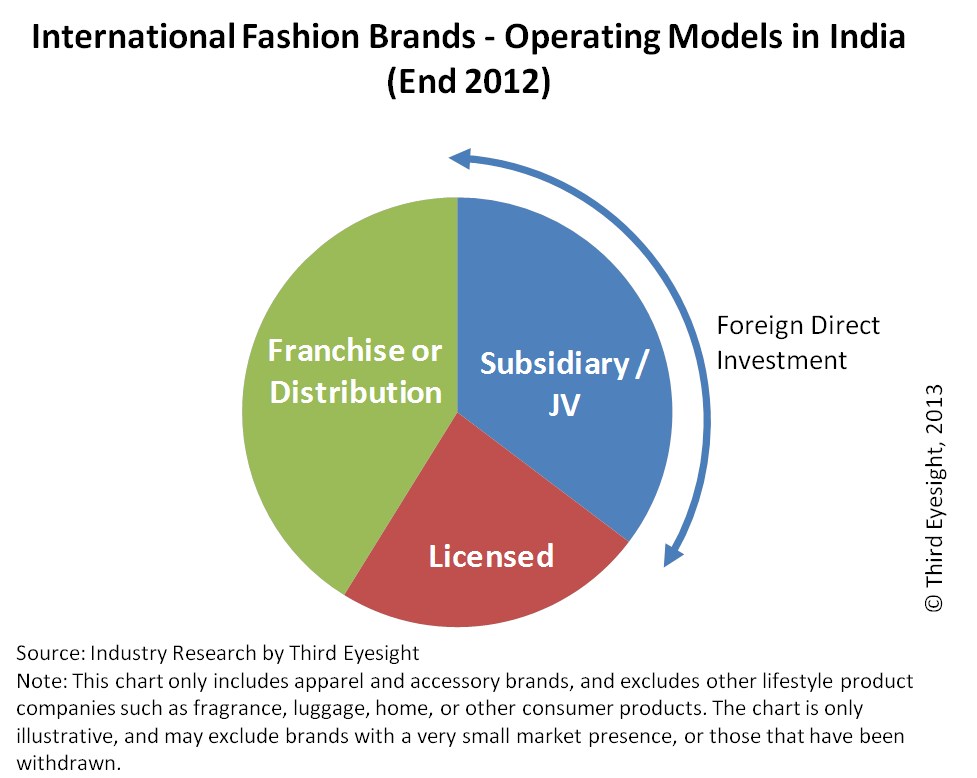
Franchising is still the more common form of route to market for most single brand retail companies although for many international companies an eventual ownership in India business may be desirable. However, licensing should not be excluded from the choice set, especially for companies that are multi-brand retail concepts such as Sephora or those that manage to find a suitable Indian partner that can provide end-to-end support from product sourcing to distribution and retail (for example, the relationship between Elle and Arvind).
Today two thirds of the international fashion brands come from three countries the U.S.A., Italy and the U.K. with nearly 30 per cent originating from the U.S.A. alone.

Is This A Lucky 13?
The theme for the year 2013 is positive for most brands, although still cautious.
Amongst the international brands that one can look forward to shopping in 2013 are “Uniqlo” of Fast Retailing, Japan’s largest apparel retailer, Sweden’s H&M, Emilio Pucci and Billabong. But India is not merely a destination anymore for the international brands to grow their business. The country is also increasingly becoming the innovation-platform or testing ground for new concepts and trends. World Co. a Japanese retailer with more than 3,000 stores in Japan and 200 stores in other parts of Asia is also test-marketing women’s apparel and accessories brands such as Couture Brooch, Opaque.clip, zoc, Tk Mixpie and Hot Beat to gain insights into consumers’ psyche. Italian brand United Colors of Benetton has recently introduced a global retail interior design concept which is present in major European cities but is the first-of-its-kind store in Asia and may well set the trend for the rest of Asia.
Gucci recently opened its largest store in India recently Delhi-NCR after two failed joint ventures. All of its five stores are now run directly by the company and the Indian business also reported to have turned profitable this year.
Brands such as Mango who have chosen the franchise route are tying up with additional partners (e.g. DLF) in the hope of making the Indian business contribute significantly to the overall revenue of the company.
UK-based apparel chain Marks & Spencer is accelerating its expansion in India with plans to add ten stores in the next six to eight months in the country. The company has identified India as one of the key markets to become the world’s most sustainable retailer by 2015. It plans to increase the number of stores in India from 24 currently to over 30 through the 51:49 joint venture with Reliance Retail.
Puma SE, the global sports lifestyle company for athletic shoes, footwear, and other sports-wear aggressively set out to gain 30 per cent of the Indian organised retail sportswear market within a year, from a share of 18-20 per cent in the top four branded sportswear segments in 2011. To this end the company targeted opening nearly 100 more stores during 2012. While the actual numbers are reportedly short of target, the brand has been opening amongst the largest stores during the year.
The confidence in the India opportunity is rising again, with existing global brands expecting the contribution from India business to grow multi-fold in a few years. However, the approach is of careful consideration and brands realise that India is a unique market, different not only from the West but also from other Asian economies such as China. Rather than adopting a “cut-and-paste” approach one needs to seriously consider the appropriate business model for India. Many of the global players have had to create a different positioning from their home markets. Some have significantly corrected pricing and fine-tuned the product offering since they first launched; these include The Body Shop and Marks & Spencer. Others are unearthing new segments to grow into; for instance, Puma and Lacoste are now seriously targeting womenswear as a growth market.
It is not only international brands that are more optimistic. Indian partners are also reviewing their approach. For instance, the Arvind Group that had looked at reducing its emphasis on international fashion brands in 2007-08 has recently acquired the business operations of Planet Retail which operated the franchises of British fashion retailers Debenhams and Next, and American lifestyle brand Nautica in India. The company termed Debenhams’ franchise as a significant acquisition as it provided an entry into the department store segment. Arvind plans to increase the India presence of Debenhams from 2 stores to 8 over the next three years. It also plants to grow the network of Next, the large-format speciality stores, from 3 to 12 in the same period.
As customer footfall and conversions pick up, international brands are also shoring up their foundations for future expansion in terms of better processes and systems, closer understanding of the market, and nurturing talent within their team. Third Eyesight’s study of the market highlights international brands’ concerns with ensuring a consistent brand message, improved organisational capabilities right down to front-line staff, and focussing on unit productivity (per store and per employee).
India shows signs of a healthier business outlook for International brands but the game has just begun and with competition getting tougher, we can expect interesting times ahead.
Tarang Gautam Saxena
February 1, 2012
As the debate over FDI (even for single brand retail) continues, over 250 international brands in the food service and fashion and lifestyle sectors alone continue to service the Indian consumers. Interestingly more than half of them are present in the Indian market through the franchising route.
Franchising has been a preferred entry strategy especially in case of the food service sector. Many of the international food brands have opted to give the master franchise to an Indian partner who can use the international brand’s name but is responsible for sourcing the ingredients and maintaining the international quality standards for food and service. One such example is Dominos, which incidentally is also the country’s largest international food service brand. Of course, as FDI liberalisation seems nearer the finish line, brands such as Starbucks are choosing to join hands with an Indian partner while others such as Denny’s Corp are planning to tie up with regional licensees.
In case of the fashion sector, in the early years of liberalisation few international companies chose franchising. Instead some chose licensing to gain a quick access to the Indian market at a minimal investment. Others set up wholly owned subsidiaries or entered into majority-owned joint ventures to have a greater control over their Indian business operations, product sourcing and supply chain and brand marketing.
However, at the turn of the last decade, many international fashion brands chose franchising owing to favourable business environment. An environment conducive for growth of franchising was created by reduction in import duties under WTO agreements, the absence of a wide network of multi-brand retail platforms, the need for using exclusive branded outlets as a marketing tool to create a full brand experience and the simultaneous growth of real estate investors who were potential master franchises ready to invest capital and real estate.

The question is how the liberalisation of FDI norms will impact the choice of market entry strategy for the international brands. Would franchising continue to remain the preferred entry mode as we set into the liberalised FDI regime? The change in foreign investment norms has already led to some brands (in particular those in the fashion and lifestyle sector) transitioning their existing licensing or franchise partnership into a joint venture or wholly owned subsidiary while the new entrants are actively considering ownership routes rather than franchising.
Certainly, the ideal scenario for an international brand would be to have complete ownership and control over the operations in a strategic market like India, but direct investment does also increase their risk and the investment is not financial alone. Amongst other choices licensing offers the least control, and while joint venture may be preferable for some brands, for many franchising still proves to be the practical choice for some time to come.
Franchising may potentially be quicker way to launch with higher chances of the retail business being successful. As it is an “entrepreneurship” model of business, the franchisee’s motivation to make the venture a success is high. The international brand has an assured income by way of royalty on the license agreement and could expand more rapidly in the market. Having a local partner with a closer understanding of the market and the ability to adapt to the changing needs of the consumers also helps to ensure that the international brand’s offering is tuned in to consumers’ demand.
Further, unlike more developed markets where brands have sizable networks of large-format store as a launch and growth platform, in India there are still limited choices to simply “plug-and-play” using department stores or any other large-format retail network. Partnering with a franchisee who has access to retail real estate can be a quick way to reach the target consumers. On his part the franchisor needs to ensure that the business model is well thought through in terms of the team and infrastructure required and is scalable.
For a successful relationship it is vital that the franchisee has an entrepreneurial mind-set. The essence of the brand needs be well understood, and the franchisee must have operational involvement rather than a “passive investment” approach.
If both partners understand their respective responsibilities, franchising can truly be a win-win business model.
Devangshu Dutta
January 6, 2012
 The transition between calendar years offers a pause. We can use it to evaluate what passed in the previous year, chalk out our journey for the next one.
The first response of most people to the question “What happened in the Indian retail sector in 2011” would be probably something like this: lots happened, and then – at the end – nothing did!
That is because one theme ran through the entire year, month after month, fuelled by tremendous interest in the mainstream media as well. This was about the change expected, hoped for, in the policy governing foreign direct investment (FDI) into the retail sector. Hearing the debate go back and forth, on one side it seemed as if FDI was going to cure every ill of the Indian economy, and on the other it seemed as if the country was being sold out to neo-colonists.
It’s worth remembering that not too long ago foreigners could invest in retail businesses in India freely. Benetton ran some of the key locations in the network through its joint-venture which subsequently became a 100 per cent owned subsidiary. Littlewoods (UK) set up a 100 per cent owned operation in India during the 1990s before its home market business collapsed, and its Indian operation was bought by the Tata Group to form Westside. And well before all these, one of the early multi-nationals, Bata, had already built a humongous network of stores across the length, breadth and depth of India.
The motivation for the decision to exclude foreigners from this sector may have been political, economic or mixed – that is not as important as the timing.
By the mid-90s India had just started to attract interest as private consumption was just about picking up steam. Several international apparel, sportswear and quick service brands entered the market during this time. Many of these brands started setting up processes and systems that changed the way the supply chain worked. They gained market share, and more importantly mindshare, with young consumers. In this process some of the domestic brands did suffer, some of them irrecoverably. However, with foreign investment suddenly blocked-off, many brands that wanted direct ownership in the business in India turned away. In their opinion the opportunity just wasn’t big enough to take on the hassle of a partner. Some did enter, but with wholesale distribution structures rather than in retail.
During this last decade, the Indian retail landscape has changed dramatically. During the 2000s the economic boom happened and India became “hot” again. So did retail and real estate, as large corporate houses pumped in significant amounts of capital into setting up modern chains to tap into the fattening consumer wallets. Clearly, FDI was going to come up on the agenda again, but not quite at once. Indian companies needed some headroom to grow; and grow they did, partly with indigenous business models and brands, and partly as partners to international brands.
By 2011, there was more of a clear consensus among the Indian businesses that retail could be opened to FDI and must be. Internationally, too, political and economic heavy-weights from the significant western economies pitched for opening up the retail sector in India to foreign investment. Here’s the small public glimpse of the hectic activity that happened internationally and domestically:
Such an anticlimax! For many, 2011 was the year that could have been a turning point. Could have been! If you had slept through the year and woken up on New Year’s Eve, would you have found nothing had really changed?
Ah, that’s the thing! I think most people observing the retail business actually slept through the year, because they were just focused on the FDI dream. Those actually engaged in the retail business know that many other things did change, some of which create the foundation for further growth.
The government did push on with the GST (goods and services tax) agenda. While stuck in politics at the moment, we look forward to incremental changes in harmonizing the taxes and tariffs regime, vital for truly unifying the country in the economic sense. On the downside, excise being levied on the retail price of clothing was a blow to retailers.
Growth continued. Indian’s retail giant, Future Group, grew to around 15 million square feet. The other giant, Reliance, announced renewed vigour and focus on the retail business with additions to the management team partnerships with international brands such as Kenneth Cole, Quiksilver and Roxy. Other new partnerships were announced, including significant American food service brands Starbucks (with the Tata Group) and Dunkin’ Donuts (with Jubilant). The British footwear brand Clark’s announced that it was aiming to make India its second-largest source country and among its top-5 markets within 5 years. Marks & Spencer pushed to expand its chain by more than 50 per cent, adding 10 stores to 19, while Walmart said its focus was on building scale rather than trying to squeeze profitability from its US$ 40 million investment so far. For fashion brands, the Rs 500 crores (US$ 100 million) sales threshold seemed more achievable as they used the accelerated pace of growth.
Many in the retail business talk about “the people problem”. Fortunately, some decided to demonstrate positive leadership, reflected in RAI’s announcement of an ambitious skill development plan for 5 million people in next 4-5 years, and industry veteran BS Nagesh announcing the launch of a non-profit venture, TRRAIN.
There was some bad news on the issue of shrinkage: a sponsored study placed India at the top of the list of countries suffering from theft. But the level was reported to be lower than the previous study, so there seemed to be hope on the horizon. The study didn’t say whether consumers and employees had become more honest, better security systems were preventing theft, or whether retailers themselves had become better at counting and managing merchandise over time.
A significant highlight was the e-commerce sector, which has found its way to grow within the existing restrictions and regulations, even as the online population is estimated to have grown to 100 million. Flipkart delighted customers with its service and racked up Rs. 50 crores (US$ 10 million) in sales. Deal sites proliferated and media channels celebrated the advertising budgets. Even offline businesses, notable among them pizza-major Domino’s, found their online mojo; Domino’s reported 10 per cent of its total revenues from online bookings within a year of launching the service.
In all of this the biggest story remains untold, which is why I call it an Invisible Revolution. This revolution is made up of the changes that are happening in the supply chain in the entire country, including investment by private companies in massive, large and small facilities to store, move and process products more efficiently. And in spite of the high costs of capital, suppliers are continuing to look at investing in upgrading their production facilities as well as their systems and processes. While the companies at the front-end will no doubt get a lot of the credit for modernizing India’s retail sector, it would be impossible without the support of the foundation that is being built by their suppliers and service providers.
2011 seems to have ended with a whimper. 2012’s beginning will be tainted by large piles of leftover inventory that needs to be cleared. Inflation seems tamer, but consumers have already tightened their belts, anticipating difficult times. The policy flip-flops and the political debates are sustaining the air of uncertainty. So what does 2012 hold?
Remember, the ancient Mayan calendar stops in December 2012, and no doubt there are many predicting doomsday! However, there are several others that see this as a possibility of rejuvenation, renewal.
Hope and fear are both fuel for taking action. Investment cycles are caused by an imbalance of one over the other.
In 2012, we’ll probably continue to see a mix of both. I recommend that we don’t take an overdose of any one of them. Even if you think 2011 was “the year that could have been”, I suggest still treating 2012 as “the year that could be”.
Here’s wishing you a successful New Year!
Tarang Gautam Saxena
October 30, 2011
 The operating environment for the fashion retailers in India is only moving towards a more challenging and competitive direction even though the market is yet to mature. The market has grown over the last two decades on account of brand proliferation and developing retail network and more recently due to new product category creations. High consumer awareness and exposure to international trends has cut the product life cycles short. Topping this up, the last 12-18 months has witnessed the growth of the online platform offering an alternate, convenient and cost effective shopping option for consumers.
It is necessary that fashion retailers manage their operations efficiently both in terms of managing a complex and responsive supply chain at the back end and delighting the customers at the store with great product offers and customer service. Adopting lean practices can help fashion retailers to achieve significant improvements in store profitability and customer satisfaction, making their retail business sustainable through a positive impact on bottom-line.
The concept of lean philosophy, pioneered by Toyota, is built on the premise that inventory hides problems. The basic tenet of this philosophy is that keeping the inventory low will highlight the problems that can be dealt with and fixed immediately instead of maintaining inventory in anticipation of any bottlenecks.
“Lean retailing” is an emerging concept and has already been adopted by retail organisations in the Western countries using technology such as barcodes, RFID (across the product value chain from raw material sourcing through production through final delivery at the retail store) and item-level inventory management and network architectures.
In an ideal scenario a retail organization would be lean at both the store and the distribution center. The organization would leverage technology such as RFID to uniquely identify the movement of its inventory accurately and use fulfillment logic as per the store’s merchandizing principle to have replenishments in tune with customer demand.
Some international retailers that have adopted lean retailing techniques include Wal-Mart, Macy’s, Bloomingdale’s, The Gap and J. C. Penny. Applying lean philosophy to fashion retail in India may sound like an avante garde concept as of now. However, there are some leading large retailers in India such as the Future Group who are early adopters and have already adopted lean practices in their retail supply chain.
An understanding of what lean retailing is and some of its principles can help in appreciating how this concept can make the apparel retail business more sustainable. Lean retailing aims to continuously eliminate “waste” from the retail value chain, waste being defined as any activity/process that is not of “value” to the customer. A fundamental principle of lean retail is to identify customers and define the “value” as those elements of products or service that the customer believes he should be paying for, not necessarily those that add value to the product. Further the value should be delivered to the customer “first-time right every time” so that waste is minimized.
Lean retailing requires simplifying the workflow design in delivering products to customer. Given that the connotation of value is customer-centric, simplifying the workflow design requires streamlining the core and associated processes so that any kind of waste is eliminated. Further pull-system drives replenishment at the stores (and the shelf) based on what customers want “just-in-time” (neither before nor after the time customer demands). This results in a value flow as pulled by the customer.
Those practising lean retail have invested in information technology that allows the stores to share sales data in real time with their suppliers. New orders for a given product maybe automatically placed with the supplier as soon as an item is scanned at the check-out counter (subject to minimum order size criteria). Smaller stores may use visual systems wherein the sales staff can gauge through the empty shelf space the products that have been sold and that need to be re-ordered.
Removing bottlenecks throughout the supply chain is another principle driving lean retail. It entails redesigning processes to eliminate activities that prevent the free flow of products to the customer. Further, lean retail requires following a culture of continuous improvement. Continuous improvement (or “Kaizen”) focuses on small improvements across the value chain that rolls up into significant improvements at an overall level. Kaizens not only can lead to elimination of wasted effort, time, materials, and motion but also focus on bringing in innovations that lead to things being done faster, better, cheaper and easier. Involvement of staff at the lowest levels is very important in Kaizen activities and that means that companies must invest in training, up-skilling their talent pool in Lean Principles.
In the context of apparel retail business, lean retail can help in improving organisational responsiveness to customer needs, the speed with which the products are delivered to them and meet their expectations as per the latest trends. Systematic application of lean principles translates in increased throughput (Sales), with lower Work in Process (Investments) and as per customer requirements of Quality, Design, Trends and Time. Improved information visibility across the chain leads to reduced instances of out of stock and excess inventory at the same time, minimising inventory control costs and reducing shrinkage. At the front-end lean retail may lead to redesigned in-store processes and systems for consistency in frontline behaviors to provide standard customer experience.
With the focus on training and involvement of the workforce, Lean principles have resulted in improving employee satisfaction without increasing labour costs that in turn positively impacts revenues and profitability. Some retailers in the West have reported reducing their store labour costs by 10-20 percent, inventory costs by 10-30 percent, and costs associated with stock outs by 20-75 percent on account of lean retail.
In addition to top-line and bottom-line impact, lean retailing by enhancing the enthusiasm and motivation of the frontline staff creates distinctive shopping experiences for customers.
Inditex, the world’s largest clothing retailer with Zara as its flagship brand, has successfully achieved supply chain excellence following lean principles. It targets fashion conscious young women and is able to spot trends as they emerge and deliver new products to stores quickly thereby establishing its position as the leading fast fashion retailer. The product development processes is based on customer pull-system. Its design team reviews the sales and inventory reports on a daily basis to identify what is selling and what is not. Additionally, regular visits to the field provide insights into the customers’ perceptions that can never be captured in the sales and inventory reports. Critical information about customer feedback is widely shared by store managers, buyers, merchandisers, designers and the production team in an open plan office at the company’s headquarters. Frequent, real time discussions and interactions within the team help them to understand the market situation and identify trends and opportunities.
Further, Zara manufactures the products in small lots and many styles are typically not repeated. Style cues for replenishments are derived from real time customer demand. At the back end, Zara holds inventory of raw materials and unfinished goods with its supply partners which may be local or offshore manufacturers. Typically, the fashion merchandise is produced at the local manufacturing base and quickly delivered while the staple low-variation range is produced offshore at cheaper costs.
Following lean retail practices implies a higher stock turn and frequent replenishments by the suppliers based on real-time sales. Building and maintaining reliable and responsive suppliers through win-win partnerships, is imperative to realize the success of lean retail implementation as high stock turns and frequent replenishments involves the commitment and involvement of the entire supplier base.
Like in any transformational effort, change management plays a critical role in reaping the benefits of lean retail. The whole philosophy requires paradigm shift in attitudes, behaviors and mind sets of those involved upstream and downstream across the value chain. Training, communicating and inspiring the front end staff is thus an important aspect in the overall success and companies need to device a compelling vision that is shared by employees across functions and hierarchy across the entire chain.
Devangshu Dutta
August 26, 2011
Indian Terrain Fashions’ plans to launch a ‘Made in America’ jeans brand using denim from a US mill made into jeans in Guatemala, is a move that bucks trends for brands sold in India. The move is an interesting twist in the growth story of a 10-year-old brand that was, until recently, a business division of the Chennai-based apparel manufacturer Celebrity Fashions. Celebrity’s notable customers include Gap, Nautica, Armani Jeans, Timberland, Dockers and Ann Taylor.
About five years ago, Celebrity had invested in growing its capacity by acquiring another exporter’s manufacturing facilities. However, Celebrity’s manufacturing and export business has been under pressure due to the difficult environment in its main markets, and last year Indian Terrain was demerged from its parent.
It now seems Indian Terrain is striking out on an independent path, with plans to launch a ‘Made in America’ jeans brand. Managing director Venkatesh Rajgopal says the company proposes to source the denim from an American mill and have the jeans manufactured Denimatrix in Guatemala, which also produces for brands such as Abercrombie & Fitch. According to him, Indian Terrain will use the same raw material as Abercrombie & Fitch, and “will be able to track every pair of jeans to the same cotton fields in Texas.”
The company’s competitors, both domestic and international brands operating in India, mainly buy denim products from within the country.
Denim is currently a very small part of Indian Terrain’s casualwear product mix which is largely sourced from its parent, Celebrity Fashions. The company is looking at launching the “mid-premium” priced brand in September that will not be “just about quality, but about offering a lifestyle.” Rajgopal estimates that denim has the potential to grow to 30-35% of the company’s business in three years.
The demerger of Indian Terrain from its parent company was carried out in 2010 with a view to achieving better valuation for the branded business and to provide additional liquidity to its founders and private equity investors. The company is currently present at about 80 exclusive brand stores and through 400 multi-brand retail stores, in eight cities, as well as in Singapore’s Mustafa Mall. It closed the financial year ending 31 March 2011 with sales of INR1.21bn (US$27m), and expects to grow its top line by 25% this year.
Its retail customers wait to see whether Indian Terrain will be able to effectively integrate denim into its core brand philosophy and grow to a third of the product range. However, for investors the critical question is this: after the demerger from the manufacturing parent and with product being imported from the Americas, will the brand business be able to maintain gross margins at the current levels of about 40% to 45%? Only time will tell.
