
admin
October 11, 2022
SHARLEEN D’SOUZA, Business Standard
Mumbai, 10 October 2022
In early 1994, Titan started selling watches with precious stones in them and called this new line, Tanishq. It went on to become a separate division of Titan Company and grew into the country’s largest branded jewellery outfit, helping raise Titan’s sales to ~28,799 crore last financial year.
Thirteen years later, in 2007, Titan Eye+ set out to shake up the eyewear market. Though it also sells sunglasses of other brands, it is the prescription segment that Titan redefined and now, according to its website, has 550 Eye+ exclusive stores in 229 cities.
In 2017, Titan sought to do an encore in yet another large market in which the demand, as in jewellery and eyewear, was almost recession-proof and largely commoditised, leaving ample space for a pan-Indian branded chain. Thus was born Taneira, with an avowed intent to become the country’s largest organised saree retailer.
“Titan had earlier tried to organise the jewellery market through Tanishq, which is successful, and this is an attempt by Titan to organise the saree market,” Ambuj Narayan, chief executive officer (CEO) of Taneira, told Business Standard.
What is unsaid is that jewellery to sarees can also be seen as a horizontal brand extension, the two do go together on occasion.
Natural extension
The Indian wear market is a 5,000-year old segment estimated to be worth ₹50,000 crore a year and growing at a compound annual growth rate of 6 to 8 per cent. Sarees account for 80 to 85 per cent of its sales, with kurta sets, blouses, and lehengas comprising the rest. Yet, despite the size and growth, there is hardly any nationally known brand in this segment, with Nalli Silks being one of the notable exceptions.
Titan insiders say the company believed sarees to be a natural extension for it, given its past success with design-led lifestyle brands. They say the company organised an internal competition to see who came up with the best expansion strategy.
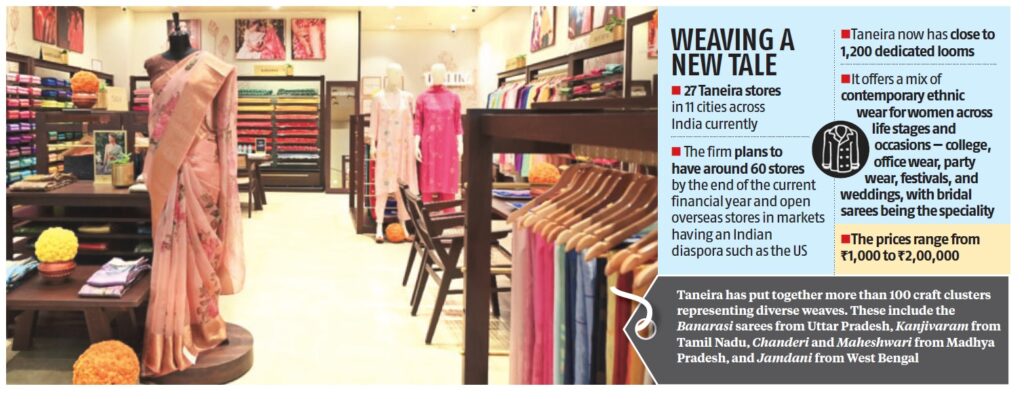
The result is a bouquet of design-differentiated products — primarily sarees and kurta sets — made from pure natural fabrics sourced from all over India. The company put together more than 100 craft clusters representing the diverse weaves. These include the Banarasi sarees from Uttar Pradesh, Kanjivaram from Tamil Nadu, Chanderi and Maheshwari from Madhya Pradesh, and Jamdani from West Bengal. The output is a mix of contemporary ethnic wear for women across life stages and occasions — college, office wear, party wear, festivals, and weddings, with bridal sarees being the speciality. The prices range from ₹1,000 to ₹2,00,000.
“The Tata group’s ventures have always been consistent with their approach — they stay the course beyond initial hiccups and eventually scale up the business. This is very much how Titan and Tanishq worked their way from initial struggles to eventually scale and become nationwide brands,” said retail expert Devangshu Dutta, CEO at Third Eyesight.
To say that Taneira has had initial hiccups would be an understatement. Three years after its launch, the Covid-induced lockdowns and restrictions brought the entire retail sector down to its knees.
Baptism by Covid
“Pandemic restrictions and high Covid-19 anxiety among the people kept socialising and weddings at a very low level of activity over the past couple of years. For Taneira, being a nascent brand with a yet-to-be-established customer base, the operating environment has been particularly tough,” Titan Company said in its FY22 annual report.
Taneira used this time to realign its strategy of connecting with customers. Thus, during 2021-22, which braved the second Covid wave in its first quarter — the dreadful Delta — and saw the third wave creep into its fourth quarter, sales at Titan’s Indian dress wear division grew by 55 per cent.
Narayan, the CEO, attributes this growth to initiatives that included staying close to the customer through e-commerce. “We really drove e-commerce out and reached out to our customers through video calling and try-at-home activities,” he said.
As consumer sentiment started to improve, Taneira already had two collections ready — wedding weave and the summer collection — which boosted sales. During 2021-22, it also increased its store count to 20 by adding six more. During the fourth quarter, Taneira sales rose 4 per cent.
Today, there are 27 Taneira stores in 11 cities across India. It plans to expand to Tier 1 and Tier 2 cities in the first phase and then to Tier 3 in the second phase of its store expansion.
However, Vishal Gutka, vice-president of research (consumer and retail sector) at Phillip Capital, said: “Taneira follows the same principle Titan used for Tanishq, where it entered an unorganised category and expanded it. But it is still early days to gauge how Taneira will pan out. Also, the company needs to give more clarity on the unit economics of each store.”
Weaving an expansion plan Titan’s annual report talks of a robust expansion plan for Taneira this financial year: “We plan to grow at an exponential rate and make our store count around 60 by the end of the current fiscal year and open overseas stores in markets having an Indian diaspora such as the US.” It adds that Taneira will become a more significant contributor to the overall revenue of Titan in the medium term.
At the heart of this grand ambition lies the humble weaver. Taneira now has close to 1,200 dedicated looms and has a programme called Weaver Shala to support them with technical expertise and in modernising their facilities. It has introduced frame looms along with basic workspace facilities for the weavers in collaboration with the localised weaver-led organisations.
The brand has closely worked with the weavers in Varanasi, Uttar Pradesh, and Champa, Chhattisgarh, and aims to take Weaver Shala to other parts of the country.
Taneira leverages Tanishq’s brand strength; mannequins at Tanishq stores, for instance, are dressed in Taneira sarees.
However, Narayan said Taneira and Tanishq will not be sold under the same roof because Titan wants to establish Taneira as a distinct brand in its own right.
(Published in the Business Standard)
admin
June 24, 2022
Written By Christina Moniz
Prashanth Aluru, a former Facebook and Bain hand, will be behind the steering wheel for this venture

The Aditya Birla Group has just announced the launch of its ‘house of brands’ business entity, TMRW, to support digital fashion and lifestyle brands. TMRW, which will operate as a wholly owned subsidiary of Aditya Birla Fashion & Retail (ABFRL), aims to build and buy over 30 brands in the next three years, the company said in a statement.
With this move, the company expects to make its entry into the D2C market, which is expected to be reach $100 billion by 2025. “What a brand like Shoppers’ Stop does in brick and mortar, ABFRL is doing online. While in the past, the company was known for certain brands, it is now pivoting itself towards a wider pitch with bigger variety of brands that could potentially appeal to a wider range of consumers,” said Ankur Bisen, senior partner and head, food and retail, Technopak Advisors. The launch could be ABFRL’s next step in positioning itself as a fashion major, he said.
Prashanth Aluru, a former Facebook and Bain hand, will be behind the steering wheel for this venture.
ABFRL will compete with start-ups like the Good Glamm Group and Mensa Brands, among others. The number of D2C brands and online sellers in the country have grown over the last couple of years, and experts believe that TMRW could be the company’s endeavour to become relevant to new-age consumers. Brands like Reliance Retail and Myntra are going down the same path, says Bisen.
The opportunity is immense; according to a report by IMARC Group, the Indian textile and apparel segment reached $151.2 billion in 2021 and is set to grow at a CAGR of 14.8% between 2022 and 2027.
ABFRL, which has a network of over 3,300 stores across India, is home to brands like Pantaloons, Van Heusen, Louis Philippe and Allen Solly, and has partnerships with labels like Forever 21, American Eagle and more recently, Reebok. The retail company has also forayed into the ethnic wear business and has forged strategic partnerships with designers such as Sabyasachi, Masaba and Shantanu & Nikhil.
Having reported losses for the last three years, the company narrowed its losses to `108.72 crore in FY22 on the back of revenues of `8,136.22 crore. The company reported a 55% surge in revenues during the last fiscal. While Madura Fashion & Lifestyle contributed 68.4% to the company’s FY22 revenue, the remainder 31.6% came from Pantaloons, according to Bloomberg data.
Ambi Parameswaran, author and founder of Brand-Building.com, said ABFRL has already built a good retail presence for the brands in its portfolio. “There must be significant synergies at the back end, but the brands are managed separately,” he said. “I suppose the new venture, TMRW, will offer all these brands as well as all the other ethnic brands that ABFRL has acquired in the last three years.”
He said the synergies will probably lie at the back end with supply chain, logistics, finance and HR. However, the brands will most likely be given the space to build strong individual identities.
This is not the company’s first foray into the e-commerce space. ABFRL shut down its e-commerce venture, ABOF (All About Fashion) in 2017, though in August last year, it said the brand would be made available on Flipkart and Myntra.
A concept like ‘house of brands’ is potentially beneficial to both — the large conglomerates and also to the smaller, emerging brands that are acquired. In a D2C framework, niche brands that would otherwise find it difficult to navigate the established multi-layered distribution and retail channels see greater feasibility in connecting with their customers directly through digital channels.
According to Devangshu Dutta, CEO of retail consultancy Third Eyesight, this makes it viable to launch a product range, which would not be immediately entertained in established channels, and allows them to retain their distinctiveness. With the passage of time and with their growth, some of these brands could also expand into established modern retail and traditional retail formats and to a more mainstream audience.
“Large companies, on the other hand, can find it difficult to grow their existing brands beyond a certain pace, and often may not be able to break new ground in terms of product development and customer experience. At some point, inorganic growth by acquiring other businesses and brands becomes an important element of their strategy,” Dutta said.
The house of brands model, to be sure, comes with its fair share of challenges. Angshuman Bhattacharya, EY India partner and national leader – consumer products and retail, said the strategy must have clear synergies from an operations and distribution perspective. “Possible challenges could emanate out of the non-compatibility of categories with the distribution. Another potential challenge could be in supporting multiple brands with marketing investments, failing which the realisable value envisaged during acquisition could stay unfulfilled,” Bhattacharya said.
The other downside, as Dutta pointed out, is that over time there is consolidation of market power within a handful of companies. This has happened across the globe and across sectors, and can negatively impact consumer choice, supplier dynamics and pricing.
Source: financialexpress
admin
March 24, 2022
Written By Aditya Kalra & Abhirup Roy

MUMBAI, March 6 (Reuters) – At a large Future Retail (FRTL.NS) supermarket in Mumbai last week, workers were unloading hundreds of bright blue grocery crates belonging to India’s biggest retailer Reliance.
Prospective customers were turned back by security, disappointed at the closed state of the store that still carries the signage of Future’s biggest brand, Big Bazaar, but which will likely soon be rebranded as a Reliance outlet.
Across India, similar scenes are being played out as Reliance Industries (RELI.NS), India’s biggest conglomerate run by Mukesh Ambani, the country’s richest man, presses ahead with a shock de facto takeover of prized retail real estate that Amazon.com Inc has been keen to take part-ownership of.
The high-profile bitter dispute between corporate titans in which Amazon has sought to block Reliance’s planned $3.4 billion purchase of Future Group’s retail assets is currently before India’s Supreme Court.
Reliance’s takeover began with utmost stealth on the night of Feb. 25 when its staff began arriving at Future stores. Many in Future’s management were in the dark about the plans as store employees from all over the country frantically began to call, according to people with direct knowledge of the matter.
“It was tense, everybody was panicking. We didn’t know who they were. They wanted access and seniors didn’t know about it,” a New Delhi Big Bazaar store employee said, describing what happened around 8 p.m. that day.
At a Future store in Sonipat town in northern Haryana state, announcements were made asking customers to leave as Reliance seized control, one source said. In Vadodara in western Gujarat, Future employees arriving for work the next morning were asked to go back home with no explanation, said another source.
Citing unpaid payments by Future, Reliance has taken control of operations of some 200 Big Bazaar stores and has plans to seize another 250 of Future’s retail outlets. Combined, they represent the crown jewels of Future’s retail network and around a third of all Future outlets. read more
Although Reliance had not played a large public role in the legal dispute, it had, according to sources, for some months assumed many of the leases held by cash-strapped Future, India’s No. 2 retailer and Amazon’s estranged business partner.
Reliance’s sudden possession of the stores appears to have landed what some analysts are calling a coup de grace that spoils Amazon’s chances of untangling the transfer of Future’s assets to Reliance. That’s despite a series of legal battles won by the U.S. e-commerce giant to date blocking the 2020 deal announced between the two Indian companies.
“What will Amazon fight for now?” said a source close to the U.S. company with knowledge of the legal dispute. “The shops are gone.”
Representatives for Reliance, Amazon and Future did not respond to Reuters queries for this article. Sources asked not to be identified due to the sensitive nature of the dispute.
AFTER THE TAKEOVER, TALKS
Future Retail said on Feb. 26 it was “scaling down its operations” to cut losses although it made no mention of Reliance in its statement. Future Group as a whole has more than $4 billion in debt.
Reliance plans to retain Future’s employees at the stores it takes over, sources have said.
Amazon, which has a stake in a separate Future Group unit that it argues prevents Future from selling retail assets without its permission, has called the supermarkets and other stores an “irreplaceable” network in a sector worth $900 billion in revenues annually.
The legal wrangles had over time become increasingly high-stakes and marked by ugly rhetoric. At one point, Amazon sought for Future Chief Executive Kishore Biyani to be detained in prison for disobeying a legal order. And Future once likened Amazon to Alexander the Great and his “ruthless ambition to scorch the earth”.
But on Thursday, six days after Reliance’s move, Amazon at a Supreme Court hearing unexpectedly called for cordial talks to end the dispute – a proposal Future agreed to.
“People have taken over shops … let’s at least have a conversation,” Amazon’s lawyer Gopal Subramanium said.
Discussions are expected to begin soon. read more
Whatever the outcome of the talks, analysts say Amazon had gravely underestimated Reliance.
“If anybody should have seen this coming, it should have been Amazon and they should have prepared against it,” said Devangshu Dutta of retail consultancy Third Eyesight.
“Clearly, they didn’t.”
Source: reuters
admin
March 24, 2022
Written By Christina Moniz
D2C brands take the offline route to widen reach

Direct-to-consumer (D2C) brands are fluffing up the Indian mattress category with promises of lower prices, mattress-in-a-box convenience, 10-year warranty and 100-day trials. In a market that is predominantly unorganised, startups such as Wakefit, The Sleep Company, SleepyCat and Flo are aspiring to establish themselves as better alternatives to legacy brands such as Kurlon and Sleepwell, with most of them looking at the offline retail route too, to boost sales.
According to a Research and Markets report, while India’s overall mattress market has grown at a CAGR of over 11% in the last five years, the organised industry has grown at 17%. The mattress category in India is worth `12,000-13,000 crore; of this the organised segment commands 40% share.
New-age mattress brands are able to deliver products at lower price points by taking control of the entire consumer journey – from product discovery to post-sales support. Therefore, these D2C brands save big on distributor and retail margins, says Devangshu Dutta, CEO, Third Eyesight. These savings go towards compensating for higher customer acquisition costs and logistics, he observes. The elimination of the middlemen means that customers get their products at 30-35% less than what traditional players offer.
However, these digital-native companies are aware that they operate in a touch-and-feel category, which is why many offer a 100-day trial period. Priyanka Salot, co-founder, The Sleep Company, says that the product return rate is only 2-3%, and the returned mattresses are donated to charities but never resold. The Sleep Company, which entered the market a little over two years ago, is eyeing a turnover of `1,000 crore in the next five years, and has plans to launch its first offline store in a few months.
Online players also save on logistics, says Chaitanya Ramalingegowda, co-founder and director at Wakefit. “We implemented the roll-pack technology that allows the mattress to fit into a compact box. This lets us ship more products at a time,” he says. Wakefit has only two factories—one in north India and the other in south India—as opposed to older players with 10-12 factories across the country, he points out. The company hopes to close FY22 with a turnover of 630 crore, up from197 crore in FY20. It has one offline experience centre in Bengaluru, with plans to launch 10 more across five cities soon; these centres will not only be experiential, but also double up as booking/ retail sales outlets.
Offline boost
Rajat Wahi, partner, Deloitte India, points out that these new-age mattress brands must establish deeper offline distribution to expand reach. “After all, more than 90% of retail is offline in India,” he notes.
This is why D2C brands are not only taking the offline route, but also foraying into other segments like furniture and sleepwear. Kabir Siddiq, founder and CEO of SleepyCat, says the brand has plans to launch around four experience centres, and aims to become a one-stop shop for all sleep and comfort solutions, offering comforters, pillows and even bedding for pets.
Is the proliferation of D2C players giving legacy brands sleepless nights? Mohanraj J, CEO, Duroflex, says it has been akin to a “wake-up call”. He says the company has poured in investments into the D2C segment in the past few years, and now even has a completely online brand called Sleepyhead, catering to the millennial consumers. “Until recently, about 10% of our company’s growth was from online sales, but we expect that number to change to 30-35% this year,” he adds.
Despite the influx of new-age players, he maintains that Duroflex has doubled its growth in the past two years, with traditional retail registering 25-30% annual growth.
Source: financialexpress
admin
December 20, 2021
Written By Vaishnavi Gupta
The furniture brand’s retail roadmap includes city stores in Delhi, Mumbai and Bengaluru, followed by tier I and II towns

For the Ikea model to succeed, adequate demand-concentration is crucial, which is being currently provided by the bigger cities in India.
After launching two large-format stores in India in a span of three years — one each in Hyderabad and Navi Mumbai — Ikea opened its first small-format store in Worli, Mumbai, to become “more accessible and convenient”. About 90,000 sq ft in size, these ‘city’ stores are already present in markets such as New York, London, Paris, Moscow and Shanghai.
The furniture market in India stood at $17.77 billion in 2020, and is expected to reach $37.72 billion by 2026, growing at a CAGR of 13.37%, according to a Research and Markets report. Godrej Interio, UrbanLadder and Pepperfry are among the big players in this space, all with a significant online presence, too. Godrej Interio has 300 exclusive stores in India, while Pepperfry has more than 110 Studios.
Spread across three floors, Ikea’s first city store has 9,000 products in focus, of which 2,200 are available for takeaway and the rest for home delivery. “We have observed that it is not easy to find large retail locations in cities like Mumbai and Bengaluru. The small store offers convenience and accessibility for consumers to experience Ikea products,” says Per Hornell, area manager and country expansion manager, Ikea India. This launch is in line with the company’s aim to become accessible to 200 million homes in India by 2025, and 500 million homes by 2030.
More launches are being planned: another city store in Mumbai in the spring of 2022 and a large-format store as well as a city store in Bengaluru by the end of 2022. For its retail expansion in Maharashtra, the company plans to invest Rs 6,000 crore by 2030. “We are on track to exceed the investment commitment of Rs 10,500 crore made for India in December last year,” adds Hornell. Delhi, Mumbai and Bengaluru are the three cities on its radar at the moment, which will be followed by tier I and II towns.
Furthermore, Ingka Centres, part of Ingka Group that includes Ikea Retail, is coming up with its first shopping centre in Gurugram (followed by Noida), which will be integrated with an Ikea store.
In India, unlike its organised furniture market competitors, Ikea doesn’t have a pan-India online presence yet. It has been following a “cluster-based expansion strategy” for its online offering, but the company insists this is not a limitation. “At present, 30% of our overall India sales come from online channels,” Hornell informs. Through its e-commerce website and mobile shopping app, the company currently operates in Hyderabad, Mumbai, Pune, Bengaluru, Surat, Ahmedabad and Vadodara.
On the other hand, players like Godrej Interio and Pepperfry have big plans to tap new markets. The former aims to add 50 exclusive stores each year, while Pepperfry aims to achieve the 200 Studios mark by March 2022. In September this year, Pepperfry forayed into the customised furniture segment with the Pepperfry Modular offering, which focusses on modular kitchens, wardrobes and entertainment units.
Good start?
This is a good time for Ikea to establish its presence in the Indian market, says Alagu Balaraman, CEO, Augmented SCM. “Earlier, people used to rely on carpenters for furnishing their homes; now, they prefer to buy ready-made furniture. The market is moving towards acceptability, making plenty of headroom for growth for these companies,” he says.
Ikea’s cautious expansion approach in a market like India where several local dynamics are at play, is tactful, analysts say. Devangshu Dutta, founder, Third Eyesight, says, “In the past, Western businesses have made the mistake of simply copy-pasting formats and strategies in emerging markets from their more developed markets.” He believes there is “nothing wrong” in being incremental while growing footprint. “There’s no sense in carpet-bombing the market with stores, when many may end up being loss-making or sub-optimal,” he adds.
Getting the product mix and pricing right would be key in realising the full potential of this market. Balaraman says Ikea will have to balance its global portfolio with what it is doing locally, and make sure it is profitable.
For the Ikea model to succeed, adequate demand-concentration is crucial, which is being currently provided by the bigger cities in India. Given its global popularity, the furniture giant, analysts say, is poised to see traction in the metros and tier I cities.
Source: financialexpress
