
Tarang Gautam Saxena
February 7, 2011
It has been almost two decades since the government in India re-opened the economy to international investors and brands. During the first dozen years or so, apart from a single visible bump in 1995, every year had a steady dribble of fashion brands coming into the country. It was not until 2005 that this rate accelerated to over 20 international fashion brands entering the Indian market annually, even as the existing brands grew their own retail footprint in the market.
2008 and 2009 were both slightly damp by comparison, reflecting the global economic sentiment, but we were optimistic as we laid out our expectations for 2010. While writing the previous version of our research report released a year ago, we felt that 2010 was going to be promising and it could well be a “curtain-raiser for a new decade of growth for international fashion brands in India”.
The increased bustle in the market has endorsed our forecast. Though initially slow, the growth of new international brands entering the Indian market in 2010 bounced back with the same vigour as before the downturn. Some brands that had exited the Indian market earlier also made a comeback as in the earlier years.
The Entry Strategies In 2010
The most preferred entry route for the international fashion brands entering India in 2010 has been franchise or distribution, with more than half the brands selecting this strategy that allows high control over the product and the supply chain with less intensity of involvement at the front-end. There are two discernible categories of brands that are picking this route: firstly, brands that are usually distributed through department stores and multi-brand independent stores in their home market and other markets, but also those brands that are as yet unsure of their capability to engage intensively with the Indian market. Franchising remained a popular choice in 2010 particularly for the brands looking to test the market or operating in niche or luxury segments.
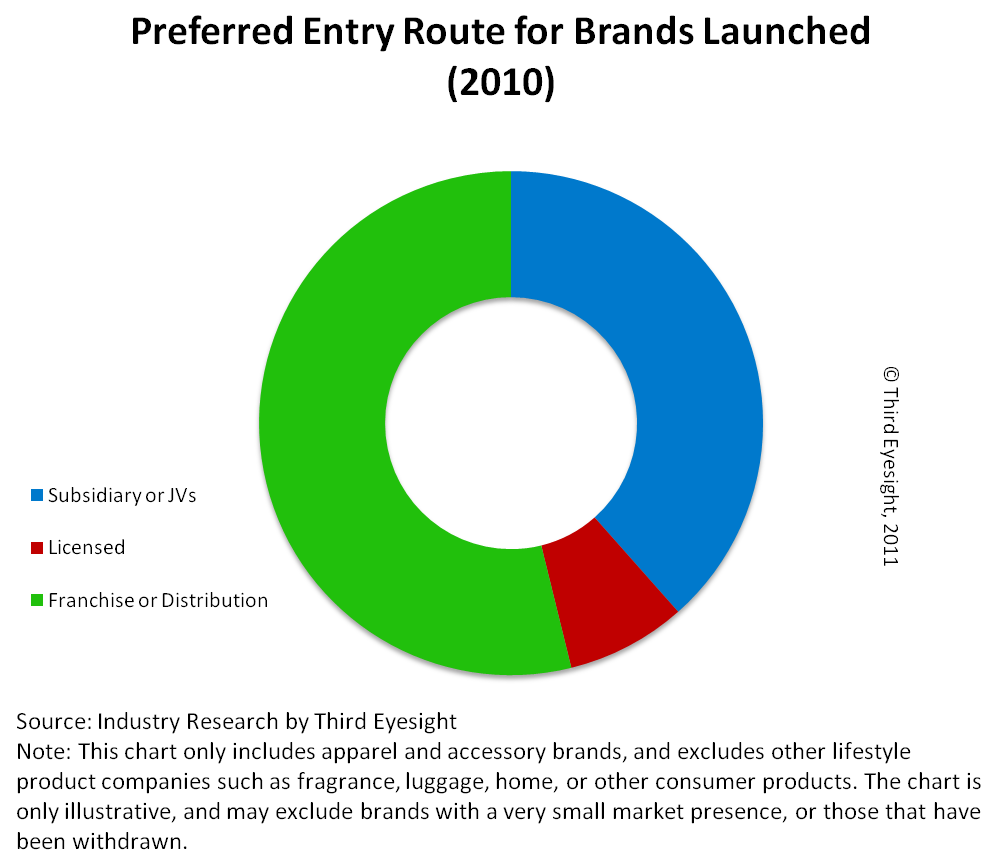
Some brands taking this route for entering the Indian market include Forever 21, Etro, Tom Ford, and Ladybird, amongst others. However, a number of brands that entered in 2010 (nearly 40% for the new entrants) also showed that they wanted a piece of the action through some degree of ownership (whether through a majority or minority stake in a joint venture or through a wholly owned subsidiary). Some – such as S. Oliver – also switched to joint-ventures from their earlier franchise structure.
Under the current regulations governing foreign investment into retail, several companies that typically want control operate either through 100% subsidiaries that sell to independent retail franchisees , or through 51:49 joint-ventures that operate the stores as well.
We are finding increasing signs among companies of a confidence in the market, a growing comfort with the operating environment, and a desire to own and control the direction their brand takes in a strategic market like India. it is likely that if the government decides to allow 100% FDI in single brand retail, several brands will opt to set up wholly-owned subsidiaries that control the entire chain of activities, source-to-store.
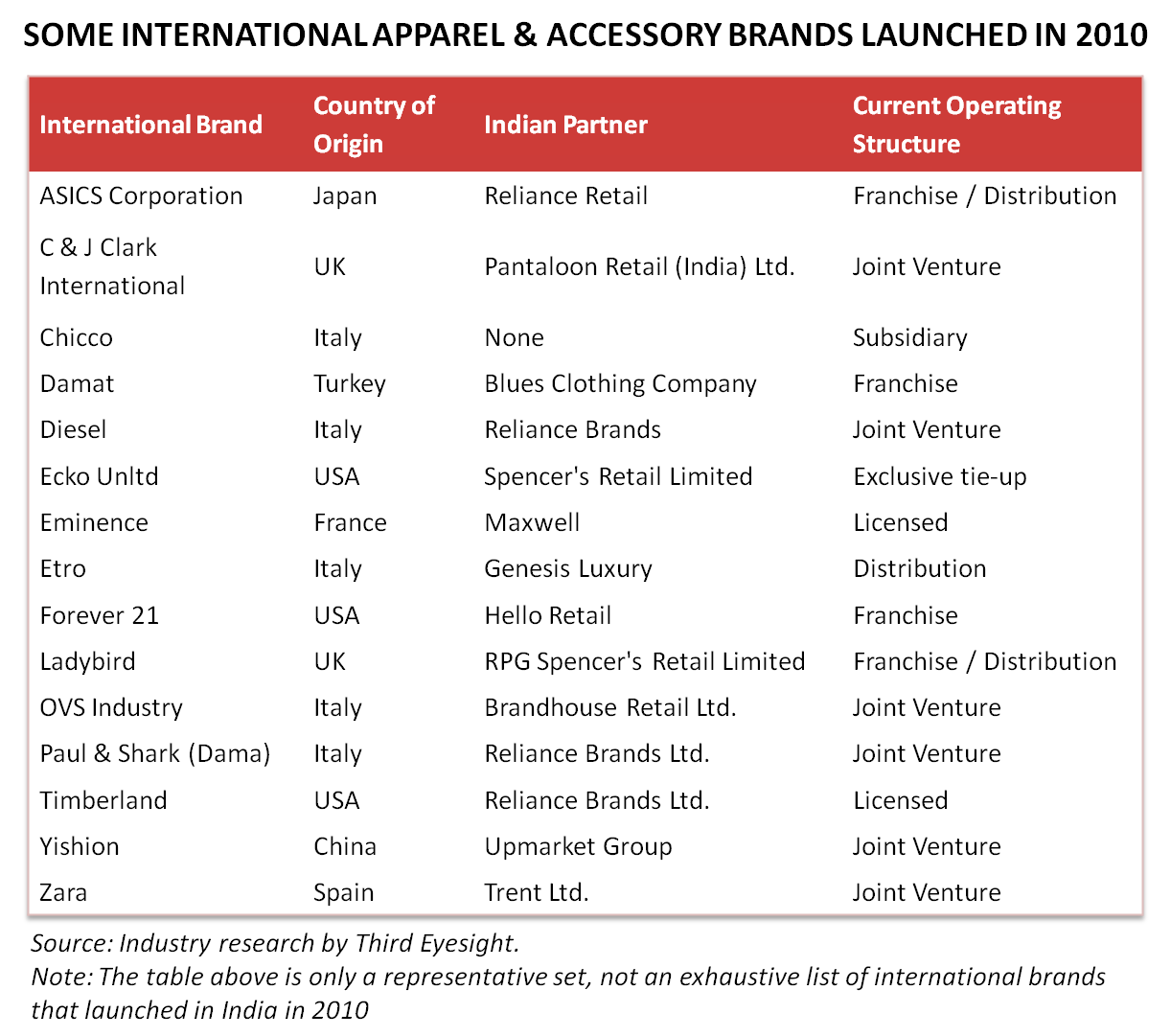
International brands opting for the ownership in the Indian venture included OVS (Italy’s Gruppo Coin), Yishion (China) and Chicco (Italy).
Fast Fashion for the Family
Amongst the new launches, a highlight of the year was the launch of the most awaited and discussed-about brand Zara. The first store was launched in Delhi with menswear, womenswear and childrenswear, followed by a store in Mumbai, and a third again in Delhi. While almost every other brand launches with an advertising blitz, Zara – in its usual fashion – needed none. The news buzz it generated created enough traffic to provide record sales during the first few weekends. It was also instrumental in generating 30-40% more footfall in the malls where it opened.
Inditex was certainly one of the brands looking for control, and has formed a 51:49 joint venture with the Tata Group’s retail business, Trent. For now the company has adopted its global supply chain for the Indian market as well which clearly adds cost and time to the supply chain. The merchandise is imported from the central distribution centre in Spain, and includes products manufactured in the Indian subcontinent. Competing brands in the industry have raised questions about Zara being able to build a successful and sustainable business in India just on the back of rapid fashion changes, at prices that are not quite “competitive”. However, the brand is reportedly aware of the struggle in building a successful business around import-led sourcing model and is seen to have planned growth conservatively.
Another southern European value fashion brand, OVS Industry, was launched last year by Oviesse through a joint-venture with Brandhouse Retail from the SKNL group. OVS Industry also offers a range for men, women and kids. While in the first year products have been imported from Italy, the company says it intends to bring in the merchandise directly from the supply source for speed and cost effectiveness, to achieve aggressive growth over the next five years.
Multi-Brand Platforms, Larger Stores
International brands have been drawn to India by its large “willing and able to spend” consumer base and the rapidly growing economy, but so also are Indian companies – manufacturers or retailers – who are ready to act as platforms for their launch.
Given the current restrictions on investment into retail operations, Indian companies are increasingly setting up large multi-brand outlets for an array of international brands under one roof. This allows the Indian franchisee to share overheads among many brands, and also negotiate harder for shopping centre space that is increasingly unaffordable. However, the idea is not only to gain from the operational efficiencies and cost efficiencies, but also to capture a higher share of the wallet of the consumers walking into the stores.
Even those Indian companies that are already retailing their own brands in a particular category are seeking franchise or distribution relationships with international brands, in order to capture a complementary segment of consumers or to offer a larger choice-set to their existing consumers.
For instance, Reliance Brands has partnered with some well known premium to luxury fashion and lifestyle brands. In 2010 alone, it brought Diesel, Paul & Shark and Timberland to the Indian market. On the other hand Maxwell Industries’ relationship with Eminence, a French innerwear brand, has allowed it to address the premium segment in which it was not present, and to compete with other international players such as Jockey, Triumph, Hanes, Fruit of the Loom and others.
RPG Group’s Spencer’s Retail, one of the pioneers of modern retail in the last two decades is looking at increasing the share of its apparel business. Apart from its private labels, Spencer’s is also actively seeking to grow its international brand portfolio quickly. Following up on its launch of Beverly Hills Polo Club in 2008, Spencer’s introduced Ecko Unltd (a youth fashion brand) in 2010. It has also become the platform for the British childrenswear brand Ladybird in its second coming to India.
While the emergence of large multi-brand franchise outlets is driven by Indian franchisees looking to optimise their businesses, the brands themselves are also looking at larger store sizes that are gradually becoming comparable to their stores elsewhere. For instance, the American brand Forever 21 launched with 10,000 square feet for only women’s western clothing and accessories. Similarly, Zara launched its business with a 14,000 square feet store. Larger stores are allowing brands to increase the efficiency of their operations, maximise the visual impact, and increase the speed at which they can achieve critical mass in the country.
Beyond Europe and the US
While European and American brands clearly dominate, 2010 also saw brands from China, Japan and Turkey making inroads to the Indian market.
China’s apparel retailer Yishion launched a 51:49 joint venture with a distribution company, Upmarket Group. Yishion is aiming at rapid growth in the mid price segment in India through own stores and multi-brand outlets (MBOs).
Turkish brands Tween, ADV and Damat from the Orka Group have been brought to the market by Blues Clothing Company, a mid-sized retailer of fashion apparel that also distributes brands such as Versace, Corneliani and Cadini.
The Strategy Shifts & Changing Structures
In the past the international brands have undergone changes in their strategy and operating structures to suit their current context and changing environment. Last year was not an exception to the correction and some brands did undergo a change in their approach and strategy for the Indian market.
Italian denim brand Energie exited the market and their partnership with Reliance Brands in 2007. However, in 2010, the Miss Sixty group entered into a licensing agreement with Arvind Limited which relaunched Energie as part of its portfolio of international denim brands. Arvind already had international brands catering to the mass and the middle segments of the denim market, and with the launch of Energie, it has achieved brand presence in the super-premium category as well.
Another notable denim brand that re-entered the market in 2010 was GAS, also from Italy. After it fell out with Raymond, the brand investigated other relationships, and finally decided to set up a fully-owned subsidiary. The brand was re-launched with one flagship store and through various shop-in-shop counters at Shoppers Stop, the department store chain.
The second attempt of the Germany-based casualwear apparel brand Lerros owned by the House of Pearl was ill-timed in 2008. With business coming up below expectations, the company decided exit the business in India. But instead of exiting the market, it granted the license to manufacture, retail and distribute Lerros to the maker of the Indian denim brand Numero Uno. With a complementary product mix, the principal and the licensee are looking to achieve greater success together.
Another brand that has undergone a shift in its strategy and the operating structure is the Italian brand Zegna, a world leader in luxury menswear. It was first introduced in the Indian market early on in the decade through a franchise arrangement. In 2005 with 51% FDI being allowed the Zegna Group invested in taking a majority stake in its Indian operations. Last year the brand entered into a joint venture with Reliance Brands Limited with the objective of ramping up its India operations and capturing a larger share in the Indian luxury market. For Reliance, it was a great addition to its international brand portfolio.
Compared to 2009, 2010 witnessed hardly any exits, Aigner being one.
Strategies for Growth and Prospects For 2011
Overall the year 2010 has been very positive and the pace of new brands entering the market is picking up. Those already present in the market, have been adapting their strategies to grow their India business. The growth strategy for international brands has revolved around lowering the prices and entering new segments.
The brands that have rationalised their pricing last year to attract more customers include Adams Kidswear. Previously priced significantly higher than the market leaders in that segment, Adams is looking to change its sourcing strategy and source a part of its product range locally. Similarly, having tasted success in the previous year, The Body Shop not only rationalised prices for more products in 2010, but also introduced new products at lower price points.
Another notable trend last year was the focus of international brands on Tier 2 and 3 cities. Marks & Spencer unveiled its plans to enter Tier 2 cities such as Jaipur and Chandigarh and grow its national footprint. Reebok, Adidas, Ed Hardy, Tommy Hilfiger, The Bodyshop and Puma are amongst those that have stated their intent to further expand to such cities. The success of adopting these strategies is bearing results already and the momentum is likely to build further as others follow.
For international brands, as for Indian brands, significant challenges remain in the path of growing their business.
At the base level is drumming up adequate demand. While India is often compared with China because of similar size of population, the fact is that urban discretionary incomes and the concentration of spend are far higher in China. This reflects in the speed with which brands have been able to ramp up in the two countries. For instance, Mango entered the two markets around the same time. However, a the end of 2010, the network of stores in India was only a tenth the size of the store network in China (100-plus), with over 200 more stores projected to open in 2011.
In scaling up, the lack of affordable good retail locations is one of the other biggest hurdles. With the slow growth in 2008 and 2009, brands are significantly more cautious in signing up space at high rentals.
Future challenges also remain more at the internal operational level. Retaining adequately trained front-line staff is an issue. Not only does the increasing number of international brands increase the competition for the employee pool, so also does growth in other segments of the economy and it is tough to sell retail as an employment option of first-choice.
We expect prices to become more realistic, but also operational efficiency to be a driver. Clustering of stores for efficient management, a concerted drive towards lower cost locations and variable (revenue-linked) payments to landlords are likely to be critical in driving better performance. We also expect many brands to seriously consider scaling up the network to provide critical mass to their business, which can also drive local sourcing of merchandise or direct shipments to the Indian business from Indian and other Asian sources.
If the Indian Government announces further relaxation in the foreign ownership norms, we would expect more brands to take equity stakes in the business in India, including the entry of those that wish to operate fully-owned subsidiaries. However, with many different signals from various arms of the government it is best not to try and read the crystal ball too closely on that issue.
Despite challenges and barriers, the market is far from being saturated right now as newer product segments and product lines create ever-newer needs. With India being one of the few large economies showing consistently strong performance, many more are considering the Indian market seriously. Among the ones reported to be interested in launching are GAP, Uniqlo and Polo by Ralph Lauren.
The market may become more segmented and even fragmented with a plethora of international brands being available.
The largest brands currently include Levi Strauss and Reebok which are both reportedly well past the US$ 100 million mark in India, but the race for market leadership is still well and truly on. No matter which brand comes out ahead the winner, without a doubt, will be the consumer.
admin
June 21, 2010
By Saumya Roy, Shloka Nath
FORBES INDIA
 Jul
21, 2010
Jul
21, 2010
Indian farmers have been selling their fair trade produce to developed markets for years by getting certified by the Fairtrade Labelling Organizations International (FLO). Now the FLO wants to invert that model. It will introduce a fair trade label for the Indian market next year. The Spice Board of India is looking to follow suit with a fair trade label for the domestic spice market.
First, let’s understand what fair trade is. Fair trade is an organised movement that helps producers in developing countries get a premium for their products if they follow better social, labour and environmental standards.
More than $4 billion worth of fair trade products were sold internationally in 2008, up 22 percent since the previous year. While sales of products like fair trade tea, coffee, flowers, wine and beer have grown in double digits for the last several years, cultivation has outpaced demand, according to reports.
If the fair trade movement is implemented in India, it could open up a huge new market for fair trade farmers, giving them stability against foreign exchange fluctuation.
For the movement to be successful, however, it requires the customers to be sensitive about this. “The size of the market is very small because Indians are not really concerned about this,” says Arvind Singhal, chief executive of retail consulting company KSA Technopak. “Companies are trying to create fair trade brands for their own reasons but if the customer is not sensitive then this will have only a limited impact.”
The Indian market and other domestic markets in producing countries are increasingly important for the fair trade movement because they could each be larger than the European market, which is the largest market for fair trade products. For instance, take Chetna Organic Farmers Association, which works with 9,000 cotton farmers in the Vidarbha region of Maharashtra, Telangana in Andhra Pradesh, and Koraput, Bolangir and Kalahandi region of Orissa. It sells most of its cotton in Europe at a premium of Rs. 320 a quintal. But even now it is able to sell only half the produce; the rest gets sold in India without any premium.
It is no wonder then that Seth Petchers, chief executive of Shop for Change, a marketing and labelling organisation for domestic fair trade products, is trying to launch this movement in India. Shop for Change launched a range of fair trade clothes along with designer Anita Dongre’s prêt label AND. The collection featured an ad campaign that starred fair trade cotton farmers along with former Miss India, Gul Panag.
This collection was made with fair trade cotton from Chetna’s farmers in Orissa, who were paid Rs. 35 per kilo of cotton rather than the market price of Rs. 30 per kilo. The FLO also fixes a fair trade price, which includes a minimum price for the product and a fair trade premium. Says Reykia Fick, external relations co-ordinator, FLO, “On top of stable prices (usually the fair trade minimum price), producer organisations are paid a fair trade premium — additional funds to invest in social or economic development projects.”
Farmer members of Chetna, in Andhra Pradesh’s Karimnagar district, have used this premium along with an international grant to build a storage warehouse for their cotton. During the off-season, they rent out the warehouse as a marriage hall and distribute earnings for the co-operative. Another farmer group in Maharashtra’s Akola district has used the premium to build a school. In Kerala’s Kannur district, the premium is used to create a fund for distressed farmers. It has also allowed the community to set up solar sensing technology as a benign blockade warding wild elephants off the cashew nut trees. Their cashew produce is labelled Jumbo Cashews in the European market.
All of this may or may not result in a price premium for a consumer depending on whether a retailer chooses to crunch its margins. Increasingly, retailers have started selling fair trade products without a price premium for consumers. Dongre’s fair trade collection sold at the same price as her other clothes. Cadbury’s launched a fair trade version of its Dairy Milk chocolate internationally at the same price as the rest of its Dairy Milk chocolates.
In case of fair trade products “it is the imagery which is different rather than a product differentiation,” says Shital Mehta, COO of premium menswear brand, Van Heusen. Right now fair trade numbers are small. Companies want to portray themselves as fair employers but are just experimenting with a small percentage of their products. Will they ever get all their products under the fair trade umbrella?
That change will come when it becomes a civil society movement as it has in the West, says Tomy Mathews, founder of Fair Trade Alliance of Kerala. Mathews’ alliance has been supplying through the FLO for years and he says, “Attempts to create independent labels diverting from the uniform global message on global trade justice is doing disservice to the philosophy of fair trade. I don’t look fairly on [the] Spice Board initiative or the Shop for Change initiative. The moment you confuse market with different logos you’re already losing the game before it begins.”
Retailers that have included more equitable conditions for artisans and weavers, such as Fabindia and Anokhi, have done well here already and this movement can get extended to farmers as well, says Roopa Mehta, president of the Fair Trade Forum of India.
But there may still be some distance between promise and scale in the market. Devangshu Dutta, CEO of retail consulting company, Third Eyesight, says he sees a market developing for fair trade products, albeit slowly. “Things will change. But that change will have to come from the customer side. Currently, it is a very limited market but it could be a business proposition for a few companies.”
Find this article in Forbes India Magazine of 30 July, 2010
Devangshu Dutta
January 5, 2010

If we were to look at phrases that have cropped up during the recent recessionary times in the consumer goods sector, “private label” has to be among those at the top of the list.
From clothing to cereals, toothpaste to televisions, there is hardly a category that has not seen retailers trying their hand at creating own labelled products.
The first motivation for most retailers to move into private label is margin. On first analysis, it appears that the branded suppliers are making tons of extra money by being out there in front of the consumer with a specific named product. The retailer finds that creating an alternative product under its own label allows it to capture extra gross margin. Typically the product category picked at the earliest stage of private label development would be one for which several generic or commodity suppliers are available.
At this early stage, the retailer is aiming for a relatively predictable, stable-demand and easily available product whose sales would be driven by the footfall that is already attracted into the store. A powerful bait to attract the customer is the visible reduction in price, as compared to a similar branded product. If the product can be compared like-for-like, customers would certainly convert to private label over time.
However, maintaining prices lower than brands can also be counter-productive. In many products, while customers might not be able to discern any qualitative difference, they may suspect that they are not getting a product comparable to one from a national or international brand. And while private label can drive off-take, the price differential can also erode gross margin which was the reason that the retailer may have got into private label in the first place. Over time, such a strategy can prove difficult to sustain, as costs of developing, sourcing and managing private label products move up.
The other strong reason a retailer chooses to have private label is to create a product offering that is differentiated from competitors who also offer brands that are similar or identical to the ones offered by the retailer. Department stores, supermarkets and hypermarkets around the world have all tried this approach – some have been more successful than others. The idea is to provide a customer strong reasons to visit their particular store, rather than any of the comparable competitors.
Of course, when differentiation is the operating factor, the products need more insight and development, and closer handling by the retailer at all stages. A price-driven private label line may be sourced from generic suppliers, but that approach isn’t good enough for a line driven by a differentiation strategy. In this case, costs of product development and management increase for the retailer. However, to compensate, the discount from a comparable national brand is not as high as generic nascent private label. In fact, some retailers have taken their private label to compete head on with national brands – they treat their private labels as respectfully as a national branded supplier would treat its brand.
So what does it take to go from a “copycat” to being a real brand?
Third Eyesight has evolved a Private Label Maturity Model (see the accompanying graphic) that can help retailers think through their approach to private label, whether their product offering is dominated by private label, or whether they have only just begun considering the possibility of including private label in their product range. The model sketches out a maturity path on five parameters that are affected by or influence the strength of a retailer’s private label offering:
In some cases, retailers may have multiple labels, some of which may be quite nascent while others might be highly evolved, clear and comparable to a national brand. This could be by default, because the labels have been launched at different times and have had more or less time to evolve. However, this can also be used as a conscious strategy to target various segments and competitive brands differently, depending on the strength of the competition and their relationship with the consumer.
The interesting thing is that size and scale do not offer any specific advantage to becoming a more sophisticated private label player. Some extremely large retailers continue to follow a discounted-price “me-too” private label strategy where even the packaging and colours of the product are copied from national brands, while much smaller players demonstrate capabilities to understand their specific consumers’ needs to design, source and promote proprietary products that compare with the best brands in the market.
For a moment, let’s also look at private labels from the suppliers’ point of view. As far as we can see, private label seems to be here to stay and grow. Suppliers can treat private labels as a threat, and figure out how to ensure that they retain a certain visibility and relationship with the consumer. On the other hand, interestingly, some suppliers are also looking at private label as an opportunity. They see the growth of private label as inevitable, and would much rather collaborate in the retailer’s private label development efforts. This way they can maintain some kind of influence on the product development, possibly avoid direct head-on conflict with their own star branded products and, if everything else fails, at least grab a share of the market that would have otherwise gone over to generic suppliers.
If you are retailer, I would suggest using the Private Label Maturity Model to clarify where you want to position yourself, and continue to use it as a guide as you develop and deliver your private label offering.
If you are a supplier concerned about private label, my suggestion would be to gauge how developed your customer is and is likely to become, and ensure that you are at least in step, if not a step ahead.
Of course, if you need support, we’ll only be too happy to help! (Contact Third Eyesight to discuss your private label needs.)
Devangshu Dutta
December 18, 2009
(Contributed to the BusinessWorld cover story – “What 2 Expect in 2010”, issue of January 4, 2010)
Everything that can be said and assumed about the Indian market is true at some level of granularity. Very simply, in India there is a segment for every product, an opportunity for every service, be it ever so small. But when bubbles are bursting all over, as the Noughties Decade comes to a close, the puzzle that is Indian consumer market also warrants a fresh look.
For most of the Noughties Decade India has seen Generation-C, the “Choice” generation, coming of age. They have moved over from being “secondary customers” consuming off their parents’ incomes, to entering the work-force and becoming customers in their own right.
It may sound trite, but Gen-C customers have grown up with many models of 2-wheelers and 4-wheelers and colour television with multiple channels. They have many more career options and many more opportunities in each career. Not only have they grown up on a diet of choice, they have also grown up with much higher confidence about the future, about their place in the world and what they can expect. And they have infected the outlook of generations older than them as well with a similar confidence.
Therefore, for most of the decade, it has been a distinctly rosy picture for consumer goods marketers and retailers. Business plans routinely expected 20-50% annualised growth, and businesses even delivered those figures on some basis or the other. Organizations as diverse as retailers and management consultants were inspired by India’s age-old image as the Bird of Gold. Supermarket chains mushroomed like never before, department stores and speciality retailers grew their footprints, quick-service and casual dining expanded covers, while electronics, durables, leisure companies, and car brands all counted India among their hottest markets.
Product off-take reflected this outlook. Amongst the FMCG sector, while basic items such as the bath and shower segment demonstrated a steady annualised growth of about 7%, premium cosmetics galloped at almost 20% a year. While the relatively mature 2-wheeler market grew at just over 7.5% annually between 2002-03 and 2008-09, the 4-wheeler passenger vehicle market demonstrated growth of almost 14% a year in the same period.
All this was before the recent rude interruption.
A speed-breaker began showing up in the consumer market in late-2007 and grew larger through 2008. Once the global financial markets melted down in late-2008, media sentiment turned acutely negative about the Indian market as well. And, eventually, with uncertainty prevailing around the world, consumer spending in India did take a hit. Consumers cut back on the frequency of purchases or traded down.
On the trade side, retail businesses began acknowledging that stores were performing below plan and went into rationalisation mode. For branded suppliers, where some of the growth had come from stuffing the pipeline and filling new shelves, wholesale order books became thinner.
Yet, as painful as the economic scenario might have appeared, the Indian consumer market has shown remarkable resilience. Demand in smaller cities and towns has remained robust. Regional brands, especially, found plenty of opportunity to grow in markets and geographical regions where they were under-penetrated or absent.
And as the mood lifted through the latter half of 2009, consumer demand clearly moved back up. The speed at which the demand rebounded would suggest that the Indian market was relatively sheltered from the global economic storm.
However, there are some critical differences to understand.
On the one hand, Gen-C’s confidence shook for the first time – a generation that has only seen upward mobility, witnessed job cuts and salary freezes or declines even if only second-hand. Comparisons with the Great Depression may be exaggerated but it is a scenario they can now imagine as a possibility. At least three new professional academic batches have or will have moved into the job market under these sober conditions. On the other hand, tremendous inflation in basic costs supports some amount of uncertainty about the future. The fact that many of the Gen-C would have just begun or would be about to begin families serves to only heighten such anxiety.
So, let’s recognise two immutable facts about the Indian consumer market in the current environment.
First: that the ancestral “steel safes” are back, at least figuratively if not literally. Customers do want to save more for now. And if they are spending, they want to feel that they are extracting far more value than the price they are exchanging across the counter, value that will last long after the transaction at the store. In recent years, this inherent ‘value orientation’ of the Indian consumer was neglected by many. Now every product, service or brand must aim to deliver this sustainable value, and demonstrate the value repeatedly.
Secondly, each business needs to look at the lifetime value of a customer if it can. Rather than cutting the golden bird open and trying to extract all the golden eggs at once, one needs need to keep the bird well-fed, happy and healthy, and enjoy its rewards over several years. Rather than creaming the market, pricing, branding and distribution need to be structured for a sustainable relationship with the customer.
Some businesses will work better than others in this market, and strategies will need to be adapted. A lifecycle approach may handy in identifying the business segments which might meet the steel safe criterion, or the golden goose criterion, or both.
The first segment that comes to mind is weddings. Wedding expenditure is seen as a “social investment” for both the families, and the actual items bought are an investment into the couple’s future together. So, bridal trousseaux and wedding wardrobes, wedding arrangers and catering, and household goods provide significantly more tangible and intangible value than the money spent.
Similarly, “first child” isn’t usually a segment in any marketing handbook, but should be. The couple’s first born, especially if the baby is the first in its generation will usually get a disproportionate amount of attention and spending on clothing and utilities. A baby’s growth into a child, of course, can provide a relationship and marketing opportunity that can last for years, but the first 2-3 years are specifically valuable. What’s more, given India’s demographic dividend in the form of a sustained under-30 age group, baby products have a sustained and growing value as a market.
As the child grows, there are clear indicators of current and future value that can drive purchases. While base schooling is an essential expenditure, extra-classes and tuitions are a high-value discretionary investment that parents are choosing to make. Sports, on the other hand, however essential they may be to a child’s development are often seen as a distraction. That is, unless the child is attending sports coaching and the parents have an eye on helping the child create a career from it – in which case, a coach who is apparently good, branded equipment and kit are definitely worth investing in. So a cricket coaching franchise might just be the ticket to fortune, while a toy company may struggle. Some may decry the decline in art, craft, philosophy and fundamental sciences, but these are not on the list of priority of most parents. In the short to medium term, parents would continue to disproportionately push their wards into academic disciplines that are seen to develop marketable skills and pay well. Expect continued growth in the engineering, medical and management education market, but also in other vocational disciplines.
On the other hand, everything is not an investment for the future. Present comforts may also provide extra value, through convenience.
Some of these comforts may be as small as enjoying out-of-home exotic meals (pizza and pasta still qualify as exotic for the bulk of the population). Or if eating out looks out of budget, ready-to-eat and ready-to-cook meals are an easy substitute. Jubilant, Yum, McDonald’s, Haldiram, Sarvana’s, Nirula’s and the thousands of other casual dining and snack food chains have a long clear highway of growth ahead, as do snacks and packaged food companies such as Nestle, Britannia and ITC.
Brown goods and white goods that offer comfort and convenience – coolers, water heaters, convectors, air-conditioners and kitchen gadgets – continue their onward march, despite the huge shortfall in electricity. Even if the big brands struggle with their price points and overheads, regional brands and private labels will continue growing strongly in these segments.
Health is another area for significant investment. With prevalence of lifestyle-ailments, from stiff necks to high blood pressure, basic pharmacists to cardiovascular specialists are all in demand. Anticipate significant growth to continue in over-the-counter medication, medical devices, as well as clinical and hospital care.
At the other end of the scale, with decent and adequate public transport lacking in most cities, we can expect personal vehicles to increase multi-fold, despite the small blip in 2008-09. About 60 million 2-wheelers and over 10 million passenger vehicles have already been added during the decade, and the growth trend looks set to resume from 2010, unless there are significant oil price or vehicle taxation shocks delivered by the government.
And as consumer confidence resurges, more overt displays or personal spends will return as well, including apparel, footwear, home products, accessories, vacations, fitness and recreation, but we would expect them to follow behind the higher priority “safe” or “geese” segments.
Finally, the one thing that marketers in any product need not be really concerned about whether there is a future in this market. Even, Hindustan Unilever, a mature FMCG company with very high distribution penetration built over decades, still counts less than 60% Indians as its customers.
Surely most companies have a much longer road ahead before they need to be worried about their markets becoming saturated.
Devangshu Dutta
March 13, 2008
Many people I know treat shopping centres or malls as a new phenomenon, a progressive development of recent times or a modern blot on the traditional cityscape (depending on your point of view).
However, Grand Bazaar (Istanbul, Turkey) is the earliest known mall, with the original structures built in 1464, with additions and embellishments later.
In India, if one were to include open arcades, Chandni Chowk in Delhi is reported to have opened around 1650, with its speciality shopping streets. (Of course, more traditional bazaars have been around many thousands of years around the world.)
But even if one were to get more “traditional” about the definition of a mall, possibly India’s first mall was founded in the hottest city in the country then, Kolkata (New Market) in 1874.
In more recent history, Delhi’s municipal pride, the air-conditioned underground Palika Bazar was a novelty in the mid-1980s, while Bangalore’s Brigade Road saw several early pioneers with their shopping arcades in the late 1980s.
Then came the mall-mania beginning with Ansal Plaza in Delhi and Crossroads in Mumbai. Everyone started looking at malls as the new goldmine, being pushed ahead by a “retail boom”.
The early stage of any such gold rush usually has several experiments missing their mark, which is what has happened with the hundreds of mall-experiments that have been launched in the last 7-8 years.
Some of the significant and common issues are starting to be addressed, but many others remain.
Catchment-Based Planning is Needed
The top-most issue in my mind is “oversupply”. While this may sound absurd to many people, given the low figures quoted for modern retail, I am referring to the over-concentration of malls in a small geography. If 8-10 malls open 4-5 million sq. ft. of shopping in a catchment that can only support 1 million sq. ft., everyone knows that some of the malls will fail. But everyone also believes that their mall will succeed (otherwise, they would obviously not have invested in the mall).
What happens to the malls that fail? Depending on the design of the building, many of them can be repurposed into office space – another area where a lot of investment is still needed. So in the end, actually, most people win, one way or the other. Yet, there will be some losers. Does anyone “plan” on being one?
The second key issue in my mind has been that mall developers have been thinking as “property developers” rather than retail space managers. The successful shopping centre operators worldwide (now also in India), are actually as concerned about what and who is occupying that space as a retailer would be. They are concerned about the composition of the catchment, the shopping patterns, the volume of sales, the shopping experience. Therefore, the tenant mixes as well as adjacencies are factored into the earliest stages of planning the shopping centres.
In fact, if I were to identify the most critical operational problem for many of the malls, it is the lack of relevance to catchment and, therefore, the low conversion of footfall into sales for the tenants other than the food-courts. Customer flow planning within the mall is another factor that can make a tremendous impact on the success and failure of the tenant stores.
Once you start looking at these factors during the planning of a mall, another obvious aspect that jumps out is “differentiation”. Currently, there is little to choose from between malls (other than possibly the anchor store). However, with more clarity in terms of the target audience, the potential strategies for differentiation also become clearer. The visitors also become segmented accordingly, and there is a natural benefit to the tenants occupying the mall.
If, as a mall operator, you want to be in business for long, and also develop other properties in the future, the success of your tenants is probably the most critical driving factor for your business.
Integration into the Urbanscape
When we gauge malls from the perspective of integrating within the urban landscape, there are obviously some glaring errors being made. Instead of aesthetic design that reflects the heritage and culture of the location and its surroundings, or some other inspirational source for the architect, most malls that have come up are concrete and glass boxes.
Beyond the looks, some of the malls are a victim of their own success. They attract more crowds during the peak than they have planned for. Not only does the parking prove to be inadequate, there is no holding capacity for cars entering or exiting the mall. The result is a traffic nightmare – not just for general public, but even for the visitors to the mall. Someone who has spent 45 minutes stuck in a jam waiting to get into the parking of a mall will certainly not be in the best frame of mind to buy merchandise at the stores occupying the mall.
Some of the problems lie outside the mall-developer’s control – for instance land costs are a major driver of the cost of the project (and, therefore, the lease costs to the tenants), and land is a commodity which is independent. Real estate is available within the cities as brown-field sites (former industrial locations), but the regulations are convoluted and the strings are in the hands of too many different departments of the government (city, state and central). This needs joint creative thinking on the part of developers, the government and the public, if our cities are to develop in a more sane fashion than they have in the past.
Similarly, land deals are still not clean enough for foreign investors to be comfortable participating in many developments. This obviously is holding back a tremendous source of capital and domain expertise that could contribute to the growth of this sector.
Many other operational issues exist – manpower, systems, health & safety – some of them can be managed or controlled by the mall developers, and it is a question of time (and of their gaining experience). Other issues are more in the domain of the government, and need a visionary push to make “urban renewal” a true mission.
New Life for the Cities
In my opinion, one of the most interesting areas which would be in the joint interest of almost all parties (that I can think of) is the possibility of revitalizing the high streets and community markets, and reinventing them as the true centres of shopping.
Many of our markets are rotting (a strong word, but let me say it anyway). The individual stores are owned by individual owners who are not all equally capable of maintaining the same look and feel throughout. The infrastructure in and around the markets are owned or managed by several different agencies. To make matters worse, there is often no cohesiveness and no synergy in the interests of most of the members of the market association. None of these individually have the power or the mandate to recreate the shopping centre. But what if they could get together and take the help of a re-developer?
If an example is needed, New Delhi’s Connaught Place provides the example of one stage of redevelopment. Connaught Place had lost its pre-eminent position as a shopping centre, due to the spread of Delhi’s population and the new local markets that had come up. Further disruption was caused by the construction by Delhi Metro. But DMRC has reconstructed an “improved” centre, and the Metro connectivity has made the customers come back into CP, as it is affectionately known in Delhi.
There are clearly many such opportunities around India’s cities. These need to be looked at as a commercial opportunity for all concerned (revenue for the redeveloper, better sales for the store owners / tenants, more tax revenue for the government from additional sales and consumption). But it is also a broader social opportunity to breathe a new life into our cities, and to make them proud beacons of a growing India.
It would be a mission that would truly prove the worth of shopping centre developers, urban planners, regulators and the retailers themselves.
Any takers?

