
admin
February 18, 2026

Kartikay Kashyap, BrandWagon, Financial Express
18 February 2026
IKEA HAS BEEN around in India for about eight years, with another three years before that spent studying the market. It has developed a range that it deems “locally relevant-like the roti maker, the tava (pan), the belan (rolling pin), and the pressure cooker -which now constitute about 50% of the products it offers in the country. It has shifted its communication strategy to sync with local culture and fit into local spaces and has worked hard to beef up its omnichannel sales model with about 30% of its sales originating online. But profitability has remained elusive for the retailer whose global sales reached approximately €45billion in the 2015 financial year (FY25).
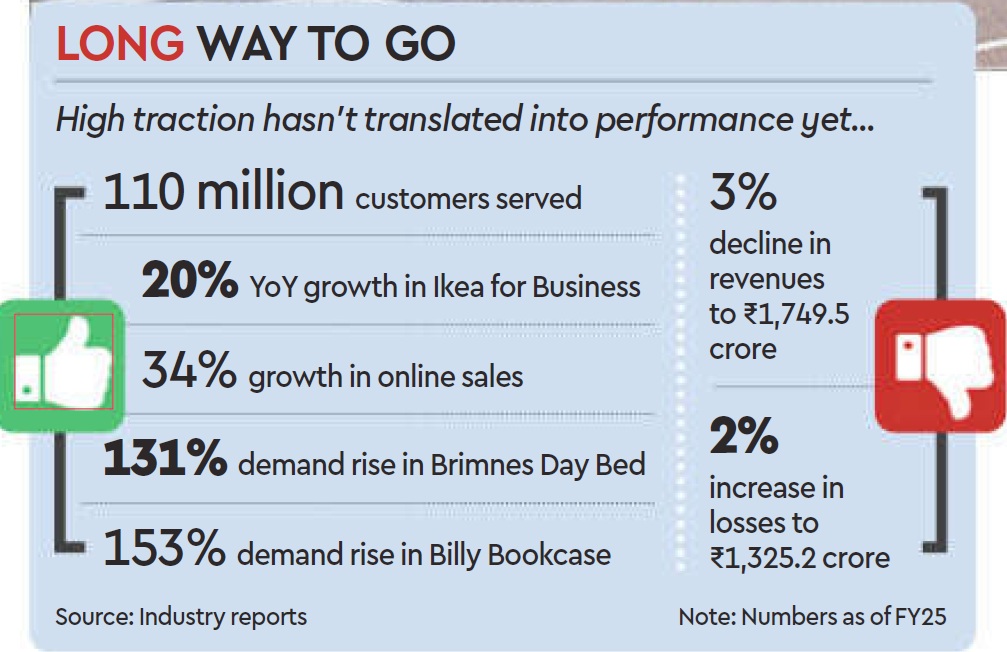
Just for context, the company’s India entity widened its losses by about 29 to 1,325.2 crore in the financial year ending March 31, 2025 (FY25). The revenue also dipped 3 to 1,749.5 crore from 1,809.8 crore in FY25.
So now the brand is taking a leaf out of its China playbook and tweaking its retail formats. Starting last year, it started piloting smaller store sizes ranging from 15,000-20,000 sq ft that are more cost-effective to set up and faster to integrate with its omnichannel model. “The goal is to create a simpler and more efficient shopping experience,” Ingka Group Retail Manager Tolga Oncu had said when the concept was unveiled last August.
Five months on, the furniture retailer is looking to take a step up the ladder – setting up new stores in the 50,000-70,000 sq ft range in the country, which will sit comfortably between its smaller stones (15,000-20,000 sq ft) and big box retail outlets (4 lakh sq ft), Adosh Sharma, country commercial manager at Ikea India told FE recently. Ikea’s broader plan also includes doubling its investments in the country to over 20,000 crore ($2.2 billion) over the next five years and improving local sourcing.
Will all this help the retailer grab a larger share of the highly fragmented furniture and furnishing market in the country? Will the brand achieve profitability in the next two years in keeping with its plans?
Ikea realises copy-pasting its global retail strategy in India is not going to work. That explains its recent moves to tweak store sizes and product design. Over and above the regular 5-M-L strategy, the fourth format the brand is developing comprises no-frills planning and order points, focused on customers who want to design homes or seek complex solutions without distraction.
“Smaller stores, which fulfill purpose-led needs will help them to get closer to their customers,” says Devangshu Dutta, founder & CEO, Third Eyesight.
The furniture and home decor segment has been up against slow purchase cycles in India. Smaller sized stores that are closer to residential arras might help step up the frequency of purchases. “Players are moving towards a higher purchase frequency strategy and smaller stores will help lkea cash in on this opportunity,” says Kushal Bhatnagar, associate partner, Redseer Consultant Strategy. He says quick commerce has helped improve the purchase cycle in the home decor space, and that is something Ikea will likely tap going forwand.
Dutta says Ikea has taken a long-term view on India and the investments in the pipeline is an indication of the opportunity that awaits players.
The brand claims it has served close to 110 million customers in FY25 across channels, and online sales are growing 34% compared to the previous fiscal. While furniture contributed the lion’s share of its revenue, the food business contributed 100% and Ikea for Business (tailored solutions for businesses) another 19% to its topline.
(Published in Financial Express)
admin
February 14, 2026

This episode of theUpStreamlife is a freewheeling conversation between Vishal Krishna and Devangshu Dutta, founder of Third Eyesight, with insights into the growth of modern retail and consumption in India, brand building and M&A, the balance of power between brands and retailers/platforms, sustainability vs growth and many other aspects, and is well-suited for founders and teams who want to be building for the long run in India.
admin
June 7, 2025

Pooja Yadav, Inc42
7 Jun 2025
SUMMARY: Nearly two decades after its founding, Myntra has made its first international foray with the launch of‘Myntra Global’ in Singapore. Armed with 100+ Indian brands and over 35,000 styles, it is betting big on the 6.5 Lakh-strong Indian diaspora. Shipping directly from India without local warehousing helps avoid upfront costs but could lead to expensive shipping, long delivery times, and tough return logistics.
Nearly two decades after its incorporation in 2007, Myntra announced last month that it marked its first international foray under the new ‘Myntra Global’ banner. The fashion ecommerce marketplace has launched its operations in Singapore.
The Flipkart-owned platform aims to leverage brand loyalty to drive cross-border commerce by tapping into the Indian diaspora of around 6.5 Lakh people in the island nation.
However, while the brand’s intent is clear, the timing and choice of market raise some concerns. For starters, Singapore isn’t going to be an easy market, especially for a newbie like Myntra. This is because the region is filled to the brim with players like Shopee, Shein, Lazada, and Zalora that enjoy a strong brand recognition and stickiness.
Then, experts believe, Singapore-based shoppers are highly selective, constantly seeking great deals and ahead of the rapidly evolving fashion trends. This, among other factors, could make Myntra’s Singapore entry arduous.
So, what makes industry observers say so? Why isn’t Singapore a promising market for Myntra to begin with? What are the stakes at play here — the hits and the misses? Let’s get right into these questions to make sense of Myntra’s Singapore foray.
A Strategic Experiment?
Myntra’s entry into Singapore isn’t just about going global, it’s a strategic experiment to understand how Indian fashion resonates beyond borders.
According to CEO Nandita Sinha, the core of this launch is Myntra’s attempt to test the waters and understand the product-market fit for Indian fashion in an overseas setting.
But why Singapore? Well, the choice was driven by data. Myntra has found that about 10–15% of its web traffic comes from international markets, and Singapore stands out as a concentrated and engaged segment.
According to Statista (2024), approximately 6.5 Lakh Indians reside in Singapore, with around 3 Lakh Persons of Indian Origin (PIOs). Sinha pointed out, “While analysing our data and exploring potential market opportunities, we discovered that nearly 30,000 of these users are visiting our platform every month.”
This organic interest gave the company confidence to make Singapore its first stop under the Myntra Global banner. The platform has gone live in Singapore with 35,000+ styles, which it now plans to scale up to 1 Lakh in the near future.
However, what’s interesting is that Myntra is betting big on desi styles and brands to cater to the Indian diaspora in Singapore. The platform has launched a curated lineup of over 100 Indian brands, including popular names like Aurelia, Global Desi, AND, Libas, Rustorange, Mochi, W, The Label Life, House of Pataudi, Chumbak, Anouk, Bombay Dyeing, and Rare Rabbit.
Whether it’s ethnic wear, fusion fashion, or home décor, the idea is to spotlight Indian design and craftsmanship. Not to mention, Myntra sees significant potential for cultural occasions such as festivals, weddings and special celebrations.
As per Devangshu Dutta, the founder and chief executive of Third Eyesight, Singapore is an ideal market for Myntra’s international test run due to several reasons. For one, it is a digitally advanced, high-income market with a significant Indian diaspora that is familiar with the brands Myntra offers.
“This makes it a natural nucleus for testing an out-of-India offering,” Dutta said, adding that Singapore’s relatively small size makes it easier to manage the complexities of merchandising across different segments, potentially making it a more efficient testing ground.
Moreover, if the business succeeds, Singapore could serve as a strategic launchpad for Myntra to expand into other Southeast Asian markets. However, for now, Myntra’s Singapore launch is less about scale and more about learning.
Ankur Bisen, senior partner and head at Technopak Advisors, said that Myntra’s recent expansion makes strong strategic sense. This is because it is no longer an Indian company, and expanding to Singapore and Southeast Asia offers significant scale and growth opportunities.
“Unlike a purely Indian company, Myntra can explore multiple markets simultaneously and is not restricted to focussing solely on India,” Bisen said.
However, not everything is rainbows and sunshine, as Myntra’s success will only hinge on pricing, local adaptation, and understanding the distinct preferences of the Indian diaspora in Singapore that may be different from Indian buyers. In simple terms, one size may not fit all.
Then, shipping delays and high logistics costs could dilute the value proposition, especially in a market like Singapore where consumers are used to fast and affordable service.
Imperative to mention that Myntra currently has no plans to set up a warehouse in Singapore. Myntra CEO Sinha mentioned that products would be shipped directly from India, where the inventory will be maintained by the brands themselves.
“Myntra Global was not intended to be a localised service tailored to the Singapore market or any other international location. Instead, the focus would remain on serving global consumers from India, with no immediate plans for physical expansion or local warehousing.”
What Could Go Wrong?
Expanding into a new market is always a risky affair. Some potential pitfalls for Myntra could be logistics complexities, return management, and supply chain localisation.
Yash Dholakia, partner, Sauce.vc, too, pointed out that execution risks extend beyond pricing and scale to include logistics, returns, and supply chain.
Dholakia added that Singapore is a different ballgame altogether, as its distinct retail landscape is not an easy feat. “The fashion industry’s fast-changing nature calls for a sharp understanding of Singapore’s diverse, millennial consumers, who have unique cultural preferences and social media-driven buying habits.”
Moreover, many second- or third-generation PIOs see themselves mainly as Singaporean and have different cultural and fashion preferences.
Therefore, assumptions that what works in India will work for this class of consumers may lead to failure.
To hedge this, Myntra will have to take a fully local approach, which will include setting up independent teams on the ground to understand and address these local differences, rather than just copying and pasting its India playbook.
Moreover, from a branding and market reach perspective, targeting just the 10–15% Indian diaspora in Singapore restricts Myntra’s audience significantly. The fashion market in the city-state is already competitive, with several efficient players offering fast and affordable options.
“Myntra’s edge would primarily be Indian ethnic wear, which restricts its ability to emerge as a broad-market contender,” Dholakia said.
Per Dutta, relying heavily on the Indian diaspora may provide a strong initial boost, but this may not sustain for too long.
A Launchpad For D2C Brands
This is not the first time Myntra has tried to enter an international market. In 2020, Myntra partnered with UAE-based platforms, noon and Namshi, to enter the Middle East with a few Indian brands.
However, its current expansion into Singapore looks more ambitious with a cavalry of over 100+ Indian brands.
To strengthen its footprint in Singapore, Myntra is offering free shipping across a wide range of categories, including women’s fashion, kidswear, and home essentials.
Myntra is offering products across a wide range of price buckets. In the women’s tops category, prices start as low as INR 350 with brands like Tokyo Talkies, and go up to INR 4,800 with brands like Berrylush, DressBerry, and Vishudh. Western dresses also extend up to INR 7,100. In ethnic wear, kurtas range from INR 833 to over INR 3,800, while sarees are priced between INR 1,200 and INR 18,000.
“In terms of pricing, it’s ultimately the brands themselves that determine their price positioning on the platform. As they begin listing and transacting with consumers, they will decide how they want to price their products,” said Sinha.
In addition, what could work in its favour is the opportunity to give the global audience a taste of fast-growing Indian D2C brands.
Many Indian internet-first brands haven’t had the chance to engage with global consumers before, but this expansion lets them showcase their products directly to the Indian diaspora in Singapore.
Besides, the expansion will allow Indian brands to understand new consumer preferences, optimise their product mix for cross-border demand, and grow their presence beyond India.
This pilot could indeed spark broader cross-border opportunities for Indian D2C brands. But it demands localised marketing, deep consumer understanding, and a willingness to adapt to regional preferences.
For brands used to making for Indian buyers, this could be a steep but rewarding learning curve. If executed well, it offers them not just an entry into Singapore but a scalable template for global expansion.
The Cross-Border Gamble
Myntra’s global play comes at a time when the ecommerce platform posted a net profit of INR 30.9 Cr in FY24 versus a loss of INR 782.4 Cr in FY23. This turnaround came on the back of a 15% increase in its operational revenue and tighter cost control.
The platform generates revenue through a mix of transaction fees from sellers, logistics services, advertising, and its private labels. To move towards profitability, Myntra brought down its total expenses to INR 5,123 Cr in FY24 from INR 5,290.1 Cr in FY23.
However, its recent entry into Singapore may bring new financial challenges, even as Myntra has opted not to set up a warehouse in Singapore. It would rather ship products from India through third-party logistics providers.
So, is the fashion major being penny-wise and pound-foolish?
Probably. While this asset-light model avoids upfront capital expenditure, it introduces risks such as longer delivery times, higher logistics costs, customs delays and complicated return processes that could sour customer sentiment. For a platform that just turned profitable, these are crucial levers that could strain margins.
Further, even though Myntra is not offering exchange and returns currently, once it does, it could complicate things further.
This is because shipping a 2 Kg fashion parcel from India to Singapore costs an estimated INR 2,800 to INR 3,500, inclusive of air freight, GST, and last-mile delivery. Reverse logistics could add another INR 1,200 to INR 2,000 per item, pushing the total cost per cross-border order significantly higher.
According to Dibyanshu Tripathi, cofounder and CEO of Hexalog, a logistics company, cross-border logistics could significantly impact Myntra’s profitability as it expands into Southeast Asia.
“Sustaining margins will be challenging with high per-order shipping costs, return expenses, and longer delivery timelines that may affect customer satisfaction. Without localised infrastructure or cost efficiencies, profitability in new markets may be hard to maintain despite revenue growth,” Tripathi said.
In contrast, players such as Lenskart and Nike have structured their global expansions with supply chain control at the core.
All in all, Myntra’s Singapore foray is a bold experiment aimed at testing global appetite for Indian fashion, especially among the diaspora.
While the move offers promising opportunities for Indian D2C brands and cross-border growth, it’s also fraught with challenges. For one, with a lack of local infrastructure, high shipping costs and a diaspora divided between two cultures, sustaining this expansion may prove tough. Can Myntra turn its Singapore pitch into a lasting global success story?
(Published on Inc42)
admin
May 23, 2025

By Kunal Purohit and Ananya Bhattacharya, Rest of World
Mumbai, India, 23 May 2025
Online retail continues to elude India’s richest man.
The Shein India app, launched by Mukesh Ambani’s Reliance Retail in partnership with the Chinese fast-fashion giant, has struggled to gain traction in a market where Amazon and Walmart have been fighting neck-to-neck for nearly a decade. Downloads for Shein India nosedived from 50,000 a day shortly after its launch in early February to 3,311 in early April, according to AppMagic, a U.S.-based app performance tracker.
In April, when U.S. tariffs hit China, the app saw renewed interest as it was in the news, but experts are unclear on whether this growth is sustainable.
“Unlike earlier times, now … [the] market is saturated with multiple options and offers, and user interest can quickly dwindle,” Yugal Joshi, partner at global research firm Everest Group, told Rest of World.
Kushal Bhatnagar of Indian consulting firm Redseer, however, sees the late-April spike as a healthy sign, given that Reliance has yet to run paid marketing campaigns for Shein.
Reliance Retail declined to respond to Rest of World’s queries about its partnership with Shein.
Reliance launched Shein for India five years after the original Shein app was banned in the country over border tensions with China. But the Shein that has returned is entirely separate from Shein’s global platform: Rather than selling made-in-China clothes and accessories directly to consumers, Shein now operates as a technology partner, while Reliance Retail handles the heavy lifting — from sourcing and manufacturing to distribution. All consumer data is managed by the Indian company.
The partnership is part of Ambani’s broader effort to overhaul his retail business, whose valuation fell to $50 billion in 2025 from $125 billion in 2022. Although the company has made a push into digital platforms like JioMart, Ajio, and most recently Shein India, the bulk of its retail revenue still comes from its 18,000 physical stores.
Lagging behind Amazon and Walmart-backed Flipkart, which together control nearly 60% of India’s e-commerce market, Reliance has spent years trying to break into the sector. Between 2020 and 2025, Ambani’s group acquired majority stakes in companies spanning digital services, online pharmaceuticals, and quick commerce. But the investments have yet to position Reliance as a serious challenger to Amazon and Flipkart.
Analysts say the Indian behemoth hopes to leverage Shein’s artificial intelligence-powered trendspotting and automated inventory systems to pursue an ambitious goal: capturing a major share of India’s e-commerce market, projected to hit $345 billion by 2030.
According to Kaustav Sengupta, director of insights at VisionNxt, an Indian government-funded initiative that uses AI to forecast fashion trends, such a model is likely to make good use of Reliance’s humongous customer data sets: more than 476 million subscribers for its Jio telecom brand, 300 million users for e-commerce platform JioMart, and 452 million subscribers for its news and entertainment portfolio, consisting of 63 channels, a streaming service, and digital news outlets.
“With these data points, Reliance wants to now sell fashion products, so all it needs is a system where it can feed all these data points,” Sengupta told Rest of World. He said the model would be able to predict best-selling products and suggest the right prices for them.
The original Shein app uses AI-driven models for intelligent warehousing and to spot customer trends before manufacturing a new product. It scales the manufacturing up or tweaks the designs based on the feedback. At any given time, the Shein website has a catalogue of more than 600,000 items. Its Indian iteration does not match up, according to reviews on the Google Play store. Several customer reviews for Reliance’s Shein app are critical of higher prices and reduced options. The app’s rating hovered at 2 out of 5 until February; in May, it climbed to 4.4, but reviews were still a mixed bag.
Reviews of the Indian app highlight the disparity with Shein’s global version, criticizing higher prices and a reduced selection of categories and styles.
As of April 25, Reliance Retail said only 12,000 products were live on Shein India, a stark contrast to the 600,000 items available on Shein’s global platforms. While Shein is reportedly set to debut on the London Stock Exchange this year, Ambani’s years-old promise to take Reliance Retail public remains unfulfilled.
Reliance Retail, which accounts for around 30% of the conglomerate’s overall business, is facing a slowdown in annual growth. Its sales rose just 7.9% in the fiscal year ending March 2025, down from 17.8% the previous year. Meanwhile, shares of rival Tata Group’s retail and fashion arm, Trent, have soared by 133%.
“Reliance would have looked at reviving that momentum and riding on it, while for Shein, adding India back on its portfolio of markets could be a plus point before its proposed public listing,” Devangshu Dutta, founder of Third Eyesight, a brand management consultancy that has worked with various global e-commerce brands including Ikea, told Rest of World.
A Reliance Retail official privy to information about its fast fashion expansion plans told Rest of World the partnership with Shein also hinges on global manufacturing ambitions as the Chinese company is trying to “source its products from other countries like India” to meet the “additional demand that is coming from newer markets.” Reliance Retail has tapped a network of small and midsize Indian manufacturers to locally source products, and its subsidiary Nextgen Fast Fashion Limited is leading the charge. “We need to first scale up our domestic manufacturing, before our partnership starts manufacturing for global markets. Let us see how that goes, first,” the official said, requesting anonymity as he is not authorized to share this information publicly.

India’s Gen Z population is at 377 million and counting, and their spending power is set to surpass $2 trillion by 2035, according to a 2024 report by Boston Consulting Group. Every fast-fashion retailer wants to capture this market, but it “is very new even for Reliance,” Rimjim Deka, founder of Indian fast-fashion platform Littlebox, told Rest of World.
Deka said smaller brands like hers “just see [a trend] and implement it,” which could take a large conglomerate months to do, by which time the trend may have lost relevance.
Reliance’s previous attempts to attract young shoppers with clothing brands like Foundry and Yousta failed to find much success. Anandita Bhuyan, who works in trend forecasting and product creation for fast-fashion clients like H&M and Myntra, told Rest of World the company has struggled to effectively leverage consumer data and target India’s youth.
According to the Reliance Retail official, the company is confident that if “there are 10 existing brands, the 11th brand will also get picked up as long as there is value and there is fashion.”
“Shein already has a recall among the youth. It gives us yet another brand in our portfolio through which we can cater to the youth,” the official said.
Shein was built in China on the back of more than 5,400 micro manufacturers — a scattered and loosely organized network of small and midsize factories.
In January this year, on a visit to China, Deka met with manufacturers working for Shein and Temu. On the outskirts of Guangzhou, Deka saw factories set up in areas that appeared residential, with “women sitting inside houses” making clothes.
“The tech is built in a way that somebody sitting there is able to see that, okay, next 15 days or next one month, how much I should be making … that is the kind of integration they have done,” Deka said.
Deka told Rest of World this model is easier to replicate at a smaller scale. “Me, coming from [the] supply chain industry, I understand that it is much easier for a brand like us because we are at a very smaller scale. We can still go to those people, we can still build it in a very unorganized way and then pull it off,” she said. Her company’s annual net revenue is 750 million Indian rupees ($8.6 million).
“[But] somebody like Reliance, they just cannot go haphazard here. … It has to be always organized,” Deka said.
Shein moved its headquarters to Singapore sometime between late 2021 and early 2022, a strategic departure to distance itself from its Chinese origins and facilitate hassle-free international expansion amid the U.S.-China trade war.
India is part of Shein’s wider strategy to diversify its supply chain — one that also includes a newly leased warehouse near Ho Chi Minh City in Vietnam, and efforts to establish alternative manufacturing hubs in Brazil and Turkey.
But in India, Reliance needs Shein as much as Shein needs Reliance for its global pivot. According to Bloomberg, Reliance Retail is focusing on creating leaner operations to weather a wider consumption slump in the Indian economy.
“It remains to be seen whether the Reliance-Shein combine can deliver on the brand’s promise with a wide range of products, fast and on-trend,” Dutta said. “In the years that Shein has been absent, the Indian market has evolved further, competition has intensified, and past goodwill is not enough to provide sales momentum.”
Kunal Purohit is a freelance journalist based in Mumbai, India.
Ananya Bhattacharya is a reporter for Rest of World covering South Asia’s tech scene. She is based in Mumbai, India.
(Published in Rest of World)
admin
February 23, 2025

Chitra Narayanan, BusinessLine
New Delhi, 23 February 2025
India’s formidable array of craft traditions got full play at the just concluded Bharat Tex 2025, the mega textile trade show in New Delhi that showcased the best of Indian weaves to the world. But if there was one theme that dominated this year’s textile extravaganza, aimed at generating more exports, it was the focus on zero-waste fashions and upcycling. Everywhere the eye could see were standees and gigantic posters pushing the message of conscious consumption and sustainability — be it regenerative cotton, innovative models of textile waste collection, or eco-friendly fibres.
Taking centre stage at one of the halls at Bharat Mandapam, the venue, was a section that showcased age-old traditional arts like rafugari (creative darning or artistic mending), patchwork quilts and toys, and chindi durries (the art of weaving rugs and carpets with waste).
Juxtaposed against these ethnic ways of upcycling waste were the modern works of startups that rose to the textile ministry’s grand innovation challenge to work with discarded materials. From microbial dyes that are non-polluting to flowing fashionable lehengas created out of textile waste, the startups showed that a lot can be done in this area. The ministry had challenges in three more segments — jute, silk and wool.
Some takeaways from a walk-through of the textile trade show:
Closing the loop
The fashion and textile industry generates enormous waste. How to cut down on this was a subject of much deliberation and showcases. There were a lot of good ideas on display, showing that a fair amount of work has been done with fibres (bamboo, banana, flax), as well as creativity and ingenuity in weaves and finished garments.
As Devangshu Dutta, Chief Executive of the consultancy Third Eyesight, points out, due credit must be given for the good work going into generating solutions that will reduce waste, be it textiles that are reprocessed and reused as yarn, or refashioned garments or reloved apparel. But, as he adds, on the other hand we have brands that are constantly looking to grow their business and there is a race to the bottom in terms of price. The relaunch of fast fashion retailer Shein in India is sending conflicting signals. “The basic engine is pumping out more and more products, and that has to be tackled,” he says, pointing to the competing forces at work.
The source of hope, he says, is the fact that the young are a bit more conservative about how they consume and what they consume.
Sandip Ghose, CEO of MP Birla Group, which has one of the oldest jute companies in India, was among the visitors at Bharat Tex. “As an industry insider, what I found good at Bharat Tex was that quite a bit of research seems to be on, both for finished fabric and for weaving. There was a lot of work on making jute look aesthetic. There were some vanity projects like tea leaves packed in jute bags. But the challenge is in two areas — commercialisation, and scaling up of these ideas,” he says.
He rues that the jute sector has not taken advantage of the production-linked incentive scheme at a time when the world is looking for eco-friendly and biodegradable textiles. “A tripartite partnership between the Centre (Niti Aayog and textile ministry), State government, and industry would address the issue of industry’s dependence on subsidies, labour issues and exports,” he says, adding that if India is looking at textiles as a major export area, jute is an option that has been missed.
Spinning into luxury
A clear trend evident from a tour of some of the apparel and home textile pavilions is the move towards premiumisation, similar to what is visible in other sectors, noticeably FMCG.
Talking to the manufacturers, especially those focused on the domestic market, the story one heard was that consumption had slowed in the mass segment, but was reassuringly strong in the premium segment.
Several players were also moving into the luxury and uber luxury segments. Both myTrident and Welspun had striking luxury collections.
Another trend visible in the home textiles section was the use of celebrity designers — myTrident’s eye-catching collection by resort-wear designers Shivan-Narresh; and Welspun’s beautiful sets from Kate Shand and Payal Singhal.
“When the economy suffers, it is the poor and middle class who cut down. There is no pressure to reduce consumption at the upper levels, and companies will try to tap into demand that is recession-proof,” says Dutta, explaining the push towards luxury by textile manufacturers.
New trade routes?
Export houses seemed reasonably happy with the buyer interest. Some mentioned that it was interesting to see buyers from Russia at the fair. However, for those supplying to US entities and Western Europe, the buyer interest from Russia may not translate into deals, given the risk of sanctions they could face.
To sum up, it was a fairly good showcase of India’s textile prowess to the world, but whether it will ring in more export orders is debatable as many of the problems and challenges the sector faces were swept under the carpet.
(Published in BusinessLine)
