
admin
January 24, 2022
Written By Devika Singh
The entry of Jubilant FoodWorks will intensify competition in the fried chicken segment, where KFC so far has maintained its stronghold.

Popeyes, founded in 1972 in New Orleans, Louisiana, has over 3,400 restaurants in over 25 countries around the world. Popeyes (Wikimedia Commons)
Jubilant FoodWorks, the franchisee for Domino’s Pizza, will launch the iconic US-based fried chicken brand Popeyes, known for spicy New Orleans-style fried chicken and chicken sandwiches, in India on January 19 with the unveiling of the first outlet in Bengaluru.
“Popeyes was founded in 1972 and has been one of America’s most popular and fastest-growing chicken brands. Popeyes aims to delight Indian guests with the bold and delicious flavours of its Louisiana-style chicken,” the company said in a filing to stock exchanges.
“The success of the brand lies in its traditional and unique technique of hand breading, battering, and marinating its fresh chicken for 12 hours in bold Cajun seasonings,” the company added.
Popeyes runs over 3,400 restaurants in 25 countries.
With the entry of Jubilant FoodWorks, the competition is set to intensify in the fried chicken segment, where KFC has maintained leadership in the country so far.
“KFC has enjoyed a free run in the fried chicken market. There are some local players in this segment but no large QSR (quick service restaurant) player had a presence in it until now. With Popeyes as a competitor, now Jubilant FoodWorks is stepping into that opportunity,” said Devangshu Dutta, chief executive at consulting firm Third Eyesight.
While launching its initial public offering (IPO) last year, Devyani International, the largest franchisee of Yum! Brands (which owns KFC), had stressed the advantage it has over other QSRs in the country.
“We have no competition for KFC in India,” Ravi Kant Jaipuria, chairman, Devyani International, had said at the time. Devyani International runs 284 KFC India stores across 107 cities and the brand contributes more than half of its revenues. Sapphire Foods, which too launched its IPO last year, is another major franchise for KFC in India.
Both the companies already compete with Jubilant FoodWorks in the pizza segment as they also operate Yum! Brands-owned Pizza Hut in India. Jubilant FoodWorks with Domino’s Pizza, however, has clear leadership in the pizza market. Sample this: Pizza Hut currently has 500 stores in India, of which 317 are run by Devyani International; Jubilant FoodWorks, on the other hand, already has 1,335 outlets of Domino’s Pizza in India.
Now with the launch of Popeyes, Jubilant FoodWorks, it seems, wants a chunk of the fried chicken pie too.
Westlife Development, which holds the master franchise for McDonald’s in southern and western India, also has set its sight on the fried chicken segment in India. In an interview with Moneycontrol in September last year, Smita Jatia, managing director of Westlife Development, shared an ambitious plan to become a market leader in the segment. The company has already introduced fried chicken in its 125 stores in South India and plans to soon launch the food item in the western region too.
Clearly, the fried chicken market is certainly headed for interesting times as several new QSR players vie for a share of it. According to experts, the segment also offers the next avenue for growth for QSR players. “While fried chicken was the first to take off in Southeast Asia, in India, pizza and burgers found takers given the preference towards wheat-based cuisine in some parts of the country,” said Rajat Tuli, partner at global management consulting firm Kearney.
“However, as Indians become more experimental with food and trying out different cuisines, the fried chicken segment offers the next arena for growth to QSR companies,” he added.
Tuli also believes that the segment has enough space for a couple of players. “The QSR space is poised for over 20 percent growth in the next five-six years and hence there is enough headroom for multiple players to grow in it,” he said.
‘Veg options and no MSG’
The Popeyes India menu will feature the signature Cajun-flavoured Chicken Sandwich and Popeyes signature Chicken in Classic and Spicy flavours. The Indian menu will also feature an array of vegetarian options and will also have rice bowls and wraps. The entire India menu has no flavour enhancer monosodium glutamate (MSG), and the chicken is antibiotic-free, said Jubilant FoodWorks.
In a statement, Shyam S. Bhartia, chairman, and Hari S. Bhartia, co-chairman, Jubilant FoodWorks, said, “We are excited to introduce the Popeyes Louisiana Kitchen brand to chicken-loving Indian consumers. We are confident that Popeyes will not only delight guests but also strategically complement our portfolio and fortify JFL’s leadership in the QSR domain.”
Popeyes will start with its flagship store in Bengaluru’s Koramangala on January 19, followed by stores in New BEL Road and Kammanahalli soon thereafter. The brand will have its own app (Android and iOS) and mobile website.
To ensure a smooth and seamless delivery experience, Jubilant FoodWorks has built its in-house delivery fleet with e-bikes to enable zero-emission delivery. The company is also taking precautions given the pandemic situation.
“Safety protocols like daily temperature screening for all employees and frequent sanitisation of the restaurant are being implemented and frequent sanitisation of bikes will be conducted. All delivery riders will be compulsorily wearing face masks and gloves while following the frequent hand sanitisation protocol,” it added.
Source: moneycontrol
admin
June 7, 2020
Indian retailers welcoming customers back as stores are opening up – a look at what changes are in store.
Devangshu Dutta
December 27, 2016
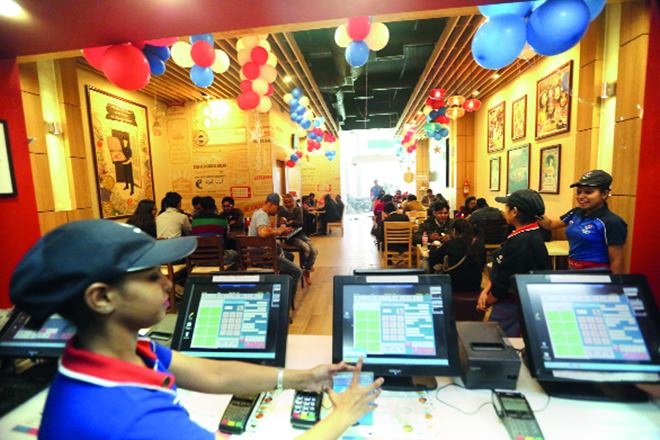
When American fast food standard bearers McDonald’s and Domino’s Pizza stepped into India in the mid-1990s, the market was just ripe enough for take-off.
McDonald’s and later Domino’s Pizza can be credited with not just growing the consumer appetite for fast food but also for fostering an entire food service ecosystem, including fresh produce, baked goods, sauces and condiments, and cold chain technology.
India has been typically difficult for business models driven by scale, replicability and predictability. The customer is price sensitive, operating costs are high and non-compliance of business standards is a frequent occurrence. In this environment, these brands have reinvented the meaning of meals, snacks and treats.
Their growth has set the stage for other international players and also set business aspirational standards for Indian food entrepreneurs and conglomerates alike.
Product experimentation has also been an important part of their success; it keeps excitement in the brand alive and help improve footfall. However, how far a product sustains and whether it becomes a menu staple can’t be predicted accurately. New products also need significant investment in both supply chain and front-of-house changes in standardisation-oriented QSRs, so the new product launch cannot be undertaken lightly. This is one reason these successful QSR formats don’t overhaul their menus drastically but make changes incrementally.
For these market leaders, future scale and deeper penetration is only feasible with higher visit frequency. For growth in middle-income India, they need to become a significantly cost-competitive option to be seen as more than a ‘treat’ or celebration destination.
So, while both McDonald’s and Domino’s Pizza have invested significantly in Indian flavours and menu offerings, perhaps it’s also best for them to reconcile with the fact that there will be a significant part of the consumer’s heart, stomach and wallet that will remain dedicated to indigenous offerings.
In a global environment that’s turning hostile to fast food, India isn’t a quick-fix growth market, but it’s certainly one to stay invested in, for the longer term.
And I have no doubt that as much as these companies aim to change India, over time India will also change them.
(Also published in Brand Wagon, The Financial Express)
Devangshu Dutta
April 24, 2016

(Published in the Financial Express, 10 May 2016)
In about 20 years, Café Coffee Day (CCD) has grown from one ‘cyber café’ in Bengaluru to the leading chain of cafés in the country by far.
In its early years, it was a conservative, almost sleepy, business. The launch of Barista in the late 1990s and its rapid growth was the wake-up call for CCD — and wake up it did!
CCD then expanded aggressively. It focussed on the young and more affluent customers. Affordability was a keystone in its strategy and it largely remains the most competitively priced among the national chains.
Its outlets ranged widely in size — and while this caused inconsistency in the brand’s image — it left competitors far behind in terms of market coverage. However, the market hasn’t stayed the same over the years and CCD now has tough competition.
CCD competes today with not only domestic cafés such as Barista or imports such as Costa and Starbucks, but also quick-service restaurants (QSRs) such as McDonald’s and Dunkin’ Donuts. In the last couple of years, in large cities, even the positioning of being a ‘hang-out place’ is threatened by a competitor as unlikely as the alcoholic beverage-focussed chain Beer Café.
CCD is certainly way ahead of other cafés in outlet numbers and visibility in over 200 cities. It has an advantage over QSRs with the focus on beverage and meetings, rather than meals. Food in CCD is mostly pre-prepared rather than in-store (unlike McD’s and Dunkin’) resulting in lower capex and training costs, as well as greater control since it’s not depending on store staff to prepare everything. However, rapid expansion stretches product and service delivery and high attrition of front-end staff is a major operational stress point. Upmarket initiatives Lounge and Square, which could improve its average billing, are still a small part of its business.
Delivery (begun in December 2015) and app-orders seem logical to capture busy consumers, and to sweat the assets invested in outlets. However, for now, I’m questioning the incremental value both for the consumer and the company’s ROI once all costs (including management time and effort) are accounted for. The delivery partner is another variable (and risk) in the customer’s experience of the brand. Increasing the density through kiosks and improving the quality of beverage dispensed could possibly do more for the brand across the board.
The biggest advantage for CCD is that India is a nascent market for cafés. The café culture has not even scratched the surface in the smaller markets and in travel-related locations. The challenge for CCD is to act as an aggressive leader in newer locations, while becoming more sophisticated in its positioning in large cities. It certainly needs to allocate capex on both fronts but larger cities need more frequent refreshment of the menu and retraining of staff.
An anonymous Turkish poet wrote: “Not the coffee, nor the coffeehouse is the longing of the soul. A friend is what the soul longs for, coffee is just the excuse.” There are still many millions of friends in India for whom the coffee-house remains unexplored territory, whom CCD could bring together.
Devangshu Dutta
January 21, 2016

Aggregator models and hyperlocal delivery, in theory, have some significant advantages over existing business models.
Unlike an inventory-based model, aggregation is asset-light, allowing rapid building of critical mass. A start-up can tap into existing infrastructure, as a bridge between existing retailers and the consumer. By tapping into fleeting consumption opportunities, the aggregator can actually drive new demand to the retailer in the short term.
A hyperlocal delivery business can concentrate on understanding the nuances of a customer group in a small geographic area and spend its management and financial resources to develop a viable presence more intensively.
However, both business models are typically constrained for margins, especially in categories such as food and grocery. As volume builds up, it’s feasible for the aggregator to transition at least part if not the entire business to an inventory-based model for improved fulfilment and better margins. By doing so the aggregator would, therefore, transition itself to being the retailer.
Customer acquisition has become very expensive over the last couple of years, with marketplaces and online retailers having driven up advertising costs – on top of that, customer stickiness is very low, which means that the platform has to spend similar amounts of money to re-acquire a large chunk of customers for each transaction.
The aggregator model also needs intensive recruitment of supply-side relationships. A key metric for an aggregator’s success is the number of local merchants it can mobilise quickly. After the initial intensive recruitment the merchants need to be equipped to use the platform optimally and also need to be able to handle the demand generated.
Most importantly, the acquisitions on both sides – merchants and customers – need to move in step as they are mutually-reinforcing. If done well, this can provide a higher stickiness with the consumer, which is a significant success outcome.
For all the attention paid to the entry and expansion of multinational retailers and nationwide ecommerce growth, retail remains predominantly a local activity. The differences among customers based on where they live or are located currently and the immediacy of their needs continue to drive diversity of shopping habits and the unpredictability of demand. Services and information based products may be delivered remotely, but with physical products local retailers do still have a better chance of servicing the consumer.
What has been missing on the part of local vendors is the ability to use web technologies to provide access to their customers at a time and in a way that is convenient for the customers. Also, importantly, their visibility and the ability to attract customer footfall has been negatively affected by ecommerce in the last 2 years. With penetration of mobile internet across a variety of income segments, conditions are today far more conducive for highly localised and aggregation-oriented services. So a hyperlocal platform that focusses on creating better visibility for small businesses, and connecting them with customers who have a need for their products and services, is an opportunity that is begging to be addressed.
It is likely that each locality will end up having two strong players: a market leader and a follower. For a hyperlocal to fit into either role, it is critical to rapidly create viability in each location it targets, and – in order to build overall scale and continued attractiveness for investors – quickly move on to replicate the model in another location, and then another. They can become potential acquisition targets for larger ecommerce companies, which could acquire to not only take out potential competition but also to imbibe the learnings and capabilities needed to deal with demand microcosms.
High stake bets are being placed on this table – and some being lost with business closures – but the game is far from being played out yet.
