
admin
July 20, 2026
Kartikay Kashyap, Financial Express / Brandwagon
30 July 2026
Wendy’s first foray into India’s quick service restaurant (QSR) market in 2015 remained a non-starter. Sierra Nevada Restaurants, the then master franchisee, could not scale its retail presence beyond four conventional restaurants concentrated largely in Delhi-NCR. This limited physical availability, brand awareness and ordering frequency.
Ten years on and under a new master franchisee Rebel Foods since 2023, Wendy’s seems to have turned over a new leaf. With more than 250 stores, and ₹200 crore in revenues, the brand wants to be the one-stop destination for the younger generation where consumers come together to celebrate food, music and a sense of community. “The longer-term ambition is to expand to approximately 500 locations by 2028 through a combination of delivery kitchens and physical restaurants,” says Joy Bamania, brand head, Wendy’s India.
As a first step, Rebel Foods recently opened what it calls its “dynamic cultural flagship store” in Delhi’s vibrant student hub of Hudson Lane, GTB Nagar. The two-level youth-centric space blends food, music and anime, offering fans experiences like live rap battles, meet-and-greets, and specialised menu items like the signature Teriyaki Burger range.
“It has been designed to be livelier, more youthful and visually engaging—an Instagram-worthy space. It is a physical expression of how we want consumers to experience Wendy’s in India: bold, fun, culturally relevant and full of energy,” says Bamania.
Even before taking over Wendy’s operations Rebel Foods had been managing its delivery-only cloud kitchens since 2020 and was familiar with the brand’s DNA and what was required to mount a serious challenge in the ₹15,000-plus crore organised burger restaurants market in the country. The low capex delivery-only model has helped to improve its gross margins, but taking on established brands like McDonalds, KFC and Burger King would be a completely new ball game.
Is the latecomer up to a second bout in the ring?
New, improved
Wendy’s has at least three things going against it. It arrived late on India’s shores and couldn’t really stand apart during its last outing. “No matter how big a global brand you are, you need to stand out in the clutter,” says Devangshu Dutta, founder & CEO, Third Eyesight.
So while McDonald’s is the kid-first family restaurant, Burger King is intentionally “imperfect” and rides on humour, pop-culture moments, and viral marketing. Wendy’s, say experts, had no differentiation than just being a global brand.
Its premium pricing was another bugbear. In its first foray, Wendy’s tried to justify its higher prices saying its ingredients were better than that offered by the rest of the pack. So while the price of a Wendy’s entry level burger was ₹100, McDonald’s retailed one at half that price. “In the QSR business, you have to get your price right. There is nothing ‘premium’ in that space,” says Ankur Bisen, senior partner, The Knowledge Company. Rebel Foods addressed these problems with four fundamental shifts.
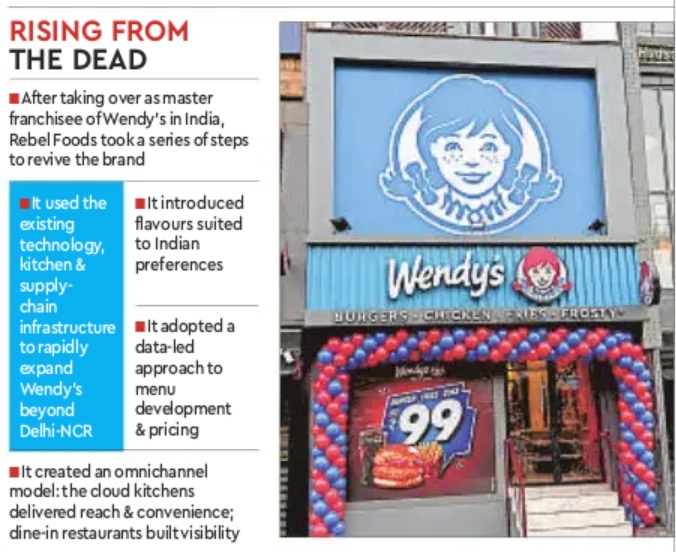
First, it used the existing technology, kitchen and supply-chain infrastructure to rapidly expand Wendy’s beyond Delhi-NCR. Second, it built a stronger and more accessible value architecture while introducing flavours suited to Indian preferences. Third, it created an omnichannel model in which cloud kitchens delivered reach and convenience, while selected dine-in restaurants built visibility and deeper brand experiences. Finally, it adopted a data-led approach to menu development, pricing, consumer feedback and operational performance.
Rebel Foods became Wendy’s master franchisee in India in 2023. At that stage, Wendy’s had approximately 90 locations across 19 cities. By March 2025, the brand had reached 200 locations across more than 50 cities, including 15 dine-in restaurants.
“The fivefold revenue growth has consequently not come from one product or campaign. It is the result of wider distribution, sharper value, continuous menu innovation, stronger operational execution and a much clearer proposition for the Indian consumer,” says Bamania.
(Published in Financial Express)
admin
January 24, 2022
Written By Devika Singh
The entry of Jubilant FoodWorks will intensify competition in the fried chicken segment, where KFC so far has maintained its stronghold.

Popeyes, founded in 1972 in New Orleans, Louisiana, has over 3,400 restaurants in over 25 countries around the world. Popeyes (Wikimedia Commons)
Jubilant FoodWorks, the franchisee for Domino’s Pizza, will launch the iconic US-based fried chicken brand Popeyes, known for spicy New Orleans-style fried chicken and chicken sandwiches, in India on January 19 with the unveiling of the first outlet in Bengaluru.
“Popeyes was founded in 1972 and has been one of America’s most popular and fastest-growing chicken brands. Popeyes aims to delight Indian guests with the bold and delicious flavours of its Louisiana-style chicken,” the company said in a filing to stock exchanges.
“The success of the brand lies in its traditional and unique technique of hand breading, battering, and marinating its fresh chicken for 12 hours in bold Cajun seasonings,” the company added.
Popeyes runs over 3,400 restaurants in 25 countries.
With the entry of Jubilant FoodWorks, the competition is set to intensify in the fried chicken segment, where KFC has maintained leadership in the country so far.
“KFC has enjoyed a free run in the fried chicken market. There are some local players in this segment but no large QSR (quick service restaurant) player had a presence in it until now. With Popeyes as a competitor, now Jubilant FoodWorks is stepping into that opportunity,” said Devangshu Dutta, chief executive at consulting firm Third Eyesight.
While launching its initial public offering (IPO) last year, Devyani International, the largest franchisee of Yum! Brands (which owns KFC), had stressed the advantage it has over other QSRs in the country.
“We have no competition for KFC in India,” Ravi Kant Jaipuria, chairman, Devyani International, had said at the time. Devyani International runs 284 KFC India stores across 107 cities and the brand contributes more than half of its revenues. Sapphire Foods, which too launched its IPO last year, is another major franchise for KFC in India.
Both the companies already compete with Jubilant FoodWorks in the pizza segment as they also operate Yum! Brands-owned Pizza Hut in India. Jubilant FoodWorks with Domino’s Pizza, however, has clear leadership in the pizza market. Sample this: Pizza Hut currently has 500 stores in India, of which 317 are run by Devyani International; Jubilant FoodWorks, on the other hand, already has 1,335 outlets of Domino’s Pizza in India.
Now with the launch of Popeyes, Jubilant FoodWorks, it seems, wants a chunk of the fried chicken pie too.
Westlife Development, which holds the master franchise for McDonald’s in southern and western India, also has set its sight on the fried chicken segment in India. In an interview with Moneycontrol in September last year, Smita Jatia, managing director of Westlife Development, shared an ambitious plan to become a market leader in the segment. The company has already introduced fried chicken in its 125 stores in South India and plans to soon launch the food item in the western region too.
Clearly, the fried chicken market is certainly headed for interesting times as several new QSR players vie for a share of it. According to experts, the segment also offers the next avenue for growth for QSR players. “While fried chicken was the first to take off in Southeast Asia, in India, pizza and burgers found takers given the preference towards wheat-based cuisine in some parts of the country,” said Rajat Tuli, partner at global management consulting firm Kearney.
“However, as Indians become more experimental with food and trying out different cuisines, the fried chicken segment offers the next arena for growth to QSR companies,” he added.
Tuli also believes that the segment has enough space for a couple of players. “The QSR space is poised for over 20 percent growth in the next five-six years and hence there is enough headroom for multiple players to grow in it,” he said.
‘Veg options and no MSG’
The Popeyes India menu will feature the signature Cajun-flavoured Chicken Sandwich and Popeyes signature Chicken in Classic and Spicy flavours. The Indian menu will also feature an array of vegetarian options and will also have rice bowls and wraps. The entire India menu has no flavour enhancer monosodium glutamate (MSG), and the chicken is antibiotic-free, said Jubilant FoodWorks.
In a statement, Shyam S. Bhartia, chairman, and Hari S. Bhartia, co-chairman, Jubilant FoodWorks, said, “We are excited to introduce the Popeyes Louisiana Kitchen brand to chicken-loving Indian consumers. We are confident that Popeyes will not only delight guests but also strategically complement our portfolio and fortify JFL’s leadership in the QSR domain.”
Popeyes will start with its flagship store in Bengaluru’s Koramangala on January 19, followed by stores in New BEL Road and Kammanahalli soon thereafter. The brand will have its own app (Android and iOS) and mobile website.
To ensure a smooth and seamless delivery experience, Jubilant FoodWorks has built its in-house delivery fleet with e-bikes to enable zero-emission delivery. The company is also taking precautions given the pandemic situation.
“Safety protocols like daily temperature screening for all employees and frequent sanitisation of the restaurant are being implemented and frequent sanitisation of bikes will be conducted. All delivery riders will be compulsorily wearing face masks and gloves while following the frequent hand sanitisation protocol,” it added.
Source: moneycontrol
admin
January 17, 2012
Global quick-service restaurant brands are expanding their footprint in the quickly evolving Indian market. But some are also falling by the wayside.
Here are some perspectives from the industry (ET Now telecast video – about 6 minutes):
