
admin
February 9, 2017
This is a recording of a short, candid talk by Devangshu Dutta (chief executive, Third Eyesight) at the ASSOCHAM’s 8th Global Food Processing Summit in New Delhi, India.
He touched upon the inherent conflicts in the food supply chain we need to be aware of before formulating policies and practices, and strongly urged everyone to look at food security from the point of view of sustainability and risk-management. (Transcript below.)
TRANSCRIPT:
I’ll just take just few minutes to share a few thoughts with you on the sector.
The session was titled “Make in India: Platform for investment opportunity in food processing sector and 100 percent FDI in food retail”.
As we all know, whoever’s been following the news, there’s all this buzz around FDI into retail being allowed, not only for physical retail but also for e-commerce companies, and there are two very strong sets of drivers. On the one hand is the likes of Walmart and Tesco and people who want to actually set up food retail. and you know food is the largest consumption in our basket of consumer products, so they obviously want to tap into that demand. The second side is Amazon and the likes of it where again you know there are no barriers in terms of location, you are buying on the net, tapping into a consumer who’s looking for convenience, and there you need to actually service that demand with food and grocery which is packaged, so there is obviously a very strong push a very strong lobby for that to happen. At the same time there’s a very strong lobby against that because there are domestic retailers who invested a lot of money over the last maybe 10-15 years in setting up a lot of retail stores. In the recent years there have been a few e-commerce companies that have come up as well with domestic and foreign capital. So there is this conflict.
In this whole ecosystem of food production and supply and retail there are some fundamental conflicts that we need to be aware of, before we get into any kind of thinking about what should be done with the sector.
First of all is foreign vs. Indian; this is a conflict which is there the world over, and I think we will see that increase in Europe, in the US, and in other places. You know, “local versus foreign” is a conflict which we will keep seeing. I think we have moved a little bit away from that within, not only this government’s regime but also the earlier government’s regime, where we started to welcome foreigners back into the country and said, “let’s do trade together”. I think it’s important to keep it in mind that local interests will always always be take predominance over foreign interests. If any government comes in and says, “I will give foreign interests precedence”, it’s going to not be there in power the next time, so that’s something which is to be kept in mind.
The second is this is a conflict between large and small…large retailers versus small retailers. A Reliance had to close shops in Uttar Pradesh, had to close shops in Kerala because they were impacting small retailers. So it’s not just about Walmart impacting small retailers, it’s also about the large Indian companies impacting smaller companies.
The third conflict is between traditional and modern, and this is happening again even in farming. Indian farmers tend to follow traditional practices, there are fragmented land holdings, and then you have modern entrepreneurial farmers, you have cooperatives which are adopting different techniques, and there is a conflict which happens at that level as well. At the local level it can get hugely political and then it starts raising barriers. So if you talk about the food supply chain, it’s not a simple thing to deal with.
Fourthly, the biggest biggest conflict – and that’s not really a conflict outright because these are people who are working together – but there are differences of interests and, therefore, there are conflicts…that is between retailer, supplier and the farmer, the interests are not aligned. A retailer wants lower prices, a supplier wants even lower prices, but the farmer wants higher yield and higher prices, so that conflict, just something on account of price and commercial terms and various other things, is bound to create friction in that supply chain.
Having understood that, I think we need to also acknowledge the fact that retailers are unlikely to invest in the supply chain and in farming. Amazon is not going to set up food processing. Amazon is not going to set up farms which are contract farming. Let’s face it, even Future Group hasn’t. Future Group has set up a food park. Future Group has taken over companies which are in food production companies but Future Group has has not set up, ground-up, contract farming. They’ve tried but it’s not their core competence, it’s not even their core interest. Reliance has done a little bit, ITC has done a few things but it’s not something which is fundamentally their business. They’re retailers, that’s what drives them, so what they can do is they can create an ecosystem.
Let’s take the example of McDonald’s or a Pizza Hut or say a Domino’s. These are foreign quick service restaurants which have come into the country. A McDonald’s had to actually build its supply chain from scratch to get the potato fries, to get the burgers done, to get the patties done and they created an ecosystem, in some cases they invested or co-invested with Indian partners, but in most cases they encouraged Indian partners to talk to their partners from Europe, US etc.
When we talk about people like Future Group, it has done a lot in being a platform for Indian companies to come on board and sometimes international companies as well. They’re a platform for them to launch and grow their business. So what the retailer can do is create the ecosystem, create the demand pipeline. Beyond that it is up to the food producer, it is up to the farmer, to take that opportunity and move on. It’s not for the retailer to handhold from scratch all the way to selling on the shelves.
In terms of the practices that we need to adopt I’d like to say this, that while we keep talking about international standards, food is a very local thing. We may be going into a world where 50 years down the line all of us will be having a white-gray powder which has no flavour and that’s what the future of food…I hope not!…The fact is the food is a very local thing because of tastes, because of cultures, because of the environment that you are in. And we are actually losing a lot. People who are here from farming, if you look back not, even very far – maybe 20-25 years – certainly, if you look back 50 years, what was being farmed we’ve lost probably 30-40 percent of that produce, because there is no demand, because it is difficult to grow, because it’s seasonal, because it is difficult to process, difficult to sell. If you go to the sabziwala today versus if we went to the sabziwala 10 years ago, you will find that the variety of produce has actually diminished. So while we are talking about food processing, what is happening is…and I’d like to mention this…You know, sometimes we come to conferences like this and we run our businesses, we run with a split personality. We do what is convenient for the business, we do what is good for the business in terms of cost, in terms of ease of processing, in terms of ease of selling etc. When it comes to us as consumers, we want fresh, we want variety, we want flavor, we want colour, we want all of it. Why do we have the split personality? Why can’t we actually combine the two and do what is right for us as consumers, our children as consumers, the environment, and the future as well?
Sustainability is should be a big driver and we forget that the kind of food processing which is going on right now, by and large the kind of plants which are being put up, are based on technology which was developed in North America and Europe between 1900 and say 1960-70. That’s been the most wasteful part of the last century in terms of energy, in terms of water, in terms of labour, in terms of anything. It’s resource intensive. Now imagine even if 20% of India – over 200 million people – started to live and depend on that kind of a lifestyle and that kind of an industrial structure! This country will be finished, certainly! The world would be finished! We cannot do that, so we’ve got to do stuff which is good for us as consumers, the environment as a whole, and good for the business. It can’t just be one. We cannot be uni-dimensional in our thinking.
Last point: I think diversity is a very, very important part of the food supply chain and diversity means that there are “many”. We tend to look at large companies as being the standard and, therefore, large being good. But the fact is that if you take food which is an integral part of our lives…You cannot live without air, you can live without food and water for a few days, you can’t survive. You can live without clothes for your entire life.
If let’s say the food supply chain and even the processing, the acquisition and everything else, if it gets consolidated beyond a certain point it becomes extremely vulnerable. Anybody who’s looked at financial services risk management or any any kind of risk assessment, you would know that it is good to have a diversified basket. From the point-of-view of farming, from the point-of-view of manufacturing, from the point-of-view of retail, consolidation beyond a certain point is actually detrimental to quality and to safety. So if you’re looking at food safety, if you’re looking at sustainability, we need to actually encourage many, many, many entrepreneurs, many small businesses.
For that…I don’t know if anybody is there from the government sitting in this audience…but Make in India will only happen if we make it easier. Today all of us who are in business know that India is one of the most hostile environments to do business of any sort. It does not matter whether you are in manufacturing, whether you’re a truck driver, whether you are running a consulting business. With all the regulations…we don’t lack regulation, there’s too much regulation…we don’t have an environment where it is easy to do business. If that can happen we will find that we will have an extremely diverse and vibrant ecosystem which will grow and we can actually be the standard, the international standard which can be followed by everybody else. I think what we should do is try and get the government to work in that direction. If we can do that, if that’s one outcome we can achieve out of this conference I’ll be really, really, really happy.
Thank you so much!
Devangshu Dutta
December 29, 2016
In 2016, brick-and-mortar modern retailers seemed to have begun recovering their confidence, and cautiously investing in expansion. However, currency shortage has significantly dampened demand at the end of the year. The hangover would continue into the first half of 2017, and consumers could be muted overall on discretionary purchases, including fashion, mobile upgrades and out-of-home dining.
On the other hand, while digital transactions introduce a note of caution (friction) in the consumer’s purchase decision, for e-tailers they do reduce complexity, cash-handling costs and potential returns which could provide significant unexpected wins.
I’ve written about this for years, and don’t tire of reiterating: the retail sector must recognise that shopping is a unified activity for the consumer; physical stores and non-store environments are alternative but complementary channels. Brands can and must use whatever channel mix works for them, and brick-and-mortar retailers need to invest in creating an integrated growth blueprint towards “unified commerce”.
On their part, while e-commerce companies are constrained by FDI policy, they will need to invest more in developing “old economy” strengths – strong product differentiation and distinguishable brands. Fashion, accessories, home decor and other lifestyle products are strong drivers of gross margin for all multi-product retailers, and e-commerce players struggling on the path to profit would focus on these even more, as well as on private labels. They also need to have management teams that are able to cast their minds 3-5 years into the future, while keeping close watch on immediate cash flows. Capital is available, but turning risk-averse. All businesses need to focus on up-skilling their teams, retaining good people, improving processes and adopting technology. In recent years, growth in the retail sector seems to have been driven by a “spray-and-pray” approach, not necessarily management sophistication. Spending like there’s no tomorrow is a sure way to no tomorrow.
In short, 2017 could be the year where the entire retail sector grows up – a lot. We hope.
(This piece was published in The Hindu – Businessline on 29 December 2016).
Devangshu Dutta
December 27, 2016
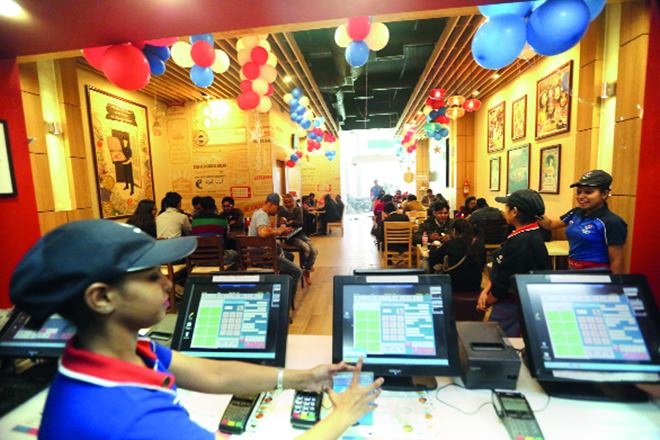
When American fast food standard bearers McDonald’s and Domino’s Pizza stepped into India in the mid-1990s, the market was just ripe enough for take-off.
McDonald’s and later Domino’s Pizza can be credited with not just growing the consumer appetite for fast food but also for fostering an entire food service ecosystem, including fresh produce, baked goods, sauces and condiments, and cold chain technology.
India has been typically difficult for business models driven by scale, replicability and predictability. The customer is price sensitive, operating costs are high and non-compliance of business standards is a frequent occurrence. In this environment, these brands have reinvented the meaning of meals, snacks and treats.
Their growth has set the stage for other international players and also set business aspirational standards for Indian food entrepreneurs and conglomerates alike.
Product experimentation has also been an important part of their success; it keeps excitement in the brand alive and help improve footfall. However, how far a product sustains and whether it becomes a menu staple can’t be predicted accurately. New products also need significant investment in both supply chain and front-of-house changes in standardisation-oriented QSRs, so the new product launch cannot be undertaken lightly. This is one reason these successful QSR formats don’t overhaul their menus drastically but make changes incrementally.
For these market leaders, future scale and deeper penetration is only feasible with higher visit frequency. For growth in middle-income India, they need to become a significantly cost-competitive option to be seen as more than a ‘treat’ or celebration destination.
So, while both McDonald’s and Domino’s Pizza have invested significantly in Indian flavours and menu offerings, perhaps it’s also best for them to reconcile with the fact that there will be a significant part of the consumer’s heart, stomach and wallet that will remain dedicated to indigenous offerings.
In a global environment that’s turning hostile to fast food, India isn’t a quick-fix growth market, but it’s certainly one to stay invested in, for the longer term.
And I have no doubt that as much as these companies aim to change India, over time India will also change them.
(Also published in Brand Wagon, The Financial Express)
Devangshu Dutta
October 9, 2016
P. Karunya Rao of Zee Business in conversation with Devangshu Dutta, Chief Executive, Third Eyesight and Narayan Devanathan, Group Executive & Strategy Officer, Dentsu India, about festive discounts, the evolution of ecommerce and retail business in India.
admin
September 12, 2016
Suneera Tandon, Quartz
New Delhi, 12 September
2016
 The Platonic ideal
“Efficiency
is doing better what is already being done.” – Peter Drucker,
Innovation & Entrepreneurship: Practices and Principles
The practice
Research
firm Gartner defines supply chain as, “…the processes of creating and
fulfilling demands for goods and services. It encompasses a trading
partner community engaged in the common goal of satisfying end
customers.”
Sounds simple? But it hardly is. In fact, the
supply chain can be one of the most complex structures in a business,
piecing together design, development, sourcing, manufacturing, and
distribution. It gets even more complex when it relies on rural India,
which is scattered over 640,867 villages and are often hard to access.
Fabindia, a chain of retail stores, has spent close to five decades
scoping India’s hinterland to connect rural Indian artisans to urban
shoppers. Here’s how they did it.
Fabindia began its India
sojourn back in 1960 when John Bissell, who was first introduced to the
country in 1958 while on a two-year grant from the Ford Foundation,
decided to set up an export shop to sell home furnishings to overseas
customers. Bissell, whose work at the foundation involved advising
government-based craft organizations on handloom fabrics, spent a lot
of time traversing the length and breadth of the country.
In
1976, the export house diversified into retail through a small store
that sold leftovers from export orders in Delhi’s tony market of
Greater Kailash. It took another two decades for retail to became the
mainstay of the company’s business.
Fifty years later, Fabindia,
managed by John’s son William Bissell, is a widely recognized global
brand, known for handwoven and hand-made goods that connect some 55,000
artisans from the country to consumers worldwide. In the process, it
has achieved two broad goals: to market the handloom tradition of India
to the rest of the world and to provide sustained employment to
artisans in rural areas.
The chain sells everything from
handwoven saris, rugs, apparel, home d�cor, and organic food in its 220
stores across 83 cities in India, including eight stores in overseas
markets such as Dubai, Singapore, Malaysia etc. It also retails its
products online to 33 countries. For the fiscal year 2014-15, Fabindia
had a turnover of Rs1,148 crore (approximately $170 million).
But
behind the red and black Ikat-printed scarves, Kalamkari prints from
south India, and block-printed Bagru fabric from north India is an
extensive and complex supply chain that runs from villages across the
country, covering a third of India’s over 650 districts.
The
retailer has successfully taken its founder’s vision to enable social
change at the grassroots level while engaging in a profit-making
business for urban shoppers. It does this while building systems that
encourage not just fair remuneration to India’s rural artisans, but
also provides infrastructure, access to technology and systems, quality
guidelines, and timely payments to these craftsmen. Fabindia also
offers access to capital and raw materials to artisans working with the
retailer.
As William Bissell puts it in a Harvard Business
School case study: “It seems contradictory that we pursue both a social
goal and a profit, but I believe that is the only way to do it.”
Through most of the ’90s and early 2000s, Fabindia grew as a retail chain expanding modestly in the country’s top metros.
Since
the opening of the Indian economy through the economic reforms of 1991,
Fabindia’s interaction with artisans scattered across the country has
grown significantly (pdf). The complexity of the company’s supply chain
is far different from that of a regular manufacturer that works through
designated factories.
The company’s interaction with these
artisans is very localized since it works with them through multiple
associations. The retailer deals directly with individual artisans who
work out of their homes and also with clusters of crafters and rural
NGOs and organizations that have a crafts supply base.
In
addition, the company uses its 11 production hubs across the country,
which are basically aggregation points, to centralize orders and pair
up vendors with artisans. Each hub has a number of field offices
attached to it.
“The production hubs and field offices act as
nodal points for interaction with the artisans that constitute the
supply chain, which is one of the most unique in the world,” said
Prableen Sabhaney, head of communications and public affairs at
Fabindia Overseas.
While most artists have the skill and the
craft, they don’t have the acumen to decipher fashion trends for the
season. So Fabindia acts like a conduit between their crafts and the
market.
At Fabindia, a large proportion of products carry some
element of the handmade, which requires an ability to communicate with
artisans and institute quality control as most artisans work largely in
India’s hinterland. For instance, an 18-step process is required to
create a simple pattern in Bagru print, a traditional form of
block-printing using natural dyes perfected in the northern state of
Rajasthan.
And the company has spent years putting processes to
ensure newer collections reach the stores on time. Recently, the
product range has become more diversified as well.
As for
remuneration, Fabindia follows a bottom-up structure. It asks artists
what it costs them in terms of—time, energy, skills, and raw material
to hand-make a certain fabric or accessory and pays accordingly.
Analysts
who track the sector believe that Fabindia’s unique model sets it apart
from other domestic or export-focused handicraft companies purely
because of the sheer volume of artisans it works with.
“In
handicraft, there are several companies that have created substantial
export-led supply bases, which tap into craft both from the rural
artisans as well as those based in smaller urban centers,” Devangshu
Dutta, chief executive at consulting firm, Third Eyesight said.
“Among
these, Fabindia has certainly had the most visible success in terms of
size and brand profile domestically. Fabindia has achieved scale by
working through artists, intermediaries and supplier companies who have
acted as anchors in the rural communities,” said Dutta.
Sabhaney
offers that challenges span from co-creating contemporary products
while using traditional techniques to quality issues, since the
products are created in environments that are very different from where
they are finally used. The company also works hard to provide access to
raw material and capital across many hard-to-access areas—and doing all
of this at scale.
“The ability to do this and not lose anything
in translation has been and will continue to be Fabindia’s strength,”
added Sabhaney.
The takeaways
As
the market evolves with e-commerce and the entry of foreign brands,
which has altered consumer preferences and style-cycles, Fabindia knows
it needs to quicken its response to these changes.
Not all of
the innovations the company has tested remain. In a unique ownership
structure created by Bissell, Fabindia set up supplier regional
communities (SRCs), which were community owned companies, self-managed
by a group of artisans, weavers and craft workers in a particular
geography back in 2007. According to a case study by INSEAD (pdf),
these SRC’s “offered artisans joint ownership of resources and access
to common facilities. It also trained artisans and developed new
handicrafts. The SRC allowed Fabindia to consolidate supply capacity
instead of dealing with single-loom weaver units, and to implement a
standard system for production and delivery control.”
The 2010
book, The Fabric of Our Lives reveals how production worked under the
SRC model. A number of dedicated designers and sourcing officers worked
closely with rural artists giving them design inputs in tandem with the
latest trends in the market and order quantities through dedicated
distribution centers in key villages. These designers worked with the
weaver to develop samples. They were then shown by the designers that
refer it to a product selection committee. The fabric was then approved
and the cost price finalized. The quantity of fabric to be produced the
first time was pre-determined by software based on a minimum stock
requirement ratio and an order is given to the weaver to make the
product. The weaver produced the requisite amount of fabric in a month
and brought it into the distribution centers.
But the SRC model has now been diluted as the company looks more innovative ways to engage rural artisans.
In
the company’s next vision plan, it is focusing more on cluster
development that will basically help bring artisans up to speed with
the processes and market trends.
“There are plans for a greater focus on the handloom and hand-craft sector,” Sabhaney said.
“There
is a much bigger focus on the social aspect, there are going to be
significant investments in developing clusters and bringing them up to
what is required around the country,” she added.
(Published in Quartz)
