
Devangshu Dutta
April 11, 2009
RetailWire’s Al McLain has asked, “What changes in consumer spending habits do you see as providing retailers and manufacturers with the most opportunity? Which habits do you think will stick around once the economy improves, and which won’t?”
Well, “the only thing certain (and permanent) in life is death…”
Economic changes – including recessions – are not permanent (unless the society itself collapses), so the market mood will shift towards spending again.
Consumer sentiment may not lead the recovery but is likely to follow it. Given that, value-consciousness will stick, even after the market turns upwards. So my reading is that private label will continue to grow, people will continue to think harder about spending on big-ticket items, deals & coupons will continue to work.
Carol Spieckerman, a RetailWire panelist, made a comment about consumer spending not returning to where it was. To that I would add this thought and question: even in these recessionary days, the average American and European household consumes more (and is more wasteful) than even the wealthier households in the so-called developing or less developed economies. What if the average American consumer begins to find out that s/he can cut back even more than s/he already has? What would that do to the traditional business and economic model?
And once that consumer role model is demolished, what would that mean for the world at large and the developing economies that have been following the “consumption-led growth model”?
Obviously, this is not a foregone conclusion, but it’s a scenario worth pondering and preparing for. And some might say, perhaps a scenario even worth encouraging.
(Here are more thoughts and commentary from the RetailWire Braintrust and others readers on Lessons from the IRI Retail-CPG Summit.)
Devangshu Dutta
April 2, 2009
(Based on the special address By Devangshu Dutta, Chief Executive, Third Eyesight opening the second day of Prime Source Forum 2009, Hong Kong)
I’d like to thank the organizing team at Prime Source Forum for this opportunity to address this distinguished group of top management from the global apparel and textile industry.
I’ll take you through a brief presentation that’s slightly different in flavour. it’s a little bit of a step back from what we discussed yesterday and will continue to discuss during the day today. It’s looking at the world as we’re seeing it evolve and unfold – discuss things are possibly being seen, heard but not really understood.
I’ve titled my presentation “Itches, Cuts and Fractures” and I’ll explain that seemingly strange title shortly.
First of all, as all of us were discussing yesterday and you must have felt it – there’s a sense of uncertainty; nobody seems to have the answers. Certainly not the experts; the experts got us here. The experts had all the answers till about six months ago and all the answers turned out to be wrong.
Instead, I’d like to take a step back and look beyond numbers, beyond rationales. All explanations and analysis seem to ignore one of the strongest drivers of humankind – emotion. Underneath all the thinking, reasoning, logical layers, it is emotions that actually drive many of our decisions.
When it comes to uncertainty – when it gets to an extreme – we tend to get into a fearful situation. When we don’t know what’s happening, or what’s going to happen, fear is actually the emotion that drives a lot of the decisions. We’re beginning to see a lot of that in the world, around the world in different countries. You might think that this might happen in the more developed economies, others might think that this is likely to happen in the less developed economies, but it is actually happening around the world.
And when it comes to another step further, fear actually causes friction.
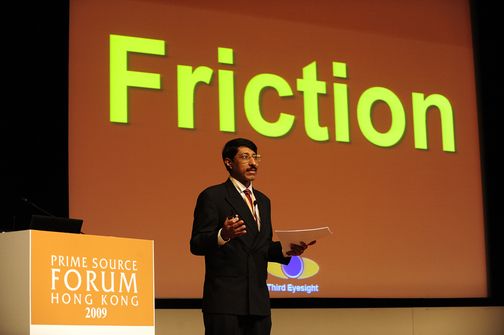
As students of Zoology, we learn about how animals respond when they are threatened. In a shifting environment with many potential threats, fear and survival instincts trigger the “fight or flight response”. The animal can either try to fight the threat or to escape.
It is no wonder, then, that ‘friction’ is the first reaction in a world where there is a lot of uncertainty and lots of fear.
And we’re beginning to see the signs of that…if you caught the news yesterday about what’s happened in London while the G-20 leaders get together for the Summit. There’s clearly a lot of anger, a lot of resentment which is bubbling over. You might remember a small news item from a few weeks ago, about somebody’s expensive car being torched by a group of youngsters in western Europe, some of whom had recently lost their jobs.
In uncertain times, not only do we stand up to fight potential threats, we even see many more things as threats than we did earlier.
Let me ask you this question – how many of you remember how the 1930s Great Depression ended? It didn’t end in a “Great Revival”, it actually ended in a World War. I don’t mean to sound alarmist, but people do stupid things when they are under pressure. We all do. That is something that nobody wants, but sometimes your hand is forced and you end up taking actions that you regret later.
This is one of the issues that I think should concern all of us, and I’d like to talk a little later about how to deal with that.
If you look at some of the actions that have happened in the political domain, it’ll be clear how this is affecting what we have discussed in this area – the global trade in apparel and textile products.
Well, we’ve already seen in the last 2-3 months the push-backs coming from different political parties in various countries, raising barriers, taking actions that are essentially “warlike”.
In fact, not very far from here [Hong Kong] American and Chinese ships actually got into aggressive posturing on the high seas. This may have been a political statement from either side. We don’t know what was going on or who was right, but clearly there is conflict arising out of friction.
This could go on to its logical conclusion, or we have the choice of a step back.
When you look at the textile and apparel business, and I mentioned this yesterday, is one of the most international around the world, this becomes critical whether you are looking at sourcing or exploring new markets. How do I know which countries are safe to go to?
A few weeks ago The Economist very helpfully published a table rating 165 countries. I could say it is surprising but it is not. Of the 165 countries rated in 2007 and 2008, only 2 countries showed an improvement from the previous year’s score, 12 showed no change (of which 7 were anyway in the very high risk or high risk category), and the rest all showed an increased vulnerability to economic, social and political unrest.
There is no surprise in the list of the countries at the top of the table or at the bottom of the table. What is surprising is the change in the rating, or the risk outlook. Countries like New Zealand, Austria, Australia, Mauritius, Norway…look at the change…as a percentage the change is very high. These are countries which you would think are fairly stable. So it is not just the already unstable becoming more so, but the potential of friction and conflict rising in relatively stable countries as well. The map looks redder – indicating higher risk – than it did last year.
So there is clearly a lot of uncertainty – we don’t know when it’s going to end, we don’t know when this recession will bottom out and we’ll see the light at the end of the tunnel. The situation looks fairly grim and the question is, what do we do?
We talked about the fight response, let’s talk about the flight response. One of the responses we have available is to not fight but to retreat, to protect ourselves.
That leads me to the other form of dealing with a threat – flight or escape. In individual terms this may literally mean running away from a location, in other cases this can mean deploying protection measures to cocoon oneself: a tortoise retracts within its shell, a squid squirts ink, while a hedgehog deploys its prickly quills.
What you’re trying to do is to protect yourself, your mind and emotions included, from all the uncertainty outside the boundaries you define.
Since countries can’t physically run away, governments build walls and engage in protectionism in the form of tariff barriers as well as non-tariff barriers such as procedural hassles in the way of imports, and get into trade fights which are essentially delaying tactics. You don’t really project too much aggression so as to get into a conflict but enough so as to present a barrier.
But – the good news is that there is hope! I believe that, fortunately for us, as Homo sapiens – “thinking humans” – we are not locked into our biological response systems alone. We have a third choice: to discuss and debate, to open a dialogue.
Partners who have turned opponents seem to be talking – there seems to be willingness to sit down at the table and talk things through. How quickly and what result will emerge remains to be seen. It is encouraging to see in this morning’s South China Morning Post a quote from the White House that the USA and China in their meeting yesterday “also agreed to work together and address the economic crisis, resist protectionism and to resume discussion about human rights as soon as possible.”
So, should we wait to see what emerges from these talks in London, and from the policy measures being announced by governments around the world? What do we do, as businesses, as individuals?
Well, I don’t think that freezing into indecision is an option. I don’t think inaction is an option. We have no way of knowing how the market will shape up, how the supply base will emerge, but we need to take steps to address our business concerns. Proactively or reactively we need to take action.
All the companies represented here in this room clearly need to respond to an economic situation that most of its management has never faced and most may never face again.
I have found as I have talked to people in the US in January, in the UK, in Europe, in India that many, many companies are postponing decisions, and the postponement is not rational. It is not to say that something will happen, and I know the window of time in which that event will happen, therefore I am postponing my decision to that future. They’re just postponing – it’s just “I’ll look into this later”, it’s procrastination – it’s not even postponement of a decision. And that is not an option. I don’t think we can sit tight and wait for this to blow over.
So what should we do? How should we respond – on the sourcing side and on the market side?
I’ll talk about the sourcing side first.
The first thing we need to do, is to break from what one author called “the Tyranny of Or”. For instance, in discussions with colleagues from the industry I’m struck by how much we think along bipolar lines of growth. We prefer things to settle either one way or the other way, for them to be conveniently predictable for us.
I would suggest that rather than debate between extremes, we need to accept that different markets and supply bases will evolve differently. It is not a choice between consolidation or fragmentation, globalization or localization (“could manufacturing move back to Europe, or to the US?”). Should we be strategic or be reactive? There has been discussion about partnership, long-term relationships, but that partnership was shaped in a world very different, many months or years ago when the world was very different. Shouldn’t we react to that change?
Should we look at getting the lowest cost or should we look at speed? Clearly when you look at speed, you would be looking at supply bases that are more capable and potentially more expensive. Should there be a trade-off?
That leads me to a second issue: eggs. That is, risk. There are two philosophies.
One philosophy says: put all your eggs in one basket and watch it very very carefully. The other more common saying advises that we should spread your risk around a little bit and spread the eggs in different baskets.
That’s the thing about risk – you can try and minimize risk, but you also need to try and mitigate risk , diversify risk.
Well, if there is just one thing we need to learn about risk, it is to “diversify, diversify, diversify”. Minimizing risk is only possible to a certain extent. So I would tend to go along with common wisdom here. And even if you believe in the first philosophy, it only works even partially if you have multiple eggs.
Yesterday we talked about a few other things – consolidating the business, conserving cash flows and being careful with our resources, and so on. But it also leads to conservatism. If you look around the room and see the number of black suits around, including the one on the stage, you’ll get a flavor of what I mean. These things are not divorced from each other. We deal with our business and rational decisions through the lens of our emotions. And when things are looking uncertain, we tend to contract, whether to regroup our energies or to protect ourselves – fight or flight which is a very instinctive, natural response.
The thing that we need to remember is that when you look at the fashion and the retail businesses, both of these businesses are fundamentally entrepreneurial in nature. Of course there are corporate businesses as well, but the successful ones promote entrepreneurship within the corporate.
And the thing about entrepreneurs is that there is a certain quality…you could call them mavericks. The night before last there was a conversation about how the average size of manufacturers and brands in this industry is much smaller than in other sectors. The reason for that is that the entrepreneurial drive actually takes precedence over any corporate diktat. The industry actually allows and encourages entrepreneurs to break off, and go and do their own thing. And that causes fragmentation.
Standing here today, after all that discussion on the sourcing panel yesterday about supply base consolidation, I have to say this: fragmentation, to my mind, in the current scenario is a good thing. You might call me crazy, but let me give you my reasoning for saying that.
Think about a beanbag – there is a lot of air in between the small pieces of foam, and the bean bag is a lot softer than one single solid piece of foam. The cushioning effect comes from the fact that there is a lot of air in between.
We need the cushion of diversity in the industry at the moment because there is no way – no way – we can predict who will succeed.
Some of the best known names in the industry have disappeared in the last six months. Twelve months ago nobody could have said, with any certainty, that they will disappear. So how do we decide what’s good, who should consolidate with whom, who will survive? We can’t! Nobody has a crystal ball, nobody can identify certain survivors. I would urge you to allow fragmentation to exist rather than just travelling on the consolidation route.
I think supply base consolidation and market consolidation has gone beyond strategic considerations, and almost become a fad. Consolidation does have some logic, but when it comes to risk, diversification is certainly preferable.
The recent crisis in global financial systems dramatically demonstrated not just how risky it is to depend solely on a few large institutions but also how the risk gets multiplied manifold due to these institutions might be interconnected.
In the textile and apparel business, instances such as SARS and the temporary re-introduction of quotas have demonstrated, again and again, the fallacy of over-depending on consolidated supply chains.
Also, too many people believe that the industry worldwide has no choice but to consolidate, that mergers and acquisitions are inevitable, and that large companies will dominate the business from retail to fibre. We forget that we are talking about the fashion industry, not the automotive or aerospace industry. Entrepreneurship here doesn’t cost billions or even millions of dollars.
We also need to look at balancing our approach – everyone has been looking at efficiency, which is a great driver: you strip out extra cost, extra time etc. but what I said about the risk is also true of innovation. You want different sources of innovation. There is not a single company in this room, or around the world in this sector, has the prerogative of being the only innovative company in the world.
As I said, this sector is entrepreneurial, and there is innovation coming from all kinds of people, from all kinds and sizes of companies. There is the need to allow that to happen and we would miss out tremendous innovation opportunities if we consolidate all our eggs into one or a few baskets.
So when you next look at dropping suppliers, think about what capabilities you might be losing or what risks you might be multiplying.
When you look at what that means for the sourcing approach, obviously you do want to reduce costs, when you are dealing with a predictable product, but the share of unpredictable is growing with every passing month.
In uncertain times such as now, and with unpredictable products, the prime driver is to “Catch the Trend” and the focus must be on “Response”. So you need to look at making the buying decision closer to the season and closer to the market. Development lead times must be shrunk and the lead time heavy decisions (such as fabric commitments, lab-dip approvals etc.) must be taken out of the critical path. This may even drive more sourcing from supply bases that are close to the market.
The panel on sourcing talked about lead-time yesterday. A lot of lead time is spent just going back and forth in the supply chain. The only way to handle this is for suppliers to not only become more capable, but to stand up and say “we are more capable”. They need to be able to say, “We don’t just convert fabric into garments, we can also do a lot of other stuff – we can design and develop new product, we can actually look at your sales trends and tell you what products we should be developing together.” This is an art, or a science, that seems to have disappeared (or is disappearing) over the last 15-20 years, as we’ve gone into this, dare I say, management consulting-led ‘strategic sourcing’ drive. The art of being a merchant is not only a retailer’s prerogative, but also something for a supplier to do. You need to be able to read the market, not just respond to a tech-pack, and I think that’s a skill set that needs to be emphasized and encouraged in the current market.
What should buyers do? Certainly, speed to market strategy is at the top of the agenda. Another response to this is to look at sourcing closer to home.
In this environment suppliers in global hubs should certainly be more concerned about reducing their “sketch-to-shop” lead times.
In fact, today buyers may look to proximity for more than just speed-to-market and the concern for clothing miles (“proximity sourcing is environmentally friendly”). Underlying that is the sense of security – that it is closer to home, more in the known territory than unknown, more “predictable”, it’s familiar – “I can manage it better”.
We’re going to see more of that – I don’t think we have a choice. Buyers are human beings, despite what several suppliers sitting in this room might think. Emotions do drive buyers’ decisions as well, and that is one of the emotions that will be driving some of the decisions.
Just a quick word on the market side: both factories and their buyers need to define the value that they bring to the market,
There is a lot of talk about partnership in this sector but, let’s be honest, there isn’t much partnership in this sector around the world. Companies do need to question what is the value they are bringing to their customers, and whether that value is greater than last year.
You can’t take it for granted that the consumer will trade down, or even trade up to a better product that will last longer. Why should they buy your product?
One of the kneejerk reactions in this kind of a market is to cut down on marketing. There is a need to sustain investment in branding (as targeted to the consumer or within the trade). In fact, if you are a supplier and have not invested in this area so far, I would suggest that the time to sow the seeds is now. Whether it is developing markets, new segments in a developed market, a country that is new to you, it takes a few years to develop a credible market presence. It’s cheaper right now – marketing costs are lower now, people are available, advertising is cheaper; the time to plant the seed is now.
On a different note, I would like to reiterate a particularly significant concern.
The fashion industry has one driving principle – that everything becomes unfashionable. We have what is called planned obsolescence. Without planned obsolescence how do you make next year’s sales? Any consumer business is built on the same principle, but the fashion industry is particularly important because it is very visible and raises the aspirational level very high.
Imagine the population as a cylinder, and imagine aspirations being pulled upwards like a piston. This upward aspirational pull affects not just those who can afford to indulge their aspirations, but also those who can’t. The stress is felt most at the bottom end.

I have to confess, this slide is about 3-years old, when I used it at a conference organized by the Confederation of Indian Industry. I used it again today because the signs that were just becoming visible at the end of 2006 are now on the news every day. The crime and the conflict arising out of this stress is apparent around the world. [Edit.: Articles referencing the original presentation are in the Business Standard of 30 November 2006, and on ]
What if the fashion industry’s consumers decided to opt-out? What if they said, we don’t want to buy more, we want to buy less? What would the business look like in that environment?
I think we need to start thinking about that now, because many companies will face that in their market. I think there are certain companies and segments in the US market that are already facing that pressure, and we will find that happening across the world.
Our business models are geared towards outdating merchandise in a matter of weeks or days or hours, and selling more to replace stuff that is still fairly serviceable. What if consumers got into the mode of conservation that many people in this room are already getting into: that “I need to conserve my resources”. Let’s not forget, we’re all consumers. Let’s looking at our spending behaviour; is it the same as last year? I would guarantee you, 80-90% of the people here would say that they have made some cutback since last year.
So how do we get out of this situation? Well, the situation is out there in the market and we can’t just get out of it, so we need to deal with it.
The manufacturing of apparel products has been and remains a great vehicle to spread income and wealth to the financially less well-off people. Also, the textile and apparel industry has such low barriers to entry that I believe it is also one of the greatest vehicles to promote entrepreneurship and self-reliance.
Finally, a word on the pain that many of us are feeling. I would like to share a very short video from Ted.com that might help to put things in perspective. [Transcript of talk continues below the video frame.]
The reason I shared that video is to explain the strange title of my talk.
I believe that many of us are experiencing the equivalent of an itch or maybe a scratch. Some have a cuts and bruises, and a few have fractures. But the fact is that we’re not dead yet. Most of us have lost much less than David Hoffman, whose presentation you just saw on the Ted.com video.
Let’s not forget: this industry has faced downturns before and has come out of them; it will again. Meanwhile we need to get our heads down and go through with doing whatever we are supposed to be doing.
Someone said: this crisis is too good to waste. There is too much opportunity in this crisis to not use. We can make changes that would be difficult in the best of the times. In the best of the times you’re going strong, everything is going well, there is no motivation to change.
The kind of transitions that look tough at other times, those investments that you can’t make at other times – this is the time to make them.
Mark Twain said, “If you feel like you’re going through hell, just keep going.” And I think that’s what we need to do.
Thank you.
Devangshu Dutta
March 23, 2009
‘Refrigerated and Frozen Food Retailer’ magazine wrote about price wars in food and grocery retail, between retailers, or between retailers’ private labels and national brands.
The comments about the difference between retailers’ own brands and national supplier brands are particularly interesting. The question, whether retailers’ own brands necessarily need to be cheaper and whether they can catch up later, is also very acute.
To me, the price difference here is really reflected by the difference between whether you are creating a brand (albeit one that is available only in one chain of stores) or a lower-priced private label.
A brand needs distinctiveness, a private label is mostly a me-too. A brand needs to build its own relationships and desirability beyond the store it is available in, while private label sells because there is an existing customer for something else that it is knocking-off. (Of course there are private labels that are not me-too and that are distinctive, but they are the exceptions proving the rule, so I would much rather go with the simplified view of the world for now.)
Finally, migrating up the price curve is difficult in the best of times. Believing that it can be done quickly after an introductory low price, in the current economic scenario, would be highly optimistic.
Price-optimization solution providers believe that retailers can increase private label prices:
DemandTec’s Derek Smith is seeing smaller price gaps between national brands and private label, with private label also adding more tiers. This allows one tier to fulfill the opening price point in a category, with the other tier playing roughly on par with the national brand or even priced above it…
“You also have to understand what price gap is necessary to get the consumer to trade up or down,” depending on your strategy, he adds. For example, you might want to incent shoppers to trade down to your private label, so you get more margin. So… do you raise the price on the national brand, lower the price on the private label, or do a bit of both? Once again, it will depend on your customer set and their purchasing history…
Lyle Walker, VP of marketing, KSS Retail, has seen some of the retailers he has worked with raise prices on their private label without losing sales – thus significantly increasing category profits. “We build demand models with two years’ worth of POS history, and then dynamically adjust elasticity values based on weekly updates of POS data,” said Mr. Walker.
Of course, Mr. Walker also qualifies the argument by saying that the increment may be “pennies here and pennies there,” implying that the discount for private label may still remain large enough for the customer not to notice the “pennies” being added on gradually.
Which sort of negates the whole question about whether retailers’ private label can really compete by pricing on par with national supplier brands, doesn’t it?
(The original RFF article is available here.)
Devangshu Dutta
February 2, 2009
A recent discussion online on retailwire.com quoted a book “Jump the Curve” by Jack Uldrich, in which he describes rapidly growing trends that stay small for a long time and then suddenly explode. He uses the example of water lilies to illustrate the point about exponential growth. Say we start with one water lily and it multiplies to cover a pond completely within 30 days. On Day 20, only 0.01 per cent of the pond would be covered, and on day 25 it would be just over 3 per cent. The last days, hours, would show dramatic growth.
The water lily example is just so apt to describe technology adoption in the retail sector (especially in fashion and other soft goods). It’s so slow sometimes that it looks like molasses dripping down a wall. (And when a weed-killer gets dumped in the water at an early stage, the adoption can take even longer. )
In 1985 the industry was breaking new ground with the principles of Quick Response (QR) – then in the 1990s Efficient Consumer Response (ECR), Collaborative Planning and Forecasting (CPFR), and numerous other acronyms appeared in the supply chain alphabet soup.
During 1999-2001 in my previous company, the team developed a collaborative supply chain enablement solution to create an easy-to-understand common platform for the various stakeholders in a supply chain to work together seamlessly. By 2001 we discovered that we were among a handful of companies speaking the same language, and among a sea of 300+ web-based portals aiming to catch up. And then the bottom fell out of the market.
As we stand today, about a decade on, design-to-delivery lead times are still measured in months, buyers are still trying to gaze into crystal balls to forecast their future demand, and their suppliers are still trying to consult oracles to interpret their buyers’ orders.
We may yet see adoption of true collaborative platforms in the next couple of decades. At that point it will look like sudden growth that’s come out of nowhere, and everyone will be asking “how did they ever manage supply chains in B.C. (Before Collaboration) Era?”
Until then….
admin
October 11, 2008
Differentiation is the key to surviving and thriving in tough times. In the lifestyle products sector (apparel, footwear, home, etc.) a big difference is the product design itself.
More than ever, it is vital for Indian companies – brands, suppliers as well as retailers – to develop their own design and product development team, in the shortest time. The team, including designers, merchandisers, buyers, sourcing people, textile and apparel manufacturers – must sharpen their skills in reading the market trends and in developing new products that can make their brands or retail stores stand apart in the customer’s eyes.
To share its insights and experience, Third Eyesight is organizing an intensive workshop on Product Development and Forecasting (with an insight on Trends for Autumn/Winter 2009/2010). Click to REGISTER NOW.
The workshop will draw upon live experiences from the area of product development in the lifestyle and fashion sector, and will cover:
Past workshops have included top / senior managers from companies such as:
Discounted delegate fees start at just over Rs. 9,000.
