
admin
March 25, 2020

T. Surendar, The Morning Context
25 March 2020
Standing on the porch of the Grand Hyatt Hotel in Mumbai suburbs, Diwakar Vaish, co-founder of Noida-based AgVa Healthcare, was trying to catch the attention of software industry executives. This is at the annual conference hosted by IT trade body Nasscom. Vaish’s stall was a side-show for startups to exhibit digital technologies in the healthcare sector.
On a cool, breezy February day, the atmosphere was nothing as grim you would expect in a hospital emergency ward. Vaish’s rig, comprising an iPad-like device on a short steel column mounted on wheels with dangling wires, was a cost-effective version of a ventilator used in critical care. There wasn’t much excitement about his solution, as few executives really understood the medical problem he aimed to solve.
Today, a robotic engineer by training, Vaish is super busy.
It is not easy to get him on the phone, as AgVa’s ventilator is suddenly in demand from all parts of the country. The company is running three shifts fulfilling orders, which have been pouring in since it became apparent that Indian hospitals did not have enough ventilators for patients rendered ill by the novel coronavirus.
Unwittingly, the need for ventilators has once again drawn attention to India’s medical devices industry or the lack of it. So much so that Anand Mahindra, chairman of the $17 billion Mahindra group, which has interests in automobiles, software and resorts, said that he was finding ways to manufacture ventilators in his factories. It isn’t easy putting together a ventilator, not when you are racing against time, but Mahindra is a hardy businessman with deep pockets, and maybe, just maybe, he will succeed.
In many ways, the Indian medical devices industry is an anomaly. India has a space programme, a nuclear programme, it is among the few countries that has developed patented medicines and a low cost version of anything from power turbines to trucks but when it comes to medical equipment, it fares poorly.
India is also the biggest supplier of FDA-approved drugs to the US, the biggest pharmaceutical market in the world. Even as the Indian market for medical equipment has grown at double-digit rates in the last five years to Rs 1 lakh crore, two-thirds of its needs are met by foreign companies such as Philips, GE Healthcare, Siemens and Abbott.
Import domination is all pervasive extending to even non-critical but common equipment like sonography machines, dentistry chairs and diagnostic equipment. Less than five Indian companies had revenue of more than Rs 500 crore a year and 90% were classified as small scale, with annual revenue less than Rs 10 crore. The biggest player in the domestic market is the Rs 1,300 crore Mumbai-based Transasia Bio-Medicals, which makes in vitro diagnostic solutions that are exported to Western markets too.
“For a long time, the government was the biggest buyer of medical equipment and they always preferred imported equipment. That meant that it was not lucrative for local entrepreneurs to invest their capital in the sector,” says G.S.K. Velu, managing director of Trivitron Healthcare, which makes and exports imaging equipment.
The proliferation of private hospitals in the last two decades also did not change things much. With well-entrenched foreign players and a liberal import duty structure to make available the best facilities in India, there were few local companies of scale who could invest big money to fend off competition. AgVa’s ventilators were priced at a fifth of the ones sold by the foreign competitors, yet it couldn’t make inroads into big hospitals. “It’s almost as if our cost was our barrier to sell. Being critical equipment, customers had a lot of inertia to even place test orders,” says Vaish.
Thanks to meagre domestic manufacturing. India also could not set standards of equipment specifications to suit the local needs. It had to tweak its own equipment standards to fall in line with those of foreign manufacturers. For example, in the US, defibrillators used to restore heartbeats by giving shock to patients had to last at least two shock cycles. But, in India, since access to hospitals and medical care was not as easy. patients arrive long after they have suffered heart attacks and Indian doctors use defibrillators for even 10 cycles at a time.
The local standards did not specify this need and as a result many imported defibrillators were not of much use in Indian conditions. “We still don’t have an act to regulate medical devices and it falls under the drugs category. Everything is still borrowed from the West,” says Aniruddha Atre, co-founder and director of Pune-based Jeevtronics Pvt. Ltd, which makes the world’s first hand-cranked defibrillator.
Trivitron’s Velu says that the share of locally produced medical equipment will increase within the next decade. This will be a combination of help from the government which will enforce more domestic manufacturing by overseas firms and increased entrepreneurship.
There is also a view that more global manufacturing will come to India, as firms de-risk their strategy of manufacturing everything in China. “In the past, when labour costs went up in the Chinese west coast, Indian garment companies were beneficiaries of increased orders even though other countries like Bangladesh and Vietnam too got a big share of it. The availability of labour and ability to scale up operations is something global players look for and to that extent India will always be an important outsourcing destination,” said Devangshu Dutta, managing partner at consultancy firm Third Eyesight.
The trend started even before the COVID-19 pandemic as companies in the US began to brace themselves for a trade war with China. For example, a US-based company has started sourcing Indian tyres at a 10-15% premium as it wants to diversify its risk from China. “India has witnessed a surge in mobile phone manufacturing. This is bound to increase the ecosystem in electronic manufacturing which in turn create ecosystems for industries like medical equipment,” says Sharad Verma, senior partner who oversees industrials at Boston Consulting Group.
The timing is also right for increase in local manufacturing, argues Verma. One of the important criteria for that is viable domestic consumption. It’s happened time and again in sectors like automobiles, mobile phones and more recently in manufacture of metro bogies after domestic consumption has reached a scale where it makes sense for companies to set up manufacturing facilities. “The industry is no longer small and the incidence of medical technology will only go up from here making it viable for even foreign companies to look at a manufacturing set up in India,” says Verma.
It will be interesting to see how it all plays out. The sector, so far, hasn’t seen much by way of private equity or venture investment. The most prominent one was an investment by a Morgan Stanley fund and Samara Capital in Surat-based Sahajanand Medical Technologies and Fidelity Growth Partners’s investment in Trivitron. But starting 2014, a government fund run by the Biotechnology Industry Research Assistance Council-incubated several companies who are slowly bringing their products to market. As some of these products hit home, especially in the wake of COVID-19, the action is definitely bound to pick up.
(published in The Morning Context)
admin
May 21, 2019
Written By Sangeeta Tanwar

Two of India’s leading retail chains are currently preparing the ground for their full-fledged e-commerce forays, albeit in totally different ways.
While the Kishore Biyani-led Future Group, which operates the popular Big Bazaar hypermarket chain, is busy listing its labels on Amazon, rival Reliance Retail is withdrawing its products from all e-commerce platforms, as parent Reliance Industries (RIL) gears up to launch its own online marketplace.
For both the traditional players, cracking online sales is important as they prepare for a future beyond high street retail.
Online sales in India will balloon from last year’s $18 billion (Rs1.25 lakh crore) to $170 billion by 2030, Jefferies India predicted recently. This potential aside, Indian e-commerce is still nascent and retailers are still perfecting their strategies.
“E-commerce is now a game of two dimensions, one of scale and the other of last-mile ubiquity. Whoever gets this right, will manage growth, revenue, and customer acquisition,” said Anil V Pillai, director of the independent marketing firm Terragni Consulting.
As for the Future Group, it thinks the best way to achieve this is by riding piggyback on Amazon’s proven capabilities in scale and last-mile delivery.
How the plan evolved
In 2016, the Future Group had made its first e-commerce acquisition by buying out the struggling furniture retailer FabFurnish from its German incubator Rocket Internet. Biyani had hoped to find synergies between the startup and his group’s furniture brand Hometown.
A year later, hit by heavy losses, FabFurnish was shuttered. Biyani downplayed the move saying his losses were “compensated” as the company had learnt “enough” from the episode.
The move now to partner Amazon seems to have stemmed from that learning.
Over the past month, the two have been trying to make joint plans, including in distribution, warehousing, and creating products for Amazon and its grocery format, Pantry. Also, Future group brands, including Big Bazaar, are being aligned with Amazon Now, which promises delivery of everyday essentials within two hours, suggest media reports.
A more serious handicap will be Amazon controlling Future Group’s data and customer relationships in the partnership. “In e-commerce, ownership of customer relationship and data, which offers consumer insights, is the real asset,” points out Devangshu Dutta, CEO of Third Eyesight, a consulting firm focussed on retail and consumer products.
Vianello agrees: “When you have your own e-commerce venture, as Reliance Retail plans, you are the owner of the data and you can slice and dice it to come up with exciting product offerings and improved service experience.”
This is one of the advantages that RIL might have seen in going it alone.
Going solo
“Reliance Retail has taken a more integrated approach towards e-commerce,” observed Dutta. “The company is set to leverage its pan-India retail presence and Reliance Jio’s (RIL’s telecom business) data capabilities to roll out an e-commerce platform,” explained Dutta.
The synergy between Reliance Jio and Reliance Retail is a big advantage. The retailer has about 10,000 stores across 6,500 towns in India, while Jio has a subscriber base of 306 million. After bringing many Indians online with Jio’s affordable data offerings, Reliance now hopes to get most of them to start shopping online as well.
The challenge, though, would be in getting the last-mile delivery right. “Reliance Retail could be at a disadvantage here compared to the Future Group, which has its delivery mechanism in place courtesy its partnership with Amazon,” suggested Vianello.
Moreover, like with Jio, consumers will expect heavy discounts from Reliance’s e-commerce venture as well, which may be difficult to sustain given the initial investments. “Biyani’s (online) launch involves lower upfront costs, while Reliance Retail’s will be resource hungry since it’s an almost greenfield project,” pointed out Pillai, adding, “Reliance’s challenge is the overwhelming perception about the group being a price warrior and disrupter.”
So, which strategy will triumph? Everything comes down to execution. “Success in retail, including e-commerce, is about more and more customers choosing to transact with you repeatedly. Achieving this is a difficult and ongoing process. There are no guaranteed or permanent winners,” says Dutta.
Source: qz
Devangshu Dutta
December 20, 2018

Do you have this feeling that 2018 went by a little too quickly? Well, however quick it seemed, it was certainly momentous for retail in India.
If 2016 was marked by the shock of demonetization, and 2017 by the pains of GST implementation, 2018 highlighted two threads – the obvious convergence of the online and offline world that had been ignored for far too long, and the interest of foreign capital in India’s consumer world.
Walmart bought India’s loss-making ecommerce leader for an eye-popping US$ 20.8 billion valuation, while ecommerce giant Amazon injecting equity into Shoppers Stop, bought Aditya Birla’s More grocery chain (49 per cent through a back-end entity), and held discussions with Future Group to acquire 9.5 per cent in Future Retail. There were rumours of a mega joint venture between Reliance Retail and China’s Alibaba, and media also reported Japan’s Softbank looking at ploughing US$200 million into Firstcry. Both rivals Amazon and Alibaba were reported to be looking at Spencer’s, one of India’s oldest retail chains currently owned by the RP-Sanjiv Goenka group.
Videos of the crush of curious crowds at India’s first, much anticipated Ikea went viral, and the company said it planned to open 40 locations over the next few years, upping its earlier projection of 25. Chinese retailer Miniso basically came out of nowhere and claimed to have clocked sales of ?700 crores in the very first year in the country.
But along with these cross-border “big bangs” we saw domestic confidence also quietly resurging. Indian retailers are not cowering before large foreign retailers and expensive ecommerce advertising splashes; today they are less defensive about their own prospects than they were two years ago. There is also a growing interest among entrepreneurs and corporates to create new retail businesses, which augers well for the diversity of competition and freshness of offerings in the market.
Going into 2019, one thing I can say with certainty is that the weather, economic and political – both in India and elsewhere – will be unpredictable, and might even turn stormy. Externally, retailers should “expect the unexpected”. To ensure that the business remains on track, however rough the track becomes, retailers must centre all major strategies and decisions on the customer. A theme that has been around for centuries, it is surprising how much it gets ignored in this most customer-facing business.
Retailers tend to divide customers into rigid segments. My suggestion would be to look at customers through the behaviour and experience lens and also recognise that the same customer behaves differently at different times and in different contexts – in effect there are no hard boundaries between “segments”.
It is often emphasised is that Indian consumers are “deal-seeking”. I don’t think we should treat this as a uniquely Indian thing: all consumers look for value-reassurance in unpredictable times and in uncertain conditions. Also remember that even in value-seeking, experience still rules. Retailers and brands that are solely focussing on price or price+feature comparisons are turning their business into a commodity. They are missing the long game: of defining the customer’s experience from the first moment of brand contact to the purchase and beyond.
In 2019, if you want to focus on a single competitive strategy, it would be this: for stickiness and sustainability, think about the customer’s experience, and actively design it, in every environment where the customer connects with you.
Lastly, technology is transformative, but tends to get restricted to being the contrast between ecommerce and physical retail. Indian retailers need to embrace technology in all forms, from using the zillions of transactions within the business and with the customer for developing actionable knowledge, to automating processes where unnecessary cost or time makes the business inefficient.
Having said that, keep the previous rule in mind when deploying at customer-facing technology – make customer-interfacing technology as invisible or intuitive as possible. When in doubt, learn from one of the leaders in the sector, Amazon: its 1-click ordering patent 20 years ago gave it a huge advantage over competitors, and it is now aiming to replicate the same seamless, friction-free behaviour physically with its Dash button. Or pick cues even from younger fashion businesses like Rebecca Minkoff, whose focus is on ease and convenience. The key reason for adopting technology is to remove friction for the customer and for processes that serve the customer.
I have no doubt that 2019 will be eventful – let the customer experience be the guiding light to keep our businesses off the rocks and afloat.
(Published in the Financial Express on 4 January 2019, under the title “Retail in 2019: Need for stronger brand-customer connections that go beyond purchase“)
Devangshu Dutta
January 10, 2017
In this piece I’ll just focus on one aspect of technology – artificial intelligence or AI – that is likely to shape many aspects of the retail business and the consumer’s experience over the coming years.
To be able to see the scope of its potential all-pervasive impact we need to go beyond our expectations of humanoid robots. We also need to understand that artificial intelligence works on a cycle of several mutually supportive elements that enable learning and adaptation. The terms “big data” and “analytics” have been bandied about a lot, but have had limited impact so far in the retail business because it usually only touches the first two, at most three, of the necessary elements.
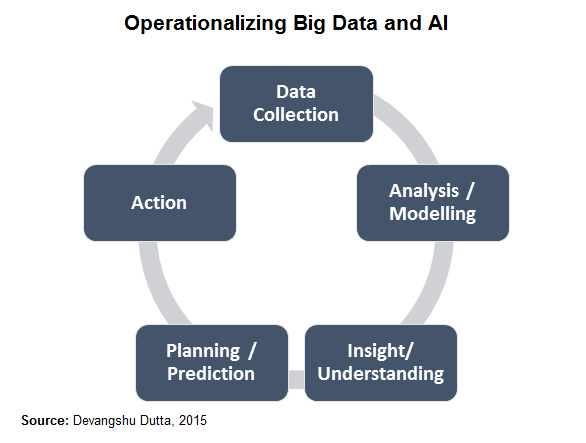
“Big data” models still depend on individuals in the business taking decisions and acting based on what is recommended or suggested by the analytics outputs, and these tend to be weak links which break the learning-adaptation chain. Of course, each of these elements can also have AI built in, for refinement over time.
Certainly retailers with a digital (web or mobile) presence are in a better position to use and benefit from AI, but that is no excuse for others to “roll over and die”. I’ll list just a few aspects of the business already being impacted and others that are likely to be in the future.
On the consumer-side, AI can deliver a far higher degree of personalisation of the experience than has been feasible in the last few decades. While I’ve described different aspects, now see them as layers one built on the other, and imagine the shopping experience you might have as a consumer. If the scenario seems as if it might be from a sci-fi movie, just give it a few years. After all, moving staircases and remote viewing were also fantasy once.
On the business end it potentially offers both flexibility and efficiency, rather than one at the cost of the other. But we’ll have to tackle that area in a separate piece.
(Also published in the Business Standard.)
admin
September 7, 2016
Horticulture production in India has been surpassing the production of food grains for many years. In 2014-15, the total production of horticultural produce was estimated by the Department of Agriculture, Cooperation and Farmers Welfare, Ministry of Agriculture to be approximately 281 million tonnes as against 252 million tonnes of food grain production and 275 million tonnes of oilseeds.
Horticulture and floriculture have result in growing foreign earnings, and India’s domestic market is also growing. In fact the demand for many types of vegetables and fruits which are not native to India such as lettuce, broccoli, gherkins, as well as for exotic flowers such as orchids, gerberas, carnations, is soaring. These crops were initially being cultivated only for export, but are now being bought by the urban population within India as well, as a result of growing familiarity with other cultures, and shifts in cuisines and lifestyles.
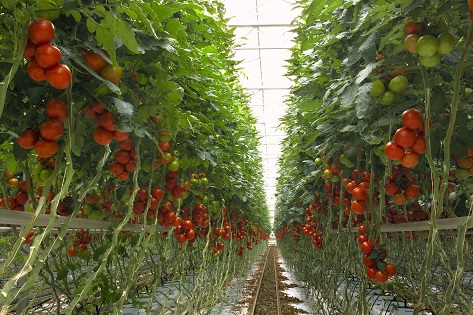
Many of these crops require specific climatic conditions which are not available in all parts of India, hence, cultivating them in controlled environments is a preferred option. Other than providing them a hospitable environment, the yield of the crop can be significantly better and availability can be all-year round, providing better market prices in the off-season. Greenhouses can be used by farmers for years to grow and sell exotic vegetables and other high-value commodities. Moreover, greenhouses help reduce the expenditure on pesticides by warding off insects and pests, many of which are carriers of viral and other infections. There is, therefore, considerable merit to extending the area under this system of cultivation, for the benefit of both producers and consumers.
While greenhouses have existed for more than one and a half centuries in various parts of the world, in India use of greenhouse technology started only during 1980’s and it was mainly used for research activities. The commercial utilization of greenhouses started from the late-1980s and with the introduction of the Government’s liberalization policies and development initiatives, several businesses were set up as 100 per cent export oriented units. Now many progressive farming organisations and individual farmers are using varied levels of technology in order to control the environment in which agriculture is done.
Although, there is an upfront capital cost involved in the setting up of a greenhouse, the scale of the greenhouse and proper management helps in yielding viable results. Most of the greenhouse projects in India at this point of time are on landholdings of up to 1 acre. However interest is seen to be growing towards projects of larger landholdings. Capital costs per acre range from Rs. 15 lakhs for a basic green house with simple techniques to control temperature and humidity, to Rs. 1.5 crore for automated greenhouses with superior humidity and temperature control, more closely managed water and nutrient dispersal etc.
Protected cultivation is one the important interventions of the National Horticulture Mission. Various patterns of assistance in the form of subsidies (ranging up to 50% of the cost of setting up the structures) have been devised by the government to encourage farmers to engage with this form of cultivation.
To encourage cultivation of vegetables under controlled atmosphere, Punjab government has empanelled five firms to assist farmers to set up polyhouses and polynet houses in their fields. The state government will provide subsidy on the greenhouse structures erected by these firms.
In Khammam, Telangana, the Horticulture Department is readying two poly-house demonstration units to popularise greenhouse technology and help farmers take up cultivation of high yielding vegetables round the year under controlled weather conditions.
Projects have already been taken up in Telangana, Gujarat and Himachal Pradesh ranging from feasibility studies of green house facilities and distribution halls for grading, sorting and packing to designing and setting up of green houses for breeding of rice and other crops and cultivation of tomatoes, strawberries, capsicum, cucumbers and lettuce.
For higher end, larger scale farms, Indian growers are also exploring technology from Europe. For instance, the Netherlands is the traditional exporter of greenhouse grown flowers and vegetables all over the world. The Dutch greenhouse industry is one of the most advanced in the world, and has now also become a provider of technology and support for the development of greenhouse cultivation around the world. Advanced technology solutions include climate sensors, air treatment devices, and software support.
However, success doesn’t only depend on equipment. Organisations such as Koppert provide biological solutions for natural pest control, natural pollination and seed treatment, to not only improve the quality and yield of the produce, but also make it safer.
There are many Indian as well as international organisations providing greenhouse solutions ranging from materials, technology and project consultancy. In the coming years it is expected that India’s rich agricultural, horticultural and relatively newer floricultural expertise will get enhanced and further competitive with the adoption of greenhouse cultivation to feed the burgeoning global and domestic demand.
