
admin
July 28, 2024

Writankar Mukherjee, Economic Times
Kolkata, 28 July 2024
Top retail chains such as Reliance Retail, Shoppers Stop and Spencer’s Retail are facing a prolonged slowdown in consumption, pushing them to exit unprofitable markets, raise debt and control costs.
India’s largest retailer Reliance Retail shuttered 249 stores in the three months ended June. The company is also going slow on expansion, opening 331 new stores in the quarter compared to 470-800 stores opened every quarter in FY22, FY23 and FY24. The closures mean the retail business of Reliance Industries made 82 net new store additions last quarter–the lowest in 15 quarters.
Spencer’s Retail has decided to completely exit North and South India markets by closing 49 stores in the National Capital Region (NCR), Andhra Pradesh and Telangana. The step will erase Rs 490 crore of annual revenue, but the company is hopeful it will improve profitability.
Shoppers Stop chief executive officer Kavindra Mishra told investors last week that it may have to defer a few store openings this fiscal due to regulatory and other issues. The company will also borrow Rs 100 crore for expansion with demand remaining soft.
Meanwhile, V-Mart Retail has closed 22 stores in the first six months of 2024, as per its latest investor presentation.
“Pruning underperforming locations is a natural reaction during times of demand stress,” said Devangshu Dutta, CEO of retail sector consulting firm Third Eyesight.
Pure Economics
“Demand forecasting can never be perfect due to a lag between demand assessment and supply. Retailers now try to do away with underperforming stores at the bottom of the pile quickly. Earlier there were prestige issues in shutting down stores, but now it’s acceptable industry practice and pure economics,” said Third Eyesight’s Dutta.
Analysts say most retailers expanded rapidly after the pandemic, banking on pent-up demand and revenge shopping at the time. With demand turning sluggish, the industry is now being forced to take various steps to sustain operations. At Reliance Retail, net profit rose by a modest 4.6% from a year earlier in the June quarter to Rs 2,549 crore while revenue grew 6.6% to Rs 66,260 crore. It was the slowest pace of revenue growth and came after a 9.8% increase in Q4FY24. Net profit and revenue from operations fell sequentially in the June quarter.
Spencer’s Retail CEO Anuj Singh told analysts on Thursday the 49 stores it is closing make up nearly 22% of revenue, but also Rs 56 crore of losses at the regional Ebitda level in North and South India. “They were a drag on the balance sheet. We will now focus on Uttar Pradesh and the East where there is a sizable consumption opportunity with a 250 million population,” he added.
Singh said the store rationalisation exercise and about 35% headcount reduction at corporate offices will reduce overheads from 8% operating cost to 6.3% of total sales. “We now expect to achieve Ebitda breakeven by March 2025 which will give us the option to raise capital,” he said.
Mishra at Shoppers Stop said demand remained subdued last quarter due to fewer wedding dates, long election season with polling dates on weekend, heatwaves, and high level of cumulative inflation. All these factors combined hit growth and volume recovery, except in value fashion and beauty.
More stores shut than opened
In fact, the sustained demand slowdown saw chains like Pantaloons, Spencer’s Retail and Nature’s Basket close more stores than they opened last fiscal. Retailers like V-Mart Retail, W, Aurelia and Titan Eye+ had a higher rate of store closures than openings in the March quarter.
(Published in Economic Times)
admin
June 15, 2024

Kolkata & New Delhi, 15 June 2024
Writankar Mukherjee and Faizan Haidar, Economic Times
Indian retail is increasingly bedevilled by shrinkage or the loss of inventory due to shoplifting by customers, theft by employees, vendor fraud and supply chain errors. As a percentage of sales, shrinkage has risen at retail chains in India with industry executives attributing this to the rise in thefts amid growth in sales volumes.
Tata-owned Trent Ltd said in its annual report that shrinkage swelled to 0.41% of sales in FY24 from 0.22% in FY23, primarily due to significant volume growth. In FY20, it was 0.21% and had actually come down to 0.19% in FY22. Trent’s sales volumes have almost doubled year-on-year in FY22, FY23 and FY24. Trent owns the Westside and Zudio chains.
At V-Mart Retail, this has gone up from 0.4% in FY23 to 0.5% in FY24.
“Shrinkage has gone up in the industry and has become a whole new challenge,” said V-Mart Retail managing director Lalit Agarwal. “Whenever business goes up, it tends to go up. Also, the new generation wants more even when times are tough. We try to ensure it remains under control.”
The All India Mobile Retailers Association (AIMRA), which represents cellphone retail stores, said several of the large and regional retail chains have reported a surge in shrinkage, mostly by employees. While five years back, it used to be around ₹50,000 to ₹1 lakh per month for the retail chains, it’s now around ₹5-10 lakh per month, AIMRA chairman Kailash Lakhyani said.
Shrinkage goes up during events such as the Indian Premier League (IPL) and the festive season when some employees try to make a quick buck by selling store inventory in the grey market, at times to fund bets, Lakhyani said.
“Retailers file police complaints and claim insurance, but still it’s a pain,” he said.
Interestingly, shrinkage disclosures by most Indian retailers – including listed ones – are something of a taboo for them unlike their western counterparts.
Highest in Apparel, Shoes and Fashion
Devangshu Dutta, chief executive at Third Eyesight, a retail sector consultancy, said shrinkage is an operational reality and a cost which retailers monitor very closely.
“However, they may not publicly disclose the numbers if it reflects poorly on their operational controls and security. Shrinkage goes up when there is economic tightening and high inflation as India has gone through in the last couple of years,” he said.
Shrinkage is the highest in apparel, shoes and fashion categories, retailers said, followed by gadgets like mobile phones, smartwatches and headphones where the risk-reward ratio is higher due to small pack sizes and the high value of the goods.
Cracking Down
Retailers are going in for stricter audits to rein in such losses. Cellphone and electronic stores have started doing them on a daily basis. Shoe retailer Woodland has set up local audit teams, unlike the centralised ones earlier, so that shrinkage can remain under control at 0.2% of sales, said chief executive Harkirat Singh.
If it goes out of control, staff can get penalised. “Shrinkage beyond a certain limit is realised from the store team,” Singh added.
Still, Retailers Association of India chief executive Kumar Rajagopalan said shrinkage till 0.5% of sales is manageable as globally it is 1.5-2%.
“We are not yet at the alarming stage. In India, the return rate of a product is high and sometimes those products are not in the condition to be sold again, adding to the burden,” he said. RAI is a grouping of organised retailers.
In a 2023 retail security survey by the US-based industry body National Retail Federation, the average shrink rate in 2022 increased to 1.6% from 1.4% in 2021. That represented $112.1 billion in losses in 2022, up from $93.9 billion in 2021.
(Published in Economic Times)
admin
October 26, 2023

Sagar Malviya, Economic Times
26 October 2023
Surging demand for fitness wear and sports equipment for disciplines other than cricket and football helped Decathlon’s India unit expand sales 37% to Rs 3,955 crore in FY23. With more than 100 large, warehouse-like stores selling products catering to 85 sporting disciplines, the French company is bigger than Adidas, Nike and Asics all put together in India.
In FY22, sales were Rs 2,936 crore, according to its latest filings with the Registrar of Companies. The retailer, however, posted a net loss of Rs 18.6 crore during the year ended March 2023 compared to a net profit of Rs 36 crore a year ago.
Experts said a host of factors – from pricing products about 30-40% lower than competing products to selling everything from running shoes, athleisure wear to mountaineering equipment under its own brands – has worked in its favour. “They have an extremely powerful format across different sporting activities and have something for both active and casual wear shoppers. For them, the market is still under penetrated with the kind of comprehensive product range they sell for outdoor sports beyond shoes and clothing,” said Devangshu Dutta, founder of retail consulting firm Third Eyesight. “Even their front end staff seem to have a strong domain knowledge about products compared to rival brands.”
By selling only private labels, Decathlon, the world’s biggest sporting goods firm, controls almost every bit of operations, from pricing and design to distribution, and keeps costs and selling prices low.
Decathlon uses a combination of in-house manufacturing and outsourcing to stock its shelves. In fact, it sources nearly 15% of its global requirement from India across sporting goods. And nearly all of its cricket merchandise sold globally is designed and made in India.
(Published in Economic Times)
admin
August 28, 2023

Viveat Susan Pinto, Financial Express
August 28, 2023
Coffee Day Global, which operates the Cafe Coffee Day (CCD) chain, has been given a temporary relief against bankruptcy proceedings initiated by lender IndusInd Bank last month. The Chennai bench of the National Company Law Tribunal (NCLAT) last week halted admission of IndusInd Bank’s plea against Coffee Day Global, a subsidiary of the listed Coffee Day Enterprises (CDEL), by the NCLT Bengaluru, till September 20.
What this means for CCD is that it get some more time at a time when it has swung into the black after struggling for the last few years, since the tragic demise of its founder VG Siddhartha in 2019. Coffee Day Global posted a net profit of Rs 24.57 crore for the June quarter of 2023-24 (FY24) versus a net loss of Rs 11.73 crore reported in the same period last year.
Revenue from operations stood at Rs 223.20 crore in the quarter under review, a growth of nearly 18% versus the year-ago period, CDEL results for Coffee Day Global showed.
More importantly, CCD outlets are down to 467 in the June quarter of FY24 from a peak of 1,752 stores in FY19, indicating that the company is shutting down unprofitable operations as it looks to manage its debt and other expenses. Group debt is down to Rs 1,711 crore, according to its latest annual report for FY23, versus Rs 7,214 crore reported in FY19.
“While the coffee retail market in India is growing, in CCD‘s case the need to downsize has to do with internal issues. Sometimes a smaller footprint just helps to manage operations better especially when you are dealing with larger problems such as a debt overhang,” says Devangshu Dutta, chief executive officer of retail consultancy Third Eyesight.
CCD’s financial health is critical for CDEL, which derives close to 94% of its group turnover from the coffee retail business, according to its FY23 annual report. In FY22, the contribution of the coffee retail business to group turnover was 85%. Losses of Coffee Day Global in FY23 narrowed to Rs 69.62 crore from Rs 112.48 crore in FY22. In FY19, the company had a net profit of Rs 10 crore.
Apart from cafes, CCD also has kiosks and vending machines installed in corporate offices, institutions and business hubs. While the number of kiosks has fallen over the last few years and is at around 265 now from a peak of 537 in FY19, the number of vending machines have been growing after briefly slowing down over the last few years. From a peak of 58,697 crore in FY20, it is now at 50,870 in number, the company’s latest results show.
CCD is also expected to fight the insolvency proceedings against it aggressively, according to industry sources. IndusInd Bank has claimed that Coffee Day Global defaulted on a loan of Rs 94 crore, which occurred on February 28, 2020. The company has disputed this in court.
(Published in Financial Express)
Devangshu Dutta
January 10, 2017
In this piece I’ll just focus on one aspect of technology – artificial intelligence or AI – that is likely to shape many aspects of the retail business and the consumer’s experience over the coming years.
To be able to see the scope of its potential all-pervasive impact we need to go beyond our expectations of humanoid robots. We also need to understand that artificial intelligence works on a cycle of several mutually supportive elements that enable learning and adaptation. The terms “big data” and “analytics” have been bandied about a lot, but have had limited impact so far in the retail business because it usually only touches the first two, at most three, of the necessary elements.
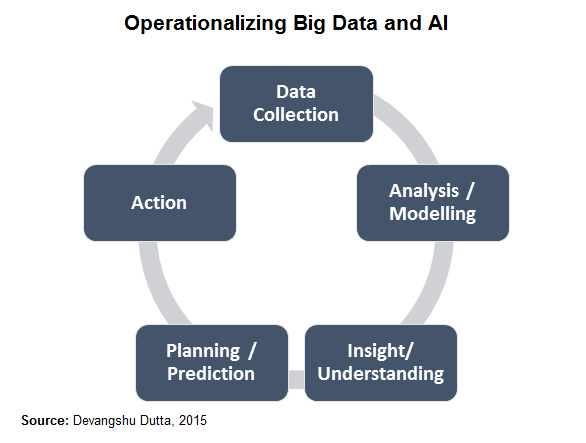
“Big data” models still depend on individuals in the business taking decisions and acting based on what is recommended or suggested by the analytics outputs, and these tend to be weak links which break the learning-adaptation chain. Of course, each of these elements can also have AI built in, for refinement over time.
Certainly retailers with a digital (web or mobile) presence are in a better position to use and benefit from AI, but that is no excuse for others to “roll over and die”. I’ll list just a few aspects of the business already being impacted and others that are likely to be in the future.
On the consumer-side, AI can deliver a far higher degree of personalisation of the experience than has been feasible in the last few decades. While I’ve described different aspects, now see them as layers one built on the other, and imagine the shopping experience you might have as a consumer. If the scenario seems as if it might be from a sci-fi movie, just give it a few years. After all, moving staircases and remote viewing were also fantasy once.
On the business end it potentially offers both flexibility and efficiency, rather than one at the cost of the other. But we’ll have to tackle that area in a separate piece.
(Also published in the Business Standard.)
