
admin
September 1, 2026
Pritha Pahari, The Core
1 September 2026
Reliance has spent more than a decade bringing together a long list of names such as Burberry and Tiffany & Co. to India. Its latest focus seems to be luxury celebrity brands, adding global pop star Rihanna’s Fenty Beauty and now media personality Kim Kardashian’s shapewear label SKIMS to its luxury brands portfolio.
Isha Ambani, executive director of Reliance Retail, has fronted most of these announcements herself.
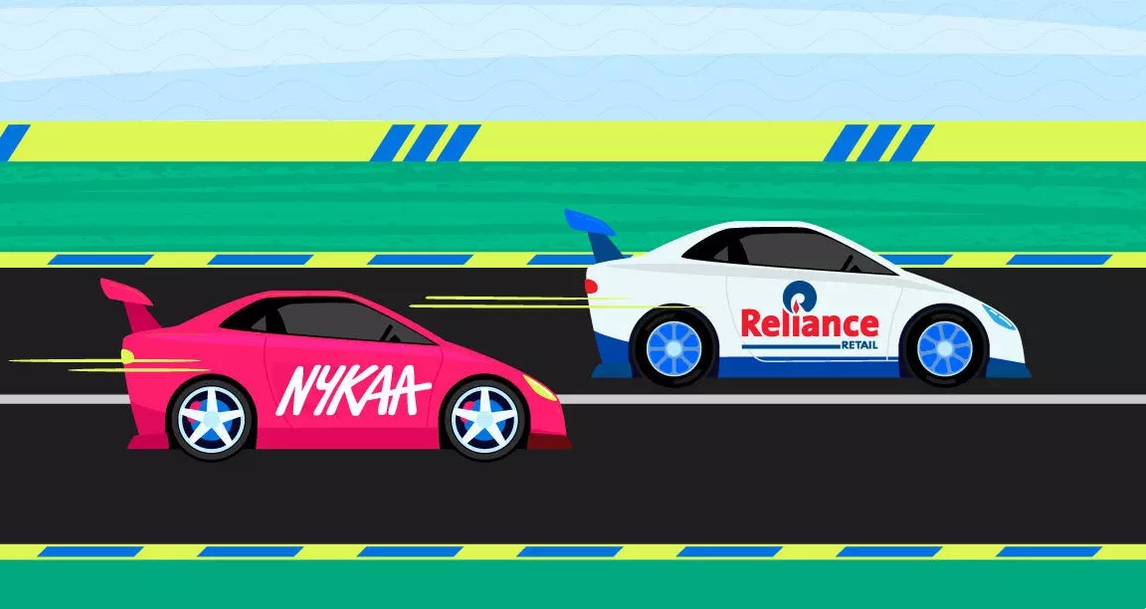
Meanwhile, Nykaa, the beauty platform Reliance Retail keeps getting compared to, spent the last year going after some of the same celebrity founders.
In August 2025, Fenty Beauty moved from Nykaa’s platform to an exclusive deal with Reliance’s Sephora India and Tira. In June 2026, Nykaa answered by signing pop star Selena Gomez’s Rare Beauty. A month later, Reliance landed SKIMS.
India’s luxury and celebrity-brand market is split between Reliance’s scale and Nykaa’s beauty expertise, with Fenty, Rare Beauty and SKIMS showing how ownership, reach and brand fit are shaping who gets the biggest names.
Big Brands, Different Bets
Reliance wins brands through scale (20,169 stores, 396 million customers) and ownership ties; Fenty’s move to Sephora India is less a market choice than an internal LVMH routing decision, given LVMH’s stakes in both Fenty and Sephora.
But Nykaa is holding its own by competing on specialism, not size; its beauty-literate audience and curated community pulled in Rare Beauty and Chanel.
The brand fit, not just distribution muscle, still decides who signs where, and some brands (like Birkenstock) skip both platforms entirely.
The economics behind these deals are harder to pin down than the headlines suggest. None of the three — Fenty, Rare Beauty, or SKIMS — have disclosed minimum guarantees, royalty rates, or sales targets for their India entries; these are announced as partnerships, not filed joint ventures.
SKIMS raised $225 million in November 2025 at a $5 billion valuation, nearing $1 billion in annual net sales.
Fenty tells a different story: $450 million in 2024 sales, now valued at $1-2 billion, down sharply from a $2.8 billion estimate in 2021, with Jay-Z’s MarcyPen Capital Partners in talks to buy LVMH’s stake.
Rare Beauty’s India entry rides on Nykaa’s own momentum; the company’s revenue from operations rose 29% year on year (YoY) to Rs 2,782 crore in Q1 FY27, up from Rs 2,154.9 crore a year earlier. In the last quarter of FY26, revenue stood at Rs 2,648.1 crore.
The Core has reached out to Reliance and Nykaa for their response, and will update this report if and when they respond.
Why Fenty Chose Reliance
Fenty’s move looks more like an internal one, according to Suumit Kapoor, a brand growth consultant.
LVMH owns 50% of Fenty Beauty through its beauty incubator Kendo Brands, a stake it has held since co-founding the brand with Rihanna in 2017. LVMH also owns Sephora globally, and Sephora in India is run by Reliance.
“When Fenty enters a new market through Sephora, LVMH is effectively distributing its own equity stake through its own global retail infrastructure,” Kapoor said. For a brand with that kind of ownership overlap, he added, the choice of partner is “close to an internal routing decision” and not a genuine trade-off.
That ownership overlap is itself now in a pickle.
LVMH has been exploring a sale of its 50% Fenty stake since October 2025, working with investment bank Evercore, according to Reuters. As of June 2026, American rapper and businessman, Jay-Z’s investment firm MarcyPen Capital Partners was reported to be among the parties in talks to buy it.
No sale has closed yet, so the Reliance-Sephora-LVMH alignment still holds for now, but it isn’t guaranteed to outlast the current ownership structure.
Fenty’s India journey backs this up. The brand’s first India listing wasn’t through Reliance at all.
It ran on Nykaa’s Cross Border Store, a low-commitment digital shelf that was discontinued before Fenty’s August 2025 relaunch, an exclusive omnichannel deal with Reliance spanning more than 50 stores across 16 cities on day one.
Kapoor doesn’t think of the switch as a deliberate strategic upgrade.
“The Cross Border Store listing may simply have underperformed on its own terms, without much marketing support behind it,” he said, adding that there is no clear evidence that Reliance stole the brand away.
Devangshu Dutta, founder of the research firm Third Eyesight, said celebrity backing only buys a brand little room.
“When a company or an investor buys into an early-stage celebrity brand, they are acquiring instant brand equity which acts as a top-of-the-funnel magnet and potentially lower CAC,” he said. “However, the ‘fame premium’ runs out if product and service execution isn’t compelling enough to drive repeat business and customer retention.”
Ownership decides the biggest deals before “competition” even enters the picture, Fenty landed at Reliance’s Sephora because LVMH owns half of each, though that alignment is shakier than it looks, with Jay-Z’s MarcyPen Capital Partners now the leading bidder for LVMH’s Fenty stake.
Beyond ownership, it’s a straight trade-off.
For brands chasing scale, Reliance’s tens of thousands of stores will get you reach. If brands want to chase community, Rare Beauty did by picking Nykaa specifically to tap its affluent, digitally engaged beauty shoppers and build loyalty. Some brands skip the fight altogether, like Birkenstock, which walked into India solo.
The Distribution Gap
Where Reliance doesn’t need an ownership story to make its case is scale. Reliance Retail closed the quarter ended June 2026 with 20,169 stores across 78.4 million square feet, 396 million registered customers, and 568 million transactions in that single quarter, up 46% year on year, according to the company’s Q1 FY27 earnings release. JioMart alone served 5,500 pincodes through its rapid delivery network in the same period.
Nykaa, by comparison, operated 324 physical stores across 105 cities as of its FY26 numbers, with a cumulative customer base of around 42 million, per its own disclosures and Business Standard’s reporting on the company’s results.
“That gap generally buys a brand not just bigger numbers, but reaches into places where a beauty specialist has no reason to be,” Kapoor said. For brands thinking beyond beauty into wellness, gifting, or lifestyle crossovers, he said that scale “is not a nice-to-have. It is the entire argument for choosing Reliance over a beauty-only platform.”
Satish Meena, founder of Datum Intelligence, a research firm, made a similar point on Reliance’s pull with brands weighing an India entry.
“With the kind of strength they have, they can always give a better deal,” he said, referring to Reliance’s ability to commit capital and guarantee scale that a newer entrant typically cannot promise on its own. He pointed to Reliance’s existing retail relationships, including Marks & Spencer, as part of the track record that makes brands comfortable signing with the group.
Experts say over the past two to three years, Nykaa has been the more prolific launch platform for major international beauty brands, while Reliance has had greater strength in international luxury and fashion.
According to experts, Nykaa reported more than 70 luxury-brand additions over the last three years, including names such as NARS, Prada Beauty, La Prairie, Chanel Beauty, Armani Beauty and Maison Margiela. Reliance, meanwhile, has built a luxury portfolio spanning Valentino, Balenciaga, Bottega Veneta, Tiffany & Co., Burberry and others, and most recently brought SKIMS to India. Reliance’s public disclosures do not provide a comparable 2–3-year count of new international brand entries.
Reliance is arguably a major gateway for international luxury/fashion, but calling it the default gateway for international brands overall is too broad.
Where Nykaa Still Wins
Reliance’s advantage on raw numbers doesn’t fully explain why Nykaa keeps landing brands too.
Nykaa built its beauty audience before it built its stores, using tutorials and curated storytelling to create what Kapoor called “a beauty-literate customer base that arrives already primed to trust the platform’s recommendations.”
That specialism is what pulled in Rare Beauty. Nykaa’s June 2026 launch made the brand available through its website, app, and 30 stores nationwide, and came from a company reporting its highest quarterly profit since listing at the time, per its own disclosures.
In a company statement announcing the launch, Anchit Nayar, Nykaa Beauty’s executive director and CEO, said the brand fit a “new generation of highly informed and globally engaged consumers seeking elevated brand experiences.” Rare Beauty’s chief executive, Scott Friedman, said in the same announcement that India was “a very important market” for the brand, citing Nykaa’s beauty community in the country as the reason to partner with it specifically.
Nykaa has run a similar playbook before. Chanel strengthened its India fragrance and beauty presence on Nykaa in 2025, Obagi Medical entered India through the platform specifically for its clinically driven skincare positioning, and Estee Lauder’s incubation arm has run its India beauty programme, Beauty and You, with Nykaa as lead partner every year since 2022.
Dutta pointed to Kay Beauty, Nykaa’s own celebrity line with actor Katrina Kaif, as an example of why platform fit matters as much as platform size. Contrasting it with 82°E, actor Deepika Padukone’s skincare brand on Tira, he said Kay Beauty had two advantages: it was priced for a much larger audience, and it had “Nykaa’s active participation across channels for merchandising and visibility.”
Not The Only Door
Reliance’s pull is real, but it isn’t the only route into India.
Reliance benefits from international-brand partnerships through retail economics, distribution and, in some cases, ownership or joint-venture economics. The potential conflict emerges because Reliance can simultaneously act as a brand’s market-entry partner and control substantial retail and digital routes to consumers. Public filings, however, do not establish that Reliance uses this position to disadvantage partner brands or competing retailers.
Meena pointed to Birkenstock, which entered by opening its own stores rather than partnering with either platform. Birkenstock and similar labels operate as single-brand retail; they can use India’s foreign direct investment rules to set up shop directly, bypassing the need for a local partner altogether.
“If the brands think that they have enough pull in the market and they can bring customers, they are opening these stores without any partnership,” Meena said. He added that most global brands take the partner route anyway because India, for many of them, is still a small share of global sales, and testing the market with an established partner for a few years is lower risk than building from scratch.
Kapoor flagged one risk worth watching no matter which partner a brand picks. Exclusive deals give a retailer more control. But Tira has also started building its own private-label products, including a colour cosmetics line, and sells them in the same stores as the global brands it distributes.
“A retailer can be a brand’s distribution partner and, on an adjacent shelf, its competitor, at the same time,” he said, a tension he noted that Nykaa’s marketplace model, without a comparable private label push against premium brands, does not carry in the same way.
For brands already tied to Reliance through ownership, like Fenty, there isn’t much of a decision to make. For everyone else, Nykaa signing Rare Beauty and Reliance signing SKIMS within weeks of each other shows this fight for celebrity founders in India is far from over.
(Published in The Core)
admin
January 28, 2026

What does it actually take to build a fashion brand in India?
This panel (“Beyond the Noise- How D2c Fashion Brands Are Reinventing Retail”) at the 25th Edition of India Fashion Forum focussed on some real answers, in a refreshing, down-to-earth conversation moderated by Devangshu Dutta (Founder, Third Eyesight), with the founders of DeMoza (Agnes Raja George), The Mom Store (Surbhi Bhatia), Miraggio (Mohit Jain), BeyondBound (Tejasvi Madan), and Bari (Sameer Khan Lodhi).
No fluff, no “disrupting the industry” talk. Just founders being honest about what’s worked, what hasn’t, and what they’d do differently. A few things that struck a chord:
• Every single brand started because the founder couldn’t find something they personally wanted: inclusive activewear, affordable handbags that didn’t look cheap, good maternity wear. Sometimes the simplest observation is the best business idea.
• Inventory management came up often. One founder took their inventory cycle from 6 months down to 4. Another re-shuffles stock every 15 days based on what’s selling where. Unglamorous? Yes, but this is what actually keeps a business alive.
• The marketing conversation highlighted a move away from traditional advertising toward things that actually make people feel something. One founder talked about turning a farmhouse into a full “apricot colour” experience for customers. Another shoots content with real customers, not influencers.
• And the most memorable line of the whole discussion came from the most experienced founder in the room sharing a learning: “I won’t open stores fast.” No explanation needed, really.
Building a brand is exciting. Keeping it alive is the harder, quieter work. This panel was a good reminder of that. Worth a watch if you’re building something in this space.
admin
October 26, 2023

Sagar Malviya, Economic Times
26 October 2023
Surging demand for fitness wear and sports equipment for disciplines other than cricket and football helped Decathlon’s India unit expand sales 37% to Rs 3,955 crore in FY23. With more than 100 large, warehouse-like stores selling products catering to 85 sporting disciplines, the French company is bigger than Adidas, Nike and Asics all put together in India.
In FY22, sales were Rs 2,936 crore, according to its latest filings with the Registrar of Companies. The retailer, however, posted a net loss of Rs 18.6 crore during the year ended March 2023 compared to a net profit of Rs 36 crore a year ago.
Experts said a host of factors – from pricing products about 30-40% lower than competing products to selling everything from running shoes, athleisure wear to mountaineering equipment under its own brands – has worked in its favour. “They have an extremely powerful format across different sporting activities and have something for both active and casual wear shoppers. For them, the market is still under penetrated with the kind of comprehensive product range they sell for outdoor sports beyond shoes and clothing,” said Devangshu Dutta, founder of retail consulting firm Third Eyesight. “Even their front end staff seem to have a strong domain knowledge about products compared to rival brands.”
By selling only private labels, Decathlon, the world’s biggest sporting goods firm, controls almost every bit of operations, from pricing and design to distribution, and keeps costs and selling prices low.
Decathlon uses a combination of in-house manufacturing and outsourcing to stock its shelves. In fact, it sources nearly 15% of its global requirement from India across sporting goods. And nearly all of its cricket merchandise sold globally is designed and made in India.
(Published in Economic Times)
