
admin
October 5, 2026
Sagar Malviya, Economic Times
5 October 2026
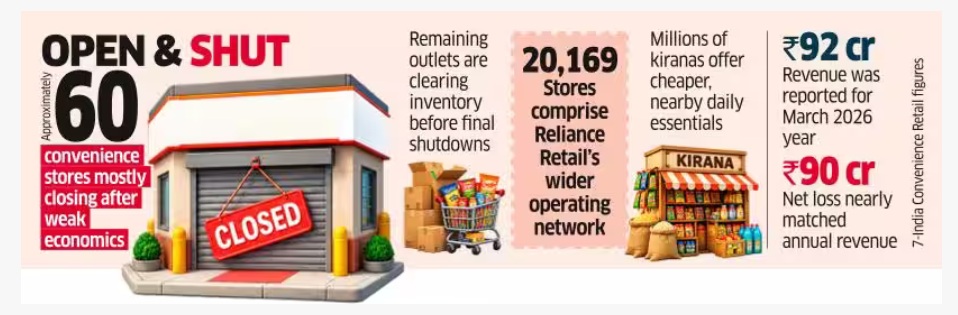
Reliance Retail and 7-Eleven are ending their five-year franchisee deal in India, closing most of the nearly 60 convenience stores they operated under the partnership, after struggling to make the format profitable, people familiar with the matter said.
A handful of outlets are clearing the inventory before shutting, they said. 7-Eleven may look for another Indian partner to keep a foothold in the market, although no decision has been made, the people said.
The exit highlights an unusual squeeze that convenience stores are facing in India, with millions of small kirana stores that have long served consumers’ immediate needs on one side and quick-commerce companies that are bringing the same snacks, groceries and daily essentials to doorsteps within minutes on the other.
Reliance and 7-Eleven did not respond to ET’s queries.
The partnership, struck in 2021, was intended to bring the world’s largest convenience-store chain to India through Reliance’s retail network. But the business struggled to achieve the scale needed to offset the relatively high costs of running branded stores.
The 7-India Convenience Retail venture reported revenue of about ₹92 crore ($10.6 million) and a net loss of nearly ₹90 crore in the year ended March 2026, according to its financial statements.
“Reliance wants to reach consumers across every channel, but sustainability ultimately matters. Convenience stores have faced increasing pressure from quick commerce since the pandemic, with both formats offering similar assortments and serving the same immediate-needs occasions,” said Devangshu Dutta, founder and CEO of Third Eyesight, a consumer-sector consultancy.
“Kiranas operate with far lower overheads and different margin expectations than corporate-run convenience stores. Reliance’s exit could therefore signal a broader rethink of the format, particularly in markets where quick commerce has become a strong alternative.”
Globally convenience stores have become powerful retail businesses in several markets despite the expansion of supermarkets and hypermarkets. 7-Eleven in Japan, Taiwan, Thailand and Singapore; Lawson in Japan and Oxxo in Mexico are among the largest retailers in their respective markets.
7-Eleven’s Japanese parent, Seven & i Holdings, operates more than 85,000 stores globally, making it one of the world’s largest retail networks. Yet the company has been restructuring its overseas operations and closing stores in North America as consumer behaviour and store economics change.
In India, however, organised convenience retail has struggled to replicate the success seen in other Asian and emerging markets. EasyDay, More and Spencer’s have either shut stores or shrank their smaller-format networks over the years, underscoring the difficulty of building profitable neighbourhood stores at scale.
Packaged consumer goods companies continue to derive roughly three-fourths of their sales from small neighbourhood stores, underlining the strength of the traditional distribution network. Quick commerce platforms are, meanwhile, expanding rapidly.
That makes it difficult for organised convenience stores to charge a premium or generate sufficient sales density to cover higher rents, staffing, inventory and logistics costs.
Convenience retail works best when operators achieve high store density and productivity, supported by strong supply chains and differentiated offerings such as fresh food and private labels.
Reliance initially expanded the 7-Eleven network in Mumbai and other markets, but the footprint remained small compared with the company’s wider retail operations.
(Published in Economic Times)
admin
August 18, 2025

Hiral Goyal, The Morning Context
18 August 2025
A trend that has been playing out through big and small changes over the last two decades is that in urban India the kirana store is easily replaceable.
When it comes to buying groceries, urban Indians have a number of options. They can visit a fancy supermarket run by a conglomerate or order online through a number of e-commerce and instant-delivery companies. And if the above doesn’t seem easy enough, they can hop over to a nearby mom-and-pop store.
It would appear it is now the turn of smaller towns in the country to witness the kirana disruption. Even though 99% of grocery shopping in these tier-3 cities is done through neighborhood general stores, there are startups that believe this is an outdated and inefficient form of retail and a change is in order.
One such company is SuperK. The startup’s mission is to build a grocery store model in small towns that has all of the advantages of modern retail packed in a compact 800-square-foot store. This is what Anil Thontepu and Neeraj Menta had set out to do when they founded the company in 2019. The idea was to bring a modern trade-like grocery shopping experience to small-town India a wide assortment of products at a better value.
“There is a cost-efficient world of general trade and a customer-loving world of modern retail,” says Thontepu. “We wanted to see if we can bridge this gap…and do something for the small-town people by bringing the best of both these worlds.”
Over the past five years, the Bengaluru-headquartered startup has opened over 130 stores across 80 towns in Andhra Pradesh. And it doesn’t want to stop there. The company wants to expand to another 300 towns in Andhra Pradesh and nearby states of Karnataka and Telangana over the next 24, months. That’s quite an ambitious target. But the founders believe the market size for Superk is so large that they should be able to build a Rs 2,000-3,000 стоore ($228-342 million) annual business from Andhra and Telangana alone.
To fuel this expansion, Superk raised Rs 100 crore ($11.7 million) in Series B funding last month. The round, led by Binny Bansal’s 3STATE Ventures and CaratLane founder Mithun Sacheti, valued Superk at 2-2.5x its previous valuation of Rs 160 crore (about $18.25 million) in 202/
Now, Superk is not entirely unique. It competes with startups like Frendy, Apna Mart and Wheelocity, which are also trying to organize the retail market in India’s smaller towns. What sets SuperK apart is its larger, bolder approach. Grocery chain Apna Mart, for instance, runs franchisee stores in tier-2 or tier-3 markets and also offers 15-minute home delivery, SuperK’s focus is only on supermarkets. Frendy operates mini-marts and micro-kiranas in villages and towns with fewer than 10,000 people, but SuperK targets small towns with populations between 20,000 and 500,000. And Wheelocity supplies only fresh produce to rural areas, while Superk sells dry groceries as well as packaged consumer goods.
This rather radical shift in focus-away from tier-1 and tier-2 cities-ties in with India’s changing consumption pattern. “Consumer mindsets are changing even in smaller cities,” says Devangshu Dutta, founder and chief executive of Third Eyesight, adding that these consumers are beginning to favour more modern retail environments. And NielsenIQ’s latest report says rural markets in India grew twice as fast as cities between April and June 2025.
In this landscape, SuperK fits like a glove, with its franchise-first approach. Thanks to an asset-light model, the company has the agility to go deeper into smaller towns.
But it won’t be all that easy either. As Dutta says, “Changing grocery habits is a long, capital-intensive game.” Moreover, big retail chains are also jumping on the bandwagon. Hypermarket chain Vishal Mega Mart, for instance, already operates 47% of its stores in tier-3 cities and plans to expand into cities with populations exceeding 50,000. Supermarket chain operator DMart is also focusing on tier-2 and tier-3 cities.
However, Superk founders believe they are prepared for the challenge. Menta says the startup has arrived at a business model that is scalable, sustainable and, more importantly, offers value to its customers.
It’s too early to say whether they will be successful in this endeavour. That said, SuperK appears to have built a smart retail business for small-town India.
Refining small-town retail
SuperK’s founders have drawn inspiration from domestic and international retail chains like DMart and Costco. But they haven’t duplicated their strategies and made their own tweaks instead. For instance, large retail chains usually run company-owned and company operated, or COCO, stores. Though this approach is more cost-intensive than the franchise model, it allows a company to ensure a uniform customer experience across all outlets:
Superk doesn’t do that. It runs only franchise-owned and franchise-operated (FOFO) stores, which are no bigger than 800 sq ft. The company is not the first to have experimented with this model, but Thontepu believes that everyone else before them “did not try with the right spirit”. A franchise-owned store, argues co-founder Menta, is run differently from a company-owned store one has to keep in mind the store owner’s incentives, needs and concerns.
Under the franchise model, entrepreneurs invest between Rs 12 lakh (about $13,690) and Rs 15 lakh (about $17,110) to set up a Superk store. Of this, Rs 4 lakh (nearly $4,560) is spent on the store fit-out and infrastructure, the rest goes towards buying inventory. These stores, according to Menta, typically achieve a breakeven point after six months. On average, a retail store takes longer than that-12-15 months to reach breakeven.
Superk fills the shelves by procuring its inventory directly from brands as well as distributors. “The inventory is recommended by us through a mobile application. Store owners have an option to make certain changes within the limits that we have set for them,” says Thontepu. Revenue is shared and the model is similar to the one followed by nearly all retailers in India. Franchisees earn varying levels of margins on different kinds of products, depending on how easy or tough it is to sell those items. For instance, staples like dal and rice have lower margins, while confectionary items and products that need greater effort to sell enjoy higher margins of up to 20%.
In addition to this, there’s a private label business, especially loose items like pulses. In fact, private labelling is part of the company’s efforts to bring some standardization in India’s unorganized retail market. “A customer coming to our store should be able to blindly expect consistent quality on the product they’re buying,” says Menta. “We have organized our sourcing, processing, cleaning, packaging, testing. Everything that a brand would do to provide a great-quality product to their customer.”
Unlike distributors or other retailers who operate franchise models though, Superk claims that it does not dump its inventory on store owners. Menta says the franchise structure is designed in a way that Superk does not benefit from selling unnecessary stock to store owners. “If I lose, he will lose. If he loses, I lose. That is the way (the structure) is created. We, in fact, recommend owners to remove some products if they are not selling.” says Menta.
On the customer side of things, Superk’s value proposition comes down to offering the best prices. More than a year ago, for instance, it introduced a membership programme that offers customers cashback that is redeemable on their future purchases. “If they pay Rs 300 [approximately $3.5) for a six-month membership, they get 10% cashback on all purchases that they are making up to Rs 300 every month,” explains Thontepu. He says 35-40% of Superk’s more than 500,000 customers are enrolled in this programme.
All of this sounds good even promising in theory. But will it be enough to build a sustainable and scalable retail business?
A long, hard look
Let’s first look at what really works in SuperK’s favour.
One, the focus on selling staples under a private label brand. This has been done successfully before. One example is Nilgiri’s, one of India’s oldest supermarket chains.
Founded in 1905, Niligiri’s operated under a franchise model and sold dairy, baked goods, chocolates and other items produced under its own brand. The supermarket chain was sold by debt-ridden Future Group for Rs 67 crore ($7.65 million) in 2023, less than one-third the price the latter paid to acquire the company from private equity firm Actis in 2014. However, its history is worth learning from.
Shomik Mukherjee, a Delhi-based consumer goods advisor who was a partner at Actis while the firm was in control of Nilgiri’s, recalls the value proposition created by Nilgiri’s private label products. “In the case of private labels, it is essential for a company to have a reason why people will walk into that store. For Nilgiri’s, it was bakery and dairy products,” says Mukherjee. Owning a private label that brought in customers also ensured that franchisee owners had incentives to continue working with Nilgiri’s. “It is about giving the franchisees a safe portfolio of private label goods that are desired by customer instead of something that is shoved down the franchisees’ throat to derive margin,” he says.
You see, the overall grocery business operates on a very low margin. But private labelling, says Satish Meena, founder of Datum Intelligence, offers the highest margins – 35-40% – in the grocery business, after fresh produce, making it a lucrative business to get into.
Superk, which sells essential items through its private label, has the opportunity to earn better margins in grocery retail. More importantly, private labelling holds the potential to become SuperK’s identity and boost customer retention and loyalty.
Two, SuperK’s franchise model allows it to expand to more locations rapidly as compared to a regular modern trade chain with company-owned stores, says Mukherjee. This model makes SuperK’s business asset-light and brings down the cost of running a network of stores. “Under this model, the franchisor does not incur the upfront cost of opening a store or having to deal with the trouble of hiring and replacing store managers,” he adds. Since most store owners in a franchise model are landowners, there is a greater stability in operations as well, he explains. Moreover, Superk stores are quite small (800 sq ft), allowing easier availability of property.
The franchise model, however, is not entirely foolproof. One of the inherent problems is the difficulty in implementing standard operating procedures (SOPs) across all stores. And the problem only worsens as the company expands operations to different cities. While Superk stores boast a no-frills fit-out that can be easily set up anywhere, how these stores are maintained through the wear and tear over the years is yet to be seen.
A bigger fear is that the store owner may start running their own store without the Superk branding. “If Superk loses the franchisee owner, it also loses the location in which the store was operating,” says Mukherjee.
Moreover, most franchisee owners in the retail business typically tend to be experienced general store owners who might not be willing to adopt new technology. “Since they have run a store before, they think they know how and what to order for inventory and may not follow SuperK’s tech-enabled recommendations,” says Mukherjee.
There’s another problem. While the founders claim to have seen considerable success (35-40% sign-ups) in the rollout of SuperK’s membership programme for customers, Third Eyesight’s Dutta raises concerns about its future growth. “Indian consumers’ price sensitivity limits membership fee potential,” he says. According to him, the programme’s value in the tier-3 market lies more in customer acquisition and retention than direct revenue generation. “Long-term success requires a cashback programme to drive purchase frequency and basket size increases to offset the costs,” says Dutta.
Menta, however, has a different view. He says SuperK’s subscription is designed in a way that benefits customers only when they make full basket purchases. Moreover, the company has different pricing slabs for membership depending on the various basket sizes, which makes the model more viable. Considering the programme is a little more than a year old, it is still too early to judge whether it will find a lot of takers in small towns.
For now, the founders are in no hurry to expand their business across India. “There is no reason to go into five states. Then, you are spread thin and your economics will not work out. It’s a business of managing operations at a very low cost,” says Menta. The plan is to stick to one region and continue to go deeper into it. “A lot of our competitors who started five years ago spread to so many places that it became very difficult for them to manage,” he adds.
This is also the crux of how Thontepu and Menta are building SuperK. By implementing what they have learnt not only from their own experiments, but also from the failures and successes of other businesses. While there’s no guarantee that Superk will become a roaring success, it does appear to have set an example by starting small and growing patiently. And if the latest funding is any proof, investors are interested.
(With inputs from Neethi Lisa Rojan)
(Published in The Morning Context)
admin
July 28, 2024

Writankar Mukherjee, Economic Times
Kolkata, 28 July 2024
Top retail chains such as Reliance Retail, Shoppers Stop and Spencer’s Retail are facing a prolonged slowdown in consumption, pushing them to exit unprofitable markets, raise debt and control costs.
India’s largest retailer Reliance Retail shuttered 249 stores in the three months ended June. The company is also going slow on expansion, opening 331 new stores in the quarter compared to 470-800 stores opened every quarter in FY22, FY23 and FY24. The closures mean the retail business of Reliance Industries made 82 net new store additions last quarter–the lowest in 15 quarters.
Spencer’s Retail has decided to completely exit North and South India markets by closing 49 stores in the National Capital Region (NCR), Andhra Pradesh and Telangana. The step will erase Rs 490 crore of annual revenue, but the company is hopeful it will improve profitability.
Shoppers Stop chief executive officer Kavindra Mishra told investors last week that it may have to defer a few store openings this fiscal due to regulatory and other issues. The company will also borrow Rs 100 crore for expansion with demand remaining soft.
Meanwhile, V-Mart Retail has closed 22 stores in the first six months of 2024, as per its latest investor presentation.
“Pruning underperforming locations is a natural reaction during times of demand stress,” said Devangshu Dutta, CEO of retail sector consulting firm Third Eyesight.
Pure Economics
“Demand forecasting can never be perfect due to a lag between demand assessment and supply. Retailers now try to do away with underperforming stores at the bottom of the pile quickly. Earlier there were prestige issues in shutting down stores, but now it’s acceptable industry practice and pure economics,” said Third Eyesight’s Dutta.
Analysts say most retailers expanded rapidly after the pandemic, banking on pent-up demand and revenge shopping at the time. With demand turning sluggish, the industry is now being forced to take various steps to sustain operations. At Reliance Retail, net profit rose by a modest 4.6% from a year earlier in the June quarter to Rs 2,549 crore while revenue grew 6.6% to Rs 66,260 crore. It was the slowest pace of revenue growth and came after a 9.8% increase in Q4FY24. Net profit and revenue from operations fell sequentially in the June quarter.
Spencer’s Retail CEO Anuj Singh told analysts on Thursday the 49 stores it is closing make up nearly 22% of revenue, but also Rs 56 crore of losses at the regional Ebitda level in North and South India. “They were a drag on the balance sheet. We will now focus on Uttar Pradesh and the East where there is a sizable consumption opportunity with a 250 million population,” he added.
Singh said the store rationalisation exercise and about 35% headcount reduction at corporate offices will reduce overheads from 8% operating cost to 6.3% of total sales. “We now expect to achieve Ebitda breakeven by March 2025 which will give us the option to raise capital,” he said.
Mishra at Shoppers Stop said demand remained subdued last quarter due to fewer wedding dates, long election season with polling dates on weekend, heatwaves, and high level of cumulative inflation. All these factors combined hit growth and volume recovery, except in value fashion and beauty.
More stores shut than opened
In fact, the sustained demand slowdown saw chains like Pantaloons, Spencer’s Retail and Nature’s Basket close more stores than they opened last fiscal. Retailers like V-Mart Retail, W, Aurelia and Titan Eye+ had a higher rate of store closures than openings in the March quarter.
(Published in Economic Times)
Devangshu Dutta
January 24, 2014

[This article appeared in the February 2014 print issue of Retailer, under the headline “Implications of the Tata-Tesco JV“]
India is a civilisation that has borne fruit from thousands of year of international cultural exchange, commerce and investment flowing both inwards and out. It is also one that has suffered from military and as well as economic colonisation over the millennia.
For those reasons, foreign investment into the country is bound to have both vociferous opponents as well as staunch supporters, and this debate is possibly most polarised in the retail sector that touches every Indian’s life daily. Over the last few decades, foreign investment into the retail sector has seen flip-flops from successive governments and political parties across the spectrum, being allowed until the late 1990s, then blocked (by Congress-led UPA), then selectively allowed (by BJP-led NDA, and later by Congress-led UPA). And more recently, with pressures, protests and influences from all sides 2011, 2012 and 2013 have certainly been on/off years during the UPA’s second successive term.
In this time Zara’s joint-venture, set up in 2010, has turned out be one of the most successful and profitable in India. More recently, Ikea announced a €1.5 billion plan for the country, followed by H&M’s US$ 115 million proposal, while Marks & Spencer identified India as its second largest potential market outside the UK. However in October 2013, the world’s largest retailer Wal-Mart decided to call off its joint venture amid investigations of its executives having supported or indulged in corruption and accusations that it had violated foreign investment norms. It decided to acquire Bharti’s stake in the cash-and-carry JV and announced that it would not invest in Bharti’s retail business.
It was soon after, as if to compensate for Wal-Mart’s blow, that India’s Tata Group and British retailer Tesco announced that they would be creating a formal joint venture in India, with Tesco investing US$ 110 million. The Congress-led government went on to quickly approve the proposal, as if to visibly shake off accusations of “policy paralysis”.
Tesco’s investment doesn’t look like much for a country the size of India, especially in the context of Ikea’s ambitious proposal or H&M’s fashion retail business that is possibly less complex than Tesco’s multi-product multi-brand format. However, let’s keep in mind that Tesco is facing tough trading conditions in Europe, took a global write-down of US$3.5 billion last year including its exit from the US market, and merged its Chinese business with retail giant China Resources Enterprise to become a minority partner. In view of all that and the unpredictability of Indian politics, US$ 110 million looks like a reasonable if not disruptive commitment. It also does somewhat limit the downside risk for Tesco if the environment turns FDI-unfriendly after the general elections.
Whenever Tesco expanded into new markets, it has tried to adopt a localised or partner-led approach. In India, since 2007, Tesco has had an arrangement to provide support to Tata’s food and general merchandise retail business. The intent underlying the partnership was clearly to look at a joint retail business when allowed by regulations and not just at back-end operations. The existing structure has provided Tesco with an opportunity to learn about the Indian market and operating environment first-hand while working closely with Tata’s retail team. Tata, in turn, has drawn upon Tesco considerable expertise of operating retail businesses in both developed and emerging markets. At the very least, the FDI inflow from Tesco will deepen this arrangement further, benefiting both partners further.
But there are the inevitable twists in the tale. While the Tesco proposal was in the works, the new Aam Aadmi Party formed a government in surprise victory in Delhi state and announced that it would not allow foreign owned retail businesses in the state of Delhi. This strikes off one of the most lucrative metropolitan markets from the geographic target list at least in the short term. (The central government has pushed back saying that while retail is a state-subject, the decision to allow FDI by the previous Congress government cannot be reversed at will by the current AAP government, but the debate goes on.) BJP-led and BJP ally-led state governments have also indicated their unwillingness to allow foreign retailers into their markets.
So should we even attempt to forecast what Tesco and Tata could do in this environment? I would rather not pre-empt and second-guess the future plans of business executives who are trying to read the intent of politicians who are focussed on elections 4 months in the future! However, whatever the plans, the retailers must comply with the regulations such as they are now and utilise the opportunities that exist. So it is likely that the following scenario will play out.
Tata and Tesco have said that the proposed joint-venture looks at “building on the existing portfolio of Star Bazaar stores in Maharashtra and Karnataka”. These are both states where Trent has multiple locations, so a certain critical mass is available. Since current government policy requires the investment to be directed at creating fresh capacity, new stores would also be opened in these states, though the expansion plans look modest, with 3-5 new stores every financial year.
But with the 50 percent investment in back-end also being a regulatory requirement, new procurement, processing and logistics infrastructure which could service stores within these states as well as in other states are is likely to be built. Tesco’s wholesale subsidiary currently supplies merchandise to Star Bazaar stores across states – this relationship is likely to continue as some of Tata’s stores are in states that are not within the FDI ambit. The product mix proposed includes vegetables, fruits, meat, fish, dairy products, tea, coffee, liquor, textiles, footwear, furniture, electronics, jewellery and books.
The norms earlier required FDI proposals to ensure that 30 per cent of product sourcing would be domestic, from small-midsized enterprises. However, in August 2013, the government relaxed this requirement to be applied only at the beginning of the joint-venture operations, and that this requirement would not include fruits and vegetables, an area where Tesco has focussed significant energy. So the immediate focus would be on meeting the domestic sourcing requirements in other categories, and creating a viable business model and scale through an appropriate product mix.
The partners are likely to continue working on improving the performance of the existing Star Bazaar stores which are 40,000-80,000 sq ft in size. However, Tata has also launched a new convenience store format, Star Daily sized at about 2,000 sq ft focussed on fresh foods, groceries and essential items. Retailers with foreign investment are now also permitted to open stores in cities with populations under one million from which they had been prohibited previously, so the new small format can provide significant expansion opportunities and more volume for the back-end operations to reach critical mass quicker.
Would there be a change of name on the store fascia? Unlikely, since Tesco has been operating stores under other brands as well in markets outside the UK and a “Tesco” name appearing on the fascia may not significantly change the consumer’s perception of the store. Other than in lifestyle categories or overtly brand-driven products (such as fashion), most Indian consumers focus on utility, quality, local relevance and price as significantly more important purchase drivers than an international name. In fact, a trusted Indian name like Tata carries as much weight or more weight in many categories than an international brand would. So the stores may carry a joint by-line, but the focus is likely to remain on the existing brand names.
And what of several other retailers who are interested in the Indian market? Will they draw inspiration from Tesco and take their plunge into the market, urged on by the outgoing government eager to demonstrate results during its final months?
Wal-Mart, for one, seems to have returned to the table, having set up a new subsidiary, perhaps preparing the ground for a retail launch with another partner. A European retailer, remaining nameless for now, is being mentioned as being the next proposal in the FDI pipeline.
However, it is likely that most will remain in the wait-and-watch mode until the outcome of the national elections is clear. The real issue is not the regulations themselves as much as the unpredictability of the regulatory environment. Policies are being made, turned around, and twisted over in the name of politics, without a clear thought given to the real impact on the country, the economy and the industry of either the original policy formulation or its reversal.
Until that dust settles down, we should expect no dramatic changes in the near term, no sudden rushes into the market. But then, we could be wrong – policy and politics have taken unexpected twists earlier, and could do so again!
Devangshu Dutta
October 9, 2013

[This article appeared in Daily News & Analysis (DNA) on 10 October 2013, under the headline “Without Wal-Mart, can Bharti play it alone?”]
A year ago, Wal-Mart had called Bharti its natural retail partner in India. But today the companies have jointly and publicly changed their relationship statuses to “single”, calling off the 6-year old marriage. Bharti will buy out or retire Wal-Mart’s debentures in the 200+ store Easyday retail business, while Wal-Mart in turn will acquire Bharti’s stake in the 20-outlet Bestprice cash-and-carry business.
By some estimates, the split was imminent for perhaps a year or longer, as the pressure rose for the two companies due to multiple factors. Several regulatory changes governing foreign investment in the Indian retail sector made it difficult for Wal-Mart to acquire a stake in the existing retail business that the two partners had set up. Anti-corruption investigations in Wal-Mart’s India business (in addition to Mexico, China and Brazil), as well as questions around the legality of US$ 100 million worth of quasi-equity compulsorily convertible debentures issued to Wal-Mart at a time FDI was not allowed in multi-brand retail businesses brought down even more external scrutiny upon the joint business. And finally, pressure against foreign investment in multi-brand retail of basic goods such as food and grocery, continued to exist not just amongst opposition parties but also parties within the ruling coalition and individuals in the government.
The split means that Wal-Mart can now overtly take complete ownership of the Bestprice business, and drive it as it sees fit. The fragmented retail market and the myriad small businesses in India do potentially provide a large customer base for the cash-and-carry business if Wal-Mart chooses to be more aggressive. However, that may not happen immediately. The business has been coasting for over a year without new openings that were already planned and significant personnel changes have happened from the seniormost levels down. Wal-Mart’s investigations of corruption allegations continue and before committing more resources it will definitely want to strengthen systems so as to not be in violation of Indian and US laws.
On the other hand, if it wishes to now enter the retail business, Wal-Mart would also have to look for a new Indian partner to set up new retail stores in a separate company. Retail is capital-hungry so Wal-Mart would need a cash-rich partner who can accept a junior position in the venture in which Wal-Mart would clearly be the driver financially, strategically and operationally.
At this time Wal-Mart seems to have decided to take a step back and evaluate what the Indian market means to it right now and in the future, what sort of investment – both in financial and management terms – it demands, and what returns the investment will bring. It remains to be seen whether it will choose to grow aggressively, coast up incrementally or, in fact, take the next exit out of the market as it has done in some other countries earlier.
And what of Bharti? Will it be able sustain the retail play without Wal-Mart’s close operational guidance and financial participation, or will it choose sell the Easyday operation to another domestic investor? On its part Bharti has stated an ongoing commitment to the business, and has also hired the former CEO of the joint venture, Raj Jain, as a Group Advisor. A 200-plus store chain is sizeable and credible in India’s fragmented food and grocery market, and is seen by the group as “a strong platform to significantly grow the business”.
However, Bharti’s core telecom business is also capital-intensive and highly competitive, and it will be difficult at this time to sustain high-paced growth in another cash-hungry, thin-margin business such as grocery retail. For now the Group’s best bet would possibly be to consolidate operations, unearth more margin opportunities and take a call at a more opportune time whether to further invest in growth or to treat retail as a non-core business and exit it.
Creating a substantial, profitable retail business is a long-term play in any part of the world. In India, as retailers are discovering, it takes just that extra dose of patience.
