
admin
September 5, 2022

Akanksha Nagar, Financial Express
September 5, 2022
Can you give a brand a second shot at life?
Reliance Retail Ventures certainly thinks so. It has acquired Campa-Cola for an estimated `22 crore from Delhi-based Pure Drinks Group on the assumption that it will not only be able to revive the five-decade-old brand but can also use it to springboard into the dog-eat-dog soft drink market in India.
It will not be a cakewalk surely. The ones who were fans of the brand—which was launched in the 70s—have moved on, and younger customers have little or no association with the brand.
Samit Sinha, managing partner, Alchemist Brand Consulting, believes that Reliance must have been very keen on getting into the soft drinks category as a part of its overall strategy of retail expansion. In any case, it hasn’t had to shell out a bomb for the brand so it is a less audacious gambit than starting from scratch. There is one other factor that might work in its favour—which is the formula, the taste of which had near widespread acceptance in its heyday.
Sandeep Goyal, managing director, Rediffusion Brand Solutions, who is handling a similar resurrection of Garden Vareli sarees, says giving an old brand like Campa-Cola a new life will be far from easy—the Campa-Cola generation is now in their sixties and therefore there is very little monetisable value in the nostalgia.
RESURRECTION RULES
Breathe life into an old brand if:
1. The market presents an opportunity to refresh the brand without compromising on its core promise
2. There are positive connotations for the brand that can be built upon in the current market context
3. The company has the resources and inclination to be a “caretaker” or “steward” of the relationship that had been created between the brand and its customers
Courtesy: Devangshu Dutta, CEO, Third Eyesight
Launch versus resurrect
From the looks of it, Campa-Cola will have to fight sip for sip, bottle for bottle.
Rohit Ohri, chairman and CEO, FCB Group India, who had managed the Pepsi account for more than a decade, says it will be difficult for a new brand to find space in a market dominated by multinationals like Pepsi and Coke. While the residual equity can help get the foothold, the real challenge would be to woo a younger consumer set.
Naresh Gupta, co-founder and CSO, Bang In The Middle, concurs: “When you try to resurrect a brand, you do it knowing that the brand isn’t doing well or has been out of circulation. That is big baggage for the brand to wipe out. Often the residual awareness and following are limited to the audience that is less likely to be your core audience today.”
There is also the fact that young people in the metros are moving away from colas, preferring healthier drinks or niche artisanal products instead. At the same time, soft drink is an impulse category and needs a large dose of salience to fly off the shelf.
Gupta says Reliance can try and build on the Indian-ness that Campa-Cola exudes. His guess is the old brand will be used as a calling card in trade and there would be a host of new launches that build upon it. “Campa-Cola may fuel a lot more fresh fizzy drinks launch from Reliance,” he adds.
That said, just the sheer time an old brand has spent on the shop-shelves would give Campa-Cola an edge over any new brand that its current owner might want to launch. An old brand can appear to be proven, experienced and secure, while a new brand could be seen as untested, raw, and risky. An old brand may have had a positive relationship with the consumer but may have been dormant due to strategic or operational reasons. In such a case, reviving the brand is clearly a good idea, says Devangshu Dutta, chief executive, Third Eyesight.
Reliance could have launched a new brand but if the existing brand has residual awareness or connection, it could be the pivot around which other brand properties can be built. Here, the new owner also has the benefit of having a wide retail network. As on March 31, 2022, Reliance Retail operated 15,196 stores across 7,000-plus cities with a retail area of over 41.6 million sq ft. This, if nothing else, will give Campa-Cola a start any new brand will die for.
(Published in Financial Express)
admin
July 27, 2022
Written ByAlakananda Chakraborty
Brand’s positioning may be just below Starbucks

It is against this background that Reliance Brands (RBL) announced its strategic partnership with global fresh food and organic coffee chain, Pret A Manger (PAM).
By Alokananda Chakraborty
India may boast of the presence of several marquee international coffee chains, but none of them, with the possible exception of Starbucks, have been able to make much of an impact. The reasons are obvious; for one, India is largely a tea-drinking market, with coffee penetration still at just about 11%. Coffee remains largely an in-home consumption drink. Then there are the usual challenges of getting prime real estate at a reasonable cost and consumers’ capacity to pay. The pandemic, which disrupted food supply chains and the overall demand, delivered a body blow, leading to shutdown of around 8% of the outlets during 2021.
It is against this background that Reliance Brands (RBL) announced its strategic partnership with global fresh food and organic coffee chain, Pret A Manger (PAM). The first store will open by the end of this financial year. While RBL is tight-lipped about the pricing or positioning strategy, experts say PAM’s biggest advantage is its association with Reliance.
“PAM is a late entrant and would have been at a huge disadvantage if it went alone,” says Anthony Dsouza, executive director & country service line leader, innovation, Ipsos India.
So what does Reliance brings to the table? “Significant investment capability, real estate strength and know-how of retail. These could lead to a much higher scalability and access to the right locations,” says Angshuman Bhattacharya, national leader, consumer product and retail sector, EY India. “However, running a café chain also involves building out the right supply chains across the country, which the brand would need to build,” he adds.
Bhattacharya is bang on. The success of an F&B franchise business depends on getting real estate at the right price. Reliance can offer a tremendous advantage here to PAM. Not only does it run a very large retail business, it also owns malls.
Experts say a lot would also depend on the right pricing. Pramod Damodaran, who had relaunched Costa Coffee India in his earlier stint as COO for that firm, and is now CEO of Wagh Bakri Tea Lounge, says, “There’s a big space between the 240 and170 for a cup of cappuccino, that is, just below the Starbucks/Costa Coffees of the world.”
PAM will probably occupy that window – it is unlikely to be a premium offering for two reasons. One, PAM is primarily a sandwich chain in the UK and it’s not clear how much premium it can command for a pre-made sandwich. Two, if PAM were to take advantage of the retail footprint of Reliance and were to follow a shop-in-shop format, say, in a Reliance Trends store, it can’t afford to be premium. The positioning would be a consequence of that captive audience.
In other words, the store location will, to a large extent, determine both the pricing and positioning of PAM. Agrees Devangshu Dutta, chief executive of Third Eyesight, a specialist management consulting firm: “At the end of the day, PAM is more a quick service outlet than a cafe. (Pret A Manger means “ready to eat” in French). And the consistency of its offering comes from what is called the pre-prep.”
All PAM outlets in the UK follow the concept of “freshness of ingredients” and “quickness of service”. The hero product – the sandwich in this case – is still a convenience food, a grab-and-go item. It is prepared by a central commissary or multiple commissaries and is at the most heated or packaged at the counter. “So it is not a restaurant and it can’t charge a restaurant price,” says Dutta.
In a sense, Domino’s has perfected this model with a lot of pre-prep done at the commissary end but the actual pizza is prepared “at location” or in the store. “In this case (PAM), you are not doing that volume of work at the consumer-facing counter,” Dutta adds. And if that is the model RBL plans to replicate in the country, the positioning, by default, is mass.
“The PAM-Reliance combination is likely to be a mass market offer, with value pricing and highly localised strategy,” Dsouza of Ipsos says.
But mass or premium positioning, PAM’s entry will no doubt roil the waters. “Incumbents have to up the food game if they want to take on the might of Reliance,” says an executive with a rival brand. Beverages form a dominant part of the café industry sales. Besides food and beverages, merchandising, which is employed largely for branding, is rapidly becoming a source of additional revenue. About 60-65% of café sales come from beverages, followed by food which forms about 20-25% and about 10% from merchandise.
For one, Tata Starbucks, which witnessed a 76% growth and logged `636 crore revenue in FY22, has been working at its food menu and delivery for some time. In a recent interview to FE BrandWagon, Sushant Dash, CEO, Tata Starbucks, had said that the brand had to “re-prioritise” because of the pandemic, with innovation becoming more important to keep the brand relevant. Starbucks innovated with the menu to keep the interest level up among customers and introduced new food items and gave the existing food items an Indian twist,” he had said.
Earlier this month, Starbucks added masala chai, filter coffee and an array of bite-sized snacks and sandwiches to its menu card. Its new milkshakes will be priced starting at 275, while masala chai and filter coffee will start from190. It also introduced the ‘Picco’ – meaning ‘small’ in Italian – starting at `185.
Will that be enough? Given PAM’s strong presence in the food space, there is no denying that existing café chains in India have to tweak their food menu considerably. In other words, they will have to get out of their comfort zones.
Source: financialexpress
admin
July 24, 2022
Written By Akanksha Nagar
Urban Company aims to bring quality, innovation and affordability to the unorganised beauty services market

As the pandemic started hammering the business, a sizeable number of beauty professionals who worked at salons jumped onto the up and coming tech-enabled home services marketplaces.
The bulk of the Indian beauty services industry remains unorganised and fragmented, dominated by expensive salon brands or small players that offer dubious products, inconsistent service and unsolicited advice. With a push from the pandemic-led restrictions, there has been a sudden rise of a clutch of organised, on-demand players that offer professional beauty care services in situ. Urban Company, for one, has witnessed a big rise in service calls in recent months, driven by rising aspiration levels and disposable income, and the growing demand for standardised and safe in-home services. The segment contributes over 40% of the total revenue for the company already. As per published documents, the firm posted a 13.8% increase in revenue from operations to `239 crore in FY21 compared to `210 crore in FY20.
According to Expert Market Research report, the Indian beauty and personal care industry attained a value of `54,558 crore in 2020, and is set to grow at a CAGR of 11% in the 2022-27 period. Of this, the Indian salon market, which stood at `55,000 crore in FY20, is expected to touch a whopping `2 trillion in FY25, at a CAGR of 28%.
Numbers aside, the spread of the Covid pandemic forced the industry to switch to reverse gear as many salons shut down permanently or closed down unviable outlets just to stay afloat. Enrich Beauty which had salons in cities like Mumbai, Delhi, Bangalore and Ahmedabad, for instance, shut down five salons since 2020, bringing the total count down to 83.
As the pandemic started hammering the business, a sizeable number of beauty professionals who worked at salons jumped onto the up and coming tech-enabled home services marketplaces. Says Anand Ramanathan, partner, Deloitte India, “Service aggregator marketplaces have helped increase organisation and bring standardisation in delivery.” It was a win-win for both the customer and the brand. Brands could directly engage with the end consumers and the customer was assured quality—of both the products used and the services rendered.
Mukund Kulashekaran, chief business officer, Urban Company, says the fundamental shift in the beauty service market has been in terms of improved quality. As long as the market remained fragmented, there was zero investment in training or upgradation of services, or in product innovation. None of the small regional players really had the wherewithal to take that leap.
Focus on quality
Urban Company devoted a lot of time and attention to training the service providers while also pursuing innovations to raise the standard of the products on offer. While it uses a number of high-end brands, it has also begun to develop its own to make its services more accessible and compete on a larger scale. It operates three levels of salons: the luxury (average ticket size `2,500), the mid-mass premium (`1,200), and the classic, which is at the economy end of the spectrum (`750) and uses proprietary products for the classic and mid-mass premium segments.
Quality is assured by continuous testing and keeping a sharp eye on customer feedback. There is also significant investment in training and automation. It currently has an in-house team of over 200 full-time trainers across 50 cities. It is stepping up investments in technology to both improve product quality and to act promptly on feedback.
The firm had introduced in-home hair and nail services for women amid the pandemic, which, Kulashekaran says, has scaled quite well. Demand for men’s salon services, launched right before the pandemic, has increased from 20,000 transactions pre-pandemic to as high as 150,000 transactions per month. It launched a Skin Clinic for laser and advanced facials in seven cities and has signed on more than two million clients already.
In terms of geographical spread, while the top ten cities account for more than 80% of its revenue, non-metros are rising fast in terms of revenue share.
Long haul
The company prioritises brand-related communication rather than performance-related. The focus is more on the video medium than the click-through media. So the focus area is TV, but YouTube in case of a targeted campaign.
In the next stage of expansion its communication strategy will be key. Jagdeep Kapoor, founder, chairman and MD, Samsika Marketing Consultants, says that while expanding beyond metros the brand has to be less urban in terms of perception and imagery and take into account the culture and taboos, and the differing definition of beauty.
Samit Sinha, managing partner, Alchemist Brand Consulting, says to keep up the pace of growth the brand has to invest in its service providers, and not just its customers. This is a business model that will not be difficult to replicate. The trick will be to incentivise the beauty care technicians so that they are able to offer high-quality services to the customer and have little reason to join a rival brand. The thing to remember: Like most other service businesses, beauticians too can bypass the company and establish direct relationships with customers — a phenomenon that has plagued the ride hailing and ride share services in India.
BOX: Staying on track (Insights from Devangshu Dutta, CEO, Third Eyesight)
Three factors that will determine success
• The customer sees the aggregation platform as the “provider” of service, rather than a listing agency. So the company needs to totally own the customer experience, end-to-end.
• Ensuring quality of service consistently is the biggest enabler for growth.
• Over time, UC has moved to this “ownership” of the experience, which does mean additional investment, but also pays off in the end.
Three factors that might undo the good work:
• If it doesn’t keep working on customer experience ownership, it could slip
• Margins/commissions need to be reasonable, otherwise, service professionals may abandon the platform
• Given the high customer acquisition costs, it has to drive repeats rather than one-time or low-frequency purchases.
Source: financialexpress
admin
July 8, 2022
Akash Podishetty & Krishna Veera Vanamali, Business Standard
New Delhi, 8 July 2022
India’s $900 billion retail market has emerged as one of the most dynamic industries and is expected to reach anywhere between $1.3-$1.5 trillion by 2025. The organized retail is seen gaining 15% market share in the overall retail space, while food & grocery and apparel and lifestyle may account for 80% of India’s retail market by 2025.
Large market offers big opportunities. And it looks like Reliance Retail has seized it, with its massive omni-channel retail play of physical stores, B2B with kiranas and e-commerce.
The company went on an acquisition spree and partnerships in the last three years, adding to its portfolio some of the biggest names, including Hamleys, Dunzo, Zivame etc.
It has also partnered with famous global retail chain 7-Eleven. Catering to India’s affluent consumers, Reliance, meanwhile, houses some of the most iconic brands such as Versace, Armani Exchange, GAP, GAS, Jimmy Choo, Michael Kors among others. The premium segment has become one of the fastest growing categories.
Also firming up its inorganic play, the company is planning to acquire dozens of niche local consumer brands to build a formidable consumer goods business.
Arvind Singhal, Chairman and Managing Director, Technopak Advisors says, there’s focus on physical retail expansion. Reliance is looking to cater to both price conscious and brand conscious customers, while trying to capture as much of the private consumption market as possible, he says.
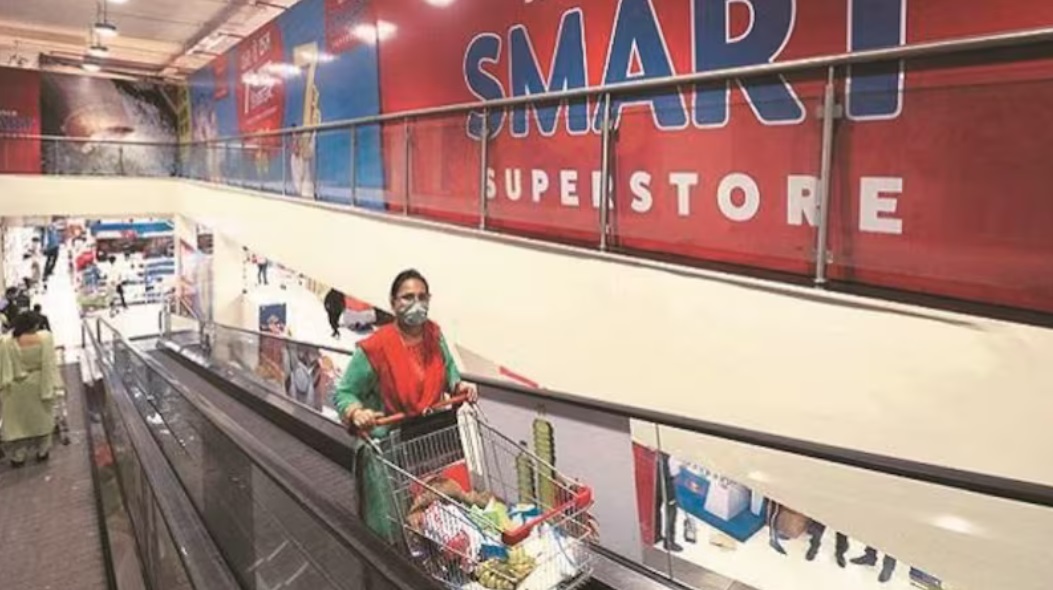
Reliance Retail’s competitors are nowhere close to even put up a fight. The company has over 15,000 offline stores across categories, compared with DMart’s 294 stores or Aditya Birla Fashion’s 3,468 outlets.
Reliance retail’s revenue has grown five times in the last five years and the core retail revenue of $18 billion is greater than competitors combined, according to a Bernstein report.
Speaking to Business Standard, Devangshu Dutta, CEO, Third Eyesight, says, Reliance wants a decent share of Indian consumers’ wallet. From that perspective, Reliance still has a long way to go, he says. As consumer preferences evolve, Reliance too should adapt.
An undisputed leader in the domestic market, the aim of Reliance, according to Mukesh Ambani, is to become one of the top 10 retailers globally. Part of this bet is based on the premise that incomes and consumption power of Indians will increase across the board in coming years. However, could the uneven recovery that different segments of the population have seen stop the pie from growing larger and prove to be a dampener for Ambani’s ambitions?
(Published in Business Standard)
admin
June 30, 2022
Written By Aditya Kalra & Abhirup Roy

MUMBAI, June 30 (Reuters) – Reliance Industries (RELI.NS) said on Thursday it would open outlets of Pret A Manger in India under a franchise deal with the British sandwich and coffee chain, a first foray by the Indian firm in the country’s growing food and beverage industry.
Reliance Brands Ltd (RBL), a unit of the conglomerate that also runs India’s biggest retail chain, would start by opening branches of Pret, as the brand is known in Britain, in big Indian cities, both companies said.
RBL Chief Executive Darshan Mehta said in joint statement the partnership was “rooted in the strong growth potential” of the Pret brand, known for its organic coffee and upmarket sandwiches, and the Indian food and beverage industry.
The first outlet would open in Mumbai before March 2023 and India was expected to become one of Pret’s top three markets in three years, a source familiar with the matter told Reuters.
Pret A Manger, whose name means “ready to eat” in French, first opened in London in 1986. It now has 550 outlets globally, including in the United States and several European states. It is owned by investment group JAB and founder Sinclair Beecham.
In India, the brand will compete with Starbucks (SBUX.O), which has a joint venture with India’s Tata, and Costa Coffee, which is owned by Coca-Cola (KO.N).
Mukesh Ambani, one India’s richest men, runs Reliance, which has more than 2,000 supermarkets and grocery stores in India. Reliance also has partnerships with luxury brands, such as Burberry and Jimmy Choo.
“Reliance wants to look at retail in all its shapes and forms. Over time, they’ve realised partnerships are the way for business formats that may be difficult or slower to crack,” said Devangshu Dutta, head of retail consultancy firm Third Eyesight.
Source: reuters
