
admin
June 7, 2023

M. Sriram and Aditya Kalra, Reuters (MUMBAI/NEW DELHI)
June 7, 2023
Starbucks is revamping its strategy to lure Indians, including children, with smaller, cheaper beverages as it looks to expand in small towns amid a fierce challenge from domestic startups in one of its fastest-growing markets.
Among the first foreign coffee brands to enter tea-loving India, the U.S. giant has taken almost 11 years to open 343 stores, in contrast with private equity-backed chains Third Wave and Blue Tokai that opened about 150 in the last three years.
“As you grow in size, you need to get new consumers,” said Sushant Dash, the chief executive of Starbucks in India, adding that the chain’s “pricing play” would help shatter a perception that it is expensive.
The company has launched a six-ounce drink, “Picco”, which starts at $2.24, and milkshakes for $3.33 as part of its revamp to target affluent Indians who prefer smaller servings.
Starbucks plans to open more stores in smaller towns, said an industry source, who spoke on condition of anonymity.
Both its new offerings are unique to India and unavailable in China, Singapore and the United States.
India’s small but fast-growing specialty tea and coffee cafe market is worth $300 million and set to grow 12% each year, Euromonitor estimates. Canada’s Tim Hortons and Britain’s Pret A Manger are also expanding, but have only a handful of outlets.
“Excessively large portion sizes are an American phenomenon,” said Devangshu Dutta, head of retail consultancy Third Eyesight.
“Indian consumers are value-conscious. If adjusting portion sizes down to what is more normal helps make prices accessible, that’s a double win.”
He was among the analysts who felt the move by Starbucks, operating in India in a joint venture with Tata Group, could further boost its sales, which hit a record $132 million in fiscal 2022/23.
Although Starbucks still dominates in India, rivalry is fizzing in the capital, New Delhi, and the technology hub of Bengaluru, where many Third Wave cafes are often as crowded as Starbucks outlets.
“We’ve lost 30 cups a day to them,” said a barista at a Starbucks shop in Delhi that sells 7,500 drinks a month, referring to a Third Wave that opened nearby months ago, but already sells 3,700.
Starbucks has faced homegrown challengers elsewhere, most notably in China, where its 6,200 stores service the biggest market outside the United States.
There, in just the last five years, Luckin Coffee has used discounts to lure customers to its 10,000 mostly pickup or delivery stores.
Bet On Chai
In India, where Starbucks has added domestic touches to its offerings over the years to boost their appeal, it is now stepping up that game, just as global giants McDonald’s and Domino’s have done.
It estimates that just 11% of Indian homes drink coffee, as opposed to 91% drinking tea. Hot milky tea, or “chai” as it is known in Hindi, is sold at roadside stalls by the hundreds of cups each day for as little as 10 rupees (12 U.S. cents).
Starbucks, which offered for years just one milk chai “latte” made with tea syrup, has launched “Indian-inspired” tea offerings laced with spices and cardamom, both favourites in many Indian homes, which start at 185 rupees ($2.24).
The drinks were introduced to attract those who do not drink coffee and shun Starbucks, said Dash, adding the company would retain its focus on coffee and not make chai a primary offering.
The launch of smaller, cheaper beverages in India indicates Starbucks may have seen “a decline in traffic related to a pushback” on higher prices, said Chas Hermann, a U.S.-based restaurant consultant and former Starbucks executive.
Competition, Small Cities Push
In May, people lured by a one-for-one offer queued in a street outside the first Starbucks store in the western city of Aurangabad, a YouTube video showed in scenes reminiscent of when it first opened in India.
But its rivals are catching up and a price war has begun.
Soon after Starbucks’ May launch of $3.33 milkshakes, designed to attract children, Third Wave launched its own range, a fifth cheaper at $2.71.
In Bengaluru, startup investors and founders hold meetings in Third Wave outlets. It has more than 40 stores there, exceeding the 35 of Starbucks, data from real estate analytics firm CRE Matrix shows.
Third Wave’s chief executive, Sushant Goel, said he planned to add 60 to 70 stores every year, with a focus on big cities. He saw Starbucks’ cheaper, small-sized drinks as a response to competition in “an incredibly price-sensitive market”.
Matt Chitharanjan, chief executive of Blue Tokai, said it had “seen success in converting customers from Starbucks”, partly because of lower prices.
While Dash said he was undeterred by competition, Starbucks recognises the threat, although privately.
In one lease deal for a Bengaluru mall reviewed by Reuters, Starbucks inserted a “cafe exclusivity” clause barring the mall owner from allotting space on the same floor to rival “premium” brands, including Third Wave and Blue Tokai.
“Going deeper into smaller cities, beyond the metros, is the only way to grow,” said Ankur Bisen, head of retail at India’s Technopak Advisors.
(Reporting by M. Sriram and Aditya Kalra; Additional reporting by Anushree Fadnavis in New Delhi, Varun Vyas and Euan Rocha in Bengaluru, Miyoung Kim in Singapore, Sophie Yu in Beijing and Hilary Russ in New York; Editing by Clarence Fernandez)
admin
May 6, 2023

Gargi Sarkar, Inc42
6 May 2023
With one of the largest consumer bases in the world, the Indian retail industry is on a constant upward spiral, thanks to the increase in the purchasing power of Indian consumers and the ever-increasing ecommerce adoption.
Notably, this has helped segments like online beauty and personal care (BPC) sustain and grow faster than the players in the offline space.
According to industry experts, the online BPC market has been growing in the range of 20% to 25% annually, compared to the offline segment at around 8% to 10% a year. According to a IMARC Group report, India’s BPC market size reached $26.3 Bn in 2022 and is expected to reach $38 Bn by 2028, growing at a CAGR of 6.45% between 2023 and 2028.
Notably, in their endeavour to capture this opportunity, new players are entering the BPC space, and the existing ones have started to scale their omnichannel presence.
The newest entrant in the space is Reliance Retail. The retail major forayed into the BPC market with its omnichannel platform, Tira, earlier last month. Along with launching its app, Reliance Retail also opened its flagship Tira store in Mumbai.
It is crucial to note that existing marketplaces like Nykaa and Purplle, and D2C brands such as SUGAR Cosmetics and Mamaearth, too, have started expanding their offline footprint, after scaling up their online presence.
Similarly, offline retailers such as Loreal India, Sephora, and Hindustan Unilever’s Lakme have increased their focus on expanding their online presence via direct-to-consumer websites.

Given that Reliance’s Tira has entered the market with an omnichannel playbook, piggybacking on its parent’s cash reserves, it becomes all the more important to understand what impact it will have in the long run on the existing players and industry dynamics.
According to the industry experts that Inc42 spoke with, the beauty and personal care market offers more than enough opportunities for multiple players to grow, due to multiple favourable factors.
“The BPC segment remains one of the fastest growing categories in consumer retail because the penetration of beauty products has remained relatively low. With increasing awareness, and more disposable income, the BPC segment has witnessed decent growth. Now, since the segment is growing, there is a scope for multiple players to grow. That is why some of the big players have entered into the market,” Ashish Dhir, EVP (consumer and retail), 1Lattice said.
Despite Dhir’s optimism, it is pertinent to note that Nykaa saw some initial pressure on its share prices and overall stock performance with the launch of Tira. Brokerage firm Macquarie said that the entry of new players such as Tira could exacerbate the problems for Nykaa at a time when the competition in the segment is already tough.
In the past, Reliance’s entry into the fashion ecommerce space with Ajio impacted leading existing players like Myntra. Now that we already have an example from the past, coupled with a falling will to spend due to factors like rising unemployment and inflation, it will be interesting to see how Nykaa performs under such pressure.
How Tira Could Threaten Nykaa & Ilks Dominance In The Beauty & Personal Care Space
It is no wonder that Reliance Retail will look at disrupting the market to emerge as a market leader as it has done in every segment.
Compared to sectors such as apparel and telecom, the BPC segment is different, and it is not very easy to scale here the way Nykaa has done over the years, according to Karan Taurani, SVP Research, Elara Capital. He noted that many other players in the past tried to scale but failed.
“Nykaa has emerged as a winner due to several factors such as a superior consumer experience on the app, trustworthiness, and product variety. Currently, the product delivery time is also lesser on Nykaa compared to Tira, although the latter could improve it. Moreover, Nykaa has created a network of influencers over the years, and its approach on social media is very different,” Taurani added.
He, however, highlighted that there will be an initial consumer churn as some customers will try Tira as well, and whether the new venture, Tira, can retain all these customers will depend on the consumer experience it provides.
As per Taurani, marketplaces like Nykaa will see some sort of pinch in terms of demand but will not have a significant impact until Tira offers a differentiated experience. Right now, Tira has very few differentiating factors.
However, we should not forget that Reliance Retail is experienced in building brands and has the heavy financial backing to scale in the offline segment.
Given that many players do not have much experience in the offline segment, they may see a visible impact facing the retail giant in the offline BPC space.
It is important to note that Nykaa’s consolidated net profit fell 70.7% year-on-year (YoY) to INR 8.5 Cr in the December quarter of the financial year 2022-23 (FY23), despite the festive season.
In addition, Mumbai-based beauty ecommerce startup Purplle’s net loss almost quadrupled to INR 203.6 Cr in the financial year 2021-22 (FY22) from INR 52 Cr in FY21.
An optimistic Dhir, however, likes to believe that Tira would only increase the competition in the segment and would not impact the profitability of its rivals, at least in the near term.

Will D2C Beauty & Personal Care Brands Face The Heat?
Along with conglomerate-backed large players such as Tata Cliq and online marketplaces, there are several Indian startups and brands such as mCaffeine, Mamaearth, Sugar and Minimalist, which are looking to capture a big chunk of the ever-increasing BPC market pie.
According to an Inc42 report, BPC will remain one of the fastest-growing D2C segments between 2022 and 2030, growing at a CAGR of 27%.
Talking about Tira’s impact, experts said these (aforementioned) D2C brands will not see any major impact due to two factors.
“Firstly, these brands will have similar arrangements with Tira as they have with Nykaa. Secondly, these brands have created a loyal customer base for the products they offer and they have their recall,” Taurani said.
“While deep-pocketed companies can spend their way into buying the market share, all brands need to be prepared for the long term. Also, for these brands a clear positioning be crucial to stand out, not just in their product and service mix but also the overall customer experience specific to their target audience. This would also give opportunities to several beauty and personal care brands to profitably serve niches that may be too small for the larger companies driving for the market, “Devangshu Dutta, the founder of Third Eyesight, said.
Also, Nykaa and Purplle have a portfolio of private labels, which includes skincare brands such as Dot & Key, Earth Rhythm, and Good Vibes, among others. Hence, it will not be surprising if Tira launches its private labels or acquires small brands to grow its portfolio.
As brands like Dot & Key, and Good Vibes are already direct competitors to these D2C beauty brands, a new player can pose more challenges for them.
What Else Could Work In Tira’s Favour
“Our vision for Tira is to be the leading beauty destination for accessible yet aspirational beauty, one that is inclusive and one that harbours the mission of becoming the most loved beauty retailer in India,” Reliance Retail’s executive director Isha Ambani said at the time of launch in April 2023.
When Reliance entered new segments like telecom and fashion ecommerce with Jio and Ajio, respectively, many of the existing players struggled to sustain in the segment as the Mukesh Ambani-led conglomerate scaled up quickly, thanks to its strong financial position. Hence, it will work as the biggest favourable factor in the beauty and personal care space as well, industry experts believe.
Tira is also expected to lure customers with big discounts. “For Tira, a big chunk of revenue will initially go towards marketing and customer acquisition, at least for the first couple of years, as it is a new brand. More than marketing, Reliance will look at discounting more prominently. Reliance will try to give higher discounts compared to other players,” Taurani said.
He added that Reliance has some expertise in building new platforms, such as Ajio, and a rich talent pool and strong brand exposure.

While players like Tata Cliq, Purplle, and Myntra’s beauty segment have tried to scale up in BPC, none of these players has seen significant growth. Hence, the market consists of one large player, making it easier for a deep-pocket player like Tira to carve its positioning quickly and create a duopoly with Nykaa.
At the time of Tira’s launch, the company said that the brand would offer a curated assortment of the best global and home-grown beauty brands. In terms of its offline play, Reliance Retail can leverage partnerships with global beauty brands and suppliers to get better deals. As it is looking at an omnichannel play at an entry stage itself, it may be able to gain market share from smaller beauty retailers, especially in bigger cities.
The Tira offline store will have the latest beauty tech tools such as virtual try-on to create customised looks and a skin analyser that will personalise and assist consumers in making purchasing decisions based on their needs, the company said.
On the luxury side, Reliance Retail is also directly targeting the market which has higher margins and could eat into the margins of Nykaa easily. It must be noted that Nykaa’s Luxe is still in its infancy.
While it is true that Tira will increase the competition in the BPC segment, it is not likely to rewrite the industry’s future over the next couple of years. Tira currently has very few differentiating factors in both the online and offline segments. Additionally, in the offline segment, Tira has opened only one store while Nykaa already has 141 physical stores across 56 Indian cities, as shared in its Q3 earnings report.
Even though there are glaring differences, some industry experts see Tira’s journey to be the same as that of Nykaa, going ahead.
(Published in Inc42)
admin
March 13, 2023
Tushar Goenka, Financial Express
March 13, 2023
Flipkart Supermart, the online grocery delivery platform of the Walmart-owned ecommerce company, is betting on regional brands to unlock the next phase of growth. Over the past few months, the e-tailer has been listing brands and making them more readily available in cities where their recall value is high.
The regional push targets staples and is pronounced across categories such as atta, tea, pulses, among others. So, instead of offering, say, just the Tata brand of tea, Flipkart also showcases local favourites like Nameri Tea for the residents of Assam. Similarly, instead of selling Nestle’s Maggi and ITC’s Yippie noodles across the country, Flipkart will also let customers pick brands selling Korean noodles, popular among north east teenagers.
The shift in focus is vital in a country whose grocery bill totals $600 billion, of which offline sales account for a staggering $592 billion, while online is a much smaller $8 billion. Further, of the total grocery bill, the share of regional brands at around 60% is much higher than organised national brands that stood at 40%, according to rough estimates from EY.
So far, the plan seems to have worked for the company. Smrithi Ravichandran, head of grocery, says her unit has grown 2.5X between June 2022 and February 2023.
The reason for this shift in focus is easy to understand. In Ravichandran’s own words, “The Indian palette changes every 150 kilometres.” Consider this. The kind of toor daal consumed in Chennai is different from that consumed in Madurai. That is, even within a single state (Tamil Nadu in this case) there is a huge difference in preferences. And that is true for most categories.
Next, look at the potential. Ravichandran’s department sees about 65-70% of its orders coming from Tier 2 and beyond, with metros and Tier 1 cities accounting for the rest.
Analysts believe Flipkart’s initiative is a step in the right direction. Says Devangshu Dutta, CEO, Third Eyesight, a retail consulting firm, “Focusing on regional brands makes eminent sense not just to cater to tastes in a particular geography but to also serve consumers who have moved away from their hometowns and might find it difficult to buy their chosen brands.”
That said, catering to regional preferences is easier said than done. “If one has the same selection even for the same state, it doesn’t help. But there is a cost in catering to that varied choice and we’ll need to operate more fulfilment centres,” Ravichandran adds.
From what to how
Flipkart’s plans to double down on the regional selection in grocery will mean partnering with some of them. Here consumer data available with Flipkart will come in handy, says Ravichandran.
Angshuman Bhattacharya, national leader, consumer product and retail, EY India, believes that by offering more regional brands in categories like atta, Flipkart will deepen penetration, giving smaller players a chance to tap a wider customer base. “Smaller, regional brands will be hungrier for growth and may end up offering healthier margins than what a nationalised player would do,” he adds.
In this, Flipkart’s approach is similar to that of Future Retail under Kishore Biyani, who underscored the importance of a regional brand-led strategy. “The Future Group had launched around 10 private labels of atta and that is no easy feat. A regional brand-led focus might prompt Flipkart to toy with the idea of launching its private labels at a later stage. Or it may even end up asking the regional brands to package staples under its brand, thereby yielding much higher margins,” Bhattacharya of EY points out.
Flipkart isn’t drawing the line just yet. The company will invest in technology to tell customers about the origin of the products they order. “Conscious consumerism is another aspect we will focus on. So, on the packet of a toor daal, consumers will have traceability regarding where and when exactly the daal was harvested,” Ravichandran adds.
This journey will not be a cakewalk for Flipkart. Analysts point out that to be able to partner with Flipkart and address its customer base of over 450 million, smaller brands must up their supply chain spends. That apart, there is always the fear that if the e-commerce giant does not get the desired results, it might discontinue such tie-ups, leaving the regional players in the lurch. Flipkart must allay these fears right at the outset.
(Published in Financial Express)
admin
November 4, 2022

Christina Moniz, Financial Express / BrandWagon
November 4, 2022
Direct-to-consumer (D2C) lingerie brands, often credited with transforming the category and the way women shop for innerwear, are expanding their offline footprint in response to growing demand from tier-II markets and beyond. Zivame, whose journey began online just over a decade ago in 2011, has grown its offline presence to over 120 stores and also sells through over 4,000 partner outlets. In its recently concluded Grand Lingerie Festival, Zivame saw its sales grow three times,with a 120% increase in new customer acquisition. “Tier-II markets are showing massive potential and though tier-1 remains our highest revenue contributor, we are seeing significant revenue baseline shifts in tier-II locations,” says Khatija Lokhandwala, head of marketing at Zivame. The company has announced that its focus will be retail expansion in the second half of this fiscal, going beyond metros and tier-I markets.
Another decade-old D2C player in the innerwear segment, Cloviais eyeing the immense opportunity presented by smaller markets with aggressive expansion plans in place. “Clovia currently has 45 exclusive brand outlets in the country and has been diversifying its product range, with plans to open 130 outlets by the end of this fiscal. Ours has always been a mass- market brand, and most of the repeat customers come from tier-II and tier-III markets,” explains Pankaj Vermani, founder and CEO, Clovia. He notes that over 65% of its customer base is from the non- metro markets, and average order values are 20% higher in these cities compared to the metros. Earlier this year, Reliance Retail Ventures acquired an 89% stake in Clovia’s parent company (Purple Panda Fashions) for Rs. 950 crore. Vermani adds that Clovia will ben- efit from the conglomerate’s scale and retail expertise, driving up growth and love for the brand. Reliance Retail had picked up 15% stake in Zivame back in 2020.
Shaping the market
The women’s innerwear market in India is set to double to reach $11-12 billion by 2025, according to a report by RedSeer. Aside from the key segments of bras and panties, ancillary products like athleisure, sleepwear, swimwear and lounge wear are also boosting the lingerie category’s growth in the country, as is evident from the widening portfolios of leading brands. The online segment for women’s innerwear is expected to become a $1 billion market by 2025.
Experts believe there is a large opportunity for companies to grow since 60% of the $6-billion women’s intimate wear market in India is unorganised, and the category is still largely underserved.
“The lingerie market is an example of improving supply feeding into a growing demand, and the increasing demand expanding the opportunity for more brands to step in. Larger cities, with their higher income profiles and demand concentration, are the logical first-choice market for companies such as Zivame,” points out Devangshu Dutta, CEO, Third Eyesight.
The competition in the large cities is greater, with a plethora of Indian and global brands, which is why Dutta recommends that e-commerce led companies should push aggressively in smaller markets to drive sustained growth.
The fact that D2C brands have better data sets at their disposal to glean insights about Indian women and their concerns when buying innerwear has also worked in their favour.
“Intimate wear shopping can be overwhelming for a lot of women. Finding the right size and choosing styles for their specific needs requires an environment free of embarrassment and judgement. At Zivame, we help women choose the right size and perfect fit, ensuring a private, comfortable and discreet shopping experience,” says Lokhandwala.
While lingerie can sometimes be prohibitively expensive, Vermani points out that Clovia’s feedback-led design approach helps it keep pricing competitive.
The brand creates each product in small quantities, and uses technology to predict future sales based on customer feedback, thereby determining the right quantities for production. He states, “With this approach, we have created a fashion brand that is low on cost, high on consumer appeal and efficient in inventory, leading to better margins and cash flows.”
(Published in Brandwagon, Financial Express)
admin
October 11, 2022
SHARLEEN D’SOUZA, Business Standard
Mumbai, 10 October 2022
In early 1994, Titan started selling watches with precious stones in them and called this new line, Tanishq. It went on to become a separate division of Titan Company and grew into the country’s largest branded jewellery outfit, helping raise Titan’s sales to ~28,799 crore last financial year.
Thirteen years later, in 2007, Titan Eye+ set out to shake up the eyewear market. Though it also sells sunglasses of other brands, it is the prescription segment that Titan redefined and now, according to its website, has 550 Eye+ exclusive stores in 229 cities.
In 2017, Titan sought to do an encore in yet another large market in which the demand, as in jewellery and eyewear, was almost recession-proof and largely commoditised, leaving ample space for a pan-Indian branded chain. Thus was born Taneira, with an avowed intent to become the country’s largest organised saree retailer.
“Titan had earlier tried to organise the jewellery market through Tanishq, which is successful, and this is an attempt by Titan to organise the saree market,” Ambuj Narayan, chief executive officer (CEO) of Taneira, told Business Standard.
What is unsaid is that jewellery to sarees can also be seen as a horizontal brand extension, the two do go together on occasion.
Natural extension
The Indian wear market is a 5,000-year old segment estimated to be worth ₹50,000 crore a year and growing at a compound annual growth rate of 6 to 8 per cent. Sarees account for 80 to 85 per cent of its sales, with kurta sets, blouses, and lehengas comprising the rest. Yet, despite the size and growth, there is hardly any nationally known brand in this segment, with Nalli Silks being one of the notable exceptions.
Titan insiders say the company believed sarees to be a natural extension for it, given its past success with design-led lifestyle brands. They say the company organised an internal competition to see who came up with the best expansion strategy.
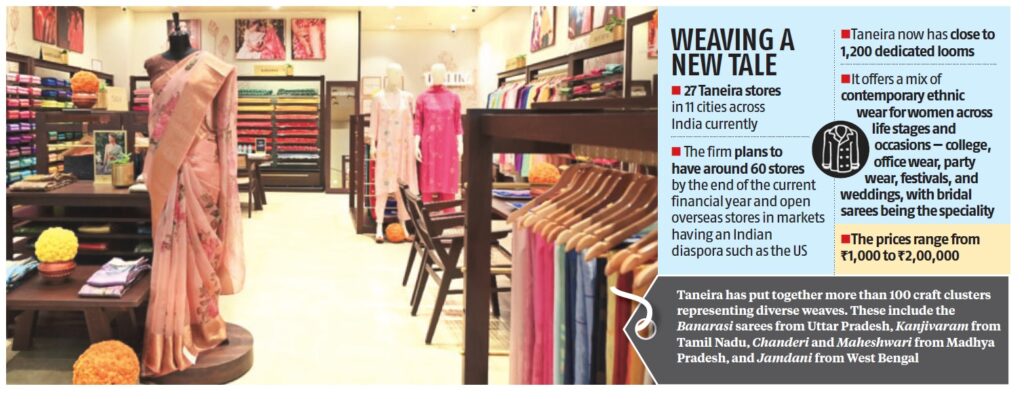
The result is a bouquet of design-differentiated products — primarily sarees and kurta sets — made from pure natural fabrics sourced from all over India. The company put together more than 100 craft clusters representing the diverse weaves. These include the Banarasi sarees from Uttar Pradesh, Kanjivaram from Tamil Nadu, Chanderi and Maheshwari from Madhya Pradesh, and Jamdani from West Bengal. The output is a mix of contemporary ethnic wear for women across life stages and occasions — college, office wear, party wear, festivals, and weddings, with bridal sarees being the speciality. The prices range from ₹1,000 to ₹2,00,000.
“The Tata group’s ventures have always been consistent with their approach — they stay the course beyond initial hiccups and eventually scale up the business. This is very much how Titan and Tanishq worked their way from initial struggles to eventually scale and become nationwide brands,” said retail expert Devangshu Dutta, CEO at Third Eyesight.
To say that Taneira has had initial hiccups would be an understatement. Three years after its launch, the Covid-induced lockdowns and restrictions brought the entire retail sector down to its knees.
Baptism by Covid
“Pandemic restrictions and high Covid-19 anxiety among the people kept socialising and weddings at a very low level of activity over the past couple of years. For Taneira, being a nascent brand with a yet-to-be-established customer base, the operating environment has been particularly tough,” Titan Company said in its FY22 annual report.
Taneira used this time to realign its strategy of connecting with customers. Thus, during 2021-22, which braved the second Covid wave in its first quarter — the dreadful Delta — and saw the third wave creep into its fourth quarter, sales at Titan’s Indian dress wear division grew by 55 per cent.
Narayan, the CEO, attributes this growth to initiatives that included staying close to the customer through e-commerce. “We really drove e-commerce out and reached out to our customers through video calling and try-at-home activities,” he said.
As consumer sentiment started to improve, Taneira already had two collections ready — wedding weave and the summer collection — which boosted sales. During 2021-22, it also increased its store count to 20 by adding six more. During the fourth quarter, Taneira sales rose 4 per cent.
Today, there are 27 Taneira stores in 11 cities across India. It plans to expand to Tier 1 and Tier 2 cities in the first phase and then to Tier 3 in the second phase of its store expansion.
However, Vishal Gutka, vice-president of research (consumer and retail sector) at Phillip Capital, said: “Taneira follows the same principle Titan used for Tanishq, where it entered an unorganised category and expanded it. But it is still early days to gauge how Taneira will pan out. Also, the company needs to give more clarity on the unit economics of each store.”
Weaving an expansion plan Titan’s annual report talks of a robust expansion plan for Taneira this financial year: “We plan to grow at an exponential rate and make our store count around 60 by the end of the current fiscal year and open overseas stores in markets having an Indian diaspora such as the US.” It adds that Taneira will become a more significant contributor to the overall revenue of Titan in the medium term.
At the heart of this grand ambition lies the humble weaver. Taneira now has close to 1,200 dedicated looms and has a programme called Weaver Shala to support them with technical expertise and in modernising their facilities. It has introduced frame looms along with basic workspace facilities for the weavers in collaboration with the localised weaver-led organisations.
The brand has closely worked with the weavers in Varanasi, Uttar Pradesh, and Champa, Chhattisgarh, and aims to take Weaver Shala to other parts of the country.
Taneira leverages Tanishq’s brand strength; mannequins at Tanishq stores, for instance, are dressed in Taneira sarees.
However, Narayan said Taneira and Tanishq will not be sold under the same roof because Titan wants to establish Taneira as a distinct brand in its own right.
(Published in the Business Standard)
