
admin
March 27, 2019
“Fashion is a zombie business. It is dead and it doesn’t know it yet,” says Devangshu Dutta, Founder of Third Eyesight, a specialist management consulting firm.
This is a must-watch excerpt from a presentation and panel discussion anchored by Devangshu Dutta on 27 March 2019 at the India Fashion Forum, in Mumbai.
The challenge he presents is simple: create a new business model for the fashion sector.
Devangshu Dutta
January 10, 2017
In this piece I’ll just focus on one aspect of technology – artificial intelligence or AI – that is likely to shape many aspects of the retail business and the consumer’s experience over the coming years.
To be able to see the scope of its potential all-pervasive impact we need to go beyond our expectations of humanoid robots. We also need to understand that artificial intelligence works on a cycle of several mutually supportive elements that enable learning and adaptation. The terms “big data” and “analytics” have been bandied about a lot, but have had limited impact so far in the retail business because it usually only touches the first two, at most three, of the necessary elements.
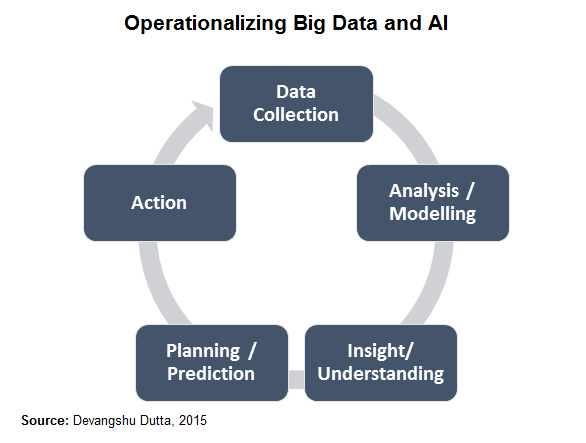
“Big data” models still depend on individuals in the business taking decisions and acting based on what is recommended or suggested by the analytics outputs, and these tend to be weak links which break the learning-adaptation chain. Of course, each of these elements can also have AI built in, for refinement over time.
Certainly retailers with a digital (web or mobile) presence are in a better position to use and benefit from AI, but that is no excuse for others to “roll over and die”. I’ll list just a few aspects of the business already being impacted and others that are likely to be in the future.
On the consumer-side, AI can deliver a far higher degree of personalisation of the experience than has been feasible in the last few decades. While I’ve described different aspects, now see them as layers one built on the other, and imagine the shopping experience you might have as a consumer. If the scenario seems as if it might be from a sci-fi movie, just give it a few years. After all, moving staircases and remote viewing were also fantasy once.
On the business end it potentially offers both flexibility and efficiency, rather than one at the cost of the other. But we’ll have to tackle that area in a separate piece.
(Also published in the Business Standard.)
Tarang Gautam Saxena
October 30, 2011
 The operating environment for the fashion retailers in India is only moving towards a more challenging and competitive direction even though the market is yet to mature. The market has grown over the last two decades on account of brand proliferation and developing retail network and more recently due to new product category creations. High consumer awareness and exposure to international trends has cut the product life cycles short. Topping this up, the last 12-18 months has witnessed the growth of the online platform offering an alternate, convenient and cost effective shopping option for consumers.
It is necessary that fashion retailers manage their operations efficiently both in terms of managing a complex and responsive supply chain at the back end and delighting the customers at the store with great product offers and customer service. Adopting lean practices can help fashion retailers to achieve significant improvements in store profitability and customer satisfaction, making their retail business sustainable through a positive impact on bottom-line.
The concept of lean philosophy, pioneered by Toyota, is built on the premise that inventory hides problems. The basic tenet of this philosophy is that keeping the inventory low will highlight the problems that can be dealt with and fixed immediately instead of maintaining inventory in anticipation of any bottlenecks.
“Lean retailing” is an emerging concept and has already been adopted by retail organisations in the Western countries using technology such as barcodes, RFID (across the product value chain from raw material sourcing through production through final delivery at the retail store) and item-level inventory management and network architectures.
In an ideal scenario a retail organization would be lean at both the store and the distribution center. The organization would leverage technology such as RFID to uniquely identify the movement of its inventory accurately and use fulfillment logic as per the store’s merchandizing principle to have replenishments in tune with customer demand.
Some international retailers that have adopted lean retailing techniques include Wal-Mart, Macy’s, Bloomingdale’s, The Gap and J. C. Penny. Applying lean philosophy to fashion retail in India may sound like an avante garde concept as of now. However, there are some leading large retailers in India such as the Future Group who are early adopters and have already adopted lean practices in their retail supply chain.
An understanding of what lean retailing is and some of its principles can help in appreciating how this concept can make the apparel retail business more sustainable. Lean retailing aims to continuously eliminate “waste” from the retail value chain, waste being defined as any activity/process that is not of “value” to the customer. A fundamental principle of lean retail is to identify customers and define the “value” as those elements of products or service that the customer believes he should be paying for, not necessarily those that add value to the product. Further the value should be delivered to the customer “first-time right every time” so that waste is minimized.
Lean retailing requires simplifying the workflow design in delivering products to customer. Given that the connotation of value is customer-centric, simplifying the workflow design requires streamlining the core and associated processes so that any kind of waste is eliminated. Further pull-system drives replenishment at the stores (and the shelf) based on what customers want “just-in-time” (neither before nor after the time customer demands). This results in a value flow as pulled by the customer.
Those practising lean retail have invested in information technology that allows the stores to share sales data in real time with their suppliers. New orders for a given product maybe automatically placed with the supplier as soon as an item is scanned at the check-out counter (subject to minimum order size criteria). Smaller stores may use visual systems wherein the sales staff can gauge through the empty shelf space the products that have been sold and that need to be re-ordered.
Removing bottlenecks throughout the supply chain is another principle driving lean retail. It entails redesigning processes to eliminate activities that prevent the free flow of products to the customer. Further, lean retail requires following a culture of continuous improvement. Continuous improvement (or “Kaizen”) focuses on small improvements across the value chain that rolls up into significant improvements at an overall level. Kaizens not only can lead to elimination of wasted effort, time, materials, and motion but also focus on bringing in innovations that lead to things being done faster, better, cheaper and easier. Involvement of staff at the lowest levels is very important in Kaizen activities and that means that companies must invest in training, up-skilling their talent pool in Lean Principles.
In the context of apparel retail business, lean retail can help in improving organisational responsiveness to customer needs, the speed with which the products are delivered to them and meet their expectations as per the latest trends. Systematic application of lean principles translates in increased throughput (Sales), with lower Work in Process (Investments) and as per customer requirements of Quality, Design, Trends and Time. Improved information visibility across the chain leads to reduced instances of out of stock and excess inventory at the same time, minimising inventory control costs and reducing shrinkage. At the front-end lean retail may lead to redesigned in-store processes and systems for consistency in frontline behaviors to provide standard customer experience.
With the focus on training and involvement of the workforce, Lean principles have resulted in improving employee satisfaction without increasing labour costs that in turn positively impacts revenues and profitability. Some retailers in the West have reported reducing their store labour costs by 10-20 percent, inventory costs by 10-30 percent, and costs associated with stock outs by 20-75 percent on account of lean retail.
In addition to top-line and bottom-line impact, lean retailing by enhancing the enthusiasm and motivation of the frontline staff creates distinctive shopping experiences for customers.
Inditex, the world’s largest clothing retailer with Zara as its flagship brand, has successfully achieved supply chain excellence following lean principles. It targets fashion conscious young women and is able to spot trends as they emerge and deliver new products to stores quickly thereby establishing its position as the leading fast fashion retailer. The product development processes is based on customer pull-system. Its design team reviews the sales and inventory reports on a daily basis to identify what is selling and what is not. Additionally, regular visits to the field provide insights into the customers’ perceptions that can never be captured in the sales and inventory reports. Critical information about customer feedback is widely shared by store managers, buyers, merchandisers, designers and the production team in an open plan office at the company’s headquarters. Frequent, real time discussions and interactions within the team help them to understand the market situation and identify trends and opportunities.
Further, Zara manufactures the products in small lots and many styles are typically not repeated. Style cues for replenishments are derived from real time customer demand. At the back end, Zara holds inventory of raw materials and unfinished goods with its supply partners which may be local or offshore manufacturers. Typically, the fashion merchandise is produced at the local manufacturing base and quickly delivered while the staple low-variation range is produced offshore at cheaper costs.
Following lean retail practices implies a higher stock turn and frequent replenishments by the suppliers based on real-time sales. Building and maintaining reliable and responsive suppliers through win-win partnerships, is imperative to realize the success of lean retail implementation as high stock turns and frequent replenishments involves the commitment and involvement of the entire supplier base.
Like in any transformational effort, change management plays a critical role in reaping the benefits of lean retail. The whole philosophy requires paradigm shift in attitudes, behaviors and mind sets of those involved upstream and downstream across the value chain. Training, communicating and inspiring the front end staff is thus an important aspect in the overall success and companies need to device a compelling vision that is shared by employees across functions and hierarchy across the entire chain.
Devangshu Dutta
July 22, 2011
The apparel retail sector worldwide thrives on change, on account of fashion as well as season.
In India, for most of the country, weather changes are less extreme, so seasonal change is not a major driver of changeover of wardrobe. Also, more modest incomes reduce the customer’s willingness to buy new clothes frequently.
We believe pricing remains a critical challenge and a barrier to growth. About 5 years ago, Third Eyesight had evaluated the pricing of various brands in the context of the average incomes of their stated target customer group. For a like-to-like comparison with average pricing in Europe, we came to the conclusion that branded merchandise in India should be priced 30-50% lower than it was currently. And this is true not just of international brands that are present in India, but Indian-based companies as well. (In fact, most international brands end up targeting a customer segment in India that is more premium than they would in their home markets.)
Of course, with growing incomes and increasing exposure to fashion trends promoted through various media, larger numbers of Indian consumers are opting to buy more, and more frequently as well. But one only has to look at the share of marked-down product, promotions and end-of-season sales to know that the Indian consumer, by and large, believes that the in-season product is overpriced.
Brands that overestimate the growth possibilities add to the problem by over-ordering – these unjustified expectations are littered across the stores at the end of each season, with big red “Sale” and “Discounted” signs. When it comes to a game of nerves, the Indian consumer has a far stronger ability to hold on to her wallet, than a brand’s ability to hold on to the price line. Most consumers are quite prepared to wait a few extra weeks, rather than buying the product as soon as it hits the shelf.
Part of the problem, at the brands’ end, could be some inflexible costs. The three big productivity issues, in my mind, are: real estate, people and advertising.
Indian retail real estate is definitely among the most expensive in the world, when viewed in the context of sales that can be expected per square foot. Similarly, sales per employee rupee could also be vastly better than they are currently. And lastly, many Indian apparel brands could possibly do better to reallocate at least part of their advertising budget to developing better product and training their sales staff; no amount of loud celebrity endorsement can compensate for disinterested automatons showing bad products at the store.
Technology can certainly be leveraged better at every step of the operation, from design through supply chain, from planogram and merchandise planning to post-sale analytics.
Also, some of the more “modern” operations are, unfortunately, modelled on business processes and merchandise calendars that are more suited to the western retail environment of the 1980s than on best-practice as needed in the Indian retail environment of 2011! The “organised” apparel brands are weighed down by too many reviews, too many batch processes, too little merchant entrepreneurship. There is far too much time and resource wasted at each stage. Decisions are deliberately bottle-necked, under the label of “organisation” and “process-orientation”. The excitement is taken out of fashion; products become “normalised”, safe, boring which the consumer doesn’t really want! Shipments get delayed, missing the peaks of the season. And added cost ends in a price which the customer doesn’t want to pay.
The Indian apparel industry certainly needs a transformation.
Whether this will happen through a rapid shakedown or a more gradual process over the next 10-15 years, whether it will be driven by large international multi-brand retailers when they are allowed to invest directly in the country or by domestic companies, I do believe the industry will see significant shifts in the coming years.
admin
February 28, 2011
 Business
Standard, Mumbai, February 28, 2011
Business
Standard, Mumbai, February 28, 2011
Sayantani
Kar (with inputs from Preeti Khicha)
When some of India’s big retail chains banded together recently to substitute Reckitt Benckiser’s products with private labels to protest the latter’s decision to cut sales margins on its products, they were doing something many global retailers have done with great success. Part of their overall strategy, especially for large chains in the US and Europe, is to develop quality private label products that complement other pieces in their marketing mix. While this is one way retailers can differentiate their firms from competition, it also helps them flex their muscles in their relationships with brand manufacturers. Indeed, retail giants Tesco, Walmart and Carrefour have a significant portion of their sales coming from private labels — ranging from 10 per cent for Costco and 50 per cent for Tesco.
India is a back runner in the private label race, but it is
catching up. A Shoppers Trend Study by Nielsen found awareness
about private labels has gone up from 64 per cent in 2009 to 78
per cent in 2010 across 11 cities in India. Nielsen Director (retail
services) Siddharthan Sundaram says, “Over the last three
to four months, we found an increased awareness of private labels
in categories such as staples, household products, personal care
products such as soaps, biscuits and packaged groceries.”
Thanks partly to the recent economic downturn, there is greater
acceptance — and even loyalty — to such brands in India,
say marketers. Future Group Business Head (private brands) Devendra
Chawla reasons, “A label on the shelf becomes a brand by
covering the two feet distance from the shelf to the trolley.
After all it is the consumer’s choice.” Even in the
toughest segment for private labels to crack — fast moving
consumer goods including food and personal care — store labels
claim share of 19-25 per cent.
Low-involvement categories such as household cleaners were among the first to see the entry of private labels (17-44 per cent of sale in modern trade), bringing in huge margin-lifts for modern retailers. In categories such as food products — jams, biscuits and staples — private labels today contribute more than 25 per cent of modern trade sales. Little wonder, retailers are now mining shopper data to make private labels shed their ‘low’ly tag — low involvement and low cost. Store chains are segmenting their brands according to consumer needs, combining more than one brand according to consumer behaviour, besides launching high-involvement premium products and innovative packaging to give national brands a run for their money.
Innovate or die
Retail innovation has had a big role to play in speeding up the
process of consumer acceptance. Future Group’s retail arm,
which includes Big Bazaar and Food Bazaar, calls its in-house
products ‘private brands’ not labels. It has a separate
team, headed by Devendra Chawla, to research and test FMCG products
before launch. The team has a range of private brands — Tasty
Treat, Fresh and Pure, Cleanmate, Caremate, Sach, John Miller,
Premium Harvest and Ektaa. Look at how it is using shopper data
to improve its products. The insight that kids found ketchup bottles
cumbersome and had to be served — making it inconvenient
if an adult was not around — led it to change the packaging
that in turn gave the brand a margin advantage. By offering ketchup
in pouches, it saved on the price of the glass bottle and freight
(pouches take up less space in a truck, hence more can be fitted
in). While ketchup in glass bottles continue to be Rs 99 for a
kilo, its Tasty Treat ketchup pouches come in Rs 59 packs.
By working with vendors it has also come up with interesting combinations — for example, its Tasty Treat jam has three small tubs packed as one unit, each tub containing a different flavour to offer consumers larger variety.
Retailers have now donned the hats of “product selectors” and “product developers” at the same time, points out Third Eyesight CEO Devangshu Dutta. “So far, most of the retailers were just selecting products from vendors which are mostly lower-priced knock-offs of manufacturer brands,” he says. Not any more.
Ashutosh Chakradeo, head (buying, merchandising and supply chain), HyperCity Retail, explains the process his company follows: “To develop food products, we identify vendors, tie up with food laboratories, chefs and consumers to be part of the tasting panels. Before launching a private label we do at least a month of consumer testing. We identify customers from our loyalty programme called Discovery Club, which tells us who buys a certain category of product. We give the relevant consumers our private label products for trial for a month. We meet the customers at their homes, take their feedback and these changes are incorporated into the private label brand.”
“Our stores act as research labs and are a constant source of feedback,” points out Chawla of Future Group. Chawla estimates 3-4 per cent of the sales of private labels are ploughed back into packaging and design innovation. Reliance Retail CEO Bijou Kurien says, “The teams are our main investment in private labels. Our 100-strong designers across all the formats help in coming up with product designs that fill a need gap or offer a few more features at the same price as national brands.” Reliance Retail has recently launched its own brand of watches priced Rs 149-199 which “no national player can offer” points out Kurien.
The edge
Most vendors directly supply to retailers’ distribution centres,
cutting out cost leakage at the distributor’s and carrying
and forwarding centres. Direct access to store shelves and aisles
also cuts out the high mainstream advertising costs that brands
have to bear. By clever product arrangements and in-store promotions,
retailers can sway the shopper and draw attention to the price
advantage. Chakradeo says, “We display private labels in
heavy footfall areas in the store. We complement displays —
so we keep our private label ketchup near the bakery.”
To tackle the tricky personal care category of face creams and shampoos that Aditya Birla Retail’s More chain has entered, it plans to communicate promotional offers straight to its loyalty programme members. “It will help us induce trials,” says Thomas Varghese, More’s CEO.
Bundling products is another way to woo the value-conscious consumer. Six months back, Future Group started bundling its private brands. Chawla says, “Take home-cleaning, which requires a floor cleaner, glass cleaner, toilet cleaner and utensil cleaner which we combined as a shudhikaran solution of our Cleanmate brand.” The combi-pack costs Rs 125, which would come to around Rs 220-250 if shoppers bought a la carte. The margins are still high at 26 per cent. “Vendors are assured of volumes,” points out Chawla.
What it also does is convert the fence-sitter who has not yet bought into a category. For example, consumers who avail of the shudhikaran solution also get into the habit of using glass cleaners — a category which has a small base and gets most of its sales from modern trade. Similarly, Future Group saw a 25 per cent spurt in the sales of soups when it clubbed soup mugs with its Tasty Treat soup packets based on the insight that Indians preference to sip their soup out of a coffee mug.
Don’t be surprised if you see MNC brands coming out with combo-offers for their products, way bigger than the occasional bucket with a detergent!
Growing up
There are signs the industry is evolving. Private labels in FMCG
are shedding their low-cost tags. But retailers know better than
to vacate low price-points altogether. Instead, they are segmenting
their brands just as a manufacturer brand would do. Chakradeo
of Hypercity says, “Over a period, we hope to increase the
stickiness and the differentiation our brands bring to our stores.
Particularly, in staples where we have seen our private label
business grow rapidly. This is a very quality and price-sensitive
category. We started with basic products but now we have premium
daals (lentils) and basmati rice as part of our portfolio.”
Future Group too has its ‘good, better, best’ policy firmly in place. In staples, the stores offer some products ‘loose’, such as rice, wheat, lentils, which is at the bottom of the ladder. Its Food Bazaar version of the products straddle the middle category, and above the two is its brand, Premium Harvest, which retails at a price higher than some manufacturer brands.
Stickiness may also result from the manner in which retailers are positioning their brands. Future Group’s brand Ektaa will retail regional food and staples across its stores in the country so that migrants can buy supplies they are comfortable with. Be it Govindbhog rice and kasundi (a rice variety and mustard sauce preferred by Bengalis), khakra (Gujarati snack) or murukku (loved by Tamilians). Boston Consulting Group Partner & Director Abheek Singhi says, “Indian retailers are not cut-pasting private label products from other markets but adapting them.”
Are private labels a risk worth taking? Chakradeo says, “The entire product formulation for our cleaners was done in partnership with Dow Chemicals, USA. We did not make any investment and we gave them a percentage of sales as fee. Investments are not huge in making private labels as in most cases it is partnered with vendors. It is more of operating expenses than capital expenditure.”
Future Group brought down logistics costs further by 6-8 per cent by appointing vendors in more than one region for 10 of its product categories to fill its distribution centres. Chakradeo adds, “As the volumes go up, we will be able to put up for backend infrastructure facilities for development and R&D.”
Should national brands be worried? Devangshu Dutta says, “As long as retailers have access to the production and development and have customers for it, the private labels will remain profitable.” India Equity Partners Operating Partner V Sitaram sums up, “In modern trade, though the market leaders will face some slip in market share, the number 3 or 4 brands might have a bigger problem in certain categories thanks to private labels.”
As retailers leverage consumer insights to deploy private labels more effectively, national brands are aggressively fighting the challenge. From sprucing up supply chains to galvanising in-store promotions, they are covering all bases. KPMG Executive Director Ramesh Srinivas says, “Earlier brands had to adjust between a modern trade and a general trade supply chain. The former had to be serviced directly at the stores or had their own supply chain while the latter used the manufacturer’s supply chain. Now, some brands separate modern trade teams and even distributors.”
Britannia Category Director (delight and lifestyle) Shalini Degan says, “We have divided our portfolio into three categories, A,B,C, each having its benchmark fill-rate. We don’t allow fill-rates to drop below those levels. Why the segmentation? We need to focus on brands which have a higher traction in modern trade when servicing it, else we might end up focusing on brands that are not modern trade-led.”
Fill-rates denote how often and to what accuracy the retailer’s orders for a product are supplied by the manufacturer. Low fill-rates could mean lost opportunity since the shopper sees an empty shelf or a private label instead of the brand she might have thought of picking up.
Samsung Vice-President and Business Head (home appliances) Mahesh Krishnan says, “We have gone in for central billing system 4-5 months back with all large-format retailers. Orders are tracked on a daily basis giving retailers more control over the chain.”
In other words, private labels are here to stay and will evolve as more and more chains gain national footprint and the economies of scale kick in. Dutta of Third Eyesight says, “Gross margins for organised retailers are still low compared to global standards: So, margin fights will continue for some time till retailers gain a bigger share of the pie.”
(Also read: The Private Label Maturity Model.)
