
Devangshu Dutta
January 10, 2017
In this piece I’ll just focus on one aspect of technology – artificial intelligence or AI – that is likely to shape many aspects of the retail business and the consumer’s experience over the coming years.
To be able to see the scope of its potential all-pervasive impact we need to go beyond our expectations of humanoid robots. We also need to understand that artificial intelligence works on a cycle of several mutually supportive elements that enable learning and adaptation. The terms “big data” and “analytics” have been bandied about a lot, but have had limited impact so far in the retail business because it usually only touches the first two, at most three, of the necessary elements.
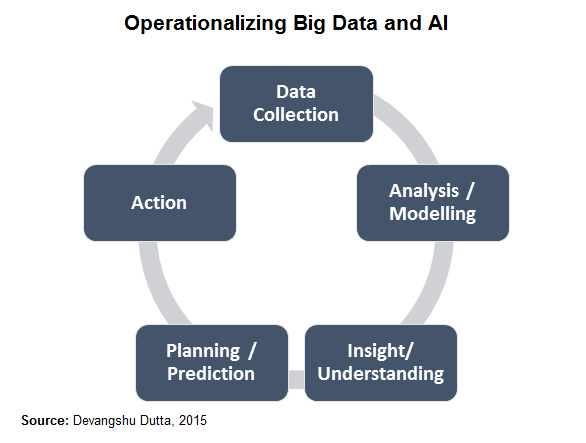
“Big data” models still depend on individuals in the business taking decisions and acting based on what is recommended or suggested by the analytics outputs, and these tend to be weak links which break the learning-adaptation chain. Of course, each of these elements can also have AI built in, for refinement over time.
Certainly retailers with a digital (web or mobile) presence are in a better position to use and benefit from AI, but that is no excuse for others to “roll over and die”. I’ll list just a few aspects of the business already being impacted and others that are likely to be in the future.
On the consumer-side, AI can deliver a far higher degree of personalisation of the experience than has been feasible in the last few decades. While I’ve described different aspects, now see them as layers one built on the other, and imagine the shopping experience you might have as a consumer. If the scenario seems as if it might be from a sci-fi movie, just give it a few years. After all, moving staircases and remote viewing were also fantasy once.
On the business end it potentially offers both flexibility and efficiency, rather than one at the cost of the other. But we’ll have to tackle that area in a separate piece.
(Also published in the Business Standard.)
Devangshu Dutta
January 21, 2016

Aggregator models and hyperlocal delivery, in theory, have some significant advantages over existing business models.
Unlike an inventory-based model, aggregation is asset-light, allowing rapid building of critical mass. A start-up can tap into existing infrastructure, as a bridge between existing retailers and the consumer. By tapping into fleeting consumption opportunities, the aggregator can actually drive new demand to the retailer in the short term.
A hyperlocal delivery business can concentrate on understanding the nuances of a customer group in a small geographic area and spend its management and financial resources to develop a viable presence more intensively.
However, both business models are typically constrained for margins, especially in categories such as food and grocery. As volume builds up, it’s feasible for the aggregator to transition at least part if not the entire business to an inventory-based model for improved fulfilment and better margins. By doing so the aggregator would, therefore, transition itself to being the retailer.
Customer acquisition has become very expensive over the last couple of years, with marketplaces and online retailers having driven up advertising costs – on top of that, customer stickiness is very low, which means that the platform has to spend similar amounts of money to re-acquire a large chunk of customers for each transaction.
The aggregator model also needs intensive recruitment of supply-side relationships. A key metric for an aggregator’s success is the number of local merchants it can mobilise quickly. After the initial intensive recruitment the merchants need to be equipped to use the platform optimally and also need to be able to handle the demand generated.
Most importantly, the acquisitions on both sides – merchants and customers – need to move in step as they are mutually-reinforcing. If done well, this can provide a higher stickiness with the consumer, which is a significant success outcome.
For all the attention paid to the entry and expansion of multinational retailers and nationwide ecommerce growth, retail remains predominantly a local activity. The differences among customers based on where they live or are located currently and the immediacy of their needs continue to drive diversity of shopping habits and the unpredictability of demand. Services and information based products may be delivered remotely, but with physical products local retailers do still have a better chance of servicing the consumer.
What has been missing on the part of local vendors is the ability to use web technologies to provide access to their customers at a time and in a way that is convenient for the customers. Also, importantly, their visibility and the ability to attract customer footfall has been negatively affected by ecommerce in the last 2 years. With penetration of mobile internet across a variety of income segments, conditions are today far more conducive for highly localised and aggregation-oriented services. So a hyperlocal platform that focusses on creating better visibility for small businesses, and connecting them with customers who have a need for their products and services, is an opportunity that is begging to be addressed.
It is likely that each locality will end up having two strong players: a market leader and a follower. For a hyperlocal to fit into either role, it is critical to rapidly create viability in each location it targets, and – in order to build overall scale and continued attractiveness for investors – quickly move on to replicate the model in another location, and then another. They can become potential acquisition targets for larger ecommerce companies, which could acquire to not only take out potential competition but also to imbibe the learnings and capabilities needed to deal with demand microcosms.
High stake bets are being placed on this table – and some being lost with business closures – but the game is far from being played out yet.
admin
April 17, 2015
Panel Discussion moderated by Mr. Devangshu Dutta, Chief Executive, Third Eyesight at the Indian Retail Congress 2015 (17-18 April 2015). The panel included Mr. Manish Mandhana (Managing Director of Mandhana Industries with the brand Being Human), Mr. Sanjay Warke (Country Head of Toshiba India), Mr. Tanmay Kumar (Chief Financial Officer of Burger King India), Mr. Kinjal Shah (Chief Executive Officer of Crossword Bookstores) and Mr. Ranjan Sharma (Chief Information Officer of Bestseller India, with the brands Vero Moda, Only, Jack & Jones).

Devangshu Dutta
February 27, 2009
There’s some speculation that salespeople in luxury stores are being asked to become more friendly, so as not to turn away and turn off potential customers.
But I think it isn’t just them. I think as the economy slows, possibly everyone might become less abrasive and nicer to each other – less business around so you don’t want to turn off the spenders no matter how they’re dressed – “a king dressed as a beggar” is a good simile.
Actually that reminds me of a story someone told about 20 years ago about an Indian farmer walking into a car showroom and being treated patronizingly by the salesman. The salesman saw a more urbane customer walk in and handed the farmer off to a less agressive colleague, only to see 4 cars being driven off by the farmer’s sons after an all CASH payment.
Maybe the image is not evocative as Julia Roberts in “Pretty Woman”, but still a pretty powerful one, nevertheless.
Devangshu Dutta
February 2, 2009
Amazon was among the few US retailers last week to report any growth in the fourth quarter of 2008. There are, possibly, as many opinions about why Amazon has apparently bucked the recession as there are business analysts observing the sector.
I’ve shopped on Amazon.com since the year they launched. Every experience has been completely satisfactory, some delightful. On some occasions Amazon has picked my pocket – made me spend on stuff that I wouldn’t have bought otherwise, by their very helpful suggestions of what others had bought while they were browsing my selections. On other occasions it has saved me money, time and heartburn by providing comprehensive customer reviews at a click.
In my experience, Amazon’s sustainable advantage is their customer-orientation – the technology, the supply chain, the design – everything is geared to making the buying experience as good as possible. A Retail 101 principle that many other retailers – online and offline – seem to ignore every day.
