
admin
September 5, 2025

Pooja Yadav, Exchange4Media
4 September 2025
Quick commerce today is no longer just about delivering groceries in 10 minutes. It has emerged as one of India’s most coveted retail media channels, where brands are willing to pay a steep premium for visibility.
If FY25 was about building scale, FY26 is definitely shaping up to be about pricing power. With consumer adoption of 10–20-minute delivery apps surging, advertisers are competing for limited inventory, pushing ad rates up by 30–50% year-on-year.
“Ad rates on quick commerce platforms have surged by 30–40% year-onyear, especially during high-impact windows like festive seasons and major cricket events. This is fuelled by rising user engagement and proven performance outcomes. With more sophisticated ad formats and attribution models now in play, advertisers increasingly view the premium as justified,” added Uday Mohan, COO, Havas Media India & Havas Play.
Scale, Pricing & Soaring Ad Rates
While agencies point to surging demand, market data shows that platforms themselves are firming up monetisation models with steep onboarding thresholds.
As per market estimations, Swiggy Instamart offers tiered onboarding packages ranging from ₹4.5 lakh to ₹10 lakh, adjustable against advertising spends over a three-month period. Zepto reportedly asks new or small brands to commit anywhere between ₹2 lakh and ₹7 lakh per month on ads, depending on the category. Blinkit, on the other hand, charges ₹25,000 per SKU per state as a non-refundable onboarding fee, which is credited to the brand’s ad wallet.
This aggressive push comes against the backdrop of a sector that has grown at breakneck speed. According to CareEdge Analytics’ July 2025 data, India’s quick commerce market was valued at around ₹64,000 crore in FY25, growing at a staggering 142% CAGR during FY22–FY25 on the back of evolving consumer preferences, hyperlocal infrastructure, and a low base.
The momentum is expected to continue with strong double-digit growth over the next few years, as adoption deepens in Tier II & III cities, delivery networks expand, and instant fulfilment becomes mainstream.
At the same time, platforms are pivoting from pure hypergrowth to sustainable profitability—tapping into advertising, subscriptions, private labels and tech-led inventory optimization as key revenue levers. This shift is being enabled by India’s expanding digital backbone: with over 1.12 billion mobile connections and 806 million internet users (a 6.5% YoY rise), the country is projected to cross 900 million internet users by the end of 2025. Rising smartphone penetration in both urban and rural areas, aided by affordable data and policy support, has created one of the world’s largest online consumer pools, with 270 million e-shoppers in 2024, making India the second-largest e-retail market globally.
Unsurprisingly, advertisers are flocking to these platforms because that’s where their consumers are. Even though seller commissions contribute the bulk of revenues (68–74%), ad placements and brand boosts already account for 9–11%. Industry data shows that ad rates on quick commerce apps have climbed by 30–50% in just a year, with premiums doubling during high-impact windows like festivals and cricket tournaments. This steep inflation reflects both rising consumer traffic and the limited nature of in-app inventory, pushing brands to pay top dollar for guaranteed visibility at the point of purchase.
Bain’s ‘How India Shops Online 2025’ report also underscores this momentum: beauty, personal care, and snacking categories are already outpacing overall e-retail growth, and these are the very segments leaning most aggressively into quick commerce ads.
“Ad rates on quick commerce platforms have jumped by nearly 40–50% compared to last year. This spike reflects that premium brands are willing to pay for immediacy and guaranteed visibility, where ad placement directly links to instant purchase behaviour,” said Mandar Lande, founder of Waayu, a zero-commission food delivery app in India.
According to Aditya Aima, Managing Director, Growth Markets; Co-MD, India & MENA, AnyMind Group, ad rates on quick commerce platforms have not only risen but demand has intensified. “The surge is fuelled by three dynamics: sticky consumer behavior with high visit frequency, dense purchase intent compared to social or entertainment platforms, and the scarcity of ad real estate.”
Quick commerce becomes a strategic channel
For brands, quick commerce has moved far beyond being a fulfillment partner. It has become a strategic advertising channel, especially for those in fast-moving and competitive categories like beauty, wellness, snacks, and personal care. The platforms offer not just last-mile delivery but also front-of-shelf visibility in an increasingly cluttered digital environment.
According to Seshu Kumar Tirumala, Chief Buying and Merchandising Officer, bigbasket, “Brands are moving beyond purely search-centric strategies and increasingly adopting immersive display activations with formats like Spotlight Videos, Banners with Add-to-Cart (ATC), targeted banners, and ATC widgets. For established brands, most investments still flow into performance-led formats such as Sponsored/PLA ads, while a portion is reserved for top-funnel initiatives like storytelling, new launches, and high-visibility events. Emerging or smaller brands usually begin with awareness and consideration campaigns before shifting focus toward performance once they’ve built stronger customer connections.” Unlike marketplaces or social media, quick commerce blends data-led targeting, high engagement, and measurable ROI.
Many brands pair Q-comm placements with collab ads on Meta, Google, and Criteo to build visibility while keeping consumers engaged across the funnel. This creates a sharper, closed-loop system where awareness, consideration, and conversion happen almost instantly. “D2C brands have been rapidly scaling up ad spends on quick commerce platforms, up to 40–50% year-on-year, with a significant share during the festive season. Among the key reasons are fast-growing adoption of Qcomm by consumers and better ROI than marketplaces,” said Shrikant Shenoy, AVP at Lodestar UM.
What sets this instant delivery model apart is its ability to compress the purchase journey. Marketplaces drive comparisons, and social platforms spark discovery, but Q-comm taps into impulse buying with SKU-level attribution.
“The quick delivery model encourages impulse purchases and immediate gratification shopping, which is particularly valuable for D2C brands. Qcomm platforms have lower competition density, and ad formats are more native and less cluttered than traditional e-commerce,” said Devangshu Dutta, founder of Third Eyesight.
“When someone opens Blinkit or Zepto, they’re usually in active purchase mode, not just browsing. For consumables, personal care, or lifestyle products, this is the sweet spot of marketing,” Dutta noted.
“Ad rates on quick commerce have gone up by more than 20% in the last year. If you want a prime slot, say a homepage banner in a big city, you might even be paying 50% more than last year. Because every brand wants it. When a Blinkit or Swiggy placement can move your product in minutes, not weeks, those ads aren’t just distribution, they are discovery,” said Mohit Singh, Head of Product at Zippee, a quick commerce logistics platform.
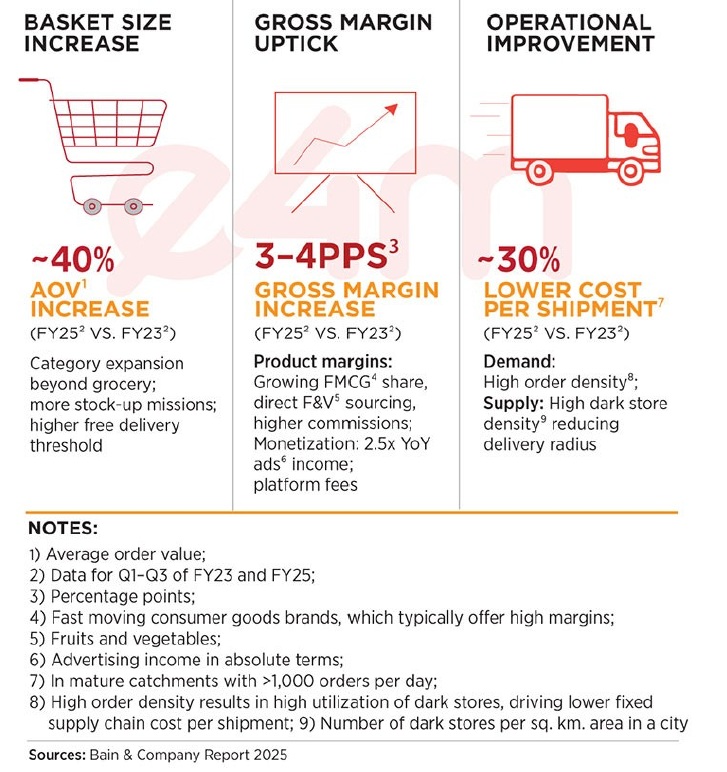
Meanwhile, pricing pressures are only going up. Ratnakar Bharti, VP, Media, Mudramax said, “Quick commerce isn’t just ‘fast delivery’ anymore, it has become high-intent retail media sitting right next to the ‘add to cart’ button, with sales that can be measured in real time. Quick commerce platforms say their ads business grew 5X in a year to about $200M ARR. At that kind of scale, inventory quality improves, targeting gets sharper, and the medium starts looking like the next big retail media play.”
“In a nutshell, expect meaningfully higher prices in peak weeks — often up to 2x — and a higher year-round floor price due to steeper minimums and fees. The trade-off is harder proof of sales at the exact SKU, which is why demand and prices are rising,” Bharti added.
“Brands pay a premium for Q-Comm because it drives sales at the point of purchase. What began as experimental spends has now become a steady line item in media plans, thanks to strong ROI and proven results,” added Jatin Kapoor, MD, AdsFlourish.
Beauty, beverages & snacking lead the charge
Notably, not all categories are leaning on quick commerce equally. Industry executives point out that beauty & personal care, beverages, snacking, and wellness are the biggest spenders, given their high repeatability, impulse-driven nature, and urban skew.
Beauty and personal care brands, for instance, are using Q-comm not just to drive trial packs and quick replenishment, but also to run festival-led campaigns targeting affluent millennials. Similarly, beverages and packaged snacks are thriving on the “in-the-moment” consumption occasions that these apps uniquely enable.
“The biggest spenders are beverages, beauty, packaged foods, and wellness. Those categories thrive on impulse and repeat consumption, which is exactly what quick commerce delivers best,” Singh added. As per many industry experts, wellness and lifestyle brands, too, are seeing outsized returns. From daily supplements to discreet personal care items, quick commerce is proving to be a low-friction purchase environment with high conversion rates.
“Quick commerce platforms have lower competition density, and ad formats are more native and less cluttered than traditional e-commerce,” explained Dutta.
Media buyers also note that Q-comm platforms are evolving fast, offering more contextual in-app placements and data-driven targeting. This is creating a level playing field for challenger brands that lack legacy shelf space in offline retail.
“Quick commerce advertising is inherently contextual. A beverage or snack brand running an IPL campaign is literally tapping into the consumer’s 15-minute window of intent, it’s that instant,” added Mohan.
With ad rates on quick commerce platforms climbing 30–50% year-on-year, it’s clear the medium is shifting from experimental budgets to a core retail media channel. However, with competition heating up, festive weeks commanding 2X pricing, and minimum spends rising, the question is: how long before quick commerce ads start resembling the crowded, high-cost landscape of traditional e-commerce marketplaces?
(Published in Exchange4Media)
admin
September 3, 2025

Aakriti Bansal, Medianama
3 September 2025
The Goods and Services Tax (GST) overhaul simplifies India’s tax structure and lowers prices for many goods. However, for e-commerce sellers, the change arrives at the worst possible moment. Platforms and sellers must adjust billing systems, invoices, and inventory records just as the festive season begins.
The festive period drives the highest order volumes of the year, and even minor disruptions in invoicing or compliance ripple through the system. Refunds get delayed, seller–platform relations strain, consumers face frustration, and penalties under GST law escalate. Moreover, the episode shows the fragility of India’s e-commerce compliance infrastructure.
Larger sellers can rely on manpower and technology, but smaller businesses remain disproportionately exposed. Platforms, meanwhile, cannot act as neutral intermediaries when their invoicing systems directly control seller compliance. The question now is whether the government, platforms, and sellers can move fast enough to make structural reforms without turning them into seasonal flashpoints.
What’s the News?
The GST Council, chaired by Finance Minister Nirmala Sitharaman, is meeting today and tomorrow (September 3–4), according to a report by Hindustan Times, to decide on a major overhaul of India’s tax system. The timing has already unsettled e-commerce. Platforms like Amazon, Flipkart, and Meesho are holding back on announcing festive sale dates, while sellers report uncertainty about how to handle inventory already billed at old rates.
Shoppers are delaying big-ticket purchases such as smartphones, televisions, and appliances, creating a visible slowdown in demand. Retailers are carrying higher stock levels, waiting to recalibrate pricing once the Council clarifies the new slabs. The pause comes just before the festive sales period, which typically contributes about a quarter of annual revenues for e-commerce platforms.
What the GST Reforms Are
The government has proposed collapsing the four-tier GST structure of 5%, 12%, 18%, and 28% into two slabs of 5% and 18%. A new 40% tier would apply to luxury and sin goods, replacing the existing compensation-cess mechanism.
If the Council approves, several categories will see rate changes. White goods such as washing machines, air-conditioners, smartphones, refrigerators, and televisions would move from 28% to 18%. Small petrol cars and motorcycles would also shift from 28% to 18%. Essentials including ghee, nuts, namkeen, packaged drinking water, and medical devices would drop from 12% to 5%. Everyday consumer products like toothpaste, shampoo, soap, and ready-to-eat foods would also move into the 5% bracket.
The 40% tier would target high-end cars, premium electric vehicles, tobacco, and pan masala. States have pushed back, warning of revenue losses, and discussions are underway on whether higher levies on luxury items or cess surpluses can offset the shortfall.
Implementation Challenges
Satish Meena of Datum Intelligence, a market research firm, flagged the absence of a transition window as “very tricky.” “Everyone wants to make the change because this is the peak sale time,” Meena explained. “But the challenge is how it will be implemented for goods already in warehouses. Once inventory has moved from the company to the warehouse under the old GST, how will you pass on the benefit to the customer?”
Devangshu Dutta, chief executive of Third Eyesight, a retail consulting firm, pointed to similar risks. “Sellers will need to rapidly adjust pricing strategies and inventory details, keeping in mind that the festive season is upon us,” Dutta explained. “One would hope that the changeover of rates doesn’t create supply unpredictability in this critical season.”
Abhishek A. Rastogi, founder of Rastogi Chambers, a law firm specialising in indirect tax and regulatory matters, warned about compliance fallout.“From a compliance perspective, the biggest challenge will be ensuring real-time alignment between product listings, tax rates, and invoices generated. Even a minor mismatch in billing, particularly during the high-volume festive season, could result in serious exposure,” Rastogi said.
Impact on Smaller Sellers
Experts agreed that smaller sellers carry the heaviest burden. “Larger sellers with manpower and technology will cope faster. Smaller sellers will face particular challenges,” Meena noted.
Dutta explained why smaller businesses feel the squeeze. “Businesses of all sizes face the burden of compliance and accurate reporting, but smaller businesses feel the impact disproportionately as their management resources are far more limited. Often it is the owner-manager, the most critical human resource in a small business, whose time gets sucked into ensuring the changes go through smoothly,” he said.
Moreover, Rastogi advised small sellers to act defensively. “Smaller sellers must ensure they maintain proper records of their communications with platforms, raise tickets on billing mismatches, and document tax advice received. Such proactive record-keeping will protect them if litigation arises later. They should also consider contractual safeguards when signing with platforms,” he said.
Platforms Under Pressure
Platforms also operate under strain. Meena pointed out that festive sales remain unannounced. “Typically, the sales should be in the week of October 13–14, or the following week. That has not been announced till now because of this GST issue,” he said.
Dutta argued that platforms must step in to steady sellers. “Sales, inventory, and return reconciliation is an ongoing issue and potential point of dissatisfaction among sellers. To avoid adding to this, e-commerce platforms need to provide enhanced seller support to smooth out the turbulence during the GST changeover,” he said.
Rastogi underlined that platforms share liability. “Legally, the burden to discharge GST liability lies on the seller. However, given that invoicing systems are often managed by e-commerce platforms, there is a shared responsibility to ensure the correct GST rate is applied. Any platform-level error that causes sellers to become non-compliant could become a contentious issue,” he explained.
He also laid out remedies. “Sellers impacted due to platform-level glitches can seek remedies under contract law and indemnity clauses in their agreements with the platform. They may also explore legal recourse if non-compliance is triggered without their fault. Ultimately, disputes of this nature will test how liability is apportioned between sellers and platforms,” Rastogi mentioned.
Consumer and Market Effects
The uncertainty already shapes consumer behaviour. “There is already a decline in demand over the last two weeks as customers are delaying purchases, waiting for festive discounts,” Meena observed. “If sales are pushed too close to Diwali, customers may move to offline stores where delivery is immediate and pricing on appliances can match e-commerce.”
Notably, Dutta pointed out that offline businesses could benefit. “Small offline businesses that don’t have GST numbers and don’t need to compile GST returns may be able to quickly benefit from lower input costs and may be able to become more price competitive,” he said.
Need for Government Clarity
Both Dutta and Rastogi called for immediate guidance.
Dutta warned that reforms must not create “supply unpredictability in this critical season.”
Rastogi pressed for intervention. “There is a strong case for the government to issue clarificatory circulars or transitional relief, particularly given the festive season volumes. Without such guidance, both sellers and platforms face a high risk of disputes, and the compliance ecosystem may be overburdened,” he noted.
Why It Matters
The GST reforms land as festive season spending sets the direction for the retail year. E-commerce platforms draw about a quarter of their annual revenues during this period, and sellers use these weeks to recover margins. Datum Intelligence estimates that online shoppers will spend around Rs. 1,20,000 crore in 2025, up 27% from 2024, with quick commerce taking 12% of that share. At this scale, even small invoicing or compliance errors can lock up billions of rupees in disputed sales.
The reforms already shape consumer behaviour. Shoppers hold back purchases while they wait for clarity on tax rates, and platforms face pressure to adjust quickly. If festive sales move closer to Diwali, buyers may switch to offline stores that match appliance prices and provide immediate delivery.
The rollout will show whether platforms and sellers manage a nationwide tax change in the middle of their busiest season or allow it to disrupt India’s largest online retail channel.
(Published in Medianama)
admin
August 21, 2025

Praveen Paramasivam, Reuters
August 21, 2025
Summary
India's luxury beauty market to quintuple by 2035
Domestic brands account for less than a tenth of sales
Global brands modify offerings for India
India’s luxury beauty market is expected to quintuple to $4 billion by 2035 from $800 million in 2023, driven by its young, affluent, social-media savvy shoppers with rising disposable incomes, consulting firm Kearney and luxury beauty distributor LUXASIA said in a report.
Luxury beauty makes up just 4% of the $21-billion beauty and personal care market, compared with 8% to 24% across top Southeast Asian countries and 25% to 48% in developed markets including China and the United States.
That means there is plenty of room for growth.
“India is the last bastion of growth for premium beauty,” said Sameer Jindal, managing director for investment bank Houlihan Lokey’s corporate finance business in India.
“The Indian consumer is willing to experiment and try out new things.”
U.S. beauty giant Estee Lauder home to the brands Clinique and MAC, expects a strong runway for expansion and long-term growth in India, even as it grapples with soft sales in the Americas and Asia-Pacific.
“India today, within the Estee Lauder network, is looked at as one of the priority emerging markets,” said country general manager Rohan Vaziralli, highlighting plans to initially target 60 million women in the nation of more than 1.4 billion.
Homemaker R. Priyanka, based in the southern city of Chennai, said she was thrilled to have better access to Estee Lauder’s Jo Malone London fragrance in India, as a benefit of the companies’ efforts.
“It is easier than asking someone (abroad) to get it for you every time,” she added.
While global beauty brands might have to modify some of their products for India, which bakes in sultry temperatures in summer and oppressive humidity at other times, they face little competition from homegrown brands.
Kearney and LUXASIA identified only Forest Essentials and Kama Ayurveda as their major rivals, underscoring how domestic brands make up less than a tenth of luxury beauty sales.
In the more established markets of China, Japan and South Korea by comparison, domestic brands account for a 40% share.
“There is, of course, a premium perception gap between globally established brands and Indian brands,” said Devangshu Dutta, founder of retail consultancy Third Eyesight.
Global beauty giants’ huge marketing budgets also give them an edge over domestic brands, other industry watchers said.
WOOING INDIAN SHOPPERS
Estee Lauder is studying online sales patterns to identify the smaller cities to target, such as Siliguri in West Bengal state, partnering with designers such as Sabyasachi Mukherjee, and launching products such as kohl, an eyeliner Indians favour.
It has also invested in Forest Essentials, a brand with herbal ingredients, and in a programme offering funding to domestic beauty start-ups.
This year France’s L’Oreal said it was investing more in India and tapping into the “elevated beauty desires” of the nation’s young, digitally savvy, empowered women shoppers to drive growth. It declined further comment.
South Korea’s Amorepacific, known for brands such as Innisfree and Etude, is trying to leverage the Korean beauty craze in India with products geared to the market.
These include items for the popular “cleanser, serum, moisturiser, and sunscreen” beauty regimen, the country head, Paul Lee, said.
Japan’s Shiseido, with a history of more than 150 years, brought its NARS brand to Indian beauty retailer Nykaa’s website this year, and plans to step up growth of its brands in the subcontinent.
Global brands are very excited about India, where consumers are splurging more to stay on top of trends such as “cherry makeup”, Nykaa co-founder Adwaita Nayar said, referring to a look featuring flushed cheeks, glossy lips, and soft pink eyes.
Amazon, which has also been seeing a big boom in beauty demand in India, aims to identify emerging global trends and bring in more brands, said Siddharth Bhagat, director of beauty and fashion at the e-commerce company in India.
Retailer Shoppers Stop, which also pioneers foreign labels, plans to open 15 to 20 beauty stores in each of the next three years to boost its revenue from the segment to a quarter from less than a fifth now, its beauty business CEO Biju Kassim said.
Reporting by Praveen Paramasivam in Chennai; Editing by Dhanya Skariachan and Clarence Fernandez
(Published on Reuters)
admin
August 6, 2025

Naini Thaker, Forbes India
Aug 06, 2025
It’s a known fact that of the thousands of startups founded each year, only a small fraction survive—and even fewer scale to become unicorns. Rarer still are those unicorns which, after reaching dizzying heights, come crashing down. The Good Glamm Group is one such cautionary tale.
Once celebrated as a unicorn that cracked the code on content-to-commerce, the company’s meteoric rise was matched only by the speed of its unravelling. At the heart of its downfall lies a critical misstep: The relentless pursuit of growth through acquisitions and brand launches, even as cracks in its house-of-brands model began to show. Instead of pausing to consolidate and build sustainably, Good Glamm doubled down—prioritising valuation over viability.
That strategy came to a head on July 23 when founder and CEO Darpan Sanghvi announced the dissolution of the group’s house-of-brands structure. In a LinkedIn post, Sanghvi confirmed that lenders would now oversee the sale of individual brands, effectively ending the company’s vision of building a digital-first FMCG conglomerate.
Despite raising $30 million in 2024 and undergoing multiple rounds of restructuring, the group failed to integrate its acquisitions or generate sustainable profitability. With key investors such as Accel and Bessemer Venture Partners exiting the board and leadership turnover accelerating, the company’s ambitious empire—built on rapid expansion and aggressive brand aggregation—has now been reduced to a lender-led breakup.
In the aftermath of the announcement, Sanghvi offered a candid reflection on what went wrong. “In hindsight, it wasn’t one decision, one market force, or one acquisition. It was three levers we pulled, which together, turned Momentum into a Trap,” he wrote in a LinkedIn post. According to Sanghvi, the group’s downfall stemmed from doing “too much, too fast and too big”.
He elaborated: “At first, Momentum feels like your greatest ally. Every headline, every funding round, every big launch is a shot of adrenaline. And you start believing you can do more and more and more. But momentum has a dark side. If you stop steering and go in a hundred different directions, it doesn’t just carry you forward, it drags you faster and faster until you can’t breathe.”
Where The Model Broke?
In October 2017, Sanghvi launched direct-to-consumer (DTC) beauty brand MyGlamm. Most brands at the time were big on selling on marketplaces such as Amazon or Nykaa. However, Sanghvi believed, “We wanted to be truly DTC and not just digitally enabled. We believed that to own the customer, the transaction needs to happen on our own platform.”
But the biggest challenge with being a DTC brand is its customer acquisition cost (CAC). Towards the end of 2019, the company was spending about $15 (over ₹1,000) to acquire a customer to transact on their website. “Around the same time, our revenue run rate was ₹100 crore. We were spending about $0.5 million to acquire 30,000 customers a month. That’s when we realised it was time to solve the CAC problem,” Sanghvi told Forbes India in 2022. In an attempt to find a solution, Sanghvi turned to the content-to-commerce model.
And then, started the acquisition spree. According to Sanghvi, with a single brand in a single category one can’t build scale. He told Forbes India, “The most you can scale it is ₹1,000 crore, if you want a company that’s doing ₹8,000 or ₹10,000 crore in revenue, it has to be multiple brands across multiple categories.” In hindsight, this perspective might be debatable.
As Devangshu Dutta, founder of consultancy Third Eyesight, points out, the “house of brands” model is essentially a modern-day consumer-facing business conglomerate—and its success hinges on multiple factors working in harmony. While there are examples globally and in India of such models thriving, both privately and publicly, the reality is far more nuanced. “Brands take time to grow, and organisations take time to mature,” Dutta notes, emphasising that rapid aggregation of founder-led businesses under a single ownership umbrella is no guarantee of success.
In recent years, Dutta feels the influx of capital into early-stage startups and copycat models—often seen as lower risk due to their success in other geographies—has shortened business lifecycles and inflated expectations. The hope is that synergies across the portfolio will unlock outsized value, but that rarely plays out as planned. “It is well-documented that more than 70 percent of mergers and acquisitions fail,” he adds, citing reasons such as weak brand fundamentals, lack of synergy, inadequate capital, limited management bandwidth, and internal misalignment.
In the case of Good Glamm, these fault lines became increasingly visible as the group expanded faster than it could integrate or stabilise.
Scaling Without Steering
In FY21, the company had losses of ₹43.63 crore, which rose to ₹362.5 crore in FY22 and went up to ₹917 crore in FY23. Despite the mounting losses, Good Glamm marked its entry into the US market, in a joint venture with tennis player Serena Williams to launch a new brand—Wyn Beauty by Serena Williams. The launch was in partnership with US-based beauty retailer Ulta Beauty.
For its international expansion, it invested close to ₹250 crore over three years. “We anticipate that the international business will account for 25 to 35 percent of our total group revenues by the end of next year. This strategic focus on international expansion is pivotal as we prepare for our IPO in October 2025,” he told Forbes India in April 2024.
Clearly, things didn’t pan out as expected. As Sanghvi rightly points out, it was indeed a momentum trap. “You tell yourself you’ll fix the leaks after the next milestone. But the milestones keep coming, and so do the leaks. Soon, you’re running from fire to fire, never realising that the whole building is getting hotter. And somewhere along the way, you lose the stillness to think,” he writes on his LinkedIn post.
Dutta feels that a strong balance sheet is the most fundamental requirement, “to provide growth-funding for the acquisitions or for allowing the time needed for the acquisitions to mature into self-sustaining businesses over years. In the case of VC-funded businesses, the pressure to scale in a short time can go against what may be best for the business or for its individual brands”.
The Good Glamm Group’s fall is a reminder that scale alone doesn’t build resilience. Its story reflects the risks of expanding faster than a business can integrate, and of prioritising valuation over value. The house-of-brands model can work—but only when backed by strategic clarity, operational discipline, and patience. This is less a warning and more a reminder for founders: Scale is not success, and speed is not strategy.
(Published in Forbes India)
admin
July 16, 2025

Prabhanu Kumar Das, Medianama
16 July 2025
E-commerce logistics platform Shiprocket announced the launch of Shunya.ai, a sovereign AI model developed in India to support the country’s Micro, Small and Medium Enterprises (MSMEs), on July 11. The company claims that it is India’s first multimodal AI stack, built in partnership with US-based Ultrasafe Inc.
This announcement comes at the heels of Shiprocket filing a confidential draft red herring prospectus (DHRP) with the Securities and Exchange Board of India (SEBI) in May 2025 for their Initial Public Offering (IPO). The company is expected to raise around Rs 2500 crore in its IPO.
What does the AI model offer?
As per Shiprocket’s website, Shunya.ai is built on a freemium model, with unlimited access priced at Rs 499 a month for MSMEs. It is directly integrated into the Shiprocket platform and offers AI agents across multiple languages. According to the company, the agents can perform the following tasks:
Shiprocket CEO Saahil Goel stated, “We’ve adapted Shunya.ai from the ground up for Indian languages, commerce workflows, and MSME needs. By embedding it directly into our platform, we’re giving over 1,50,000 sellers instant access to tools that are intelligent, local, and scalable, levelling the playing field for businesses across Bharat.” Notably, Larsen and Toubro’s AI cloud arm, Cloudfiniti is reportedly providing the underlying GPU infrastructure, ensuring that all data processing and storage remains within India.
This AI model does offer multiple benefits but it will not level the playing field against big players, as per Devangshu Dutta who is the founder of specialist consulting firm, Third Eyesight.
“While Shunya AI can help small businesses compete better, it won’t completely level the playing field. Large companies still have greater organisational capacity and capability to respond to the insights offered, including more data and bigger budgets. The real benefit for small businesses is improving how they work and serve customers within their current markets, rather than suddenly competing with giants,” Dutta said.
The E-Commerce AI Pivot
This is not the first time that an Indian e-commerce platform has unveiled a B2B AI service through its existing platform. Zepto recently launched Zepto Atom in May 2025, a real-time tool that offers consumer brands available on the platform minute-level updates, PIN-code level performance maps, and Zepto GPT, a Natural Language Processing (NLP) assistant trained on internal data that brands can query about their stock keeping units (SKUs) and performance data.
Zomato and its e-commerce arm Blinkit have also been growing their AI capabilities. Analytics India Magazine previously reported that the company’s generative AI team has grown from 3 to 20 engineers in the time-span of a year. Zomato introduced a personalised AI food assistant for users, and also uses AI in its backend to optimise delivery times and improve consumer support. Blinkit also released the Recipe Rover AI in May 2023, an AI assistant for recipes.
Other companies like Swiggy with ‘What to Eat’ AI, Myntra’s MyFashionGPT AI shopping assistant, and Amazon’s Rufus have also adopted AI assistants on their platform as a tool for the consumer.
The issue of merchant stickiness
Dutta asserts that this shift means platforms like Zepto and Shiprocket are changing from being service providers to becoming data intelligence companies. They are generating, or are in the process of generating revenue through transactional data that flows through the company.
“While this can create better insights and automation for merchants on these platforms, it also could make the merchants more dependent on the platforms. Once a merchant builds its operations around a platform’s specific AI tools and insights, it becomes much harder to switch to a competitor – creating stronger merchant stickiness. We already see this in infrastructure and core services such as banking and financial services, enterprise cloud services, building management etc. and the same is likely to happen in AI-enabled process management”, he said.
Why this matters
As Shiprocket is preparing for an IPO, Shunya.ai becomes another means to generate revenue for the company. This app can extend Shiprocket’s reach to local physical stores and MSMEs, by offering them the opportunity to provide the same experiences and support to the consumer that larger retailers and e-commerce platforms do, while automating delivery automation, cataloguing, and customer support.
Furthermore, the launch of this model is also part of the larger trend of AI integration and automation, both within e-commerce platforms for their consumers and within the back-end for optimisation.
Competition in these sectors and merchant stickiness may also become an issue, as businesses hosted on these e-commerce services may become reliant on specific AI tools and their outputs.
Questions of data privacy are also important when it comes to service companies moving towards data intelligence: How do these AI models gather and use data? The consent of end-consumers in these B2B models, data storage, and security are all issues that need to be studied as e-commerce and retails pivots towards AI.
Some Unanswered Questions
MediaNama has reached out to Shiprocket with the following questions and will update the article when we receive a response.
(Published in Medianama)
