
admin
November 26, 2025
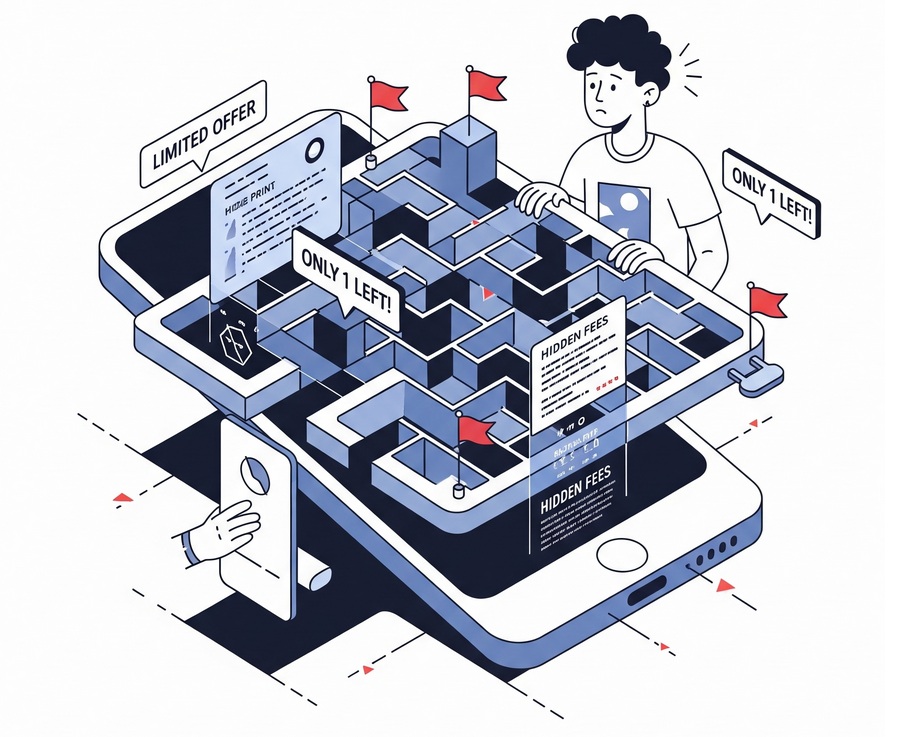
Aakriti Bansal, Medianama
November 26, 2025
MediaNama’s Take: The Central Consumer Protection Authority’s (CCPA) decision to publish 18 self-declarations confirms only a partial picture of its dark pattern(s) identifying exercise. The authority has stated that 26 platforms have filed their declarations, but it has made only 18 of them public. This gap means the public still cannot see what eight major platforms submitted or whether those filings contain any meaningful detail. Moreover, even among the published declarations, several are one-paragraph statements that offer almost no insight into the scope or accuracy of the companies’ internal audits.
LocalCircles’ new survey adds further complications, reporting that 21 of the 26 platforms that submitted declarations still display at least one dark pattern. This finding suggests that the CCPA’s reliance on voluntary self-assessment may not be enough to shift platform behaviour at scale. It also raises questions about what the unpublished declarations contain and whether the missing submissions are similarly sparse or incomplete.
Notably, the CCPA has not clarified how it plans to verify the accuracy of any of the declarations, whether published or unpublished. If filings remain unverified for months, compliance risks turning into a box-ticking exercise rather than a meaningful regulatory process. Therefore, the next phase matters far more than the publication of select declarations, because the current approach raises more questions than it answers.
What’s the News
The CCPA has made 18 dark pattern self-declarations public, despite stating that 26 platforms have filed their compliance letters. The publication follows an RTI filed by MediaNama that revealed which companies had submitted their declarations, and pointed out that none of the filings had been available to the public at the time.
These declarations stem from the Ministry’s June 5 advisory, which required e-commerce and quick commerce companies to conduct internal audits under the 2023 Guidelines for Prevention and Regulation of Dark Patterns and submit compliance letters within 90 days.
For context, Moneycontrol reported that Amazon has still not filed its declaration and has asked for additional time. A senior government official told the publication that the government “has done what it had to” and does not plan further discussions.
The official also said that any punitive action would depend on consumer complaints routed through channels such as the national consumer helpline. This indicates that the enforcement approach continues to be reactive rather than compliance-driven.
What Did The CCPA Ask Platforms To Do?
The June 5 advisory set out a simple compliance framework for digital platforms. It asked every e-commerce and quick commerce company to complete a self-audit of its website and mobile app within 90 days and check their interfaces for the 13 dark patterns listed in the 2023 guidelines. Platforms were required to file a self-declaration confirming compliance once this internal review was complete.
However, the advisory did not specify how the audit should be conducted. Companies were free to choose any methodology, and the CCPA did not prescribe a standard format, a uniform checklist, or a minimum evidence requirement. Also, the advisory did not require independent audits or third-party validation.
Furthermore, there was no explanation of how the CCPA planned to verify whether the declarations were accurate or complete. In effect, the responsibility for defining the scope, depth, and rigour of the audit rested entirely with each platform.
What the CCPA Has Done With the Declarations
As mentioned before, the CCPA has now published 18 self-declarations on its website. The release confirms that companies submitted their compliance letters, but it does not indicate whether the authority evaluated the accuracy or depth of the filings.
Several platforms submitted very short statements that simply assert compliance without describing any checks or findings. BigBasket, Zomato, Blinkit and Swiggy were among the companies that filed especially minimal disclosures. The CCPA has not explained why these filings were accepted or whether any follow-up questions were asked. Therefore, asking for and disclosing self-declarations shows some administrative progress, but it does not reflect any regulatory scrutiny.
This lack of verification aligns with concerns raised by Devangshu Dutta, Founder of business consulting firm Third Eyesight. He told MediaNama that self-declarations “do not change things much” when regulators do not audit submissions or impose consequences.
Further, Dutta remarked that most companies comply at the minimum level required if their claims are not examined and are not made public in full. According to him, revenue-driving design choices such as forced add-ons, confusing checkout flows or misleading scarcity claims will not be voluntarily removed sans oversight.
What Independent Evidence Shows
LocalCircles’ latest audit presents a sharply different picture from the companies’ filings. The organisation found that 21 of the 26 platforms that submitted “dark pattern free” declarations still use one or more manipulative design practices. The assessment relied on feedback from more than 250,000 consumers across 392 districts along with AI-assisted testing.
The most common violations include forced action, subscription traps, bait and switch, basket sneaking, interface interference and disguised advertisements. In practice, these dark patterns respectively mean that users are pushed into steps they did not choose, face hidden or hard-to-cancel subscriptions, see offers change during checkout, encounter fees added at the last moment, get nudged toward platform-favoured choices, and come across ads that appear as regular listings.
LocalCircles also identified drip pricing (gradually adding mandatory fees during the checkout process) on 11 of the 26 companies, including Flipkart, Myntra, Cleartrip, MakeMyTrip, BigBasket, Zomato and Blinkit, among others. The organisation said that many platforms appear to misunderstand what qualifies as drip pricing, which has led to incomplete corrections.
Trust Can Erode Due To Gap Between Declarations And User Experience
Sachin Taparia, Founder of LocalCircles, said that the problem begins with the absence of any verification. “Our understanding is that CCPA is wanting that companies submit a self-declaration at the earliest. However, there is no cross checking of claims that is being done by the CCPA, and as a result the companies are not being as thorough with their dark-pattern detection and resolution,” he said.
Taparia added that discrepancies between declarations and user experience could harm trust. “LocalCircles has found dark patterns on 21 of the 26 platforms submitting self-declarations. If this exercise is not done with high accuracy, both platforms doing so and CCPA could see consumer trust being impacted,” he said.
Importantly, Dutta echoed this concern, saying that the absence of penalties or reputation-related consequences allows companies to self-declare compliance while keeping revenue-generating patterns intact. He described the current process as “more an administrative formality [rather] than a behaviour-changing regulatory tool”.
Why This Matters
The gap between self-declarations and independent audits in the true sense of the word brings the real enforcement question into focus. What should the next phase of regulation look like?
In this context, Dutta said that regulators need to move beyond self-certifications and mandate detailed user experience (UX) audit reports that map every user journey, including pop-ups, onboarding, search, checkout, cancellations and returns.
He explained that regulators should reinforce this by demanding substantive evidence instead of brief compliance letters. This evidence can include screenshots and screen recordings of key flows, version histories that show how an interface changed over time, and product design documents or A/B testing results that reveal why specific nudges were introduced. To explain, A/B testing is essentially a method for comparing two versions of something to see which one performs better.
Furthermore, Dutta noted that platforms already collect extensive data on user complaints and drop-off points, which can help identify harmful or confusing design choices. He also said that independent third-party attestations, similar to security or accessibility audits, can provide a credible external check and increase the cost of non-compliance.
Multiple Annual Audits For Apps that Change Interface Frequently
Notably, Dutta stressed that most dark pattern categories appear across e-commerce, quick commerce and Direct-to-Consumer (D2C) websites, which means regulators can create a baseline audit standard that works across sectors instead of relying on platform-specific interpretations. He also suggested that audits should occur at least once a year, and companies that frequently modify their interfaces may need to report two or three times annually.
The larger concern now is whether the CCPA plans to move toward such a structured framework. Without independent verification and clear audit expectations, companies can continue declaring compliance even when manipulative designs remain embedded in their interfaces.
(Published in Medianama)
Devangshu Dutta
June 30, 2025

In every strategy meeting today, one metric is invariably mentioned: Customer Acquisition Cost (CAC). Whether you’re a well-funded corporate retailer, or raising your first angel round, or a well-established digital duopolist brand scaling Series C, CAC is one of the key performance metrics. “Real” spend that is neatly broken down by channel, optimised by funnel tweaks, scrutinised to the last rupee or dollar.
But there’s a metric we almost never hear about that could be costing brands far more in the long run.
Let’s call it Customer Forfeiture Cost (CFC), the residual lifetime value that is lost when a customer walks away from your business not because of price, competition, or even shifting needs, but because of a “burn”: a delivery missed or messed up, a refund that took weeks, an arrogant customer service call, or a product that failed spectacularly against the promise. In other words, when your brand hurts someone enough to make them walk away. Probably for ever.
It’s a paradox: brands are pumping thousands of crores into acquiring users, but they’re bleeding value at the other end. Yet, while CAC is a line item in every financial statement, CFC is invisible in management dashboards. CEOs don’t announce, “We’ve cut our forfeiture cost by 20% this quarter.”
Yet. every CXO knows it exists. The NPS scores, the social media complaints, the “never again” comments in reviews, the sinking feeling when repeat purchase rates fall.
Why CFC Matters More Than Ever
In every business, during the early stages each sale is a victory. Whether it was the retail chains that grew in the 1990s and early-2000s or the digital upstarts that came up through 2010s and 2020s, scale has been the mantra, and investors have poured money into scaling through the growing consumption of India 1 and India 2 customers.
Today customer acquisition isn’t cheap. The same person who clicked impulsively in 2020 now thinks twice before confirming payment. In this landscape, retention isn’t optional, it’s existential.
Every lost customer isn’t just a refund processed, or a cart abandoned. It’s the long tail of future repeat purchases that will never happen, negative word of mouth and brand distrust in the customer’s circle of influence, and increased future CAC due to declining organic reach.
Way back in 1967, management consultant Peter Drucker wrote in his book “The Effective Executive”: “What gets measured, gets managed”.
Today your CAC may be Rs. 500-1,000. If the average customer life time value (LTV) is Rs. 10,000, and a single burn causes churn after just one order worth Rs. 2,000, your CFC is Rs. 8,000, and that doesn’t even include reputational spillover.
Why We Don’t Measure It
Yes, CFC is hard to quantify. It’s not as easily attributable as ad spends. There’s usually no neat model telling you why someone never returned, because tech stacks aren’t typically designed to track emotional exits. And let’s face it, introspection about broken relationships is uncomfortable, even for management teams.
But that doesn’t mean it’s not real. If a customer leaves because your delivery executive messed up, or because your app crashed during checkout twice in a row, that’s on you, not the market. And in a business climate where sustainable growth is the mantra, LTV is king.
Ignoring CFC is like watching your roof leak and blaming the rain.
Toward a New Discipline
Brands and retailers must start measuring CFC, the value lost when customers disengage due to friction, mistrust, or neglect, and then start working on reducing it. This can be done by:
The Competitive Edge We’re Not Using
In a crowded space where everyone’s vying for eyeballs, trust is the true moat. Customers don’t expect perfection – they do expect accountability, authenticity, and recovery when things go wrong.
Brands that understand and act on Customer Forfeiture Costs will quietly start building a powerful edge: deeper brand loyalty, lower CAC over time thanks to referrals and repeats and greater lifetime value per user.
In other words, real, compounding value.
As the Indian brand ecosystem matures, Customer Forfeiture Cost needs to be as visible and valued as CAC. Acquisition is the invitation; experience is the relationship. Relationships, once broken, are expensive to rebuild; if they can be rebuilt at all.
In the end, growth isn’t just about who comes in. It’s about who stays, and why.
(Written by Devangshu Dutta, Founder of Third Eyesight, this was published in Financial Express on 2 July 2025)
admin
May 8, 2024
At the recent Phygital Retail Convention in Mumbai, Devangshu Dutta anchored an engaging “Fireside Chat” with Bhavana Jaiswal of IKEA India and Kapil Makhija of Unicommerce , on retailers engaging with their customers across channels and formats, and the opportunities as well as challenges in managing experiences seamlessly across online and offline interfaces.
Watch the video at this link:
Devangshu Dutta
December 20, 2018

Do you have this feeling that 2018 went by a little too quickly? Well, however quick it seemed, it was certainly momentous for retail in India.
If 2016 was marked by the shock of demonetization, and 2017 by the pains of GST implementation, 2018 highlighted two threads – the obvious convergence of the online and offline world that had been ignored for far too long, and the interest of foreign capital in India’s consumer world.
Walmart bought India’s loss-making ecommerce leader for an eye-popping US$ 20.8 billion valuation, while ecommerce giant Amazon injecting equity into Shoppers Stop, bought Aditya Birla’s More grocery chain (49 per cent through a back-end entity), and held discussions with Future Group to acquire 9.5 per cent in Future Retail. There were rumours of a mega joint venture between Reliance Retail and China’s Alibaba, and media also reported Japan’s Softbank looking at ploughing US$200 million into Firstcry. Both rivals Amazon and Alibaba were reported to be looking at Spencer’s, one of India’s oldest retail chains currently owned by the RP-Sanjiv Goenka group.
Videos of the crush of curious crowds at India’s first, much anticipated Ikea went viral, and the company said it planned to open 40 locations over the next few years, upping its earlier projection of 25. Chinese retailer Miniso basically came out of nowhere and claimed to have clocked sales of ?700 crores in the very first year in the country.
But along with these cross-border “big bangs” we saw domestic confidence also quietly resurging. Indian retailers are not cowering before large foreign retailers and expensive ecommerce advertising splashes; today they are less defensive about their own prospects than they were two years ago. There is also a growing interest among entrepreneurs and corporates to create new retail businesses, which augers well for the diversity of competition and freshness of offerings in the market.
Going into 2019, one thing I can say with certainty is that the weather, economic and political – both in India and elsewhere – will be unpredictable, and might even turn stormy. Externally, retailers should “expect the unexpected”. To ensure that the business remains on track, however rough the track becomes, retailers must centre all major strategies and decisions on the customer. A theme that has been around for centuries, it is surprising how much it gets ignored in this most customer-facing business.
Retailers tend to divide customers into rigid segments. My suggestion would be to look at customers through the behaviour and experience lens and also recognise that the same customer behaves differently at different times and in different contexts – in effect there are no hard boundaries between “segments”.
It is often emphasised is that Indian consumers are “deal-seeking”. I don’t think we should treat this as a uniquely Indian thing: all consumers look for value-reassurance in unpredictable times and in uncertain conditions. Also remember that even in value-seeking, experience still rules. Retailers and brands that are solely focussing on price or price+feature comparisons are turning their business into a commodity. They are missing the long game: of defining the customer’s experience from the first moment of brand contact to the purchase and beyond.
In 2019, if you want to focus on a single competitive strategy, it would be this: for stickiness and sustainability, think about the customer’s experience, and actively design it, in every environment where the customer connects with you.
Lastly, technology is transformative, but tends to get restricted to being the contrast between ecommerce and physical retail. Indian retailers need to embrace technology in all forms, from using the zillions of transactions within the business and with the customer for developing actionable knowledge, to automating processes where unnecessary cost or time makes the business inefficient.
Having said that, keep the previous rule in mind when deploying at customer-facing technology – make customer-interfacing technology as invisible or intuitive as possible. When in doubt, learn from one of the leaders in the sector, Amazon: its 1-click ordering patent 20 years ago gave it a huge advantage over competitors, and it is now aiming to replicate the same seamless, friction-free behaviour physically with its Dash button. Or pick cues even from younger fashion businesses like Rebecca Minkoff, whose focus is on ease and convenience. The key reason for adopting technology is to remove friction for the customer and for processes that serve the customer.
I have no doubt that 2019 will be eventful – let the customer experience be the guiding light to keep our businesses off the rocks and afloat.
(Published in the Financial Express on 4 January 2019, under the title “Retail in 2019: Need for stronger brand-customer connections that go beyond purchase“)
Devangshu Dutta
August 19, 2013

If you’re planning to develop a mall, here’s a short-list of key issues you must address:
Fail-proof the business plan by focussing on the customer: Focus on the development of retail brands and not solely on quick returns on investment. The primary responsibility should be that of catering to the consumer catchment and driving footfalls for the retail occupants. The other requirements follow from this simple premise. Also, a tenant-unfriendly revenue model that overloads the tenant with a high rent (whether fixed or as a percentage of sales) leads to a churn in tenants, and in combination with other factors, keeps the best tenants out of the mall making it unattractive to customer as well.
Do a thorough recce of the catchment: Ask questions like “can the catchment support the development in terms of consumer footfall and spending?”, “Is there a connect between the needs of the immediate catchment and the occupants of the mall?”, “Are there too many malls in the catchment area?”
Offer a good occupant mix: You cannot have mall occupants who have little relevance for the target consumer. Also, the retailers must complement each other in a healthy way rather than cannibalise customers and sales from each other.
Ensure good access: Accessibility and connectivity to get the traffic smoothly in and out of the mall is a must; ensure there is adequate parking space.
Avoid undersizing: A small-sized is a straight handicap because it will lack variety, and you run the risk of getting dwarfed by the next big mall that throws its hat into the ring. [However, the specific size can vary depending on the state of development of your own catchment.]
Focus on design: This involves making the mall brands ‘visible’, ensuring appropriate ‘zoning’ in terms of entertainment, multiplexes, kids’ areas, food courts etc. This will result in better customer flow management. Bad design and poor customer flow management within the mall leaves large parts of mall “invisible” to visiting consumers, or improper zoning that confuses customers and breaks up the traffic.
Finally, remember, it’s not so much about the “square feet”, as about the feet that will occupy it! Focus on the consumers that you want visiting the mall and why they should return again and again.
