
admin
October 13, 2023

Anand JC, Economic Times
13 October 2023
Once the butt of jokes in Dalal Street circles, 113-year-old ITC has turned a new leaf in recent years, as its strategy to derive higher revenue from its consumer business is bearing fruit, bit by bit.
Registered in Calcutta as the Imperial Tobacco Company, the FMCG major has always relied on its cigarettes and leaf tobacco business for a major chunk of its revenues. ITC’s true diversification move might have begun with the launch of its hotel in Chennai in 1975, including a failed attempt at the financial services business, but it wasn’t until August 2001 that the tale of the FMCG behemoth came to be.
Having relied on its cigarette business since 1910, ITC has increasingly sought to earn more from its ‘cleaner’ consumer goods products. In a 2018 interview, CEO Sanjiv Puri admitted that while the journey to diversify the company started a long time ago, it only got traction around 2008. Under Puri’s first term as the ITC chairman, the company embarked on the ‘ITC Next’ strategy. The first decade was focused on preparing the company for the transition, he said. ITC now can innovate products, create brands and allow “pro-neurs” or professional entrepreneurs to build businesses in FMCG.
The plan has worked
ITC, a darling of dividend-led investing lovers, has always been a long-term growth story in the making. Nearly two decades after entering the food business, the company holds a leadership position across categories.
As per the company’s latest annual report, it holds the leadership spot in the branded Atta market through Aashirvaad, cream biscuits segment via Sunfeast, bridges segment of snack foods via Bingo!, notebooks via Classmate and dhoop segment via Mangaldeep. Its Yippee noodles trails Nestle’s Maggi, as the latter continues to lead in a highly consolidated market. However, Yippee has managed to gobble up Maggi’s share at an enviable pace. Capturing these positions, this quickly is no easy feat either.
One of the things that worked for ITC is their understanding of the distribution of products, stemming from their strength in the tobacco business. ITC started exploring aggressively diversifying away from the tobacco business around the 90s, says Devangshu Dutta, head of retail consultancy Third Eyesight.
ITC’s foray into the food business was supported by its presence in the hotel business. “Some of the marquee products that used to be served in their hotel restaurants, packaged dal and so on, they packaged and sold but it was not a humungous success. It was marginal at best.”
“But they started understanding the distribution aspect because those were sold through traditional distribution channels,” Dutta says.
ITC also put in a lot of financial muscle behind the brand building, given no dearth of resources, Dutta says. This helped them grow rapidly in product categories in which they didn’t have a presence earlier on.

“Starting from scratch, particularly on the foods side, ITC has been one of the most successful companies in the last 15-20 years. Their overall revenue this year has been roughly Rs 19,000 crore, out of which Rs 15,000-16,000 is purely from foods segment,” Amnish Aggarwal, Head of Research, Prabhudas Lilladher told ET Online.
“For a company which started this business, maybe, say, two decades back, this is a very big achievement,” he says.
Unlike its commanding position in its cigarette business, ITC’s ‘other-FMCG’ ambitions faced stiff competition from local and national companies in categories including soaps, shampoos, atta, snacks, biscuits, noodles and confectioneries.
Supporting ITC’s ‘other-FMCG’ ambitions is its core competency, the cigarette business. ITC’s consumer business’ growth has weathered storms, in part, thanks to the cash flows generated by its cigarette business which has helped it create stronger brands, an essential part of any consumer-centric business. Through its cigarette business, ITC also gets unparalleled access to a network of brick-and-mortar stores that have a diverse presence across India.
Also complimenting its growth is ITC’s agri-business, a segment which has also grown in strength over the years. From 10 per cent in FY14, the agri-business in FY23 contributed around 24 per cent to the company’s revenue from operations, as per ET Online’s calculations. ITC over the years has invested in building a competitive agri-commodity sourcing expertise. Some of these structural advantages have facilitated the company’s sourcing of agri raw materials for ITC’s branded packaged foods businesses, be it towards its atta, dairy or spices.
Like its peers, ITC too has given a fair deal of importance to its digital push, with more and more companies launching their D2C platforms. These platforms help customers buy products directly from the company website without the hassle of dealing with channel partners, and at the same time, the companies get their hands on first-party data. Such access can help the company market its offerings better. ITC, like some of its other peers, has also been investing in start-ups to diversify its product portfolio. It recently invested in Yoga Bar and Mother Sparsh.
The numbers behind ITC’s consumer business behemoth
Built to engage in the tobacco business, ITC got into cigarette packaging nearly 100 years ago. Another intent in recent decades has been to focus more on the non-cigarette business.
Puri saw it coming.
Upon being asked about the FMCG business overtaking cigarettes, Puri had said “We do not give guidance. But it will certainly happen because the other businesses are growing faster.”

After contributing nearly 62 per cent to the overall revenue in FY14, the cigarettes business in FY23 contributed only around 37 per cent.
ET Online calculations show that the other-FMCG business contributed 17 per cent to the overall revenue in FY14, which grew to 25 per cent in FY23.
Data confirms the claims made in the above segment. ITC’s non-cigarettes businesses have grown over 31-fold and currently form over two-thirds of its net segmental revenues. The company’s other-FMCG business didn’t start turning consistent profits up until FY14. Since then, it has gone from strength to strength.
ITC’s Other FMCG segment (the second largest contributor to sales) is also witnessing strong earnings and growth momentum, unlike most consumer staples peers.
The segment clocked a revenue of 19 per cent YoY while Nestle and Britannia saw 21 and 11 per cent growth each. FMCG EBITDA performance was even better, with the margin expanding by 430 bps YoY to 13.3 per cent & EBITDA growing 2.1x YoY.

Laughing stock no more
For years, the cigarette business has funded the growth of ITC’s other businesses like non-cigarette FMCG products, sometimes to the ire of shareholders who weren’t happy with the slow growth in financials and scrip value.
A slower growth in scrip value meant that for years ITC was also the laughing stock among social media circles. The stock often remained elusive during market rallies in the previous decade, offering poor returns in comparison to FMCG peers. Between 2014 and July 2022, ITC rose with dividends rose 53 per cent while Nifty50 rose 200 per cent, as per moneydhan.com, a SEBI RIA. ITC’s shares trailed the Sensex for five out of eight years through 2020.
“In the last ten years, HUL has done far, far better than ITC. And if you look at other companies in the same universe, say Dabur, it has also given superior performance. ITC has actually underperformed many of the large consumer names,” Aggarwal said.
But fast forward to 2023, not only is it among the best performers within the benchmark index, ITC has even trumped it. While Nifty50 has gained around 17 per cent in the last year, ITC has grown nearly 40 per cent. The ITC scrip in July crossed a market capitalization of Rs 6 lakh crore, beating HUL to become the largest FMCG company.
Sin stock
Prompting a move away to other segments is the nature of the cigarettes business. Tobacco is toxic, and investors are increasingly recognising it as such. Sin stocks are shares of companies engaged in a business or industry that is considered unethical or immoral.
While Environment, Social, and Governance (ESG) investing may be at a nascent stage in India, it is a serious parameter for global investors. Asia’s largest cigarette maker ITC cannot ignore it.
“The company sustained its ‘AA’ rating by MSCI-ESG –the highest amongst global tobacco companies– and was also included in the Dow Jones Sustainability Emerging Markets Index,” Puri noted in the company’s 2022 sustainability report.

Cigarettes, a bitter but essential overhang
For all the accolades for its gains in its other-FMCG business, ITC is nowhere close to ending its love for cigarettes, not that we are claiming it wants to. The Gold Flake-maker currently controls nearly 80% of the cigarette market.
The numbers in recent years suggest that the segment is flourishing more than ever before.
On an annualized basis, the return on depreciated cigarette assets is approaching a staggering 240%, three times the level two decades ago, as per a Bloomberg report. The entire legal cigarette industry was bleeding in the recent past due to punitive and discriminatory taxation on cigarettes. Taxes on cigarettes in India are multiple times higher than in developed countries viz. 17x of USA, 10x of Japan, 7x of Germany and so on, data shows.
But, companies are now recovering due to stable taxation. ITC’s three four-year cigarette sales CAGR are at their best levels since FY15 despite the company not taking material price increases over the last 13-14 months, as per a Motilal Oswal report.
ITC, which accounts for three out of every four cigarettes sold in the white market in the country, is currently seeing its best growth levels in over a decade, and is far superior to the flattish volumes of the past ten and twenty years.
(Published in Economic Times)
admin
September 25, 2023

Akanksha Nagar, Financial Express
September 25, 2023
Adding to the fizz in the energy drink market, NourishCo, a division of Tata Consumer Products (TCP), has unveiled Say Never — a caffeine-based energy drink priced at Rs 10 for a 200 ml cup — in two variants of red (berries) and blue (tropical flavours). In its initial phase of launch, the brand will be available largely through general trade outlets in Karnataka and some key markets of the north, including Delhi, NCR, Uttar Pradesh and Bihar. Vikram Grover, MD, NourishCo Beverages, TCP, says, “With Say Never we are celebrating the heroes who carve their own path.”
As a functional beverage, the energy drinks segment has grown by leaps and bounds in recent years to stand at Rs 3,500 crore in 2022. Experts reckon the market will touch Rs 10,000 crore by 2027. Red Bull is the category leader with a 61% market share of the market.
PepsiCo’s debut of Sting a few years ago at an inviting Rs 50 for 250 ml (as opposed to Red Bull’s Rs 125 for 250 ml can) had shaken up the category. With a 7% market share Sting has surpassed PepsiCo’s older products like Mountain Dew to become the company’s fastest-growing brand. Charged by Thums Up kept up the buzz for Coca-Cola during the 2023 edition of the Indian Premier League on Star Sports. Grover says Say Never will stand out for two reasons — the attractive price point and the cup delivery format, which the company has used with Gluco+. “The rapid growth in this energy segment in the recent past has come on the back of price disruption, and we feel that we can take that disruption forward,” he adds.
As energy drinks still operate in a niche segment with a premium play, an affordable price point can be a game-changer, say experts. “Affordability is a significant driver in India, especially for pre-teens, teens and college students,” says Devangshu Dutta, CEO, Third Eyesight. For many years energy drinks were treated as a niche premium opportunity, but the availability of lower price options has opened up the mass market as demonstrated by PepsiCo’s Sting in PET bottles with a much lower price point.
While the cola giants have an obvious advantage in terms of shelf space accessibility, given the market’s trajectory even smaller players stand a good chance to create a space for themselves. “Clarity in positioning, techniques to make the brand stand out, and ensuring availability with strong distribution and replenishment is imperative to get ahead,” Dutta suggests.
TCP plays in the energy space with Tata Gluco+, a glucose-based energy drink targeting a young consumer set; for Say Never the target is the youth between the ages of 18 and 35.
Besides pricing, what will be make or break is marketing muscle and a differentiated appeal, says Samit Sinha, managing partner, Alchemist Brand Consulting. “Say Never can position itself as a party-drink — akin to how Red Bull is equated with active lifestyles. There are enough opportunities to create nuanced differences in attributes, functional benefits and most of all, emotional benefits.”
NourishCo contributes 4% to the TCP overall business and in Q1 of FY23, its recorded a strong revenue growth of 60%. TCP’s flagship drink Tata Gluco+ registered a growth of 61% in the same period.
(Published in Financial Express)
admin
August 26, 2023
Several new-age startups in the D2C space in India are being acquired by bigger FMCG companies.
admin
May 6, 2023

Gargi Sarkar, Inc42
6 May 2023
With one of the largest consumer bases in the world, the Indian retail industry is on a constant upward spiral, thanks to the increase in the purchasing power of Indian consumers and the ever-increasing ecommerce adoption.
Notably, this has helped segments like online beauty and personal care (BPC) sustain and grow faster than the players in the offline space.
According to industry experts, the online BPC market has been growing in the range of 20% to 25% annually, compared to the offline segment at around 8% to 10% a year. According to a IMARC Group report, India’s BPC market size reached $26.3 Bn in 2022 and is expected to reach $38 Bn by 2028, growing at a CAGR of 6.45% between 2023 and 2028.
Notably, in their endeavour to capture this opportunity, new players are entering the BPC space, and the existing ones have started to scale their omnichannel presence.
The newest entrant in the space is Reliance Retail. The retail major forayed into the BPC market with its omnichannel platform, Tira, earlier last month. Along with launching its app, Reliance Retail also opened its flagship Tira store in Mumbai.
It is crucial to note that existing marketplaces like Nykaa and Purplle, and D2C brands such as SUGAR Cosmetics and Mamaearth, too, have started expanding their offline footprint, after scaling up their online presence.
Similarly, offline retailers such as Loreal India, Sephora, and Hindustan Unilever’s Lakme have increased their focus on expanding their online presence via direct-to-consumer websites.

Given that Reliance’s Tira has entered the market with an omnichannel playbook, piggybacking on its parent’s cash reserves, it becomes all the more important to understand what impact it will have in the long run on the existing players and industry dynamics.
According to the industry experts that Inc42 spoke with, the beauty and personal care market offers more than enough opportunities for multiple players to grow, due to multiple favourable factors.
“The BPC segment remains one of the fastest growing categories in consumer retail because the penetration of beauty products has remained relatively low. With increasing awareness, and more disposable income, the BPC segment has witnessed decent growth. Now, since the segment is growing, there is a scope for multiple players to grow. That is why some of the big players have entered into the market,” Ashish Dhir, EVP (consumer and retail), 1Lattice said.
Despite Dhir’s optimism, it is pertinent to note that Nykaa saw some initial pressure on its share prices and overall stock performance with the launch of Tira. Brokerage firm Macquarie said that the entry of new players such as Tira could exacerbate the problems for Nykaa at a time when the competition in the segment is already tough.
In the past, Reliance’s entry into the fashion ecommerce space with Ajio impacted leading existing players like Myntra. Now that we already have an example from the past, coupled with a falling will to spend due to factors like rising unemployment and inflation, it will be interesting to see how Nykaa performs under such pressure.
How Tira Could Threaten Nykaa & Ilks Dominance In The Beauty & Personal Care Space
It is no wonder that Reliance Retail will look at disrupting the market to emerge as a market leader as it has done in every segment.
Compared to sectors such as apparel and telecom, the BPC segment is different, and it is not very easy to scale here the way Nykaa has done over the years, according to Karan Taurani, SVP Research, Elara Capital. He noted that many other players in the past tried to scale but failed.
“Nykaa has emerged as a winner due to several factors such as a superior consumer experience on the app, trustworthiness, and product variety. Currently, the product delivery time is also lesser on Nykaa compared to Tira, although the latter could improve it. Moreover, Nykaa has created a network of influencers over the years, and its approach on social media is very different,” Taurani added.
He, however, highlighted that there will be an initial consumer churn as some customers will try Tira as well, and whether the new venture, Tira, can retain all these customers will depend on the consumer experience it provides.
As per Taurani, marketplaces like Nykaa will see some sort of pinch in terms of demand but will not have a significant impact until Tira offers a differentiated experience. Right now, Tira has very few differentiating factors.
However, we should not forget that Reliance Retail is experienced in building brands and has the heavy financial backing to scale in the offline segment.
Given that many players do not have much experience in the offline segment, they may see a visible impact facing the retail giant in the offline BPC space.
It is important to note that Nykaa’s consolidated net profit fell 70.7% year-on-year (YoY) to INR 8.5 Cr in the December quarter of the financial year 2022-23 (FY23), despite the festive season.
In addition, Mumbai-based beauty ecommerce startup Purplle’s net loss almost quadrupled to INR 203.6 Cr in the financial year 2021-22 (FY22) from INR 52 Cr in FY21.
An optimistic Dhir, however, likes to believe that Tira would only increase the competition in the segment and would not impact the profitability of its rivals, at least in the near term.

Will D2C Beauty & Personal Care Brands Face The Heat?
Along with conglomerate-backed large players such as Tata Cliq and online marketplaces, there are several Indian startups and brands such as mCaffeine, Mamaearth, Sugar and Minimalist, which are looking to capture a big chunk of the ever-increasing BPC market pie.
According to an Inc42 report, BPC will remain one of the fastest-growing D2C segments between 2022 and 2030, growing at a CAGR of 27%.
Talking about Tira’s impact, experts said these (aforementioned) D2C brands will not see any major impact due to two factors.
“Firstly, these brands will have similar arrangements with Tira as they have with Nykaa. Secondly, these brands have created a loyal customer base for the products they offer and they have their recall,” Taurani said.
“While deep-pocketed companies can spend their way into buying the market share, all brands need to be prepared for the long term. Also, for these brands a clear positioning be crucial to stand out, not just in their product and service mix but also the overall customer experience specific to their target audience. This would also give opportunities to several beauty and personal care brands to profitably serve niches that may be too small for the larger companies driving for the market, “Devangshu Dutta, the founder of Third Eyesight, said.
Also, Nykaa and Purplle have a portfolio of private labels, which includes skincare brands such as Dot & Key, Earth Rhythm, and Good Vibes, among others. Hence, it will not be surprising if Tira launches its private labels or acquires small brands to grow its portfolio.
As brands like Dot & Key, and Good Vibes are already direct competitors to these D2C beauty brands, a new player can pose more challenges for them.
What Else Could Work In Tira’s Favour
“Our vision for Tira is to be the leading beauty destination for accessible yet aspirational beauty, one that is inclusive and one that harbours the mission of becoming the most loved beauty retailer in India,” Reliance Retail’s executive director Isha Ambani said at the time of launch in April 2023.
When Reliance entered new segments like telecom and fashion ecommerce with Jio and Ajio, respectively, many of the existing players struggled to sustain in the segment as the Mukesh Ambani-led conglomerate scaled up quickly, thanks to its strong financial position. Hence, it will work as the biggest favourable factor in the beauty and personal care space as well, industry experts believe.
Tira is also expected to lure customers with big discounts. “For Tira, a big chunk of revenue will initially go towards marketing and customer acquisition, at least for the first couple of years, as it is a new brand. More than marketing, Reliance will look at discounting more prominently. Reliance will try to give higher discounts compared to other players,” Taurani said.
He added that Reliance has some expertise in building new platforms, such as Ajio, and a rich talent pool and strong brand exposure.

While players like Tata Cliq, Purplle, and Myntra’s beauty segment have tried to scale up in BPC, none of these players has seen significant growth. Hence, the market consists of one large player, making it easier for a deep-pocket player like Tira to carve its positioning quickly and create a duopoly with Nykaa.
At the time of Tira’s launch, the company said that the brand would offer a curated assortment of the best global and home-grown beauty brands. In terms of its offline play, Reliance Retail can leverage partnerships with global beauty brands and suppliers to get better deals. As it is looking at an omnichannel play at an entry stage itself, it may be able to gain market share from smaller beauty retailers, especially in bigger cities.
The Tira offline store will have the latest beauty tech tools such as virtual try-on to create customised looks and a skin analyser that will personalise and assist consumers in making purchasing decisions based on their needs, the company said.
On the luxury side, Reliance Retail is also directly targeting the market which has higher margins and could eat into the margins of Nykaa easily. It must be noted that Nykaa’s Luxe is still in its infancy.
While it is true that Tira will increase the competition in the BPC segment, it is not likely to rewrite the industry’s future over the next couple of years. Tira currently has very few differentiating factors in both the online and offline segments. Additionally, in the offline segment, Tira has opened only one store while Nykaa already has 141 physical stores across 56 Indian cities, as shared in its Q3 earnings report.
Even though there are glaring differences, some industry experts see Tira’s journey to be the same as that of Nykaa, going ahead.
(Published in Inc42)
admin
October 11, 2022
SHARLEEN D’SOUZA, Business Standard
Mumbai, 10 October 2022
In early 1994, Titan started selling watches with precious stones in them and called this new line, Tanishq. It went on to become a separate division of Titan Company and grew into the country’s largest branded jewellery outfit, helping raise Titan’s sales to ~28,799 crore last financial year.
Thirteen years later, in 2007, Titan Eye+ set out to shake up the eyewear market. Though it also sells sunglasses of other brands, it is the prescription segment that Titan redefined and now, according to its website, has 550 Eye+ exclusive stores in 229 cities.
In 2017, Titan sought to do an encore in yet another large market in which the demand, as in jewellery and eyewear, was almost recession-proof and largely commoditised, leaving ample space for a pan-Indian branded chain. Thus was born Taneira, with an avowed intent to become the country’s largest organised saree retailer.
“Titan had earlier tried to organise the jewellery market through Tanishq, which is successful, and this is an attempt by Titan to organise the saree market,” Ambuj Narayan, chief executive officer (CEO) of Taneira, told Business Standard.
What is unsaid is that jewellery to sarees can also be seen as a horizontal brand extension, the two do go together on occasion.
Natural extension
The Indian wear market is a 5,000-year old segment estimated to be worth ₹50,000 crore a year and growing at a compound annual growth rate of 6 to 8 per cent. Sarees account for 80 to 85 per cent of its sales, with kurta sets, blouses, and lehengas comprising the rest. Yet, despite the size and growth, there is hardly any nationally known brand in this segment, with Nalli Silks being one of the notable exceptions.
Titan insiders say the company believed sarees to be a natural extension for it, given its past success with design-led lifestyle brands. They say the company organised an internal competition to see who came up with the best expansion strategy.
The result is a bouquet of design-differentiated products — primarily sarees and kurta sets — made from pure natural fabrics sourced from all over India. The company put together more than 100 craft clusters representing the diverse weaves. These include the Banarasi sarees from Uttar Pradesh, Kanjivaram from Tamil Nadu, Chanderi and Maheshwari from Madhya Pradesh, and Jamdani from West Bengal. The output is a mix of contemporary ethnic wear for women across life stages and occasions — college, office wear, party wear, festivals, and weddings, with bridal sarees being the speciality. The prices range from ₹1,000 to ₹2,00,000.
“The Tata group’s ventures have always been consistent with their approach — they stay the course beyond initial hiccups and eventually scale up the business. This is very much how Titan and Tanishq worked their way from initial struggles to eventually scale and become nationwide brands,” said retail expert Devangshu Dutta, CEO at Third Eyesight.
To say that Taneira has had initial hiccups would be an understatement. Three years after its launch, the Covid-induced lockdowns and restrictions brought the entire retail sector down to its knees.
Baptism by Covid
“Pandemic restrictions and high Covid-19 anxiety among the people kept socialising and weddings at a very low level of activity over the past couple of years. For Taneira, being a nascent brand with a yet-to-be-established customer base, the operating environment has been particularly tough,” Titan Company said in its FY22 annual report.
Taneira used this time to realign its strategy of connecting with customers. Thus, during 2021-22, which braved the second Covid wave in its first quarter — the dreadful Delta — and saw the third wave creep into its fourth quarter, sales at Titan’s Indian dress wear division grew by 55 per cent.
Narayan, the CEO, attributes this growth to initiatives that included staying close to the customer through e-commerce. “We really drove e-commerce out and reached out to our customers through video calling and try-at-home activities,” he said.
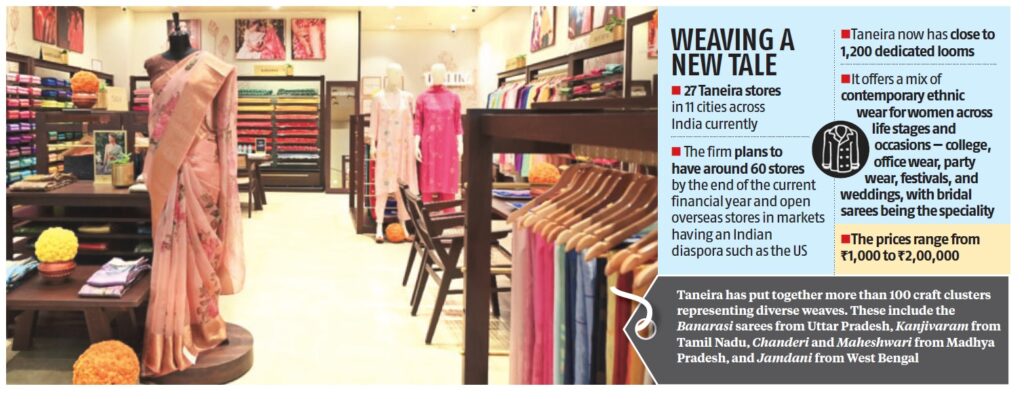
As consumer sentiment started to improve, Taneira already had two collections ready — wedding weave and the summer collection — which boosted sales. During 2021-22, it also increased its store count to 20 by adding six more. During the fourth quarter, Taneira sales rose 4 per cent.
Today, there are 27 Taneira stores in 11 cities across India. It plans to expand to Tier 1 and Tier 2 cities in the first phase and then to Tier 3 in the second phase of its store expansion.
However, Vishal Gutka, vice-president of research (consumer and retail sector) at Phillip Capital, said: “Taneira follows the same principle Titan used for Tanishq, where it entered an unorganised category and expanded it. But it is still early days to gauge how Taneira will pan out. Also, the company needs to give more clarity on the unit economics of each store.”
Weaving an expansion plan Titan’s annual report talks of a robust expansion plan for Taneira this financial year: “We plan to grow at an exponential rate and make our store count around 60 by the end of the current fiscal year and open overseas stores in markets having an Indian diaspora such as the US.” It adds that Taneira will become a more significant contributor to the overall revenue of Titan in the medium term.
At the heart of this grand ambition lies the humble weaver. Taneira now has close to 1,200 dedicated looms and has a programme called Weaver Shala to support them with technical expertise and in modernising their facilities. It has introduced frame looms along with basic workspace facilities for the weavers in collaboration with the localised weaver-led organisations.
The brand has closely worked with the weavers in Varanasi, Uttar Pradesh, and Champa, Chhattisgarh, and aims to take Weaver Shala to other parts of the country.
Taneira leverages Tanishq’s brand strength; mannequins at Tanishq stores, for instance, are dressed in Taneira sarees.
However, Narayan said Taneira and Tanishq will not be sold under the same roof because Titan wants to establish Taneira as a distinct brand in its own right.
(Published in the Business Standard)
