
Devangshu Dutta
January 10, 2017
In this piece I’ll just focus on one aspect of technology – artificial intelligence or AI – that is likely to shape many aspects of the retail business and the consumer’s experience over the coming years.
To be able to see the scope of its potential all-pervasive impact we need to go beyond our expectations of humanoid robots. We also need to understand that artificial intelligence works on a cycle of several mutually supportive elements that enable learning and adaptation. The terms “big data” and “analytics” have been bandied about a lot, but have had limited impact so far in the retail business because it usually only touches the first two, at most three, of the necessary elements.
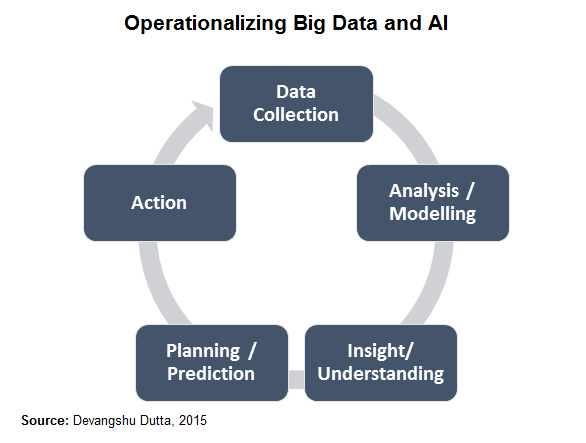
“Big data” models still depend on individuals in the business taking decisions and acting based on what is recommended or suggested by the analytics outputs, and these tend to be weak links which break the learning-adaptation chain. Of course, each of these elements can also have AI built in, for refinement over time.
Certainly retailers with a digital (web or mobile) presence are in a better position to use and benefit from AI, but that is no excuse for others to “roll over and die”. I’ll list just a few aspects of the business already being impacted and others that are likely to be in the future.
On the consumer-side, AI can deliver a far higher degree of personalisation of the experience than has been feasible in the last few decades. While I’ve described different aspects, now see them as layers one built on the other, and imagine the shopping experience you might have as a consumer. If the scenario seems as if it might be from a sci-fi movie, just give it a few years. After all, moving staircases and remote viewing were also fantasy once.
On the business end it potentially offers both flexibility and efficiency, rather than one at the cost of the other. But we’ll have to tackle that area in a separate piece.
(Also published in the Business Standard.)
Devangshu Dutta
October 9, 2016
P. Karunya Rao of Zee Business in conversation with Devangshu Dutta, Chief Executive, Third Eyesight and Narayan Devanathan, Group Executive & Strategy Officer, Dentsu India, about festive discounts, the evolution of ecommerce and retail business in India.
Devangshu Dutta
April 24, 2016

(Published in the Financial Express, 10 May 2016)
In about 20 years, Café Coffee Day (CCD) has grown from one ‘cyber café’ in Bengaluru to the leading chain of cafés in the country by far.
In its early years, it was a conservative, almost sleepy, business. The launch of Barista in the late 1990s and its rapid growth was the wake-up call for CCD — and wake up it did!
CCD then expanded aggressively. It focussed on the young and more affluent customers. Affordability was a keystone in its strategy and it largely remains the most competitively priced among the national chains.
Its outlets ranged widely in size — and while this caused inconsistency in the brand’s image — it left competitors far behind in terms of market coverage. However, the market hasn’t stayed the same over the years and CCD now has tough competition.
CCD competes today with not only domestic cafés such as Barista or imports such as Costa and Starbucks, but also quick-service restaurants (QSRs) such as McDonald’s and Dunkin’ Donuts. In the last couple of years, in large cities, even the positioning of being a ‘hang-out place’ is threatened by a competitor as unlikely as the alcoholic beverage-focussed chain Beer Café.
CCD is certainly way ahead of other cafés in outlet numbers and visibility in over 200 cities. It has an advantage over QSRs with the focus on beverage and meetings, rather than meals. Food in CCD is mostly pre-prepared rather than in-store (unlike McD’s and Dunkin’) resulting in lower capex and training costs, as well as greater control since it’s not depending on store staff to prepare everything. However, rapid expansion stretches product and service delivery and high attrition of front-end staff is a major operational stress point. Upmarket initiatives Lounge and Square, which could improve its average billing, are still a small part of its business.
Delivery (begun in December 2015) and app-orders seem logical to capture busy consumers, and to sweat the assets invested in outlets. However, for now, I’m questioning the incremental value both for the consumer and the company’s ROI once all costs (including management time and effort) are accounted for. The delivery partner is another variable (and risk) in the customer’s experience of the brand. Increasing the density through kiosks and improving the quality of beverage dispensed could possibly do more for the brand across the board.
The biggest advantage for CCD is that India is a nascent market for cafés. The café culture has not even scratched the surface in the smaller markets and in travel-related locations. The challenge for CCD is to act as an aggressive leader in newer locations, while becoming more sophisticated in its positioning in large cities. It certainly needs to allocate capex on both fronts but larger cities need more frequent refreshment of the menu and retraining of staff.
An anonymous Turkish poet wrote: “Not the coffee, nor the coffeehouse is the longing of the soul. A friend is what the soul longs for, coffee is just the excuse.” There are still many millions of friends in India for whom the coffee-house remains unexplored territory, whom CCD could bring together.
admin
February 21, 2016
 Shinmin
Bali, Financial Express
Shinmin
Bali, Financial Express
Mumbai,
21 February 2016
 Having
created quite a stir at the time of their launch, hyperlocal companies
are now witnessing a dampened mood. While several have folded
up operations in some cities, others have downsized staff, tweaked
the services they offer and even made alterations to their business
models. A recent example is Grofers shutting down operations in
Bhopal, Bhubaneswar, Coimbatore, Kochi, Ludhiana, Mysuru, Nashik,
Rajkot and Visakhapatnam.
Having
created quite a stir at the time of their launch, hyperlocal companies
are now witnessing a dampened mood. While several have folded
up operations in some cities, others have downsized staff, tweaked
the services they offer and even made alterations to their business
models. A recent example is Grofers shutting down operations in
Bhopal, Bhubaneswar, Coimbatore, Kochi, Ludhiana, Mysuru, Nashik,
Rajkot and Visakhapatnam.
TinyOwl last year was in the news for a poorly-handled downsizing
operation in Pune, with a dramatic hostage situation involving
its co-founder Gaurav Choudhary. PepperTap also recently shut
down operations in six cities.
Ironically, giants like Amazon have not only aggressively entered
the hyperlocal space, they are building on it. Amazon is currently
offering the service in Bengaluru, Amazon Now, after running a
pilot project, Kirana Now, in 2015.
The investor sentiment in India is also on a decline, as was
reported earlier this year. Investments by venture capitalists
have dropped from $2.12 billion (October-December 2014) to $1.15
billion (October-December 2015), according to a report by CB Insights
and KPMG International. This leaves an even shorter window of
opportunity for players to retain investor interest.
Albinder Dhindsa, co-founder, Grofers, states that differing
levels of technology literacy among the majority of merchants
and consumer adaptation to the online platform are concern areas
for the company. In 2016, the company is looking to bring over
one lakh merchants aboard and ensure that turnaround time stays
under an hour. Grofers delivers more than 35,000 orders per day
on average. In Q4 2015, the firm acquired teams of SpoonJoy and
Townrush to bring dynamic learning to the table.
For Swiggy’s co-founder Nandan Reddy, the focus is currently
to grow the market, while catering to a wide demographic of consumers.
He admits that in the early stages, the brand had trouble educating
even its partners. Furthermore, operating a delivery fleet in
an on-demand service offering sub-40 minute deliveries is a challenging
task, given that there are at least 15 points of failure in an
average order. Swiggy currently owns a delivery fleet of 3,800
delivery executives. The brand’s repeat consumers contribute
to over 80% of orders.
Debadutta Upadhyaya, co-founder, Timesaverz, says some of the
major challenges in a hyperlocal market are optimum resource utilisation
and matching locations, price points, and other specific requirements
to customer needs. Timesaverz currently has a service range spread
across 40 categories, aided by a network of over 2,500 service
partners across five metros. Its revenue model is commission based,
where 80% of earnings from consumers are shared with service partners.
Vinod Murali, MD, Innoven Capital, points out that as the hyperlocal
industry is in its nascent stages, it needs a fair amount of time
to grow. “One aspect to keep in mind is that a large sized
equity cheque does not imply that a company has achieved operational
maturity or robust business metrics, especially in this segment,”
he notes.
Given the recent consolidation in this category, the survivors
have the opportunity and time to focus on improving unit economics
and demonstrate that their businesses are viable and valuable.
Devangshu Dutta, CEO, Third Eyesight, is of the opinion that
hyperlocals make the mistake of borrowing business models and
terminologies from Silicon Valley, without adequately understanding
the real context of the Indian market. “Is there an existing
or even potential demand for the service claimed to be provided?
Or are you just going to introduce an intermediary and an additional
link in the chain, with additional costs and unnecessary administration
involved?” he asks.
(Published in Financial Express)
Devangshu Dutta
January 21, 2016

Aggregator models and hyperlocal delivery, in theory, have some significant advantages over existing business models.
Unlike an inventory-based model, aggregation is asset-light, allowing rapid building of critical mass. A start-up can tap into existing infrastructure, as a bridge between existing retailers and the consumer. By tapping into fleeting consumption opportunities, the aggregator can actually drive new demand to the retailer in the short term.
A hyperlocal delivery business can concentrate on understanding the nuances of a customer group in a small geographic area and spend its management and financial resources to develop a viable presence more intensively.
However, both business models are typically constrained for margins, especially in categories such as food and grocery. As volume builds up, it’s feasible for the aggregator to transition at least part if not the entire business to an inventory-based model for improved fulfilment and better margins. By doing so the aggregator would, therefore, transition itself to being the retailer.
Customer acquisition has become very expensive over the last couple of years, with marketplaces and online retailers having driven up advertising costs – on top of that, customer stickiness is very low, which means that the platform has to spend similar amounts of money to re-acquire a large chunk of customers for each transaction.
The aggregator model also needs intensive recruitment of supply-side relationships. A key metric for an aggregator’s success is the number of local merchants it can mobilise quickly. After the initial intensive recruitment the merchants need to be equipped to use the platform optimally and also need to be able to handle the demand generated.
Most importantly, the acquisitions on both sides – merchants and customers – need to move in step as they are mutually-reinforcing. If done well, this can provide a higher stickiness with the consumer, which is a significant success outcome.
For all the attention paid to the entry and expansion of multinational retailers and nationwide ecommerce growth, retail remains predominantly a local activity. The differences among customers based on where they live or are located currently and the immediacy of their needs continue to drive diversity of shopping habits and the unpredictability of demand. Services and information based products may be delivered remotely, but with physical products local retailers do still have a better chance of servicing the consumer.
What has been missing on the part of local vendors is the ability to use web technologies to provide access to their customers at a time and in a way that is convenient for the customers. Also, importantly, their visibility and the ability to attract customer footfall has been negatively affected by ecommerce in the last 2 years. With penetration of mobile internet across a variety of income segments, conditions are today far more conducive for highly localised and aggregation-oriented services. So a hyperlocal platform that focusses on creating better visibility for small businesses, and connecting them with customers who have a need for their products and services, is an opportunity that is begging to be addressed.
It is likely that each locality will end up having two strong players: a market leader and a follower. For a hyperlocal to fit into either role, it is critical to rapidly create viability in each location it targets, and – in order to build overall scale and continued attractiveness for investors – quickly move on to replicate the model in another location, and then another. They can become potential acquisition targets for larger ecommerce companies, which could acquire to not only take out potential competition but also to imbibe the learnings and capabilities needed to deal with demand microcosms.
High stake bets are being placed on this table – and some being lost with business closures – but the game is far from being played out yet.
