
admin
September 15, 2025

Shabori Das & Sagar Malviya, Economic Times
15 September 2025
ITC Foods is making a strategic entry into fresh packaged foods including short shelf-life cookies, cakes, and chapatis, among others, part of its broader aim to ride the surge in quick commerce demand, said Hemant Malik, chief executive of the food division of ITC.
The move is also prompted by the cigarette-to-snack maker’s aim to capture India’s growing appetite for convenience-led, freshly-made food with shelf life of a few days, instead of 12-24 months for other food products, with quicker fulfilment systems.
“There is a growing consumer demand for fresh packaged food products, powered by enhanced accessibility and convenience provided by the surge in quick commerce platforms,” Malik told ET, adding that the company has extended its Sunfeast and and Aashirvaad brands into these categories.
ITC has created a hyper-local production and distribution ecosystem to enable next-day delivery from oven to doorstep in a country where supply chains are often fragmented and 75% of the sales are through local kiranas. The company said its small-batch model, scaled across urban micro-markets, will help maintain freshness while sidestepping the usual constraints of long-haul logistics and warehouse storage.
“We are leveraging tech-enabled capabilities, supply chain efficiencies including hyper-local agile production and rapid fulfilment together with focus on fresh sourcing,” Malik added.
Analysts however noted that relying solely on quick commerce won’t ensure scale while limited shelf life could require bigger retail channels including modern and general trade.
“These products will need to move fast. So inventory management in terms of space for quick commerce will be challenging,” said Devangshu Dutta, founder of retail consulting firm Third Eyesight. “And in case of quick commerce, it will need to have catchment focus as not every micromarket in a city will have demand for such products.”
“In the case of large FMCG companies, scalability is always what is needed, and quick commerce alone will not help with that. Eventually modern trade and general trade for these shorter shelf life products will be considered,” he said.
ITC’s packaged food business clocked ₹18,270 crore in gross sales during FY25, up 6% on-year.
Quick commerce platforms such as Blinkit, Swiggy Instamart, and Zepto have made it easier than ever to deliver ultra-fresh products within hours–and they have been tapped by local bakeries and direct-to-consumer companies including Theobroma, Baker’s Dozen, and Id Fresh.
Over the past few months, mainstream companies including Hindustan Unilever, Marico, Adani Wilmar and Parle have carved out separate sales and distribution teams for quick commerce, responding to the need for a faster turnaround in stocking as well as a distinct portfolio for the segment.
(Published in Economic Times)
admin
September 5, 2025
Pooja Yadav, Exchange4Media
4 September 2025
Quick commerce today is no longer just about delivering groceries in 10 minutes. It has emerged as one of India’s most coveted retail media channels, where brands are willing to pay a steep premium for visibility.
If FY25 was about building scale, FY26 is definitely shaping up to be about pricing power. With consumer adoption of 10–20-minute delivery apps surging, advertisers are competing for limited inventory, pushing ad rates up by 30–50% year-on-year.
“Ad rates on quick commerce platforms have surged by 30–40% year-onyear, especially during high-impact windows like festive seasons and major cricket events. This is fuelled by rising user engagement and proven performance outcomes. With more sophisticated ad formats and attribution models now in play, advertisers increasingly view the premium as justified,” added Uday Mohan, COO, Havas Media India & Havas Play.
Scale, Pricing & Soaring Ad Rates
While agencies point to surging demand, market data shows that platforms themselves are firming up monetisation models with steep onboarding thresholds.
As per market estimations, Swiggy Instamart offers tiered onboarding packages ranging from ₹4.5 lakh to ₹10 lakh, adjustable against advertising spends over a three-month period. Zepto reportedly asks new or small brands to commit anywhere between ₹2 lakh and ₹7 lakh per month on ads, depending on the category. Blinkit, on the other hand, charges ₹25,000 per SKU per state as a non-refundable onboarding fee, which is credited to the brand’s ad wallet.
This aggressive push comes against the backdrop of a sector that has grown at breakneck speed. According to CareEdge Analytics’ July 2025 data, India’s quick commerce market was valued at around ₹64,000 crore in FY25, growing at a staggering 142% CAGR during FY22–FY25 on the back of evolving consumer preferences, hyperlocal infrastructure, and a low base.
The momentum is expected to continue with strong double-digit growth over the next few years, as adoption deepens in Tier II & III cities, delivery networks expand, and instant fulfilment becomes mainstream.
At the same time, platforms are pivoting from pure hypergrowth to sustainable profitability—tapping into advertising, subscriptions, private labels and tech-led inventory optimization as key revenue levers. This shift is being enabled by India’s expanding digital backbone: with over 1.12 billion mobile connections and 806 million internet users (a 6.5% YoY rise), the country is projected to cross 900 million internet users by the end of 2025. Rising smartphone penetration in both urban and rural areas, aided by affordable data and policy support, has created one of the world’s largest online consumer pools, with 270 million e-shoppers in 2024, making India the second-largest e-retail market globally.
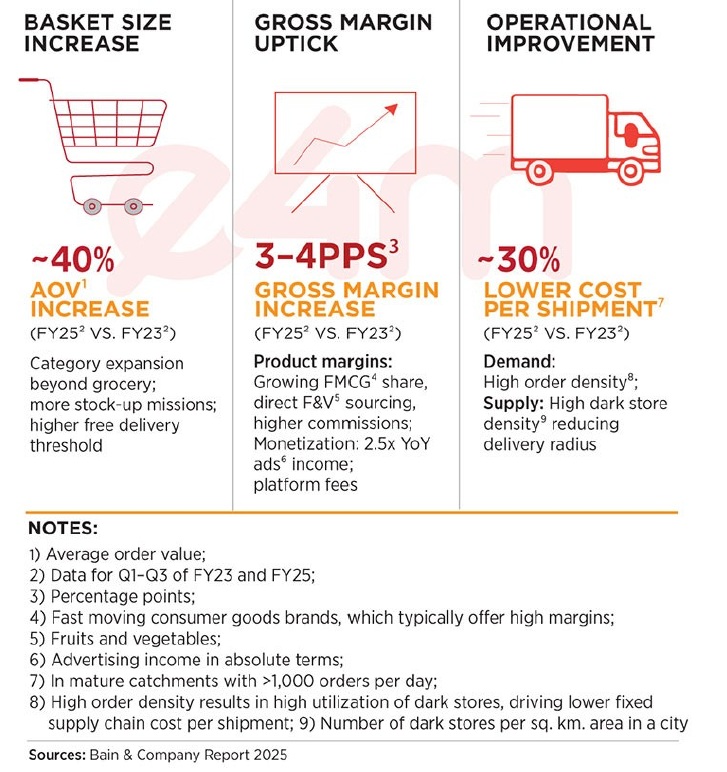
Unsurprisingly, advertisers are flocking to these platforms because that’s where their consumers are. Even though seller commissions contribute the bulk of revenues (68–74%), ad placements and brand boosts already account for 9–11%. Industry data shows that ad rates on quick commerce apps have climbed by 30–50% in just a year, with premiums doubling during high-impact windows like festivals and cricket tournaments. This steep inflation reflects both rising consumer traffic and the limited nature of in-app inventory, pushing brands to pay top dollar for guaranteed visibility at the point of purchase.
Bain’s ‘How India Shops Online 2025’ report also underscores this momentum: beauty, personal care, and snacking categories are already outpacing overall e-retail growth, and these are the very segments leaning most aggressively into quick commerce ads.
“Ad rates on quick commerce platforms have jumped by nearly 40–50% compared to last year. This spike reflects that premium brands are willing to pay for immediacy and guaranteed visibility, where ad placement directly links to instant purchase behaviour,” said Mandar Lande, founder of Waayu, a zero-commission food delivery app in India.
According to Aditya Aima, Managing Director, Growth Markets; Co-MD, India & MENA, AnyMind Group, ad rates on quick commerce platforms have not only risen but demand has intensified. “The surge is fuelled by three dynamics: sticky consumer behavior with high visit frequency, dense purchase intent compared to social or entertainment platforms, and the scarcity of ad real estate.”
Quick commerce becomes a strategic channel
For brands, quick commerce has moved far beyond being a fulfillment partner. It has become a strategic advertising channel, especially for those in fast-moving and competitive categories like beauty, wellness, snacks, and personal care. The platforms offer not just last-mile delivery but also front-of-shelf visibility in an increasingly cluttered digital environment.
According to Seshu Kumar Tirumala, Chief Buying and Merchandising Officer, bigbasket, “Brands are moving beyond purely search-centric strategies and increasingly adopting immersive display activations with formats like Spotlight Videos, Banners with Add-to-Cart (ATC), targeted banners, and ATC widgets. For established brands, most investments still flow into performance-led formats such as Sponsored/PLA ads, while a portion is reserved for top-funnel initiatives like storytelling, new launches, and high-visibility events. Emerging or smaller brands usually begin with awareness and consideration campaigns before shifting focus toward performance once they’ve built stronger customer connections.” Unlike marketplaces or social media, quick commerce blends data-led targeting, high engagement, and measurable ROI.
Many brands pair Q-comm placements with collab ads on Meta, Google, and Criteo to build visibility while keeping consumers engaged across the funnel. This creates a sharper, closed-loop system where awareness, consideration, and conversion happen almost instantly. “D2C brands have been rapidly scaling up ad spends on quick commerce platforms, up to 40–50% year-on-year, with a significant share during the festive season. Among the key reasons are fast-growing adoption of Qcomm by consumers and better ROI than marketplaces,” said Shrikant Shenoy, AVP at Lodestar UM.
What sets this instant delivery model apart is its ability to compress the purchase journey. Marketplaces drive comparisons, and social platforms spark discovery, but Q-comm taps into impulse buying with SKU-level attribution.
“The quick delivery model encourages impulse purchases and immediate gratification shopping, which is particularly valuable for D2C brands. Qcomm platforms have lower competition density, and ad formats are more native and less cluttered than traditional e-commerce,” said Devangshu Dutta, founder of Third Eyesight.
“When someone opens Blinkit or Zepto, they’re usually in active purchase mode, not just browsing. For consumables, personal care, or lifestyle products, this is the sweet spot of marketing,” Dutta noted.
“Ad rates on quick commerce have gone up by more than 20% in the last year. If you want a prime slot, say a homepage banner in a big city, you might even be paying 50% more than last year. Because every brand wants it. When a Blinkit or Swiggy placement can move your product in minutes, not weeks, those ads aren’t just distribution, they are discovery,” said Mohit Singh, Head of Product at Zippee, a quick commerce logistics platform.
Meanwhile, pricing pressures are only going up. Ratnakar Bharti, VP, Media, Mudramax said, “Quick commerce isn’t just ‘fast delivery’ anymore, it has become high-intent retail media sitting right next to the ‘add to cart’ button, with sales that can be measured in real time. Quick commerce platforms say their ads business grew 5X in a year to about $200M ARR. At that kind of scale, inventory quality improves, targeting gets sharper, and the medium starts looking like the next big retail media play.”
“In a nutshell, expect meaningfully higher prices in peak weeks — often up to 2x — and a higher year-round floor price due to steeper minimums and fees. The trade-off is harder proof of sales at the exact SKU, which is why demand and prices are rising,” Bharti added.
“Brands pay a premium for Q-Comm because it drives sales at the point of purchase. What began as experimental spends has now become a steady line item in media plans, thanks to strong ROI and proven results,” added Jatin Kapoor, MD, AdsFlourish.
Beauty, beverages & snacking lead the charge
Notably, not all categories are leaning on quick commerce equally. Industry executives point out that beauty & personal care, beverages, snacking, and wellness are the biggest spenders, given their high repeatability, impulse-driven nature, and urban skew.
Beauty and personal care brands, for instance, are using Q-comm not just to drive trial packs and quick replenishment, but also to run festival-led campaigns targeting affluent millennials. Similarly, beverages and packaged snacks are thriving on the “in-the-moment” consumption occasions that these apps uniquely enable.
“The biggest spenders are beverages, beauty, packaged foods, and wellness. Those categories thrive on impulse and repeat consumption, which is exactly what quick commerce delivers best,” Singh added. As per many industry experts, wellness and lifestyle brands, too, are seeing outsized returns. From daily supplements to discreet personal care items, quick commerce is proving to be a low-friction purchase environment with high conversion rates.
“Quick commerce platforms have lower competition density, and ad formats are more native and less cluttered than traditional e-commerce,” explained Dutta.
Media buyers also note that Q-comm platforms are evolving fast, offering more contextual in-app placements and data-driven targeting. This is creating a level playing field for challenger brands that lack legacy shelf space in offline retail.
“Quick commerce advertising is inherently contextual. A beverage or snack brand running an IPL campaign is literally tapping into the consumer’s 15-minute window of intent, it’s that instant,” added Mohan.
With ad rates on quick commerce platforms climbing 30–50% year-on-year, it’s clear the medium is shifting from experimental budgets to a core retail media channel. However, with competition heating up, festive weeks commanding 2X pricing, and minimum spends rising, the question is: how long before quick commerce ads start resembling the crowded, high-cost landscape of traditional e-commerce marketplaces?
(Published in Exchange4Media)
admin
August 5, 2025

Aakriti Bansal, Medianama
August 5, 2025
MediaNama’s Take: Swiggy is shifting from individual convenience to workplace capture. With DeskEats and Corporate Rewards, the company is embedding itself directly into the workday. This move is not just about food delivery. It is about becoming part of employees’ daily routines. More repetition leads to more orders, stronger retention, and access to a new layer of user behaviour: professional identity.
This approach draws from older models like office canteens and Sodexo meal cards. However, Swiggy reworks it for the app economy. Instead of fixed menus or closed ecosystems, it offers personalized choices tied to employer-subsidised benefits. That creates stickiness. When a company supports one app and offers discounts, switching becomes less likely.
The key question now is whether this integration creates lasting value or opens up new responsibilities. These include questions around consent, profiling, and where to draw the line between workplace systems and digital platforms.
What’s the News
Swiggy rolled out DeskEats, a curated food delivery collection for working professionals, in 30 cities and over 7,000 corporate hubs, according to Storyboard18. MediaNama also reviewed the feature on the Swiggy app. The collection includes categories like Stress Munchies, Healthy Nibbles, One-Handed Grabbies, and Deadline Desserts, aimed at common workday cravings.
During the pilot, DeskEats reached 14,000 companies and 1.5 lakh employees. Users can find it in the app by typing “Office” or “Work.”

Swiggy also launched Corporate Rewards, which lets users access benefits by verifying their work email. These include flat Rs 225 off food orders, Rs 2,000 off on Dineout, and Rs 100 off on Instamart.

On LinkedIn, Swiggy VP Deepak Maloo described Corporate Rewards as the professional version of its earlier Student Rewards program which offers perks like free deliveries, flat Rs 200 discounts, and deals starting at Rs 49, tailored for students aged 18–25 across India.
Financial Context
Swiggy may have launched DeskEats while under pressure to control its burn. In Q1 FY26, it spent Rs 1,036 crore on ads—a 132% jump and posted a loss of Rs 1,197 crore. DeskEats and Corporate Rewards offer a way to stabilise repeat orders without over-relying on discounts or ad spending.
The company’s adjusted Earnings Before Interest, Taxes, Depreciation and Amortisation (EBITDA) loss widened to Rs 813 crore. Overall, food delivery revenue grew by 20.2% year-over-year to Rs 2,080 crore, with order volume growing by 23.3%. At the same time, newer formats like ultrafast Bolt and SNACC are aimed at increasing consumption frequency and improving retention. These efforts signal Swiggy’s larger bet on everyday integration to drive value.
Platform Strategy and Corporate Integration
DeskEats gives Swiggy access to dense, time-sensitive demand during work hours. Devangshu Dutta, founder of Third Eyesight, says this helps streamline operations: “By integrating directly with workplaces, Swiggy can anchor itself in employees’ daily routines and provide a more predictable stream of orders.”
He adds, “Scheduled office meals create habitual consumption patterns and increase customer lifetime value, especially when the employer endorses a single platform and offers a favourable price-value mix.”
“This is the age-old model followed by contracted office canteens or cafeterias as well, but updated to the mobile app era, with more flexibility in terms of the items that an individual can order based on their own preferences”, Dutta added.
Furthermore Dutta opined, “Adoption is likely to be more in the larger cities where there is a greater concentration of demand and out-of-home consumption is higher among migrant professionals with high discretionary spending power.”
Data, Consent, and Workplace Targeting
To access Corporate Rewards, users verify with their work email. Swiggy hasn’t said whether it collects additional employee data or whether employers see usage metrics. It’s also unclear if enrolment is opt-in or automatic.
This concern mirrors recent questions raised about Zepto, which began recommending mood-specific product bundles like “Crampy” or “Ragey” based on user searches for PMS. Critics pointed out that such inferences may not be accurate and are often made without the user’s explicit awareness. Zepto’s privacy policy permits broad data collection, including health and behavioural patterns, but lacks clear disclosure on profiling. While Swiggy may not be doing this visibly, the direction of workplace-linked behaviour data raises similar concerns under India’s Digital Personal Data Protection Act (DPDPA), which still doesn’t regulate inferred or behavioural data clearly.
As this model scales, it raises questions under India’s DPDPA especially around purpose limitation and workplace-based profiling.
Why This Matters
Swiggy’s push into the workplace mirrors a broader shift across the food delivery market. Zomato recently launched ‘Zomato for Enterprise,’ a corporate food expense management platform that allows employees to charge business orders directly to their companies. With features like budgeting, ordering rules, and account toggling between work and personal use, Zomato is positioning itself as a paperless, digital alternative to legacy players like Sodexo. According to CEO Deepinder Goyal, over 100 companies have already onboarded the platform.
This move signals intensifying competition in the enterprise food space. While Zomato focuses on billing and reimbursements through employer-tied accounts, Swiggy is targeting recurring workplace consumption through curated menus and behavioural nudges. Both platforms appear to be building business-facing verticals that go beyond consumer ordering, aiming to lock in institutional clients and expand platform dependency within the workspace.
Unanswered Questions
MediaNama reached out to Swiggy with the following questions. The article will be updated when we receive a response:
Is Swiggy positioning DeskEats and Corporate Rewards as part of a larger shift into corporate benefits?
How do companies sign up for Corporate Rewards? Are there different plans or models based on company size?
What employee data does Swiggy collect when someone signs up using their work email?
Are DeskEats and Corporate Rewards linked to Swiggy One or any other paid subscription?
How many companies and users are currently active on DeskEats?
Does Swiggy plan to scale this into a standalone B2B vertical?
(Published in Medianama)
admin
July 16, 2025

Prabhanu Kumar Das, Medianama
16 July 2025
E-commerce logistics platform Shiprocket announced the launch of Shunya.ai, a sovereign AI model developed in India to support the country’s Micro, Small and Medium Enterprises (MSMEs), on July 11. The company claims that it is India’s first multimodal AI stack, built in partnership with US-based Ultrasafe Inc.
This announcement comes at the heels of Shiprocket filing a confidential draft red herring prospectus (DHRP) with the Securities and Exchange Board of India (SEBI) in May 2025 for their Initial Public Offering (IPO). The company is expected to raise around Rs 2500 crore in its IPO.
What does the AI model offer?
As per Shiprocket’s website, Shunya.ai is built on a freemium model, with unlimited access priced at Rs 499 a month for MSMEs. It is directly integrated into the Shiprocket platform and offers AI agents across multiple languages. According to the company, the agents can perform the following tasks:
Shiprocket CEO Saahil Goel stated, “We’ve adapted Shunya.ai from the ground up for Indian languages, commerce workflows, and MSME needs. By embedding it directly into our platform, we’re giving over 1,50,000 sellers instant access to tools that are intelligent, local, and scalable, levelling the playing field for businesses across Bharat.” Notably, Larsen and Toubro’s AI cloud arm, Cloudfiniti is reportedly providing the underlying GPU infrastructure, ensuring that all data processing and storage remains within India.
This AI model does offer multiple benefits but it will not level the playing field against big players, as per Devangshu Dutta who is the founder of specialist consulting firm, Third Eyesight.
“While Shunya AI can help small businesses compete better, it won’t completely level the playing field. Large companies still have greater organisational capacity and capability to respond to the insights offered, including more data and bigger budgets. The real benefit for small businesses is improving how they work and serve customers within their current markets, rather than suddenly competing with giants,” Dutta said.
The E-Commerce AI Pivot
This is not the first time that an Indian e-commerce platform has unveiled a B2B AI service through its existing platform. Zepto recently launched Zepto Atom in May 2025, a real-time tool that offers consumer brands available on the platform minute-level updates, PIN-code level performance maps, and Zepto GPT, a Natural Language Processing (NLP) assistant trained on internal data that brands can query about their stock keeping units (SKUs) and performance data.
Zomato and its e-commerce arm Blinkit have also been growing their AI capabilities. Analytics India Magazine previously reported that the company’s generative AI team has grown from 3 to 20 engineers in the time-span of a year. Zomato introduced a personalised AI food assistant for users, and also uses AI in its backend to optimise delivery times and improve consumer support. Blinkit also released the Recipe Rover AI in May 2023, an AI assistant for recipes.
Other companies like Swiggy with ‘What to Eat’ AI, Myntra’s MyFashionGPT AI shopping assistant, and Amazon’s Rufus have also adopted AI assistants on their platform as a tool for the consumer.
The issue of merchant stickiness
Dutta asserts that this shift means platforms like Zepto and Shiprocket are changing from being service providers to becoming data intelligence companies. They are generating, or are in the process of generating revenue through transactional data that flows through the company.
“While this can create better insights and automation for merchants on these platforms, it also could make the merchants more dependent on the platforms. Once a merchant builds its operations around a platform’s specific AI tools and insights, it becomes much harder to switch to a competitor – creating stronger merchant stickiness. We already see this in infrastructure and core services such as banking and financial services, enterprise cloud services, building management etc. and the same is likely to happen in AI-enabled process management”, he said.
Why this matters
As Shiprocket is preparing for an IPO, Shunya.ai becomes another means to generate revenue for the company. This app can extend Shiprocket’s reach to local physical stores and MSMEs, by offering them the opportunity to provide the same experiences and support to the consumer that larger retailers and e-commerce platforms do, while automating delivery automation, cataloguing, and customer support.
Furthermore, the launch of this model is also part of the larger trend of AI integration and automation, both within e-commerce platforms for their consumers and within the back-end for optimisation.
Competition in these sectors and merchant stickiness may also become an issue, as businesses hosted on these e-commerce services may become reliant on specific AI tools and their outputs.
Questions of data privacy are also important when it comes to service companies moving towards data intelligence: How do these AI models gather and use data? The consent of end-consumers in these B2B models, data storage, and security are all issues that need to be studied as e-commerce and retails pivots towards AI.
Some Unanswered Questions
MediaNama has reached out to Shiprocket with the following questions and will update the article when we receive a response.
(Published in Medianama)
admin
July 10, 2025

Alka Jain, Outlook Business
10 July 2025
Just when Blinkit, Instamart and Zepto were slowing down in their quick commerce game, Amazon’s entry may spur them towards a more aggressive race. The ecommerce giant has begun offering deliveries in as little as ten minutes in Delhi after Bengaluru, under the name ‘Amazon Now’.
“We are excited with the initial customer response and positive feedback, especially from Prime members. Based on this, we are now expanding the service over the next few months addressing immediate customer needs while maintaining Amazon’s standards for safety, quality and reliability,” the company said in an official statement.
Till now, the company was moving at its own pace with the idea that Indian consumers would wait a day or two for their deliveries. But the game has changed now—convenience is king here. Online shoppers want everything from milk to mobile chargers within a few minutes at their doorsteps.
And the big three of the quick commerce market—Blinkit, Instamart, Zepto—have cracked the consumer code perfectly. This trend has nudged Amazon and Flipkart to enter the 10-minute delivery segment. It started as an experiment in the larger ecommerce sector but has now become a necessity for online retailers.
Kathryn McLay, chief executive of Walmart International—an American multinational retail corporation—revealed that quick commerce now accounts for 20% of India’s ecommerce market and is growing at a rate of 50% annually. According to a Morgan Stanley report, the market is expected to reach $57bn by 2030.
Hence, Amazon could not afford to stay on the sidelines. The company has already pumped $11bn into Indian market since 2013 and recently announced another $233mn to upgrade its infrastructure and speed up deliveries. In addition, it has also opened five fulfilment centres across the country.
Despite continued investment, there are doubts if Amazon can disrupt the quick commerce game. Industry experts state that the ecommerce major’s late entry could upend the fragile unit economics of the space. It can even reignite discount wars and increase burn rate (a company spending its cash reserve while going through loss) for the incumbents, once the ecommerce giants begin to exert pressure and begin to capture market share.

Open Market, Thin Margins
Given the growth momentum and market size, quick commerce start-up Kiko.live cofounder Alok Chawla believes that there is definitely headroom to accommodate another player in the quick commerce market. However, margins may remain negative for a couple of years due to high business and delivery costs.
As per data, the average order value of ₹350–₹400 yields a gross margin of approximately 20% but high fulfilment and delivery costs (₹50–₹60 per order) significantly reduce overall profitability, often cancelling out most of the gains.
“Indian customers will not be willing to pay high shipping charges for convenience. But the market will continue to grow due to cart subsidies and shipping discounts. On top of this, profitability also remains quite some time away,” he says.
Even a survey by Grant Thornton Bharat, a professional services firm, shows that 81% of Indian quick commerce users cite discounts and offers as one of the main reasons they shop on platforms like Blinkit and Instamart.
But the fact is Amazon has extremely deep pockets, which means, the trio will once again have to get into aggressive discounting to protect their turf, said Chawla, indicating the possibility of higher cash burn quarters ahead.
In February, reports revealed that Indian quick commerce companies, including new entrants, were burning cash to the tune of ₹1,300–₹1,500 crore on a monthly basis. But a few months later, Aadit Palicha, chief executive of Zepto, a fast-growing 10-minute delivery platform, claimed that the company had slashed its operating cash burn by 50% in the previous quarter.
Still, the path to profitability remains shaky. Though Amazon can get an advantage of its existing huge customer base that is habitual of making online purchases including those in similar categories.
The real challenge lies beneath the surface because ecommerce and quick commerce operate on fundamentally different engines.
E-Comm vs Q-Comm: A Different Game
It may seem like a simple extension of what Amazon already does: deliver products. But in practice, the logistics, timelines and cost structures behind traditional ecommerce and quick commerce are different, said Somdutta Singh, founder and chief executive of Assiduus Global, a cross-border ecommerce accelerator that helps brands scale on global marketplaces through end-to-end solutions.
She explains the difference using a hypothetical situation: let’s say you order a phone case in Mumbai, which is picked from a nearby fulfilment centre. It will be added to a pre-routed delivery run with 30-50 other stops. This batching on the basis of route optimisation, keeps last-mile costs low, somewhere around ₹40–₹80.
But if you order the same item in a smaller town like Alleppey, it may first travel mid-mile from a hub in Cochin, then be handed off to a local partner like India Post. This increases the delivery time but keeps costs manageable through scale and planned routing.
This setup suits well in ecommerce business, which is built for reach and variety, not for speed. However, quick commerce runs on a completely different playbook because speed becomes priority here.
For instance, you order a pack of chips and a cold drink via Zepto in Andheri. These items are already stocked in a dark store within one to two kilometers of your home. The moment you place the order; someone picks it off the shelf. A rider is dispatched almost immediately and heads directly to your address.
There is no mid-mile movement, no routing logic and no batching. Each trip is a solo run. Delivery often happens within 10 to 15 minutes. This kind of speed relies on a dense network of local stores and a steady flow of short-range riders. But it also means higher costs.
“With no bundling of orders and lower average cart sizes, usually ₹250 to ₹300, the delivery cost per order can shoot up to ₹60 to ₹120. That is a heavy operational burden. Unlike traditional ecommerce, where cost efficiency scales with distance and order volume, quick commerce is constrained by geography and time pressure,” she explains.
So, it becomes more than just a category expansion for e-commerce platforms like Amazon and Flipkart. It marks a pivot in their “logistics thinking” and signals a broader shift in entry strategies. What once worked must now be retooled for hyperlocal and real-time operations.
Speed over Scale Not Easy
There are multiple challenges ahead for Amazon to make its presence felt and stay competitive in the quick commerce space. Firstly, it must build an operations and logistics layer that enables sub-15-minute deliveries, along with a technology stack to support it, according to Mit Desai, practice member at Praxis Global Alliance, a management consulting firm.
Second, it needs to build a dark store network to succeed in the space which is crucial to meet the 10-15 minutes delivery promise. Experts believe that a hybrid model will be the most successful in India—a mix of micro warehouses, partner stores and dark stores.
Desai states that Amazon’s existing capabilities can give it a base to build on, but it would also have to account for complexities and differences that come with the quick commerce business.
“For Amazon, the challenge will be operations. Can they build 700+ dark stores? Can they go hyperlocal? Can they navigate the chaos of Gurugram rain, Bengaluru traffic or the lanes of Dadar?” wonders Madhav Kasturia, founder and chief executive of Zippee, a quick commerce fulfilment start-up focused on hyperlocal deliveries and dark store management.
Another challenge can be repeat, loyal customers. As of now, customers check prices across platforms, and order where prices are the lowest. So, Amazon will have to spend heavily on discounts to gain market share. Chawla says retention will remain a problem because Zepto’s growth has also slowed down after a reduction in discounting burn.
However, Singh highlights that Amazon may not roll out everything in one shot. “We will likely see small-scale pilots, co-branded dark stores, local partnerships, new rider networks, tested in top cities before any nationwide push. They will also reveal whether it is viable to retrofit scale-driven e-commerce infrastructure into something that runs well in a hyperlocal loop,” she added.
Profitability Remains a Concern
While the quick commerce space is becoming increasingly dynamic with new entrants, the core question remains: is it a sustainable business model? The path to profitability is still fraught with operational complexity, margin constraints and uncertainty in consumer behaviour.
“Margins in quick commerce were never pretty to begin with,” says Kasturia. Yet he remains optimistic about the market because India’s grocery market is still largely untapped online.
As per data, India’s grocery and essentials market is over $600bn, of which online commerce is just three to four percent. Even quick commerce is sitting at ₹7,000–₹9,000 crore gross merchandise value today. So, the market isn’t crowded. It’s just early.
“We are barely scratching the surface,” he says, arguing that whoever wins customer behaviour, will lead the game. For example, in tier 1 cities, users no longer compare prices—they compare time.
For Amazon, this is both an opportunity and a constraint. Experts believe that the ecommerce giant can stand out by focusing on trust, hygiene and reliability—areas where existing players sometimes falter.
Kasturia says that the platform should not even chase everything, rather focus on profitable categories like fruits, dairy and personal care. “Build strong private labels. Nail density before geography and don’t discount blindly,” he adds.
The key is to build for reorders, not virality. That’s when customer acquisition cost (CAC) drops, margins compound and a player stops bleeding money per order. And to reduce the cost of dark stores, Chawla suggests an alternative route.
“Riding to neighbourhood stores for long-tail stock keeping unit can cut real estate and wastage costs,” he says, adding that it can decentralise inventory without owning all of it.
To follow this playbook, Devangshu Dutta, founder of Third Eyesight, a management consulting and services firm, says that every player needs to invest hundreds of crores before the model begins to show surplus cash. It will demand multiple, interlocked shifts—in pricing strategy, tech backbone, category mix, and even brand positioning.
Amazon’s entry doesn’t merely add another contender in the 10-minute delivery race—it rewrites the playbook for every player. The real question now is: can the frontrunners hold their turf, or will Amazon’s scale and deep pockets tip the balance of power?
