
admin
August 18, 2023

Viveat Susan Pinto, Financial Express
August 18, 2023
Retail activity in the country is set to increase with some 20 foreign brands likely to enter India in the next 6-8 months, according to retail consultants and experts. This is double the number of about 10 foreign brands that would enter India annually in the pre-pandemic period.
An attractive retail market and growing affluence and consumer tastes are among the key reasons for the interest shown by foreign brands in India, said experts. Also, large groups such as Reliance and Aditya Birla are open to partnerships with foreign brands, with Reliance Brands, part of Reliance Retail, in particular, being the most aggressive of the lot.
“Global markets are witnessing slowdown and recessionary concerns, which is hurting retail sentiment. In contrast, retail sentiment in India is upbeat despite food inflationary pressures. Spending across non-essential categories will also grow as the festive season nears,” said Abhinav Joshi, head of research, India, Middle East & North Africa at consultancy CBRE.
The consultancy on Thursday released a report which said that retail leasing activity in India had grown 24% year-on-year in the first half of CY2023, led by foreign and domestic brands. The second half of the year was also expected to see a strong double-digit rate of growth in terms of leasing activity, with overall retail leasing likely to touch 5.5-6 million sq. ft. at the end of the CY2023, second only to the peak of 6.8 million sq. ft. seen in CY2019.
Of the names eyeing an India-entry in the next few quarters include labels such as Italian luxury fashion brand Roberto Cavalli, American sportswear and footwear brand Foot Locker, Armani Caffe, the luxury cafe brand of Armani, British luxury brand Dunhill, Dubai’s Brands for Less, Old Navy and Banana Republic from Gap, Chinese brand Shein, Maison De Couture from Valentino, Spanish luxury brand Balenciaga, EL&N, a UK-based boutique cafe, Galleries Lafayette from Paris, Kiabi, Mavi, Damat, Dufy, Tudba Deri, Avva, Boohooman and Miss Poem, all apparel brands from Turkey and Europe, say industry sources.
Barring Galleries Lafayette which has tied up with Aditya Birla Fashion and Retail for its India entry, most other names are either talking to Reliance Brands (part of Reliance Retail) or have tied up with the company, persons in the know said. For instance, Balenciaga, EL&N, Shein, Gap’s Old Navy and Banana Republic, Armani Caffe, Maison de Couture from Valentino have tied up with Reliance Brands for their India entry. Executives at Reliance Brands were not immediately available for comment.
Most of these brands are eyeing a presence in cities such as Mumbai, Delhi-NCR, Bengaluru and Hyderabad in the first phase of launch, before expanding their presence to other cities such as Pune, Ahmedabad, Chennai and Kolkata.
“The India retail opportunity is a compelling one, which most foreign retailers don’t want to miss,” says Devangshu Dutta, chief executive officer at Gurugram-based consultancy Third Eyesight.
“Some of the brands who’ve come earlier have also tasted success especially in the fast fashion category. This is an indication that brand awareness is growing and that people are ready to spend on global products as discretionary incomes grow,” he says.
On Wednesday, Japanese fast fashion retailer Uniqlo said that it was setting up two new stores in Mumbai in October, after launching 10 stores in the north over the last four years. The company’s chief executive officer Tomohiko Sei indicated that the retailer was open to new markets and store openings, but would focus on Mumbai for now.
CBRE says that Mumbai has seen retail leasing grow by 14.6% year-on-year in the first half of CY2023 on the back of a push by foreign brands to acquire space in the city. Delhi-NCR, meanwhile, reported a higher 65% year-on-year growth in retail leasing in the first half of the year, led by retail activity by both foreign and domestic brands.
(Published in Financial Express)
admin
July 8, 2022
Akash Podishetty & Krishna Veera Vanamali, Business Standard
New Delhi, 8 July 2022
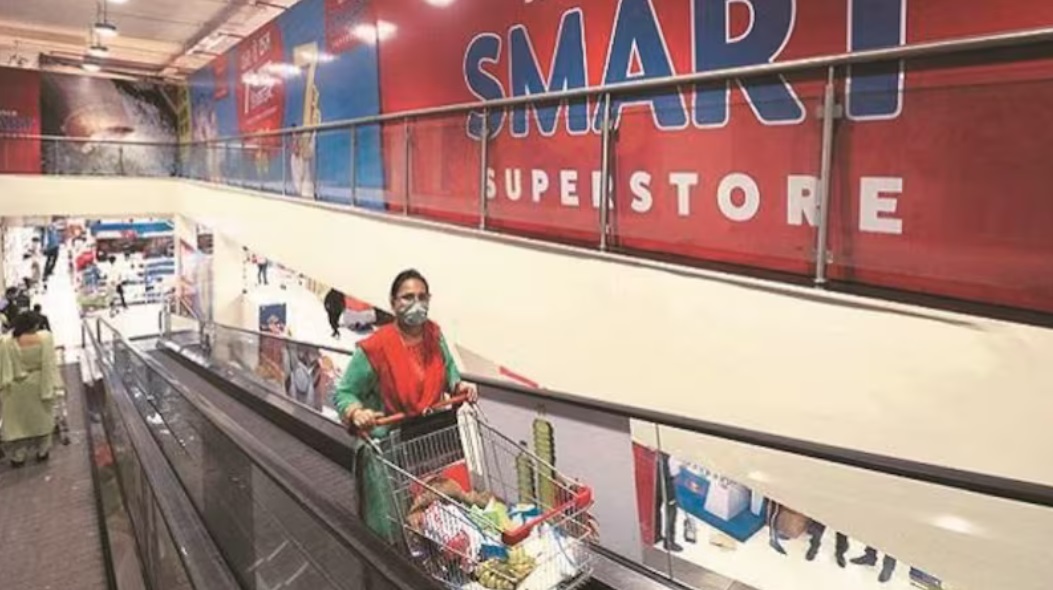
India’s $900 billion retail market has emerged as one of the most dynamic industries and is expected to reach anywhere between $1.3-$1.5 trillion by 2025. The organized retail is seen gaining 15% market share in the overall retail space, while food & grocery and apparel and lifestyle may account for 80% of India’s retail market by 2025.
Large market offers big opportunities. And it looks like Reliance Retail has seized it, with its massive omni-channel retail play of physical stores, B2B with kiranas and e-commerce.
The company went on an acquisition spree and partnerships in the last three years, adding to its portfolio some of the biggest names, including Hamleys, Dunzo, Zivame etc.
It has also partnered with famous global retail chain 7-Eleven. Catering to India’s affluent consumers, Reliance, meanwhile, houses some of the most iconic brands such as Versace, Armani Exchange, GAP, GAS, Jimmy Choo, Michael Kors among others. The premium segment has become one of the fastest growing categories.
Also firming up its inorganic play, the company is planning to acquire dozens of niche local consumer brands to build a formidable consumer goods business.
Arvind Singhal, Chairman and Managing Director, Technopak Advisors says, there’s focus on physical retail expansion. Reliance is looking to cater to both price conscious and brand conscious customers, while trying to capture as much of the private consumption market as possible, he says.
Reliance Retail’s competitors are nowhere close to even put up a fight. The company has over 15,000 offline stores across categories, compared with DMart’s 294 stores or Aditya Birla Fashion’s 3,468 outlets.
Reliance retail’s revenue has grown five times in the last five years and the core retail revenue of $18 billion is greater than competitors combined, according to a Bernstein report.
Speaking to Business Standard, Devangshu Dutta, CEO, Third Eyesight, says, Reliance wants a decent share of Indian consumers’ wallet. From that perspective, Reliance still has a long way to go, he says. As consumer preferences evolve, Reliance too should adapt.
An undisputed leader in the domestic market, the aim of Reliance, according to Mukesh Ambani, is to become one of the top 10 retailers globally. Part of this bet is based on the premise that incomes and consumption power of Indians will increase across the board in coming years. However, could the uneven recovery that different segments of the population have seen stop the pie from growing larger and prove to be a dampener for Ambani’s ambitions?
(Published in Business Standard)
admin
April 24, 2022
Written By Devika Singh
The Enforcement Directorate (ED) on April 19 accused Amway India of running a “multi-level marketing (MLM) scam” and attached its assets worth Rs 757.77 crore. This is not the first time that Amway India has been accused of running a ‘pyramid scheme’. Read on to understand how direct selling is different from pyramid schemes and why has the ED attached Amway India’s assets?

The direct selling industry is again under the regulatory scanner in India with the Enforcement Directorate’s (ED) move to attach the assets of the Indian unit of US-based direct selling company, Amway. The ED has accused the company of running a “multi-level marketing (MLM) scam” and attached its assets worth Rs 757.77 crore.
According to an ED statement, the attached property includes Amway India’s land and factory building at Dindigul district in Tamil Nadu, plant and machinery vehicles, bank accounts and fixed deposits.
“Immovable and movable properties worth Rs 411.83 crore and bank balances of Rs 345.94 crore from 36 different accounts belonging to Amway attached,” the ED said. The seizures, the ED said, have been made under the Prevention of Money Laundering Act (PMLA).
This is not the first time that Amway India has been accused of running a ‘pyramid scheme’. The company faced accusations on similar lines in the US in the 1970s and has been under government scrutiny in Karnataka and Kerala in the past. In fact, in 2013, Kerala police arrested then Amway India chief William Scott Pinckney and its directors, accusing them of running a pyramid scheme.
Direct selling has come under scrutiny time and again, as over the years, consumers have been duped by fake sellers hawking defective products and services in the garb of direct selling. To discourage such schemes, the government had proposed a draft policy last year, which aims at regulating the direct selling market segment.
Read on to understand what is direct selling, why the ED attached Amway India’s assets, what is Amway’s stand on the issue, how is direct selling different from pyramid schemes, and what are government regulations around direct selling in India?
What is direct selling?
Direct selling firms deploy agents who buy products from the company and then directly reach out and sell to consumers at their homes or other places instead of through a retail format like a store. The direct selling entity and the agent share the profits made through the sale of products. According to industry estimates, there are about 60 lakh agents in the country, who pursue direct selling as a means of earning additional income.
The direct selling industry, as per estimates, is pegged at Rs 10,000 crore in India, and has been growing at 12-13 percent per annum over the last five years. Experts say multi-vitamins, and home care and personal care products are the top-selling categories through this channel.
Beside Amway, companies such as Avon, Oriflame, Modicare and Tupperware operate in the direct selling segment. Some of these companies have been in India for decades now.
What is pyramid scheme and how is it different from direct selling?
Pyramid schemes are defined as a form of investment in which a paying participant recruits further participants and gets rewarded for it. Over the years, consumers have been duped by fake sellers hawking defective products and services in the garb of direct selling, often bringing the direct selling industry too, under scrutiny.
“Pyramid scheme is a scam to make money for a few people and it is based on selling an empty promise, multiplying it through recruiting people,” said Devangshu Dutta, CEO of retail consultancy Third Eyesight.
However, he added, it has to collapse somewhere because you are selling a product or service that does not exist.
“As opposed to that, in direct selling, the companies are selling products and at the end of it there is a tangible exchange of goods or services. So, even if you have downline distributors, as long as at the end of it the customer is getting something of value, then it’s not really a pyramid scheme,” he added.
Why has ED attached Amway India’s assets?
According to the ED’s press statement, Amway India runs a multi-level-marketing scheme or pyramid scheme, which “induces the common gullible public to join as members of the company and purchase products at exorbitant prices.”
The ED said the prices of most Amway products are “exorbitant as compared to the alternative popular products of reputed manufacturers available in the open market”. The new members, who are asked by the company to join it, are not buying the products to be used by themselves, but to become rich by becoming members as showcased by the upline members, said ED.
“The reality is that the commissions received by the upline members contribute enormously to the hike in prices of the products,” the ED said.
And this, indicated the ED, makes Amway’s operations similar to a pyramid scheme, where new members are recruited by existing members with claims of amassing wealth and becoming rich.
The agency claimed that between FY2003 and FY2022, Amway collected Rs 27,562 crore, of which it paid commissions worth Rs 7,588 crore to affiliate members and distributors in the United States and India.
What is Amway’s stand on the issue?
Amway, however, claims that it does not offer any incentives to new members to join the company and the members are only paid once they make a transaction or sell the product, and hence they are not operating a pyramid scheme.
The company has released a statement saying that the action of the authorities is with regard to the investigation dating back to 2011 and since then Amway has been co-operating with the department and has shared all information as sought from Amway from time to time. Amway said it will continue to cooperate with the government authorities for a fair, legal, and logical conclusion of the outstanding issues.
“As the matter is sub judice, we do not wish to comment further. We request you to exercise caution, considering a misleading impression about our business also affects the livelihood of over 5.5 lakh direct sellers in the country,” it said in a statement to media.
In an conversation last year with Moneycontrol, Amway India CEO Anshu Budhraja had said that Amway India does not charge any registration fee to its agents.
“There are no charges for joining Amway business. Further, to ensure that the customers have a satisfying experience with Amway, our products are backed by a money-back guarantee for 100 percent satisfaction of use,” Budhraja had said.
What are the regulations around direct selling?
The government last year included Direct Selling under the Consumer Protection Act (Direct Selling) Rules, 2021. These new rules prohibit direct selling companies from charging registration fees from their agents, and bars them from charging their agents for the cost of demonstration to prospective buyers.
The rules also forbid direct sellers from engaging in pyramid and money circulation schemes. The rules mandate that the companies operating in the segment would have to appoint a Chief Compliance Officer, a Grievance Redressal Officer, and a Nodal Contact Person. The companies would also need to be registered with the Department for Promotion of Industry and Internal Trade and must have an office in India.
They would also be mandated to maintain a website with all relevant information.
“Every direct selling entity shall establish a mechanism for filing of complaints by consumers through its offices, branches and direct sellers through a person, post, telephone, e-mail, and website,” as per the regulation.
“Every direct selling entity shall establish a mechanism for filing of complaints by consumers through its offices, branches and direct sellers through a person, post, telephone, e-mail, and website,” as per the regulation.
It adds: “Every direct selling entity shall ensure that such registration number is displayed prominently to its users in a clear and accessible manner on its website and each invoice issued for each transaction.”
In addition, such companies would have to maintain a record of direct sellers working with them, including their ID proof, address proof, email ID, and other contact information.
Source: moneycontrol
admin
March 24, 2022
Written By Christina Moniz
D2C brands take the offline route to widen reach

Direct-to-consumer (D2C) brands are fluffing up the Indian mattress category with promises of lower prices, mattress-in-a-box convenience, 10-year warranty and 100-day trials. In a market that is predominantly unorganised, startups such as Wakefit, The Sleep Company, SleepyCat and Flo are aspiring to establish themselves as better alternatives to legacy brands such as Kurlon and Sleepwell, with most of them looking at the offline retail route too, to boost sales.
According to a Research and Markets report, while India’s overall mattress market has grown at a CAGR of over 11% in the last five years, the organised industry has grown at 17%. The mattress category in India is worth `12,000-13,000 crore; of this the organised segment commands 40% share.
New-age mattress brands are able to deliver products at lower price points by taking control of the entire consumer journey – from product discovery to post-sales support. Therefore, these D2C brands save big on distributor and retail margins, says Devangshu Dutta, CEO, Third Eyesight. These savings go towards compensating for higher customer acquisition costs and logistics, he observes. The elimination of the middlemen means that customers get their products at 30-35% less than what traditional players offer.
However, these digital-native companies are aware that they operate in a touch-and-feel category, which is why many offer a 100-day trial period. Priyanka Salot, co-founder, The Sleep Company, says that the product return rate is only 2-3%, and the returned mattresses are donated to charities but never resold. The Sleep Company, which entered the market a little over two years ago, is eyeing a turnover of `1,000 crore in the next five years, and has plans to launch its first offline store in a few months.
Online players also save on logistics, says Chaitanya Ramalingegowda, co-founder and director at Wakefit. “We implemented the roll-pack technology that allows the mattress to fit into a compact box. This lets us ship more products at a time,” he says. Wakefit has only two factories—one in north India and the other in south India—as opposed to older players with 10-12 factories across the country, he points out. The company hopes to close FY22 with a turnover of 630 crore, up from197 crore in FY20. It has one offline experience centre in Bengaluru, with plans to launch 10 more across five cities soon; these centres will not only be experiential, but also double up as booking/ retail sales outlets.
Offline boost
Rajat Wahi, partner, Deloitte India, points out that these new-age mattress brands must establish deeper offline distribution to expand reach. “After all, more than 90% of retail is offline in India,” he notes.
This is why D2C brands are not only taking the offline route, but also foraying into other segments like furniture and sleepwear. Kabir Siddiq, founder and CEO of SleepyCat, says the brand has plans to launch around four experience centres, and aims to become a one-stop shop for all sleep and comfort solutions, offering comforters, pillows and even bedding for pets.
Is the proliferation of D2C players giving legacy brands sleepless nights? Mohanraj J, CEO, Duroflex, says it has been akin to a “wake-up call”. He says the company has poured in investments into the D2C segment in the past few years, and now even has a completely online brand called Sleepyhead, catering to the millennial consumers. “Until recently, about 10% of our company’s growth was from online sales, but we expect that number to change to 30-35% this year,” he adds.
Despite the influx of new-age players, he maintains that Duroflex has doubled its growth in the past two years, with traditional retail registering 25-30% annual growth.
Source: financialexpress
admin
December 20, 2021
Written By Vaishnavi Gupta
The furniture brand’s retail roadmap includes city stores in Delhi, Mumbai and Bengaluru, followed by tier I and II towns

For the Ikea model to succeed, adequate demand-concentration is crucial, which is being currently provided by the bigger cities in India.
After launching two large-format stores in India in a span of three years — one each in Hyderabad and Navi Mumbai — Ikea opened its first small-format store in Worli, Mumbai, to become “more accessible and convenient”. About 90,000 sq ft in size, these ‘city’ stores are already present in markets such as New York, London, Paris, Moscow and Shanghai.
The furniture market in India stood at $17.77 billion in 2020, and is expected to reach $37.72 billion by 2026, growing at a CAGR of 13.37%, according to a Research and Markets report. Godrej Interio, UrbanLadder and Pepperfry are among the big players in this space, all with a significant online presence, too. Godrej Interio has 300 exclusive stores in India, while Pepperfry has more than 110 Studios.
Spread across three floors, Ikea’s first city store has 9,000 products in focus, of which 2,200 are available for takeaway and the rest for home delivery. “We have observed that it is not easy to find large retail locations in cities like Mumbai and Bengaluru. The small store offers convenience and accessibility for consumers to experience Ikea products,” says Per Hornell, area manager and country expansion manager, Ikea India. This launch is in line with the company’s aim to become accessible to 200 million homes in India by 2025, and 500 million homes by 2030.
More launches are being planned: another city store in Mumbai in the spring of 2022 and a large-format store as well as a city store in Bengaluru by the end of 2022. For its retail expansion in Maharashtra, the company plans to invest Rs 6,000 crore by 2030. “We are on track to exceed the investment commitment of Rs 10,500 crore made for India in December last year,” adds Hornell. Delhi, Mumbai and Bengaluru are the three cities on its radar at the moment, which will be followed by tier I and II towns.
Furthermore, Ingka Centres, part of Ingka Group that includes Ikea Retail, is coming up with its first shopping centre in Gurugram (followed by Noida), which will be integrated with an Ikea store.
In India, unlike its organised furniture market competitors, Ikea doesn’t have a pan-India online presence yet. It has been following a “cluster-based expansion strategy” for its online offering, but the company insists this is not a limitation. “At present, 30% of our overall India sales come from online channels,” Hornell informs. Through its e-commerce website and mobile shopping app, the company currently operates in Hyderabad, Mumbai, Pune, Bengaluru, Surat, Ahmedabad and Vadodara.
On the other hand, players like Godrej Interio and Pepperfry have big plans to tap new markets. The former aims to add 50 exclusive stores each year, while Pepperfry aims to achieve the 200 Studios mark by March 2022. In September this year, Pepperfry forayed into the customised furniture segment with the Pepperfry Modular offering, which focusses on modular kitchens, wardrobes and entertainment units.
Good start?
This is a good time for Ikea to establish its presence in the Indian market, says Alagu Balaraman, CEO, Augmented SCM. “Earlier, people used to rely on carpenters for furnishing their homes; now, they prefer to buy ready-made furniture. The market is moving towards acceptability, making plenty of headroom for growth for these companies,” he says.
Ikea’s cautious expansion approach in a market like India where several local dynamics are at play, is tactful, analysts say. Devangshu Dutta, founder, Third Eyesight, says, “In the past, Western businesses have made the mistake of simply copy-pasting formats and strategies in emerging markets from their more developed markets.” He believes there is “nothing wrong” in being incremental while growing footprint. “There’s no sense in carpet-bombing the market with stores, when many may end up being loss-making or sub-optimal,” he adds.
Getting the product mix and pricing right would be key in realising the full potential of this market. Balaraman says Ikea will have to balance its global portfolio with what it is doing locally, and make sure it is profitable.
For the Ikea model to succeed, adequate demand-concentration is crucial, which is being currently provided by the bigger cities in India. Given its global popularity, the furniture giant, analysts say, is poised to see traction in the metros and tier I cities.
Source: financialexpress
