
admin
November 19, 2022

Chloe Cornish, Financial Times (select extracts)
Mumbai, November 19, 2022
Billionaire Mukesh Ambani’s oil-to-data conglomerate Reliance Industries, India’s biggest single listed company by market capitalisation, profits most from its refinery, the world’s largest. But Reliance wants to embed itself in India’s towns and cities by dominating the $800bn retail market as well, from partnerships with luxury fashion houses like Balenciaga to acquiring a Coca-Cola copycat.
Despite being India’s biggest retailer by revenues, Reliance’s 16-year-old shopping unit has often been overlooked, as Ambani’s Jio mobile network stole the limelight in transforming India’s data landscape.
Taking advantage of restrictions that hamper foreign companies’ ability to compete in India’s fragmented retail sector, still largely made up of mom and pop shops, Reliance is expanding its shopping empire at a rate of seven stores a day, using acquisitions to accelerate growth and investing around $3.6bn last financial year. It has 16,000 stores across India, while online purchases contribute 17 per cent of revenues, according to a person with direct knowledge of the matter.
India’s tycoons have long ventured into consumer businesses, from the Tata family, once best known for steel and now also boasting jewellery stores and a joint venture with Starbucks, to industrialists like Aditya Birla, whose conglomerate includes a large fashion business. Reliance, however, has aimed to control entire supply chains, all the way from the petrochemicals in the fibres it uses to produce textiles.
“The ethos of the group is dominance,” said Devangshu Dutta, founder of Gurgaon-headquartered retail consultancy Third Eyesight. “Unless other businesses step up to the plate, their dominance is a foregone conclusion.”
In its latest potential acquisition, Retail has reportedly bid $500mn for German wholesaler Metro’s Indian business. Indian rules allow foreign companies to own 100 per cent of a cash and carry business, but only if they do not sell directly to consumers. Reliance, by contrast, could unlock value by extending the business to sell direct to shoppers through Metro’s 31 distribution centres, said a person familiar with the company’s thinking.
Reliance has also announced it will launch its own fast-moving consumer goods company by the end of this year. The person close to the company said it would look to acquire brands to build the business, akin to its August deal for Campa, a nostalgic Indian fizzy drink, as well as exploring licensing and joint ventures.
While its ecommerce business JioMart has recently tied up with WhatsApp, owned by Reliance investor Meta, to increase its online reach, Reliance further boosted its physical shop space this year. It swooped to thwart potential foreign competitor Amazon in a battle over failing shopping group Future Retail.
Reliance Retail recorded quarterly revenue of around $8bn for the three months ending September 30, earning a net profit of $283mn, a 36 per cent increase year-on-year.
Reliance Retail declined to comment for this story.
Additional reporting by Andrea Rodrigues in Mumbai
admin
November 4, 2022

Christina Moniz, Financial Express / BrandWagon
November 4, 2022
Direct-to-consumer (D2C) lingerie brands, often credited with transforming the category and the way women shop for innerwear, are expanding their offline footprint in response to growing demand from tier-II markets and beyond. Zivame, whose journey began online just over a decade ago in 2011, has grown its offline presence to over 120 stores and also sells through over 4,000 partner outlets. In its recently concluded Grand Lingerie Festival, Zivame saw its sales grow three times,with a 120% increase in new customer acquisition. “Tier-II markets are showing massive potential and though tier-1 remains our highest revenue contributor, we are seeing significant revenue baseline shifts in tier-II locations,” says Khatija Lokhandwala, head of marketing at Zivame. The company has announced that its focus will be retail expansion in the second half of this fiscal, going beyond metros and tier-I markets.
Another decade-old D2C player in the innerwear segment, Cloviais eyeing the immense opportunity presented by smaller markets with aggressive expansion plans in place. “Clovia currently has 45 exclusive brand outlets in the country and has been diversifying its product range, with plans to open 130 outlets by the end of this fiscal. Ours has always been a mass- market brand, and most of the repeat customers come from tier-II and tier-III markets,” explains Pankaj Vermani, founder and CEO, Clovia. He notes that over 65% of its customer base is from the non- metro markets, and average order values are 20% higher in these cities compared to the metros. Earlier this year, Reliance Retail Ventures acquired an 89% stake in Clovia’s parent company (Purple Panda Fashions) for Rs. 950 crore. Vermani adds that Clovia will ben- efit from the conglomerate’s scale and retail expertise, driving up growth and love for the brand. Reliance Retail had picked up 15% stake in Zivame back in 2020.
Shaping the market
The women’s innerwear market in India is set to double to reach $11-12 billion by 2025, according to a report by RedSeer. Aside from the key segments of bras and panties, ancillary products like athleisure, sleepwear, swimwear and lounge wear are also boosting the lingerie category’s growth in the country, as is evident from the widening portfolios of leading brands. The online segment for women’s innerwear is expected to become a $1 billion market by 2025.
Experts believe there is a large opportunity for companies to grow since 60% of the $6-billion women’s intimate wear market in India is unorganised, and the category is still largely underserved.
“The lingerie market is an example of improving supply feeding into a growing demand, and the increasing demand expanding the opportunity for more brands to step in. Larger cities, with their higher income profiles and demand concentration, are the logical first-choice market for companies such as Zivame,” points out Devangshu Dutta, CEO, Third Eyesight.
The competition in the large cities is greater, with a plethora of Indian and global brands, which is why Dutta recommends that e-commerce led companies should push aggressively in smaller markets to drive sustained growth.
The fact that D2C brands have better data sets at their disposal to glean insights about Indian women and their concerns when buying innerwear has also worked in their favour.
“Intimate wear shopping can be overwhelming for a lot of women. Finding the right size and choosing styles for their specific needs requires an environment free of embarrassment and judgement. At Zivame, we help women choose the right size and perfect fit, ensuring a private, comfortable and discreet shopping experience,” says Lokhandwala.
While lingerie can sometimes be prohibitively expensive, Vermani points out that Clovia’s feedback-led design approach helps it keep pricing competitive.
The brand creates each product in small quantities, and uses technology to predict future sales based on customer feedback, thereby determining the right quantities for production. He states, “With this approach, we have created a fashion brand that is low on cost, high on consumer appeal and efficient in inventory, leading to better margins and cash flows.”
(Published in Brandwagon, Financial Express)
admin
October 11, 2022
SHARLEEN D’SOUZA, Business Standard
Mumbai, 10 October 2022
In early 1994, Titan started selling watches with precious stones in them and called this new line, Tanishq. It went on to become a separate division of Titan Company and grew into the country’s largest branded jewellery outfit, helping raise Titan’s sales to ~28,799 crore last financial year.
Thirteen years later, in 2007, Titan Eye+ set out to shake up the eyewear market. Though it also sells sunglasses of other brands, it is the prescription segment that Titan redefined and now, according to its website, has 550 Eye+ exclusive stores in 229 cities.
In 2017, Titan sought to do an encore in yet another large market in which the demand, as in jewellery and eyewear, was almost recession-proof and largely commoditised, leaving ample space for a pan-Indian branded chain. Thus was born Taneira, with an avowed intent to become the country’s largest organised saree retailer.
“Titan had earlier tried to organise the jewellery market through Tanishq, which is successful, and this is an attempt by Titan to organise the saree market,” Ambuj Narayan, chief executive officer (CEO) of Taneira, told Business Standard.
What is unsaid is that jewellery to sarees can also be seen as a horizontal brand extension, the two do go together on occasion.
Natural extension
The Indian wear market is a 5,000-year old segment estimated to be worth ₹50,000 crore a year and growing at a compound annual growth rate of 6 to 8 per cent. Sarees account for 80 to 85 per cent of its sales, with kurta sets, blouses, and lehengas comprising the rest. Yet, despite the size and growth, there is hardly any nationally known brand in this segment, with Nalli Silks being one of the notable exceptions.
Titan insiders say the company believed sarees to be a natural extension for it, given its past success with design-led lifestyle brands. They say the company organised an internal competition to see who came up with the best expansion strategy.
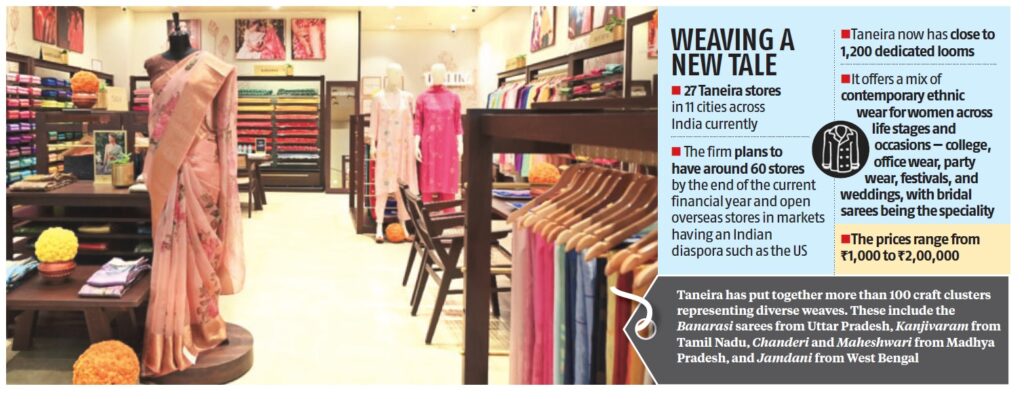
The result is a bouquet of design-differentiated products — primarily sarees and kurta sets — made from pure natural fabrics sourced from all over India. The company put together more than 100 craft clusters representing the diverse weaves. These include the Banarasi sarees from Uttar Pradesh, Kanjivaram from Tamil Nadu, Chanderi and Maheshwari from Madhya Pradesh, and Jamdani from West Bengal. The output is a mix of contemporary ethnic wear for women across life stages and occasions — college, office wear, party wear, festivals, and weddings, with bridal sarees being the speciality. The prices range from ₹1,000 to ₹2,00,000.
“The Tata group’s ventures have always been consistent with their approach — they stay the course beyond initial hiccups and eventually scale up the business. This is very much how Titan and Tanishq worked their way from initial struggles to eventually scale and become nationwide brands,” said retail expert Devangshu Dutta, CEO at Third Eyesight.
To say that Taneira has had initial hiccups would be an understatement. Three years after its launch, the Covid-induced lockdowns and restrictions brought the entire retail sector down to its knees.
Baptism by Covid
“Pandemic restrictions and high Covid-19 anxiety among the people kept socialising and weddings at a very low level of activity over the past couple of years. For Taneira, being a nascent brand with a yet-to-be-established customer base, the operating environment has been particularly tough,” Titan Company said in its FY22 annual report.
Taneira used this time to realign its strategy of connecting with customers. Thus, during 2021-22, which braved the second Covid wave in its first quarter — the dreadful Delta — and saw the third wave creep into its fourth quarter, sales at Titan’s Indian dress wear division grew by 55 per cent.
Narayan, the CEO, attributes this growth to initiatives that included staying close to the customer through e-commerce. “We really drove e-commerce out and reached out to our customers through video calling and try-at-home activities,” he said.
As consumer sentiment started to improve, Taneira already had two collections ready — wedding weave and the summer collection — which boosted sales. During 2021-22, it also increased its store count to 20 by adding six more. During the fourth quarter, Taneira sales rose 4 per cent.
Today, there are 27 Taneira stores in 11 cities across India. It plans to expand to Tier 1 and Tier 2 cities in the first phase and then to Tier 3 in the second phase of its store expansion.
However, Vishal Gutka, vice-president of research (consumer and retail sector) at Phillip Capital, said: “Taneira follows the same principle Titan used for Tanishq, where it entered an unorganised category and expanded it. But it is still early days to gauge how Taneira will pan out. Also, the company needs to give more clarity on the unit economics of each store.”
Weaving an expansion plan Titan’s annual report talks of a robust expansion plan for Taneira this financial year: “We plan to grow at an exponential rate and make our store count around 60 by the end of the current fiscal year and open overseas stores in markets having an Indian diaspora such as the US.” It adds that Taneira will become a more significant contributor to the overall revenue of Titan in the medium term.
At the heart of this grand ambition lies the humble weaver. Taneira now has close to 1,200 dedicated looms and has a programme called Weaver Shala to support them with technical expertise and in modernising their facilities. It has introduced frame looms along with basic workspace facilities for the weavers in collaboration with the localised weaver-led organisations.
The brand has closely worked with the weavers in Varanasi, Uttar Pradesh, and Champa, Chhattisgarh, and aims to take Weaver Shala to other parts of the country.
Taneira leverages Tanishq’s brand strength; mannequins at Tanishq stores, for instance, are dressed in Taneira sarees.
However, Narayan said Taneira and Tanishq will not be sold under the same roof because Titan wants to establish Taneira as a distinct brand in its own right.
(Published in the Business Standard)
admin
September 23, 2022
Sagar Malviya, The Economic Times
September 13, 2022
Uniqlo, Asia’s biggest clothing brand, has turned profitable in India in less than three years after it opened its first store in the country despite operating in a period marked by Covid-led lockdowns and restrictions.
The Japanese brand posted a net profit of ₹21.4 crore for 2021-22 compared to a loss of ₹36.1 crore in the previous year, according to business intelligence firm AltInfo. Its sales rose 63% year on year to ₹391.7 crore for the year to March 2022, a slower pace compared to FY21 when it clocked 86% sales growth on a low base.
Experts feel Uniqlo’s strategy of pricing its merchandise at least 20% higher than rivals Zara and H&M has helped it earn better margins despite inflationary pressures in terms of raw materials.
“The market is not easy and turning profitable at a time when most rivals are spending aggressively is a good indication of success. As an international brand, they (Uniqlo) are able to get good locations and are preferred tenants, which helps in generating sales, especially in top cities,” said Devangshu Dutta, founder of Third Eyesight, a strategy consulting firm. “However, the pricing is a bit premium and until they are able to source locally, selling products at a right value for the market will remain challenging.”
The Japanese brand opened its first door in the country in September 2019, but stringent lockdown measures announced in March 2020 to contain the Covid-19 outbreak delayed its store expansion plans, restricting its store count to about seven outlets so far.
Uniqlo has said India is one of the most priority markets where consumers are increasingly shifting from ‘fast-fashion’ to long-lasting essentials and functional wear. “India is an important and very big priority market,” Tomohiko Sei, CEO of Uniqlo India told ET in June.
(Published in The Economic Times)
admin
June 24, 2022
Written By Christina Moniz
Prashanth Aluru, a former Facebook and Bain hand, will be behind the steering wheel for this venture

The Aditya Birla Group has just announced the launch of its ‘house of brands’ business entity, TMRW, to support digital fashion and lifestyle brands. TMRW, which will operate as a wholly owned subsidiary of Aditya Birla Fashion & Retail (ABFRL), aims to build and buy over 30 brands in the next three years, the company said in a statement.
With this move, the company expects to make its entry into the D2C market, which is expected to be reach $100 billion by 2025. “What a brand like Shoppers’ Stop does in brick and mortar, ABFRL is doing online. While in the past, the company was known for certain brands, it is now pivoting itself towards a wider pitch with bigger variety of brands that could potentially appeal to a wider range of consumers,” said Ankur Bisen, senior partner and head, food and retail, Technopak Advisors. The launch could be ABFRL’s next step in positioning itself as a fashion major, he said.
Prashanth Aluru, a former Facebook and Bain hand, will be behind the steering wheel for this venture.
ABFRL will compete with start-ups like the Good Glamm Group and Mensa Brands, among others. The number of D2C brands and online sellers in the country have grown over the last couple of years, and experts believe that TMRW could be the company’s endeavour to become relevant to new-age consumers. Brands like Reliance Retail and Myntra are going down the same path, says Bisen.
The opportunity is immense; according to a report by IMARC Group, the Indian textile and apparel segment reached $151.2 billion in 2021 and is set to grow at a CAGR of 14.8% between 2022 and 2027.
ABFRL, which has a network of over 3,300 stores across India, is home to brands like Pantaloons, Van Heusen, Louis Philippe and Allen Solly, and has partnerships with labels like Forever 21, American Eagle and more recently, Reebok. The retail company has also forayed into the ethnic wear business and has forged strategic partnerships with designers such as Sabyasachi, Masaba and Shantanu & Nikhil.
Having reported losses for the last three years, the company narrowed its losses to `108.72 crore in FY22 on the back of revenues of `8,136.22 crore. The company reported a 55% surge in revenues during the last fiscal. While Madura Fashion & Lifestyle contributed 68.4% to the company’s FY22 revenue, the remainder 31.6% came from Pantaloons, according to Bloomberg data.
Ambi Parameswaran, author and founder of Brand-Building.com, said ABFRL has already built a good retail presence for the brands in its portfolio. “There must be significant synergies at the back end, but the brands are managed separately,” he said. “I suppose the new venture, TMRW, will offer all these brands as well as all the other ethnic brands that ABFRL has acquired in the last three years.”
He said the synergies will probably lie at the back end with supply chain, logistics, finance and HR. However, the brands will most likely be given the space to build strong individual identities.
This is not the company’s first foray into the e-commerce space. ABFRL shut down its e-commerce venture, ABOF (All About Fashion) in 2017, though in August last year, it said the brand would be made available on Flipkart and Myntra.
A concept like ‘house of brands’ is potentially beneficial to both — the large conglomerates and also to the smaller, emerging brands that are acquired. In a D2C framework, niche brands that would otherwise find it difficult to navigate the established multi-layered distribution and retail channels see greater feasibility in connecting with their customers directly through digital channels.
According to Devangshu Dutta, CEO of retail consultancy Third Eyesight, this makes it viable to launch a product range, which would not be immediately entertained in established channels, and allows them to retain their distinctiveness. With the passage of time and with their growth, some of these brands could also expand into established modern retail and traditional retail formats and to a more mainstream audience.
“Large companies, on the other hand, can find it difficult to grow their existing brands beyond a certain pace, and often may not be able to break new ground in terms of product development and customer experience. At some point, inorganic growth by acquiring other businesses and brands becomes an important element of their strategy,” Dutta said.
The house of brands model, to be sure, comes with its fair share of challenges. Angshuman Bhattacharya, EY India partner and national leader – consumer products and retail, said the strategy must have clear synergies from an operations and distribution perspective. “Possible challenges could emanate out of the non-compatibility of categories with the distribution. Another potential challenge could be in supporting multiple brands with marketing investments, failing which the realisable value envisaged during acquisition could stay unfulfilled,” Bhattacharya said.
The other downside, as Dutta pointed out, is that over time there is consolidation of market power within a handful of companies. This has happened across the globe and across sectors, and can negatively impact consumer choice, supplier dynamics and pricing.
Source: financialexpress
