
Devangshu Dutta
December 27, 2016
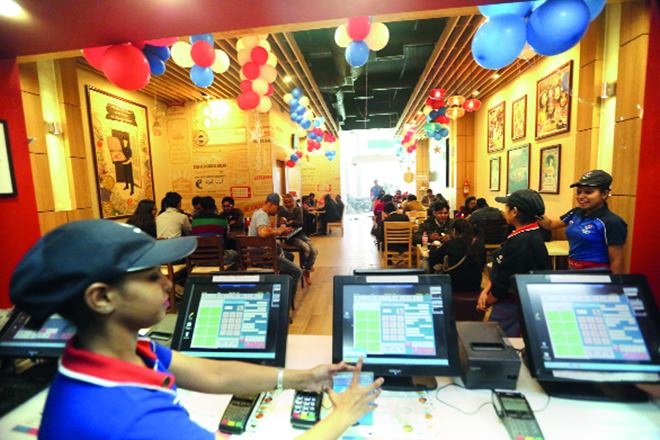
When American fast food standard bearers McDonald’s and Domino’s Pizza stepped into India in the mid-1990s, the market was just ripe enough for take-off.
McDonald’s and later Domino’s Pizza can be credited with not just growing the consumer appetite for fast food but also for fostering an entire food service ecosystem, including fresh produce, baked goods, sauces and condiments, and cold chain technology.
India has been typically difficult for business models driven by scale, replicability and predictability. The customer is price sensitive, operating costs are high and non-compliance of business standards is a frequent occurrence. In this environment, these brands have reinvented the meaning of meals, snacks and treats.
Their growth has set the stage for other international players and also set business aspirational standards for Indian food entrepreneurs and conglomerates alike.
Product experimentation has also been an important part of their success; it keeps excitement in the brand alive and help improve footfall. However, how far a product sustains and whether it becomes a menu staple can’t be predicted accurately. New products also need significant investment in both supply chain and front-of-house changes in standardisation-oriented QSRs, so the new product launch cannot be undertaken lightly. This is one reason these successful QSR formats don’t overhaul their menus drastically but make changes incrementally.
For these market leaders, future scale and deeper penetration is only feasible with higher visit frequency. For growth in middle-income India, they need to become a significantly cost-competitive option to be seen as more than a ‘treat’ or celebration destination.
So, while both McDonald’s and Domino’s Pizza have invested significantly in Indian flavours and menu offerings, perhaps it’s also best for them to reconcile with the fact that there will be a significant part of the consumer’s heart, stomach and wallet that will remain dedicated to indigenous offerings.
In a global environment that’s turning hostile to fast food, India isn’t a quick-fix growth market, but it’s certainly one to stay invested in, for the longer term.
And I have no doubt that as much as these companies aim to change India, over time India will also change them.
(Also published in Brand Wagon, The Financial Express)
Tarang Gautam Saxena
February 14, 2014
2013 has been a mixed year for retail in the Indian market with multiple factors working in favour of and against the business prospects.
Economic growth had slowed to 5% for 2012-13 (as per advance estimates by The Central Statistics Office, Government of India), down from 9.3% in 2011. The ray of hope is that the growth rate is expected to rebound to 6.8% in 2013-14. Spiralling inflation, with prices of some basic vegetables shooting up almost eight to ten times, distracted the consumers from discretionary spending. The year hardly saw irrational expansions by retail businesses as they primarily focused on bottom line performance.
While the Government of India liberalised Foreign Direct Investment (FDI) policy in retail in September 2012, international investors have been slow to respond and sizeable foreign investments have been announced only recently at the end of 2013.
The political environment also took unexpected turn with the success of Aam Aadmi Party (AAP) at the Delhi Assembly Elections held towards the end of the year. This may augur in a new era of politics driven by performance and results but in the short term it could restrict market access for international multi-brand retailers, as the AAP has declared their opposition to investment from foreign multi-brand retailers.
So is India still a strategic market for international fashion brands to look at?

FDI Policy – Clarifications and Impact
India’s Foreign Direct Investment (FDI) policy has come a long way with foreign investments now being allowed in multiple sectors including retail, telecom, aviation, defence and so on. The Indian government is now exploring the possibility of allowing FDI in sectors such as railways and construction.
The year 2006 was a significant year for international brands in fashion and lifestyle space as the Government of India allowed up to 51 per cent foreign direct investment in the newly-defined category of “Single Brand retail”. In September 2012 the Indian Government liberalised the retail FDI policy to allow foreign investment up to 100 per cent in single brand operations and up to 51 per cent in multi-brand retail albeit with certain conditions related to the ownership of the brand, mandatory domestic sourcing norms for both single-brand and multi-brand retailers and additionally certain investment parameters for the backend operations of the multi-brand retail business. The idea was to attract foreign investment in retail trading a part of which could flow into improving the supply chain while providing Indian businesses access to global designs, technologies and management practices.
Large Investments in the Pipeline
The investments flowed in slowly initially. Some of these have looked at converting existing operations, such as Decathlon Sports which was present in India through a 100% owned subsidiary in cash and carry business. The brand is converting its cash and carry business in India to fully-owned single brand retailing business.
But there have been some significant moves as well. A record breaking FDI proposal in single brand retail is the Swedish furniture brand IKEA’s, that had to apply three times since December 2012 before its’ proposed investment of €1.5 billion (Rs. 101 billion) received the nod from the Government. However, the proposal is reportedly still in the works, as Ikea looks to structure the business to comply with the laws of the land. And as the year came to a close the Government cleared Swedish clothing brand Hennes and Mauritz’s (H&M) US$ 115 million (Rs.7.2 billion) investment proposal. According to news reports the brand had already begun blocking real estate with the goal of launching its stores in India at the soonest.
While the initial response to the relaxation of FDI policy spelt positive inflow for single brand retail, there was no new investment forthcoming in multi-brand retail. The existing foreign multi-brand retailers present in India through the cash and carry format showed a marked lack of interest in switching to a retail business model. On the other hand Walmart, the only foreign multi-brand retailer having access to a network of retail stores through its wholesale joint venture Indian partner, Bharti Enterprises Ltd., ended its five year long relationship and has restricted itself to the wholesale business. Though the company cited that it was disheartened by complicated regulations, it was also caught up in its own corruption investigation as well as allegations that it had violated foreign investment norms. The sole bright spot was the world’s fourth largest global retailer Tesco proposing and getting approval for a US$ 115 million investment into the multi-brand retail business of its partner, the Tata Group. At the time of writing the precise scope of this investment remains unclear.
If you want the full paper please send us an email with your full name, company name and designation to services[at]thirdeyesight[dot]in.

Devangshu Dutta
January 24, 2014

[This article appeared in the February 2014 print issue of Retailer, under the headline “Implications of the Tata-Tesco JV“]
India is a civilisation that has borne fruit from thousands of year of international cultural exchange, commerce and investment flowing both inwards and out. It is also one that has suffered from military and as well as economic colonisation over the millennia.
For those reasons, foreign investment into the country is bound to have both vociferous opponents as well as staunch supporters, and this debate is possibly most polarised in the retail sector that touches every Indian’s life daily. Over the last few decades, foreign investment into the retail sector has seen flip-flops from successive governments and political parties across the spectrum, being allowed until the late 1990s, then blocked (by Congress-led UPA), then selectively allowed (by BJP-led NDA, and later by Congress-led UPA). And more recently, with pressures, protests and influences from all sides 2011, 2012 and 2013 have certainly been on/off years during the UPA’s second successive term.
In this time Zara’s joint-venture, set up in 2010, has turned out be one of the most successful and profitable in India. More recently, Ikea announced a €1.5 billion plan for the country, followed by H&M’s US$ 115 million proposal, while Marks & Spencer identified India as its second largest potential market outside the UK. However in October 2013, the world’s largest retailer Wal-Mart decided to call off its joint venture amid investigations of its executives having supported or indulged in corruption and accusations that it had violated foreign investment norms. It decided to acquire Bharti’s stake in the cash-and-carry JV and announced that it would not invest in Bharti’s retail business.
It was soon after, as if to compensate for Wal-Mart’s blow, that India’s Tata Group and British retailer Tesco announced that they would be creating a formal joint venture in India, with Tesco investing US$ 110 million. The Congress-led government went on to quickly approve the proposal, as if to visibly shake off accusations of “policy paralysis”.
Tesco’s investment doesn’t look like much for a country the size of India, especially in the context of Ikea’s ambitious proposal or H&M’s fashion retail business that is possibly less complex than Tesco’s multi-product multi-brand format. However, let’s keep in mind that Tesco is facing tough trading conditions in Europe, took a global write-down of US$3.5 billion last year including its exit from the US market, and merged its Chinese business with retail giant China Resources Enterprise to become a minority partner. In view of all that and the unpredictability of Indian politics, US$ 110 million looks like a reasonable if not disruptive commitment. It also does somewhat limit the downside risk for Tesco if the environment turns FDI-unfriendly after the general elections.
Whenever Tesco expanded into new markets, it has tried to adopt a localised or partner-led approach. In India, since 2007, Tesco has had an arrangement to provide support to Tata’s food and general merchandise retail business. The intent underlying the partnership was clearly to look at a joint retail business when allowed by regulations and not just at back-end operations. The existing structure has provided Tesco with an opportunity to learn about the Indian market and operating environment first-hand while working closely with Tata’s retail team. Tata, in turn, has drawn upon Tesco considerable expertise of operating retail businesses in both developed and emerging markets. At the very least, the FDI inflow from Tesco will deepen this arrangement further, benefiting both partners further.
But there are the inevitable twists in the tale. While the Tesco proposal was in the works, the new Aam Aadmi Party formed a government in surprise victory in Delhi state and announced that it would not allow foreign owned retail businesses in the state of Delhi. This strikes off one of the most lucrative metropolitan markets from the geographic target list at least in the short term. (The central government has pushed back saying that while retail is a state-subject, the decision to allow FDI by the previous Congress government cannot be reversed at will by the current AAP government, but the debate goes on.) BJP-led and BJP ally-led state governments have also indicated their unwillingness to allow foreign retailers into their markets.
So should we even attempt to forecast what Tesco and Tata could do in this environment? I would rather not pre-empt and second-guess the future plans of business executives who are trying to read the intent of politicians who are focussed on elections 4 months in the future! However, whatever the plans, the retailers must comply with the regulations such as they are now and utilise the opportunities that exist. So it is likely that the following scenario will play out.
Tata and Tesco have said that the proposed joint-venture looks at “building on the existing portfolio of Star Bazaar stores in Maharashtra and Karnataka”. These are both states where Trent has multiple locations, so a certain critical mass is available. Since current government policy requires the investment to be directed at creating fresh capacity, new stores would also be opened in these states, though the expansion plans look modest, with 3-5 new stores every financial year.
But with the 50 percent investment in back-end also being a regulatory requirement, new procurement, processing and logistics infrastructure which could service stores within these states as well as in other states are is likely to be built. Tesco’s wholesale subsidiary currently supplies merchandise to Star Bazaar stores across states – this relationship is likely to continue as some of Tata’s stores are in states that are not within the FDI ambit. The product mix proposed includes vegetables, fruits, meat, fish, dairy products, tea, coffee, liquor, textiles, footwear, furniture, electronics, jewellery and books.
The norms earlier required FDI proposals to ensure that 30 per cent of product sourcing would be domestic, from small-midsized enterprises. However, in August 2013, the government relaxed this requirement to be applied only at the beginning of the joint-venture operations, and that this requirement would not include fruits and vegetables, an area where Tesco has focussed significant energy. So the immediate focus would be on meeting the domestic sourcing requirements in other categories, and creating a viable business model and scale through an appropriate product mix.
The partners are likely to continue working on improving the performance of the existing Star Bazaar stores which are 40,000-80,000 sq ft in size. However, Tata has also launched a new convenience store format, Star Daily sized at about 2,000 sq ft focussed on fresh foods, groceries and essential items. Retailers with foreign investment are now also permitted to open stores in cities with populations under one million from which they had been prohibited previously, so the new small format can provide significant expansion opportunities and more volume for the back-end operations to reach critical mass quicker.
Would there be a change of name on the store fascia? Unlikely, since Tesco has been operating stores under other brands as well in markets outside the UK and a “Tesco” name appearing on the fascia may not significantly change the consumer’s perception of the store. Other than in lifestyle categories or overtly brand-driven products (such as fashion), most Indian consumers focus on utility, quality, local relevance and price as significantly more important purchase drivers than an international name. In fact, a trusted Indian name like Tata carries as much weight or more weight in many categories than an international brand would. So the stores may carry a joint by-line, but the focus is likely to remain on the existing brand names.
And what of several other retailers who are interested in the Indian market? Will they draw inspiration from Tesco and take their plunge into the market, urged on by the outgoing government eager to demonstrate results during its final months?
Wal-Mart, for one, seems to have returned to the table, having set up a new subsidiary, perhaps preparing the ground for a retail launch with another partner. A European retailer, remaining nameless for now, is being mentioned as being the next proposal in the FDI pipeline.
However, it is likely that most will remain in the wait-and-watch mode until the outcome of the national elections is clear. The real issue is not the regulations themselves as much as the unpredictability of the regulatory environment. Policies are being made, turned around, and twisted over in the name of politics, without a clear thought given to the real impact on the country, the economy and the industry of either the original policy formulation or its reversal.
Until that dust settles down, we should expect no dramatic changes in the near term, no sudden rushes into the market. But then, we could be wrong – policy and politics have taken unexpected twists earlier, and could do so again!
Devangshu Dutta
December 5, 2013
(Published in ETRetail.com on 6 December 2013)
Franchising isn’t rocket science, but advanced space programmes offer at least one parallel which we can learn from – the staging of objectives and planning accordingly.
A franchise development programme can be staged like a space launch, each successive stage being designed and defined for a specific function or role, and sequentially building the needed velocity and direction to successfully create a franchise operation. The stages may be equated to Launch, Booster, Orbiter and Landing stages, and cover the following aspects:

Stage 1: Launch
The first and perhaps the most important stage in launching a franchise programme is to check whether the organisation is really ready to create a franchise network. Sure, inept franchisees can cause damage to the brand, but it is important to first look at the responsibilities that a brand has to making the franchise network a success. Too many brands see franchising as a quick-fix for expansion, as a low-cost source for capital and manpower at the expense of franchisee-investors. It is vital for the franchiser to demonstrate that it has a successful and profitable business model, as well as the ability to provide support to a network of multiple operating locations in diverse geographies. For this, it has to have put in place management resources (people with the appropriate skills, business processes, financial and information systems) as well as budgets to provide the support the franchisee needs to succeed. The failure of many franchise concepts, in fact, lies in weakness within the franchiser’s organisation rather than outside.
Stage 2: Booster
Once the organisation and the brand are assessed to be “franchise-ready”, there is still work to be put into two sets of documents: one related to the brand and the second related to the operations processes and systems. A comprehensive marketing reference manual needs to be in place to be able to convey the “pulling” power that the brand will provide to the franchisee, clearly articulate the tangible and intangible aspects that comprise the brand, and also specify the guidelines for usage of brand materials in various marketing environments. The operations manual aims to document standard operating procedures that provide consistency across the franchise network and are aimed at reducing variability in customer experience and performance. It must be noted that both sets of documents must be seen as evolving with growth of the business and with changes in the external environment – the Marketing Manual is likely to be more stable, while the Operations Manual necessary needs to be as dynamic as the internal and external environment.
Stage 3: Orbiter
Now the brand is ready to reach out to potential franchisees. How wide a brand reaches, across how many potential franchisees, with what sort of terms, all depend on the vision of the brand, its business plan and the practices prevalent in the market. However, in all cases, it is essential to adopt a “parent” framework that defines the essential and desirable characteristics that a franchisee should possess, the relationship structure that needs to be consistent across markets (if that is the case), and any commercial terms about which the franchiser wishes to be rigid. This would allow clearer direction and focussed efforts on the part of the franchiser, and filter out proposals that do not fit the franchiser’s requirements. Franchisees can be connected through a variety of means: some will find you through other franchisees, or through your website or other marketing materials; others you might reach out to yourselves through marketing outreach programmes, trade shows, or through business partners. During all of this it is useful, perhaps essential, to create a single point of responsibility at a senior level in the organisation to be able to maintain both consistency and flexibility during the franchise recruitment and negotiation process, through to the stage where a franchisee is signed-on.
Stage 4: Landing
Congratulations – the destination is in sight. The search might have been hard, the negotiations harder still, but you now – officially – have a partner who has agreed to put in their money and their efforts behind launching YOUR brand in THEIR market, and to even pay you for the period that they would be running the business under your name. That’s a big commitment on the franchisee’s part. The commitment with which the franchiser handles this stage is important, because this is where the foundation will be laid for the success – or failure – of the franchisee’s business. Other than a general orientation that you need to start you franchisee off with, the Marketing Manual and the Operational Manual are essential tools during the training process for the franchisee’s team. Depending on the complexity of the business and the infrastructure available with the franchiser, the franchisee’s team may be first trained at the franchiser’s location, followed by pre-launch training at the franchisee’s own location, and that may be augmented by active operational support for a certain period provided by the franchiser’s staff at the franchisee’s site. The duration and the amount of support are best determined by the nature of the business and the relative maturity of both parties in the relationship. For instance, someone picking up a food service franchise without any prior experience in the industry is certainly likely to need more training and support than a franchisee who is already successfully running other food service locations.
Will going through these steps guarantee that the franchise location or the franchise network succeeds? Perhaps not. But at the very least the framework will provide much more direction and clarity to your business, and will improve the chances of its success. And it’s a whole lot better than flapping around unpredictably during the heat of negotiations with high-energy franchisees in high-potential markets.
Devangshu Dutta
October 9, 2013

[This article appeared in Daily News & Analysis (DNA) on 10 October 2013, under the headline “Without Wal-Mart, can Bharti play it alone?”]
A year ago, Wal-Mart had called Bharti its natural retail partner in India. But today the companies have jointly and publicly changed their relationship statuses to “single”, calling off the 6-year old marriage. Bharti will buy out or retire Wal-Mart’s debentures in the 200+ store Easyday retail business, while Wal-Mart in turn will acquire Bharti’s stake in the 20-outlet Bestprice cash-and-carry business.
By some estimates, the split was imminent for perhaps a year or longer, as the pressure rose for the two companies due to multiple factors. Several regulatory changes governing foreign investment in the Indian retail sector made it difficult for Wal-Mart to acquire a stake in the existing retail business that the two partners had set up. Anti-corruption investigations in Wal-Mart’s India business (in addition to Mexico, China and Brazil), as well as questions around the legality of US$ 100 million worth of quasi-equity compulsorily convertible debentures issued to Wal-Mart at a time FDI was not allowed in multi-brand retail businesses brought down even more external scrutiny upon the joint business. And finally, pressure against foreign investment in multi-brand retail of basic goods such as food and grocery, continued to exist not just amongst opposition parties but also parties within the ruling coalition and individuals in the government.
The split means that Wal-Mart can now overtly take complete ownership of the Bestprice business, and drive it as it sees fit. The fragmented retail market and the myriad small businesses in India do potentially provide a large customer base for the cash-and-carry business if Wal-Mart chooses to be more aggressive. However, that may not happen immediately. The business has been coasting for over a year without new openings that were already planned and significant personnel changes have happened from the seniormost levels down. Wal-Mart’s investigations of corruption allegations continue and before committing more resources it will definitely want to strengthen systems so as to not be in violation of Indian and US laws.
On the other hand, if it wishes to now enter the retail business, Wal-Mart would also have to look for a new Indian partner to set up new retail stores in a separate company. Retail is capital-hungry so Wal-Mart would need a cash-rich partner who can accept a junior position in the venture in which Wal-Mart would clearly be the driver financially, strategically and operationally.
At this time Wal-Mart seems to have decided to take a step back and evaluate what the Indian market means to it right now and in the future, what sort of investment – both in financial and management terms – it demands, and what returns the investment will bring. It remains to be seen whether it will choose to grow aggressively, coast up incrementally or, in fact, take the next exit out of the market as it has done in some other countries earlier.
And what of Bharti? Will it be able sustain the retail play without Wal-Mart’s close operational guidance and financial participation, or will it choose sell the Easyday operation to another domestic investor? On its part Bharti has stated an ongoing commitment to the business, and has also hired the former CEO of the joint venture, Raj Jain, as a Group Advisor. A 200-plus store chain is sizeable and credible in India’s fragmented food and grocery market, and is seen by the group as “a strong platform to significantly grow the business”.
However, Bharti’s core telecom business is also capital-intensive and highly competitive, and it will be difficult at this time to sustain high-paced growth in another cash-hungry, thin-margin business such as grocery retail. For now the Group’s best bet would possibly be to consolidate operations, unearth more margin opportunities and take a call at a more opportune time whether to further invest in growth or to treat retail as a non-core business and exit it.
Creating a substantial, profitable retail business is a long-term play in any part of the world. In India, as retailers are discovering, it takes just that extra dose of patience.
