
admin
November 28, 2021

By Rasul Bailay & Writankar Mukherjee, Economic Times
November 27, 2021
Reliance Retail aims to be one of the world’s top retailers, but for the last couple of years, it has been a buyer, not a seller. It has bought a string of retail brands — from online pharmacy Netmeds and online furniture retailer Urban Ladder to digital lingerie seller Zivame, online grocer MilkBasket and haute couture label Ritu Kumar. The latest acquisition was Sri Lankan lingerie brand Amante.
These acquisitions are crucial cogs in Reliance Retail’s further push into brick-and-mortar and ecommerce, and are part of Mukesh Ambani-led Reliance Industries Ltd (RIL) unit’s larger strategy: To break into the global top ten retailers. India’s largest retailer (by sales as well as by the number of stores) is currently ranked 53rd in the world, according to Deloitte’s Global Powers of Retailing 2021. Reliance Retail reported an annual revenue of $22 billion and a net profit of $750 million for the fiscal year ending March 2021.
At the same time, the company is looking beyond pure retailing. It’s pursuing a larger play to tap into the growing pie of the country’s overall consumption story — from contract manufacturing to distribution of everything from affordable fashion and consumer electronics to grocery products in India’s $850 billion annual retail market that is expected to swell to $1.3 trillion in the next few years. (Reliance did not respond to ET’s questionnaire.)
Analysts say Reliance’s overall plan is to engage India’s burgeoning consumers in its ecosystem one way or the other at any given point of time: shopping in its vast network of physical stores or on JioMart ecommerce platform, using Jio’s mobile or WiFi networks, watching movies on Jio Cinema, paying through Jio wallet so on and so forth that it is dubbed by the petroleum-to-telecommunications conglomerate as “retail plus” strategy.
“Their plan is to weave their products and services so deeply into your life that from morning to evening you are spending time and money on their networks either directly or indirectly,” says a top executive of an online grocery retailer. “Their idea is to constantly keep consumers engaged in a Jio bubble or in a Jio world.” The executive estimates India has a middle class of around 40 crore people. “Even if they succeed in capturing 10% of that wallet share, it is going to be huge,” he says.
That’s the reason Reliance Retail is betting big on business-to-business (B2B) ecommerce, with a digital wholesale marketplace along the lines of Alibaba for products such as smartphones, televisions, garments and grocery items, among other products, according to people aware of the plan. It’s looking to service a whole gamut of retailers in cities and villages.
Reliance has already started distributing its licencee products of Kelvinator- and BPL-branded consumer electronic items and its smartphone JioPhone Next, produced in collaboration with Google, to retailers outside of Reliance’s stable. The company also boasts a whole host of private brands and many of them are making inroads into general trade.
“The market for modern retail and ecommerce put together would be 15-20% in India. The rest 80% is still in the traditional market. If Reliance can make an entry into the traditional market and partner the smaller stores, the opportunity for growth and revenue is much more,” says an industry executive aware of the plans.
“Reliance’s approach is not to be a threat to small stores or merchants, but to be their enabler, provide them merchandise at best wholesale rates, upgrade their stores and even list them on their ecommerce platforms to help them reach newer consumers,” he adds.
Reliance is doing exactly that. Earlier this year, it started supplying Puric InstaSafe-branded FMCG products like soaps, home disinfectants and sanitisers to kiranas in Punjab and West Bengal. It is planning to roll these items nationwide. The company has put in place a marketing team for the first time to push these products. Similarly, B2B portal Ajio Business is selling T-shirts for Rs 79 onwards, a pair of jeans for Rs 220 and shirts for Rs 170 onwards to small businesses. Last quarter, Reliance Retail forayed into the wholesale business of medicines through Netmeds by roping in neighbourhood pharmacies under its B2B initiative.
These are some of the steps in the conglomerate’s bet not just on pure retail play but on end-to-end gameplay in the retail ecosystem, controlling manufacturing, wholesale, supply chain, ecommerce and payments.
To augment its digital wholesale plans, Reliance Retail has already converted its network of cash-and-carry outlets into fulfilment centres.
Analysts say Reliance’s ambitions are long-term and capital intensive and the company is ready for the long haul and to spend. “Reliance’s plan to rope in and aggregate many elements together — retailers, B2B buyers, suppliers, small players — and bring them on board takes time and is a capital-hungry business,” says Devangshu Dutta, chief executive of consulting firm Third Eyesight. “But controlling end-to-end is Reliance’s game plan in any business, including telecom, where it spans the entire value chain of not just providing the mobile network but also a digital interface with consumers.”
In a bid to feed its ambitious consumption plans, Reliance Retail is lapping up stores and warehouses nationwide to service both ecommerce and B2B sales through its “new commerce” omnichannel plans that will also involve legions of kiranas as last-mile delivery agents as well as buyers of Reliance’s products. Reliance Retail, which operates more than 13,000 stores of various formats, plans to open around 5,000 outlets of its Smart Point that would entail a convenience store, a pharmacy, agnostic centre, a telecom services and financial services products outlet all rolled into one across the country.
Reliance is planning to take this format to even tehsils, according to sources. Real estate agents and mall executives say Reliance is scouting for space for supermarkets, fashion outlets and jewellery and footwear stores.
They say Reliance is also planning to enter newer retail formats like a department store chain to compete with Shoppers Stop and Lifestyle. Also in the works is a Sephora-style beauty and cosmetics chain, they say.
“We will focus on expanding our store footprint multifold this year with co-located delivery hubs over the next few years. They will provide a strong network to reach and serve millions of merchants and customers,” Ambani said at the last AGM of shareholders.
Deloitte’s Global Powers of Retailing 2021 report ranked Reliance Retail as the world’s second fastest growing retailer, behind South Korea’s Coupang Corp.
Global financial and tech titans have taken notice of Reliance Retail’s play and pumped billions of dollars into it. Last year, the holding company Reliance Retail Ventures Ltd raised Rs 47,265 crore by selling about 10% stake to some of the biggest names in global private equity, including Silver Lake, KKR, General Atlantic, Abu Dhabi Investment Authority and TPG.
Reliance will continue with its acquisition spree, say analysts. However, Reliance Retail’s largest, the Rs 25,000 crore acquisition of Future Group, is bogged down by Amazon’s opposition to the proposed deal.
(Published in Economic Times)
admin
November 1, 2021
Written By Vaishnavi Gupta
D2C brands are taking the traditional retail route to scale up

Analysts say that the move to offline retail makes sense for digital-first brands in categories where experiencing the product is an important driver for purchase
While brands across categories made a beeline for e-commerce during the pandemic, physical retail earned prominence among direct-to-consumer (D2C) brands. Melorra, Plum, Pee Safe and Libas, among others, have been building their offline presence over the past year.
The total retail market in India is estimated to be worth Rs 63 lakh crore, of which 95% buying happens through offline formats, according to Devangshu Dutta, founder, Third Eyesight.
Having started as an online-only brand in 2013, Pee Safe launched its first exclusive store in India in February, 2021. The personal hygiene brand currently operates a store each in Gurugram, Bengaluru and Ahmedabad; and plans to launch 50 offline stores in the next 12 months. “There is a strong demand for personal hygiene and wellness products in the offline market. Hence, opening exclusive outlets is a crucial element of our growth strategy,” says Srijana Bagaria, co-founder and director, Pee Safe. These exclusive brand outlets (EBOs) will be launched through the franchise-owned and franchise-operated (FOFO) model.
Online ethnic wear brand Libas, meanwhile, unveiled two brick-and-mortar stores in New Delhi in September, 2021. The brand has an ambitious target of 200 more stores by 2025 in malls and high streets across metro and tier II cities. A click-and-collect facility will be operational soon, says Sidhant Keshwani, managing director, Libas. “We are aiming for our offline market share to be 25% in the coming two years,” he adds.
The brand offers a range of wedding and occasion wear, as well as ready-to-stitch fabrics exclusively in its offline stores. Soon, it also plans to foray into the kidswear and menswear categories, as well as home décor.
Beauty brand Plum, which has been retailing online since 2014, launched its first store in Mumbai in October, 2021. Plum’s founder and CEO, Shankar Prasad, says the goal is to take the store count to 50 by 2023, and for EBOs to contribute “10-20% of our total sales in two-three years”.
Jewellery brand Melorra extended its presence offline back in December, 2020. “We have been growing 200% year-on-year; we expect to post even stronger numbers this year with the addition of offline stores. We are looking to touch $1 billion in revenue in five years,” says the company’s founder and CEO, Saroja Yeramilli.
A good step?
Analysts say that the move to offline retail makes sense for digital-first brands in categories where experiencing the product is an important driver for purchase. “D2C players have so far done a great job of owning the consumer journey which is largely online. They now see that for the next wave of growth and penetration, they need good representation in a larger set of touchpoints,” says Rachit Mathur, partner and MD, BCG.
However, online is likely to remain the primary revenue stream for these digital-first brands. “Brands such as Lenskart, Nykaa and FirstCry have done a great job in driving strong retail presence and viable productivity, but continue to have a higher bias of online sales,” Mathur notes.
D2C brands could perhaps try a mix of formats for an offline foray, from EBOs to a presence in departmental stores, or even small SIS (shop-in-shop) counters in shopping centres. But brands would need to be cognisant of the fact that consumers behave differently depending on the shopping environment they are in. Hence, the interface, service offering, and even the product mix may have to be tweaked. “Simply bringing in technology into an offline environment just because you are an online-first brand may do nothing to enhance the consumer experience, and may even detract from it,” Dutta says.
Source: financialexpress
admin
June 1, 2021
Written By DEVIKA SINGH
The FMCG major in a presentation circulated internally has acknowledged that more than 60 percent of its products do not meet recognised definition of health.

NESTLE USA – entrance to headquarters building with sign (Source: ShutterStock) Nestle
The spectre of ‘unhealthy foods’ is back to haunt Nestle again, this time globally. One of the largest food companies in the world and the maker of popular brands in India such as Maggi and KitKat has been cast in a negative light after (inadvertently) admitting that it has a large share of ‘unhealthy products’ in its portfolio.
If you are wondering what the fuss is about, here are answers to five big questions on the episode, including the potential implication on the company’s Indian unit.
What is the row all about?
Nestle in a document circulated internally has acknowledged that more than 60 percent of its products do not meet the “recognised definition of health” and that some of its products “will never be healthy no matter how much the company renovates,” reported the Financial Times.
According to the UK-based newspaper, the presentation was circulated internally among the company’s top executives earlier this year and said only 37 percent of Nestle’s food and beverages by revenues, excluding products such as pet food and specialised medical nutrition, achieve a rating above 3.5 under Australia’s health star rating system.
Even within its overall food and drink portfolio, about 70 percent of food products failed to meet that threshold, along with 96 percent of beverages — excluding pure coffee — and 99 percent of confectionery and ice cream portfolio, as per the report.
The rating system is used in research by international groups such as the Access to Nutrition Foundation.
Ouch! What does Nestle have to say about this revelation?
After the report surfaced, Nestle S.A released a statement saying that it is working on a company-wide project to update nutrition and health strategy.
“We are looking at our entire portfolio across the different phases of people’s lives to ensure our products are helping meet their nutritional needs and supporting a balanced diet,” said a Nestle S.A spokesperson.
The company in its statement cited its efforts to improve the nutritional footprint of its products. “For example, we have reduced the sugar and sodium in our products significantly in the past two decades, about 14-15 percent in the past 7 years alone.”
However, it also specified that external nutrition profiling systems like the Health Star Rating and Nutri-Score don’t capture Nestle’s entire portfolio.
“About half of our sales are not covered by these systems. That includes categories such as infant nutrition, specialised health products, and pet food, which follow regulated nutrition standards,” the spokesperson said.
The company’s Indian unit also has released a statement on the controversy.
“Nestle India believes that nutrition is a fundamental need and the food industry has a vital role to play in enabling healthier lives. Driven by our purpose, we are constantly striving to increase the nutrient profile of our products, as well as innovate with new and nutritious offerings,” said a Nestle India Spokesperson.
Hmm … will the development have an impact on the company’s Indian unit?
According to analysts, given that Nestle’s India portfolio is quite different from its parent company, the development will not have much of an impact here.
“Given that Nestle has not positioned its products such as Maggi in the health category there is no change in the perception towards its brand with the recent development,” says an analyst at a top brokerage firm.
Out of Nestle’s 35 billionaire brands, only nine have a presence in India. Its brands such as DiGiorno croissant crust pizza, Hot Pockets pepperoni pizza, San Pellegrino drink, and Nesquik with the worst scores, as mentioned in the Financial Times report, are not present in India.
“Indian portfolio is different from the parent company’s as it is a small sub-set with a lot of localisation for country-specific needs. Also, India is one of the few countries which has had a local research and development facility for a long time,” said Abneesh Roy, Executive Vice-President, Edelweiss Financial Services.
Besides this, Nestle India has a higher share of milk and value-added milk products in its sales mix, which bodes well for the company say analysts given that milk has a high nutritional quotient. Last year, the company drew over 46 percent of its sales from milk and nutrition products, higher than prepared dishes which includes Maggi noodles (shown in the chart below). Volume growth, however, is driven by prepared dishes.
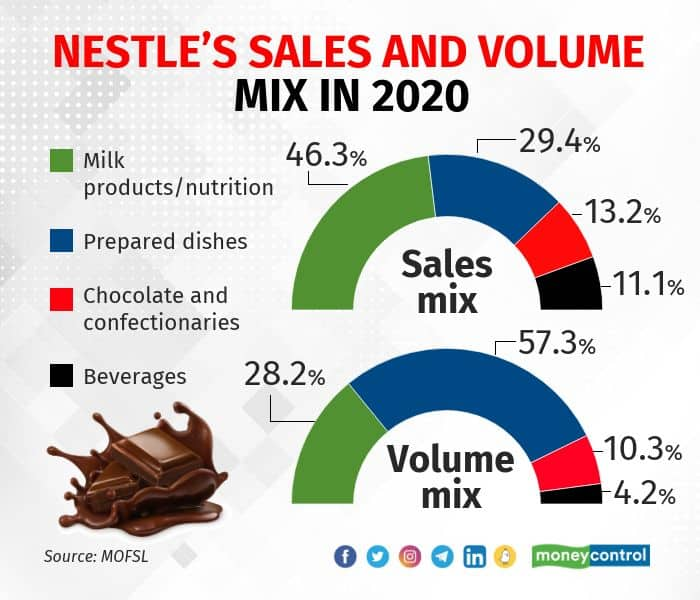
Its initiatives in the country towards introducing atta, spinach variants of Maggi noodles, fruit and nuts to chocolates and reducing sugar and salt content are being seen as an effort to increase the health quotient in its products, by analysts.
Devangshu Dutta, chief executive at retail consultancy Third Eyesight is of opinion that India usually remains unimpacted by developments in these multinationals globally as there is lower sensitivity and awareness in the country. “Take, for example, veganism which is a huge trend in the West but has not caught on as much in India yet.”
He believes the country would eventually be impacted by these developments but not immediately.
What is the real significance of this controversy?
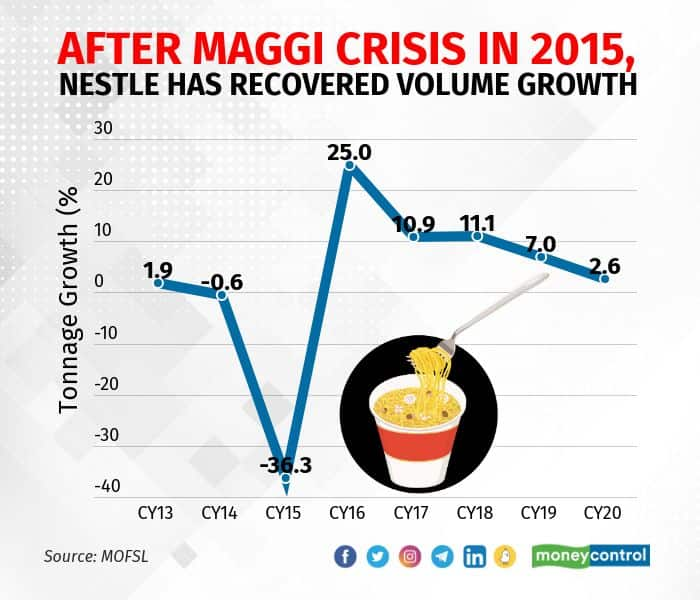
Nestle has come under fire in the past because of concerns about its food products. Back in 2015, Nestle had landed in trouble after Maggi, its most popular product in the country, was found to have monosodium glutamate or MSG by the Food Safety and Standards Authority of India (FSSAI). In a major setback for the company, the food safety regulator had consequently banned the sale of the product in the country. Maggi then commanded over 80 percent of the market share in India. Nestle’s volumes had plunged sharply in 2015 due to the Maggi crisis. (as shown in the chart below).
Subsequently, after five months of legal battle, Nestle relaunched Maggi in the country, however, it resulted in the loss of some of its market share. Today, the company holds almost 60 percent market share in the instant noodles category, as per estimates.
In the light of these events, the recent controversy around its product portfolio becomes significant as Nestle cannot afford a repeat.
Source: moneycontrol
admin
February 11, 2021
Written By MONEYCONTROL NEWS
The biggest winner in terms of sales was BigBasket, which accounted for 50 percent of the sales growth followed by DMart, Grofers, Spencer’s Retail and StarQuick (Tata)

Representative Image (Reuters)
Online grocery sales for the largest online and offline retailers grew by a combined 65 percent to Rs 6,820 crore in FY20, while collective losses measured Rs 1,175 crore.
The biggest winner in terms of sales was BigBasket, which accounted for 50 percent of the sales growth, followed by DMart, Grofers, Spencer’s Retail and StarQuick (Tata), a report by The Economic Times said.
Moneycontrol could not independently verify the report.
BigBasket owner Innovative Retail Concepts clocked a net sales growth of 43 percent, or Rs 3,418 crore, while losses rose to Rs 424 crore, as per data with the Registrar of Companies and business intelligence platform Tofler, the report said.
Most executives and experts credit the growth jump to the COVID-19 pandemic and lockdowns, which pushed consumers towards online options for grocery and other purchases, it added.
Follow our LIVE Updates on the coronavirus pandemic here
A spokesperson for Grofers told the newspaper that the value of goods the company sold in FY20 vaulted 88 percent to Rs 3,000 crore, with losses at Rs 637 crore, largely due to investments for strengthening delivery services and building awareness.
Among offline retail chains, DMart’s e-commerce business saw sales zoom to Rs 345 crore, with losses at Rs 79 crore. StarQuick operator Fiora Online saw revenue of Rs 33 crore against a loss of Rs 21 crore and Spencer’s owner Omnipresent Retail reported Rs 15 crore sales with a loss at Rs 14 crore.
Devangshu Dutta, CEO of consulting firm Third Eyesight, said that the customer shift to online propelled investments to enhance capabilities in the space, while a concurrent rise in the average order values would likely benefit companies with a “healthier bottom line”.
Nielsen noted that online sales in the FMCG segment were notable, accounting for 3.1 percent of the India market value–in metros this surged to 8.6 percent as of the September quarter.
Source: moneycontrol
admin
September 28, 2020
Written By Mihir Dalal

(From left to right) Doug McMillon, CEO of Walmart, which owns Flipkart; Mukesh Ambani, chairman and MD of RIL; Jeff Bezos, CEO of Amazon
BENGALURU : Last month, Nimit Jain, an entrepreneur, ordered biscuits, shampoo, toothpaste and other items for his family in Kota. He used JioMart—the new online shopping app by Mukesh Ambani’s Reliance Industries Limited—lured by its low prices and freebies.
JioMart was to deliver the order within two days, but Jain’s family didn’t receive the items on time and JioMart didn’t inform Jain about the delay. The delivery was done four days after he had placed the order, a few hours after Jain had complained to the firm via email and Twitter.
A few products were missing, Jain’s parents informed him. It took time to figure out the missing items because the details of the order weren’t available on the app. Jain had paid online and asked JioMart for a partial refund. Instead of receiving an acknowledgement for his refund request, he received a response for his previous email about the delay in delivery. Five days later, Jain got a refund.
Mumbai-based Jain, a computer science graduate from the Indian Institute of Technology, Madras, usually orders groceries from BigBasket and sometimes from Dunzo. He said that he doesn’t plan to use JioMart again.
“A couple of my friends and relatives (in Mumbai and Kota) have also had similarly bad experiences. It doesn’t look like JioMart is ready for online groceries. Their operations and customer care teams weren’t in sync,” Jain said.
Since JioMart expanded to more than 200 cities this summer, scores of customers like Jain have complained about missing products, delayed deliveries and generally poor service. Still, industry executives say that while its service levels have been inconsistent, JioMart is registering similar order volumes to BigBasket, the largest e-grocer, on the back of aggressive marketing and discounts.
These volumes still comprise a small fraction of the overall business of Amazon India and Walmart-owned Flipkart, the two dominant online retailers. But that’s because JioMart is only selling groceries now; it plans to sell other products like fashion and electronics soon. It’s clear that after many years of talk and hype, Reliance, which owns India’s largest offline retail chain, is finally becoming a serious challenger to Amazon and Flipkart, as well as BigBasket and Grofers.
Still, industry executives, logistics firms, consultants and analysts that Mint spoke with said that Reliance will find it tough to break the dominance of Amazon-Flipkart in e-commerce, similar to how Walmart is struggling to challenge Amazon in digital sales in the US even as its stores continue to prosper. Amazon and Flipkart both have deep pockets, proven expertise in e-commerce, popular brands and good knowledge of the Indian market.
“Reliance has the financial muscle, but Walmart (Flipkart) and Amazon are no pushovers,” said Harminder Sahni, managing director, Wazir Advisors, a consultancy. “Today, most people who want to shop online are happy with Flipkart and Amazon. These companies have achieved significant scale and have very few weaknesses. As a latecomer, it will be very difficult for Reliance to make a big dent in the market.”
Reliance did not respond to an emailed questionnaire seeking comment.
Local internet powerhouse
During the pandemic, Reliance has not only moved fast to make inroads into the e-commerce market, it has also consolidated its leadership in organized offline retail. Last month, Reliance bought most of the businesses of Future Group for about $3.4 billion in a deal that will take its retail footprint to nearly 14,000 stores—by far, the largest in India.
In the past six months, Reliance has raised more than $21 billion for its digital unit Jio Platforms. This month, Reliance kickstarted a separate fund-raising spree for its retail unit, Reliance Retail, bagging about $1.8 billion from private equity firms Silver Lake and KKR, two of the investors in Jio. Several more investment firms, including other shareholders in Jio, are expected to join them.
These moves are part of Reliance’s efforts to transform itself into a 21stcentury digital behemoth. It is positioning itself as India’s answer to Amazon, Facebook, Google, Alibaba and other world-class digital giants, and unlike local startups like Flipkart, Ola and Paytm that have or had similar ambitions, Reliance enjoys some unparalleled advantages.
It is now accepted wisdom among politicians and regulators that India needs a ‘local’ internet powerhouse to counter the dominance of America’s Big Tech and the growing influence of Chinese firms, partly because of sovereignty concerns. Reliance’s mastery in lobbying and its political clout makes the firm best-placed to exploit this urgent establishment need to find a domestic internet powerhouse.
Amazon, Flipkart, Facebook and others face many policy-related restrictions that not only serve as obstacles to them but pave the way for domestic firms led by Reliance to enter the fray. For instance, foreign investment rules prevent Amazon and Flipkart from owning inventory or selling private labels (though critics say that these firms do it anyway using clever legal workarounds), while Reliance has no such constraints. Apart from a supportive policy environment and huge capital resources, on the business front, too, Reliance has an enviable digital distribution network and reservoir of customer data on account of Jio.
But despite these formidable advantages, Reliance has yet to prove that it has the chops to realise its ambitious vision.
The war among Reliance and Flipkart and Amazon and other internet firms is also not restricted to retail, but will extend to other sectors like financial services, content and business-to-business commerce. The technology-centric nature of the battle is more suited to the internet companies than to Reliance. There’s little doubt that Reliance will be a major player in the digital business, but the jury’s out on how much value the firm can corner. Its foray in e-commerce and B2B will provide early answers to this question.
Retail battle
After JioMart began testing its service late last year, media reports said that the company would deliver products to customers from local kirana stores. After Facebook invested in Jio in April in a deal that included a business partnership between JioMart and WhatsApp, Ambani said that JioMart would soon connect some 3 crore kirana stores with their neighbourhood customers.
Many analysts, too, expect the partnership with WhatsApp, the most popular app in India, to be a game-changer. In July, Goldman Sachs estimated that Reliance’s entry will help expand the online grocery market by 20 times to about $29 billion by 2024. Reliance’s partnership with Facebook could help the firm become the leader in e-grocery and garner a market share of more than 50% by 2024, Goldman said.
But Mint learns that Reliance is sourcing a majority of orders on JioMart in many cities through Reliance Retail’s supply chain; only a small number of orders are served through kirana stores. JioMart is signing up a few thousand kirana stores every month, but its expansion is happening at a slower rate than many analysts expect. Two industry executives said that JioMart’s average order value is lower than that of other e-grocers, which means that Reliance is losing larger amounts of money on every order.
According to one e-commerce executive, for BigBasket and Grofers, the delivery cost is about 3-4% of the average order value, which exceeds ₹1000. For Reliance, the delivery cost is presently much higher because its order value is below ₹800. The lower order value is partly because most of JioMart’s 200 city-markets are non-metros. BigBasket and others generate an overwhelming majority of their business from the metros. Reliance is betting on expanding the e-grocery market rather, than taking market share from incumbents, which generate an overwhelming majority of their sales from 10-15 cities. But while Reliance may be able to attract customers in smaller cities initially with discounts, profitability will be tough.
“The economics of serving metros are very different from the rest of India. In the mass market, bill values are much, much lower. Right now, Reliance’s main focus is to scale JioMart, so they aren’t worried about the delivery cost,” the executive cited above said. “But eventually, reality will catch up, and they will have to increase basket sizes because this model isn’t sustainable. Grocery has very thin margins to start with. “
Private label push
One obvious way for Reliance to boost margins is by selling more private label products. In the grocery category, Reliance Retail already generates 14% of its revenues from private labels. People familiar with Reliance’s plans said that the company wants to push its private label products to kirana stores. While there are hundreds of well-known brands in FMCG, the grocery category (products like rice, pulses and flour) is largely unstructured. Reliance plans to sell its private label products both in grocery and FMCG.
Apart from retail, Reliance is also rapidly expanding its B2B business. Its private label products form a key component of its retail and wholesale business plans, the people cited above said.
The private label push, however, is making large FMCG companies like Hindustan Unilever, Marico and Dabur, which sell competing products, wary of working with Reliance’s B2B arm.
Like Flipkart and Amazon, which are also expanding their B2B businesses, Reliance’s grand vision over time is to have an integrated ecosystem of wholesale and retail in which it connects consumer goods makers with kirana stores and retailers, supplies a large number of private label products across many categories to retailers and end-customers, and becomes the biggest omnichannel retail firm in the country. But realising this vision will require Reliance to work seamlessly with millions of kirana stores, thousands of brands, modern retailers (all of which will see the firm as a rival to an extent)—and provide exceptional service in a profitable manner to retail customers.
Analysts and industry executives said that Reliance has a higher probability of finding success in categories like fashion (in which it already runs a portal called Ajio) and grocery that are mostly unorganised and have a shortage of established brands. In these categories, Reliance faces fewer barriers from existing players and has a better chance of pushing its private labels in both the wholesale and retail markets. But in categories like electronics and FMCG, which are dominated by entrenched brands, kirana stores and e-commerce firms, Reliance may struggle to scale as fast.
For instance, Flipkart and Amazon dominate online sales of electronics and fashion, which together comprise more than 75% of all e-commerce. To win significant share in electronics, Reliance will have to spend enormous amounts on discounts, marketing and offering favourable terms to brands . But, in fashion, Reliance can tap its low-priced private labels to lure customers without resorting to value destruction.
“The market is too varied for one player to be big in all categories,” an investment banker said. “Reliance will have to carefully choose its battles. There’s a risk that it may spread itself too thin, so it’s wise for them to have started with grocery.”
Meanwhile, while Google and Facebook have together invested more than $10 billion in Reliance, both companies are continuing to expand their own businesses in India. Google and Facebook have ambitions to enter e-commerce and expand in other sectors like payments and content. What this means is that while Google and Facebook will end up collaborating with Reliance in some areas, they will also compete with the firm in others, joining Flipkart and Amazon in the war of the digital conglomerates.
Flipkart and Amazon have already stepped up their lobbying efforts with the emergence of Reliance as a threat. Because of the pandemic that has made e-commerce indispensable, there has been a thaw in the government’s attitude towards the US e-commerce firms. A more antagonistic attitude may return when the pandemic passes.
Eventually, though, the war will be decided by customers. Here, experts are divided on whether Reliance will emerge as the winner. “Reliance still has to do a lot more on getting the customer experience in place, but given the strides they’ve made, it is well-placed to compete in the digital space,” said Devangshu Dutta, head of retail consultancy firm Third Eyesight.
Source: livemint
