
admin
July 20, 2026
Kartikay Kashyap, Financial Express / Brandwagon
30 July 2026
Wendy’s first foray into India’s quick service restaurant (QSR) market in 2015 remained a non-starter. Sierra Nevada Restaurants, the then master franchisee, could not scale its retail presence beyond four conventional restaurants concentrated largely in Delhi-NCR. This limited physical availability, brand awareness and ordering frequency.
Ten years on and under a new master franchisee Rebel Foods since 2023, Wendy’s seems to have turned over a new leaf. With more than 250 stores, and ₹200 crore in revenues, the brand wants to be the one-stop destination for the younger generation where consumers come together to celebrate food, music and a sense of community. “The longer-term ambition is to expand to approximately 500 locations by 2028 through a combination of delivery kitchens and physical restaurants,” says Joy Bamania, brand head, Wendy’s India.
As a first step, Rebel Foods recently opened what it calls its “dynamic cultural flagship store” in Delhi’s vibrant student hub of Hudson Lane, GTB Nagar. The two-level youth-centric space blends food, music and anime, offering fans experiences like live rap battles, meet-and-greets, and specialised menu items like the signature Teriyaki Burger range.
“It has been designed to be livelier, more youthful and visually engaging—an Instagram-worthy space. It is a physical expression of how we want consumers to experience Wendy’s in India: bold, fun, culturally relevant and full of energy,” says Bamania.
Even before taking over Wendy’s operations Rebel Foods had been managing its delivery-only cloud kitchens since 2020 and was familiar with the brand’s DNA and what was required to mount a serious challenge in the ₹15,000-plus crore organised burger restaurants market in the country. The low capex delivery-only model has helped to improve its gross margins, but taking on established brands like McDonalds, KFC and Burger King would be a completely new ball game.
Is the latecomer up to a second bout in the ring?
New, improved
Wendy’s has at least three things going against it. It arrived late on India’s shores and couldn’t really stand apart during its last outing. “No matter how big a global brand you are, you need to stand out in the clutter,” says Devangshu Dutta, founder & CEO, Third Eyesight.
So while McDonald’s is the kid-first family restaurant, Burger King is intentionally “imperfect” and rides on humour, pop-culture moments, and viral marketing. Wendy’s, say experts, had no differentiation than just being a global brand.
Its premium pricing was another bugbear. In its first foray, Wendy’s tried to justify its higher prices saying its ingredients were better than that offered by the rest of the pack. So while the price of a Wendy’s entry level burger was ₹100, McDonald’s retailed one at half that price. “In the QSR business, you have to get your price right. There is nothing ‘premium’ in that space,” says Ankur Bisen, senior partner, The Knowledge Company. Rebel Foods addressed these problems with four fundamental shifts.
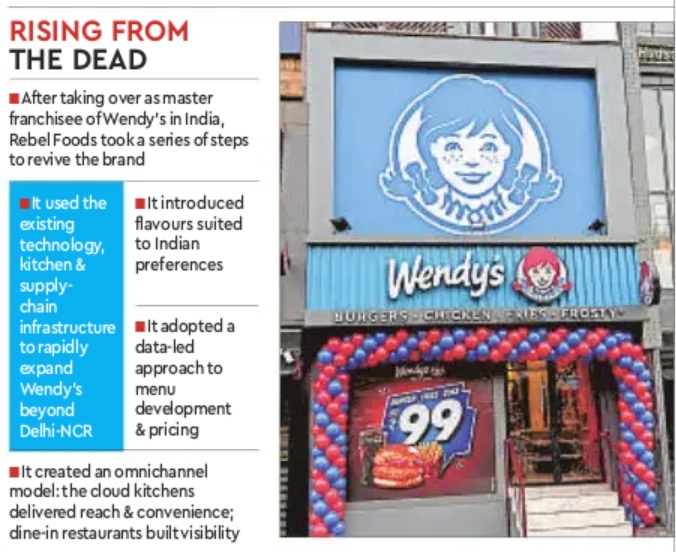
First, it used the existing technology, kitchen and supply-chain infrastructure to rapidly expand Wendy’s beyond Delhi-NCR. Second, it built a stronger and more accessible value architecture while introducing flavours suited to Indian preferences. Third, it created an omnichannel model in which cloud kitchens delivered reach and convenience, while selected dine-in restaurants built visibility and deeper brand experiences. Finally, it adopted a data-led approach to menu development, pricing, consumer feedback and operational performance.
Rebel Foods became Wendy’s master franchisee in India in 2023. At that stage, Wendy’s had approximately 90 locations across 19 cities. By March 2025, the brand had reached 200 locations across more than 50 cities, including 15 dine-in restaurants.
“The fivefold revenue growth has consequently not come from one product or campaign. It is the result of wider distribution, sharper value, continuous menu innovation, stronger operational execution and a much clearer proposition for the Indian consumer,” says Bamania.
(Published in Financial Express)
admin
August 19, 2024

Ratna Bhushan, Economic Times
New Delhi, 19 August 2024
Close to a dozen small to mid-sized global cafes and restaurant brands have either entered India in the past two quarters or are in talks with local players at a time when large global chains are seeing sharp decline in same store sales and growth.
Mid-sized global chains are making investments even in a modest range of Rs. 20-30 crore to tap select cities and intend to keep store counts under about 30 to stay profitable on each store. This is in contrast to earlier times when cafes and chains entered India with mega deals and investment plans, executives said.
Belgian bakery Le Pain Quotidien, French patisserie chain Laduree, UK’s JD Wetherspoon and Frank HotDogs are among those to have inked collaborations with Indian partners, while newer homegrown ones such as Harley’s, Paper & Pie, abCoffee and First Coffee are expanding with first-time investors and mid-rung store rollouts.
“A combination of factors is driving this change of newer, smaller launches,” said Devangshu Dutta, chief executive of retail consultancy Third Eyesight. “There are niches the newer chains are addressing as consumers’ choices evolve and get more specific. Also, there’s a broadening of a wealth base in India leading to mid-sized business houses having capability to invest and willingness to try out newer segments,” he said.
With the big-bang launches in food services drying up, there’s been a mushrooming of small deals that is expected to surge.
Bake & Brew, which has inked a master franchise agreement with Belgian bakery chain Le Pain Quotidien to re-enter India, is investing Rs 35 crore in the first year. “We’ll start in metros and may expand to smaller towns later. We also see potential in travel retail, airports and larger train stations,” Annick Van Overstraeten, chief executive of Le Pain Quotidien, told ET. Bake & Brew is backed by the Nalanda group with core business interests in automotive metal parts.
Earlier this month, the French patisserie chain Laduree said it was launching its cafe at Ritz-Carlton, Pune, in collaboration with CK Israni Group which has business interests in home decor and construction. Its Managing Director Chandni Nath Israni said in a statement that the CK Israni group planned to expand Laduree’s presence across other Indian cities.
Experimenting in newer cuisines is also driving the change. “Our decision to expand in India stems from a deep appreciation for variety and a passion for bold flavours. We see great potential in the Indian market,” said Benjamin Attal, founder of US chain Franks Hot Dog.
Smaller and newer homegrown chains, in contrast, are expanding, backed by mid-ticket investors and business houses, many of whom are foraying into food services for the first time.
Last week Brigade Group, a realtor, announced a partnership with specialty coffee chain abCoffee to set up six outlets within Brigade properties.
“We partnered with abCoffee to enhance the F&B offerings at our office parks. abCoffee is able to retrofit into operational buildings without requiring additional water or gas points,” Arvind Rao, vice president – commercial business, Brigade Group, said.
Specialty coffee startup First Coffee plans to open 35 stores by 2024-end “focused on delivery and minimalist store aesthetic,” according to a company statement, to sell flavoured coffees, cold brews and bubble teas.
(Published in Economic Times)
admin
February 23, 2024

Kailash Babar & Sagar Malviya, Economic Times
Mumbai, 23 February 2024
Tata Group and Reliance Industries, two of India’s largest conglomerates, are vying for premium retail real estate in Mumbai as they extend their footprints, creating rivalry in a city starved of marquee properties. From Zara and Starbucks to Westside and Titan, the Tata Group occupies nearly 25 million square feet of retail space in India. That is still no match for Reliance Industries that control three times more at 73 million sq ft for more than 100 local and global brands.
But in Mumbai, they are evenly matched, having nearly 3 million sq ft of retail space each. That is a quarter of what is considered the most prime retail real estate in the country, and both the retail giants are looking for more.
“In a modern retail environment, most visible locations contain more successful or larger brands. It just so happens that many of those brands are owned by either Reliance or the Tatas,” said Devangshu Dutta, founder of Third Eyesight, a strategy consulting firm.
“Tatas have been in retail for longer but also slower to scale up compared to Reliance which had this stated ambition of being the most dominant and put the money behind it,” he said.
In a market where demand is much higher than supply, developers and landlords seek to separate the wheat from the chaff, experts said. Ultimately, success in Mumbai’s retail real estate scene hinges on a delicate equilibrium between accommodating industry leaders and fostering a vibrant, varied shopping environment, they said. “In the competitive landscape of retail real estate in Mumbai, commercial developers and mall owners often face the strategic challenge of accommodating prominent retail brands,” said Abhishek Sharma, director, retail, at commercial real estate consultants Knight Frank India.
“These big brands, with a significant market share of 40-45% in the Indian retail sector, can easily be termed as industry giants and possess the potential to command 45-50% of space in any mall,” he said. According to Sharma, there may be perceptions of preferential treatments, but the dynamics are complex, and developers must balance the demand from these major brands with the need for a diverse tenant mix.
Tata Group entered retail in the late 1980s, initially by opening Titan watch stores and a decade later by launching department store Westside. So far, it has about 4,600 stores, including brands such as Tanishq, Starbucks, Westside, Zudio, Zara and Croma.
While Reliance Retail started in 2006, it overcompensated for its late entry by aggressively opening stores across formats. Reliance has over 18,774 stores across supermarkets, electronics, jewellery, and apparel space. It has also either partnered or acquired over 80 global brands, from Gap and Superdry to Balenciaga and Jimmy Choo. A diverse portfolio of brands across various segments through strategic partnerships and collaborations helps an entity like Reliance to leverage synergies and enhance retail presence, especially in malls, experts said.
“The array of brands with Reliance bouquet allows it to enter early into the project and set the tone and positioning of the mall,” said a retail leasing expert who requested not to be identified.
“This positively helps the mall to set its own positioning and future tenant mix. It also helps Reliance place their brands in most relevant zones within the mall. This will emerge as a clear differentiator in a city like Mumbai where brands are already jostling for space, which is the costliest in the country,” the person added.
(Published in Economic Times)
admin
June 30, 2022
Written By Aditya Kalra & Abhirup Roy

MUMBAI, June 30 (Reuters) – Reliance Industries (RELI.NS) said on Thursday it would open outlets of Pret A Manger in India under a franchise deal with the British sandwich and coffee chain, a first foray by the Indian firm in the country’s growing food and beverage industry.
Reliance Brands Ltd (RBL), a unit of the conglomerate that also runs India’s biggest retail chain, would start by opening branches of Pret, as the brand is known in Britain, in big Indian cities, both companies said.
RBL Chief Executive Darshan Mehta said in joint statement the partnership was “rooted in the strong growth potential” of the Pret brand, known for its organic coffee and upmarket sandwiches, and the Indian food and beverage industry.
The first outlet would open in Mumbai before March 2023 and India was expected to become one of Pret’s top three markets in three years, a source familiar with the matter told Reuters.
Pret A Manger, whose name means “ready to eat” in French, first opened in London in 1986. It now has 550 outlets globally, including in the United States and several European states. It is owned by investment group JAB and founder Sinclair Beecham.
In India, the brand will compete with Starbucks (SBUX.O), which has a joint venture with India’s Tata, and Costa Coffee, which is owned by Coca-Cola (KO.N).
Mukesh Ambani, one India’s richest men, runs Reliance, which has more than 2,000 supermarkets and grocery stores in India. Reliance also has partnerships with luxury brands, such as Burberry and Jimmy Choo.
“Reliance wants to look at retail in all its shapes and forms. Over time, they’ve realised partnerships are the way for business formats that may be difficult or slower to crack,” said Devangshu Dutta, head of retail consultancy firm Third Eyesight.
Source: reuters
Devangshu Dutta
January 24, 2014

[This article appeared in the February 2014 print issue of Retailer, under the headline “Implications of the Tata-Tesco JV“]
India is a civilisation that has borne fruit from thousands of year of international cultural exchange, commerce and investment flowing both inwards and out. It is also one that has suffered from military and as well as economic colonisation over the millennia.
For those reasons, foreign investment into the country is bound to have both vociferous opponents as well as staunch supporters, and this debate is possibly most polarised in the retail sector that touches every Indian’s life daily. Over the last few decades, foreign investment into the retail sector has seen flip-flops from successive governments and political parties across the spectrum, being allowed until the late 1990s, then blocked (by Congress-led UPA), then selectively allowed (by BJP-led NDA, and later by Congress-led UPA). And more recently, with pressures, protests and influences from all sides 2011, 2012 and 2013 have certainly been on/off years during the UPA’s second successive term.
In this time Zara’s joint-venture, set up in 2010, has turned out be one of the most successful and profitable in India. More recently, Ikea announced a €1.5 billion plan for the country, followed by H&M’s US$ 115 million proposal, while Marks & Spencer identified India as its second largest potential market outside the UK. However in October 2013, the world’s largest retailer Wal-Mart decided to call off its joint venture amid investigations of its executives having supported or indulged in corruption and accusations that it had violated foreign investment norms. It decided to acquire Bharti’s stake in the cash-and-carry JV and announced that it would not invest in Bharti’s retail business.
It was soon after, as if to compensate for Wal-Mart’s blow, that India’s Tata Group and British retailer Tesco announced that they would be creating a formal joint venture in India, with Tesco investing US$ 110 million. The Congress-led government went on to quickly approve the proposal, as if to visibly shake off accusations of “policy paralysis”.
Tesco’s investment doesn’t look like much for a country the size of India, especially in the context of Ikea’s ambitious proposal or H&M’s fashion retail business that is possibly less complex than Tesco’s multi-product multi-brand format. However, let’s keep in mind that Tesco is facing tough trading conditions in Europe, took a global write-down of US$3.5 billion last year including its exit from the US market, and merged its Chinese business with retail giant China Resources Enterprise to become a minority partner. In view of all that and the unpredictability of Indian politics, US$ 110 million looks like a reasonable if not disruptive commitment. It also does somewhat limit the downside risk for Tesco if the environment turns FDI-unfriendly after the general elections.
Whenever Tesco expanded into new markets, it has tried to adopt a localised or partner-led approach. In India, since 2007, Tesco has had an arrangement to provide support to Tata’s food and general merchandise retail business. The intent underlying the partnership was clearly to look at a joint retail business when allowed by regulations and not just at back-end operations. The existing structure has provided Tesco with an opportunity to learn about the Indian market and operating environment first-hand while working closely with Tata’s retail team. Tata, in turn, has drawn upon Tesco considerable expertise of operating retail businesses in both developed and emerging markets. At the very least, the FDI inflow from Tesco will deepen this arrangement further, benefiting both partners further.
But there are the inevitable twists in the tale. While the Tesco proposal was in the works, the new Aam Aadmi Party formed a government in surprise victory in Delhi state and announced that it would not allow foreign owned retail businesses in the state of Delhi. This strikes off one of the most lucrative metropolitan markets from the geographic target list at least in the short term. (The central government has pushed back saying that while retail is a state-subject, the decision to allow FDI by the previous Congress government cannot be reversed at will by the current AAP government, but the debate goes on.) BJP-led and BJP ally-led state governments have also indicated their unwillingness to allow foreign retailers into their markets.
So should we even attempt to forecast what Tesco and Tata could do in this environment? I would rather not pre-empt and second-guess the future plans of business executives who are trying to read the intent of politicians who are focussed on elections 4 months in the future! However, whatever the plans, the retailers must comply with the regulations such as they are now and utilise the opportunities that exist. So it is likely that the following scenario will play out.
Tata and Tesco have said that the proposed joint-venture looks at “building on the existing portfolio of Star Bazaar stores in Maharashtra and Karnataka”. These are both states where Trent has multiple locations, so a certain critical mass is available. Since current government policy requires the investment to be directed at creating fresh capacity, new stores would also be opened in these states, though the expansion plans look modest, with 3-5 new stores every financial year.
But with the 50 percent investment in back-end also being a regulatory requirement, new procurement, processing and logistics infrastructure which could service stores within these states as well as in other states are is likely to be built. Tesco’s wholesale subsidiary currently supplies merchandise to Star Bazaar stores across states – this relationship is likely to continue as some of Tata’s stores are in states that are not within the FDI ambit. The product mix proposed includes vegetables, fruits, meat, fish, dairy products, tea, coffee, liquor, textiles, footwear, furniture, electronics, jewellery and books.
The norms earlier required FDI proposals to ensure that 30 per cent of product sourcing would be domestic, from small-midsized enterprises. However, in August 2013, the government relaxed this requirement to be applied only at the beginning of the joint-venture operations, and that this requirement would not include fruits and vegetables, an area where Tesco has focussed significant energy. So the immediate focus would be on meeting the domestic sourcing requirements in other categories, and creating a viable business model and scale through an appropriate product mix.
The partners are likely to continue working on improving the performance of the existing Star Bazaar stores which are 40,000-80,000 sq ft in size. However, Tata has also launched a new convenience store format, Star Daily sized at about 2,000 sq ft focussed on fresh foods, groceries and essential items. Retailers with foreign investment are now also permitted to open stores in cities with populations under one million from which they had been prohibited previously, so the new small format can provide significant expansion opportunities and more volume for the back-end operations to reach critical mass quicker.
Would there be a change of name on the store fascia? Unlikely, since Tesco has been operating stores under other brands as well in markets outside the UK and a “Tesco” name appearing on the fascia may not significantly change the consumer’s perception of the store. Other than in lifestyle categories or overtly brand-driven products (such as fashion), most Indian consumers focus on utility, quality, local relevance and price as significantly more important purchase drivers than an international name. In fact, a trusted Indian name like Tata carries as much weight or more weight in many categories than an international brand would. So the stores may carry a joint by-line, but the focus is likely to remain on the existing brand names.
And what of several other retailers who are interested in the Indian market? Will they draw inspiration from Tesco and take their plunge into the market, urged on by the outgoing government eager to demonstrate results during its final months?
Wal-Mart, for one, seems to have returned to the table, having set up a new subsidiary, perhaps preparing the ground for a retail launch with another partner. A European retailer, remaining nameless for now, is being mentioned as being the next proposal in the FDI pipeline.
However, it is likely that most will remain in the wait-and-watch mode until the outcome of the national elections is clear. The real issue is not the regulations themselves as much as the unpredictability of the regulatory environment. Policies are being made, turned around, and twisted over in the name of politics, without a clear thought given to the real impact on the country, the economy and the industry of either the original policy formulation or its reversal.
Until that dust settles down, we should expect no dramatic changes in the near term, no sudden rushes into the market. But then, we could be wrong – policy and politics have taken unexpected twists earlier, and could do so again!
