
Devangshu Dutta
December 18, 2009
(Contributed to the BusinessWorld cover story – “What 2 Expect in 2010”, issue of January 4, 2010)
Everything that can be said and assumed about the Indian market is true at some level of granularity. Very simply, in India there is a segment for every product, an opportunity for every service, be it ever so small. But when bubbles are bursting all over, as the Noughties Decade comes to a close, the puzzle that is Indian consumer market also warrants a fresh look.
For most of the Noughties Decade India has seen Generation-C, the “Choice” generation, coming of age. They have moved over from being “secondary customers” consuming off their parents’ incomes, to entering the work-force and becoming customers in their own right.
It may sound trite, but Gen-C customers have grown up with many models of 2-wheelers and 4-wheelers and colour television with multiple channels. They have many more career options and many more opportunities in each career. Not only have they grown up on a diet of choice, they have also grown up with much higher confidence about the future, about their place in the world and what they can expect. And they have infected the outlook of generations older than them as well with a similar confidence.
Therefore, for most of the decade, it has been a distinctly rosy picture for consumer goods marketers and retailers. Business plans routinely expected 20-50% annualised growth, and businesses even delivered those figures on some basis or the other. Organizations as diverse as retailers and management consultants were inspired by India’s age-old image as the Bird of Gold. Supermarket chains mushroomed like never before, department stores and speciality retailers grew their footprints, quick-service and casual dining expanded covers, while electronics, durables, leisure companies, and car brands all counted India among their hottest markets.
Product off-take reflected this outlook. Amongst the FMCG sector, while basic items such as the bath and shower segment demonstrated a steady annualised growth of about 7%, premium cosmetics galloped at almost 20% a year. While the relatively mature 2-wheeler market grew at just over 7.5% annually between 2002-03 and 2008-09, the 4-wheeler passenger vehicle market demonstrated growth of almost 14% a year in the same period.
All this was before the recent rude interruption.
A speed-breaker began showing up in the consumer market in late-2007 and grew larger through 2008. Once the global financial markets melted down in late-2008, media sentiment turned acutely negative about the Indian market as well. And, eventually, with uncertainty prevailing around the world, consumer spending in India did take a hit. Consumers cut back on the frequency of purchases or traded down.
On the trade side, retail businesses began acknowledging that stores were performing below plan and went into rationalisation mode. For branded suppliers, where some of the growth had come from stuffing the pipeline and filling new shelves, wholesale order books became thinner.
Yet, as painful as the economic scenario might have appeared, the Indian consumer market has shown remarkable resilience. Demand in smaller cities and towns has remained robust. Regional brands, especially, found plenty of opportunity to grow in markets and geographical regions where they were under-penetrated or absent.
And as the mood lifted through the latter half of 2009, consumer demand clearly moved back up. The speed at which the demand rebounded would suggest that the Indian market was relatively sheltered from the global economic storm.
However, there are some critical differences to understand.
On the one hand, Gen-C’s confidence shook for the first time – a generation that has only seen upward mobility, witnessed job cuts and salary freezes or declines even if only second-hand. Comparisons with the Great Depression may be exaggerated but it is a scenario they can now imagine as a possibility. At least three new professional academic batches have or will have moved into the job market under these sober conditions. On the other hand, tremendous inflation in basic costs supports some amount of uncertainty about the future. The fact that many of the Gen-C would have just begun or would be about to begin families serves to only heighten such anxiety.
So, let’s recognise two immutable facts about the Indian consumer market in the current environment.
First: that the ancestral “steel safes” are back, at least figuratively if not literally. Customers do want to save more for now. And if they are spending, they want to feel that they are extracting far more value than the price they are exchanging across the counter, value that will last long after the transaction at the store. In recent years, this inherent ‘value orientation’ of the Indian consumer was neglected by many. Now every product, service or brand must aim to deliver this sustainable value, and demonstrate the value repeatedly.
Secondly, each business needs to look at the lifetime value of a customer if it can. Rather than cutting the golden bird open and trying to extract all the golden eggs at once, one needs need to keep the bird well-fed, happy and healthy, and enjoy its rewards over several years. Rather than creaming the market, pricing, branding and distribution need to be structured for a sustainable relationship with the customer.
Some businesses will work better than others in this market, and strategies will need to be adapted. A lifecycle approach may handy in identifying the business segments which might meet the steel safe criterion, or the golden goose criterion, or both.
The first segment that comes to mind is weddings. Wedding expenditure is seen as a “social investment” for both the families, and the actual items bought are an investment into the couple’s future together. So, bridal trousseaux and wedding wardrobes, wedding arrangers and catering, and household goods provide significantly more tangible and intangible value than the money spent.
Similarly, “first child” isn’t usually a segment in any marketing handbook, but should be. The couple’s first born, especially if the baby is the first in its generation will usually get a disproportionate amount of attention and spending on clothing and utilities. A baby’s growth into a child, of course, can provide a relationship and marketing opportunity that can last for years, but the first 2-3 years are specifically valuable. What’s more, given India’s demographic dividend in the form of a sustained under-30 age group, baby products have a sustained and growing value as a market.
As the child grows, there are clear indicators of current and future value that can drive purchases. While base schooling is an essential expenditure, extra-classes and tuitions are a high-value discretionary investment that parents are choosing to make. Sports, on the other hand, however essential they may be to a child’s development are often seen as a distraction. That is, unless the child is attending sports coaching and the parents have an eye on helping the child create a career from it – in which case, a coach who is apparently good, branded equipment and kit are definitely worth investing in. So a cricket coaching franchise might just be the ticket to fortune, while a toy company may struggle. Some may decry the decline in art, craft, philosophy and fundamental sciences, but these are not on the list of priority of most parents. In the short to medium term, parents would continue to disproportionately push their wards into academic disciplines that are seen to develop marketable skills and pay well. Expect continued growth in the engineering, medical and management education market, but also in other vocational disciplines.
On the other hand, everything is not an investment for the future. Present comforts may also provide extra value, through convenience.
Some of these comforts may be as small as enjoying out-of-home exotic meals (pizza and pasta still qualify as exotic for the bulk of the population). Or if eating out looks out of budget, ready-to-eat and ready-to-cook meals are an easy substitute. Jubilant, Yum, McDonald’s, Haldiram, Sarvana’s, Nirula’s and the thousands of other casual dining and snack food chains have a long clear highway of growth ahead, as do snacks and packaged food companies such as Nestle, Britannia and ITC.
Brown goods and white goods that offer comfort and convenience – coolers, water heaters, convectors, air-conditioners and kitchen gadgets – continue their onward march, despite the huge shortfall in electricity. Even if the big brands struggle with their price points and overheads, regional brands and private labels will continue growing strongly in these segments.
Health is another area for significant investment. With prevalence of lifestyle-ailments, from stiff necks to high blood pressure, basic pharmacists to cardiovascular specialists are all in demand. Anticipate significant growth to continue in over-the-counter medication, medical devices, as well as clinical and hospital care.
At the other end of the scale, with decent and adequate public transport lacking in most cities, we can expect personal vehicles to increase multi-fold, despite the small blip in 2008-09. About 60 million 2-wheelers and over 10 million passenger vehicles have already been added during the decade, and the growth trend looks set to resume from 2010, unless there are significant oil price or vehicle taxation shocks delivered by the government.
And as consumer confidence resurges, more overt displays or personal spends will return as well, including apparel, footwear, home products, accessories, vacations, fitness and recreation, but we would expect them to follow behind the higher priority “safe” or “geese” segments.
Finally, the one thing that marketers in any product need not be really concerned about whether there is a future in this market. Even, Hindustan Unilever, a mature FMCG company with very high distribution penetration built over decades, still counts less than 60% Indians as its customers.
Surely most companies have a much longer road ahead before they need to be worried about their markets becoming saturated.
Devangshu Dutta
July 16, 2009
The grocery market is loud. From the times when food markets were in streets and town squares, hawkers have cried out their wares, and the freshness or newness of everything made evident to the customers passing by. So, I guess, it is no surprise that today’s FMCG and food market is also tuned to high-decibel promotion.
You don’t need to search too long for the reason – margins are generally thin on these frequent-use products and inventories need to move fast. And what you don’t make a noise about may not be visible to the customer and may remain unsold.
But if that was the whole story, most players should be focussing on one brand, or at most a few brands, and should be using their advertising budgets to maximum effect on these.
Instead we see exactly the reverse phenomenon in the market – more brands, more sub-brands, more varieties of everything. Why? Because newness sells – it creates excitement, anticipation, and in customers with a sense of experimentation it creates the urge to buy.
The old proven method of doing this was the “New Improved” starburst on the pack. The slicker, updated method is to launch a new variety that is apparently different in some way. For instance, if the old supplement helped to strengthen bones, the new line might contain separate “child” and “adult” versions (growth vs. osteoporosis). The old shampoo might have helped to keep hair clean and prevent dandruff – the new one might leave the customer wondering if she should pick the dandruff-fighter that also reduces hair loss, or the variety that makes her hair glossy, or even the one that provides a date for the next weekend! By the time she reaches the end of the shelf, she might have forgotten that her need essentially was to prevent dandruff.
Due to this, the grocery and FMCG product mix is fractal. Each grocery shelf or grocery store is susceptible to fragmentation. Each such fraction is supposed to act as the seed that can allow a new segment in the market or a new use occasion to grow, and provide the FMCG company or the retailer with an avenue for additional business. This phenomenon is particularly visible in a growing consumption environment – consumption feeds proliferation, while proliferation provides further occasions to consume.
However, an unfortunate outcome of this proliferation of brands and SKUs is the heightened noise, in which the brand often loses its unique voice. Also, over time, the brand may be too thinly spread or be undifferentiated from its competitors, and its sales only sustained through ever increasing bouts of expensive advertising – a vicious spiral.
Another issue is the real estate availability and the cost. Chris Anderson wrote about “the long tail” about 5 years ago – the myriad products for which the market is limited, but demand may be sustained over a long period of time through internet sales. However, while the long tail works for e-commerce businesses such as Amazon that carry limited inventory, the physical store runs out of space for micro-segment items very quickly.
All of these factors obviously start hurting visibly when the market turns down, and when marketing investments start being evaluated against the returns. This is when proliferation starts giving way to “rationalization”, reduction of the brand portfolio, narrowing the SKU focus.
We are already seeing signs of this in many of the developed modern retail markets currently, where retailers and their suppliers are closely analyzing which parts of their portfolio they need to sustain, and which they need to drop.
The story in the Indian market is slightly different for a variety of reasons.
First, the market is still growing, and for most FMCG suppliers there are vast expanses of the market are still blank canvases.
Secondly, India has been a branded supplier driven market for a long time, and remains so, by and large. However, the SKU and brand density is nowhere close to what is seen in the West. There is plenty of headroom still for new varieties to be added and new brands to be developed.
But possibly the most important factor is the new modern retailers, who are desperately seeking additional sources of margin. When there is a limit to the traffic that you can divert from traditional mom-and-pop stores, and when you hit the glass ceiling on transaction values per customer, proliferation becomes the game to play. Therefore, these retailers are either busy introducing own labels or encouraging new branded vendors who would offer them higher margins than the more established brands.
Own label is obviously the tricky one. The customer needs to feel comfortable with the switch – in the US, a study showed that consumers would more easily switch to own label merchandise in categories where the “risk” was perceived to be low (such as household goods, rather than children’s products). Also, the best own label gross margins typically come from products that are presented to the consumer as “brands” comparable to national branded products, because the pricing is more on par.
So, on the retailer’s part, this requires sophistication of product development and brand management that may be expensive and may need time to develop. A short-cut could be the acquisition of an existing brand, its entire assets including the organisation, as some retailers have been reportedly looking to do. How well they integrate the brands into their businesses remains to be seen.
In the long term, like their counterparts in more developed markets, these retailers may also come to the point where they wonder whether these owned brands offer them enough return on the expense and the management effort spent on them, or whether they would be better off just buying brands that consumers are already familiar with through multiple channels.
In the short term, however, we can expect proliferation, fragmentation, fractalization in all its forms. We can expect the illusion of plenty of choice to continue driving sales, and more and more products to fulfil needs that even the customer doesn’t know he has.
Devangshu Dutta
April 2, 2009
(Based on the special address By Devangshu Dutta, Chief Executive, Third Eyesight opening the second day of Prime Source Forum 2009, Hong Kong)
I’d like to thank the organizing team at Prime Source Forum for this opportunity to address this distinguished group of top management from the global apparel and textile industry.
I’ll take you through a brief presentation that’s slightly different in flavour. it’s a little bit of a step back from what we discussed yesterday and will continue to discuss during the day today. It’s looking at the world as we’re seeing it evolve and unfold – discuss things are possibly being seen, heard but not really understood.
I’ve titled my presentation “Itches, Cuts and Fractures” and I’ll explain that seemingly strange title shortly.
First of all, as all of us were discussing yesterday and you must have felt it – there’s a sense of uncertainty; nobody seems to have the answers. Certainly not the experts; the experts got us here. The experts had all the answers till about six months ago and all the answers turned out to be wrong.
Instead, I’d like to take a step back and look beyond numbers, beyond rationales. All explanations and analysis seem to ignore one of the strongest drivers of humankind – emotion. Underneath all the thinking, reasoning, logical layers, it is emotions that actually drive many of our decisions.
When it comes to uncertainty – when it gets to an extreme – we tend to get into a fearful situation. When we don’t know what’s happening, or what’s going to happen, fear is actually the emotion that drives a lot of the decisions. We’re beginning to see a lot of that in the world, around the world in different countries. You might think that this might happen in the more developed economies, others might think that this is likely to happen in the less developed economies, but it is actually happening around the world.
And when it comes to another step further, fear actually causes friction.
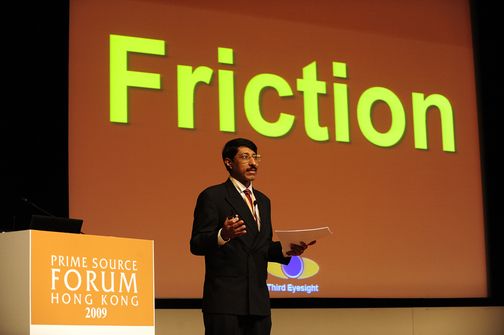
As students of Zoology, we learn about how animals respond when they are threatened. In a shifting environment with many potential threats, fear and survival instincts trigger the “fight or flight response”. The animal can either try to fight the threat or to escape.
It is no wonder, then, that ‘friction’ is the first reaction in a world where there is a lot of uncertainty and lots of fear.
And we’re beginning to see the signs of that…if you caught the news yesterday about what’s happened in London while the G-20 leaders get together for the Summit. There’s clearly a lot of anger, a lot of resentment which is bubbling over. You might remember a small news item from a few weeks ago, about somebody’s expensive car being torched by a group of youngsters in western Europe, some of whom had recently lost their jobs.
In uncertain times, not only do we stand up to fight potential threats, we even see many more things as threats than we did earlier.
Let me ask you this question – how many of you remember how the 1930s Great Depression ended? It didn’t end in a “Great Revival”, it actually ended in a World War. I don’t mean to sound alarmist, but people do stupid things when they are under pressure. We all do. That is something that nobody wants, but sometimes your hand is forced and you end up taking actions that you regret later.
This is one of the issues that I think should concern all of us, and I’d like to talk a little later about how to deal with that.
If you look at some of the actions that have happened in the political domain, it’ll be clear how this is affecting what we have discussed in this area – the global trade in apparel and textile products.
Well, we’ve already seen in the last 2-3 months the push-backs coming from different political parties in various countries, raising barriers, taking actions that are essentially “warlike”.
In fact, not very far from here [Hong Kong] American and Chinese ships actually got into aggressive posturing on the high seas. This may have been a political statement from either side. We don’t know what was going on or who was right, but clearly there is conflict arising out of friction.
This could go on to its logical conclusion, or we have the choice of a step back.
When you look at the textile and apparel business, and I mentioned this yesterday, is one of the most international around the world, this becomes critical whether you are looking at sourcing or exploring new markets. How do I know which countries are safe to go to?
A few weeks ago The Economist very helpfully published a table rating 165 countries. I could say it is surprising but it is not. Of the 165 countries rated in 2007 and 2008, only 2 countries showed an improvement from the previous year’s score, 12 showed no change (of which 7 were anyway in the very high risk or high risk category), and the rest all showed an increased vulnerability to economic, social and political unrest.
There is no surprise in the list of the countries at the top of the table or at the bottom of the table. What is surprising is the change in the rating, or the risk outlook. Countries like New Zealand, Austria, Australia, Mauritius, Norway…look at the change…as a percentage the change is very high. These are countries which you would think are fairly stable. So it is not just the already unstable becoming more so, but the potential of friction and conflict rising in relatively stable countries as well. The map looks redder – indicating higher risk – than it did last year.
So there is clearly a lot of uncertainty – we don’t know when it’s going to end, we don’t know when this recession will bottom out and we’ll see the light at the end of the tunnel. The situation looks fairly grim and the question is, what do we do?
We talked about the fight response, let’s talk about the flight response. One of the responses we have available is to not fight but to retreat, to protect ourselves.
That leads me to the other form of dealing with a threat – flight or escape. In individual terms this may literally mean running away from a location, in other cases this can mean deploying protection measures to cocoon oneself: a tortoise retracts within its shell, a squid squirts ink, while a hedgehog deploys its prickly quills.
What you’re trying to do is to protect yourself, your mind and emotions included, from all the uncertainty outside the boundaries you define.
Since countries can’t physically run away, governments build walls and engage in protectionism in the form of tariff barriers as well as non-tariff barriers such as procedural hassles in the way of imports, and get into trade fights which are essentially delaying tactics. You don’t really project too much aggression so as to get into a conflict but enough so as to present a barrier.
But – the good news is that there is hope! I believe that, fortunately for us, as Homo sapiens – “thinking humans” – we are not locked into our biological response systems alone. We have a third choice: to discuss and debate, to open a dialogue.
Partners who have turned opponents seem to be talking – there seems to be willingness to sit down at the table and talk things through. How quickly and what result will emerge remains to be seen. It is encouraging to see in this morning’s South China Morning Post a quote from the White House that the USA and China in their meeting yesterday “also agreed to work together and address the economic crisis, resist protectionism and to resume discussion about human rights as soon as possible.”
So, should we wait to see what emerges from these talks in London, and from the policy measures being announced by governments around the world? What do we do, as businesses, as individuals?
Well, I don’t think that freezing into indecision is an option. I don’t think inaction is an option. We have no way of knowing how the market will shape up, how the supply base will emerge, but we need to take steps to address our business concerns. Proactively or reactively we need to take action.
All the companies represented here in this room clearly need to respond to an economic situation that most of its management has never faced and most may never face again.
I have found as I have talked to people in the US in January, in the UK, in Europe, in India that many, many companies are postponing decisions, and the postponement is not rational. It is not to say that something will happen, and I know the window of time in which that event will happen, therefore I am postponing my decision to that future. They’re just postponing – it’s just “I’ll look into this later”, it’s procrastination – it’s not even postponement of a decision. And that is not an option. I don’t think we can sit tight and wait for this to blow over.
So what should we do? How should we respond – on the sourcing side and on the market side?
I’ll talk about the sourcing side first.
The first thing we need to do, is to break from what one author called “the Tyranny of Or”. For instance, in discussions with colleagues from the industry I’m struck by how much we think along bipolar lines of growth. We prefer things to settle either one way or the other way, for them to be conveniently predictable for us.
I would suggest that rather than debate between extremes, we need to accept that different markets and supply bases will evolve differently. It is not a choice between consolidation or fragmentation, globalization or localization (“could manufacturing move back to Europe, or to the US?”). Should we be strategic or be reactive? There has been discussion about partnership, long-term relationships, but that partnership was shaped in a world very different, many months or years ago when the world was very different. Shouldn’t we react to that change?
Should we look at getting the lowest cost or should we look at speed? Clearly when you look at speed, you would be looking at supply bases that are more capable and potentially more expensive. Should there be a trade-off?
That leads me to a second issue: eggs. That is, risk. There are two philosophies.
One philosophy says: put all your eggs in one basket and watch it very very carefully. The other more common saying advises that we should spread your risk around a little bit and spread the eggs in different baskets.
That’s the thing about risk – you can try and minimize risk, but you also need to try and mitigate risk , diversify risk.
Well, if there is just one thing we need to learn about risk, it is to “diversify, diversify, diversify”. Minimizing risk is only possible to a certain extent. So I would tend to go along with common wisdom here. And even if you believe in the first philosophy, it only works even partially if you have multiple eggs.
Yesterday we talked about a few other things – consolidating the business, conserving cash flows and being careful with our resources, and so on. But it also leads to conservatism. If you look around the room and see the number of black suits around, including the one on the stage, you’ll get a flavor of what I mean. These things are not divorced from each other. We deal with our business and rational decisions through the lens of our emotions. And when things are looking uncertain, we tend to contract, whether to regroup our energies or to protect ourselves – fight or flight which is a very instinctive, natural response.
The thing that we need to remember is that when you look at the fashion and the retail businesses, both of these businesses are fundamentally entrepreneurial in nature. Of course there are corporate businesses as well, but the successful ones promote entrepreneurship within the corporate.
And the thing about entrepreneurs is that there is a certain quality…you could call them mavericks. The night before last there was a conversation about how the average size of manufacturers and brands in this industry is much smaller than in other sectors. The reason for that is that the entrepreneurial drive actually takes precedence over any corporate diktat. The industry actually allows and encourages entrepreneurs to break off, and go and do their own thing. And that causes fragmentation.
Standing here today, after all that discussion on the sourcing panel yesterday about supply base consolidation, I have to say this: fragmentation, to my mind, in the current scenario is a good thing. You might call me crazy, but let me give you my reasoning for saying that.
Think about a beanbag – there is a lot of air in between the small pieces of foam, and the bean bag is a lot softer than one single solid piece of foam. The cushioning effect comes from the fact that there is a lot of air in between.
We need the cushion of diversity in the industry at the moment because there is no way – no way – we can predict who will succeed.
Some of the best known names in the industry have disappeared in the last six months. Twelve months ago nobody could have said, with any certainty, that they will disappear. So how do we decide what’s good, who should consolidate with whom, who will survive? We can’t! Nobody has a crystal ball, nobody can identify certain survivors. I would urge you to allow fragmentation to exist rather than just travelling on the consolidation route.
I think supply base consolidation and market consolidation has gone beyond strategic considerations, and almost become a fad. Consolidation does have some logic, but when it comes to risk, diversification is certainly preferable.
The recent crisis in global financial systems dramatically demonstrated not just how risky it is to depend solely on a few large institutions but also how the risk gets multiplied manifold due to these institutions might be interconnected.
In the textile and apparel business, instances such as SARS and the temporary re-introduction of quotas have demonstrated, again and again, the fallacy of over-depending on consolidated supply chains.
Also, too many people believe that the industry worldwide has no choice but to consolidate, that mergers and acquisitions are inevitable, and that large companies will dominate the business from retail to fibre. We forget that we are talking about the fashion industry, not the automotive or aerospace industry. Entrepreneurship here doesn’t cost billions or even millions of dollars.
We also need to look at balancing our approach – everyone has been looking at efficiency, which is a great driver: you strip out extra cost, extra time etc. but what I said about the risk is also true of innovation. You want different sources of innovation. There is not a single company in this room, or around the world in this sector, has the prerogative of being the only innovative company in the world.
As I said, this sector is entrepreneurial, and there is innovation coming from all kinds of people, from all kinds and sizes of companies. There is the need to allow that to happen and we would miss out tremendous innovation opportunities if we consolidate all our eggs into one or a few baskets.
So when you next look at dropping suppliers, think about what capabilities you might be losing or what risks you might be multiplying.
When you look at what that means for the sourcing approach, obviously you do want to reduce costs, when you are dealing with a predictable product, but the share of unpredictable is growing with every passing month.
In uncertain times such as now, and with unpredictable products, the prime driver is to “Catch the Trend” and the focus must be on “Response”. So you need to look at making the buying decision closer to the season and closer to the market. Development lead times must be shrunk and the lead time heavy decisions (such as fabric commitments, lab-dip approvals etc.) must be taken out of the critical path. This may even drive more sourcing from supply bases that are close to the market.
The panel on sourcing talked about lead-time yesterday. A lot of lead time is spent just going back and forth in the supply chain. The only way to handle this is for suppliers to not only become more capable, but to stand up and say “we are more capable”. They need to be able to say, “We don’t just convert fabric into garments, we can also do a lot of other stuff – we can design and develop new product, we can actually look at your sales trends and tell you what products we should be developing together.” This is an art, or a science, that seems to have disappeared (or is disappearing) over the last 15-20 years, as we’ve gone into this, dare I say, management consulting-led ‘strategic sourcing’ drive. The art of being a merchant is not only a retailer’s prerogative, but also something for a supplier to do. You need to be able to read the market, not just respond to a tech-pack, and I think that’s a skill set that needs to be emphasized and encouraged in the current market.
What should buyers do? Certainly, speed to market strategy is at the top of the agenda. Another response to this is to look at sourcing closer to home.
In this environment suppliers in global hubs should certainly be more concerned about reducing their “sketch-to-shop” lead times.
In fact, today buyers may look to proximity for more than just speed-to-market and the concern for clothing miles (“proximity sourcing is environmentally friendly”). Underlying that is the sense of security – that it is closer to home, more in the known territory than unknown, more “predictable”, it’s familiar – “I can manage it better”.
We’re going to see more of that – I don’t think we have a choice. Buyers are human beings, despite what several suppliers sitting in this room might think. Emotions do drive buyers’ decisions as well, and that is one of the emotions that will be driving some of the decisions.
Just a quick word on the market side: both factories and their buyers need to define the value that they bring to the market,
There is a lot of talk about partnership in this sector but, let’s be honest, there isn’t much partnership in this sector around the world. Companies do need to question what is the value they are bringing to their customers, and whether that value is greater than last year.
You can’t take it for granted that the consumer will trade down, or even trade up to a better product that will last longer. Why should they buy your product?
One of the kneejerk reactions in this kind of a market is to cut down on marketing. There is a need to sustain investment in branding (as targeted to the consumer or within the trade). In fact, if you are a supplier and have not invested in this area so far, I would suggest that the time to sow the seeds is now. Whether it is developing markets, new segments in a developed market, a country that is new to you, it takes a few years to develop a credible market presence. It’s cheaper right now – marketing costs are lower now, people are available, advertising is cheaper; the time to plant the seed is now.
On a different note, I would like to reiterate a particularly significant concern.
The fashion industry has one driving principle – that everything becomes unfashionable. We have what is called planned obsolescence. Without planned obsolescence how do you make next year’s sales? Any consumer business is built on the same principle, but the fashion industry is particularly important because it is very visible and raises the aspirational level very high.
Imagine the population as a cylinder, and imagine aspirations being pulled upwards like a piston. This upward aspirational pull affects not just those who can afford to indulge their aspirations, but also those who can’t. The stress is felt most at the bottom end.

I have to confess, this slide is about 3-years old, when I used it at a conference organized by the Confederation of Indian Industry. I used it again today because the signs that were just becoming visible at the end of 2006 are now on the news every day. The crime and the conflict arising out of this stress is apparent around the world. [Edit.: Articles referencing the original presentation are in the Business Standard of 30 November 2006, and on ]
What if the fashion industry’s consumers decided to opt-out? What if they said, we don’t want to buy more, we want to buy less? What would the business look like in that environment?
I think we need to start thinking about that now, because many companies will face that in their market. I think there are certain companies and segments in the US market that are already facing that pressure, and we will find that happening across the world.
Our business models are geared towards outdating merchandise in a matter of weeks or days or hours, and selling more to replace stuff that is still fairly serviceable. What if consumers got into the mode of conservation that many people in this room are already getting into: that “I need to conserve my resources”. Let’s not forget, we’re all consumers. Let’s looking at our spending behaviour; is it the same as last year? I would guarantee you, 80-90% of the people here would say that they have made some cutback since last year.
So how do we get out of this situation? Well, the situation is out there in the market and we can’t just get out of it, so we need to deal with it.
The manufacturing of apparel products has been and remains a great vehicle to spread income and wealth to the financially less well-off people. Also, the textile and apparel industry has such low barriers to entry that I believe it is also one of the greatest vehicles to promote entrepreneurship and self-reliance.
Finally, a word on the pain that many of us are feeling. I would like to share a very short video from Ted.com that might help to put things in perspective. [Transcript of talk continues below the video frame.]
The reason I shared that video is to explain the strange title of my talk.
I believe that many of us are experiencing the equivalent of an itch or maybe a scratch. Some have a cuts and bruises, and a few have fractures. But the fact is that we’re not dead yet. Most of us have lost much less than David Hoffman, whose presentation you just saw on the Ted.com video.
Let’s not forget: this industry has faced downturns before and has come out of them; it will again. Meanwhile we need to get our heads down and go through with doing whatever we are supposed to be doing.
Someone said: this crisis is too good to waste. There is too much opportunity in this crisis to not use. We can make changes that would be difficult in the best of the times. In the best of the times you’re going strong, everything is going well, there is no motivation to change.
The kind of transitions that look tough at other times, those investments that you can’t make at other times – this is the time to make them.
Mark Twain said, “If you feel like you’re going through hell, just keep going.” And I think that’s what we need to do.
Thank you.
Devangshu Dutta
February 13, 2009
In the last few months, I’ve interacted with retailers and their suppliers from a number of countries in North America, Europe and Asia and, except for a handful, the conversations have not been happy.
In November-December companies in France, Belgium, Germany and the United Kingdom were dealing with a season where there was as much red on the P&L statements as in the Christmas shop windows. In January 2009, the National Retail Federation’s annual convention in New York had participation that was somewhat thinner than in past years, but the gloom in the atmosphere was thick enough to slow everyone down.
On the other side, the factory of the world, China, had been battered by a Year of the Rat that brought increasing costs, erratic power supplies, slowdown in orders, safety concerns and product recalls. All of this culminated in reports of factory closures and migrant workers at railway stations on their way home for the Chinese New Year holiday carrying not just clothing, but all their possessions including fridges and TVs. The resultant unemployment figures expected currently range from 20 million to 40 million people.
The Indian retail sector, of course, has had its share of pain. In an idle conversation on a sunny December afternoon, a real estate broker in Ludhiana had a pithy description for one of the retail chains: “Unhone apne haath khade kar diye hain. Bakee logon ne abhi tak toh haath neeche rakhe huey hain – unke bhi upar ho jayenge.” (“They have thrown their hands up in despair. The rest still have their “hands down” – but they’ll also give up eventually.”)
On the one hand you have the gloom-seekers. In the eyes of some of these people, the retail boom is over. In the eyes of others, the retail boom was all hype anyway, a big bubble of artificial expectations.
On the other hand, you have other people asking some uncomfortable questions: here’s a country that apparently has the largest population of under-25s, where millions of new jobs have been created and incomes have been growing. How can retail businesses be showing a decline in their top-lines?
I don’t think anyone has all the answers, but I can offer at least one speculation, borrowing from the title of a book that came out some years ago, named “Irrational Exuberance”. Robert Shiller’s first edition was related to the dot-com stock bubble, and his 2005 edition added an analysis on housing bubble that was developing at the time. He had, in turn, borrowed the term from the US Federal Reserve chairman Alan Greenspan who in December 1996 had said in a speech: “…how do we know when irrational exuberance has unduly escalated asset values, which then become subject to unexpected and prolonged contractions…?”
We now seem to be in such an unexpected (but was it really unexpected?) and prolonged contraction. Of course, consumers are feeling more cautious about spending, even if their actual income has not been affected (just as it wasn’t affected when they were feeling suddenly wealthy 12-18 months ago). Obviously, stores that should not have been opened will now get closed, or excessively large stores will be reduced in size. Companies that are over-stretched may collapse completely.
But I would label the mood prevailing now “irrational despair” as far as a consumer market such as India is concerned. From a position of over-optimism, the pendulum seems to be swinging to the other extreme of utmost misery, dejection and complete pessimism, and I think that is a swing too far.
I think it’s worth reminding ourselves of the factors that make India a market for sustained consumer growth. The country looks likely to have a large under-25 profile well into the next several decades. These young people will grow older and get into jobs. They will get married and therefore expand the number of consuming households. If the policy-makers don’t really mess up, real incomes should go up. Infrastructure projects should largely remain on track, regardless of the political party or parties in power, facilitating industry, trade and wealth distribution.
So the time is right for business plans that have sound fundamental assumptions – or as the cement ad says: “andar sey solid” (solid from within).
I’d like to repeat issues that I have highlighted earlier as top priority for retailers and consumer products companies in India. These are as follows:
A number of companies worldwide that we know as market leaders and businesses to be emulated found their feet in the depths of the Great Depression of the 1930s. That should give some hope to entrepreneurs and professionals.
However, does that mean that only bad companies or unprofessional managements will fail in the current downturn? Certainly not. Does it also mean that all good companies or competent entrepreneurs will succeed? Again, the answer is, no.
Some bad companies will manage to ride through this trough, while some really deserving people will run out of cash, ideas and opportunities. Life and “natural selection” processes are not fair.
But, by and large, if we can get our heads down and focus on getting the right people together, making money to get through and having something left over to invest in the future of the business, we would have more chances of succeeding than by over-stretching, or by swinging to the other extreme and being totally defensive.
I won’t even attempt to predict how long the current downturn will last. The Great Depression lasted a whole decade, was “walled” by the Second World War, and the first blooms of real recovery only appeared in the early-1950s, or about twenty years from the first downturn. Other recessions have been shorter. In 2000, after the dot-com bust car bumper stickers in the US quoted a political satirist, saying, “I want to be irrationally exuberant again.” Within a few short years, many people were showing those very signs.
We can be pretty sure that such a time will come again. But I’m also quite sure that durable companies are unlikely to be built on bursts of such exuberance.
Devangshu Dutta
November 13, 2008
For all those who have admired the consistency and presentability of produce in western supermarkets, here’s proof that tough times really focus us on substance and force us to look beyond skin-deep beauty.
Even in fruits and vegetables.
British supermarket Sainsbury has challenged European Union guidelines that restrict the sales of fruits by certain physical standards. Sainsbury’s is questioning EU regulations that prevent selling “ugly” fruit and vegetables. Due to EU regulations such as size of cauliflower (minimum 11 cm diameter) and the shape of carrots (requirement that there should be a single root, not multiple), Sainsbury estimates that up to one-fifth of what is produced in British farms cannot be sold in the supermarket. According to Sainsbury’s estimate, not following these regulations can help to reduce prices by up to 40%, and reduce wastage by up to 20%. The retailer is also trying to drum up customer support by running an online poll (94% responses were in favour of Sainsbury’s move, at the time this column was being written).
So less beauty could mean more veggies in the supermarket, and more money in everyone’s pocket including, hopefully, the farmer.
And this may also vindicate anyone who has complained that the beautiful veggies and fruits in western supermarkets taste inferior to their “ugly” counterparts sold on Asian hand-carts. Give us more substance and less style, any day.
Let’s look at some other substantial issues that merchants should consider.
Remember “I can’t get no satisfaction”? That’s what Mick Jagger and his mates in the Rolling Stones hit the world in the face with in 1965, allegedly in response to the rampant commercialism they had seen in the US.
After 43 years – at least judging by the modern supermarket shelves – apparently we still ain’t getting no satisfaction. In fact, the array of choice tends towards “overload”.
A typical developed country supermarket is estimated to carry over 40,000 SKU’s. Can you think of 40,000 types of items (or even 10,000) that you would need from the supermarket for your home?
So here’s the result. During my travels, if I’m in a store that is unfamiliar I could spend over an hour wheeling a trolley around before reaching the checkout. The first 5-10 minutes are focussed on figuring out the aisles based on my list. The next 10 minutes are spent picking what is actually on my list. And the rest of the time before the checkout is usually spent browsing through the thousands of SKU’s and picking stuff that we never knew we needed when the family made the shopping list.
Now, the guys who run the supermarkets are generally a smart bunch – they’ve figured that the more options you put in front of consumers, the more they buy. My cash receipts are proof of that. But, as American professor and author Barry Schwartz (“The Paradox of Choice”) says, the point where the choice becomes counter-productive is already well-past in developed markets.
With such overwhelming choice, consumers get into analysis-paralysis. And even after they finally purchase something out of the enormous range, you get shades of post-purchase dissonance. Only, in this case the dissonance, the dissatisfaction is not related to a bad product, but: “What if there I had made another choice? What if there was a better product than this? What if there was something available for less?”
During these times, it is pertinent to also put this in the context of business costs. There is surely a cost of providing that humongous choice in supermarkets. Have we considered what the saving could be, if the variety was reduced, if the product range was consolidated?
Consider the time (and therefore cost) spent on product mix and pricing decisions – surely merchandising teams have to be larger if you have a larger product mix, since each person can only handle a finite workload. Consider the cost of logistics of handling a widely diversified range. Consider the efficiencies lost in diverse production mix. So, does the consumer really need, really even want all that choice?
Retailers like the German chain Aldi raise precisely those questions. Aldi sells about 1,100 SKUs compared to the usual 40,000. And it claims that the typical shopping basket in Aldi’s UK stores is 25% less than competing supermarkets.
Indian retailers, of course, are possibly yet to reach that pain threshold of choice. There are possibly some potentially useful choices that are still missing. But even here, it is well worth taking a hard look at the product offering. With availability levels that can dip as low as 50-60%, it is probably worth asking – what if we dropped XYZ product from our range? Would it really hurt our sales or even our image; or would it help us to focus better on the products that really matter?
If we took our attention away from building such false choices, could the business become more profitable and therefore more sustainable?
The US and European markets are often the source of many a management thought and business model related to consumer products and retail, and of “best practices”.
So, in closing, I should share this question someone asked me recently: “when do you think consumer spending will bounce back in the US?” My first response was, “If only I had a crystal ball”. But the next thought in my mind was what if US consumers actually came to a decision that they had “enough”? What if their excessive consumption was no longer the role model for consumers in emerging economies? What if, instead, the frugal consumers of India and China became the global role model?
What would your business model look like then? Would your corporate be more socially responsible? And would it have a better chance of lasting longer?
For those who are interested in taking this inquiry even further, I can recommend John Naish (“Enough: Breaking Free from the World of More”, 2008), John Lane, Satish Kumar, M. K. Gandhi, Alan Durning (“How Much is Enough?”), or any number of ancient Indian, Chinese, Greek or Roman schools of thought, many of them pigeonholed into “religious” or spiritual categories.
You might also like this video of a talk by Barry Schwartz on Ted.com (below).
Do please share the results of your inquiry with us, too.
