
admin
October 11, 2022
SHARLEEN D’SOUZA, Business Standard
Mumbai, 10 October 2022
In early 1994, Titan started selling watches with precious stones in them and called this new line, Tanishq. It went on to become a separate division of Titan Company and grew into the country’s largest branded jewellery outfit, helping raise Titan’s sales to ~28,799 crore last financial year.
Thirteen years later, in 2007, Titan Eye+ set out to shake up the eyewear market. Though it also sells sunglasses of other brands, it is the prescription segment that Titan redefined and now, according to its website, has 550 Eye+ exclusive stores in 229 cities.
In 2017, Titan sought to do an encore in yet another large market in which the demand, as in jewellery and eyewear, was almost recession-proof and largely commoditised, leaving ample space for a pan-Indian branded chain. Thus was born Taneira, with an avowed intent to become the country’s largest organised saree retailer.
“Titan had earlier tried to organise the jewellery market through Tanishq, which is successful, and this is an attempt by Titan to organise the saree market,” Ambuj Narayan, chief executive officer (CEO) of Taneira, told Business Standard.
What is unsaid is that jewellery to sarees can also be seen as a horizontal brand extension, the two do go together on occasion.
Natural extension
The Indian wear market is a 5,000-year old segment estimated to be worth ₹50,000 crore a year and growing at a compound annual growth rate of 6 to 8 per cent. Sarees account for 80 to 85 per cent of its sales, with kurta sets, blouses, and lehengas comprising the rest. Yet, despite the size and growth, there is hardly any nationally known brand in this segment, with Nalli Silks being one of the notable exceptions.
Titan insiders say the company believed sarees to be a natural extension for it, given its past success with design-led lifestyle brands. They say the company organised an internal competition to see who came up with the best expansion strategy.
The result is a bouquet of design-differentiated products — primarily sarees and kurta sets — made from pure natural fabrics sourced from all over India. The company put together more than 100 craft clusters representing the diverse weaves. These include the Banarasi sarees from Uttar Pradesh, Kanjivaram from Tamil Nadu, Chanderi and Maheshwari from Madhya Pradesh, and Jamdani from West Bengal. The output is a mix of contemporary ethnic wear for women across life stages and occasions — college, office wear, party wear, festivals, and weddings, with bridal sarees being the speciality. The prices range from ₹1,000 to ₹2,00,000.
“The Tata group’s ventures have always been consistent with their approach — they stay the course beyond initial hiccups and eventually scale up the business. This is very much how Titan and Tanishq worked their way from initial struggles to eventually scale and become nationwide brands,” said retail expert Devangshu Dutta, CEO at Third Eyesight.
To say that Taneira has had initial hiccups would be an understatement. Three years after its launch, the Covid-induced lockdowns and restrictions brought the entire retail sector down to its knees.
Baptism by Covid
“Pandemic restrictions and high Covid-19 anxiety among the people kept socialising and weddings at a very low level of activity over the past couple of years. For Taneira, being a nascent brand with a yet-to-be-established customer base, the operating environment has been particularly tough,” Titan Company said in its FY22 annual report.
Taneira used this time to realign its strategy of connecting with customers. Thus, during 2021-22, which braved the second Covid wave in its first quarter — the dreadful Delta — and saw the third wave creep into its fourth quarter, sales at Titan’s Indian dress wear division grew by 55 per cent.
Narayan, the CEO, attributes this growth to initiatives that included staying close to the customer through e-commerce. “We really drove e-commerce out and reached out to our customers through video calling and try-at-home activities,” he said.
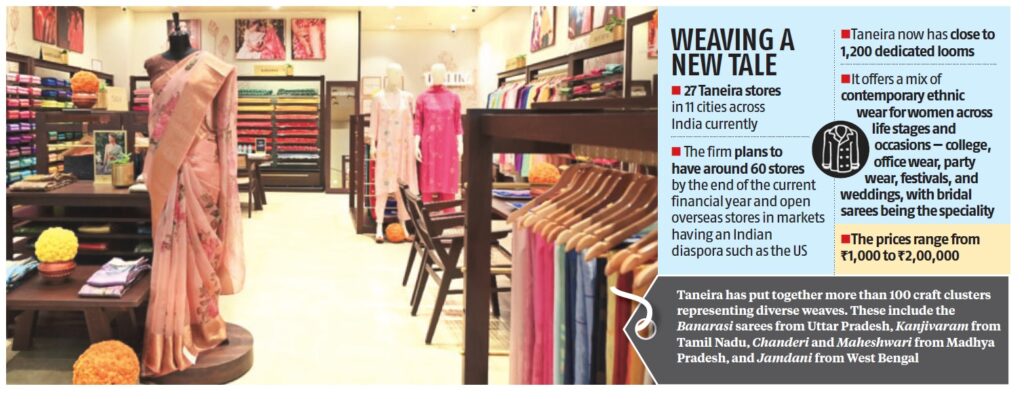
As consumer sentiment started to improve, Taneira already had two collections ready — wedding weave and the summer collection — which boosted sales. During 2021-22, it also increased its store count to 20 by adding six more. During the fourth quarter, Taneira sales rose 4 per cent.
Today, there are 27 Taneira stores in 11 cities across India. It plans to expand to Tier 1 and Tier 2 cities in the first phase and then to Tier 3 in the second phase of its store expansion.
However, Vishal Gutka, vice-president of research (consumer and retail sector) at Phillip Capital, said: “Taneira follows the same principle Titan used for Tanishq, where it entered an unorganised category and expanded it. But it is still early days to gauge how Taneira will pan out. Also, the company needs to give more clarity on the unit economics of each store.”
Weaving an expansion plan Titan’s annual report talks of a robust expansion plan for Taneira this financial year: “We plan to grow at an exponential rate and make our store count around 60 by the end of the current fiscal year and open overseas stores in markets having an Indian diaspora such as the US.” It adds that Taneira will become a more significant contributor to the overall revenue of Titan in the medium term.
At the heart of this grand ambition lies the humble weaver. Taneira now has close to 1,200 dedicated looms and has a programme called Weaver Shala to support them with technical expertise and in modernising their facilities. It has introduced frame looms along with basic workspace facilities for the weavers in collaboration with the localised weaver-led organisations.
The brand has closely worked with the weavers in Varanasi, Uttar Pradesh, and Champa, Chhattisgarh, and aims to take Weaver Shala to other parts of the country.
Taneira leverages Tanishq’s brand strength; mannequins at Tanishq stores, for instance, are dressed in Taneira sarees.
However, Narayan said Taneira and Tanishq will not be sold under the same roof because Titan wants to establish Taneira as a distinct brand in its own right.
(Published in the Business Standard)
admin
September 23, 2022
Sagar Malviya, The Economic Times
September 13, 2022
Uniqlo, Asia’s biggest clothing brand, has turned profitable in India in less than three years after it opened its first store in the country despite operating in a period marked by Covid-led lockdowns and restrictions.
The Japanese brand posted a net profit of ₹21.4 crore for 2021-22 compared to a loss of ₹36.1 crore in the previous year, according to business intelligence firm AltInfo. Its sales rose 63% year on year to ₹391.7 crore for the year to March 2022, a slower pace compared to FY21 when it clocked 86% sales growth on a low base.
Experts feel Uniqlo’s strategy of pricing its merchandise at least 20% higher than rivals Zara and H&M has helped it earn better margins despite inflationary pressures in terms of raw materials.
“The market is not easy and turning profitable at a time when most rivals are spending aggressively is a good indication of success. As an international brand, they (Uniqlo) are able to get good locations and are preferred tenants, which helps in generating sales, especially in top cities,” said Devangshu Dutta, founder of Third Eyesight, a strategy consulting firm. “However, the pricing is a bit premium and until they are able to source locally, selling products at a right value for the market will remain challenging.”
The Japanese brand opened its first door in the country in September 2019, but stringent lockdown measures announced in March 2020 to contain the Covid-19 outbreak delayed its store expansion plans, restricting its store count to about seven outlets so far.
Uniqlo has said India is one of the most priority markets where consumers are increasingly shifting from ‘fast-fashion’ to long-lasting essentials and functional wear. “India is an important and very big priority market,” Tomohiko Sei, CEO of Uniqlo India told ET in June.
(Published in The Economic Times)
admin
September 16, 2022
Over the past five years, legacy players have made a slew of investments in D2C startups.
Marico has acquired men’s grooming brand Beardo, beauty brand Just Herbs and breakfast brand True Elements. Similarly, Emami acquired vegan cosmetics brand Brillare Science and grooming brand The Man Company. It recently picked up a minority stake in nutrition company TruNativ. Colgate-Palmolive and Reckitt both hold minority stakes in Bombay Shaving Company, whereas Wipro Consumer Care has invested in The Ayurveda Company. ITC has invested in baby and mother care brands Mother Sparsh and Mylo.
Devangshu Dutta explained the reasons behind the trend of larger FMCG companies acquiring D2C brands.
admin
September 5, 2022

Akanksha Nagar, Financial Express
September 5, 2022
Can you give a brand a second shot at life?
Reliance Retail Ventures certainly thinks so. It has acquired Campa-Cola for an estimated `22 crore from Delhi-based Pure Drinks Group on the assumption that it will not only be able to revive the five-decade-old brand but can also use it to springboard into the dog-eat-dog soft drink market in India.
It will not be a cakewalk surely. The ones who were fans of the brand—which was launched in the 70s—have moved on, and younger customers have little or no association with the brand.
Samit Sinha, managing partner, Alchemist Brand Consulting, believes that Reliance must have been very keen on getting into the soft drinks category as a part of its overall strategy of retail expansion. In any case, it hasn’t had to shell out a bomb for the brand so it is a less audacious gambit than starting from scratch. There is one other factor that might work in its favour—which is the formula, the taste of which had near widespread acceptance in its heyday.
Sandeep Goyal, managing director, Rediffusion Brand Solutions, who is handling a similar resurrection of Garden Vareli sarees, says giving an old brand like Campa-Cola a new life will be far from easy—the Campa-Cola generation is now in their sixties and therefore there is very little monetisable value in the nostalgia.
RESURRECTION RULES
Breathe life into an old brand if:
1. The market presents an opportunity to refresh the brand without compromising on its core promise
2. There are positive connotations for the brand that can be built upon in the current market context
3. The company has the resources and inclination to be a “caretaker” or “steward” of the relationship that had been created between the brand and its customers
Courtesy: Devangshu Dutta, CEO, Third Eyesight
Launch versus resurrect
From the looks of it, Campa-Cola will have to fight sip for sip, bottle for bottle.
Rohit Ohri, chairman and CEO, FCB Group India, who had managed the Pepsi account for more than a decade, says it will be difficult for a new brand to find space in a market dominated by multinationals like Pepsi and Coke. While the residual equity can help get the foothold, the real challenge would be to woo a younger consumer set.
Naresh Gupta, co-founder and CSO, Bang In The Middle, concurs: “When you try to resurrect a brand, you do it knowing that the brand isn’t doing well or has been out of circulation. That is big baggage for the brand to wipe out. Often the residual awareness and following are limited to the audience that is less likely to be your core audience today.”
There is also the fact that young people in the metros are moving away from colas, preferring healthier drinks or niche artisanal products instead. At the same time, soft drink is an impulse category and needs a large dose of salience to fly off the shelf.
Gupta says Reliance can try and build on the Indian-ness that Campa-Cola exudes. His guess is the old brand will be used as a calling card in trade and there would be a host of new launches that build upon it. “Campa-Cola may fuel a lot more fresh fizzy drinks launch from Reliance,” he adds.
That said, just the sheer time an old brand has spent on the shop-shelves would give Campa-Cola an edge over any new brand that its current owner might want to launch. An old brand can appear to be proven, experienced and secure, while a new brand could be seen as untested, raw, and risky. An old brand may have had a positive relationship with the consumer but may have been dormant due to strategic or operational reasons. In such a case, reviving the brand is clearly a good idea, says Devangshu Dutta, chief executive, Third Eyesight.
Reliance could have launched a new brand but if the existing brand has residual awareness or connection, it could be the pivot around which other brand properties can be built. Here, the new owner also has the benefit of having a wide retail network. As on March 31, 2022, Reliance Retail operated 15,196 stores across 7,000-plus cities with a retail area of over 41.6 million sq ft. This, if nothing else, will give Campa-Cola a start any new brand will die for.
(Published in Financial Express)
admin
September 2, 2022
Written by Christina Moniz
Retail chains are on an expansion spree, riding on growing demand from a young consumer cohort
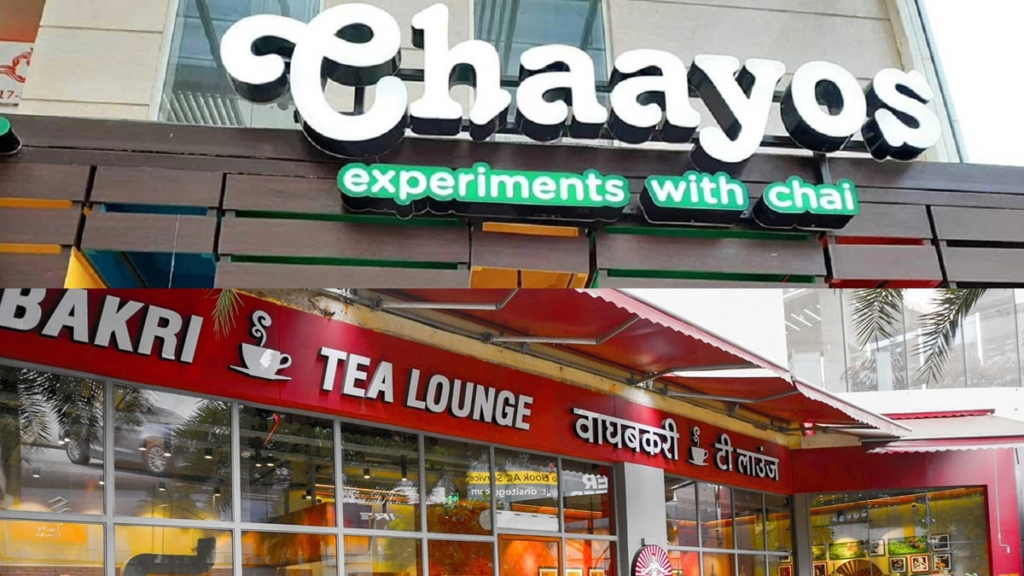
Just about a month back, Wagh Bakri Tea Group, the third largest packaged tea company in India with a turnover of over `1,500 crore, opened its 15th tea lounge in Noida’s upscale DLF Mall of India.
A little over two years ago, Chaayos’ physical footprint was 75 outlets across the country. Currently, its store count is 200.
Just about a month back, Wagh Bakri Tea Group, the third largest packaged tea company in India with a turnover of over `1,500 crore, opened its 15th tea lounge in Noida’s upscale DLF Mall of India.
A little over two years ago, Chaayos’ physical footprint was 75 outlets across the country. Currently, its store count is 200.
Get the drift?
Today the humble cuppa is much bigger than an excuse for roadside tittle-tattle. The rash of tea lounges and bars have taken what used to be, at its best, a social lubricant, and turned it into a `700-crore market.
Homegrown tea café chains have been quick to cash in on the out-of-home demand from a young consumer cohort, offering snacks, groovy ambience and even free wi-fi connectivity. Chains such as Chaayos, Chai Point and Wagh Bakri’s Tea Lounge are ramping up their offerings to cater to a segment for whom coffee shops were the default hang-out zone. Up until now.
But how sustainable are they, given that 80% of the tea drinking market is unorganised? Pramod Damodaran, CEO, Wagh Bakri Tea Lounge, says brands in this segment are catering to the “need state of the consumer”, whether it is meetings,family outings, a quick rest after shopping at the mall or a quiet moment in airports, offices or hospitals. “We elevate the tea drinking experience and make it premium, almost akin to how tea drinkers in the past would enjoy their tea at fancy hotels, but we offer the experience at affordable prices,” he says. While coffee chains offer muffins and croissants with their beverages, Wagh Bakri pairs its teas with pakoras, samosas and vada pav, which resonate more with the average Indian consumer.
Growing the market
Nitin Saluja, founder, Chaayos, draws parallels with global coffee brand, Starbucks. “Before Starbucks launched in the US, there were very few good quality coffee retail outlets. In the Indian context, before chai cafes were launched, consumers could barely enjoy a good cup of tea in a hygienic retail space outside their homes,” he says.
The pandemic, too, played its part in getting consumers to choose hygienic options. That is why home delivery, which was 20% of Chaayos’ revenue prior to the pandemic, now hovers around 30-35%.
The success of chai chains is a reflection of evolving consumer preferences. Saluja says despite the presence of huge international and homegrown brands in the coffee retail segment, the category earns an annual revenue of around 1,500 crore. “In comparison, there are only 3-4 homegrown chai café players, but their combined annual revenue is around700 crore. Only chai retail chains in India can replicate the success of coffee chains in the West,” he says.
Damodaran says his chain is not competing with coffee chains but rather catering to the growing need for cafes. It is for this reason that the brand also offers coffee across its outlets. Wagh Bakri has 15 tea lounges and 10 tea kiosks (Tea World) across Maharashtra, Gujarat and Delhi NCR but plans to ramp up its footprint in the North, West and South over the next three years.
“The industry can ensure long-term health only by capturing the value offered by out-of-home consumption in modern branded formats, packaged branded sales in modern retail and direct-to-consumer models,” sums up Devangshu Dutta, CEO, Third Eyesight.
Source: financialexpress
