
admin
April 13, 2023

Economic Times / ETRetail
April 13, 2023
There will be blood!
An all-out war has started in India’s FMCG space. At one end are the behemoths – HUL, P&G, Dabur, Marico, Tata Consumer, ITC, and others – and on the other side is the master disruptor, Reliance.
Known to change the market dynamics by venturing into new segments, Mukesh Ambani-owned Reliance Retail Ventures, a part of Reliance Retail, has now set its eyes on India’s over USD500 billion grocery retail market, as estimated by Euromonitor International. And the company is depending on its distribution channel and kirana partners to conquer this feat.
The strategy
In the last couple of years, Reliance Retail has been slowly and steadily developing a distributor ecosystem to take on the FMCG giants. However, its strategy is different from the incumbents.
Helmed by Isha Ambani, Reliance Retail has announced its plans to go big on FMCG with the help of local brands and manufacturers. During its AGM last year, the company mentioned that it intends on launching affordable products.
To carve a niche in the sector, it is using four primary moves:

What can we expect from each of these moves taken by Reliance to take over the FMCG market?
Reliance Retail has been a few years behind in entering the retail space. It entered the e-commerce market as well in 2016. But the delayed entry did not stop it from giving a tough competition to its competitors. Reliance is perhaps planning to repeat the success with its delayed foray into FMCG business as well.
Out of the INR50,000 crore grocery retail market of India, more than 75% is still dominated by kirana stores. And Reliance is not just eyeing the 25%, it is working with kiranas, and hence, targeting the whole market and not just the organised sector.
Let’s deep dive.
Reliance’s ‘selling ecosystem’
The grocery retail market of India constitutes nearly 67% of the country’s total retail market, according to Euromonitor International. Within the grocery retail, the channels are further divided by modern and traditional retailers. The former covers hypermarkets, supermarkets, and convenience stores, while the latter consists of kirana stores.


Kirana stores are the lifeline of grocery retail in India — 75% of all grocery sales happen via this channel. A presence across this channel is imperative for any FMCG brand.
The biggest FMCG conglomerates are available pan-India across majority of kirana stores with their cheapest SKUs as well – this could be the smallest SKU, for example sachets for shampoos, or the largest to make it cost efficient and allow consumers to buy in bulk; read products like detergents.
In India, the grocery retailing is always driven by value and availability, and not just cost.
Reliance Retail Ventures started interacting with the kiranas during the pandemic the way no one had done before. The company decided to become distributors. It sold both its own products, and competitive brands.

Conquering distribution
Distributors form the backbone of FMCG sales in India. While manufacturers sell with no credit timeline to distributors, the latter allows discounts to wholesalers, who then extend a 30-day period of credit line to retailers. Retailers then finally sell the product to consumers.
Reliance is now on its way to becoming one of the most aggressive distributors in the country.
Abhijit Kundu, senior vice-president-research, Antique Stock Broking Ltd, says, “Reliance’s focus on the FMCG industry started with the distribution business. They are essentially creating an entire ecosystem of their own. They are now distributors of their own brands, their acquired brands, and competitor brands, all. And here’s the best part, they are providing one of the deepest discounts to wholesalers as well.”
Almost three years ago Reliance started its distribution business. The company is now developing that and calls it the “selling ecosystem” in its annual report.

According to Reliance Retail’s FY22 annual report, “The company has expanded its physical footprint into tier-II and tier-III markets, bringing the benefits of modern trade to consumers in smaller towns.”
“Extending its reach even further to reach India’s 200 million households, the company is building one of the world’s largest distribution platforms under its ‘new commerce’ initiative by leveraging its extensive supply chain and sourcing capabilities, as well as New Age technologies, to support and enable millions of kirana and merchant partners across the country, assisting them to modernise, provide easy access to a diverse product portfolio, become more efficient and generate revenue,” the report states.
The MCA filing of Reliance Retail Venture’s FY21 report says, “In the lockdown period, Reliance Retail established itself as the ‘preferred’ partner to kiranas by ensuring uninterrupted supply of essential items. JioMart kirana service, now active in 33 cities, launched self-onboarding application, aiding rapid merchant additions.”
Speaking of the developing distribution network of its own by Reliance, Devangshu Dutta, founder, Third Eyesight, says, “Disintermediation, that is removal of middlemen, is a natural outcome of consolidation of the market. However, even in the most developed and some of the most consolidated consumer markets, intermediaries continue to exist because they provide value in terms of aggregation of demand from smaller markets or segments, as well as providing some financial buffer for both buyers and sellers.”
Working with kiranas
What is interesting is how Reliance Retail is engaging with the kirana stores and using their strength to its advantage. The company launched JioMart in December 2019, in phases.
“Reliance is working very smartly as a distributor. Instead of giving deep discounts on all brands, across SKUs, the company is providing deep discounts on the fastest-moving SKUs. Imagine you run a kirana store, technically no one has loyalty only to one distributor or wholesaler. Now, if as a kirana store owner you know you need 10 packets of let’s say Surf Excel, 1 Kg SKU, chances are that kirana will order the same from Reliance, as RRL knows that is the fastest-moving SKU, and hence will give the deepest discount on that. The discounts offered by RRL are almost 15%-20% higher than what any other distributor is providing right now,” says Kundu.
“The same kirana store owner will probably order other things from other distributors, depending on discounts again. What Reliance is doing is focusing on the volume game, and on the fastest-moving SKUs and brands, cause as a distributor they know these will move, no matter what,” he adds.
According to a Kotak Securities report in March 2021, the average number of distributors that a retailer works with is 10-15. And foods, which include staples, dairy, packaged foods, beverages and such contribute 75% of average daily sales.
The same report surveyed at the time of freshly launched JioMart selling ecosystem kirana partners in Mumbai, the count of which was 60, and majority of these kirana store retailers surveyed mentioned that JioMart has lower pricing than other distributors and offers better profit margins. Around 37% respondents also mentioned that Reliance pushed its own private labels while having all brands in stock.
Isha Ambani during the 45th Annual General Meeting of Reliance Industries Ltd mentioned that the company now has a merchant partner base of 20 lakh partners and is adding 150,000 partners every month. The company has five-year plans to cover 7,500 towns and 3 lakh villages.
“JioMart, delivering in over 260 towns, was rated India’s No. 1 trusted brand for online grocery. JioMart works on a hyperlocal delivery model and is India’s largest deployment of omni-channel capabilities,” she said.
“The FMCG and grocery business of Reliance, back in 2021-2022, was nearly INR55,000 crore – INR60,000 crore already. And this was even before the company was involved in brand sales of its own. This was primarily driven by its distributor business,” says Kundu of Antique Stock Broking.
Acquisitions and private labels
Dutta of Third Eyesight says, “Regarding the FMCG and food/beverage brand acquisitions by Reliance Retail, while they are relatively small, they feed into a strategy that side-steps the need to create brands from scratch – both, as private labels for its retail formats and other acquisitions for its broader expansion into other retail channels.”
“Creating new brands takes time and success is not guaranteed, no matter who is behind the brand. Riding on the goodwill and awareness of existing brands provides a shortcut, and further growth can be fuelled by additional resources,” adds Dutta.
Clearly, something Reliance Retail seems to believe as well. Or maybe it just wants to shorten the process of establishing its retail brands’ presence amongst consumers.
One of the biggest acquisitions of the company was Metro Cash & Carry, the German B2B wholesale company. Reliance acquired the latter in a 100% stake sale for INR2,850 crore. This would give a huge leg-up to Reliance’s already burgeoning “selling ecosystem” business.
Speaking about this acquisition Isha Ambani said in the press release, “We believe that Metro India’s healthy assets combined with our deep understanding of Indian merchant / kirana ecosystem will help offer a differentiated value proposition to small businesses in India.”
Metro India, which entered in 2003, was operating 31 stores across 21 cities. The company was servicing nearly 3 million customers via its B2B channel, of whom 1 million (customers) were frequent buyers. As of FY22, Metro Cash & Carry generated revenues worth INR7,000 crore and losses of INR49.7 crore, as reported by Tofler.
In 2021, Reliance Retail also acquired online milk and dairy products delivery platform, Milkbasket. As per its FY22 annual report, the company integrated Milkbasket with JioMart, and there were double the number of subscriptions on the Milkbasket platform. The company seems to have dairy leadership plans as well. Reliance Retail has recently got RS Sodhi, ex-managing director of Gujarat Cooperative Milk Marketing Federation (GCMMF), the parent company of Amul, onboard. Sodhi was associated with GCMMF for 40 years, out of which 12 years he held the position of managing director.
Besides, the company is also targeting the FMCG market with the help of private labels and acquiring brands. Over the last few years, Reliance Retail has spent nearly USD1.1 billion on brand acquisitions – this is across grocery and non-grocery segments.
Reliance Retail acquired Chaudhary brothers’-owned Campa Cola for INR22 crore, and relaunched the brand in March 2023. Moreover, the company has also announced its plans to acquire 50% of the 100-year-old Gujarat-based beverage company, Sosyo Hajoori Beverages.
Prior to that, it acquired 51% stake in Lotus Chocolate Company for INR74 crore and plans to take over an additional 26% of the latter eventually.
In the non-grocery FMCG category, the company has acquired lingerie brand Zivame for INR1,200 crore in 2020, 89% stake in Clovia — another more affordable brand compared to Zivame — for INR950 crore, offline lingerie brand Amante (owned by MAS Holdings) for an undisclosed amount, British toy retailer Hamleys for INR620 crore in an all-cash deal, majority stake in online furniture company Urban Ladder for INR182 crore, majority stake in online pharmacy retailer Nedmed for INR620 crore, and 26% stake of task-runner and quick-commerce app Dunzo for INR1,488 crore.
While not fast moving, but consumer goods nonetheless, Reliance Retail acquired couture fashion brands namely, 52% of Ritu Kumar for an undisclosed amount, 51% of Abu Jani and Sandeep Khosla, 40% of Manish Malhotra’s couture brand, and the company has joint ventures with Anamika Khanna and Rahul Mishra.
In terms of private label, the company recently launched Independence, which will have an array of staples such as edible oil, packaged atta, and packaged pulses, under its umbrella, along with biscuits. Reliance Retail also has private label brands such as Good Life, Snac Tac, Pure It, and Enzo. These brands cut across almost all grocery FMCG categories such as packaged foods inclusive of noodles, home cleaning, beauty and personal care including hand wash brands, dishwash, and floor cleaners.
The company is not limiting itself to only Indian brands – national or regional when it comes to its acquisition strategy. Reliance Retail in February 2023 acquired Sri Lanka-based Maliban biscuits, and plans to bring the brand to India, and clearly will now be targeting the biscuits category as well. Biscuits in India is nearly INR38,000 crore market, with leaders such as Parle Products, Britannia, and ITC.
The bottom line
Reliance Retail is targeting the FMCG market of India from all angles namely retail outlets, national and regional brands, private labels, and distribution.
However, it doesn’t end there. The company is also providing financial services with the help of Jio PoS terminals, which is used by kiranas for both transactions and supply chain management. Jio Financial Services is expected to become the fifth-largest fintech company in the country soon.
The company is not just foraying into the FMCG market, it is on its way to create an entire ecosystem in the FMCG market. While acquiring a consumer is obviously the end goal, it is targeting the spine of the FMCG retail of the country first – the kiranas.
The company has added 2,500 stores in FY22, taking the total count of retail stores to 15,000, covering 42 million square feet. It has also doubled its warehousing fulfilment area to 670 million cubic feet. Warehousing and distribution are at the core of its retail plans, clearly.
“Most retailers in India are small, family-run operations that operate at a subsistence level, and that receive the financial and operational support of the distributors and wholesalers. So, removing intermediaries from the distribution chain in India will take time, unless deep-pocketed players like Reliance decide to explicitly price them out of the market while also providing credit to retailers,” concludes Dutta.
(Published in Economic Times)
admin
November 28, 2022

Sagar Malviya, ET Bureau
November 28, 2022
About half a dozen global apparel and lifestyle brands expanded anywhere between 30% and 70% to garner combined annual revenues of nearly $2 billion in FY22, reversing the performance from a year ago when Covid-induced curbs on mobility and business operations caused sales to shrink.
Sales of Swedish fashion retailer H&M expanded 49% while rival Zara reported a 61% increase in its topline. Japanese brand Uniqlo saw a 64% jump in sales while American denim maker Levi Strauss posted a 58% increase, latest filings with the Registrar of Companies showed. Dubai-based department store Lifestyle International, too, saw a 38% jump in revenues on a large base while German brand Puma expanded 68% despite being the biggest firm in the sporting segment.
“This is a combined impact of a rebound in industry-wide demand in India, a low base effect for some brands, and the visibility and mindshare advantage global brands have,” said Devangshu Dutta, founder of Third Eyesight, a strategy consulting firm.
Big Focus on Online Sales
“Global brands are aspirational not only for consumers but also for real estate developers. Perceived as anchor tenants, they get their choice of the best locations – this provides more impetus to their stores vis-a-vis Indian brands, which are shunted to higher floors in multi-level shopping spaces,” Dutta said.
The revenue surge comes at a time when most of these retailers are facing intensifying competition from both local and global rivals in an increasingly crowded market where web-commerce firms continue to offer steep discounts. Even multinational companies have upped their online focus and for some, web-based orders make up more than a third of their revenues.
For instance, Puma India’s online sales make up nearly half its total business, while for H&M the share is 42%.
Abhishek Ganguly, managing director, Puma India and Southeast Asia, said the affinity of young Indian consumers toward ecommerce is extremely high and that adoption of the online mode of shopping continues to accelerate even after the resumption of normal business operations.
“Consumers may have bought online for the first time during the lockdowns, but they have embraced ecommerce in their shopping journey,” said Ganguly.
“Almost half of our business is in the form of digital commerce today. Having said that, we are witnessing equally strong growth – both in our offline and online channels,” he said.
As the world’s second most-populated country, India is an attractive market for aspirational apparel brands as rising disposable incomes cause the consuming base of the pyramid to broaden further. The performance by global brands is also in line with the overall trend within the home-grown apparel and lifestyle segment, with Shoppers Stop, Tata-owned Trent and Aditya Birla Fashion & Retail also reporting smart performance rebounds, indicating a secular demand for discretionary products.
(Published in Economic Times)
admin
October 11, 2022
SHARLEEN D’SOUZA, Business Standard
Mumbai, 10 October 2022
In early 1994, Titan started selling watches with precious stones in them and called this new line, Tanishq. It went on to become a separate division of Titan Company and grew into the country’s largest branded jewellery outfit, helping raise Titan’s sales to ~28,799 crore last financial year.
Thirteen years later, in 2007, Titan Eye+ set out to shake up the eyewear market. Though it also sells sunglasses of other brands, it is the prescription segment that Titan redefined and now, according to its website, has 550 Eye+ exclusive stores in 229 cities.
In 2017, Titan sought to do an encore in yet another large market in which the demand, as in jewellery and eyewear, was almost recession-proof and largely commoditised, leaving ample space for a pan-Indian branded chain. Thus was born Taneira, with an avowed intent to become the country’s largest organised saree retailer.
“Titan had earlier tried to organise the jewellery market through Tanishq, which is successful, and this is an attempt by Titan to organise the saree market,” Ambuj Narayan, chief executive officer (CEO) of Taneira, told Business Standard.
What is unsaid is that jewellery to sarees can also be seen as a horizontal brand extension, the two do go together on occasion.
Natural extension
The Indian wear market is a 5,000-year old segment estimated to be worth ₹50,000 crore a year and growing at a compound annual growth rate of 6 to 8 per cent. Sarees account for 80 to 85 per cent of its sales, with kurta sets, blouses, and lehengas comprising the rest. Yet, despite the size and growth, there is hardly any nationally known brand in this segment, with Nalli Silks being one of the notable exceptions.
Titan insiders say the company believed sarees to be a natural extension for it, given its past success with design-led lifestyle brands. They say the company organised an internal competition to see who came up with the best expansion strategy.
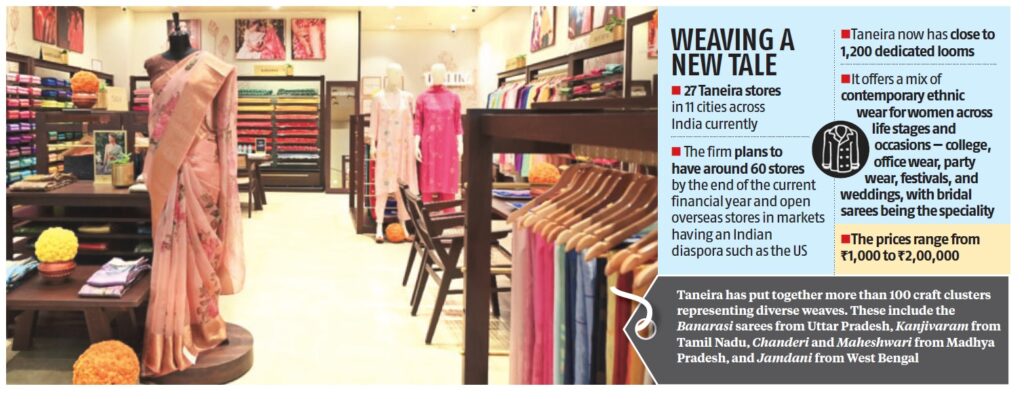
The result is a bouquet of design-differentiated products — primarily sarees and kurta sets — made from pure natural fabrics sourced from all over India. The company put together more than 100 craft clusters representing the diverse weaves. These include the Banarasi sarees from Uttar Pradesh, Kanjivaram from Tamil Nadu, Chanderi and Maheshwari from Madhya Pradesh, and Jamdani from West Bengal. The output is a mix of contemporary ethnic wear for women across life stages and occasions — college, office wear, party wear, festivals, and weddings, with bridal sarees being the speciality. The prices range from ₹1,000 to ₹2,00,000.
“The Tata group’s ventures have always been consistent with their approach — they stay the course beyond initial hiccups and eventually scale up the business. This is very much how Titan and Tanishq worked their way from initial struggles to eventually scale and become nationwide brands,” said retail expert Devangshu Dutta, CEO at Third Eyesight.
To say that Taneira has had initial hiccups would be an understatement. Three years after its launch, the Covid-induced lockdowns and restrictions brought the entire retail sector down to its knees.
Baptism by Covid
“Pandemic restrictions and high Covid-19 anxiety among the people kept socialising and weddings at a very low level of activity over the past couple of years. For Taneira, being a nascent brand with a yet-to-be-established customer base, the operating environment has been particularly tough,” Titan Company said in its FY22 annual report.
Taneira used this time to realign its strategy of connecting with customers. Thus, during 2021-22, which braved the second Covid wave in its first quarter — the dreadful Delta — and saw the third wave creep into its fourth quarter, sales at Titan’s Indian dress wear division grew by 55 per cent.
Narayan, the CEO, attributes this growth to initiatives that included staying close to the customer through e-commerce. “We really drove e-commerce out and reached out to our customers through video calling and try-at-home activities,” he said.
As consumer sentiment started to improve, Taneira already had two collections ready — wedding weave and the summer collection — which boosted sales. During 2021-22, it also increased its store count to 20 by adding six more. During the fourth quarter, Taneira sales rose 4 per cent.
Today, there are 27 Taneira stores in 11 cities across India. It plans to expand to Tier 1 and Tier 2 cities in the first phase and then to Tier 3 in the second phase of its store expansion.
However, Vishal Gutka, vice-president of research (consumer and retail sector) at Phillip Capital, said: “Taneira follows the same principle Titan used for Tanishq, where it entered an unorganised category and expanded it. But it is still early days to gauge how Taneira will pan out. Also, the company needs to give more clarity on the unit economics of each store.”
Weaving an expansion plan Titan’s annual report talks of a robust expansion plan for Taneira this financial year: “We plan to grow at an exponential rate and make our store count around 60 by the end of the current fiscal year and open overseas stores in markets having an Indian diaspora such as the US.” It adds that Taneira will become a more significant contributor to the overall revenue of Titan in the medium term.
At the heart of this grand ambition lies the humble weaver. Taneira now has close to 1,200 dedicated looms and has a programme called Weaver Shala to support them with technical expertise and in modernising their facilities. It has introduced frame looms along with basic workspace facilities for the weavers in collaboration with the localised weaver-led organisations.
The brand has closely worked with the weavers in Varanasi, Uttar Pradesh, and Champa, Chhattisgarh, and aims to take Weaver Shala to other parts of the country.
Taneira leverages Tanishq’s brand strength; mannequins at Tanishq stores, for instance, are dressed in Taneira sarees.
However, Narayan said Taneira and Tanishq will not be sold under the same roof because Titan wants to establish Taneira as a distinct brand in its own right.
(Published in the Business Standard)
admin
September 23, 2022
Sagar Malviya, The Economic Times
September 13, 2022
Uniqlo, Asia’s biggest clothing brand, has turned profitable in India in less than three years after it opened its first store in the country despite operating in a period marked by Covid-led lockdowns and restrictions.
The Japanese brand posted a net profit of ₹21.4 crore for 2021-22 compared to a loss of ₹36.1 crore in the previous year, according to business intelligence firm AltInfo. Its sales rose 63% year on year to ₹391.7 crore for the year to March 2022, a slower pace compared to FY21 when it clocked 86% sales growth on a low base.
Experts feel Uniqlo’s strategy of pricing its merchandise at least 20% higher than rivals Zara and H&M has helped it earn better margins despite inflationary pressures in terms of raw materials.
“The market is not easy and turning profitable at a time when most rivals are spending aggressively is a good indication of success. As an international brand, they (Uniqlo) are able to get good locations and are preferred tenants, which helps in generating sales, especially in top cities,” said Devangshu Dutta, founder of Third Eyesight, a strategy consulting firm. “However, the pricing is a bit premium and until they are able to source locally, selling products at a right value for the market will remain challenging.”
The Japanese brand opened its first door in the country in September 2019, but stringent lockdown measures announced in March 2020 to contain the Covid-19 outbreak delayed its store expansion plans, restricting its store count to about seven outlets so far.
Uniqlo has said India is one of the most priority markets where consumers are increasingly shifting from ‘fast-fashion’ to long-lasting essentials and functional wear. “India is an important and very big priority market,” Tomohiko Sei, CEO of Uniqlo India told ET in June.
(Published in The Economic Times)
admin
July 8, 2022
Akash Podishetty & Krishna Veera Vanamali, Business Standard
New Delhi, 8 July 2022
India’s $900 billion retail market has emerged as one of the most dynamic industries and is expected to reach anywhere between $1.3-$1.5 trillion by 2025. The organized retail is seen gaining 15% market share in the overall retail space, while food & grocery and apparel and lifestyle may account for 80% of India’s retail market by 2025.
Large market offers big opportunities. And it looks like Reliance Retail has seized it, with its massive omni-channel retail play of physical stores, B2B with kiranas and e-commerce.
The company went on an acquisition spree and partnerships in the last three years, adding to its portfolio some of the biggest names, including Hamleys, Dunzo, Zivame etc.
It has also partnered with famous global retail chain 7-Eleven. Catering to India’s affluent consumers, Reliance, meanwhile, houses some of the most iconic brands such as Versace, Armani Exchange, GAP, GAS, Jimmy Choo, Michael Kors among others. The premium segment has become one of the fastest growing categories.
Also firming up its inorganic play, the company is planning to acquire dozens of niche local consumer brands to build a formidable consumer goods business.
Arvind Singhal, Chairman and Managing Director, Technopak Advisors says, there’s focus on physical retail expansion. Reliance is looking to cater to both price conscious and brand conscious customers, while trying to capture as much of the private consumption market as possible, he says.
Reliance Retail’s competitors are nowhere close to even put up a fight. The company has over 15,000 offline stores across categories, compared with DMart’s 294 stores or Aditya Birla Fashion’s 3,468 outlets.
Reliance retail’s revenue has grown five times in the last five years and the core retail revenue of $18 billion is greater than competitors combined, according to a Bernstein report.
Speaking to Business Standard, Devangshu Dutta, CEO, Third Eyesight, says, Reliance wants a decent share of Indian consumers’ wallet. From that perspective, Reliance still has a long way to go, he says. As consumer preferences evolve, Reliance too should adapt.
An undisputed leader in the domestic market, the aim of Reliance, according to Mukesh Ambani, is to become one of the top 10 retailers globally. Part of this bet is based on the premise that incomes and consumption power of Indians will increase across the board in coming years. However, could the uneven recovery that different segments of the population have seen stop the pie from growing larger and prove to be a dampener for Ambani’s ambitions?
(Published in Business Standard)
