
admin
June 29, 2023

Raghavendra Kamath, Financial Express
June 29, 2023
Zara, touted as “Fast Fashion Queen”, has achieved a unique feat in India. The Spanish brand has been growing its revenues without opening any new stores.
The fashion brand, run by a joint venture between Tata-owned Trent and Spain’s retail group Inditex, posted a 40.7% growth in its revenues to Rs 2553.8 crore in FY23. The catch is that while many retailers/brands garner sales from opening new stores, Zara did not open any store but closed one during FY23.
In FY21 and FY22, its store count remained constant at 21 but its revenue grew 61.2% in FY22. Zara’s revenues grew at a 15.5 % CAGR in the last five years.
“Zara did not foray into any new city and closed one store. That said, it saw an exceptional performance on store productivity (83% higher than FY19). The increase in revenues lead to highest ever Ebitda margins at 16.3%,” said Nuvama Institutional Equities in a recent report.
The contribution in productivity includes contribution from online and also increase in store sizes, the brokerage said.
A mail sent to Inditex did not elicit any response. Trent executives could not be contacted.
Experts attribute Zara’s success to increase in customer spends and improved offerings by the brand.
“The customer base they are targeting has grown and their merchandise mix has become sharper,” said Devangshu Dutta, chief executive officer at Third Eyesight, a retail consultant.
Dutta said when a retailer opens stores, it would immediately boost sales, but to maintain sales momentum, one has to have “right merchandise at right price and have stores at right locations”.
Zara is known to churn its designs and styles very fast, and target young customers. In its Indian venture also, its parent Inditex controls merchandise mix and so on.
“The said entities (Zara and Massimo Dutti) are obliged to source merchandise only from the Inditex Group. Also, the choice of product & related specifications are at the latter’s discretion. Further, the entities are dependent on Inditex for permissions to use the said brands in India subject to its terms & specifications,” Trent said in its FY23 annual report.
Zara is also focusing on opening in select locations, a reason it could not open more stores in the country, experts said.
“The incremental store openings for Zara continue to be calibrated with focus on presence only in very high-quality retail spaces,” Trent said.
Susil Dungarwal, founder at Beyond Squarefeet, a mall management firm, said that propensity to spend has gone up among Indian shoppers after the pandemic and Zara being a renowned global brand with its stylish merchandise seems to be have been the beneficiary of the trend.
“They understand customers very well and brought products which are liked by Indian shoppers in terms of looks, styles and so on,” Dungarwal said.
Zara is a case study for Indian brands as to how to run a retail business successfully, he said.
(Published in Financial Express)
admin
June 9, 2023

By Pavan Lall, Fortune India
Jun 9, 2023
For fashion designer Tarun Tahiliani, getting funding from a corporate house was incidental. It happened through a high-profile customer, none other than Aditya Birla Group chairman Kumar Mangalam Birla. Birla had been a customer of Tahiliani’s Ensemble some three decades ago when he was getting engaged. They stayed in touch over the years and at one stage discussed the need for an Indian fashion brand focused on scale and accessibility. “It came out of a conversation and was a two-year ambling route. I had asked if they were expanding their designer brand footprint, and he (Birla) told me to meet the Aditya Birla Fashion and Retail (ABFRL) CEO for a deeper chat,” recalls Tahiliani.

The result was Tasva, a sub-brand that Tahiliani has a minority stake in. The focus was to zero in on the ethnic space, not lose out on the homegrown touch, yet keep user-friendly clothes in traditional silhouettes at accessible price points that were not haute couture. Launched in December 2021, Tasva primarily caters to the premium occasion-wear segment, and has been growing at a fast pace.
Raising Cash
Tahiliani, who got ₹67 crore funding for a third of his company with an option to further offload up to 20%, isn’t the only one to see corporate finance push capital into his designs and stores. Sabyasachi Mukherjee of Kolkata, who opened a large multi-level store in a heritage-style building early this year in Mumbai, sold a little over half his company to Birla, reportedly for around ₹398 crore. ABFRL has also bought a 51% stake in House of Masaba Lifestyle, the entity that houses apparel, personal care, and accessories businesses under brand ‘Masaba’ owned by designer Masaba Gupta. Besides the Aditya Birla Group, Mukesh Ambani-led Reliance Brands has bought a 52% stake in Ritu Kumar, 51% in Abu Jani Sandeep Khosla, and 40% in Manish Malhotra. Earlier, in 2008, Kishore Biyani’s Future Group took a 23% stake in Anita Dongre, which was later sold to private equity player General Atlantic for ₹150 crore.
“While we are reaching a sense of critical mass in terms of consumer base, luxury is not new to India. Designers have been flogging their wares for decades,” says Devangshu Dutta, founder of Third Eyesight, a consultancy firm focused on consumer goods and modern retail. “What has changed is the size of the target audience.”
According to a recent Knight Frank wealth report, India is set to see a projected 58.4% increase in ultra-high-net-worth individuals, those with a net worth over $30 million, from 12,069 in 2022 to 19,119 in 2027. The domestic apparel market, too, was pegged at $60 billion last year, not far behind the developed world, a McKinsey’s FashionScope report has said.


“Earlier, India was a country that just produced for the world. Today India is also becoming the largest consumer market. International brands are keen to invest in business relationships with India. India will change the game for luxury. Where else will you get a billion people who are of a young age, and will be the future luxury buyers of brands?” says Sabyasachi.
“The economy has expanded beyond bigger cities, which has raised the consumption size” adds Dutta of Third Eyesight.
Corporate Handholding
“Corporate involvement helps scale faster than organically, and a lot of designers are tying up with companies with technical expertise and go-to-market for smaller towns and cities,” says Anita Dongre. “For a designer, having a corporate brings in processes, technical expertise and management know-how, and helps her focus on designing,” she adds. In Sabyasachi’s case, too, a new CEO — Sumati Mattu, as well as a new HR head and COO, were brought on board to prepare for the brand’s expansion.
For Sabyasachi though, it has helped in creating a safety net, especially for his employees, more than anything else. “Right now we have two investors — me and Birla together, so it makes me feel protected. Nothing else has changed. The only thing that has changed is that we have a great HR policy with the Birlas; they will be able to look after my people better, as I have created a beautiful safety net for all my employees.”
Dutta, on the other hand, says that “for large companies in the fashion space such as Aditya Birla, it is a natural step to buy into an established brand with scale since brand recognition combined with capital and organisational structure make for a win-win. The platform of fashion is currently at the right juncture to replicate networks and create scale,” he adds.
Other designers, including Manish Malhotra, who has also received funding from Reliance, say, “corporatisation of fashion houses in India has brought about a safety net for luxury brands, making us push for larger creative forces and expansion in terms of scale, branding and customers.”
Growing Into India
Tahiliani says we have opened 55 Tasva stores and will reach 90 in this financial year. Tasva crossed around ₹60 crore in annual revenue in 2022, and is set to hit ₹200 crore this year, he adds.


Similarly, Dongre, widely regarded as the largest designer and fashion house by revenue, has around 150 stores across brands, and Global Desi, a substantial increase from the 10-15 stores she ran before receiving her first funding. “The added benefit is that such funding helps push into international markets.” While Dongre launched her stores in Dubai and New York a few years ago, Sabyasachi launched a New York-located store in West Village last year.
So, what’s the road ahead?
“Corporate India has successfully built large-scale fashion businesses and acquired international brands, but has not been able to create a homegrown luxury brand of cultural or social significance. That will change now,” says Sabyasachi. Jewellery is set to be his focus, along with sunglasses, beauty, shoes, and other categories. “Jewellery is a very important category in the country, a great revenue earner,” he says.
“The film industry was corporatised because its potential was discovered, now it is fashion’s time,” adds Manish Malhotra. “Corporatisation lets designers look beyond bridal-wear, occasion-wear, and focus on newer creative strategies as there’s more space and potential for experimentation.”
Tahiliani agrees that compared to overseas, the trend is an expected one. “Most of the brands abroad have seen stellar growth because they have been aligned with corporate houses.” He points to the famous Alexander McQueen, who started in 1992, and was discovered by Isabella “Issie” Blow. The tie-up allowed him to expand his label, open boutiques around the world, and push into the categories of perfume, eyewear, accessories trainer and clothes for men.
Globally, France-based Kering group owns designer labels Gucci, Alexander McQueen, and Balenciaga, among others. LVMH Moët Hennessy Louis Vuitton, commonly known as LVMH, owns Loro Piana, Fendi, Christian Dior, Kenzo and Marc Jacobs.
The question then is, with all the global exposure and corporatisation, will there be a shift in Indian design sensibilities?
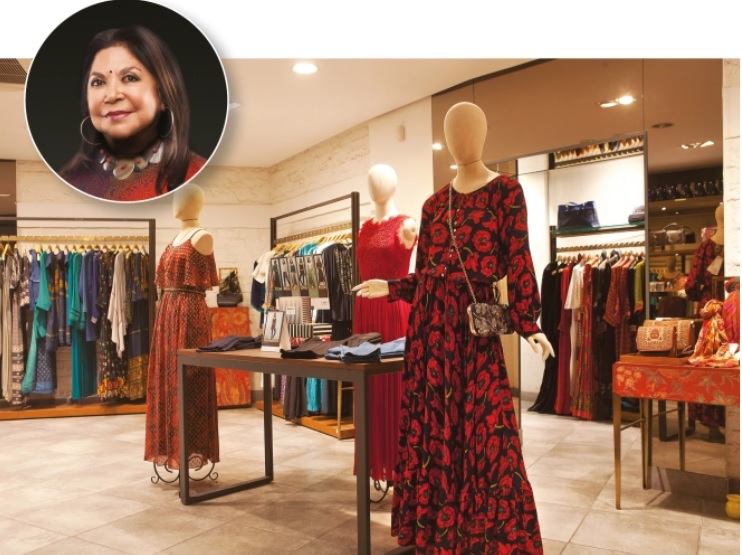

“Now you see people wearing bold gowns or black ties for one or two events, but Indians have kept a unique spirit of celebration and culture unlike anywhere else in the world. Bollywood has played a huge part in amplifying this because of the song and dance and colours and events such as Holi and Sangeet,” feels Tahiliani.
The bottomline: Luxury fashion is now more inclusive, and regional customers are the next big target area for brands.
(With inputs from Priya Kumari Rana)
(Published in Fortune India)
admin
May 25, 2023

Rochelle Britto & Shabori Das, The Economic Times
May 25, 2023
“Taiyaar Hoke Aaiye”. It seems the tagline has worked for the company which has been able to attract investors who came prepared for its offer for sale (OFS).
In a bid to reduce promoters’ shareholding down to 75% as per SEBI norms, Vedant Fashions, known for its ethnic wear brand Manyavar, floated the OFS on May 19 which saw huge participation — oversubscribed 1.4 times with bids for 34 million shares as compared to 24 million shares on the offer. The non-retail segment was oversubscribed 2.24 times.
The shares were offered at a price of INR1,161. While the stock initially fell 1.5% on May 19 to INR1,230, it was trading at INR1,268 on May 24, up 4.59% in five days.
The promoters have offloaded 16.9 million shares, which works out to 7% of the total equity shares with an option to sell additional 6.9 million (2.88%) shares, taking the total to 9.88%.
Manyavar represents the premium wedding market of the country and boasts of some big names as its brand ambassador — Virat Kohli, Amitabh Bachchan, Ranveer Singh, and Kartik Aaryan. With strong fundamentals, the company has grown at 30% CAGR over the last one year and investors feel this is one classic growth stock with high valuations that cannot be ignored. Vedant Fashions trades at a PE multiple of 73x while Trent, a competitor, has a PE of 119x.
The great Indian wedding
The sales of Vedant Fashion are highly correlated to the wedding season. The Indian wedding market is massive at USD50 billion with around 3 million weddings or events taking place every year. According to news reports, the spending is growing and is likely to be around INR3.75 lakh crore this year.
According to Crisil, weddings are getting bigger, grander, and longer, fuelled by higher disposable incomes and a surge in discretionary spending. It expects the ethnic-apparel market to grow between 15% and 17% to nearly INR1.38 trillion by 2025, supported by a growing desire among Indians to wear traditional attire instead of western wear for big celebrations.
While a lavish spending is done on everything, from venue to food to even flower arrangement, clothes hog the limelight. The business has become high-margin, elite, and high-fashion. And the organised market is growing at a very fast pace.
In the organised market, Vedant Fashion has a 40% market share which might be difficult to maintain as competition increases. “In the upcoming quarter, while April experiences a slight lull in wedding dates, May and June present an abundance of excellent opportunities. Moreover, as we analyse the entire year ahead, we are highly confident in the favourable wedding dates during Q3 and Q4. These trends align closely with our historical data, reinforcing our optimism for the current new financial year,”says Vedant Modi, chief marketing officer, Vedant Fashions.
“Vedant Fashions has successfully tapped into and emerged as the market leader, head and shoulders above competitors, in a segment that has been extremely fragmented. Festive wear and occasion wear is not immune to downturns, but is better placed to ride them out, and this makes it a very attractive product segment. However, Vedant have exploited this opportunity and scaled up much more successfully than other companies, beginning with menswear and then in womenswear,” says Devangshu Dutta, CEO, Third Eyesight.
Expansion spree
Vedant Fashions is expanding its retail footprint by adding around 75,000 sq ft retail area in Q4FY23. It has a total retail presence of 1.47 million square feet as of March FY23, spanning across 649 stores in 257 cities. There is a direct correlation between the addition of stores and the growth in sales, but the full potential of a new store takes some time. Almost 40% of the expansion has happened in the fourth quarter, so the full revenue (of the expansion) would come in the following year. Thus, many times the store growth doesn’t match the revenue growth.
The company is also expanding in US, UAE, London, and Canada to cater to the growing Indian community in these markets. For FY23, it has had sales growth of 30% at INR1,355 crore with Ebitda margins at 50%.
However, the growth witnessed by the company in FY23 has slowed down despite an upswing in events and weddings.
Vedant Fashions reported revenue growth of 76% in FY22 over FY21 and profit growth of 136% during the same period. While the slowdown in the growth rate can be attributed to settling down of revenge shopping post-pandemic, the number of social events has definitely increased to not take notice.
“Market valuations are an indicator of not only present value of a business but also perceived future value, and market leaders usually are rewarded with richer valuations(Page Industries is another such example),” adds Dutta.
The company’s latest presentation states that it has achieved 95% ROCE for FY23. The company is still in an investment stage and its cash flow statement says that INR249 crore is blocked in investments for FY23.

Market outlook
In a market that is lacking growth, the wedding season almost looks like recession-proof. The market has returned to growth mode even at a time when inflation is high and the overall economy is subdued. But then, the Indian wedding market — especially the part that Vedant Fashion tracks — is on a high and the growth will continue for a long time.
While the number of players is increasing, not many have a picture-perfect balance sheet with high ROEs and even higher Ebitda margins. Vedant Fashions has become the classic growth stock with very high valuations. It has a price/book value of 28x but investors feel that for a company that generates a high ROE and a high growth, the valuation is not extreme.
Mutual funds and institutional investors are making a beeline for the stock because of the growth rate and the overall size of the market. According to BSE filings, mutual funds account for 8.90% of the total holding where SBI Mutual Fund has the biggest share at 3.80%. On the other hand, retail holds 1.43%. Post the OFS, these numbers will go up.
The company successfully launched its initial public offering (IPO) last year. The stock debuted at an 8.08% premium over the issue price of INR866. The share slipped more than 4% on May 18 as the promoters announced plans to sell stake in the company.
Since listing, the company has gained 36% and has had a great run with its stock being up by a significant 27% over the last one year as compared to its peer Aditya Birla, which is down by 30.95%, and Nifty 50, up by just 12%.
The Indian apparel market is amongst the top three consumer categories. The pandemic made a lot of consumers switch to the online channel — which was also enabled by easy returns. However, while western apparel in India is a lot more frequently purchased when it comes to the online channel, the offline channel continues to be the primary source of consumers and footfall for ethnic-wear brands. The organised ethnic wear market in India is still relatively small, as the unorganised apparel category, ethnic and otherwise, continues to dominate.
The primary market for the unorganised ethnic wear is mostly women, driven by everyday and wedding wear categories.
According to Euromonitor International, a UK-based market research firm, the Indian apparel market is expected to be at USD58,773.8 million by the end CY23 (excluding the footwear market). The market is expected to grow at a CAGR of 8.6% during CY2023-CY2027.
“The apparel and footwear market experienced significant recovery in 2022 with the easing of Covid-19 restrictions. The industry also benefited from the return of festivals and weddings to their pre-pandemic fervour, as these are periods when the demand for categories such as ethnic apparel and other occasion-based apparel spiked,” says Euromonitor International.
The peer play
Prominent players like Aditya Birla Fashion, Reliance Retail, and Tata-owned Trent are making strategic investments in the country’s thriving ethnic wear market, estimated at INR1.84 trillion.
The recent acquisition of TCNS Clothing by Aditya Birla Fashion further solidifies this ongoing trend. With a transaction value of INR1,650 crore for a controlling stake of 51%, this acquisition highlights the company’s commitment to capitalising on the prevailing market dynamics.
According to Ashish Dikshit, managing director of Aditya Birla Fashion, ethnic wear commands the largest market share in India’s apparel industry, comprising 30% (equivalent to INR1.84 trillion) of the total domestic apparel market valued at INR6.15 trillion, while 80%-85% of the ethnic wear market, according to experts, is dominated by the unorganised segment. The branded or organised end of the market at 15%-20% (around INR28,000 crore – INR37,000 crore in size) is growing at around 20% per annum.
Trent, owned by Tata, has launched a new ethnic wear brand Samoh to increase its market share, as consumers splurge on fresh attire for every event. The new brand will help Trent to compete with Manyavar, and Aditya Birla in the ethnic wear space. The company also has two other fashion retail formats. Its flagship concept, Westside, caters to discerning customers who are aspirational and yet seek value for money. The other format, Zudio, with much smaller stores, operates in a more mass-priced segment. Besides, Trent runs a relatively new concept store, Utsa, which sells its own ethnic and indie wear private labels like Utsa, Zuba, Vark, and Diza.
A growth stock?
The management’s disciplined approach to growth, exemplified by the gradual scale-up of brands like Mohey and Twamev, has been instrumental in mitigating the risks associated with inflated working capital and excessive write-downs. This prudent strategy has safeguarded Vedant Fashions’ profitability and allowed it to maintain sustainable growth without compromising on scalability.
The company’s strong design capabilities with data-driven decision making (leading to no discounted sales), tech-driven supply chain, and auto replenishment model, exclusive vendor ecosystem, and franchise-based EBO expansion have helped scale up its business and achieve superior margins. Most brokerage houses give the stock a “buy” rating.
Manyavar’s decision to team up with some of the country’s top names like Virat Kohli, Ranveer Singh, and Kiara Advani (for Mohey) demonstrates its ambition to capture new markets and connect with a diverse customer base. Continuing the brand’s vision to associate with the best, it reinforced #DulhanWaliFeeling by looping in actress Kiara Advani in January 2023 as the new brand ambassador. With all of them on board, Vedant Fashions hopes to have a joyful journey in style!
By capitalising on their influence, Manyavar solidifies its position as a leading ethnic wear brand in India. But will the company live up to the investors’ expectations? For a growth investor, the answer is yes.
(Published in Economic Times)
admin
May 6, 2023

Gargi Sarkar, Inc42
6 May 2023
With one of the largest consumer bases in the world, the Indian retail industry is on a constant upward spiral, thanks to the increase in the purchasing power of Indian consumers and the ever-increasing ecommerce adoption.
Notably, this has helped segments like online beauty and personal care (BPC) sustain and grow faster than the players in the offline space.
According to industry experts, the online BPC market has been growing in the range of 20% to 25% annually, compared to the offline segment at around 8% to 10% a year. According to a IMARC Group report, India’s BPC market size reached $26.3 Bn in 2022 and is expected to reach $38 Bn by 2028, growing at a CAGR of 6.45% between 2023 and 2028.
Notably, in their endeavour to capture this opportunity, new players are entering the BPC space, and the existing ones have started to scale their omnichannel presence.
The newest entrant in the space is Reliance Retail. The retail major forayed into the BPC market with its omnichannel platform, Tira, earlier last month. Along with launching its app, Reliance Retail also opened its flagship Tira store in Mumbai.
It is crucial to note that existing marketplaces like Nykaa and Purplle, and D2C brands such as SUGAR Cosmetics and Mamaearth, too, have started expanding their offline footprint, after scaling up their online presence.
Similarly, offline retailers such as Loreal India, Sephora, and Hindustan Unilever’s Lakme have increased their focus on expanding their online presence via direct-to-consumer websites.

Given that Reliance’s Tira has entered the market with an omnichannel playbook, piggybacking on its parent’s cash reserves, it becomes all the more important to understand what impact it will have in the long run on the existing players and industry dynamics.
According to the industry experts that Inc42 spoke with, the beauty and personal care market offers more than enough opportunities for multiple players to grow, due to multiple favourable factors.
“The BPC segment remains one of the fastest growing categories in consumer retail because the penetration of beauty products has remained relatively low. With increasing awareness, and more disposable income, the BPC segment has witnessed decent growth. Now, since the segment is growing, there is a scope for multiple players to grow. That is why some of the big players have entered into the market,” Ashish Dhir, EVP (consumer and retail), 1Lattice said.
Despite Dhir’s optimism, it is pertinent to note that Nykaa saw some initial pressure on its share prices and overall stock performance with the launch of Tira. Brokerage firm Macquarie said that the entry of new players such as Tira could exacerbate the problems for Nykaa at a time when the competition in the segment is already tough.
In the past, Reliance’s entry into the fashion ecommerce space with Ajio impacted leading existing players like Myntra. Now that we already have an example from the past, coupled with a falling will to spend due to factors like rising unemployment and inflation, it will be interesting to see how Nykaa performs under such pressure.
How Tira Could Threaten Nykaa & Ilks Dominance In The Beauty & Personal Care Space
It is no wonder that Reliance Retail will look at disrupting the market to emerge as a market leader as it has done in every segment.
Compared to sectors such as apparel and telecom, the BPC segment is different, and it is not very easy to scale here the way Nykaa has done over the years, according to Karan Taurani, SVP Research, Elara Capital. He noted that many other players in the past tried to scale but failed.
“Nykaa has emerged as a winner due to several factors such as a superior consumer experience on the app, trustworthiness, and product variety. Currently, the product delivery time is also lesser on Nykaa compared to Tira, although the latter could improve it. Moreover, Nykaa has created a network of influencers over the years, and its approach on social media is very different,” Taurani added.
He, however, highlighted that there will be an initial consumer churn as some customers will try Tira as well, and whether the new venture, Tira, can retain all these customers will depend on the consumer experience it provides.
As per Taurani, marketplaces like Nykaa will see some sort of pinch in terms of demand but will not have a significant impact until Tira offers a differentiated experience. Right now, Tira has very few differentiating factors.
However, we should not forget that Reliance Retail is experienced in building brands and has the heavy financial backing to scale in the offline segment.
Given that many players do not have much experience in the offline segment, they may see a visible impact facing the retail giant in the offline BPC space.
It is important to note that Nykaa’s consolidated net profit fell 70.7% year-on-year (YoY) to INR 8.5 Cr in the December quarter of the financial year 2022-23 (FY23), despite the festive season.
In addition, Mumbai-based beauty ecommerce startup Purplle’s net loss almost quadrupled to INR 203.6 Cr in the financial year 2021-22 (FY22) from INR 52 Cr in FY21.
An optimistic Dhir, however, likes to believe that Tira would only increase the competition in the segment and would not impact the profitability of its rivals, at least in the near term.

Will D2C Beauty & Personal Care Brands Face The Heat?
Along with conglomerate-backed large players such as Tata Cliq and online marketplaces, there are several Indian startups and brands such as mCaffeine, Mamaearth, Sugar and Minimalist, which are looking to capture a big chunk of the ever-increasing BPC market pie.
According to an Inc42 report, BPC will remain one of the fastest-growing D2C segments between 2022 and 2030, growing at a CAGR of 27%.
Talking about Tira’s impact, experts said these (aforementioned) D2C brands will not see any major impact due to two factors.
“Firstly, these brands will have similar arrangements with Tira as they have with Nykaa. Secondly, these brands have created a loyal customer base for the products they offer and they have their recall,” Taurani said.
“While deep-pocketed companies can spend their way into buying the market share, all brands need to be prepared for the long term. Also, for these brands a clear positioning be crucial to stand out, not just in their product and service mix but also the overall customer experience specific to their target audience. This would also give opportunities to several beauty and personal care brands to profitably serve niches that may be too small for the larger companies driving for the market, “Devangshu Dutta, the founder of Third Eyesight, said.
Also, Nykaa and Purplle have a portfolio of private labels, which includes skincare brands such as Dot & Key, Earth Rhythm, and Good Vibes, among others. Hence, it will not be surprising if Tira launches its private labels or acquires small brands to grow its portfolio.
As brands like Dot & Key, and Good Vibes are already direct competitors to these D2C beauty brands, a new player can pose more challenges for them.
What Else Could Work In Tira’s Favour
“Our vision for Tira is to be the leading beauty destination for accessible yet aspirational beauty, one that is inclusive and one that harbours the mission of becoming the most loved beauty retailer in India,” Reliance Retail’s executive director Isha Ambani said at the time of launch in April 2023.
When Reliance entered new segments like telecom and fashion ecommerce with Jio and Ajio, respectively, many of the existing players struggled to sustain in the segment as the Mukesh Ambani-led conglomerate scaled up quickly, thanks to its strong financial position. Hence, it will work as the biggest favourable factor in the beauty and personal care space as well, industry experts believe.
Tira is also expected to lure customers with big discounts. “For Tira, a big chunk of revenue will initially go towards marketing and customer acquisition, at least for the first couple of years, as it is a new brand. More than marketing, Reliance will look at discounting more prominently. Reliance will try to give higher discounts compared to other players,” Taurani said.
He added that Reliance has some expertise in building new platforms, such as Ajio, and a rich talent pool and strong brand exposure.

While players like Tata Cliq, Purplle, and Myntra’s beauty segment have tried to scale up in BPC, none of these players has seen significant growth. Hence, the market consists of one large player, making it easier for a deep-pocket player like Tira to carve its positioning quickly and create a duopoly with Nykaa.
At the time of Tira’s launch, the company said that the brand would offer a curated assortment of the best global and home-grown beauty brands. In terms of its offline play, Reliance Retail can leverage partnerships with global beauty brands and suppliers to get better deals. As it is looking at an omnichannel play at an entry stage itself, it may be able to gain market share from smaller beauty retailers, especially in bigger cities.
The Tira offline store will have the latest beauty tech tools such as virtual try-on to create customised looks and a skin analyser that will personalise and assist consumers in making purchasing decisions based on their needs, the company said.
On the luxury side, Reliance Retail is also directly targeting the market which has higher margins and could eat into the margins of Nykaa easily. It must be noted that Nykaa’s Luxe is still in its infancy.
While it is true that Tira will increase the competition in the BPC segment, it is not likely to rewrite the industry’s future over the next couple of years. Tira currently has very few differentiating factors in both the online and offline segments. Additionally, in the offline segment, Tira has opened only one store while Nykaa already has 141 physical stores across 56 Indian cities, as shared in its Q3 earnings report.
Even though there are glaring differences, some industry experts see Tira’s journey to be the same as that of Nykaa, going ahead.
(Published in Inc42)
admin
April 24, 2023

Samar Srivastava, Forbes India
April 24, 2023
A board meeting scheduled for May 2 promises to be the start of the value unlocking process for Reliance Industries [Disclaimer: Reliance Industries is the owner of the Network18 group, which publishes Forbes India]. Shareholders of India’s largest company, which has a presence in industries as diverse as petrochemicals, retail and telecom, will each receive shares in its financial services unit—Jio Financial Services.
User data—what consumers search for, their demographic profile as well as their likes as dislikes—are available to India’s largest telecom company with 426 million users. If it can use that data to underwrite credit for consumers, it has a winner. Jio Financial is in a unique position.
Loans to India’s middle class have grown at three percent in the last year. Compare that with credit to industry that has grown at a mere seven percent and it becomes clear why the company is keen to spin this off an independent entity and list it separately on the bourses. A successful listing could result in telecom and retail being eventually listed separately.
An analysis by Jefferies, a brokerage, shows that loans to India’s consuming class present a large market opportunity. Home loans account for about ₹25,00,000 crore, auto loans for ₹471,400 crore, consumer durable loans for ₹37,000 crore, and microfinance for ₹280,000 crore. And there is the rapidly growing personal loan segment at ₹79,000 crore. These all present a large whitespace for the company to tap into. Jeffries also points out that a key advantage of the business would be their access to low-cost capital due to the high credit rating to Reliance Industries.
The step also marks an important milestone in Chairman Mukesh Ambani’s aim to cement his position in the world’s list of billionaires. At $83.4 billion, Ambani is rank 9 on the 2023 Forbes list of world billionaires. Since the pandemic in March 2020, the second-generation entrepreneur has started work on a new energy business, strengthened his retail operations with the acquisition of Metro Cash and Carry, and broadened Jio’s subscriber base with the launch of 5G services.
As he sets out to independently grow his businesses, Ambani finds himself occupying the largest retailer spot by revenue. In the last year, store count is up 52 percent to 17,225 stores while revenues are up 17 percent to ₹67,000 crore and profit up six percent to ₹2,400 crore.
Reliance Retail has adopted a multi-format approach. There is Ajio.com and JioMart that make up its online offering. Digital plus new commerce accounts for 18 percent of sales, according to CLSA, a brokerage. Reliance Trends is its cut price fashion format. There is the soon-to-be-launched Azorte to compete against the likes of Mango and Zara, as well as Reliance Brands that houses global names like Burberry, Armani Exchange, Canali and Jimmy Choo, among others. Add to that its private label business with brands like Campa Cola and Independence and the growth drivers for the next decade are in place.
“Reliance has been clear about dominating the landscape in any sector it has entered in the last 30 years, whether it is petrochemicals, telecom or retail,” says Devangshu Dutta, founder and CEO of Third Eyesight, a retail consultancy. He believes the company is getting into many sectors or formats to capture a larger share of the consumer wallet.

At Jio, its strategy to add subscribers (mainly from Vodafone Idea), increase average revenue per user as well as spread the 5G network has paid off. At 426 million users, it is now the largest telecom operator in the country with an average revenue per user (ARPU) of ₹177. The business has delivered a topline of ₹29,195 crore and profit after tax of ₹4,881 crore. CLSA expects the launch of its portable 5G device, Jio AirFiber, as well as an affordable 5G smartphone to drive growth.
Add to this the synergies that could play out with Jio Financial Services. The business starts with a net worth of ₹1,07,200 crore, giving its balance sheet the strength to leverage and make loans. Even a conservative gearing of five times net worth would make its loan capacity ₹6,00,000 crore—or twice the size of Bajaj Finance—today.
In the new energy business, the company is working on plans to commence production at its new gigafactory in Jamnagar. The company is yet to share updates on progress on this front.
These developments have prompted upgrades by brokerages who believe Reliance Industries offers a favourable risk reward as the downside is capped on account of strong profit growth. In a recent report, CLSA termed Reliance Industries a ‘bargain buy’. In the last 12 months, sales were up 36 percent to ₹2,17,164 crore, while profits were up 16 percent to ₹70,782 crore. Still, the stock price is down eight percent to ₹2,346 per share, and its market capitalisation stands at ₹15,87,500 crore, making it the most valuable company in India.
They point to key monitorables being the rollout of its green energy ventures as well as the execution in its 5G rollout. For now, the company has a comfortable position with regard to leverage. In the quarter ended September 2022, Reliance Industries had reserves of ₹7,83,283 crore and borrowings of ₹3,16,030 crore, leaving it with scope to borrow if new business opportunities come its way. Ambani usually uses the Reliance AGM to announce new plans. Expect the next meeting in a few months to possibly come up with some.
(With inputs from Varsha Meghani)
(Published in Forbes India)
