
Devangshu Dutta
August 26, 2011
A few months ago, when asked to speak about value-addition at a food industry seminar, I decided, in a deviation from the usual discussion, to dissect the meaning of “value”.
Most people in industry focus on only one dimension of value-addition – the economic value added by processing and transforming food raw materials – virtually ignoring two other dimensions which are required for most of the (undernourished) population: calorific value and nutritional value (see “Perishable Value Opportunities”).
At the end of that seminar session, an agriculturist from the audience put forth a very pointed question: “What is the cost of the potatoes in a bag of branded chips that sells for Rs. 10? Or to put it another way, how much of the retail price actually goes back to the potato farmer?”
The question, of course, was completely loaded with angst on the economic imbalance between farm and factory, supplier and buyer, small and big, rural and urban. But it also underlined missed opportunities to capture economic value, which in turn accentuate the imbalances in growth.
Economic value can be added to food through improvement, providing protection, changing the basic product and through marketing. Improvement typically focuses on seeds, growing techniques and post-harvest areas for improved quality of harvests, disease resistance, better colours, size and flavour, possibly nutrition. Protection initiatives work across cultivation, harvest and post-harvest, storage, during processing, through packaging, while change is essentially focused on processing techniques (cooking, combining, breaking down and reconstitution).
There is a lot of work going on in the food supply chain to enhance the value captured closer to the farmgate. And, certainly, the “value-added” earlier is vital to maintaining and building value later in the supply chain.
However, what is striking is the fact that as we move downstream towards final consumption, the economic value captured as a price premium also increases dramatically.
So, as depressing as the multiplier may be to the farmer, on a kilo-for-kilo comparison, the bag of factory-fresh potato chips is priced many times higher than his farm-fresh potatoes. And, the maximum economic value is created, or at least captured, by the act of branding and marketing.
The Love is in the Brand
A short quiz break: can you recall the “most valuable company” in the world in August 2011, as measured by valuation on the stock market?
The answer is Apple. It is a company that physically manufactures nothing, but tightly controls the design, development, sourcing, distribution and, yes, branding of a group of products and services, whose fans seem to grow by the minute.
Of course, one can argue that Apple “produces” by the very act of designing completely new, highly desirable, products that are not available from anyone else, and that this is what provides the premium. But similar premium – which is due to branding and marketing, rather than proprietary products – is also visible in thousands of companies, across product sectors, including food. That sustained price premium is the sign that the consumer trusts and wants a particular brand’s product more than another one. There is a hook, a strong connect, due to which that consumer is willing to lighten her wallet just that much more.
In India, surprisingly, “value-addition” discussions in the food industry focus almost entirely on cultivation, storage and transformation through processing, virtually ignoring branding and marketing. In fact, branding is usually only discussed in the context of multinationals or some of the largest Indian companies. What’s more, most of the brands discussed are focussed largely in the area of processed food products that originated in the west.
Run these tests yourself. When you think of food and beverage branded companies who do you think of? And, when you think of food brands, what kind of products come to mind first?
The answer is that the brand landscape is dominated by products such as biscuits and cookies, jams, fruit and non-fruit beverages, potato chips, 2-minute noodles, confectionary products and food supplements, mostly from the portfolio of some of the largest companies operating in the market.
Of course, there are some alternative examples.
Aashirvaad and Kitchens of India present quintessentially Indian products (albeit from the gigantic stables of ITC which also has a multinational parent).
And, yes, there are cooperatives such as Lijjat, as well as home-grown mid-sized companies such as the Indian snack maker Haldiram’s, spice brands such as MTR and MDH, pickle brands such as “Mother’s Recipe”, rice brands such as Kohinoor and Daawat.
But, given the size of the Indian food market and the width and depth of Indian cuisine, shouldn’t there be more brands that are Indian and focussed on essentially Indian food products?
This is a tremendous opportunity – a gap – not just in the Indian market (among the largest and fastest growing in the world), but also globally.
The Hurdles to Branding
So, why aren’t there more Indian brands?
Let’s face it, for most companies, marketing fulfils one need: to communicate their name to potential customers. Most of them generally hope that if they do it enough, they would actually be able to sell more volume.
Of course, no one has been able to draw a straight line graph that correlates more marketing expense with higher sales.
Those are two self-destructive notions. Obviously, if marketing is an expense, then it must be minimised! And secondly, if it cannot be proven to be effective, why would you spend money doing it? For most people, branding is even fuzzier in that regard, in terms of what it is and what it achieves.
However, the picture changes when you look at marketing as an investment rather than an expense. As we evaluate any investment, there should be an expected return that should be quantifiable. Examples of Apple and other brands make it amply clear that branding and marketing, when done well, can certainly create quantifiable financial returns on the investment.
The second hurdle to branding and marketing is that they require consistency, which is not a strong point for most wannabe brands. They end up with too many messages to the consumer, or the messages keep changing and shifting. The company, the name, end up representing many things, sometimes everything, and eventually nothing.
The third, enormous, hurdle is the time needed to develop a brand with a decent sized marketing footprint and a deep relationship with the consumer. Most small and mid-sized companies, constrained as they are for resources, focus on areas that seem to offer more immediate returns, such as distribution margins or discounts, or even expansion of production capacity. Especially in the early years of the business, the benefits of branding and marketing seem to be too far in the future to be a priority for investment.
Due to these one of these reasons or a combination, many companies are unable to see their brands through to success. In fact, sadly, most companies do not last long enough to become owners of successful brands.
Even those who do achieve success and even market leadership, sometimes choose to cash-out on their success by selling their brands to larger competitors, rather than competing with the financial might of the giants (such as Thums Up being sold to Coca Cola; Kissan, Kwality and Milkfood being sold to Hindustan Unilever).
In the past, one of the other barriers in India was the hugely fragmented retail and distribution system, which essentially sapped energy, resources and focus for any company that wished to grow a brand across regions. In fact, one of the key lessons from the western markets is that the growth of brands has been closely linked to the expansion of retail chains. So, certainly, we should view the growth of modern retail in India as a platform for the emergence of regional, national and global Indian food brands.
However, there is a flip side to this retail growth. In the west, most retailers were focussed on running shops, and were content to leave product development and brand development to their suppliers, the national brands. These retailers began looking at private labels only as an additional source of margin well after they had gained scale, and even then they ventured rather carefully into the space. In India, on the other hand, private label is very high on the priority list of our nascent modern retailers, precisely because the effectiveness of that business model has been proven elsewhere and because there are such few national brands that have a strong, irrevocable connect with the consumer.
Should You Invest in Branding?
The short answer is to that question is: yes.
It doesn’t matter if you run a small company or start-up, or a more mature company. It doesn’t matter whether you are selling a consumer product directly, which is the most effective and most necessary playing field for building a brand, or an intermediate product or service where you can still achieve a premium within the trade.
If you are committed to selling only commodities, where your selling prices are determined only by the tug-of-war between supply and demand, government policies and Acts of God, then you wouldn’t be reading this article.
Since you are reading this, you should brand.
In the short to medium term, if you do the job well, your customers will pay you a premium. And in the mid to long term, financial investors looking to ride India’s economic growth are more willing to put their money in a company that has a recognisable hook and a trading premium over its generic competition.
The brand can be built on any platform for which there could be a discernible premium. This can be trust (quality, quantity), simplicity and convenience (prepared snacks and meals, pre-ground spices, flour instead of grain), or even novelty (fizzy coloured sweetened water, reconstituted potato “chips” so uniform in shape and size such that they fit into a cylinder). Organic, vegan, fair-trade – you take your pick of the platform on which to build the brand.
Possibly the strongest driver of premium and brand value is a properly maintained heritage. Some brands have a past, some of them even have a history, but very few have a heritage. If your business has a history, there is a heritage waiting to be discovered, and it is worth a lot.
Of course, this doesn’t mean that a brand should become anchored at a certain historical time point and expect to only milk its age. Heritage is always viewed in a cultural context and culture evolves over time, so the most effective brands maintain a link between the attributes of their past to their ever-evolving present.
As with most other things, it is good idea to start early. Take on board the lessons of branding early in the company’s life so that the foundation is strong, and the brand can grow organically. As a side benefit, strongly branded companies also have strong and cohesive organisation cultures, a fantastic defence during times of high employee attrition.
The Global Branding Opportunity for Indian Food Companies
One of the most important ingredients of a good brand is clarity of identity and origin.
Often we confuse identity with the name, the logo, fonts or colours associated with a brand. Yes, a brand’s identity is certainly indicated by these – as much as our name and our physical appearance indicate our identity. However, the identity itself is much larger; in fact, it is helpful to think of the brand’s identity as a personality. The personality gets expressed in many different ways, but is tied together in a definable manner and has some strong traits that define its actions.
There are clear statements that can be associated with effective brands, whether or not they have been expressed by the company or brand in any of its formal communications. For instance, some globally relevant Indian brands include Tata Nano (“frugal engineering”), the Taj Mahal (“timeless beauty”), Goa (“party”), Rajasthan (“royal exotica”), and Kerala (“bliss”).
(I am deliberately picking “global relevance” as a theme to keep in mind that there is, literally, a world of opportunity that we could be looking at.)
We find a high number of tourism-related brands in this list, because these are destinations that pull the customer in – as long as they are true to themselves and relevant to the context of the consumer, they will be successful.
More conventional consumer product brands, on the other hand, must work harder to fit into the consumer own context, especially as they move away from their geographical origin, their home market.
This is particularly true of food, which is widely divergent across geographies. Some products can be adopted into multiple cuisines, offering more easily accessible opportunities and potentially greater scale. Rice and generic spices fit the bill here. However, for most other food items, the context of the home country cuisine is vital. Therefore, the growth of food brands, not surprisingly, is linked to the expansion of cuisines across borders. It is partly driven by the movement of people, and partly by the movement of culture (television and movies being the most important in current times), mostly both together.
For Indian companies, there is certainly an opportunity to ride on the back of the Indian diaspora across the world. And now there is an additional opportunity: expatriates who spend a few years living and working in India can also help to carry the cuisine and its associated brands out.
Finished product brands such as Tasty Bite, Haldiram’s and Amul are good examples of diaspora-led expansion, where the original driver was to bring people of Indian-origin a taste of home. In fact, Amul has recently announced that it wants to set up a manufacturing plant for cheese and other dairy products in the US, to service the Indian-origin population more effectively. Should it be restricted only to that? Certainly not; availability, if supported well by branding, can help it to cross into other segments as well.
As the consumption of Indian food grows across ethnic lines, it is likely to drive the growth of Indian ingredients as well – a perfect vehicle for branded ingredient suppliers. What’s more, Indian recipe books could even specify Amul Cheddar Cheese, MDH Chaat Masala or MTR’s Dosa Mix as ingredients – they wouldn’t achieve a 100% hit rate, but it would certainly be significantly higher than zero!
There is an opportunity to capture economic value that branding offers, which is very often greater than any other process in the food supply chain. Remember two phrases made famous by Hollywood: “show me the money” and “show me some love”. In the business of brands, these are one and the same.
It’s worth asking: do we have the patience to live through the lifecycle of a brand, and can we commit resources to nurturing it? If the answer is “yes” to both, we are most likely to benefit from branding.
Here’s to more Indian food brands that grow within India and across the world.
(If you need support with growing brands, do connect with us.)
Devangshu Dutta
August 26, 2011
Indian Terrain Fashions’ plans to launch a ‘Made in America’ jeans brand using denim from a US mill made into jeans in Guatemala, is a move that bucks trends for brands sold in India. The move is an interesting twist in the growth story of a 10-year-old brand that was, until recently, a business division of the Chennai-based apparel manufacturer Celebrity Fashions. Celebrity’s notable customers include Gap, Nautica, Armani Jeans, Timberland, Dockers and Ann Taylor.
About five years ago, Celebrity had invested in growing its capacity by acquiring another exporter’s manufacturing facilities. However, Celebrity’s manufacturing and export business has been under pressure due to the difficult environment in its main markets, and last year Indian Terrain was demerged from its parent.
It now seems Indian Terrain is striking out on an independent path, with plans to launch a ‘Made in America’ jeans brand. Managing director Venkatesh Rajgopal says the company proposes to source the denim from an American mill and have the jeans manufactured Denimatrix in Guatemala, which also produces for brands such as Abercrombie & Fitch. According to him, Indian Terrain will use the same raw material as Abercrombie & Fitch, and “will be able to track every pair of jeans to the same cotton fields in Texas.”
The company’s competitors, both domestic and international brands operating in India, mainly buy denim products from within the country.
Denim is currently a very small part of Indian Terrain’s casualwear product mix which is largely sourced from its parent, Celebrity Fashions. The company is looking at launching the “mid-premium” priced brand in September that will not be “just about quality, but about offering a lifestyle.” Rajgopal estimates that denim has the potential to grow to 30-35% of the company’s business in three years.
The demerger of Indian Terrain from its parent company was carried out in 2010 with a view to achieving better valuation for the branded business and to provide additional liquidity to its founders and private equity investors. The company is currently present at about 80 exclusive brand stores and through 400 multi-brand retail stores, in eight cities, as well as in Singapore’s Mustafa Mall. It closed the financial year ending 31 March 2011 with sales of INR1.21bn (US$27m), and expects to grow its top line by 25% this year.
Its retail customers wait to see whether Indian Terrain will be able to effectively integrate denim into its core brand philosophy and grow to a third of the product range. However, for investors the critical question is this: after the demerger from the manufacturing parent and with product being imported from the Americas, will the brand business be able to maintain gross margins at the current levels of about 40% to 45%? Only time will tell.
Devangshu Dutta
July 22, 2011
The apparel retail sector worldwide thrives on change, on account of fashion as well as season.
In India, for most of the country, weather changes are less extreme, so seasonal change is not a major driver of changeover of wardrobe. Also, more modest incomes reduce the customer’s willingness to buy new clothes frequently.
We believe pricing remains a critical challenge and a barrier to growth. About 5 years ago, Third Eyesight had evaluated the pricing of various brands in the context of the average incomes of their stated target customer group. For a like-to-like comparison with average pricing in Europe, we came to the conclusion that branded merchandise in India should be priced 30-50% lower than it was currently. And this is true not just of international brands that are present in India, but Indian-based companies as well. (In fact, most international brands end up targeting a customer segment in India that is more premium than they would in their home markets.)
Of course, with growing incomes and increasing exposure to fashion trends promoted through various media, larger numbers of Indian consumers are opting to buy more, and more frequently as well. But one only has to look at the share of marked-down product, promotions and end-of-season sales to know that the Indian consumer, by and large, believes that the in-season product is overpriced.
Brands that overestimate the growth possibilities add to the problem by over-ordering – these unjustified expectations are littered across the stores at the end of each season, with big red “Sale” and “Discounted” signs. When it comes to a game of nerves, the Indian consumer has a far stronger ability to hold on to her wallet, than a brand’s ability to hold on to the price line. Most consumers are quite prepared to wait a few extra weeks, rather than buying the product as soon as it hits the shelf.
Part of the problem, at the brands’ end, could be some inflexible costs. The three big productivity issues, in my mind, are: real estate, people and advertising.
Indian retail real estate is definitely among the most expensive in the world, when viewed in the context of sales that can be expected per square foot. Similarly, sales per employee rupee could also be vastly better than they are currently. And lastly, many Indian apparel brands could possibly do better to reallocate at least part of their advertising budget to developing better product and training their sales staff; no amount of loud celebrity endorsement can compensate for disinterested automatons showing bad products at the store.
Technology can certainly be leveraged better at every step of the operation, from design through supply chain, from planogram and merchandise planning to post-sale analytics.
Also, some of the more “modern” operations are, unfortunately, modelled on business processes and merchandise calendars that are more suited to the western retail environment of the 1980s than on best-practice as needed in the Indian retail environment of 2011! The “organised” apparel brands are weighed down by too many reviews, too many batch processes, too little merchant entrepreneurship. There is far too much time and resource wasted at each stage. Decisions are deliberately bottle-necked, under the label of “organisation” and “process-orientation”. The excitement is taken out of fashion; products become “normalised”, safe, boring which the consumer doesn’t really want! Shipments get delayed, missing the peaks of the season. And added cost ends in a price which the customer doesn’t want to pay.
The Indian apparel industry certainly needs a transformation.
Whether this will happen through a rapid shakedown or a more gradual process over the next 10-15 years, whether it will be driven by large international multi-brand retailers when they are allowed to invest directly in the country or by domestic companies, I do believe the industry will see significant shifts in the coming years.
admin
February 28, 2011
 Business
Standard, Mumbai, February 28, 2011
Business
Standard, Mumbai, February 28, 2011
Sayantani
Kar (with inputs from Preeti Khicha)
When some of India’s big retail chains banded together recently to substitute Reckitt Benckiser’s products with private labels to protest the latter’s decision to cut sales margins on its products, they were doing something many global retailers have done with great success. Part of their overall strategy, especially for large chains in the US and Europe, is to develop quality private label products that complement other pieces in their marketing mix. While this is one way retailers can differentiate their firms from competition, it also helps them flex their muscles in their relationships with brand manufacturers. Indeed, retail giants Tesco, Walmart and Carrefour have a significant portion of their sales coming from private labels — ranging from 10 per cent for Costco and 50 per cent for Tesco.
India is a back runner in the private label race, but it is
catching up. A Shoppers Trend Study by Nielsen found awareness
about private labels has gone up from 64 per cent in 2009 to 78
per cent in 2010 across 11 cities in India. Nielsen Director (retail
services) Siddharthan Sundaram says, “Over the last three
to four months, we found an increased awareness of private labels
in categories such as staples, household products, personal care
products such as soaps, biscuits and packaged groceries.”
Thanks partly to the recent economic downturn, there is greater
acceptance — and even loyalty — to such brands in India,
say marketers. Future Group Business Head (private brands) Devendra
Chawla reasons, “A label on the shelf becomes a brand by
covering the two feet distance from the shelf to the trolley.
After all it is the consumer’s choice.” Even in the
toughest segment for private labels to crack — fast moving
consumer goods including food and personal care — store labels
claim share of 19-25 per cent.
Low-involvement categories such as household cleaners were among the first to see the entry of private labels (17-44 per cent of sale in modern trade), bringing in huge margin-lifts for modern retailers. In categories such as food products — jams, biscuits and staples — private labels today contribute more than 25 per cent of modern trade sales. Little wonder, retailers are now mining shopper data to make private labels shed their ‘low’ly tag — low involvement and low cost. Store chains are segmenting their brands according to consumer needs, combining more than one brand according to consumer behaviour, besides launching high-involvement premium products and innovative packaging to give national brands a run for their money.
Innovate or die
Retail innovation has had a big role to play in speeding up the
process of consumer acceptance. Future Group’s retail arm,
which includes Big Bazaar and Food Bazaar, calls its in-house
products ‘private brands’ not labels. It has a separate
team, headed by Devendra Chawla, to research and test FMCG products
before launch. The team has a range of private brands — Tasty
Treat, Fresh and Pure, Cleanmate, Caremate, Sach, John Miller,
Premium Harvest and Ektaa. Look at how it is using shopper data
to improve its products. The insight that kids found ketchup bottles
cumbersome and had to be served — making it inconvenient
if an adult was not around — led it to change the packaging
that in turn gave the brand a margin advantage. By offering ketchup
in pouches, it saved on the price of the glass bottle and freight
(pouches take up less space in a truck, hence more can be fitted
in). While ketchup in glass bottles continue to be Rs 99 for a
kilo, its Tasty Treat ketchup pouches come in Rs 59 packs.
By working with vendors it has also come up with interesting combinations — for example, its Tasty Treat jam has three small tubs packed as one unit, each tub containing a different flavour to offer consumers larger variety.
Retailers have now donned the hats of “product selectors” and “product developers” at the same time, points out Third Eyesight CEO Devangshu Dutta. “So far, most of the retailers were just selecting products from vendors which are mostly lower-priced knock-offs of manufacturer brands,” he says. Not any more.
Ashutosh Chakradeo, head (buying, merchandising and supply chain), HyperCity Retail, explains the process his company follows: “To develop food products, we identify vendors, tie up with food laboratories, chefs and consumers to be part of the tasting panels. Before launching a private label we do at least a month of consumer testing. We identify customers from our loyalty programme called Discovery Club, which tells us who buys a certain category of product. We give the relevant consumers our private label products for trial for a month. We meet the customers at their homes, take their feedback and these changes are incorporated into the private label brand.”
“Our stores act as research labs and are a constant source of feedback,” points out Chawla of Future Group. Chawla estimates 3-4 per cent of the sales of private labels are ploughed back into packaging and design innovation. Reliance Retail CEO Bijou Kurien says, “The teams are our main investment in private labels. Our 100-strong designers across all the formats help in coming up with product designs that fill a need gap or offer a few more features at the same price as national brands.” Reliance Retail has recently launched its own brand of watches priced Rs 149-199 which “no national player can offer” points out Kurien.
The edge
Most vendors directly supply to retailers’ distribution centres,
cutting out cost leakage at the distributor’s and carrying
and forwarding centres. Direct access to store shelves and aisles
also cuts out the high mainstream advertising costs that brands
have to bear. By clever product arrangements and in-store promotions,
retailers can sway the shopper and draw attention to the price
advantage. Chakradeo says, “We display private labels in
heavy footfall areas in the store. We complement displays —
so we keep our private label ketchup near the bakery.”
To tackle the tricky personal care category of face creams and shampoos that Aditya Birla Retail’s More chain has entered, it plans to communicate promotional offers straight to its loyalty programme members. “It will help us induce trials,” says Thomas Varghese, More’s CEO.
Bundling products is another way to woo the value-conscious consumer. Six months back, Future Group started bundling its private brands. Chawla says, “Take home-cleaning, which requires a floor cleaner, glass cleaner, toilet cleaner and utensil cleaner which we combined as a shudhikaran solution of our Cleanmate brand.” The combi-pack costs Rs 125, which would come to around Rs 220-250 if shoppers bought a la carte. The margins are still high at 26 per cent. “Vendors are assured of volumes,” points out Chawla.
What it also does is convert the fence-sitter who has not yet bought into a category. For example, consumers who avail of the shudhikaran solution also get into the habit of using glass cleaners — a category which has a small base and gets most of its sales from modern trade. Similarly, Future Group saw a 25 per cent spurt in the sales of soups when it clubbed soup mugs with its Tasty Treat soup packets based on the insight that Indians preference to sip their soup out of a coffee mug.
Don’t be surprised if you see MNC brands coming out with combo-offers for their products, way bigger than the occasional bucket with a detergent!
Growing up
There are signs the industry is evolving. Private labels in FMCG
are shedding their low-cost tags. But retailers know better than
to vacate low price-points altogether. Instead, they are segmenting
their brands just as a manufacturer brand would do. Chakradeo
of Hypercity says, “Over a period, we hope to increase the
stickiness and the differentiation our brands bring to our stores.
Particularly, in staples where we have seen our private label
business grow rapidly. This is a very quality and price-sensitive
category. We started with basic products but now we have premium
daals (lentils) and basmati rice as part of our portfolio.”
Future Group too has its ‘good, better, best’ policy firmly in place. In staples, the stores offer some products ‘loose’, such as rice, wheat, lentils, which is at the bottom of the ladder. Its Food Bazaar version of the products straddle the middle category, and above the two is its brand, Premium Harvest, which retails at a price higher than some manufacturer brands.
Stickiness may also result from the manner in which retailers are positioning their brands. Future Group’s brand Ektaa will retail regional food and staples across its stores in the country so that migrants can buy supplies they are comfortable with. Be it Govindbhog rice and kasundi (a rice variety and mustard sauce preferred by Bengalis), khakra (Gujarati snack) or murukku (loved by Tamilians). Boston Consulting Group Partner & Director Abheek Singhi says, “Indian retailers are not cut-pasting private label products from other markets but adapting them.”
Are private labels a risk worth taking? Chakradeo says, “The entire product formulation for our cleaners was done in partnership with Dow Chemicals, USA. We did not make any investment and we gave them a percentage of sales as fee. Investments are not huge in making private labels as in most cases it is partnered with vendors. It is more of operating expenses than capital expenditure.”
Future Group brought down logistics costs further by 6-8 per cent by appointing vendors in more than one region for 10 of its product categories to fill its distribution centres. Chakradeo adds, “As the volumes go up, we will be able to put up for backend infrastructure facilities for development and R&D.”
Should national brands be worried? Devangshu Dutta says, “As long as retailers have access to the production and development and have customers for it, the private labels will remain profitable.” India Equity Partners Operating Partner V Sitaram sums up, “In modern trade, though the market leaders will face some slip in market share, the number 3 or 4 brands might have a bigger problem in certain categories thanks to private labels.”
As retailers leverage consumer insights to deploy private labels more effectively, national brands are aggressively fighting the challenge. From sprucing up supply chains to galvanising in-store promotions, they are covering all bases. KPMG Executive Director Ramesh Srinivas says, “Earlier brands had to adjust between a modern trade and a general trade supply chain. The former had to be serviced directly at the stores or had their own supply chain while the latter used the manufacturer’s supply chain. Now, some brands separate modern trade teams and even distributors.”
Britannia Category Director (delight and lifestyle) Shalini Degan says, “We have divided our portfolio into three categories, A,B,C, each having its benchmark fill-rate. We don’t allow fill-rates to drop below those levels. Why the segmentation? We need to focus on brands which have a higher traction in modern trade when servicing it, else we might end up focusing on brands that are not modern trade-led.”
Fill-rates denote how often and to what accuracy the retailer’s orders for a product are supplied by the manufacturer. Low fill-rates could mean lost opportunity since the shopper sees an empty shelf or a private label instead of the brand she might have thought of picking up.
Samsung Vice-President and Business Head (home appliances) Mahesh Krishnan says, “We have gone in for central billing system 4-5 months back with all large-format retailers. Orders are tracked on a daily basis giving retailers more control over the chain.”
In other words, private labels are here to stay and will evolve as more and more chains gain national footprint and the economies of scale kick in. Dutta of Third Eyesight says, “Gross margins for organised retailers are still low compared to global standards: So, margin fights will continue for some time till retailers gain a bigger share of the pie.”
(Also read: The Private Label Maturity Model.)
Tarang Gautam Saxena
February 7, 2011
It has been almost two decades since the government in India re-opened the economy to international investors and brands. During the first dozen years or so, apart from a single visible bump in 1995, every year had a steady dribble of fashion brands coming into the country. It was not until 2005 that this rate accelerated to over 20 international fashion brands entering the Indian market annually, even as the existing brands grew their own retail footprint in the market.
2008 and 2009 were both slightly damp by comparison, reflecting the global economic sentiment, but we were optimistic as we laid out our expectations for 2010. While writing the previous version of our research report released a year ago, we felt that 2010 was going to be promising and it could well be a “curtain-raiser for a new decade of growth for international fashion brands in India”.
The increased bustle in the market has endorsed our forecast. Though initially slow, the growth of new international brands entering the Indian market in 2010 bounced back with the same vigour as before the downturn. Some brands that had exited the Indian market earlier also made a comeback as in the earlier years.
The Entry Strategies In 2010
The most preferred entry route for the international fashion brands entering India in 2010 has been franchise or distribution, with more than half the brands selecting this strategy that allows high control over the product and the supply chain with less intensity of involvement at the front-end. There are two discernible categories of brands that are picking this route: firstly, brands that are usually distributed through department stores and multi-brand independent stores in their home market and other markets, but also those brands that are as yet unsure of their capability to engage intensively with the Indian market. Franchising remained a popular choice in 2010 particularly for the brands looking to test the market or operating in niche or luxury segments.
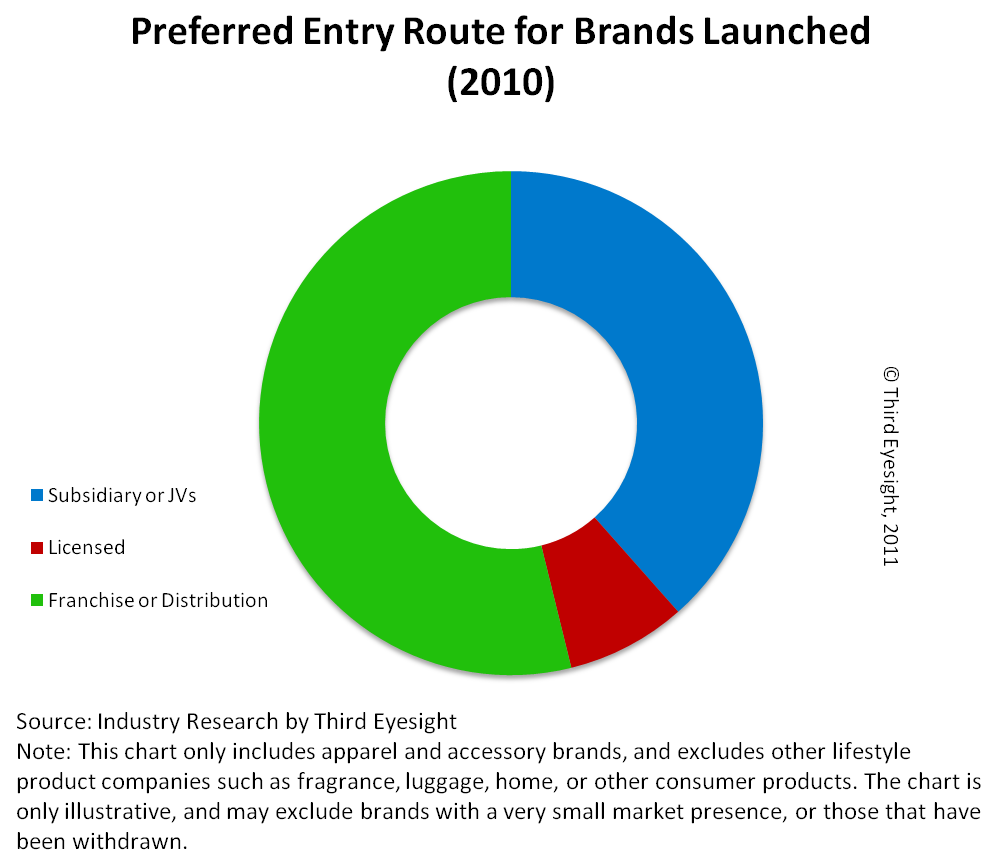
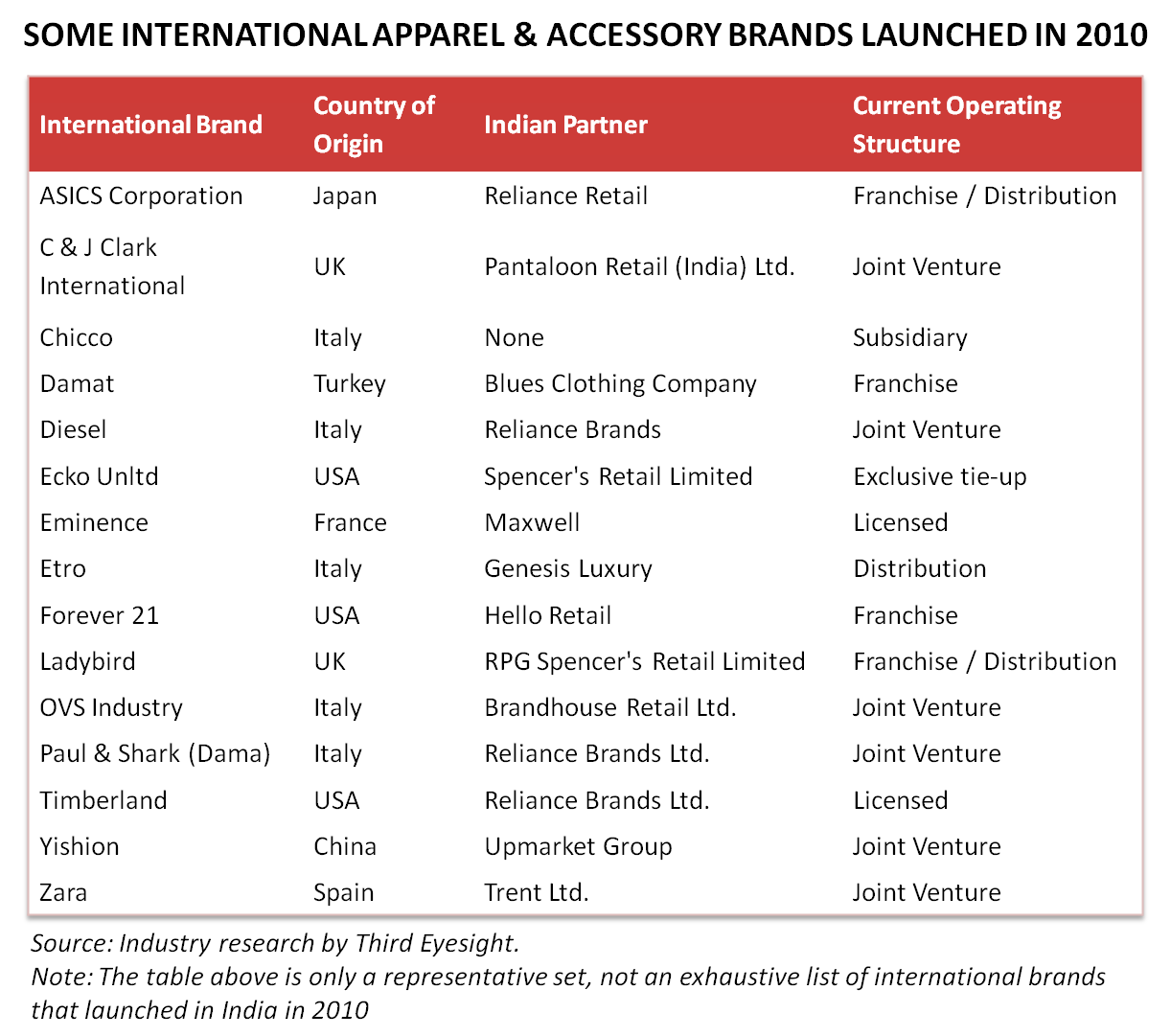
Some brands taking this route for entering the Indian market include Forever 21, Etro, Tom Ford, and Ladybird, amongst others. However, a number of brands that entered in 2010 (nearly 40% for the new entrants) also showed that they wanted a piece of the action through some degree of ownership (whether through a majority or minority stake in a joint venture or through a wholly owned subsidiary). Some – such as S. Oliver – also switched to joint-ventures from their earlier franchise structure.
Under the current regulations governing foreign investment into retail, several companies that typically want control operate either through 100% subsidiaries that sell to independent retail franchisees , or through 51:49 joint-ventures that operate the stores as well.
We are finding increasing signs among companies of a confidence in the market, a growing comfort with the operating environment, and a desire to own and control the direction their brand takes in a strategic market like India. it is likely that if the government decides to allow 100% FDI in single brand retail, several brands will opt to set up wholly-owned subsidiaries that control the entire chain of activities, source-to-store.
International brands opting for the ownership in the Indian venture included OVS (Italy’s Gruppo Coin), Yishion (China) and Chicco (Italy).
Fast Fashion for the Family
Amongst the new launches, a highlight of the year was the launch of the most awaited and discussed-about brand Zara. The first store was launched in Delhi with menswear, womenswear and childrenswear, followed by a store in Mumbai, and a third again in Delhi. While almost every other brand launches with an advertising blitz, Zara – in its usual fashion – needed none. The news buzz it generated created enough traffic to provide record sales during the first few weekends. It was also instrumental in generating 30-40% more footfall in the malls where it opened.
Inditex was certainly one of the brands looking for control, and has formed a 51:49 joint venture with the Tata Group’s retail business, Trent. For now the company has adopted its global supply chain for the Indian market as well which clearly adds cost and time to the supply chain. The merchandise is imported from the central distribution centre in Spain, and includes products manufactured in the Indian subcontinent. Competing brands in the industry have raised questions about Zara being able to build a successful and sustainable business in India just on the back of rapid fashion changes, at prices that are not quite “competitive”. However, the brand is reportedly aware of the struggle in building a successful business around import-led sourcing model and is seen to have planned growth conservatively.
Another southern European value fashion brand, OVS Industry, was launched last year by Oviesse through a joint-venture with Brandhouse Retail from the SKNL group. OVS Industry also offers a range for men, women and kids. While in the first year products have been imported from Italy, the company says it intends to bring in the merchandise directly from the supply source for speed and cost effectiveness, to achieve aggressive growth over the next five years.
Multi-Brand Platforms, Larger Stores
International brands have been drawn to India by its large “willing and able to spend” consumer base and the rapidly growing economy, but so also are Indian companies – manufacturers or retailers – who are ready to act as platforms for their launch.
Given the current restrictions on investment into retail operations, Indian companies are increasingly setting up large multi-brand outlets for an array of international brands under one roof. This allows the Indian franchisee to share overheads among many brands, and also negotiate harder for shopping centre space that is increasingly unaffordable. However, the idea is not only to gain from the operational efficiencies and cost efficiencies, but also to capture a higher share of the wallet of the consumers walking into the stores.
Even those Indian companies that are already retailing their own brands in a particular category are seeking franchise or distribution relationships with international brands, in order to capture a complementary segment of consumers or to offer a larger choice-set to their existing consumers.
For instance, Reliance Brands has partnered with some well known premium to luxury fashion and lifestyle brands. In 2010 alone, it brought Diesel, Paul & Shark and Timberland to the Indian market. On the other hand Maxwell Industries’ relationship with Eminence, a French innerwear brand, has allowed it to address the premium segment in which it was not present, and to compete with other international players such as Jockey, Triumph, Hanes, Fruit of the Loom and others.
RPG Group’s Spencer’s Retail, one of the pioneers of modern retail in the last two decades is looking at increasing the share of its apparel business. Apart from its private labels, Spencer’s is also actively seeking to grow its international brand portfolio quickly. Following up on its launch of Beverly Hills Polo Club in 2008, Spencer’s introduced Ecko Unltd (a youth fashion brand) in 2010. It has also become the platform for the British childrenswear brand Ladybird in its second coming to India.
While the emergence of large multi-brand franchise outlets is driven by Indian franchisees looking to optimise their businesses, the brands themselves are also looking at larger store sizes that are gradually becoming comparable to their stores elsewhere. For instance, the American brand Forever 21 launched with 10,000 square feet for only women’s western clothing and accessories. Similarly, Zara launched its business with a 14,000 square feet store. Larger stores are allowing brands to increase the efficiency of their operations, maximise the visual impact, and increase the speed at which they can achieve critical mass in the country.
Beyond Europe and the US
While European and American brands clearly dominate, 2010 also saw brands from China, Japan and Turkey making inroads to the Indian market.
China’s apparel retailer Yishion launched a 51:49 joint venture with a distribution company, Upmarket Group. Yishion is aiming at rapid growth in the mid price segment in India through own stores and multi-brand outlets (MBOs).
Turkish brands Tween, ADV and Damat from the Orka Group have been brought to the market by Blues Clothing Company, a mid-sized retailer of fashion apparel that also distributes brands such as Versace, Corneliani and Cadini.
The Strategy Shifts & Changing Structures
In the past the international brands have undergone changes in their strategy and operating structures to suit their current context and changing environment. Last year was not an exception to the correction and some brands did undergo a change in their approach and strategy for the Indian market.
Italian denim brand Energie exited the market and their partnership with Reliance Brands in 2007. However, in 2010, the Miss Sixty group entered into a licensing agreement with Arvind Limited which relaunched Energie as part of its portfolio of international denim brands. Arvind already had international brands catering to the mass and the middle segments of the denim market, and with the launch of Energie, it has achieved brand presence in the super-premium category as well.
Another notable denim brand that re-entered the market in 2010 was GAS, also from Italy. After it fell out with Raymond, the brand investigated other relationships, and finally decided to set up a fully-owned subsidiary. The brand was re-launched with one flagship store and through various shop-in-shop counters at Shoppers Stop, the department store chain.
The second attempt of the Germany-based casualwear apparel brand Lerros owned by the House of Pearl was ill-timed in 2008. With business coming up below expectations, the company decided exit the business in India. But instead of exiting the market, it granted the license to manufacture, retail and distribute Lerros to the maker of the Indian denim brand Numero Uno. With a complementary product mix, the principal and the licensee are looking to achieve greater success together.
Another brand that has undergone a shift in its strategy and the operating structure is the Italian brand Zegna, a world leader in luxury menswear. It was first introduced in the Indian market early on in the decade through a franchise arrangement. In 2005 with 51% FDI being allowed the Zegna Group invested in taking a majority stake in its Indian operations. Last year the brand entered into a joint venture with Reliance Brands Limited with the objective of ramping up its India operations and capturing a larger share in the Indian luxury market. For Reliance, it was a great addition to its international brand portfolio.
Compared to 2009, 2010 witnessed hardly any exits, Aigner being one.
Strategies for Growth and Prospects For 2011
Overall the year 2010 has been very positive and the pace of new brands entering the market is picking up. Those already present in the market, have been adapting their strategies to grow their India business. The growth strategy for international brands has revolved around lowering the prices and entering new segments.
The brands that have rationalised their pricing last year to attract more customers include Adams Kidswear. Previously priced significantly higher than the market leaders in that segment, Adams is looking to change its sourcing strategy and source a part of its product range locally. Similarly, having tasted success in the previous year, The Body Shop not only rationalised prices for more products in 2010, but also introduced new products at lower price points.
Another notable trend last year was the focus of international brands on Tier 2 and 3 cities. Marks & Spencer unveiled its plans to enter Tier 2 cities such as Jaipur and Chandigarh and grow its national footprint. Reebok, Adidas, Ed Hardy, Tommy Hilfiger, The Bodyshop and Puma are amongst those that have stated their intent to further expand to such cities. The success of adopting these strategies is bearing results already and the momentum is likely to build further as others follow.
For international brands, as for Indian brands, significant challenges remain in the path of growing their business.
At the base level is drumming up adequate demand. While India is often compared with China because of similar size of population, the fact is that urban discretionary incomes and the concentration of spend are far higher in China. This reflects in the speed with which brands have been able to ramp up in the two countries. For instance, Mango entered the two markets around the same time. However, a the end of 2010, the network of stores in India was only a tenth the size of the store network in China (100-plus), with over 200 more stores projected to open in 2011.
In scaling up, the lack of affordable good retail locations is one of the other biggest hurdles. With the slow growth in 2008 and 2009, brands are significantly more cautious in signing up space at high rentals.
Future challenges also remain more at the internal operational level. Retaining adequately trained front-line staff is an issue. Not only does the increasing number of international brands increase the competition for the employee pool, so also does growth in other segments of the economy and it is tough to sell retail as an employment option of first-choice.
We expect prices to become more realistic, but also operational efficiency to be a driver. Clustering of stores for efficient management, a concerted drive towards lower cost locations and variable (revenue-linked) payments to landlords are likely to be critical in driving better performance. We also expect many brands to seriously consider scaling up the network to provide critical mass to their business, which can also drive local sourcing of merchandise or direct shipments to the Indian business from Indian and other Asian sources.
If the Indian Government announces further relaxation in the foreign ownership norms, we would expect more brands to take equity stakes in the business in India, including the entry of those that wish to operate fully-owned subsidiaries. However, with many different signals from various arms of the government it is best not to try and read the crystal ball too closely on that issue.
Despite challenges and barriers, the market is far from being saturated right now as newer product segments and product lines create ever-newer needs. With India being one of the few large economies showing consistently strong performance, many more are considering the Indian market seriously. Among the ones reported to be interested in launching are GAP, Uniqlo and Polo by Ralph Lauren.
The market may become more segmented and even fragmented with a plethora of international brands being available.
The largest brands currently include Levi Strauss and Reebok which are both reportedly well past the US$ 100 million mark in India, but the race for market leadership is still well and truly on. No matter which brand comes out ahead the winner, without a doubt, will be the consumer.
